You are currently browsing the category archive for the ‘★★★’ category.
Director: Gerry Chiniquy
Release date: January 18, 1964
Stars: Bugs Bunny, Yosemite Sam, Porky Pig
Rating: ★★★
Review:
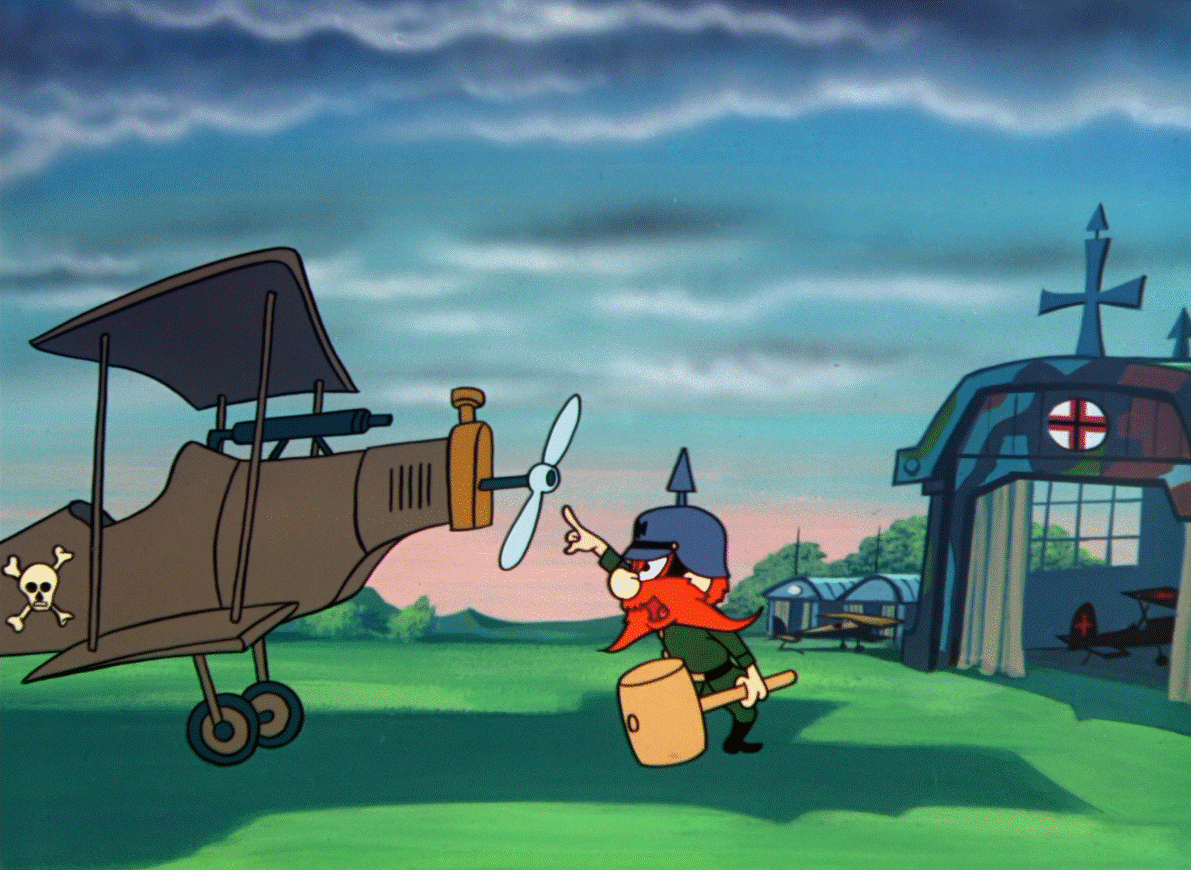
‘Dumb Patrol’ is the last of the Bugs Bunny vs. Yosemite Sam cartoons, being the last screen appearance by the hot-tempered little villain, after a career of nineteen years. Set in World War I the film is dedicated to an air battle between Bugs and Sam, here billed as Sam von Shpamm.
Gerry Chiniquy’s timing is all too relaxed, and unfortunately there’s way too much talking, but there are some fine gags, like Sam shooting his own plane to pieces. The short is no standout, but certainly no bad farewell to the little mustached character. Note Porky Pig’s short cameo as a French soldier.
Watch ‘Dumb Patrol’ yourself and tell me what you think:
This is Bugs Bunny cartoon No. 165
To the previous Bugs Bunny cartoon: Transylvania 6-5000
To the next Bugs Bunny cartoon: Dr. Devil and Mr. Hare
‘Dum Patrol’ is available on the Blu-Ray ‘Looney Tunes Collector’s Choice Vol. 3’
Director: Robert McKimson
Release date: January 20, 1962
Stars: Bugs Bunny
Rating: ★★★
Review:

In ‘Wet Hare’ Bugs Bunny battles one ‘Black Jack Shellac’ over a waterfall which the apparently French Canadian wants to dam (we’ll never know why).
The gags are not as they could have been due to McKimson’s all to relaxed timing and the talkative characters. Nevertheless, Bugs’ final scheme is a fine one, as are his Al Jolson-impersonations when singing under the waterfall, which mean that Mel Blanc manages to make Bugs Bunny sound like himself and like Al Jolson at the same time!
Watch ‘Wet Hare’ yourself and tell me what you think:
This is Bugs Bunny cartoon No. 156
To the previous Bugs Bunny cartoon: Prince Violent
To the next Bugs Bunny cartoon: Bill of Hare
‘Wet Hare’ is available on the Blu-Ray ‘Looney Tunes Collector’s Choice Vol. 3’
Directors: William Hanna & Joseph Barbera
Airing date: March 22, 1963
Stars: The Flintstones
Rating: ★★★
Review:
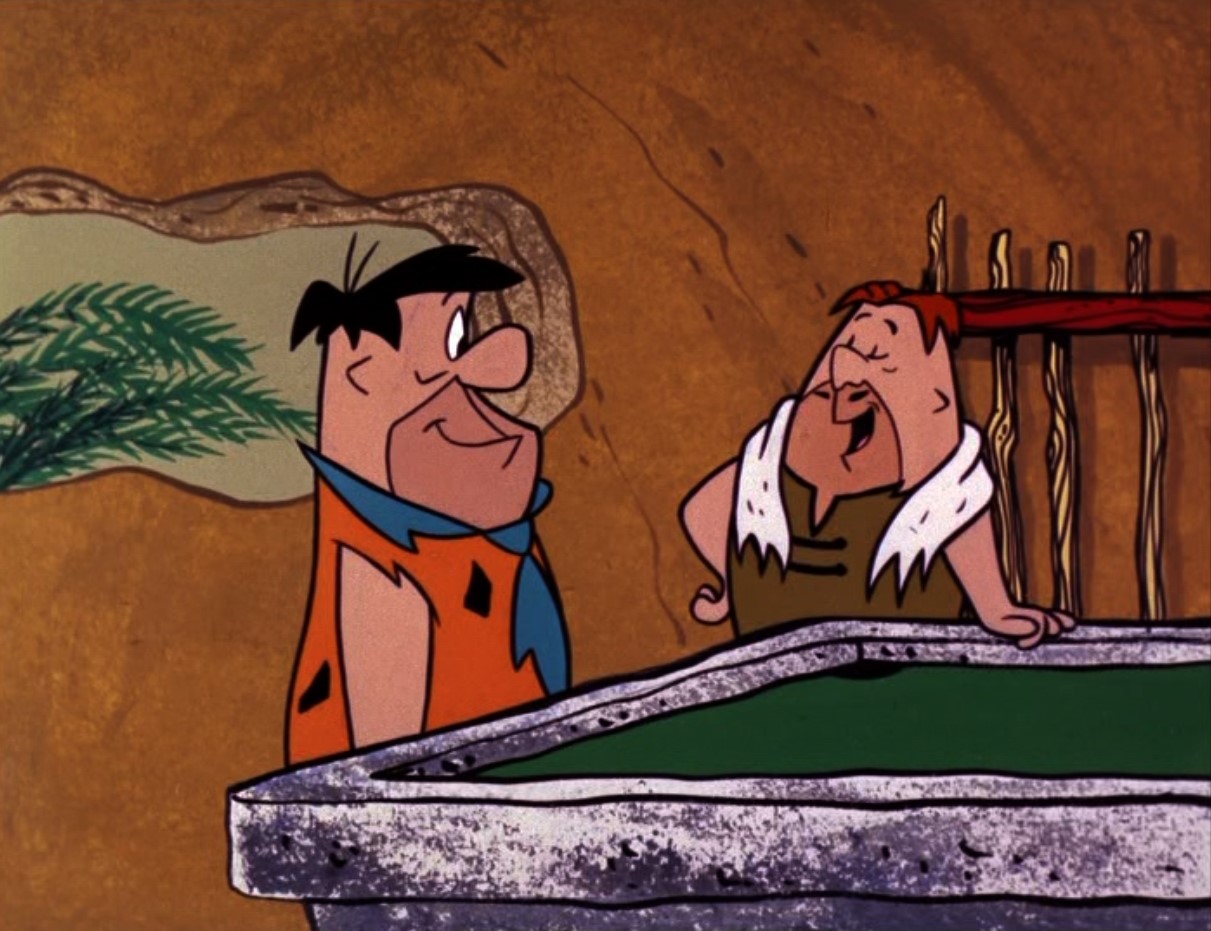
In ‘The Big Move’ young Pebbles triggers the action. When her first words turn out to be ‘scooby dooby doo’, ‘shoot pool’ and ‘play poker’, thanks to Barney, Fred wants to move to a more upper class neighborhood, so Pebbles can get a proper influence.
Soon he and Wilma move upon hill to a land leased house in the snubbiest neighborhood imaginable. Fred immediately starts lying about his car, his ‘personnel’ and his work, much to Wilma’s chagrin. But of course he misses Barney before soon, and with an unlikely scheme (with Barney and Betty posing as some hillbilly family) things are soon back to normal.
‘The Big Move’ is very predictable, and Fred behaves absolutely detestably in this episode. Most interesting is his bedtime story to Pebbles, with which the episode starts and the expression ‘scooby dooby doo’ six years before Hanna-Barbera launched the series featuring the famous hound and mystery solving team.
Watch an excerpt from ‘The Big Move’ yourself and tell me what you think:
This is The Flintstones Season Three episode 26
To the previous The Flintstones episode: Ventriloquist Barney
To the next Flintstones episode: Swedish Visitors
‘The Big Move’ is available on the Blu-Ray ‘The Flintstones – The Complete Series’ and the DVD-box ‘The Flintstones Season 3’
Directors: William Hanna & Joseph Barbera
Airing date: January 25, 1963
Stars: The Flintstones
Rating: ★★★
Review:
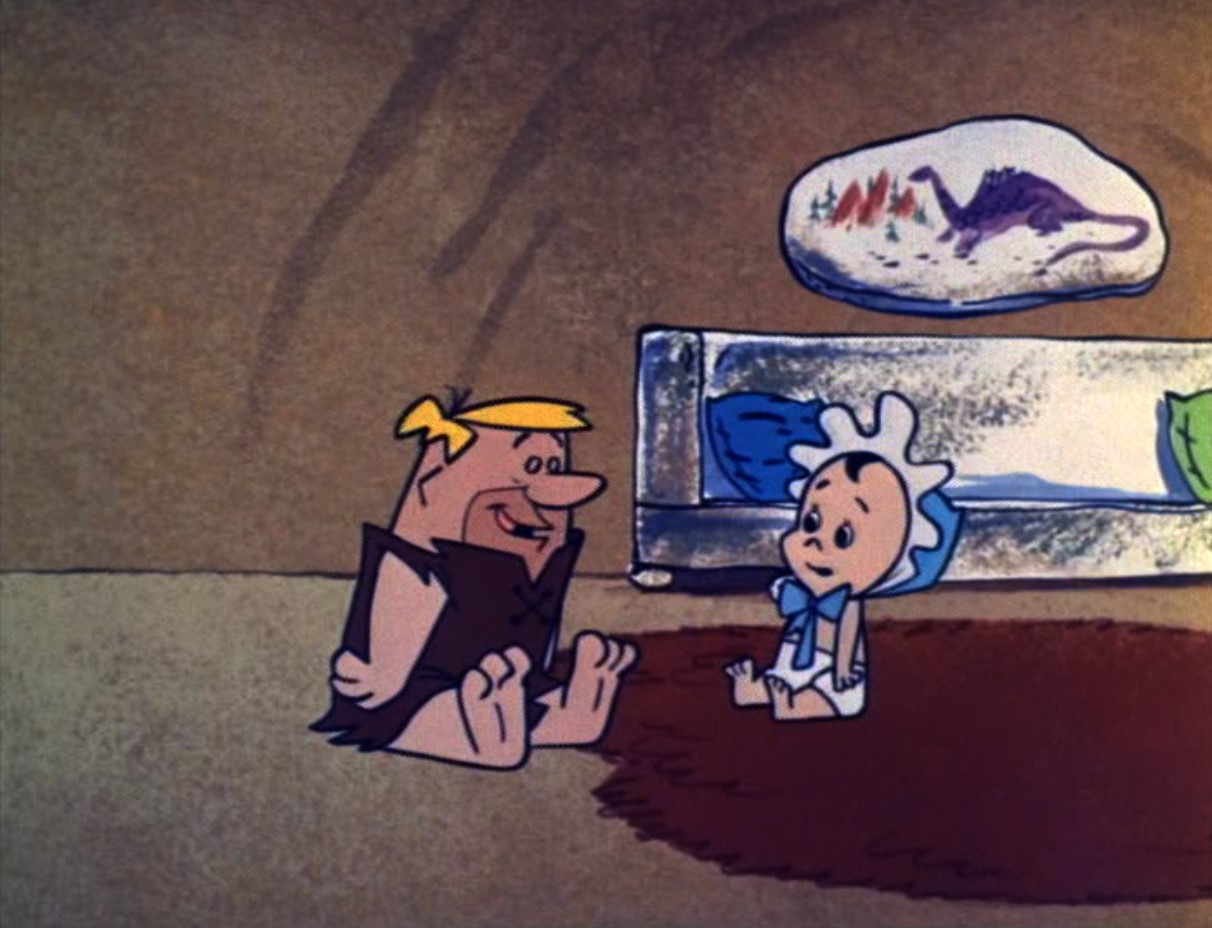
‘The Surprise’ is the first episode in what was to become the first continuum in television animation. The show starts with Betty pushing a baby carriage. The carriage contains little Marblehead, her nephew.
Barney completely falls for the baby, and even forsakes the last game of the bowling tournament, making his team lose. Fred, of course, is not amused, and throughout the episode expresses a disliking of babies. Of course, he softens up as time progresses, and then Wilma indeed has some surprising news.
The whole episode is more gentle and cute than genuinely funny, but Fred’s doubletake when Barney and Betty catch him entertaining little Marblehead is priceless. The episode is also noteworthy for Fred addressing the public directly at the end.
The stone age gags, meanwhile, are modest: a crab and a bird used as scissors, and a mammoth as a water hose. None of these animals speaks, which spares us some lame gags.
Watch an excerpt from ‘The Surprise’ yourself and tell me what you think:
This is The Flintstones Season Three episode 19
To the previous The Flintstones episode: The Hero
To the next Flintstones episode: Mother-in-Law’s Visit
‘The Surprise’ is available on the Blu-Ray ‘The Flintstones – The Complete Series’ and the DVD-box ‘The Flintstones Season 3’
Directors: William Hanna & Joseph Barbera
Airing date: January 11, 1963
Stars: The Flintstones
Rating: ★★★
Review:
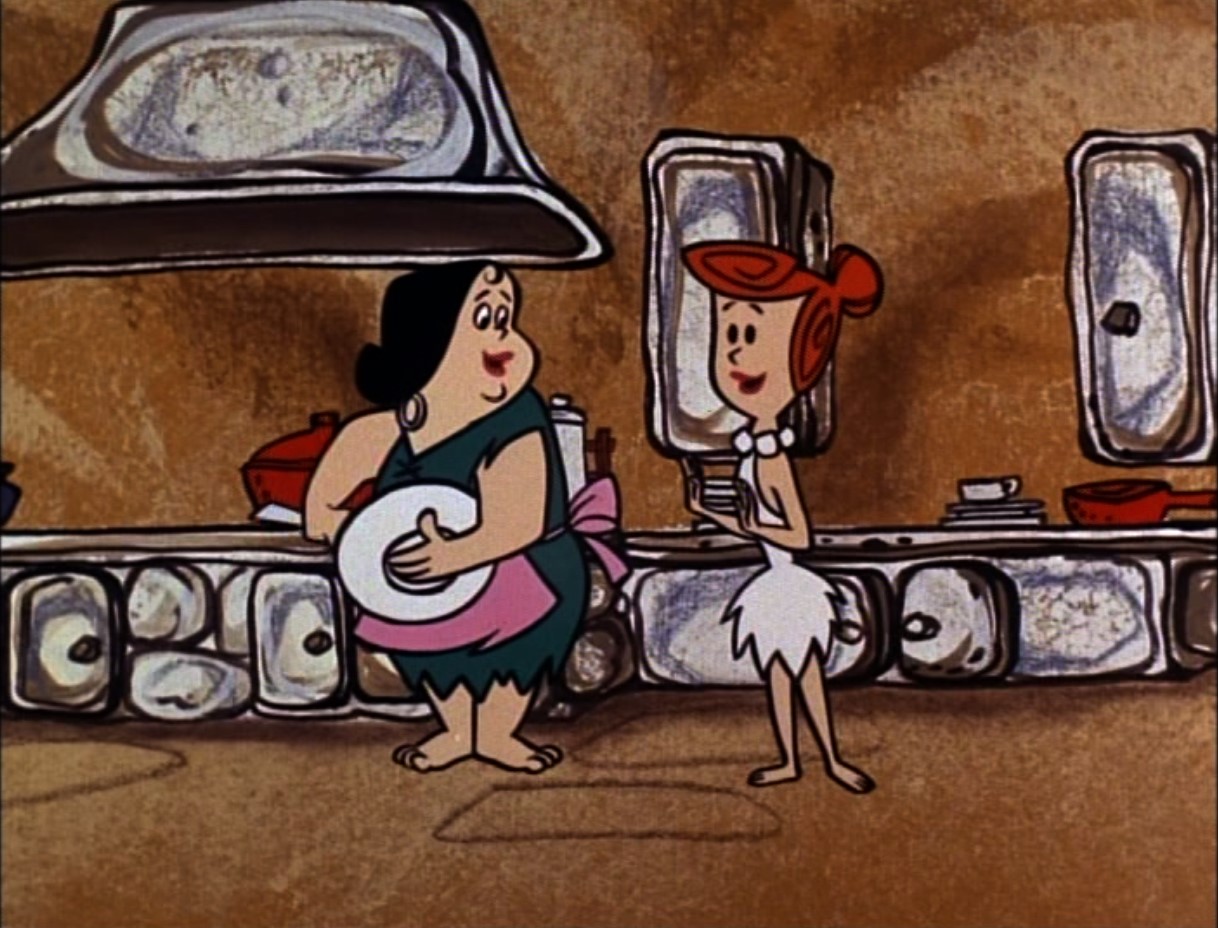
In this Flintstones episode Wilma would like to have a maid. The story takes some unexpected turns, however, and even a real maid shows up.
The maid has the telling name of Lollobrickida, but does not look like the stunning actress Gina Lollobrigida who was the inspiration of her name. How a maid can be Italian in a prehistoric world is never explained, but it doesn’t spoil the comedy, which is of a fine sort, even if things turn out well all too easily in the end.
The prehistory gags include long-billed birds as knitting needles and a huge dinosaur acting as a toll bridge.
Watch an excerpt from ‘Wilma the Maid’ yourself and tell me what you think:
This is The Flintstones Season Three episode 17
To the previous The Flintstones episode: The Kissing Burglar
To the next Flintstones episode: The Hero
‘Wilma the Maid’ is available on the Blu-Ray ‘The Flintstones – The Complete Series’ and the DVD-box ‘The Flintstones Season 3’
Directors: William Hanna & Joseph Barbera
Airing date: December 21, 1962
Stars: The Flintstones
Rating: ★★★
Review:
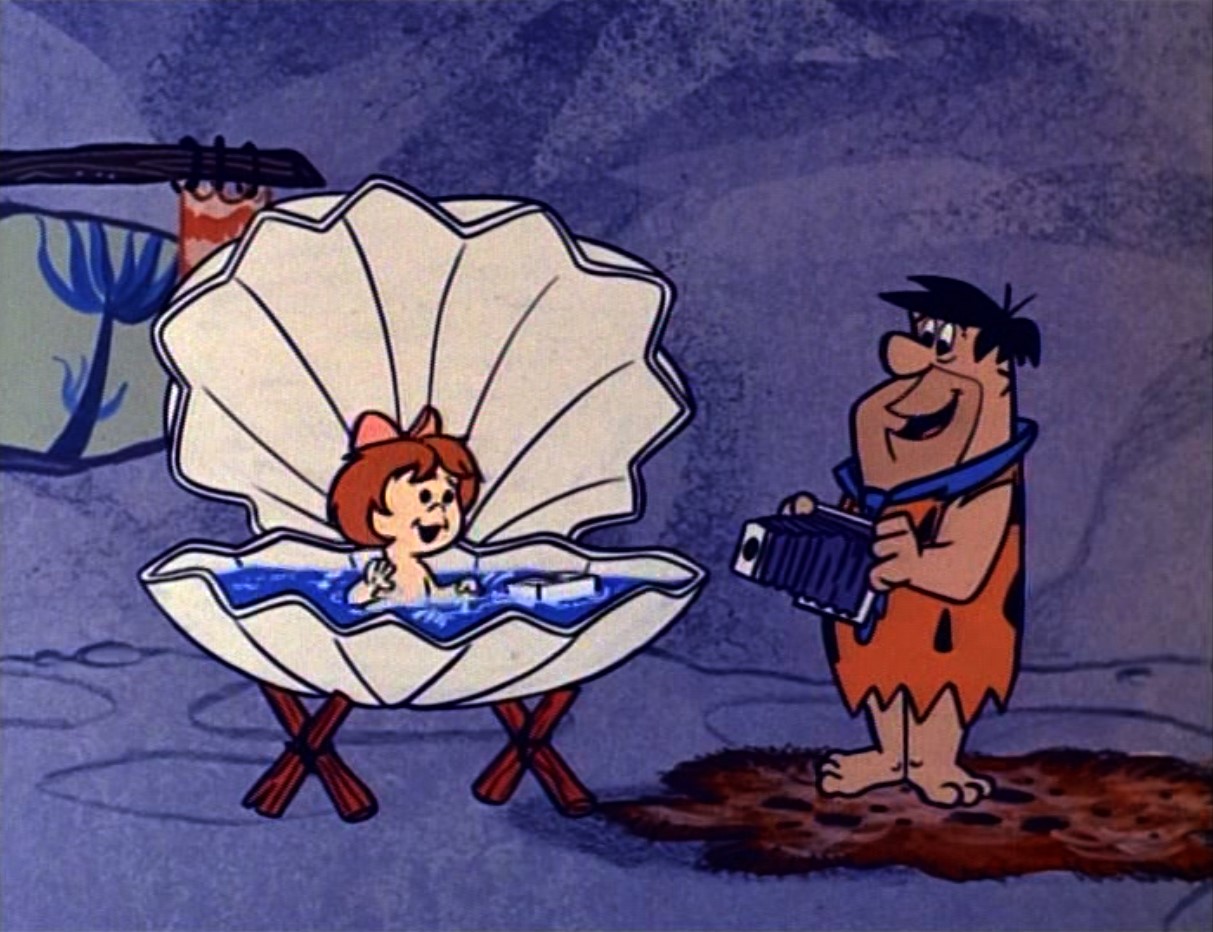
The boys are having their vacation at home, and the episode starts with a long and superfluous slapstick routine of Fred trying to get Dino to the vet for a shot. Then another long scene at a store leads to the main story in which Fred and Barney take up photography.
The result is another slapstick episode with a story that never satisfies the story ideas to their full potential. The stone age gags are all in the beginning with one of those numerous mammoths functioning as a tap, a porcupine, and a little bird inside Fred and Barney’s camera.
The designs on Fred and Barney are erratic from one scene to the next and the background art is particularly dull in this episode, with its faint shades of gray and blue. Harvey Milstone and his wife look like stone age versions of George and Judy from The Jetsons, a series that had just started in September.
Watch an excerpt from ‘Flashgun Freddie’ yourself and tell me what you think:
This is The Flintstones Season Three episode 15
To the previous The Flintstones episode: Dial “S” for Suspicion
To the next Flintstones episode: The Kissing Burglar
‘Flashgun Freddie’ is available on the Blu-Ray ‘The Flintstones – The Complete Series’ and the DVD-box ‘The Flintstones Season 3’
Directors: William Hanna & Joseph Barbera
Airing date: November 30, 1962
Stars: The Flintstones
Rating: ★★★
Review:
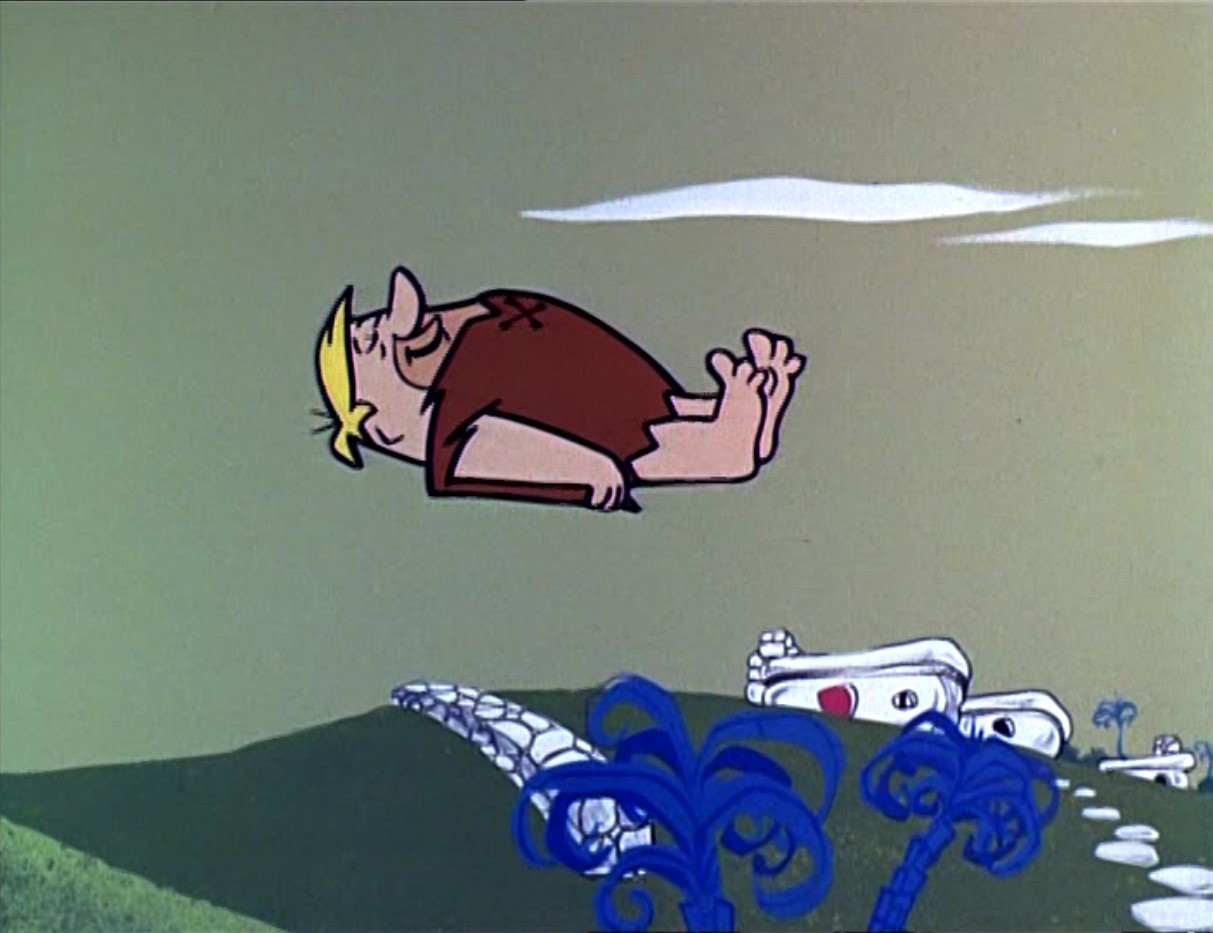
This episode starts with some mysterious wailing in the night, which turns out to be Barney with a toothache. The next day Fred takes Barney to the dentist, but when Fred wants to save the necessary $10 to see a fight, he changes plans.
‘Nuthin’ but the Tooth’ is one of the silliest Flintstones episodes, full of nonsensical cartoon humor and slapstick scenes. Unfortunately, the writers milk the gas gag way too long, and there’s nothing of the more subtle character comedy of other episodes.
The best stone age gag is the parrot who functions as the dentist’s intercom. Notice the rare appearance of the sabretooth cat, so frequently seen during the titles, within an episode itself.
Watch an excerpt from ‘Nuthin’ but the Tooth’ yourself and tell me what you think:
This is The Flintstones Season Three episode 12
To the previous The Flintstones episode: Ladies’ Day
To the next Flintstones episode: High School Fred
‘Nuthin’ but the Tooth’ is available on the Blu-Ray ‘The Flintstones – The Complete Series’ and the DVD-box ‘The Flintstones Season 3’
Directors: William Hanna & Joseph Barbera
Airing date: November 16, 1962
Stars: The Flintstones
Rating: ★★★
Review:
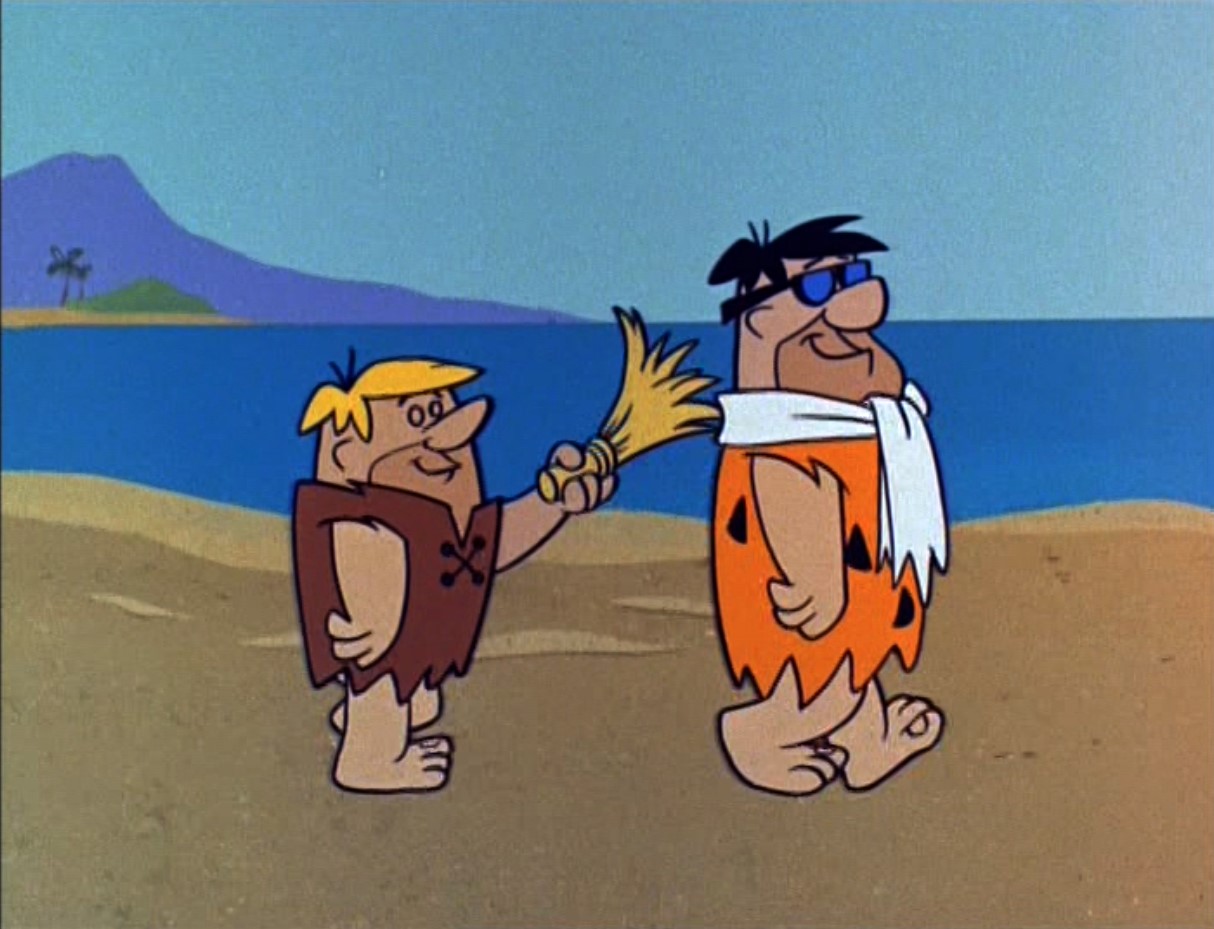
Surprisingly many Flintstones episodes deal with the average viewer’s dream to become an actor. In the third season ‘Hawaiian Escapade’ is the second after ‘Dino Goes Hollyrock‘.
This episode feels mostly like a remake from ‘The Monster from the Tarpits‘ from the first series. In both episodes Fred ends up as a stunt double, and even the Hollywood star, Larry Lava, is a faint echo of the Gary Granite of the former episode. There’s also an echo from ‘Hollyrock, Here I Come‘, another episode from the first season, as in both episodes, fame goes to Fred’s head.
The rehash of earlier tried tropes make ‘Hawaiian Escapade’ rather dull and uninspired. Even the stone age gags fall flat. Much more interesting is the running gag of Wilma burning Fred’s steak, and the cute finale.
Watch an excerpt from ‘Hawaiian Escapade’ yourself and tell me what you think:
This is The Flintstones Season Three episode 10
To the previous The Flintstones episode: Baby Barney
To the next Flintstones episode: Ladies’ Day
‘Hawaiian Escapade’ is available on the Blu-Ray ‘The Flintstones – The Complete Series’ and the DVD-box ‘The Flintstones Season 3’
Directors: William Hanna & Joseph Barbera
Airing date: November 9, 1962
Stars: The Flintstones
Rating: ★★★
Review:

After ‘The Little Stranger’ ‘Baby Barney’ is the second Flintstones episode trying out Fred’s attitude to fatherhood, anticipating the great continuity later in the series.
This time Fred’s fatherhood is triggered by the coming of a rich uncle Tex, whom he promised a ‘little Tex’. It’s the unfortunate Barney who has to pose as the improbable baby. This accounts for a lot of slapstick, but in the end it’s Fred acting like a father for the first time that stays most. Stone age gags, meanwhile, are rare, as I can only mention a lawnmower dinosaur.
Watch an excerpt from ‘Baby Barney’ yourself and tell me what you think:
This is The Flintstones Season Three episode 9
To the previous The Flintstones episode: The Little Stranger
To the next Flintstones episode: Hawaiian Escapade
‘Baby Barney’ is available on the Blu-Ray ‘The Flintstones – The Complete Series’ and the DVD-box ‘The Flintstones Season 3’
Directors: William Hanna & Joseph Barbera
Airing date: November 2, 1962
Stars: The Flintstones
Rating: ★★★
Review:
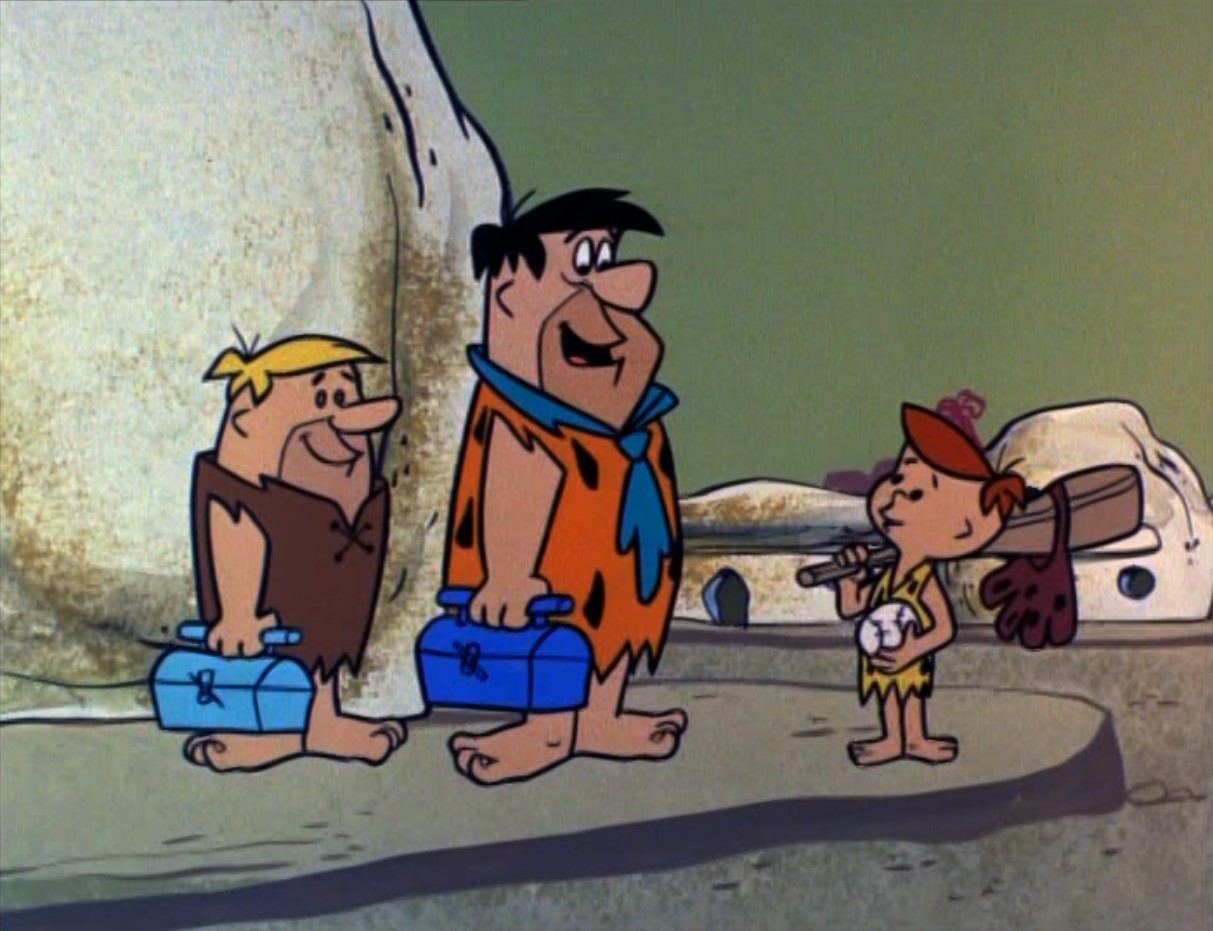
‘The Little Stranger’ starts with a Fred so grumpy Wilma sends him to a doctor to get examined. On the way Fred and Barney repeatedly meet a paper delivering little boy called Arnold, who gets the better of Fred each time. However, we have to wait until the 11th minute before the story really begins.
As with some of the best Flintstones episodes ‘The Little Stranger’ is a comedy of errors, and it is a delight to watch Fred’s sweet side, as well as him running back and forth when he thinks Wilma is expecting a little baby any minute. The best sight gag however, is when the doctor makes Fred inhale and exhale, a breath so powerful it moves Barney, who’s reading on a chair, through the office.
‘The Little Stranger’ feels like a prequel to the continuous story of the Flintstones getting a baby, which makes the third season so unique. It’s the first episode in which the baby idea comes up, and Fred’s reaction indeed is inviting to make the character deal with the real thing.
The stone age gags, meanwhile, are modest, and include a dish washing pelican, the now almost regular mammoth vacuum cleaner, and a bizarre bag-crocodile. Notice that for once, one of the windows is glass-covered, to get a gag with Arnold along.
Watch an excerpt from ‘The Little Stranger’ yourself and tell me what you think:
This is The Flintstones Season Three episode 8
To the previous The Flintstones episode: The Buffalo Convention
To the next Flintstones episode: Baby Barney
‘The Little Stranger’ is available on the Blu-Ray ‘The Flintstones – The Complete Series’ and the DVD-box ‘The Flintstones Season 3’
Directors: William Hanna & Joseph Barbera
Airing date: October 12, 1962
Stars: The Flintstones
Rating: ★★★
Review:

‘The Twitch’ is the Flintstones’ answer to Chubby Checker’s huge success with ‘The Twist’ (1960).
In this episode Fred promises Wilma to get ‘Rock Roll’ (voiced by Hal Smith) to play for free at her auxilliary show. Rock Roll’s big hit is ‘The Twitch’, a catchy parody song, which is accompanied by the familiar twist gestures, as well as Chuck Berry’s duckwalk.
The fun is further enhanced by the final scene (a twist in itself), a series of terrible vaudeville acts and several stone age gags, like a horned crocodile-like potato peeler, a nail-polishing bird and a weird massage device. Also note the caricature of Fred Sullivan. All these aspects make ‘The Twitch’ one of the more enjoyable episodes of the Flintstones’ third season.
Watch an excerpt from ‘The Twitch’ yourself and tell me what you think:
This is The Flintstones Season Three episode 5
To the previous The Flintstones episode: Bowling Ballet
To the next Flintstones episode: Here’s Snow in Your Eyes
‘The Twitch’ is available on the Blu-Ray ‘The Flintstones – The Complete Series’ and the DVD-box ‘The Flintstones Season 3’
5
Director: unknown
Production date: ca. 1962
Stars: The Marx Brothers
Rating: ★★★
Review:
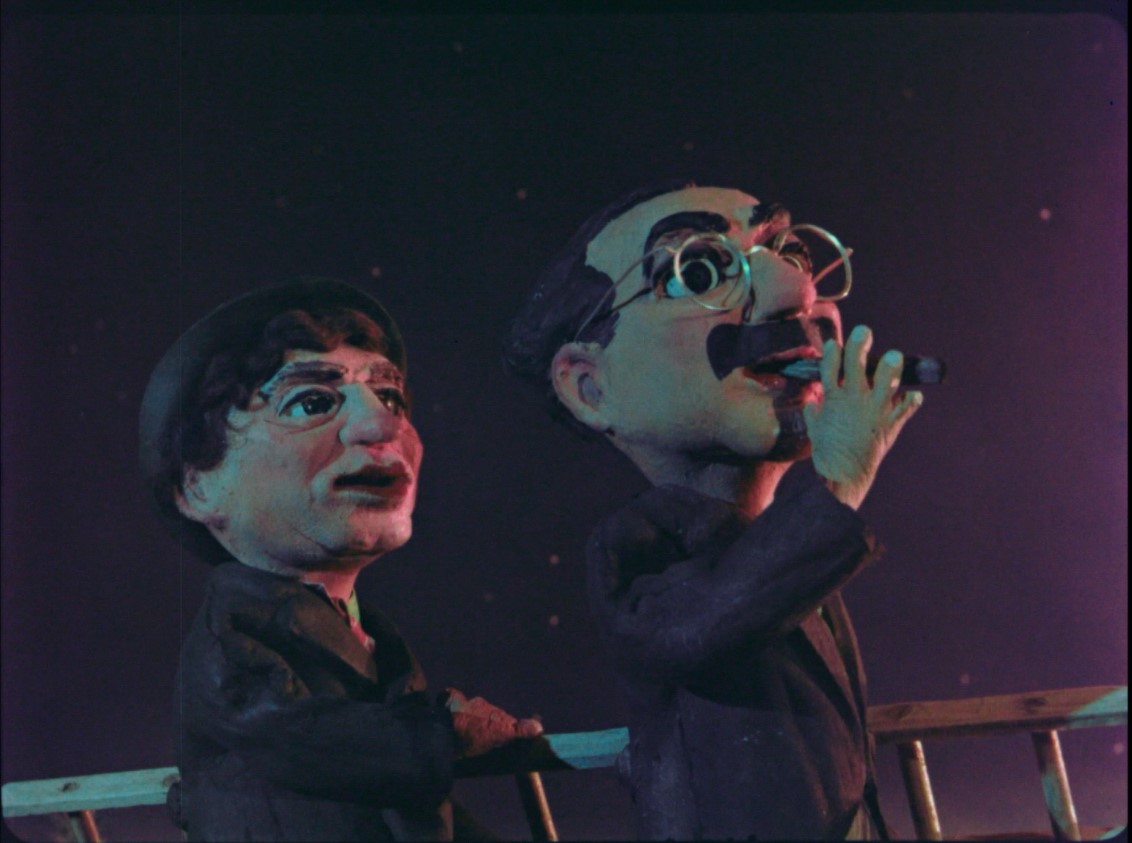
‘The Marx Brothers’ is an odd curiosity unearthed by the ever amazing Steve Stanchfield, who specializes in discovering animated oddities. Apparently this is a pilot from the early sixties by Screen Gems for a Marx Brothers cartoon series, curiously done in stop-motion (more cartoon plans were made at the time, see Jim Korkis’s excellent article on this).
The short involves the three Marx Brothers, and a stout woman called Hortense. The puppets are immediately recognizable as the Marx Brothers, but also crude and on the ugly side. The least well-done is Chico, whose puppet falls short both in looks and voice, and he hardly has any gags. Harpo should translate easier to the cartoon medium, but due to the poor timing he more comes over as an obligatory additional clown than the great comedian he could be in the live action films.
The fun comes mostly from Groucho and his side-cracks, but there’s hardly anything done with the powers of animation, the pacing is slow, and the animation not beyond fair. Moreover, the ‘story’ amounts to nothing. Most striking is a close-up of the magazine called ‘Babes’ Groucho is reading in the opening scene, which shows real nudity.
Watch ‘The Marx Brothers’ yourself and tell me what you think:
Steve Stanchfield put this short on his private DVD release ‘Top Shelf Scans (Goosed)’
Director: Friz Freleng
Release date: July 15, 1961
Stars: Tweety and Sylvester
Rating: ★★★
Review:

‘The Rebel Without Claws’ is the penultimate Tweety and Sylvester cartoon by the original Warner Bros. studio. In this short Tweety is a messenger pigeon in the American civil war. Sylvester, naturally, is a ‘messenger destroyer’ trying to intercept Tweety and his message.
Except for the last one, the gags are fine, and Freleng’s timing, as always, is excellent. Especially the canon gag is a marvel. Moreover, the human designs are fine examples of the cartoon modern era. But it is a little grim to see our yellow friend in the service of the confederate army, which after all fought to maintain slavery. This makes this Tweety and Sylvester cartoon the only one in which one hopes that Sylvester wins (which he, incidentally, does).
Watch ‘The Rebel Without Claws’ yourself and tell me what you think:
‘The Rebel Without Claws’ is available on the Blu-Ray ‘Looney Tunes Collector’s Choice Vol. 2’
Director: Chuck Jones
Release date: June 3, 1961
Stars: Road Runner & Wile E. Coyote
Rating: ★★★
Review:
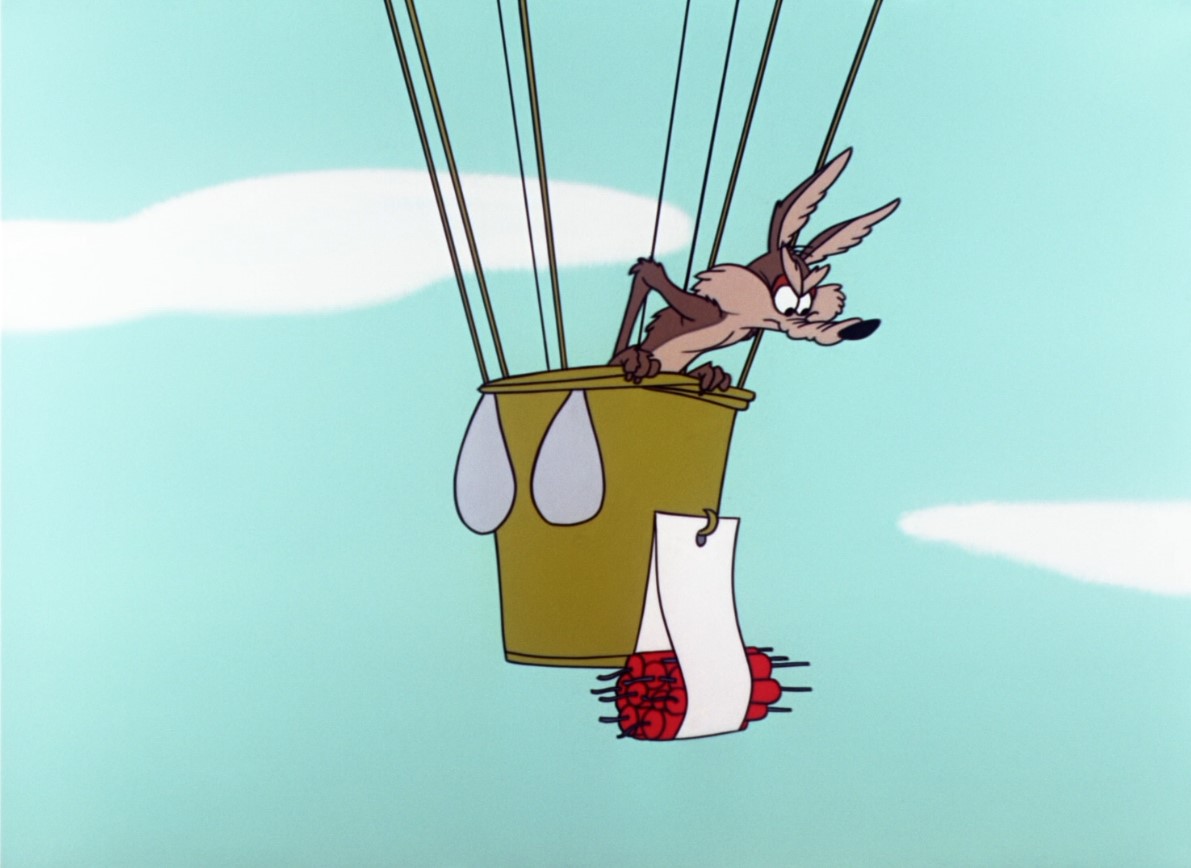
The twentieth Road Runner cartoon is a surprisingly inspired one. The short starts with the Coyote introducing himself and the Roadrunner with signs. What follows are seven attempts, with the third influencing all subsequent ones.
Both the animation and the background art are beautiful, Jones’ timing is excellent and the gags are fine. Milt Jackson’s score, on the other hand, makes one long for Carl Stalling, and there’s a level of mannerism that is a little irritating. Especially the extreme lagging of the coyote’s upper body, when zooming off, feels more tiresome than funny. Nevertheless, it’s a surprise that such a late Road Runner cartoon can still be of such a fine quality.
Watch an excerpt from ‘Lickety-Splat’ yourself and tell me what you think:
‘Lickety-Splat’ is available on the Blu-Ray ‘Looney Tunes Collector’s Choice Vol. 2’
Director: Michel Ocelot
Release date: June 11, 2018
Rating: ★★★
Review:

Michel Ocelot belongs to the great author-directors of animated feature films, bringing us such gems as ‘Kirikou et la Sorcière’ (1998), ‘Azur & Asmar’ (2006) and ‘Les Contes de la nuit’ (2011). But somehow, his latest movie, ‘Dilili à Paris’ from 2018 has escaped international attention.
The most obvious reason for this is that ‘Dilili à Paris’ is first and foremost an ode to Paris of 1900-1901*. It’s thus an utterly French film, simply crowded by famous people, many of which actively play a role in the story. I counted 26 painters, actors, dancers, authors, composers, and scientists, not counting a multitude of more in the background. Luckily, this doesn’t mean that film is a nationalistic one, for Ocelot includes a lot of foreigners in his pantheon of greats, e.g. Polish scientist Marie Curie, Romanian sculptor Constantin Brâncuși, Venezuelan composer Reynaldo Hahn, future British king Edward VII and Brazilian aviation pioneer Alberto Santos-Dumont.
In fact, by centering the film on these great minds in science and art, the film is also an ode to the fantasy and free thought of people. At the same time, the film is a firm statement against narrowmindedness, xenophobia, and oppression. Which brings us to the third theme of the film, which is a strong feminist one. In fact, apart from Dilili’s friend, the Parisian boy Orel, all main players are women, including soprano Emma Calvé (voiced by Natalie Dessay), stage actress Sarah Bernhardt, the aforementioned Marie Curie, and the feminist Louise Michel. Together with these women and many of the other famed people, Dilili and Orel unravel a secret plot in which the mysterious ‘male-masters’ kidnap little girls. Their anti-feminist scheme turns out to be one of nightmarish proportions. It’s clear that to Ocelot one should not underestimate, let alone oppress any human being, whether based on age, sex, color, nationality or whatever. A message that cannot be reinstated enough.
Dilili herself is an original heroine, a tiny Kanak girl from New Caledonia, who speaks French fluently, but who’s only brought to Paris to reenact her lifestyle in the jungle at the Exposition Universelle, a world exhibition that run from April 14 to November 12, 1900. When touring through Paris Dilili is dressed like a prize doll, and she also provides the film running gag, because to every person she meets she repeats the utterly polite sentence of ‘je suis heureuse de vous rencontrer’ (I am delighted to meet you). Of course, she experiences racism during her Parisian journeys, but this is not the film’s main theme.
Paris meanwhile comes to life in the extremely intricate background art, which is clearly based on photo material of contemporary Paris. The computer animation unfortunately is less impressive, and at times downright stiff. Especially Orel is poorly animated. When he makes friends with Dilili his moves and facial expressions are so terribly rigid, it doesn’t transcend puppet theater. The ending, too, leaves much to be desired, as the film’s finale is partly told during the end titles.
In the end the film is a little bit too crowded by famous people and certainly too poorly animated to be a masterpiece, but the mystery plot is a fine one, and the film’s message an important one. Above all ‘Dilili à Paris’ is a fine children’s film that deserves to be seen at least once.
Watch the trailer for ‘Dilili à Paris’ yourself and tell me what you think:
‘Dilili à Paris’ is available on Blu-Ray and DVD
* In fact, we can date the time period of the film pretty well, as Pablo Picasso first set foot in Paris in September 1900, and Edward VII became king on January 22, 1901, thus the events must be placed between September 1900 and January 1901.
Director: Osamu Tezuka
Release date: November 1962
Rating: ★★★
Review:

‘Tales of a Street Corner’ was Osamu Tezuka’s first animated film, and the first production of his company Mushi productions, which Tezuka founded in 1961, after his contract ended at Toei Animations, Japan’s most important animation studio of that time.
The film immediately shows Tezuka’s high ambitions. First, ‘Tales of a Street Corner’ is of considerable length, clocking 39 minutes. Second, its designs echo the cartoon modern style of Europe, unlike anything previous in Japan. Third, Tezuka’s storytelling is highly poetical, reminiscent of Paul Grimault, avoiding tried story cliches. Fourth, the film has a strong anti-militaristic and pacificist tone, and is more than just mere entertainment.
It’s striking to note that, unlike Tezuka’s Astro Boy television series from a year later, ‘Tales of a Street Corner’ lacks any Japanese character. Instead, the film feels very European, both in its looks and in its music. Even the town in which the story takes place is clearly European, as are the poster violinist and pianist. These two characters form the heart of a romantic tale that Tezuka spins, with other protagonists being a little mouse, a moth, and even a broken lantern and a tree.
The whole tale is set in motion when a little girl drops her teddy bear in a gutter, but Tezuka’s story is anything but straightforward, and allows for some poetic moments, as well two series of silly gags involving numerous posters. The animation ranges from full animation to zooming into still images, with everything in between, and it is quite possible that Tezuka’s choices in the complexity of animation were motivated not only by its artistic value, but also by cost reduction.
‘Tales of a Street Corner’ is certainly charming, but as would later be more often the case with Tezuka, the director wants too much within one short. In fact, the short is overlong, and it’s unclear what he wanted the resulting film to be: a children’s film? A romance? A comedy? An anti-war statement? Now, the film is all this and thus none of that at the same time. Nevertheless, ‘Tales of a Street Corner’ remains a delight to look at throughout, and with this film Japan surely entered a new phase in animation, even if the film is still copying its European models.
Watch ‘Tales of a Street Corner’ yourself and tell me what you think:
‘Tales of a Street Corner’ is available on the DVD ‘The Astonishing Work of Tezuka Osamu’
Director: Nina Paley
Release date: June 11, 2018
Rating: ★★★
Review:

Seder-Masochism is the second feature animation film by independent animation artist Nina Paley (born 1968), who created quite a stir with the lovely ‘Sita Sings the Blues’ (2008) in which she blended events in her personal life with the story of the Ramayana, but from a woman’s view.
Apparently, Paley was criticized for using a myth from another culture for her feminist message, with attackers typically focusing on Paley’s supposed lack of understanding of Hindu religion, an irrelevant argument, as the misogyny that Paley attacked is plainly visible in the source text (especially in the last book). Moreover, the Ramayana is hardly unique in its treatment of women as second rate citizens, which can be found in practically all ancient texts.
To underline this message, for her second feature Paley dived into her own heretical religious culture, that of Jewism. The result is a more vicious and more pamphlet-like feature than ‘Sita Sings the Blues’, mostly because the personal note is hardly present, only in an interview of Paley with her father, recorded years prior, about his stance towards Judaism, and that of the Pesach (or Passover) in particular. In these scenes Paley is shown as a sacrificial goat and her father as God himself.
The Pesach, and the story from the book of Exodus behind it, forms the central element of ‘Seder-Masochism’. The ‘Seder’ in the title apparently is a ritual feast at the beginning of the Jewish Pesach celebration, and contains some questionable elements, like rejoicing over the Egyptian victims of the ten plagues and of the closing of the Red Sea.
Surprisingly, Paley juxtaposes the story of Exodus with the idea that initially human culture was matriarchal and devoted to mother goddesses, a theory popular with feminists, but unsupported by archeological evidence. Paley even goes so far as suggesting the golden calf from the Exodus story was a return to such a mother goddess, and thus to times of more equality between and women. Indeed, Paley seems to blame Moses, or monotheism in general for the misogynist patriarchy that dominates most of human culture in its historical existence. This is pure fantasy and can be easily debunked. But of course, ‘Seder-Masochism’ is no documentary, but Paley’s personal take on monotheism and its approach to women.
Yet, Paley’s clear atheist approach to the biblical story is more vicious than anything in ‘Sita Sings the Blues’, which makes the film less approachable and less a classic than Paley’s first movie. Especially when Paley turns to real life footage of religion-inspired violence the film becomes pure agit-prop. Nevertheless, the scene in which Moses returns from Mount Sinai, commanding a stop to the women’s temporal liberation and forcing them back into their niqab-like clothing remains a painful one, and rightfully evokes anger about religious societies who limit the freedom of women.
Even with its strong message, Paley’s way of storytelling remains highly attractive. Paley’s dry sense of humor permeates much of the film, and her visual style is charming throughout, her command of minimal, but effective animation one of the highest degrees. I especially like the poetic intro in which a female goddess flows through space, and sprouts plants, animals, and eventually men on a soundtrack of the most beautiful Bulgarian female chant. Paley’s dance animation of ancient female statues is also a masterstroke, and an attraction in its own right (Paley offers them as singular GIFs).
Moreover, Paley very skillfully mixes the interview excerpts, an enormous variety of existing music and even a 1950s record in which a man tells about the Seder celebration. In contrast with ‘Sita Sings the Blues’, in which only records by 1920s singer Annette Hanshaw were used, ‘Seder-Masochism’ plunders the Western pop music tradition, often to a very striking effect. Notice, for example the single sample of ‘Helter Skelter’ from The Beatles during the sixth plague, and the earlier mentioned scene in which Moses returns uses Led Zeppelin’s ‘Your Time Is Gonna Come’ to a painful effect. But the film’s highlight in this respect must be the use of 10cc’s ‘The Things We Do for Love’ which accompanies images of Jews gleefully chopping off foreskins, beheading little goats and killing men and women.
The bitter irony of this sequence is topped by the ‘This Land Is Mine’ sequence, which Paley finished first, and which can be watched as a separate video clip. In this utterly bleak section, we watch several nations fight over the land of Israel, killing one another in greater and greater numbers, with Death itself ultimately being triumphant. With Israel raging the war in Gaza today, with its tens of thousands of innocent Palestine victims, this bleak sequence remains as topical as ever.
The ‘This Land Is Mine’ sequence was also one of the last pieces of animation Paley did in Macromedia Flash, before moving over to Moho. But the most surprising piece of animation in the film is not done on either platform but done with embroidery, in a process Paley calls ‘embroidermation’. This is a lovely piece of stop-motion that Paley rightfully saves for the end, just before the ‘This Land Is Mine’ finale.
In all, ‘Seder-Masochism’ is a beautiful, if rather angry film with a strong feminist message. It cannot stand the comparison with ‘Sita Sings the Blues’, which remains the more balanced work, but as author feature films like this remain utterly rare in the animation field, I strongly recommend watching this feature nonetheless. At least it will make you think about the position of women in society. Paley offers her film for free online, and the movie can be downloaded from her site.
Watch the trailer for ‘Seder-Masochism’ yourself and tell me what you think:
‘Seder-Masochism’ can be downloaded for free from Nina Paley’s website
Director: Hermína Týrlová
Release date: 1962
Rating: ★★★
Review:

In ‘Two Balls of Wool’ the insides of a sewing box come to life, including a scissors, a measuring tape, thread spools, a horse-like pincushion, and, most importantly, two balls of wool.
The pink ball of wool turns into a girl, while the blue one turns into a boy. The boy plays the flute on a needle, charming the measuring tape, who acts like a snake. When the snake captures the girl, the boy comes to the rescue, riding the pincushion horse. The two also perform some acrobatic tricks, and accidentally unwind a knitted piece, until the scissors forces them to knit the piece back again
The film has a rather weak story, but it’s a marvel how Týrlová spins a film out of such ordinary material, making use of the properties of these objects. The animation is top notch. For example, note how Týrlová manages to turn the scissors (which can’t do anymore than the scissors in your drawer) into an authority figure, imposing on the other objects. ‘Two Balls of Wool’ thus is a charming little short, showing Týrlová’s great talent as an animator.
Watch ‘Two Balls of Wool’ yourself and tell me what you think:
https://noodlemagazine.com/watch/-167471844_456240845
‘Two Balls of Wool’ is available on the DVD box ‘Hermína Týrlová Výběr z tvorby/Selected Works’
Director: Jan Iván
Release date: 1961
Rating: ★★★
Review:
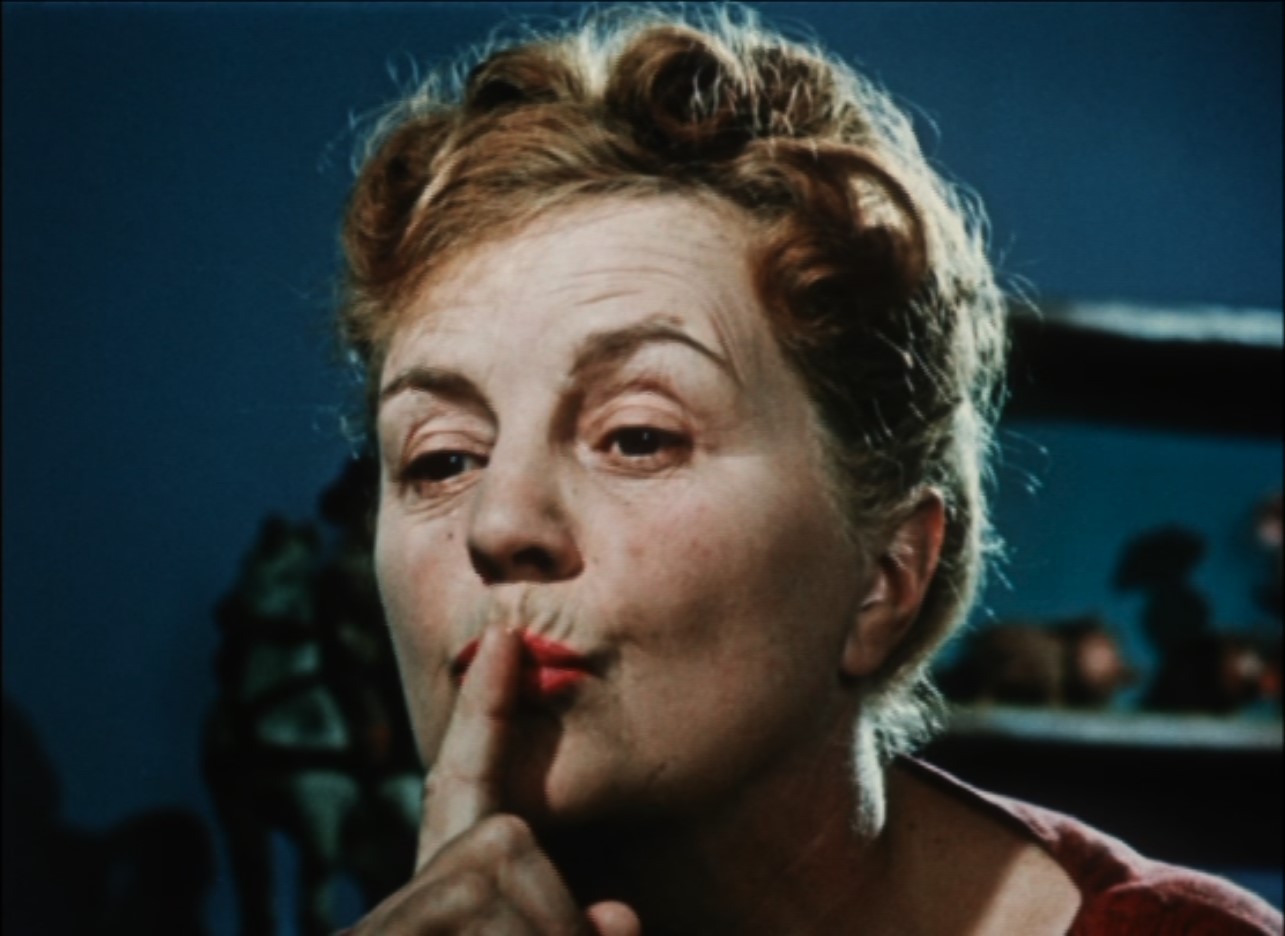
This a gentle documentary film made in honour of the Czech animation pioneer’s sixtieth birthday.
The film showcases excerpts from quite a few of Hermína Týrlová’s films, including her first, ‘Ferda the Ant’ (1944), Czechoslowakia’s first stop motion film anyhow. Other excerpts are from ‘Revolt of the Toys’ (1945), apparently an anti-fascist film, ‘The Knot in the Handkerchief’ (1958) and ‘Badly Made Toy-Man’ (1951), which is revealed as Týrlová’s favorite character.
Indeed, it’s the Badly Made Toy-Man who stars the bridging stop-motion sequences, for this documentary features quite some original animated material, made by Týrlová especially for this film. Especially, the short sequence starring the two balls of whool-characters for her upcoming ‘Two Balls of Wool’ (1962) are a delight, for this cannot be found in the final film, and is presented as a depiction of Týrlová’s imagination.
The film is narrated, and although we watch Týrlová acting out herself, e.g. recreating the painstaking ways with which she made ‘Ferda the Ant’ and interacting with children, her main audience, we do not hear her, and there are no interviews, only images. Nevertheless, the documentary succeeds in showing where Týrlová’s greatest talent lies: in creating charming animation films for children in which ordinary toys and objects come to life.
‘Hermína Týrlová’ is available on the DVD box ‘Hermína Týrlová Výběr z tvorby/Selected Works’
Directors: William Hanna & Joseph Barbera
Airing date: September 14, 1962
Stars: The Flintstones
Rating: ★★★
Review:

The third season of The Flintstones kicks off with an episode devoted to Dino, Fred and Wilma’s purple pet dinosaur. The dog-like dinosaur appears to have a favorite television program called Sassie, starring a female dinosaur with a wig.
When Fred discovers that the show looks for a new star, he goes on an audition with Dino. Dino, however, only shows to be a great performer after discovering he will be in a love scene with Sassie. After one scene, Dino is hired, and Fred paid off and sent home, much to his own regret, but then Dino discovers something…
This episode has a rather slow start and is surprisingly low on gags, but its finale has a nice emotional touch. The cheap and old-fashioned melodrama of the tv show is fun, but the highlight of the episode is Dino’s reaction to his manager’s and director’s plans with him.
Watch an excerpt from ‘Dino Goes Hollyrock’ yourself and tell me what you think:
This is The Flintstones Season Three episode 1
To the previous The Flintstones episode: Take Me Out to the Ball Game
To the next Flintstones episode: Fred’s New Boss
‘Dino Goes Hollyrock’ is available on the Blu-Ray ‘The Flintstones – The Complete Series’ and the DVD-box ‘The Flintstones Season 3’


 Dr. Grob's Animation Review