
You are currently browsing the category archive for the ‘★★’ category.
Director: William Hanna & Joseph Barbera
Release Date: July 7, 1951
Stars: Tom & Jerry
Rating: ★★
Review:
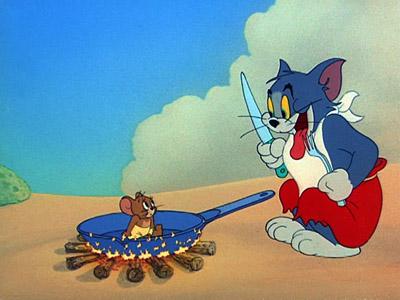 Somehow Tom is shipwrecked. He’s washed ashore a tropical island where he meets a Crusoe-like Jerry, whom he wants to eat.
In what must be the film’s highlight Jerry fools him by pretending to be a cannibalistic native, but in the end both characters have to flee for real cannibals, the first human beings we see in their entirety in a Tom & Jerry film
‘His Mouse Friday’ must be one of the least inspired Tom & Jerry cartoons ever. Not only are the two completely out of place on the tropical island, the comedy feels tired, the humor is offensive, and the designs of our heroes mediocre. Tom’s designs in the opening scene are particularly sloppy. It seems that these designs inspired the Gene Deitch cartoons, because they look remarkably similar, which is no advertisement.
Unfortunately, ‘His Mouse Friday’ is no isolated incident. From mid-1951 on, we see the quality of the series gradually deteriorate: character designs get simpler and sloppier, backgrounds less lush, and stories more routine or uninspired. There were still some great Tom & Jerry cartoons to come, and even two Oscar winners, but one nonetheless gets the impression that by mid-1951 their heyday was over.
Watch ‘His Mouse Friday’ yourself and tell me what you think:
This is Tom & Jerry cartoon No. 59
To the previous Tom & Jerry cartoon: Sleepy Time Tom
To the next Tom & Jerry cartoon: Slicked-up Pup
Director: Jack Hannah
Release Date: November 24, 1950
Stars: Bootle Beetle
Rating: ★★
Review:
 ‘Morris, the Midget Moose’ starts with an eldery bootle beetle who tells two young bootle beetles the short’s story.
The beetle tells us about Morris, a very small moose with normal antlers who befriends Balsam, a moose with small antlers. They’re both outcasts, but together they defeat the reigning moose, the invincible Thunderclap.
This moralistic story is very sweet, but also slow and boring. It reuses a gag from ‘Moose Hunters’ (1937) of moose throwing each other on the ground, affecting the complete landscape, but the gag is executed less elaborately, and with less funny results.
‘Morris, the Midget Moose’ was the only cartoon featuring Bootle Beetle outside Jack Hannah’s Donald Duck series. It was also the little insect’s last appearance on the movie screen.
Watch ‘Morris, the Midget Moose’ yourself and tell me what you think:
‘Morris, the Midget Moose’ is available on the DVD ‘Walt Disney Treasures: Disney Rarities’
Director: Jack Kinney
Release Date: March 3, 1950
Rating: ★★
Review:
 After the Walt Disney studios quit its package features, it started to release ‘specials’ again, one-shot cartoons featuring no recurring character.
These specials were essentially the successors of the Silly Symphonies, and a few were made during World War II. However, most of them were made in the fifties, if not necessarily to advance animation, then certainly to keep animators busy between feature films. Unfortunately, almost none of these shorts match the inventiveness of the Silly Symphonies or were really successful (the Academy Award winning ‘Toot Whistle Plunk and Boom’ (1953) is the prime exception).
For example, ‘The Brave engineer’, the first special from the fifties, looks like it has been a left-over from the compilation feature ‘Melody Time‘ (1948). Like this feature’s sequences ‘The Legend of Johnny Appleseed‘ and ‘Pecos Bill‘, it’s a half sung and half narrated tall-tale based on a poem about a legendary American hero from the 19th century.
This time comedian Jerry Colonna sings and tells the story of Casey Jones, a train engineer, a character who really existed. In the cartoon Casey desperately tries to deliver the western mail on time. On the way he encounters all the cliches featured in westerns involving trains: a damsel on the rails, train robbers and a villain who blows up a bridge. The ride ends in a clash with another train. Unlike the real Casey Jones, who died in the crash, the cartoon Casey survives and delivers the mail on time, almost…
Despite the relatively fast pace and many corny gags, the story never really takes off. The viewer somehow never gets involved in the story and remains uninterested to the end.
Watch ‘The Brave Engineer’ yourself and tell me what you think:
‘The Brave Engineer’ is available on the DVD ‘Walt Disney Treasures: Disney Rarities’
Director: Chuck Jones
Release Date: March 10, 1951
Stars: Bugs Bunny, The Crusher
Rating: ★★
Review:
 Three years after ‘Rabbit Punch‘ (1948) Bugs Bunny faces the Crusher again.
This time Bugs is the mascot of ‘Ravishing Ronald’, a gay looking ballet dancer type of character with a hair net. This guy challenges the Crusher in a wrestling match, but is clobbered immediately.
In order not to lose his job Bugs Bunny challenges the Crusher, too, as the ‘masked terror’. Of course, he wins the game, by strategy in a rather boring and uninspired cartoon, especially when compared to the delightful ‘Rabbit Punch’. The best gags are in the beginning: the Crusher showing his enormous excess of muscles and the extravagant entry of Ravishing Ronald.
Watch ‘Bunny Hugged’ yourself and tell me what you think:
http://www.ebaumsworld.com/video/watch/82493307/
This is Bugs Bunny cartoon No. 80
To the previous Bugs Bunny cartoon: Rabbit Every Monday
To the next Bugs Bunny cartoon: Fair-Haired Hare
Director: Luiz Bolognesi
Release Date: April 5, 2013
Rating: ★★
Review:
 ‘Uma História de Amor e Fúria’ (Rio 2096: a Story of Love and Fury) is a a rather depressing film from Brazil, showing three violent episodes in Brazilian history, plus one in the future.
Main protagonist is the Tupinambá Indian Abeguar, who is granted the possibility of flight and immortality, reincarnating as a bird. Through his eternal love interest Janaína he can reincarnate back into a human form, which he does three times during the film.
This framing story binds the four separate episodes, which take place in 1556, the 1820s, 1968-1980 and 2096. The first episode shows us his Tupinambá self, and how his tribe gets slaughtered and enslaved by Portuguese colonists. In the second episode Abeguar reincarnates as a poor farmer joining a troop of enraged farmers and escaped slaves during Brazil’s war of independence. In the third episode he’s a teacher fighting the military dictatorship, and in the last episode, taking place in the future, he fights in a war over scarce water.
‘Uma História de Amor e Fúria’ shows Brazil’s troubled history. Throughout the picture life is showed through the eyes of the underdog. Abeguar sarcastically observes that his oppressors get statues, while the oppressed remain anonymous.
‘Uma História de Amor e Fúria’ is an accomplished work: the animation is fairly good, if a little mechanical, the backgrounds are gorgeous, and the production values pretty high. The film clearly aims at a more adult audience, not eschewing nudity or graphic violence.
The film is hampered, however, by rather ugly designs: the humans look like those from Disney’s Pocahontas (1995), but with even more angular designs. The animation of emotions is crude and stereotypical. But more important: the film is totally devoid of humor. It is dark and heavy throughout, without any light moments. This gives the film a propagandistic gravity, which becomes tiresome in the end.
Watch the official trailer of ‘Uma História de Amor e Fúria’ and tell me what you think:
Directors: William Hanna & Joseph Barbera
Release Date: May 14, 1949
Stars: Tom & Jerry
Rating: ★★
Review:
 An egg rolls into Jerry’s house where it hatches, revealing a tiny woodpecker.
The little woodpecker thinks Jerry is his mother and who destroys Jerry’s wooden household almost instantly. When Jerry sends the fledgling home, it encounters Tom and of course Jerry and the woodpecker team against him.
‘Hatch Up Your Troubles’ is one of those Jerry-teams-a-bird-cartoons that are more cute than that they are funny. It is only interesting for its experiments using oil in the backgrounds. It was re-shot in 1956 in Cinemascope as ‘The Egg and Jerry’, which used the same animation against new fifties style backgrounds.
Watch en excerpt from ‘Hatch up your Troubles’ yourself and tell me what you think:
This is Tom & Jerry cartoon No. 41
To the previous Tom & Jerry cartoon: The Little Orphan
To the next Tom & Jerry cartoon: Heavenly Puss
Director: Charles Nichols
Release Date: June 24, 1949
Stars: Pluto, The Bee
Rating: ★★
Review:
 While playing with a ball in a city park, Pluto encounters a bubblegum collecting bee, who, oddly enough, lives on his own in a wasp’s nest.
Pluto ruins the bee’s home and swallows all his bubblegum. The bee takes revenge of course, which leads to quite original, but remarkably unfunny gags with bubbles.
‘Bubble Bee’ is the only short in which Jack Hannah’s bee, introduced in ‘Inferior Decorator’ (1948), acts without Donald Duck.
Watch ‘Bubble Bee’ yourself and tell me what you think:
This is Pluto cartoon No. 31
To the previous Pluto cartoon: Pluto’s Sweater
To the next Pluto cartoon: Sheep Dog
Directors: William Hanna & Joseph Barbera
Release Date: September 27, 1947
Stars: Tom & Jerry, Spike
Rating: ★★
Review:
 During a chase Jerry accidentally falls into a bottle of invisible ink, rendering him invisible, too. In this condition he gives Tom a hard time.
The invisible mouse is wonderfully animated, especially in the scenes where Jerry’s presence is only suggested by forces on pillows and clothes. However, it suffers from an all too powerful Jerry. Tom doesn’t stand a chance against his invisible opponent, making him pitiful rather than a comical foe. The soundtrack, with its surprisingly low amount of sound effects, doesn’t help, but the main problem lies in the invisibility itself, for the Donald Duck short ‘The Vanishing Private‘ (1942), using the same idea, leads to an equally unfunny cartoon.
Watch ‘The Invisible Mouse’ yourself and tell me what you think:
http://www.dailymotion.com/video/x2x9ceo
This is Tom & Jerry cartoon No. 33
To the previous Tom & Jerry cartoon: A Mouse in the House
To the next Tom & Jerry cartoon: Kitty Foiled
Director: ?
Release Date: May 27, 1948
Rating: ★★
Review:
 ‘Trees’, the fifth segment from ‘Melody Time‘, is a mood piece, like ‘Night‘ (1930) and ‘The Old Mill’ (1937).
However, this religious poem about trees is easily the least interesting example of its kind, despite its rather beautiful images of trees and wildlife. Neither the music nor the poem (with its moral “only God can create a tree”) is remotely interesting, rendering this short sequence dull and forgettable.
Watch ‘Trees’ yourself and tell me what you think:
Director: ?
Release Date: May 27, 1948
Rating: ★★
Review:
 The fourth segment of ‘Melody Time‘ is based on a children’s book by former Disney animator Hardie Gramatky
In ‘Little Toot’ the Andrews Sisters sing the story of the humanized tugboat Little Toot who’s expelled first, but who becomes a hero by saving an ocean liner from a terrible storm. This storm, which contains some very spectacular animation of water, is the most interesting part of this otherwise dull and sugary story.
‘Little Toot’ is very similar to ‘Pedro the airplane’ sequence from ‘Saludos Amigos‘ (1942), but much less successful.
Watch ‘Little Toot’ yourself and tell me what you think:
Directors: Clyde Geronimi, Wilfred Jackson, Jack Kinney, Hamilton Luske
Release Date: May 27, 1948
Stars: Donald Duck, Joe Carioca, The Aracuan Bird
Rating: ★★
Review:
 Melody Time’ is a compilation film in the same vein as ‘Make Mine Music’ (1946).
It consists of seven unrelated episodes, connected by a voice over and an animated brush. The songs of these sequences are sung by popular artists, who, except for the Andrews Sisters and Roy Rogers, are all but forgotten today. Even more obviously than in ‘Make Mine Music’, these songs are clearly designed for the cartoons, instead of the other way round, like in ‘Fantasia’ (1940). In any sense ‘Melody Time’ is a far cry from that latter film, and the most interesting feature of this film is not the animation, but the film’s beautifully stylized backgrounds, especially in ‘Once upon a Wintertime‘ and ‘The Legend of Johnny Appleseed‘.
The sequences themselves are mediocre, often slow and only moderately funny at best. Luckily, Disney would soon return to real features, for ‘Melody Time’ shows that the studio’s compilation features had outstayed their welcome.
Melody Time consists of the following episodes, which I will discuss in more detail, elsewhere:
Director: Charles Nichols
Release Date: March 21, 1947
Stars: Pluto
Rating: ★★
Review:
 Pluto somehow is a rescue dog in the arctic, where he encounters the little seal from ‘Pluto’s Playmate‘ (1941).
In a story all too similar to this earlier entry, Pluto tries to get rid of it, but when the seal rescues him from almost drowning, they become friends.
This is one of the more forgettable Pluto shorts in which Pluto befriends a little animal. Its story is told quite slowly. However, it contains some broad and funny animation of Pluto. The seal would return the following year in ‘Mickey and the Seal‘.
Watch ‘Rescue Dog’ yourself and tell me what you think:
This is Pluto cartoon No. 21
To the previous Pluto cartoon: Pluto’s Housewarming
To the next Pluto cartoon: Mail Dog
Director: Clyde Geronimi
Release Date: February 6, 1948
Stars: Goofy
Rating: ★★
Review:
 In ‘The Big Wash’ Goofy tries to wash his unwilling circus elephant Dolores (or Dolorious as he calls her).
‘The Big Wash’ was Clyde Geronimi’s last cartoon and his only one in the Goofy series. In the years to follow he would concentrate his directing skills on feature films, with the exception of two short specials, ‘Susie, the Little Blue Coupe’ (1952) and ‘The Story of Anyburg, U.S.A.’ (1957).
‘The Big Wash’ is not really a highlight in Geronimi’s career. Like ‘Foul Hunting‘ from the previous year, it uses the original Goofy character and Pinto Colvig’s voice, and, like in the former cartoon, this results in a slow, boring and remarkably old-fashioned film. The short is cute, but terribly unfunny, especially when compared to most other Goofy cartoons or contemporary entries from other studios.
‘The Big Wash’ was the last cartoon to feature the Goofy character as it was developed in the thirties. In his next cartoon, ‘Tennis Racquet‘, Goofy was not only once again voiceless, he was also redesigned, making him more fitting to the post-war era.
Watch ‘The Big Wash’ yourself and tell me what you think:
This is Goofy cartoon No. 22
To the previous Goofy cartoon: They’re Off
To the next Goofy cartoon: Tennis Racquet
Director: Jack Hannah
Release Date: October 31, 1947
Stars: Goofy
Rating: ★★
Review:
 In ‘Foul Hunting’ Goofy is hunting ducks, which all resemble Sonja from ‘Peter and the Wolf’ in ‘Make Mine Music’ (1946).
‘Foul Hunting’ is Jack Hannah’s third Goofy cartoon, and it is very different from his first two (‘A Knight for a Day‘ and ‘Double Dribble‘ from 1946). This cartoon returns to the original Goofy character, arguably unseen since ‘Baggage Buster‘ from 1941. More surprisingly, Goofy suddenly has his voice back – apparently, Pinto Colvig had returned to Disney.
Unfortunately, it’s this voice that slows down the action, making the cartoon less funny than the voiceless entries and giving it a painfully old-fashioned appearance. After five years of cartoons with multiple Goofies, this return to the ‘real’ Goofy feels like a retrogression. Pinto Colvig would be Goofy’s voice again in the equally unfunny ‘The Big Wash‘ (1948).
Watch ‘Foul Hunting’ yourself and tell me what you think:
This is Goofy cartoon No. 20
To the previous Goofy cartoon: Double Dribble
To the next Goofy cartoon: They’re Off
Director: Robert McKimson
Release date: June 29, 1946
Stars: Bugs Bunny
Rating: ★★
Review:
 ‘Acrobatty Bunny’ is director Robert McKimson’s first Bugs Bunny cartoon. It’s not his best.
When a circus moves in, it disturbs Bugs Bunny’s quiet home life. When he wants to complain, he encounters a lion and the rest of the cartoon consists of his battle with this animal.
Bugs seems in less control than he normally is and their battle is not very funny. McKimson would bring Bugs back to the circus in the more successful ‘Big Top Bunny‘ (1951).
Watch ‘Acrobatty Bunny’ yourself and tell me what you think:
http://ulozto.net/live/x2MQDJj/bugs-bunny-acrobatty-bunny-1946-avi
This is Bugs Bunny cartoon No. 38
To the previous Bugs Bunny cartoon: Hair-Raising Hare
To the next Bugs Bunny cartoon: Racketeer Rabbit
Director: Frank Tashlin
Release Date: March 23, 1946
Stars: Bugs Bunny, Elmer Fudd
Rating: ★★
Review:
 In ‘Hare Remover’ Elmer Fudd is an unlikely evil scientist developing a potion to change animals into monsters.
He tries it on a dog, but it only makes it eat grass. Because he has run out of test animals, he has to find a rabbit to try the potion on. Enter Bugs Bunny. What follows is a plot in which both characters think they’ve turned the other into a monster, which happens to be a totally confused bear.
‘Hare Remover’ was to be Frank Tashlin’s last Warner Brothers cartoon and the second of only two Bugs Bunny cartoons directed by him. Unfortunately, it’s not a grand finale.
Despite some great gags and a clever story, the director seems at loss with the two personalities. Elmer, who has a slightly altered design, having suddenly received buck-teeth, is awkward enough as a scientist. But watching Bugs being aghast that he really has made his foe into a monster, and trying to revive Elmer’s former self by making a chemical drink of his own, is just out of character.
In September 1944 Frank Tashlin would leave Warner Brothers, to direct puppet films for the Joan Sutherland studio. Then he left animation all together to work at feature films, first as a gag writer and screen writer, then as a director, in 1951.
Robert McKimson would succeed Frank Tashlin as a director. When Bob Clampett left Warner Brothers, too, in May 1945, the studio had entered a new era. The wild days were over.
Watch ‘Hare Remover’ yourself and tell me what you think:
http://www.dailymotion.com/video/x2uvj6k
This is Bugs Bunny cartoon No. 36
To the previous Bugs Bunny cartoon: Baseball Bugs
To the next Bugs Bunny cartoon: Hair-Raising Hare
Director: Jack Kinney
Release Date: October 15, 1943
Stars: Figaro, Cleo
Rating: ★★
Review:

Figaro and Cleo, the two animal sidekicks from ‘Pinocchio‘ (1940) star in this short, which is Disney’s first spin-off cartoon from a feature film (apart from some propaganda shorts).
As J.B. Kaufman reveals in his insightful book ‘Pinocchio: The Making of the Disney Epic’, this short even features some left over animation that didn’t make into Disney’s second feature film.
In ‘Figaro and Cleo’ the two animals are propelled into 20th century America and live in a mansion that’s kept clean by the Mammy Two-shoes-like character from ‘Three Orphan Kittens‘ (1935) and ‘Pantry Pirate‘ (1940). When Figaro doesn’t get his milk for punishment for his endearing misbehavior, he tries to capture the female fish Cleo, who actually seems to be in love with Figaro.
First Cleo is saved by Mammy from Figaro’s clutches, but at the third attempt Figaro’s rescued by Mammy from drowning. In the end, the two are friends again, and Figaro gets his milk, after all.
It’s surprising that this very cute, but remarkably unfunny cartoon was directed by Jack Kinney, famous for his hilarious Goofy films. The sweet tone is set immediately, as the cartoon starts with a sugary song by Ned Washington and Leigh Harline, reminiscent of some 1930s entries.
This theme song would be used again in the two other Figaro cartoons. Besides these, Figaro would also appear in three Pluto cartoons: ‘First Aiders‘ (1944), ‘Cat Nap Pluto‘ (1948) and ‘Pluto’s Sweater‘ (1949).
Cleo, on the other hand, never appeared in a Disney short, again…
Watch ‘Figaro and Cleo’ yourself and tell me what you think:
Director: Dave Fleischer
Release Date: April 24, 1942
Stars: Superman
Rating: ★★
Review:
 In ‘The Magnetic Telescope’, the sixth entry in the Superman series, yet another evil scientist attracts ‘flaming comets’ with a ridiculously looking magnetic telescope.
As one comet has destroyed part of the city, the police tries to stop the villain from hauling in another one. But their attempts make the professor lose control over the comet, and while destruction is at hand, Lois phones the Daily Planet from the laboratory. When her call ends in a scream, Clark Kent rushes… er… takes a cab to the laboratory. Only when the cab is stopped by one of the comet’s offshoots, he changes into Superman and flies up there…
Superman, of course, saves the day. He first tries to stop the comet itself (which falls remarkably slowly), but surprisingly, this is too much for him, and his antics produce more offshoots, which destroy bridges and such. So, in a bright moment he restores power to the magnetic telescope, telling Lois to put the machine on ‘reverse’… (how Superman came to know how the telescope works, we’ll never know…).
The whole story is amazingly ridiculous, especially because the story is told in the most sincere fashion. It shows the Fleischer studio’s discomfort with realism all too clearly.
The all too powerful comet is a minor surprise within the formulaic Superman series. But ‘The Magnetic Telescope’ has two other deviations from the story formula: in this entry Clark Kent doesn’t say his usual ” this looks like a job for Superman”,’ and Lois manages to kiss Superman, who, unfortunately turns out to be Clark Kent, after all…
Watch ‘The Magnetic Telescope’ yourself and tell me what you think:
This is Superman film No. 6
To the previous Superman film: The Bulleteers
To the next Superman film: Electric Earthquake
Director: Dave Fleischer
Release Date: March 26, 1942
Stars: Superman
Rating: ★★
Review:
 Although it’s only the fifth Superman cartoon, ‘The Bulleteers’ already feels so formulaic, it’s depressing.
Like in Superman’s first two cartoons some evil scientists with some crazy machine threaten the city, Lois gets into trouble, superman saves her and Clark Kent discusses her story in the newspaper with her. This time the novelty is that we’re watching three villains.
The evil trio has invented a ‘bullet car’ (part car, part plane, part rocket), with which they destroy the police headquarters and a power-plant by flying through it. Lois foolishly climbs aboard the car, but Superman drags her and the villains out of it in flight.
The spectacular angular staging and effective lighting in this cartoon cannot hide the fact that with ‘The Bulleteers’ the series had reached an inspirational low point story-wise. Later in 1942, the war became a major theme in the Superman series, which fortunately led to more inspired story ideas.
Watch ‘The Bulleteers’ yourself and tell me what you think:
This is Superman film No. 5
To the previous Superman film: The Arctic Giant
To the next Superman film: The Magnetic Telescope
Director: Chuck Jones
Release Date: February 14, 1942
Stars: Conrad Cat, Daffy Duck
Rating: ★★½
Review:
 ‘Conrad the Sailor’ is the third and last cartoon featuring the early Chuck Jones character Conrad Cat, who also starred ‘Porky’s Cafe’ and ‘The Bird Came C.O.D.’, all from early 1942.
Conrad’s most distinctive trait was his voice, provided by Pinto Colvig, who also voiced Goofy. Indeed, Conrad’s and Goofy’s voices are very similar. However, in ‘Conrad the Sailor’ his voice is rarely heard, as most of the comedy is silent.
In ‘Conrad the Sailor’ Conrad Cat works as a sailor on a battle cruiser (a setting reflecting the war time), where he is nagged by Daffy Duck. Their chase is stopped several times by a small captain who pops up at unexpected moments, a type of gag typical for early Chuck Jones cartoons (see e.g. ‘Inki and the Minah bird’ from 1941 and ‘The Dover Boys‘ from 1942).
‘Conrad the Sailor’ is not a very funny cartoon: neither Conrad nor Daffy behave sympathetically, and the origin of their conflict remains unknown. The Daffy-Conrad-encounters appear to be nothing more than a string of unrelated events. Moreover, Jones’s pacing is still rather slow at times, wearing the comedy down. Conrad’s personality is rather undefined, and after this cartoon he was shelved.
Notwithstanding its weaknesses, the cartoon is noteworthy for its remarkably stylized and surprisingly angled backgrounds, courtesy of lay-out artist John McGrew, who collaborated with Jones on a number of cartoons, before joining the navy himself in 1942. The backgrounds in these cartoons are often the real highlight of the short, and look all the way forward to UPA’s cartoon modern style of the early fifties. McGrew would push the limits even further in ‘The Aristo-Cat‘ (1943).
This is Daffy Duck cartoon No. 12
To the previous Daffy Duck cartoon: The Henpecked Duck
To the next Daffy Duck cartoon: Daffy’s Southern Exposure
‘Conrad the Sailor’ is available on the DVD-set ‘Looney Tunes Golden Collection Volume Four’


 Dr. Grob's Animation Review