Director: Henry Selick
Release Date: October 29, 1993
Rating: ★★★

Tim Burton’s ‘The Nightmare Before Christmas’ is an impressive film. Combining replacement techniques with puppets with complex armatures, computer-controlled camera movements, and a bit of drawn animation, Burton’s team takes the art of stop-motion to new heights.

Moreover, the film is surprisingly elaborate, and uses nineteen stages, 230 sets, sixty characters, and hundreds of puppets to tell its story. The opening scene alone is a tour-de-force of mind-blowing images, with too much happening to register it all.

The result is a stop motion film with the highest production values thus far, and simply bursting with stunning visuals. Together with Aardman’s ‘The Wrong Trousers’ from the same year the feature easily sets new standards for stop-motion.

So why don’t I give this film a five-star rating? The main reason is the songs. ‘The Nightmare Before Christmas’ was made at a time when American animation film practically equaled musical, but even so in this film soundtrack composer Elfman takes the musical idea to the max. There are no less than eleven songs within the 68 minutes the feature lasts, taking a staggering 43% of the screen time.

But Elfman is no Alan Menken, and all his songs are terribly meandering and forgettable, slowing down the action, with characters halting to express their emotions, like in a Baroque opera.

Low point arguably is Sally’s song, which could have been a moving expression of feelings, but turns out to be an all too short and completely aimless bit of music, lasting only 96 seconds. If one compares Elfman’s absent song-craft to the strong melodies of Menken’s ‘Beauty and the Beast’ (1991) or ‘Aladdin’ (1992), it becomes clear that Elfman’s efforts don’t add to the story, but drag it down, to a point that one screams to be freed from the omnipresent singing.

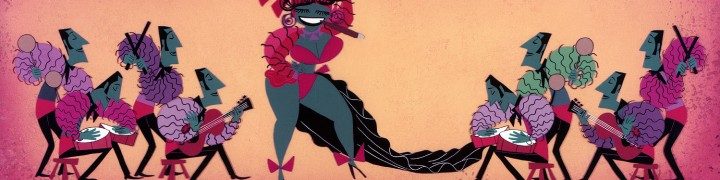
The film is typical Burton with its friendly take on horror, and Burton’s head animator Henry Selick rightly calls the film’s overall style a mix of “German expressionism and Dr. Seuss”. Selick and his team manage to make Burton’s pen and ink drawings come to life in believable puppets, despite the often very long limbs and unsteady balance of some of the characters.

With this animation effort Selick turned out to be a strong new voice in the animation field, and after ‘The Nightmare Before Christmas’ he continued to impress, first with ‘James and the Giant Peach’ (1996), then with ‘Coraline’ (2009), although his feature ‘Monkeybone’ (2001) was much less of a success.

Burton’s story is based on an original idea, but is not worked out too well. The idea of Holiday lands is a good one, but how does one return from Christmas land to Halloween land? And there is a focus problem: ‘The Nightmare Before Christmas’ follows two main characters, Jack Skellington and Sally, without choosing one as its principal character.

Jack is a bit of a problematical character anyhow: he’s king of his land, but remarkably bored, and he’s willing to take a huge risk to fill his own feelings of emptiness. Moreover, his selfish plans means a year without Halloween, not to mention the disastrous Christmas he makes. Jack does develop during the film, but his remorse and recovery come too quickly to be entirely convincing.

In the end, it’s Sally who turns out to be the most interesting character of the two: when we first watch her, she literally falls apart. She’s controlled and hold back by her maker, the possessive Dr. Finkelstein, and naturally very shy, but during the movie she becomes bolder and more venturous.

The film’s villain, The Bogeyman, is scary, but his role in Burton’s universe is obscure: why is he the only nightmarish character that is genuinely scary and unfriendly? I have no idea. A nice touch are the Cab Calloway influences on this character. He even literally quotes Calloway when saying “I’m doing the best I can” like Calloway did in the Betty Boop cartoon ‘The Old Man from the Mountain’ (1933).

The film’s story flaws would certainly be forgivable, given the film’s stunning visuals, if it were not for the songs. The biggest problem of ‘The Nightmare Before Christmas’ remains its unappealing soundtrack, reducing an otherwise fantastic film into a hardly tolerable one. An immense pity, for one remains wondering what the film could have been if it had not been the obligate and ugly musical it turned out to be.

Watch an excerpt from ‘The Nightmare Before Christmas’ yourself and tell me what you think:

‘The Nightmare Before Christmas’ is available on DVD and Blu-Ray

Director: Andreas Hykade
Release Date: 1995
Rating: ★★★½

‘Wir lebten im Gras’ is the first of three films in which German animator Andreas Hykade explores the loss of innocence, the other two being ‘Ring of Fire’ (2000) and ‘Der Kloane’ (The Runt, 2006).

The film is also the most cryptic of the three, full of images that are very difficult to decipher. The film is set in a rather mythical place, ‘two streets away from the end of the world’ and has a timeless and universal feel.

The story is told by a boy voice over, who reminisces about his father, who told him that “All women is whore and all men is soldier”. Outside the voice over there is no dialogue. The little boy tries to see the world through his father’s eyes, but this conflicts with his softer side, and he’d rather fall in love with the enigmatic ‘dandelion girl’.

The film is less straightforward than this synopsis suggests, however, and the film is more surreal and suggestive than narrative. For example, the boy’s adventures are interjected by nightmarish dream sequences, the meaning of which is never really explained. These dream sequences are rendered in an expressionistic pastel style, reminiscent of Lorenzo Mattotti’s art work. This style contrasts highly with the simple cel animation.

Hykade’s drawing style is highly original. His human designs are simple, almost stickman-like, but genitals are very prominent, and the father is drawn as a more robust, earthly character.

The animation is very virtuoso, with a great feel for timing. Moreover, Hykade uses a lot of changing perspective, and has an admirable command of movement.

‘Wir lebten im Gras’ was Hykade’s last student film, but it certainly is his first major work. With this film Hykade proved to be a strong new voice in the animation world, a fact he consoled with his masterpiece ‘Ring of Fire’ from 2000.

Watch ‘Wir lebten im Gras’ yourself and tell me what you think:

‘Wir lebten im Gras’ is available on the DVD ‘Desire & Sexuality – Animating the Unconscious Vol. 2’

Directors: Roger Allers & Rob Minkoff
Release Date: June 15, 1994
Rating: ★★★★★ ♕

When ‘The Lion King’ was released I went to see the film three times in a row. At the time I lived on the tiny Caribbean isle of Tobago, and I went three times, partly because there was little else to do, partly because the film would disappear from the screen in ca. five days, anyway, but most importantly because the film made a deep impression on me. Strangely enough, I hadn’t seen the movie since, so after 25 years it has become high time.


Luckily, the film holds up very well after all these years. Indeed, not only was ‘The Lion King’ the highest grossing animation film thus far on its release, the movie still is one of the most popular animation films of all time. For example, it takes place 34 at IMDb’s top rated movie, as the second animated movie, after ‘Spirited Away’ on place 27, checked on November 21, 2020).

In that regard ‘The Lion King’ can be seen as the pinnacle of the Disney renaissance, because it tops an excellent row of Disney features (‘The Little Mermaid’ from 1988, ‘Beauty and the Beast’ from 1990, and ‘Aladdin’ from 1992), while the subsequent Disney movies of the nineties, while still good, would not reach the same heights again, nor stir the same sensation as these first four features did.

According to Mark Mayerson in ‘Animation Art’ this was partly because Disney’s success “caused other companies to start producing animated features. This diluted the talent pool and forced up wages and budgets” prompting management to interfere more in the film making process. Mayerson also detects pretentiousness and a lack of warmth in these later pictures (Animation Art, p. 305).

What certainly didn’t help was Toy Story’s big hit in 1995, suddenly shifting the future of animation from traditional to computer generated animation, a process that more or less was completed ten years later, after which traditionally animated features would become extremely rare, at least in the United States.

Indeed, even in ‘The Lion King’ one of the biggest stirs among audiences (including me) was the computer generated stampede of wildebeests. This tour-de-force of computer animation was an impressive feat on the big screen, and though computer animation has been pushing the envelope ever forward since, the scene still holds up today, interestingly partly because the wildebeests are based on hand drawn designs.

There are more technical stunts to be found in ‘The Lion King’, both aided by the computer and not. Especially the opening scenes are literally stuffed with them, showing a sequence of mind-blowing images of African nature to the song ‘The Circle of Life’.

But much more impressive in the end is the character animation, which is top notch throughout, and which has an apparent effortlessness to it that never ceases to amaze. Especially the work by Andreas Deja and his team on Scar is impressive, making him a worthy successor of that other outstanding feline villain of the silver screen, Shere Khan (Jungle Book, 1967), greatly helped by his voice artist Jeremy Irons, who gives the character the perfect mix of self-pithy, sarcasm and sinister slyness.

Another stand out in the voices are Mufasa’s voice, which is deep and commanding, yet fatherly and compassionate, and which is provided by James Earl Jones of Darth Vader fame. Yet another is Whoopi Goldberg as the leader of a villain trio of hyenas.

Being a nineties Disney film, ‘The Lion King’ of course is a musical, a genre that certainly is not my favorite, but I must admit that Elton John’s and Tim Rice’s songs hold up very well, greatly aided by the imagery. ‘The Circle of Life’, as said, makes an impressive opener; ‘I Just Can’t Wait to Be King’ is spiced by very bold colors, and stylized background art (as well as anteaters, which do not occur in Africa – a strange and unnecessary error); Scar’s song ‘Be prepared’ is accompanied by evil greens and purples in a clear echo of Maleficent in ‘Sleeping Beauty’ (1959), and the love ballad ‘Can You Feel the Love Tonight’ is rescued from sappiness by the inclusion of Timon and Pumbaa mourning the loss of their friend. All these songs propel the story forward, none more so than the best song of all, ‘Hakuna Matata’, which neatly changes the infant Simba into the adult one.

Which brings me to the main reason the film still is a great classic: it’s told so well. The pace of the film is almost flawless, with exciting and more relaxing scenes distributed in perfect fashion. The only implausible scenes come at the end of the film: first there is Rafik’s all too simple cure of Simba’s guilt complex. I bet many psychiatric patients would die for such a quick resolution of their youth inflicted mental problems. Moreover, this scene includes a very unconvincing mystical dialogue between Simba and his deceased father. The finale uses two little too evident symbols of change and renewal (fire and rain), and how Simba manages to turn the wasteland of his kingdom into a prosperous country again remains an utter mystery.

Nevertheless, the guilt that haunts Simba makes him an interesting and relatable lead character – like Aladdin he isn’t a flawless hero. And while it’s understandable that he embraces Pumbaa’s and Timon’s relaxed lifestyle, it clearly cannot cure him from the haunts of his past. He just has to face them in the end, which means he has to overcome his biggest fears and insecurities.

It’s a great feat that the film makers have managed to weave such a deep theme into the more classic usurper tale, which is notably dark: we watch both a murder and a dead body on the screen, in what must be the most harrowing scene in a Disney animation film since the death of Bambi’s mother in ‘Bambi’ (1942), the film with which ‘The Lion King’ has most in common: both follow the main protagonist in his youth and in his adult life, both depict a very romantic concept of nature, and both have ‘the circle of life’ as their main theme, with ‘The Lion King’’s opening and closing scenes being undisputed echoes of the closing scene of the classic from the 1940s.

Because ‘The Lion King’ is a rather serious tale, it’s a little low on comedy. Indeed, there are very few real gags in this film, one of them unusually self-parodying: at one point a caged Zazu (Rowan Atkinson) starts singing ‘it’s a small world after all’, which immediately prompts Scar in an anxious ‘No, no, anything but that!’. The other great gag of the movie is when Timon refers to the sad Simba as ‘He looks blue’, on which Pumbaa replies ‘I’d say brownish gold’. That said, the film is absolutely balanced in its mix of humor and drama, and never becomes heavy-handed.

In all, ‘The Lion King’ has hold up after these 25 years, and has his rightful place as one of the greatest films of all time, animated or not. And I seriously wonder why a remake was at all necessary or welcome, for in my opinion the original cannot be topped.

Watch the trailer for ‘The Lion King’ yourself and tell me what you think:

‘The Lion King’ is available on DVD and Blu-Ray

Director: Jeff McGrath
Stars: Duckman
Airing Date: June 11, 1994
Rating: ★★★½

‘Joking the Chicken’ is all about humor. It all starts nicely with a spoof on ‘2001: a Space Odyssey’, now with the invention of humor instead of violence (in fact the invention of humor looks surprisingly like a similar scene in ‘La guerre du feu’ (Quest for Fire) from 1981).

The episode features a dorky bespectacled little stand-up comedian called Iggy Catalpa, who isn’t at all funny, but oh so politically correct. Enter an enigmatic manager who mysteriously turns the failing comedian into a star, forcing all comedy into being politically correct on the way.

It’s clear where the makers are heading, which is nicely summed up during the episode’s finale, in which Duckman holds a powerful speech that not only holds up today, but is even more necessary than ever.

Yet, the episode is hampered by a lack of substance story-wise, and by the reapparance of Duckman’s arch nemesis, King Chicken (see ‘Ride the Highschool‘), who is a much less interesting character than the makers want him to be.

Most strange is a 1930s-like musical number sung by the manager accompanied by Cornfed on the piano. Duckman isn’t impressed, and we are neither, because this number is rather trite than funny, and only manages to emphasize the obsolescence of the style.

Thus ends the first season of Duckman: Private Dick/Family Man. It was clear that there was more to do with the character, thus three seasons would follow, and the series lasted until 1997.

Watch ‘Joking the Chicken’ yourself and tell me what you think:

This is Duckman episode no. 13
To the previous Duckman episode: About Face
To the next Duckman episode: Papa Oom M.O.W. M.O.W.

‘Joking the Chicken’ is available on the DVD-box ‘Duckman – The Complete Series’

Director: Raymie Muzquiz
Stars: Duckman
Airing Date: June 4, 1994
Rating: ★★★★★

‘About Face’ is one of the deepest of the Duckman episodes, and together with ‘Psyche‘ and ‘American Dicks’ forms the highlight of the first season.

Despite the usual dose of absurd humor and fast verbal wisecracking, the episode is actually moving, and knows an unexpectedly touching and somber ending, a very rare feat in both animated series and television comedy, indeed.

In this episode Mambo accidentally swallows a model of the titanic, which prompts Duckman to call 911. He immediately falls in love with the sweet voice on the other side of the line, and when she calls back, he immediately sets out to date her. Her name turns out to be Angela, and she is the sole person with whom Duckman not only feels like a good person, but also behaves like one.

Problem is, she’s “facially challenged” as Cornfed puts it, not to say hideously ugly (this trait is played out grotesquely, with people becoming terrified, fainting and fleeing when she walks by, echoing the skunk gags in Tex Avery’s ‘Little ‘Tinker’ from 1948). But then she decides to change all this…

This is one of the Duckman episodes deepening the character of the series’ protagonist, and actually make the audience feel for him. Notwithstanding, the episode contains plenty of comedy, with as highlights the scene in which Duckman is holding a telephone conversation with his beloved while his house burns down, and the scene in which Cornfed and his own date are mime dancing to no music.

Watch ‘About Face’ yourself and tell me what you think:

This is Duckman episode no. 12
To the previous Duckman episode: American Dicks
To the next Duckman episode: Joking the Chicken

‘About Face’ is available on the DVD-box ‘Duckman – The Complete Series’

Director: John Eng
Stars: Duckman
Airing Date: May 28, 1994
Rating: ★★★★★

In what is arguably one of the most inspired Duckman episodes of all, Duckman is the unlikely star of a reality television show called ‘American Dicks’, a spoof on the television series Cops, which first appeared on television in 1989, and still runs.

In this episode Duckman suppossedly is followed by a cameraman with a hand-held camera, which leads to scenes with odd staging, distorted body parts, as Duckman and the others repeatedly talk into the camera, and even animated backgrounds, a rare feat since the early 1930s.

Moreover, the images are more often than not in constant motion, suggesting camera movements and even walking. This is done with such skill that the ‘documentary camera style’ is evoked very convincingly, despite the looney images within them.

This episode is one of the very few episodes in which Duckman veritably is a private detective, even if he turns out to be the worst and most oblivious one around, leaving it to Cornfed to solve the case.

What doesn’t help is that Aunt Bernice interferes with the program when she learns that the audience is predominantly male between the age of 20 and 55. Promptly, she advertises herself as wedding material. During the finale there are even severe closeups of her breasts and buttocks.

Even the kids get their moments in this episode, which is full of great gags, both in visually as in the soundtrack. A true classic.

Watch ‘American Dicks’ yourself and tell me what you think:

This is Duckman episode no. 11
To the previous Duckman episode: Cellar Beware
To the next Duckman episode: About Face

‘American Dicks’ is available on the DVD-box ‘Duckman – The Complete Series’

Director: Norton Virgien
Stars: Duckman
Airing Date: May 21, 1994
Rating: ★★★½

‘Cellar Beware’ is another episode exploring Duckman’s role as a “responsible” father.

This time Aunt Bernice decides to ask some visitors over, and drills the men of the house to behave. She also invites some speaker about home security, and after a lecture full of apparently horrifying slides, the once so skeptical Duckman buys the “Interloper Führer 2000” security system, which soon turns against the family itself.

It’s hard to sympathize with Duckman in this episode, even though he acts surprisingly heroically in the end. The party sequence is probably the highlight of the episode, which is entertaining mostly because of Ajax’s brainless remarks, and because of a bizarre reference to ‘The Sound of Music’. Note Mambo’s very Paul Driessen-like double take ten minutes into the episode.

Watch ‘Cellar Beware’ yourself and tell me what you think:

This is Duckman episode no. 10
To the previous Duckman episode: It’s the Thing of the Principal
To the next Duckman episode: American Dicks

‘Cellar Beware’ is available on the DVD-box ‘Duckman – The Complete Series’

Director: Igor Kovalyov
Stars: Duckman
Airing Date: May 7, 1994
Rating: ★★★½

Russian independent animation master Igor Kovalyov directs this erotically charged episode in which Duckman’s son Ajax falls in love.

The story features a very unlikely undercover investigation by Duckman and Cornfed dressed as ‘teenagers’ in Ajax’s school. More convincing and more importantly to the series is the search for Ajax by Aunt Bernice and Duckman in some honeymoon town in Mexico.

Duckman is more lustful than ever in this episode, which expands on both his relationship with Aunt Bernice as with his son, Ajax. Cornfed, on the other hand, is hardly present. His best gag is when he’s in a tree together with Duckman, spying on Ajax’s vice principle, fooling Duckman with describing erotic images to drive the latter’s lust to a boil.

The whole episode bursts with sex without revealing anything, and certainly is one of the most adult of all Duckman episodes, even if Duckman’s own desires and objectifications of women are rather juvenile.

Watch ‘It’s the Thing of the Principal’ yourself and tell me what you think:

This is Duckman episode no. 9
To the previous Duckman episode: Not So Easy Riders
To the next Duckman episode: Cellar Beware

‘It’s the Thing of the Principal’ is available on the DVD-box ‘Duckman – The Complete Series’

Director: Paul Demeyer
Stars: Duckman
Airing Date: April 30, 1994
Rating: ★★½

Still from 'Not So Easy Riders' featuring Duckman and Cornfed as Easy Riders

This episode is all about the money. It starts with Duckman chasing a one dollar bill on a busy street, getting hit by cars and trucks repeatedly.

Next Duckman gets a letter from the IRS summoning him to finally pay his taxes. With help of a motor gang Duckman escapes, and, together with Cornfed, ends up in Las Vegas.

‘Not So Easy Riders’ contains obvious references to ‘Easy Rider’ (1969). Especially Duckman’s psychedelic trip is noteworthy for its continuous flow of metamorphosis animation and psychedelic sixties-like imagery.

Moreover, the episode can boost to contain some nice snippets of familiar Frank Zappa songs, like ‘Disco Boy’ and ‘Take Your Clothes Off When You Dance’.

Yet, its story arch is weak and the humor relies a little too much on dialogue.

Watch ‘Not So Easy Riders’ yourself and tell me what you think:

This is Duckman episode no. 9
To the previous Duckman episode: A Civil War
To the next Duckman episode: It’s the Thing of the Principal

‘Not So Easy Riders’ is available on the DVD-box ‘Duckman – The Complete Series’

Director: Norton Virgien
Stars: Duckman
Airing Date: April 23, 1994
Rating: ★★★½

In an act of jealousy Duckman fires Cornfed, but without his partner the avine crimefighter doesn’t go anywhere in solving a murder case…

This episode knows some extreme camera angles, and a running gag in which everybody sees something else in a Rorschach-test-like pen stain on Duckman’s chest.

Watch ‘A Civil War’ yourself and tell me what you think:

This is Duckman episode no. 8
To the previous Duckman episode: Ride the High School
To the next Duckman episode: Not So Easy Riders

‘A Civil War’ is available on the DVD-box ‘Duckman – The Complete Series’

Director: Raymie Muzquiz
Stars: Duckman
Airing Date: April 16, 1994
Rating: ★★★

In this episode Duckman’s backward son Ajax is invited to attend a boarding school. After Duckman has visited Ajax’s present school, he sends his son off quickly.

Duckman’s visit to Ajax’s most atrocious school is a highlight. He e.g. gets beaten by caricatures of ‘Our Gang’. Better still is the montage sequence of Duckman and Ajax having some quality time during their last weekend together. Yet, the best line is for aunt Bernice, who tells Duckman when he drools over an attractive boarding school student: “You’re despicable! You’ve got kidney stones older than her!”.

‘Ride the High School’ introduces King Chicken as Duckman’s arch nemesis. King Chicken would never become a frequently recurring star, but he would return in eleven more episodes, including the very last one.

Watch ‘Ride the High School’ yourself and tell me what you think:

This is Duckman episode no. 6
To the previous Duckman episode: Gland of Opportunity
To the next Duckman episode: A Civil War

‘Ride the High School’ is available on the DVD-box ‘Duckman – The Complete Series’

Director: John Eng
Stars: Duckman
Airing Date: April 9, 1994
Rating: ★★★★

‘Gland of Opportunity’ starts with the family being stuck in a long traffic jam on their way to an amusement park, loosely based on Disneyland.

Inside the amusement park, Duckman and his family spend the rest of the day waiting in an overlong line for a roller coaster, but Duckman chickens out just before the ride.

In a rather incomprehensible scene switch he suddenly finds himself in a hospital about to get an andrenoid gland transplant. He goes through with it in the hope to get more courage, and to become more of a role model to his kids.

And indeed, as soon he awakes, and convinces himself he has the gland of a deceased daredevil he becomes a superhero, solving crimes by the dozen and becoming a superstar in now time. But he also is a bad influence on his kids, whom he takes from school to experience ‘the school of life’, which is one long trip around the world. It’s up to Cornfed to restore the situation.

What’s great about ‘Gland of Opportunity’ is that the makers make clear that Duckman’s newborn drive may be originated in a delusion, but that it’s motivated by Duckman’s desire to be respected and admired by his sons. Of course, in the end he utterly fails, but by then we viewers have had a wonderful roller coaster ride of an episode.

Watch ‘Gland of Opportunity’ yourself and tell me what you think:

This is Duckman episode no. 5
To the previous Duckman episode: Psyche
To the next Duckman episode: Ride the High School

‘Gland of Opportunity’ is available on the DVD-box ‘Duckman – The Complete Series’

This episode is all about Duckman’s sexual fantasies.

Director: Paul Demeyer
Stars: Duckman
Airing Date: March 26, 1994
Rating: ★★★★★

After the death of his wife Beatrice, one and a half year ago, Duckman’s sexual live has come to a standstill, while Cornfed even admits he’s still a virgin.

Matters get worse when Duckman and Cornfed are visited by a blonde twin, who look like the epitome of male fantasies, with their huge boobs and seductive voices. But Duckman is so insecure he goes through plastic surgery, enlarging his bill, to dare to confront the twin.

Yet he really gets cured by a weird dominatrix-psychiatrist. This part contains a great journey inside Duckman’s inner soul, and we learn how his former wife Beatrice died.

This highly entertaining episode knows some great reuse of Avery’s classic wolf takes, and features excerpts from two Frank Zappa songs.

Watch ‘Psyche’ yourself and tell me what you think:

This is Duckman episode no. 4
To the previous Duckman episode: Gripes of Wrath
To the next Duckman episode: Gland of Opportinity

‘Psyche’ is available on the DVD-box ‘Duckman – The Complete Series’

Director: Norton Virgien
Stars: Duckman
Airing Date: March 19, 1994
Rating: ★★½

Still from 'Gripes of Wrath' featuring Cornfed and Duckman wandering through the perfect world

After the first two great Duckman episodes, ‘Gripes of Wrath’ feels as an enormous letdown. Compared to the earlier two entries, this story is surprisingly disjointed.

The episode starts with Duckman wanting to go to mud wrestling, but ending up taking his sons to a science exhibition instead. There they meet a giant supercomputer, and before soon this machine has taken over the world and turned it into a perfect one. But this perfection can’t last and as easily the same world disintegrates into one worse than before.

These series of events are clearly modeled on ‘Back to the Future Part II’ (1989), with a bit of ‘2001: a Space Odyssey’ thrown in.

Unfortunately, the story is told rather confusingly and quite hard to follow, and the underlying discourse about the use of technology never really takes off properly.

Watch ‘Gripes of Wrath’ yourself and tell me what you think:

This is Duckman episode no. 3
To the previous Duckman episode: T.V. or Not to Be
To the next Duckman episode: Psyche

‘Gripes of Wrath’ is available on the DVD-box ‘Duckman – The Complete Series’

Director: Raymie Muzquiz
Stars: Duckman
Airing Date: March 12, 1994
Rating: ★★★★½

T.V. or Not to Be © Klasky Csupo

Already in its second episode the Duckman series mocks the medium on which it appears itself: The episode starts with Duckman zapping through countless channels, one even more stupid than the other.

When he finally finds a show he likes, he gets overruled by the rest of the family, who all want to watch ‘Mother Mirabelle’s Home Miracle Network’.

This show clearly lampoons pseudo-religious shows on television, but not too easily. Strikingly, Duckman almost dies and has a near-death experience, which makes him a believer.

The scenes in heaven form the highlight of the episode, but it’s also great to watch Duckman being disguised as Vincent van Gogh or on a hopeless mission to convert the public as a hare krishna at one airport.

The episode also lampoons the art world, with the villain clearly being a caricature of Andy Warhol, assisted by a gift wrapping Christo.

Watch an excerpt from ‘T.V. or Not to Be’ yourself and tell me what you think:

This is Duckman episode no. 2
To the first Duckman episode: I, Duckman
To the next Duckman episode: Gripes of Wrath

‘T.V. or Not to Be’ is available on the DVD-box ‘Duckman – The Complete Series’

Directors: Marv Newland, Robin Steele, Drew Takahaki & Andy Knight
Stars: Duckman
Airing Date: March 5, 1994
Rating: ★★★★½

One of the great things of the animation renaissance that started at the end of the 1980s was the return of animated series for adults.

I, Duckman © Klasky Csupo

The first and most prominent of these was, of course, The Simpsons, which started at the end of the 1989, but in the slipstream of their success the nineties saw the emergence of other series, like The Critic (1994-1995), Dr. Katz – Professional Therapist (1995-2002), and The Maxx (1995).

The greatest among these early shows arguably was ‘Duckman’ (or officially, Duckman: Private Dick/Family Man), which ran from 1994 to 1997. The series was made by the Klasky Csupo studio, which also had been responsible for the first three seasons of The Simpsons. But where the Simpsons were clearly in the style of Matt Groening, ‘Duckman’ much more evidently saw the typical Klasky-Csupo style, which was also visible in their Nickelodeon series Rugrats (1991-2004) and Aaahh!!! Real Monsters (1994-1997).

More than the Simpsons Duckman had a genuine independent design style, much influenced by independent greats like Bill Plympton and Igor Kovalyov. Indeed, this first episode was storyboarded and directed by American-Canadian indie veteran Marv Newland, while Kovalyov himself directed the ninth episode.

Thus, the designs and animation of this first episode are an absolute delight to watch. Despite the episode relying heavily on (very witty) dialogue, there remains a lot to look at.

Duckman is a private detective, assisted by two all too cute teddybears called Fluffy and Uranus, whom Duckman tortures and kills in almost each episode, and by a pig called Cornfed (greatly voiced by Gregg Berger). But he’s also a single father of a dimwitted son called Ajax, and a much more intelligent two-headed son called Charles and Mambo (could this Siamese twin be inspired by Daffy Duck’s photo album in ‘The Stupid Cupid’ from 1944?). To complicate matters Duckman lives with his fitness-loving sister-in-law Bernice and his flatulent mother-in-law.

Duckman himself is an utterly cynical, misanthropic and selfish character, but already in his very first entry he gets a considerable amount of depth, when he realizes nobody cares about him. When he’s the victim of bomb attacks this prompts him to dive into his own memories (which features a great scene with Duckman playing old 8mm films to his deputy Cornfed, in a scene lampooning A Clockwork Orange, Steamboat Willie, Popeye, Yogi Bear and The Simpsons in one go). We learn about Duckman’s love for his deceased wife Beatrice, and almost feel for him, despite the wisecracking and sarcasm that surround him.

Cornfed is a great partner to Duckman: stoic where Duckman is explosive, and acting as Duckman’s conscience, whether the latter likes it or not.

Besides the wild animation, bold designs, surprisingly interesting characters and outlandish stories the first season could also boast to be able to use snippets of Frank Zappa’s music in its score, and the previously unknown voice talent of Zappa’s son Dweezil (as Ajax).

In all, ‘I, Duckman’ is a great start of a great series.

Watch an excerpt from ‘I, Duckman’ yourself and tell me what you think:

This is the first Duckman episode
To the next Duckman episode: T.V. or Not to Be

‘I, Duckman’ is available on the DVD-box ‘Duckman – The Complete Series’

Director: Mike Booth
Release Date: October 1996
Rating: ★★★½

The Saint Inspector © BolexbrothersThis Bolexbrothers short tells about a rather fat, naked hermit. He lives in complete meditation on a platform high above the mountains and clouds.

One day he gets a visit from the ‘saint inspector’, a robot. The robot inspects the meditative state of the hermit, who only once reacts to the robot’s tests. This prompts the robot to look inside the hermit’s brain, which leads to a mesmerizing string of rapidly changing and rather disturbing images.

‘The Saint Inspector’ is quite an absurd film, and more than anything else demonstrates the limitless potential of animation.

Watch ‘The Saint Inspector’ yourself and tell me what you think:

‘The Saint Inspector’ is available on the DVD ‘The Secret Adventures of Tom Thumb’

Director: Nick Park
Release Date: December 26, 1993
Stars: Wallace and Gromit
Rating: ★★★★★ ♕

The Wrong Trousers © Aardman‘The Wrong Trousers’ was the second short featuring the cheese-loving duo Wallace & Gromit.

Their first outing, ‘A Grand Day Out’ had been a virtuoso piece of clay animation, but even so, ‘The Wrong Trousers’ was a giant leap forward, taking Aardman’s claymation out of the independent animation atmosphere into the mainstream of slick studio productions, without losing an inch of character.

Despite being only 29 minutes long and featuring only three characters, ‘The Wrong Trousers’ feels like classic cinema. The fifties horror typography of the opening titles immediately makes it clear that we’re in for a mystery plot, and indeed this is a crime thriller with a small penguin as a most unlikely, but very convincing villain.

The film opens on Gromit’s birthday, a day which turns out quite sour. First, Wallace seems to have forgotten all about it, then he gives him the most useless gift imaginable: automatic trousers to walk him out without his faithful master. Then it turns out that Wallace has to cut expenses and … a room for rent.

That very evening the penguin comes in as the new boarder, but instead of taking the vacant room, he heads immediately for Gromit’s room. The mysterious penguin first takes care of Gromit, chasing the poor dog out of the house, then he uses the trousers in a diamond heist scheme.

The whole film is very well shot, featuring expressionistic angles and clever zooming in and out between the  front and back of the set. The suspense is greatly added by dramatic orchestral music by Julian Nott. And throughout the animation, by Nick Park himself and by Steve Box, is top notch.

Especially the two silent characters, the penguin and Gromit, are very well animated: the penguin creepy and enigmatic, hardly revealing its emotions, except in the heist scene, Gromit with a multitude of expressions, making great use of Nick Park’s trademark brow technique. In fact, Gromit is such a rounded character, he easily carries the whole film easily using the expressions of his eyes alone. Especially Gromit’s agony, having to watch how the penguin silently takes over his home, is tantalizing.

Nevertheless, the most impressive part of this short is the finale. This is a remarkable chase scene, ridiculously set indoors on miniature trains, but it consists of five frantic minutes with a sense of speed never seen before in a stop-motion film. This finale alone takes the possibilities of stop-motion forward to new heights, and together with ‘The Nightmare Before Christmas‘ from the same year, ‘The Wrong Trousers’ must be regarded as a milestone in animation. Thus, the next year the film rightfully won the Academy Award for animated short.

The film also started a sort of Wallace and Gromit tradition of combining silly inventions with mystery thriller plots, as this would be the promise of all three subsequent Wallace and Gromit films.

Watch ‘The Wrong Trousers’ yourself and tell me what you think:

‘The Wrong Trousers’ is available on the DVD ‘Wallace & Gromit – The Complete Collection’

Director: Tomomi Mochizuki
Release Date: December 25, 1993
Rating: ★★★★½

Ocean Waves © Ghibli‘Ocean Waves’ was an animated feature the Studio Ghibli made for television. It’s also one of those Japanese animation films that could pretty well be made in live action.

According to Wikipedia the film was an attempt by Studio Ghibli to allow their younger staff members to make a film reasonably cheaply. So, it may not come to a surprise that the film is a little underwhelming when compared to contemporary Ghibli films like ‘Porco Rosso‘ (1992) or ‘Pom Poko‘ (1994), let alone later masterpieces like ‘Princess Mononoke’ (1997) or ‘Spirited Away‘ (2001).

But taken on its own, ‘Ocean Waves’ is a very nicely told tale of high school romance, full of nostalgia, especially in its depiction of hot summers. The film takes place in Kōchi, on the Southern island of Shikoku. The film is told by Taku, now a student at a University in Tokyo. He reminisces about his high school friendship with bespectacled Matsuno Yutaka, and how he met the erratic girl Muto Rikako.

Rikako clearly is a troubled girl: she has moved to Kōchi from Tokyo, only with her mother and brother, and she hardly makes friends. Yutaka is clearly interested in her, raising jealousy in Taku, but it’s Taku who ends up in an all too improvised trip to Tokyo with Rikako, who wants to see her father again. The trip turns into a disaster, and Rikako even unwillingly manages to separate the two friends, but the film ends on a high note, even if years later.

The film’s style is very understated: only little is spoken out, and most of the feelings transgress through body gestures. Rikako remains enigmatic to the very end, and Taku blunders through his meetings with her. The film remains highly realistic, and the characters believable throughout.

‘Ocean Waves’ may not be a Ghibli masterpiece, it’s still a gentle animation film, well worth seeing.

Watch the trailer for ‘Ocean Waves’ yourself and tell me what you think:

‘Ocean Waves’ is available on DVD and Blu-Ray

Director: Dave Borthwick
Release Date: December 10, 1993
Rating: ★★★

The Secret Adventures of Tom Thumb © Bolexbrothers1993 was a great year for stop-motion animation: it saw the screening of the groundbreaking feature film ‘The Nightmare Before Christmas‘, as well as the Wallace & Gromit short ‘The Wrong Trousers‘, which also covered new grounds.

Much less well known is the stop-motion feature film ‘The Secret Adventures of Tom Thumb’, also released that year. Made by Dave Borthwick at the British Bolexbrothers studio the film is a much rougher affair than the smooth stop-motion efforts of Disney and Aardman. In fact, it stands firmly in a tradition of gritty and disturbing stop-motion films that via Jan Švankmajer harks all the way back to Władysław Starewicz.

To begin with the film takes place in a dark and disturbing world, where large insects crawl and violence roams. In this gloomy world a poor couple gives birth to a child the size of a small fetus, whom they call Tom Thumb (in one of ca. three lines of dialogue in the entire film).

But Tom soon is kidnapped and taken to a sinister laboratory populated by several chimeral creatures tortured by insane experiments. A two-legged lizard-like creature helps Tom escape. Outside Tom meets a human tribe his own size, who unfortunately kill his chimeral companion. Jack, the leader of the tribe and a master of weapons, takes Tom back to the laboratory, where they eventually apparently destroy the laboratory’s power…

Much of what’s happening in this film is rather incomprehensible, and the plot could do with some cleaning. For example, it remains utterly unclear why Tom is kidnapped, and what the origin of the little people is. Throughout Tom remains a silent and innocent character, not unlike Pinocchio or Dumbo, and he hardly acts.

In the end the film is more interesting because of its disturbing images and for its unique artwork than for its story. The creators made especially well use of pixillation (the animation of people), giving all actors a grotesque appearance and ditto movement.

The best scenes remain the ones inside the laboratory, where Tom sees some pathetic creatures. Especially the one in which one of the creatures asks Tom to shut down the power that sustains them, is a moving piece of animation.

The Secret Adventures of Tom Thumb’ may never get the classic status of a ‘The Nightmare Before Christmas’ or a ‘The Wrong Trousers’, it still is a film that shows the limitless power of animation in the hands of creators with a lot of imagination.

Watch ‘The Secret Adventures of Tom Thumb’ yourself and tell me what you think:

‘The Secret Adventures of Tom Thumb’ is available on DVD

Enter your email address to follow this blog and receive notifications of new posts by email.

Join 915 other subscribers
Bookmark and Share

Categories