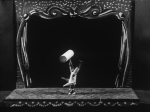
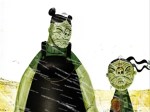
This stop-motion film consists of a series of twelve ultra-short scenes in which we watch a puppet using various ways of transport and doing some sports.
All actions go wrong: the puppet’s horse throws him off, his car breaks down, he falls with his bicycle, his boat capsizes etc. The film is enriched with witty intertitles. The film is extremely simple: all scenes take place at the same small table setting, without any background art. Nevertheless, the puppet has a grain of a character, as he repeatedly looks at the audience for recognition.
Watch ‘Soyons donc sportifs’ yourself and tell me what you think:
‘Soyons donc sportifs’ is available on the DVDs ‘Émile Cohl – L’agitateur aux mille images’
‘L’hôtel du silence’ is Émile Cohl’s answer to J. Stuart Blackton’s influential ‘The Haunted Hotel’ from 1907. Unlike Blackton, Cohl doesn’t employ stop motion in his film, however, making ‘L’hôtel du silence’ an addition to the trick film tradition, not an entry in the animation canon.
The film features a man visiting a hotel without any personnel. The man’s stay at the hotel is far from pleasant, however: his dinner disappears into the floor, his bed throws him on the floor when the alarm clock rings, and a shower soaks him completely. In the end, he’s confronted by an enormous bill. The man tries to sneak away without paying, but he is held inside the lobby by the desk. Even the door refuses to let him go out before he has paid some tips. This last gag is arguably the best of the whole film.
The unknown actor who plays the hapless visitor clearly is a professional clown: he acts out his emotions to the audience with broad gestures, and he’s clearly used to slapstick comedy, making him a forerunner of the American slapstick tradition. The camera remains static, with all the actions taking place in two tableaux: the lobby and the bedroom. Cohl uses a lot of contraptions and quite some trick photography, but no animation to tell his story, which is quite static, but pretty amusing for a film of the 1900s.
Watch ‘L’hôtel du silence’ yourself and tell me what you think:
‘L’hôtel du silence’ is available on the DVDs ‘Émile Cohl – L’agitateur aux mille images’
‘Le petit soldat qui devient dieu’ is a short film about a little tin soldier.
We watch him and the other tin soldiers leave their box, and perform some antics in front of a childlike drawing of a house. At one point the little soldier is left behind, when the others return to their box. Suddenly we watch him floating on a paper boat down the sewer, and on the Seine.
Apparently the tin soldier floats to the ocean, because in the next scene he’s found by an African boy and taken to his negro tribe, who are about to kill another black man. The chief licks the tin soldier and dies instantly. Then the other tribesman crown the other black man. The end.
‘Le petit soldat qui devient dieu’ is another one of Cohl’s early experiments in stop-motion, blending it with live action. Unfortunately, the short is the weakest of Cohl’s 1908 films: the tin soldier sequences are very static, all taking place against the same backdrop, and consisting of little more than soldiers marching. Moreover, none of the action makes sense. But the end is the worst: not only is this scene totally incomprehensible, the cannibals are but white men in blackface, and their characters are the worst cliche cannibals imaginable.
Watch ‘Le petit soldat qui devient dieu’ yourself and tell me what you think:
‘Le petit soldat qui devient dieu’ is available on the DVDs ‘Émile Cohl – L’agitateur aux mille images’
‘Les frères Boutdebois’ are two wooden puppets who perform some acrobatic tricks against a theatrical backdrop.
The film contains no story and ends abruptly, but the stop-motion is quite good, and an enormous improvement on ‘Japon de faintasie‘. The two puppets seem to have some character, and the trick photography is pretty convincing.
Somehow this short little film seems the direct ancestor of Jan Švankmajer’s stop-motion films, both in animation style and in atmosphere, even though this film lacks Švankmajer’s surrealism (or that of Cohl’s own ‘Fantasmagorie’ for that matter).
Watch ‘Les frères Boutdebois’ yourself and tell me what you think:
‘Les frères Boutdebois’ is available on the DVDs ‘Émile Cohl – L’agitateur aux mille images’
‘Le cerceau magique’ starts with a live action sequence taking place in a park.
There a girl brings her broken hoop to her uncle, who conjures a new one, a bigger one, and an even bigger one. The last hoop is a magical hoop, able to change the man’s and girl’s outfits into 16th century costumes.
Happily the girl runs off with the hoop, which leads to a short string of images showing life in 1908 Paris. But at one point she hangs the hoop on a wall, and here the real film starts, because inside the hoop all kinds of images form and move, like origami animals, some dice forming a word, a paper man with a wheelbarrow circling the hoop from the inside, a compass drawing a flowery figure, a moon-face, a clown balancing on his nose, etc. The film ends when the girl takes the hoop from the wall again and bows to the audience, implying that she was the conjurer of these images.
‘Le cerceau magique’ is a unique film because it features both stop-motion and drawn animation. Rarely are these techniques used together. Cohl even adds live action to the mix, leading to a quite enjoyable film, if a rather directionless one. Unfortunately, the surviving print is very bad, and quite a bit of the middle section is indistinguishable through the wearing of the film.
Watch ‘Le cerceau magique’ yourself and tell me what you think:
‘Le cerceau magique’ is available on the DVDs ‘Émile Cohl – L’agitateur aux mille images’
After two drawn animation films of mind-blowing surrealism, Émile Cohl turned down his wild fantasy to tell a much more consistent tale.
‘Un drame chez les fantoches’ tells of a man, who, after being rejected by a woman, enters her house, chases her away and rips off her dress. The woman is rescued by a policeman, who gets awarded for this deed. The evil man gets arrested, but he escapes from jail to beat up another man. In the end the woman declares her love for the policeman, and all four protagonists take a bow to the audience.
‘Un drame chez les fantoches’ is told in the same simple stick man style as ‘Fantasmagorie‘ and ‘Le cauchemar de Fantoche‘, but metamorphosis now is used as a story device to go from one scene to another. At that point the scene devolves into abstract shapes, which then rearrange into another setting. This is a novel and totally unique way of cutting, and it’s a pity it has not been used more often. The cartoon’s clear plot makes ‘Un drame chez les fantoches’ the first drawn film ever to tell a story.
Watch ‘Un drame chez les fantoches’ yourself and tell me what you think:
‘Un drame chez les fantoches’ is available on the DVDs ‘Émile Cohl – L’agitateur aux mille images’
‘Le cauchemar de Fantoche’ can be seen as the sequel to ‘Fantasmagorie‘.
Like Cohl’s groundbreaking film, the short consists of a stream-of-consciousness-like series of images, in which metamorphosis and free association run wild. The little clown from ‘Fantasmagorie’ is nowhere to be found, and the hero of this film, despite being called Fantoche as well, is a rather bland stick man, who has to endure quite some body deformations, for example changing into a pumpkin and into an umbrella. At one point he’s even hanged.
Nothing is certain in Cohl’s fantasy world, and ‘Le cauchemar de Fantoche’ is every bit as interesting as ‘Fantasmagorie’, and the only reason it is much, much less known, is because it suffers the fate of simply not being the first.
Watch ‘Le cauchemar de Fantoche’ yourself and tell me what you think:
‘Le cauchemar de Fantoche’ is available on the DVDs ‘Émile Cohl – L’agitateur aux mille images’
Somewhere before or after his groundbreaking ‘Fantasmagorie’ Cohl explored the older animation technique of stop motion. ‘Japon de faintasie’ is an ultrashort venture into this technique, and the only reason of its existence seems to be the exploration of its possibilities.
Despite its short length of a mere one minute, the film consists of three clear sections: two Japanese figurines moving, a bee moving, and a face changing into a mask that sprouts mice. The film feels like a study, and is not as sophisticated as Cohl’s stop motion films from 1908, like ‘Le cerceau magique‘ or ‘Les frères Boutdebois‘, which points to an early production date.
Watch ‘Japon de fantaisie’ yourself and tell me what you think:
‘Japon de fantaisie’ is available on the DVDs ‘Émile Cohl – L’agitateur aux mille images’
‘Fantasmagorie’ is without doubt the very first real drawn animation film.
Like Blackton’s films the short starts with a hand drawing a figure. But where Stuart J. Blackton’s ‘Humorous Phases of Funny Faces‘ and ‘Lightning Sketches‘ were pretty static tricks, ‘Fantasmagorie’ is a dazzling series of tableaux, moving into each other through metamorphosis. There’s no plot, but a strong sense of stream-of-consciousness, making this one of the very first surreal films ever.
Apart from the mind blowing images, the film also features the world’s first animated cartoon hero, Fantoche, a clown that starts the film and ends it by riding a horse and waving goodbye. In between, Fantoche keeps appearing, disappearing and changing into things and other characters. At one point he falls and loses his head, and Cohl’s hands have to put him together again. Even though by that time we did know the clown for only a few seconds, this still comes as a rather unsettling event.
Apart from the clown’s death and resurrection, so much is happening on the screen that after a mere two minutes the film leaves the viewer almost exhausted. There’s only one elongated gag, in which a man in a cinema is hindered by the giant head of the lady in front of him. It’s interesting to note that this early experiment of cinema uses its own still fresh medium as a setting.
Cohl’s drawing style is extremely simple, almost naive, and his stick-man-like figures have a child-like charm, which adds to the surrealism of the images. The film is totally devoid of timing, and the fast but steady flow of images give the film its unique character.
By all means ‘Fantasmagorie’ is not only a milestone of animated cinema, it still is a strong film in its own right, perfectly able to mesmerize even after more than a century since its completion.
‘Fantasmagorie’ was most probably Émile Cohl’s first film. He made the short inspired by Blackton’s influential stop-motion film ‘The Haunted Hotel’. Cohl was already 51 when he made this film, yet he would become one of the most prolific animators of all time, completing more than 250 films (not all of them animated) over a span of 13 years. Unfortunately, by the 1930s he was largely forgotten, and in 1938 he died as a poor man, never enjoying a rediscovery like the one that happened to his compatriot and fellow film pioneer Georges Méliès.
Watch ‘Fantasmagorie’ yourself and tell me what you think:
‘Fantasmagorie’ is available on the DVDs ‘Émile Cohl – L’agitateur aux mille images’ and ‘Before Walt’
Director: J. Stuart Blackton Release Date: July 15, 1907 Rating: ★★½ Review:
‘Lightning Sketches’ is the third surviving film by J. Stuart Blackton in which he used drawn animation.
Unfortunately the film has less in common with his ground-breaking film ‘Humorous Phases of Funny Faces‘ (1906), and much more with his first trick film ‘The Enchanted Drawing’ from 1900: Once again Blackton himself appears on screen, and not only his hand. As in the earliest film, he now draws with a brush on paper, replacing the chalk and chalkboard.
Compared to ‘Humorous Phases of Funny Faces’ ‘Lightning Sketches’ is by all means the lesser product: there is less animation or movement (the best is of a bottle of champagne and a bottle of soda water filling a glass). Worse, Blackton’s first gag involves a stereotype ‘coon’ and Jew, but no animation at all.
In no sense ‘Lightning Sketches’ did propel the medium of animation forward, and it was up to others pioneers, like Émile Cohl, Winsor McCay and J.R. Bray to advance upon the new technique.
Watch ‘Lightning Sketches’ yourself and tell me what you think:
‘Lightning Sketches’ is available on the DVD/Blu-Ray ‘Cartoon Roots’
Director: J. Stuart Blackton Release Date: April 6, 1906 Rating: ★★★½ Review:
‘Humorous Phases of Funny Faces’ is arguably the first drawn animation film. Like Blackton’s first film, ‘The Enchanted Drawing’ from 1900, the short combines the tradition of live sketching with that of trick filming to a novelty effect. Made for Thomas A. Edison, the film is an important step forward, however, because, unlike ‘The Enchanted Drawing’ there now is animated movement.
The film starts with a live action hand drawing the face of a man on a chalkboard. Next to the man a woman is drawn, now without the hand. The two faces alter, and at one point the man grows a cigar and a top hat. This ‘scene’ ends when the man’s smoke covers the whole woman, and the hand erases the drawing.
Next come two other faces. Little is happening here, so soon we cut to an old man with an umbrella. This part shows a little arm movement, done with cut-out. Blackton used the cut-out technique more extensively in the last shot, that of a clown, toying with his hat, a hoop and a poodle. The film ends with the hand erasing again. The whole experience lasts less than three minutes.
Overall, the image is pretty static, and it’s clear that the whole film is made pure for the novelty of its tricks. Of course, ‘Humorous Phases of Funny Faces’ is historically important, yet, it’s difficult to call this first hand-drawn animation film (and probably the first one to use cut-out) an instant classic, as apart from the movement hardly anything is happening, and only the smoke gag comes somewhere near being funny. Moreover, Blackton’s arm can be seen a few times, which hampers the trick.
Watch ‘Humorous Phases of Funny Faces’ yourself and tell me what you think:
‘Humorous Phases of Funny Faces’ is available on the DVD ‘Before Walt’
‘Theatre Patouffe’ features a performance of lifeless objects, mostly of things on wheels, but also of some furniture performing acrobatics, and of three flying machines.
The objects and theater settings are beautifully made, and evoke a very surreal atmosphere, reminiscent of Jan Švankmajer’s films. Moreover, the film is full of clever ideas, and at one point one of the contraption even shows films of other contraptions performing, creating quite a Droste effect.
Unfortunately, the film suffers from the lack of a story arc. This renders the short unsatisfying, despite the intriguing images, and unique atmosphere
‘Theatre Patouffe’ is available on the DVD ‘Animazing! – Mindblowing Animation Films Supportes by the Netherlands Film Fund 1998-2008’
Directors: Paul Driessen & Kaj Driessen Release Date: 2008 Rating: ★★★★½ Review:
With ‘The 7 Brothers’ Dutch director Paul Driessen elaborates on the fairy tale ideas he had explored in ‘3 Misses’ (1988).
‘The 7 Brothers’ tells the tale of no less than seven old writers, and their stories, all Driessen’s own idiosyncratic variations on classic fairy tales, featuring a mixture of Cinderella, Rapunzel, Little Red Riding Hood, The Wolf and the Seven Young Goats, Snow White, Puss in Boots and Hansel and Gretel. There are seven short gags, all rather cruel takes on the familiar tales.
The film is unique within Driessen’s oeuvre, for its use of live action: the seven gag segments are bridged by shots of the old men wandering on a cobbled street at night. These surreal live action images were directed by his son, Kaj Driessen. The result is a beautiful and funny, if rather unassuming film.
Watch ‘The 7 Brothers’ yourself and tell me what you think:
‘The 7 Brothers’ is available on the DVD ‘Animazing! – Mindblowing Animation Films Supportes by the Netherlands Film Fund 1998-2008’
‘Hard Boiled Chicken’ is a short gag short about a rooster and a chicken who try to save their egg from the farmer.
The film is shot in sepia tones, and uses simple comic designs on the chickens, while the cat and the farmer are a little more elaborate in design. The short partly evokes the atmosphere of a film noir detective, but this idea is not worked out well (for example, the short also features a totally unrelated The Matrix-inspired moment), and in the end the short falls short in its inconsistency. Yet, ‘Hard Boiled Chicken’ is a small, gentle film, and excellent for children.
Watch ‘Hard Boiled Chicken’ yourself and tell me what you think:
‘Hard Boiled Chicken’ is available as a bonus on the DVD ‘Animazing! – Mindblowing Animation Films Supportes by the Netherlands Film Fund 1998-2008’ and on the DVD ‘Independent Animation from The Netherlands Volume 2’
‘The ChubbChubbs Save Xmas’ sees the return of the ChubbChubbs, the title heroes of Sony’s Academy Award winning short ‘The ChubbChubbs!‘ from 2002, and their alien keeper Meeper.
After five years these personas are still as annoying as they had been in 2002, but surprisingly, ‘The ChubbChubbs Save Xmas’ is a better movie than the original short had been. Things at Sony animation clearly had improved in the five years that separate the two films, and both character design, color schemes and overall design are much more consistent in the new film than in the original. Consequence is that Meeper and his friends are rather out of tune with their more modern and slicker surroundings, which makes them even more obnoxious.
The short’s story is utterly forgettable, but there are some good gags, even if some are pretty violent for a Christmas film. Nevertheless, ‘The ChubbChubbs Save Christmas’ is only one notch up from the earlier film, and remains mediocre, if only because Meeper and the ChubbChubbs themselves are such ugly-voiced and annoying characters.
Watch ‘The ChubbChubbs Save Xmas’ yourself and tell me what you think:
In ‘The House of Small Cubes’ (better known by its french title ‘La maison en petits cubes’) an old man lives in an almost abandoned town, flooded by an ever rising sea level.
Each time the level reaches his doorstep, he builds another level on top of the former one. One day his pipe falls down into a former home. The man dives to retrieve his pipe, but also into his own memories. By diving into ever deeper levels the old man remembers his deceased wife, his former family, and even the times before the flood began.
‘The House of Small Cubes’ is a gentle and sweet little movie on memory and loss. Despite being made in Japan, nothing in the film looks Japanese, and the short’s surreal but moving story is by all means universal. The film thus rightfully won the 2008 Academy Award for best animated short film.
Watch ‘The House of Small Cubes’ yourself and tell me what you think:
‘The House of Small Cubes’ is available on the DVD Box ‘The Animation Show of Shows Box Set 9’ and on the French DVD box set ‘Annecy – Le coffret du 50e anniversaire’
Director: Luis Cook Release Date: June 11, 2007 Rating: ★★★★ Review:
‘The Pearce Sisters’ is an atypical product from the Aardman studio, as it does not use claymation, but 2D computer animation.
Cook tells a tale by Mick Jackson about two ugly sisters who live on a windy beach, far from the rest of the world. Their life is harsh, but they have each other. Then, one day, they save a man out of the sea…
The short is a rather morbid tale, but Cook manages to focus on the relationship between the two sisters, making the film gentler than one would expect. Cook’s style is completely his own – and owes nothing to Aardman’s general ‘Nick Park’ style. Cook tells his tale in great silent scenes, enhanced by a superb audio design – there’s only one line of dialogue in the entire film.
Watch ‘The Pearce Sisters’ yourself and tell me what you think:
‘The Pearce Sisters’ is available on the DVD Box ‘The Animation Show of Shows Box Set 6’ and on the French DVD box set ‘Annecy – Le coffret du 50e anniversaire’
Directors: The Blackheart Gang Release Date: March 2006 Rating: ★★½ Review:
‘The Tale of How’ is a tale about birds trapped on an island by a large sea monster, but rescued by a mouse.
In this short the Blackheart Gang has used a mix of 2D and 3D computer techniques to make a film that is baroque in its complexity of images and intricate designs. The combination of weird surrealism and quasi-medieval ornamentation give the film its unique atmosphere. Unfortunately, the film’s story is less compelling than the images: the tale is sung in an all too uninteresting quasi-operatic style and very hard to follow, indeed.
Watch ‘The Tale of How’ yourself and tell me what you think:
‘The Tale of How’ is available on the French DVD box set ‘Annecy – Le coffret du 50e anniversaire’
‘5 Centimeters per Second’ is a rather original love story in three parts. Central character is high school student Takaki, whose love interest Akari, moves from Tokyo to Iwafune, a distance three hours by train.
The first part consists of Akari’s voice over reading her letters to Takaki, accompanied by a lightning rapid montage of images of Takaki and his memories to his girl. When, after a year of exchanging letters, Takaki is about to move to the South himself, he decides to make a one time visit to Akari. This train journey through a snow storm, which delays him for no less than four hours forms the emotional highlight of the film. Nevertheless, Takaki and Akari are reunited in Iwafune, only to have to part again.
The second part is set in Tanegashima, a small island in the far South of Japan, and although set in October, its sunny images form a welcome contrast to the snowy images of the first part. This part is told by Kanae, who’s secretly in love with Takaki, but never able to tell him that. Like the first part, the second part ends with an opportunity lost.
The third part is set in Tokyo again. This part is the shortest, the most fragmentary, and the least satisfactory of the three. Sadly this episode shows that Takaki hasn’t really learned to love and to allow others near him, still longing for something else. Akari is seen, too, but her ‘story’ is touched on so little it could well be missed. Added to Takaki’s admirers is yet another girl, who is hardly seen, but as he declines her calls, her pain and loneliness are certainly felt. The episode ends with images set to the rock ballad ‘One More Time, One More Chance’ (1997) by Masayoshi Yamazaki, unknown to us Western viewers, but apparently instantly recognizable to the Japanese audience, and adding to the film’s nostalgic feel. The film ends undefined, and with its mere sixty minutes the feature feels a little incomplete.
Like many other Japanese anime, ‘5 Centimeters per Second’ needn’t necessarily be made with animation, as its characters and settings are highly realistic, and drawn from everyday life. But as it is animated, one can only marvel at Shinkai’s beautiful and engaging images. ‘5 Centimeters per Second’ is a story about distance and love, but despite being a story of emotions, the character designs and human animation, both by Takayo Nishimura, are not very impressive: the character designs are very generic, while the facial expressions never reach enough subtlety to draw one into the character.
No, the real emotional story is told almost exclusively by the background art. This film uses a multitude of shots, often lasting only a fraction of seconds, and in its in these extraordinarily beautiful images that Shankai tells his tale. Indeed, many of these images he drew himself. The images are highly realistic, but as Shankai tells in the interview included in the DVD, they’re drenched in emotional memory, and they’re never neutral. And neither is his staging or cutting, which are both highly original. All these background images, with their glorious colors and superb lighting (made in Photoshop) give the film its unique and poetic character.
With ‘5 Centimeters per Second’ Shankai proved to be a new important voice in the Japanese animation field, a reputation he steadied with his next films, ‘Children Who Chase Lost Voices‘ (2011) and most notably, ‘Your Name’ (2016), which also deals with distance and love.
Watch ‘5 Centimeters per Second’ yourself and tell me what you think:
Director: Eric Armstrong Release Date: July 3, 2002 Rating: ★ Review:
The star of ‘The ChubbChubbs!’ is a humble alien who swipes the floor of a nightclub on some planet.
When the nightclub is threatened by some monsters, the alien repeatedly tries to warn its clientele, but only manages to ruin the singer’s act three times. In the end the alien disposes of the approaching army of monsters with help of some yellow animals, the ChubbChubbs of the title. These turn out to have rotating razor-blade mouths, belying their cute appearance.
‘The ChubbChubbs!’ was a sort of test film for Sony Pictures Imageworks, and thus it’s not a very deep film. In fact, the film feels rather childish and immature, and the only source of humor stems from the cameos of familiar science fiction movie characters, like Darth Vader, Yoda, Alien and E.T.. The rest of the cartoon humor feels forced and overtly cliche.
The film isn’t helped by a trite story, a too talkative soundtrack, ugly voice designs (especially of the alien itself), ugly color designs, mediocre animation, and very inconsistent computer art, blending an array of styles from cartoony to realistic into a far from convincing world. That this utterly forgettable film managed to win an Academy Award is beyond me, especially when considering that one of the other nominees was Kōji Yamamura’s classic short ‘Mt. Head’.
Watch ‘The ChubbChubbs!’ yourself and tell me what you think:
Animation Backgrounds
A blog dedicated to background paintings from animation films. Kept until 2016.
Animation Scoop
Animation historian Jerry Beck’s animation film news blog.
Cartoon Brew
Topical blog on animation film, led by animation historian Amid Amidi.
Cartoon Modern
Amid Amidi’s blog on modern design cartoon art from the forties, fifties and sixties.
Cartoon Research
THE site on classic animation research, hosted by cartoon historian Jerry Beck.
Cartoons Theory
Frank Beef analyzes classic cartoons. Kept until 2020.
Century Film Project
Michael reviews films of 100 years old and older, roughly in chronological order.
Classic Cartoons
A similar blog featuring many stills and comic strips. Kept until 2012.
Comet over Hollywood
Jessica Pickens reviews classic Hollywood films, especially musicals.
Deja View
Top ex-Disney animator Andreas Deja’s own blog.
Disney History
Esteemed Disney historian Didier Ghez on the latest books on Disney history.
Feeling Animated
Paul Astell brings us thorough reviews of animated features.
Flickers in Time
Short and to the point reviews of classic films (lately mostly pre-code talkies) by an anonymous retired Foreign Service Officer from California

 This stop-motion film consists of a series of twelve ultra-short scenes in which we watch a puppet using various ways of transport and doing some sports.









 Dr. Grob's Animation Review