Director: Chuck Jones
Release Date: February 1, 1941
Stars: Sniffles
Rating: ★★★½
Review:

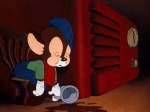
Sniffles Bells the Cat © Warner Bros.In the seventh of twelve Sniffles cartoons Sniffles suddenly has a number of lookalikes, who are as annoying as the title character himself.

In the opening scene we watch them all fleeing from a cat. When Sniffles wishes out loud that the cat should have a bell, the others immediately put him on the job.

Like other Sniffles cartoons, ‘Sniffles Bells the Cat’ is slow and pretty unfunny. Yet the chase scenes show some beautiful background art, emphasizing the vastness of the house for a little mouse like Sniffles. Moreover, Carl Stalling’s music is extraordinarily beautiful in this cartoon.

However, the cartoon is most important in the development of Jones’s mature style. Like in ‘Bedtime for Sniffles’ Jones excels in giving the cute little character a surprisingly broad range of emotions, especially when Sniffles realizes he has to tie the bell to the cat himself. This scene is the undisputed highlight of the cartoon and shows that even at this early stage Jones knew hardly an equal in handling facial expressions. The cat, too, is animated delightfully when he performs the old shell game with considerable deftness. These two scenes contain the seeds of more to come, and make the cartoon one of Sniffles’s best, despite its slugged pace.

Watch ‘Sniffles Bells the Cat’ yourself and tell me what you think:

‘Sniffles Bells the Cat’ is available on the Blu-Ray set ‘Looney Tunes Mouse Chronicles: The Chuck Jones Collection’

Director: Chuck Jones
Release Date: November 23, 1940
Stars: Sniffles
Rating: ★★★½
Review:

Bedtime for Sniffles © Warner Bros.This Christmas cartoon opens with a stunning scene in which the camera zooms over a winter village scene. ‘Bedtime for Sniffles’ may not be a ‘Pinocchio’, this is still a very atmospheric opening intro to the Christmas spirited cartoon.

Cut to Sniffles, who wants to stay awake until Santa comes. Unfortunately the radio plays a lullaby, drowsing our cute little hero.

Because this is a cartoon about the familiar problem of trying to stay awake despite a desire to sleep, this is a more entertaining short than most other Sniffles cartoons, and a great antecedent to the classic Tom & Jerry cartoon ‘Sleepy Time Tom’ (1951), which covers similar grounds. The animation of Sniffles’s eyes when he tries to stay awake, is priceless, and is an early showcase of Jones’s upcoming mastery of facial expressions. Sniffles’s reluctant walk into bed, too, points forward to Jones’s mature style.

Apart from this, ‘Bedtime for Sniffles’ excels in great background art, and lovely lay-outs, with delightful details, like a walnut functioning as a waste basket, and cigarette paper substituting for a towel.

Watch ‘Bedtime for Sniffles’ yourself and tell me what you think:

https://www.dailymotion.com/video/x3afe84

‘Bedtime for Sniffles’ is available on the Blu-Ray set ‘Looney Tunes Mouse Chronicles: The Chuck Jones Collection’

Director: Chuck Jones
Release Date: July 20, 1940
Stars: Sniffles
Rating:
Review:

The Egg Collector © Warner Bros.In the 1930s Frank Tashlin had made the most beautiful cartoons at Warner Bros. When Chuck Jones inherited his unit at the end of 1938, he too made the most beautiful shorts of all.

‘The Egg Collector’ is a prime example, with stunning background art, original camera angles (a clear Tashlin influence), great shading and excellent animation. However, unlike Tashlin’s cartoons, Jones’s were extremely slow. ‘The Egg Collector’, for example , moves at such a sluggish speed, one almost falls asleep while watching it.

The short stars the little mouse Sniffles, Jones’s very first returning character, and his friend, the bookworm from ‘Sniffles and the Bookworm’ (1939). They read in a book about egg collecting, and wish to collect an owl’s egg, not realizing that the fact that eats small rodents means it can possibly eat them. Thus they are on their way to a church nearby, where they soon discover the real nature of the barn owl. There’s little humor in this cute and boring cartoon, although the little owl’s hoots are very charming. The design of the little owl is exactly the same as the one in ‘Little Brother Rat‘.

Carl Stalling accompanies the church scenes with particularly solemn music, based on Felix Mendelssohn’s stage music for A Midsummernight’s Dream. His score rarely sounded so German as it does in this particular short.

Watch ‘The Egg Collector’ yourself and tell me what you think:

https://www.dailymotion.com/video/x3odk7v

‘The Egg Collector’ is available on the Blu-Ray set ‘Looney Tunes Mouse Chronicles: The Chuck Jones Collection’

Director: Dave Fleischer
Release Date: August 22, 1941
Stars: Hunky & Spunky
Rating:  ★
Review:

Vitamin Hay © Max Fleischer‘Vitamin Hay’ was the very last of the Color Classics, a series that arguably already had run out of steam by 1938.

‘Vitamin Hay’ seems to have appeared almost as an afterthought, being released almost a year after the second to last Color Classic, ‘You Can’t Shoe a Horsefly‘. Like the previous three Color Classic cartoons it starred the boring burro duo of Hunky and Spunky.

This time Spunky refuses to eat his ‘vitamin hay’, and joins a goat in eating car parts. When he swallows a car horn he gets into trouble with some angry geese, and Hunky, once again, has to come to the rescue.

Hunky and Spunky never were remotely interesting to watch, and certainly not fit for the more adult war era, so I doubt whether anyone missed them when they were shelved. ‘Vitamin Hay’, is a fitting farewell to the donkeys, being as tiresome and as devoid of humor as the worst of their previous cartoons. Luckily, the Fleischer had a new, more daring star with ‘Superman‘. Yet he, like Popeye, had not been conceived by themselves, leaving Koko the Clown and Betty Boop the Fleischer’s only two successful creations during the long existence of their studio.

In hindsight the Fleischers’ Color Classics were a disappointing series that never fulfilled their promise. They never approached the quality of their original, Disney’s Silly Symphonies’, and most entries were ill-fated attempts at emulating the Disney style, resulting in sugary, childish and terribly unfunny cartoons. It was clear that in this series the Fleischers tried to be something they were not. This was a pity, for the contemporary Popeye series proved that they needn’t to. In the Popeye cartoons the Fleischers could stay true to themselves, producing some of the best shorts of the 1930s, including several classics, where in my opinion the Color Classics produced none, bar the very first one, the Betty Boop vehicle ‘Poor Cinderella‘ (1934).

Watch ‘Vitamin Hay’ yourself and tell me what you think:

‘Vitamin Hay’ is available on the DVD set ‘Somewhere in Dreamland – Max Fleischer’s Color Classics: The Definitive Collection’

Director: Dave Fleischer
Release Date: August 23, 1940
Stars: Hunky & Spunky
Rating:  ★★½
Review:

You Can't Shoe a Horsefly © Max Fleischer‘You Can’t Shoe a Horsefly’ opens with a tired Hunky & Spunky laying themselves down to sleep.

Unfortunately, Spunky is soon troubled by a horsefly, who looks like a miniature winged horse and who sings the title song. The antagonism between Spunky and the horsefly, which even leads to a chase scene makes ‘You Can’t Shoe a Horsefly’ the most modern of the Hunky & Spunky cartoons, and the only one fitting the then emerging chase cartoon era. However, it’s still Hunky who has to come to the rescue, killing the horsefly and all his friends in one stroke.

Composer Sammy Timberg nicely intertwines the lullaby ‘Go to Sleep My Baby’ (which I know best as sung by Oliver Hardy in ‘Brats’ from 1930), into the soundtrack when the two donkeys are trying to sleep.

Watch ‘You Can’t Shoe a Horsefly’ yourself and tell me what you think:

‘You Can’t Shoe a Horsefly’ is available on the DVD set ‘Somewhere in Dreamland – Max Fleischer’s Color Classics: The Definitive Collection’

Director: Dave Fleischer
Release Date: July 19, 1940
Stars: Hunky & Spunky
Rating:  ★★★
Review:

Snubbed by a Snob © Max FleischerIn ‘Snubbed by a Snob’ Hunky & Spunky encounter a snobby race horse and his/her son.

Spunky wants to play with the young horse, who tries to get rid of the eager burro. At one point the foal eats too many apples and drinks too much water, and Spunky rescues him from an angry bull. So, in the end all’s well between the race horse and the burros.

‘Snubbed by a Snob’ is as boring as other Hunky & Spunky cartoons, but it’s rescued a little by the Cousin Louie gag, and the rather silly singing bull.

Watch ‘Snubbed by a Snob’ yourself and tell me what you think:

‘Snubbed by a Snob’ is available on the DVD set ‘Somewhere in Dreamland – Max Fleischer’s Color Classics: The Definitive Collection’

Director: Dave Fleischer
Release Date: May 17, 1940
Stars: Hunky & Spunky
Rating:  ★★½
Review:

A Kick in Time © Max FleischerThe last stage of the Fleischers’ Color Classics series was solely devoted to Hunky & Spunky, the donkey duo introduced in the eponymous cartoon from 1938.

When Betty Boop retired in 1939, the Fleischers were left without a star of their own (their biggest star Popeye was owned by King Features). Thus Hunky & Spunky, were promoted to be their top stars, together with Gabby from ‘Gulliver’s Travels‘ (1939) and the Stone Age characters, both introduced in 1940. None of these stars had any appeal, and they hardly stood a chance against contemporaries like Disney’s Donald Duck and Goofy, or Warner Bros.’ Porky Pig and Daffy. Nevertheless, Hunky and Spunky survived until 1941, starring seven cartoons in total.

In their fourth cartoon, ‘A Kick in Time’, Spunky is kidnapped and sold to an Italian rag collector, who irons the little burro. Spunky’s antics with the bit and irons are very reminiscent of Donald Duck’s problems with inanimate objects. However, as the bit and irons are clearly introduced as tools of torture, Spunky’s antics are painful to watch, not funny. Meanwhile Hunky seeks his/her son in the large city, and she saves his/her child in the nick of time from being crushed by an approaching streetcar.

There’s little to enjoy in ‘A Kick in Time’, but the cartoon is well animated by top animators Shamus Culhane and Al Eugster, and features quite elaborate human designs and realistic close ups of human hands. Moreover, the urban setting gives the cartoon a distinct character, absent in the other Hunky & Spunky cartoons.

Watch ‘A Kick in Time’ yourself and tell me what you think:

‘A Kick in Time’ is available on the DVD set ‘Somewhere in Dreamland – Max Fleischer’s Color Classics: The Definitive Collection’

Director: Sanae Yamamoto
Release Date: 1942
Rating:  ★★½
Review:

The Animal Village in Trouble © Sanae Yamamoto‘The Animal Village in Trouble’ tells the tale of three families: the monkeys, the bears and the raccoon dogs.

The monkeys’ family is very large, and hard to feed. But when a storm breaks out, it’s the only family that manages to protect its home. Moreover, the monkeys save the other two families from drowning. Is this a message to the audience to produce more offspring in times of war?

This film is essentially silent, with a voice over. The designs are quite elegant, and more clearly Japanese than usual in pre-war/wartime anime. The animation is mostly fair, with the storm scene in particular being quite spectacular. Also interesting is the occurrence of metamorphosis, a rarity in prewar/wartime Japanese animation: one raccoon dog transforms itself into an alarm clock, while another changes into a bridge at one point.

Sanae Yamamoto (1898-1981) came into prominence as an animator in the 1920s. In the 1950s he would join the Tōei animation studio, where he became supervising animator until his retirement in 1967.

Watch ‘The Animal Village in Trouble’ yourself and tell me what you think:

https://www.senscritique.com/film/Doubutsu_Mura_no_Daisodou/21070972

‘The Animal Village in Trouble’ is available on the DVD-box set ‘Japanese Anime Classic Collection’

Director: Yoshitaro Kataoka
Release Date: 1942
Rating:  ★★½
Review:

Sankichi the Monkey The Air Combat © Yoshitaro KataokaWith ‘Sankichi the Monkey: The Air Combat’ we’re clearly in propaganda area. The film’s motto says it all: “Protect our sky! The best defense is offense!”.

In the film the monkeys (Japan) are attacked by an air squadron of bears (Soviet Union). The monkeys shoot the bears out of the sky by the dozen, and win the day. But the film warns the audience: ‘There still are other enemies. We must protect our sky!”.

The film’s message, as if Japan were threatened by other nations and had to be aggressive out of defense, is sickening. When the film was released, in 1942, Japan was already the cruel occupier of most of South East Asia, an aggressor on a scale only matched by Nazi Germany.

‘Sankichi the Monkey: The Air Combat’ is a silent film, and the animation is poor and old-fashioned. In fact, the film looks like as if it had been made in 1929, not 1942. At least the short sheds a light on how the military government sold its actions to the Japanese public: with lies and seeds of fear. And while in 1945 the Soviet Union did declare war on Japan (on August 9, after the U.S. had dropped the atomic bomb on Hiroshima and Japan was on the brink of collapse), the Soviet air attack never materialized.

Watch ‘Sankichi the Monkey: The Air Combat’ yourself and tell me what you think:

‘Sankichi the Monkey: The Air Combat’ is available on the DVD-box set ‘Japanese Anime Classic Collection’

Director: unknown
Release Date: 1940
Rating:  ★★★½
Review:

Baby Kangaroo's Birthday Surprise‘Baby Kangaroo’s Birthday Surprise’ tells about the birthday of Kan-Chan, the youngest kangaroo in a family of five.

All goes well, until a hungry wolf arrives. The wolf eats all the food, and kidnaps Kan-Chan to eat him as well. The family comes to the rescue, aided by a troupe of moles, who dig a bunch of holes into the wolf’s hut. They taunt and finally bind him, so the family of kangaroos can reunite.

‘Baby Kangaroo’s Birthday Surprise’ is a silent film, but the animation is more advanced than in contemporary Japanese films, incorporating various lessons from Disney animation (squash and stretch, follow-through etc.). The wolf is clearly modeled on Disney’s wolf from ‘Three Little Pigs‘, and he’s animated best, probably because of the more sophisticated source material.

Watch ‘Baby Kangaroo’s Birthday Surprise’ yourself and tell me what you think:

‘Baby Kangaroo’s Birthday Surprise’ is available on the DVD-box set ‘Japanese Anime Classic Collection’

Director: Ikuo Ōishi
Release Date: 1939
Rating:  ★★
Review:

Swim, Monkey, Swim © Ikuo Ōishi‘Swim, Monkey, Swim’ tells about monkey, who learns to swim, and immediately joins a swimming contest.

The monkey wins by cheating, riding a ‘water imp’. In the end he succeeds in “cheating the others, but not his heart”.

‘Swim Monkey Swim’ is a primitive film, with the designs and animation looking like an Aesop Fable from the 1920s. Indeed, Ōishi was a Japanese animation pioneer, already making films in the 1910s. But if this film really was made 1939, it seems he had little learned since. The designs are nice and readable, but the film’s timing is too slow, rendering endless footage of the race. With its ten minutes the film is overlong and overstays its welcome.

Watch ‘Swim, Monkey, Swim’ yourself and tell me what you think:

‘Swim, Monkey, Swim’ is available on the DVD-box set ‘Japanese Anime Classic Collection’

Director: Unknown
Release Date: 1938
Stars: Mabō
Rating:  ★★★
Review:

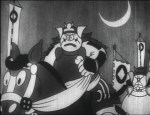
Mabō as Tokichiro Kinoshita © Satō Film Production Works‘Mabō as Tokichiro Kinoshita’ is the sixth of twelve Mabō films, produced by Satō Film Production Works.

Mabō is a young boy, and in this film he plays Kinoshita Tōkichirō, the legendary pseudonym of Toyotomi Hideyoshi, a 16th century Samurai warrior. The film reenacts some scenes from Hideyoshi’s life, most probably instantly recognizable for Japanese viewers, but, alas, not for us Westerners. Some of the reenactments involve modern warfare like machine guns and tanks, a clear sign of the ever growing militarization of Japanese society at the time, even invading children’s films like this.

The animation is a strange mix of 1920s animation and more modern techniques, and some of the battle scenes are most impressive. The designs even look forward to postwar anime. But none of the animation matches the dialogue, and lip synch is nowhere to be seen.

Watch ‘Mabō as Tokichiro Kinoshita’ yourself and tell me what you think:

‘Mabō as Tokichiro Kinoshita’ is available on the DVD-box set ‘Japanese Anime Classic Collection’

Director: Bob Clampett
Release Date: November 2, 1940
Stars: Porky Pig
Rating:  ★★★
Review:

The Sour Puss © Warner Bros.When Porky reads in the paper that fishing season will open the day after, he goes out fishing with his cat next day.

At the pond they encounter a flying fish (actually a marine species), which soon turns out to be as loony as Daffy Duck. The fish has the last laugh, imitating comedian Lew Lehr, saying “pussycats is the craziest people”.

‘The Sour Puss’ is a pretty run of the mill cartoon, and over before you know it. Porky has a modest role in a cartoon that’s actually devoted to his cat. Most interesting is the convincing animation of Porky in his rocking chair: one can see his body shift to move the chair. Also noteworthy are a bizarre shot in which Porky imitates a fish, a mussel with Popeye-like arms, and the cat’s over-joyous reaction to Porky’s promise of a fish dinner: he even kisses a mouse, which prompts a canary on committing suicide, saying ‘Now I’ve seen everything’. This last gag was repeated by a Pete Lorre-like fish in ‘Horton Hatches the Egg‘ (1942), while the Lew Lehr line reappeared in ‘Scaredy Cat‘ (1948).

Watch ‘The Sour Puss’ yourself and tell me what you think:

This is Porky Pig cartoon no. 79
To the previous Porky Pig cartoon: Prehistoric Porky
To the next Porky Pig cartoon: Porky’s Hired Hand

‘The Sour Puss’ is available on the DVD sets ‘Looney Tunes Golden Collection Volume Four’ and ‘Porky Pig 101’.

Director: Bob Clampett
Release Date: April 27, 1940
Stars: Porky Pig
Rating:  ★★½
Review:

Porky's Poor Fish © Warner Bros.Bob Clampett is one of the greatest ‘authors’ of the classic cartoon era, but not every cartoon he made was a winner. For example, ‘Porky’s Poor Fish’ is less than impressive.

‘Porky’s Poor Fish’ revisits a story idea that goes all the way back to the Silly Symphony ‘The Bird Store‘ (1932): a cat enters a pet store and when he catches one specimen, the other animals come to the rescue in a war-like reaction.

In Clampett’s film the bird store has changed in to a fish store, and the war scene involves a squadron of flying fish, a very silly hammerhead shark, and electric eels. There’s nothing special to the story, and the film’s charm and laughs lie exclusively in the abundance of puns, e.g. on holey mackerel and sole.

Watch ‘Porky’s Poor Fish’ yourself and tell me what you think:

https://www.dailymotion.com/video/x44gbro

This is Porky Pig cartoon no. 72
To the previous Porky Pig cartoon: Slap Happy Pappy
To the next Porky Pig cartoon: You Ought to Be in Pictures

‘Porky’s Poor Fish’ is available on the DVD sets ‘Looney Tunes Golden Collection Volume Four’ and ‘Porky Pig 101’.

Director: Paul Fennell?
Release Date: 1940
Stars: Gran’ Pop Monkey
Rating:  ★
Review:

Baby Checkers © Ub Iwerks‘Baby Checkers’ is the last of three surviving Gran’ Pop Monkey cartoons, a cut series made in the last days of the Ub Iwerks studio.

The cartoon copies the story of the first, ‘Beauty Shoppe‘, in that Gran’ Pop Monkey and his two grandsons try a new business. This time they try their luck with a baby nursery. The first day is highly successful, with countless mothers bringing in their babies. Unfortunately, Gran’ Pop Monkey’s system to remember which baby is whose, soon runs haywire, and causes much discomfort among the mothers at the end of the cartoon. In between all kinds of things go wrong, like feeding and bathing the baby animals.

Nowhere ‘Baby Checkers’ gets near being funny, even if the short makes more sense than ‘A Busy Day‘. The action remains tiresome, the story is disjointed, and the grand finale anything but that. The terrible voice acting and erratic designs don’t help either, and like in the other two Gran’ Pop Monkey cartoons, only the musical score is of a high quality. This, of course, wasn’t enough, and although the reasons are unknown, the series was justly abandoned.

‘Baby Checkers’ has only survived in a black and white copy, which is available on the DVD ‘Cultoons! Rare, Lost and Strange Cartoons! Volume 3: Monkeys, Monsters & More!’

Director: Paul Fennell?
Release Date: 1940
Stars: Gran’ Pop Monkey
Rating:  ★
Review:

A Busy Day © Ub Iwerks‘A Busy Day’ is the second of three surviving Gran’ Pop Monkey cartoons, and arguably the worst of the trio.

The short starts excellently enough, with a rhythmical start of the day, with sound effects, music and images being in perfect harmony to evoke a bright and promising morning. However, this sequence is discarded all too soon, when we cut to Gran’ Pop Monkey, who’s still in bed. His two grandsons awake him, and we watch the trio on a working day in their office on a high tree in the jungle.

This setting itself strains the believability of the cartoon, but worse, from that point on, things just start happening on the screen. Somehow, they involve some sneezing by Gran’ Pop Monkey, but otherwise nothing makes sense. In the end of the cartoon an exhausted Gran’ Pop Monkey ends up in bed again, and we, as an audience, are glad that this endless cartoon is over, even if it’s only seven minutes long.

Watch ‘A Busy Day’ yourself and tell me what you think:

‘A Busy Day’ is available on the DVD ‘Cultoons! Rare, Lost and Strange Cartoons! Volume 3: Monkeys, Monsters & More!’

Director: Paul Fennell?
Release Date: 1940
Stars: Gran’ Pop Monkey
Rating:  ★★½
Review:

Beauty Shoppe © Ub IwerksThe Gran’ Pop Monkey cartoon were made during the aftermath of the Ub Iwerks studio (then called Cartoon Films, LTD), just before Iwerks sold the studio and went back to Disney himself.

The character Gran’ Pop Monkey was based on illustrations by British artist Lawson Wood (1878-1957), and in 1939 the studio announced it would make 24 cartoons with the character. However, only three are known today, which were all three released in 1940. In fact, as Yowp notices in his comment to Steve Stanchfield’s informative blog post on this cartoon, these three had already been finished by the end of 1938, so perhaps these were the only ones ever made. In any case, it remains unclear why the series was discontinued, but one thing is certain: they are far from classics.

All three Gran’ Pop Monkey cartoons were shot in Cinecolor, a 2-color system, lacking the vibrant color range of Technicolor, and although the animation is fair, the stories, the designs, voices and gags are not, and the three films make a tiresome watch. In fact, the most enjoyable part of these three cartoons is their excellent musical score.

The first, ‘Beauty Shoppe’ is arguably the best of the surviving trio. In this short Gran’ Pop Monkey is a barber, helped by his two grandsons (who look like macaques, while Gran’ Pop Monkey clearly is a chimpanzee). Business isn’t going well, however, in contrast to that of the beauty salon across the street (the film takes place in a jungle, but anyway). So, one of the grandson suggests to copy the salon’s formula. Soon, female animals rush into Gran’ Pop Monkey’s cabin-turned-beauty salon (including a colorful company of a badger, a penguin, a seal, a pig and a kangaroo). When a gangster-like gorilla demands they make his wife, a hippo, beautiful, things turn very bad for the trio, indeed. Curiously, ‘Beauty Shoppe’ starts with some dialogue in rhyme, which is discarded halfway.

Watch ‘Beauty Shoppe’ yourself and tell me what you think:

‘Beauty Shoppe’ is available on the DVD ‘Cultoons! Rare, Lost and Strange Cartoons! Volume 3: Monkeys, Monsters & More!’

Director: Dave Fleischer
Release Date: August 30, 1940
Stars: Popeye, Olive Oyl
Rating:  ★★★
Review:

Puttin on the Act © Max Fleischer‘Puttin on the Act’ reveals that Popeye and Olive had been a vaudeville duo once.

The short opens with Olive running to Popeye, full of joy, because she has read in the newspaper that vaudeville is coming back. This would be a surprise, as already during the 1920s vaudeville had gone into a steady decline, due to radio, film, and jazz.

But Olive and Popeye immediately revive their old routines in their own home. Most fun is Popeye doing impersonations, imitating Jimmy Durante, Stan Laurel and Groucho Marx (using some of Marx’s best quotes). Their routine ends with ‘The Adagio’, an acrobatic act that is very similar to the one by Horace Horsecollar, Clarabelle Cow and Goofy in ‘Orphan’s Benefit‘ (1935), proving this was a staple act in vaudeville. At the end of the cartoon, unfortunately, it’s revealed that Olive’s newspaper had been from 1898…

‘Puttin on the Act’ is nice piece of nostalgia. Most of the animators and story artists of the time had grown up in the vaudeville era, and this cartoon is a homage to a form of entertainment long lost since.

Watch ‘Puttin on the Act’ yourself and tell me what you think:

This Popeye film No. 86
To the previous Popeye film: Wimmin Hadn’t Oughta Drive
To the next Popeye film: Popeye Meets William Tell

‘Puttin on the Act’ is available on the DVD set ‘Popeye the Sailor Volume Two’


Director: Dave Fleischer
Release Date: August 2, 1940
Stars: Popeye, Swee’Pea
Rating:  ★★★½
Review:

Doing Impossikible Stunts © Max Fleischer‘Doing Impossikible Stunts’ is a cheater, a.k.a. a compilation cartoon. Yet within this genre, this short is a nicely told one.

In this cartoon Popeye heads for ‘Mystery Pictures, Inc.’ , to apply as a stunt man. He has brought with him some footage of his stunt work. Little Swee’Pea follows him, and at one time swaps Popeye’s footage for his own, gaining the job.

Popeye’s films are excerpts from ‘I never Changes My Altitude’ (1937), ‘I Wanna be a Lifeguard’ (1936) and ‘Bridge Ahoy’ (1936), and Swee’Pea’s is from ‘Lost and Foundry’ (1937).

The film company’s slogan, ‘If it’s a good picture, it’s a mystery’ echoes a similar gag involving Wonder pictures, in ‘Daffy Duck in Hollywood‘ (1938).

Watch ‘Doing Impossikible Stunts’ yourself and tell me what you think:

https://www.dailymotion.com/video/x3plrdp

This Popeye film No. 84
To the previous Popeye film: Fightin Pals
To the next Popeye film: Wimmin Hadn’t Oughta Drive

‘Doing Impossikible Stunts’ is available on the DVD set ‘Popeye the Sailor Volume Two’

Director: Dave Fleischer
Release Date: July 12, 1940
Stars: Popeye, Bluto
Rating:  ★★★½
Review:

Fightin Pals © Max Fleischer‘Fightin Pals’ is a cartoon devoted to the love-hate relationship between Popeye and Bluto. 

The short opens with Dr. Bluto boarding a ship for an African Expedition. Popeye and Bluto show their own tough way of saying goodbye, but as soon as Bluto has left, Popeye starts pining for his rival. Thus, when he hears on the radio Bluto has been lost, he himself sails straight into dark Africa to look for his lost pal. Soon, Popeye is in a bad state himself, and when he finally discovers Bluto, who is pampered by some beautiful natives, it’s Bluto who has to revive him by giving the poor sailor spinach. As soon as Popeye is on his feet, the two immediately resume their happy quarrel again.

‘Fightin Pals’ is a beautiful cartoon on friendship. Jack Mercer’s mumbling is particularly inspired in this cartoon. The short also shows a brief World War II reference: when Popeye sails passes Europe he encounters some violent fighting there.

After ‘Fightin Pals’ it looks as if Bluto stayed in Africa, for he was not seen in any Popeye cartoon for almost two years. He returned to the screen in ‘Olive Oyl and Water Don’t Mix’ (1942), this time to stay.

Watch ‘Fightin Pals’ yourself and tell me what you think:

https://www.dailymotion.com/video/x3plr1w

This Popeye film No. 83
To the previous Popeye film: Nurse-Mates
To the next Popeye film: Doing Impossikible Stunts

‘Fightin Pals’ is available on the DVD set ‘Popeye the Sailor Volume Two’
Enter your email address to follow this blog and receive notifications of new posts by email.

Join 915 other subscribers
Bookmark and Share

Categories