Director: unknown
Release Date:
 August 13, 1932
Stars: Flip the Frog
Rating: ★★★★★♕
Review:

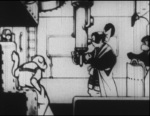
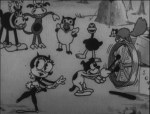
Room Runners © Ub Iwerks‘Room Runners’ starts with Flip trying to sneak out of his apartment block to escape six months of arrears. Unfortunately, he’s discovered by the landlady, and a long chase starts, which also involves a policeman and a running gag of a man with a tooth ache.

‘Room Runners’ takes the eroticism introduced in ‘The Office Boy‘ to heights that even surpass the sexual references in Fleischer’s Betty Boop cartoons. Already in the first scene we watch a young lady (the secretary from the previous cartoon) wandering in her night gown. Flip then runs into a bathroom, where a naked woman takes a shower, and he spies on naked ladies twice. Finally, the landlady falls into a painting of a naked woman, with bare breasts.

The cartoon is gag packed, but the animation is erratic, and the visual language sometimes straight from the silent era – something typical of the mid-1932 Flip the Frog cartoons. Both this strange mix of styles and its strong erotic content make ‘Room Runners’ a unique short. If you can watch only one Flip the Frog cartoon, this one should be it.

Watch ‘Room Runners’ yourself and tell me what you think:


This is Flip the Frog cartoon No. 24
To the previous Flip the Frog cartoon: The Office Boy
To the next Flip the Frog cartoon: Stormy Seas

‘The Office Boy’ is available on the DVD Cartoons that Time Forgot – The Ub Iwerks


Director: unknown
Release Date:
 July 16, 1932
Stars: Flip the Frog
Rating: ★★★★★
Review:

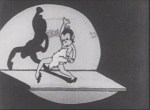
The Office Boy © Ub IwerksIn ‘The Office Boy’ Flips applies to be an office boy, and he’s hired on the post, after he has washed away all his competitors with a fire hose.

Once at work he accidentally starts a record player, and he and the sexy secretary start to dance to some rumba music. Later, a cat and a mouse cause havoc, leading to the secretary losing her dress, and Flip being fired.

‘The Office Boy’ is a gag-packed cartoon, the best of which is the one with a face Flip paints on a dirty window. Flip’s voice is remarkably Mickey Mouse-like in this cartoon, but most of the humor would not fit Mickey, at all, as many gags involve the sexy secretary, repeatedly revealing her underwear.

The secretary would be used again in Flip’s next cartoon, ‘Room Runners‘, which is even more erotic. The secretary is also shown chewing bubble gum, in one of the first animated depictions of this 1928 invention (another contender is the Mickey Mouse film ‘Barnyard Olympics‘ from April).

The erotic secretary seems proof that Iwerks wanted to compete with Fleischer’s sensual Betty Boop cartoons. However, it may also be an example of an increased amount of sex references employed by Hollywood in 1932 in general, for a stronger sexual content can also be noted in live action movies from the era.

This higher level of eroticism in Hollywood cinema remained extant until 1934, when the Hays code kicked in with a vengeance, and the tables were turned exactly the other way: for most of the 1930s cartoons often became ridiculously goody-goody and childish, reaching a low point around 1935/1936.

Watch ‘The Office Boy’ yourself and tell me what you think:

This is Flip the Frog cartoon No. 23
To the previous Flip the Frog cartoon: The Bully
To the next Flip the Frog cartoon: Room Runners

‘The Office Boy’ is available on the DVD Cartoons that Time Forgot – The Ub Iwerks Collection Vol. 2

Director: unknown
Release Date:
 June 18, 1932
Stars: Flip the Frog
Rating: ★★★★
Review:

The Bully © Ub Iwerks‘The Bully’ is a Flip the Frog featuring Flip’s little human child friend from ‘The Milkman‘ and ‘What a Life‘. However, unlike those two cartoons it’s not sentimental, but a gag-packed cartoon.

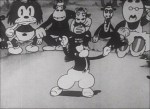
When a bully destroys the child’s balloon with his cigar, Flip and him start a fight. A passer-by suggests they continue their fight in the ring, which leads to a long boxing match scene that belongs to the most entertaining of the era, outplaying the similar ‘The Robot‘ (Fleischer, 1932) and ‘Mickey’s Mechanical Man‘ (1933), not in the least because Flip has to face the bully himself instead of letting a robot doing the work for him. The boxing scene is even more interesting than the one in the Laurel & Hardy short ‘Any Old Port’ from three months earlier, which is a more valid comparison.

The highlight of the fight is the knockout in which the bully hits Flip into orbit around the earth only to get floored by Flip falling on his head. The boxing match features some interesting and very vivid backgrounds of constantly moving spectators. It also features strong stereotypes of Afro-Americans and a homosexual.

At this point in Iwerks’s career his studio could produce cartoons with strong stories consisting of a continuous string of gags. In 1932 only Disney could tell more consistent stories. Unfortunately, the studio’s cartoons were hampered by silent era visual language, erratic animation, inconsistent designs and sloppy timing. In other words, Iwerks’s style was as modern as it was old-fashioned.

Watch ‘The Bully’ yourself and tell me what you think:

This is Flip the Frog cartoon No. 22
To the previous Flip the Frog cartoon: School Days
To the next Flip the Frog cartoon: The Office Boy

‘The Bully’ is available on the DVD Cartoons that Time Forgot – The Ub Iwerks Collection Vol. 2
 

Directors: Yasuji Murata & Chuzo Aoji
Release Date: 1932
Rating:
★★
Review:

Sports Day at Animal Village © Yasuji Murata & Chuzo Aoji‘Sports Day at Animal Village’ is one of several sports cartoons Aoji and Murata made together (earlier examples are ‘Our Baseball Match’ and ‘Animal Sumo’ from 1931).

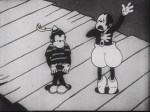
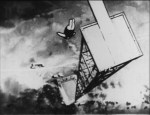
In this film we watch several sports events: monkeys turning, a judo match between a tiger and a lion, several polar bears and a hippo diving, a boxing match between a pig and a kangaroo, and finally, a tug-of-war between an elephant and numerous other animals.

There’s pretty little to enjoy in this lighthearted film, but it contains one nicely staged scene of a polar bear diving from a ridiculously high platform. However, the best animation is found in the tug-of-war scene, in which Murata manages to put a real sense of weight and muscle tension.

Watch ‘Sports Day at Animal Village’ yourself and tell me what you think:

‘Sports Day at Animal Village’ is available on the Japanese DVD Box Set ‘Japanese Anime Classic Collection’.

Directors: Yasuji Murata & Chuzo Aoji
Release Date:
 1932
Stars: Momotaro
Rating:
Review:

Momotaro's Underwater Adventure © Chuzo AojiAfter ‘Momotaro’s Sky Adventure‘ Aoji and Murata send Japan’s folk hero off in a military submarine to fight a large shark.

Like in his earlier film Momotaro is asked by others to do that, and the film vaguely seems to glorify the navy, even though it’s much less successful in doing so than Momotaro’s earlier nationalist film was for the air force: the film runs rather short, Murata’s 1920s style animation is not particularly exciting or convincing, and for today’s audiences it’s quite unsettling to watch the hero fighting a large fish with a surplus of warfare, including numerous torpedoes. The Japanese clearly had less difficulties with this slaughter. In any case, the hero, and his friends Monkey and Dog (Crane couldn’t join them as he can’t swim) are awarded as heroes at the end of the cartoon.

Watch ‘Momotaro’s Underwater Adventure’ yourself and tell me what you think:

‘Momotaro’s Underwater Adventure’ is available on the Japanese DVD Box Set ‘Japanese Anime Classic Collection’.

Director: Wilfred Jackson
Release Date:
 June 8, 1932
Stars: Mickey Mouse, Minnie Mouse, Pluto
Rating: ★★½
Review:

Musical Farmer © Walt DisneyIn this film Mickey and Minnie are farmers, which makes the film a little like a remake of ‘The Plow Boy‘ (1929).

First we watch Mickey planting seeds with help from Pluto, and Minnie milking a cow. Then Mickey decides to scare Minnie by stepping inside the scarecrow. A string of gags leads to Mickey playing the bagpipes on three geese. This starts a musical number, which is almost Silly Symphony-like in its directionless musical fun at the barnyard. We watch cows, lamb, ducks, pigeons, turkeys and chickens moving and dancing to the tune of Turkey in the Straw.

But then we cut to several chickens laying multitudes of eggs, except for poor Fanny. At this point suddenly a story develops, with Fanny laying an enormous egg, which attracts a lot of attention from her fellow chickens, the other animals, and finally, Mickey. Mickey rushes to bring his camera to make a picture of it, but unfortunately, he uses too much flash light powder, and everything explodes. This final gag was also used by Floyd Gottfredson in the Mickey Mouse comic strip, published on March 13, 1932.

‘The Musical Farmer’ is one of the weaker Mickey Mouse films of 1932. Like e.g. ‘Mickey Cuts Up‘ and ‘The Grocery Boy‘ it’s uses the part-musical-number-part-frantic-finale-formula, but by mid-1932 shots of dancing animals had become a bit tiring and old-fashioned. Moreover, Fanny’s story feels a little out of place, and I suspect that part of this film was intentionally designed as a Silly Symphony, which apparently never really took off.

Watch ‘Musical Farmer’ yourself and tell me what you think:

This is Mickey Mouse cartoon No. 42
To the previous Mickey Mouse cartoon: Mickey’s Revue
To the next Mickey Mouse cartoon: Mickey in Arabia

‘Musical Farmer’ is available on the DVD ‘Walt Disney Treasures: Mickey Mouse in Black and White Volume Two’

Director: Boyd La Vero
Release Date:
 1932
Stars: Marty the Monk
Rating:
Review

Mexican Lilly © Associated Films‘Mexically Lilly’ is the last of three known Marty the Monk cartoons.

Like Marty’s previous cartoon, ‘Mere Maids‘, it opens with live action footage of Boyd La Vero himself, but this time, the cartoon is a complete original, even though it thematically covers similar grounds as ‘The Cactus Kid’ (Walt Disney, 1930) and ‘Hot Tamale’ (Van Beuren, 1930).

‘Mexican Lilly’ thus is a classic Western cartoon. It starts with Marty riding horseback, being followed by a bunch of thugs(?). He escapes to Mexico, where he visits a canteen. There he encounters another villain, but he’s rescued by a fan dancer, who takes him to her bedroom, where she – believe it or not – strips before Marty’s very eyes. She leaves Marty to perform a risque fan dance. But then the thugs appear, and in a dark gun fight, everyone gets killed but Marty, the fan dancer, and the Mexican villain, who runs into the distance, naked.

‘Mexically Lily’ makes a little more sense than Marty’s first two films, but the animation remains crude and erratic. Unfortunately, Steve Stanchfield’s copy is rather poor, and devoid of sound, which was recreated, with okay results. The film was to be Marty’s last known screen appearance. I’m sorry to say that he will not be missed.

‘Mexically Lilly’ is available on the DVD ‘Cultoons! Rare, Lost and Strange Cartoons! Volume 3: Monkeys, Monsters & More!’

Director: Boyd La Vero
Release Date:
 1932
Stars: Marty the Monk
Rating:
Review

Mere Maids © Associated Films‘Mere Maids’ is the second of three known Marty the Monk cartoons.

The short opens interestingly enough with Boyd La Vero sitting at his desk, working. We then cut to Marty, who drives to his sweetie’s house to drive her to ‘Parade Grounds’. But wait! Marty’s first cartoon, ‘Marty the Monk‘, took place there, too! Indeed, from that scene on, practically every scene is reused from the first cartoon, here and there with mild alterations in timing and gag development.

I’ve never before seen such blatant self-plagiarism: as if La Vero wanted to remake his own cartoon immediately. Unfortunately, the second attempt is as bad as the first one, and would in no way have a better chance to propel Marty’s career forward.

‘Mere Maids’ is available on the DVD ‘Cultoons! Rare, Lost and Strange Cartoons! Volume 3: Monkeys, Monsters & More!’

Director: Boyd La Vero
Release Date:
 1931
Stars: Marty the Monk
Rating:
Review

Marty the Monk © Associated FilmsThe work of Steve Stanchfield from Thunderbean Animation cannot be praised enough. His tireless work to unravel lost or forgotten animation films from the golden age has resulted in many great finds. Many of the films discussed on this blog can be found on Thunderbean Animation DVDs only.

However, there are times when Steve Stanchfield unravels something that is hardly worth unraveling. Boyd La Vero’s Marty the Monk series is one of those. The series, made for Associated Films, apparently only comprised three known episodes. These three shorts are typical products of the rubberhose animation era, but they are all hampered by erratic storytelling, poor animation, slow timing and hardly any sense of gravity.

In the first cartoon we watch several animals, including Marty, riding a streetcar to ‘Parade Grounds’, where Marty starts to conduct an orchestra, while a fashion show of bathing beauties is going on. One of the beauties is a female monkey, and the two dance together in what’s the only interestingly animated scene of the entire cartoon. Next there’s a diving contest, and the female monkey falls into the pond, to be rescued by Marty or is she?

There’s extremely little to enjoy in ‘Marty the Monk’, and to me it’s no wonder the character and his maker are forgotten today. So, who was Boyd La Vero? I have no idea. The only person telling us something on the internet is historian David Gerstein, who reveals that animator Cal Dalton (of later Warner Bros. fame) worked for him… Perhaps he can tell us a little bit more?

‘Marty the Monk’ is available on the DVD ‘Cultoons! Rare, Lost and Strange Cartoons! Volume 3: Monkeys, Monsters & More!’

Directors: John Foster & George Stallings
Release Date:
 July 23, 1932
Stars: Tom and Jerry
Rating: ★★★
Review

Redskin Blues © Van BeurenImmediately after having insulted the black part of the population in ‘Plane Dumb‘, Tom and Jerry turned their attention to the native Americans.

‘Redskin Blues’ opens without delay: Tom & Jerry are riding a stage coach, surrounded by Indians on horseback. The fight is severe, and soon their coach is destroyed completely. Tom & Jerry manage to escape to the top of a large cliff, but the Indians use their feathers to fly(!) after them. Soon Tom & Jerry are captured and tied to stakes. But with their feet the two play a lively xylophone tune on the wood surrounding them, prompting a dance scene.

When Jerry blows a horn for help, the cavalry arrives, and the navy, and the air force, and a battalion of tanks. Needless to say, the Indians flee, but a Buffalo Bill-like type catches the chief, who turns out to be Jewish and who scares everyone away with a single mouse.

‘Redskin Blues’ is a fast, and action packed cartoon. The rescue scene is one of the most inspired gags within the complete series, and would prompt similar scenes in the Marx Brothers film ‘Duck Soup’ and the Fleischer cartoon ‘Betty Boop’s Big Boss‘ (both 1933). Nevertheless, the film’s highlight is a short sequence during the dance scene in which some sexy squaws dancing in a circle.

Watch ‘Redskin Blues’ yourself and tell me what you think:

This is Tom & Jerry cartoon No. 13
To the previous Tom & Jerry cartoon: Plane Dumb
To the next Tom & Jerry cartoon: Jolly Fish

‘Redskin Blues’ is available on the DVD ‘The Complete Animated Adventures of Van Beuren Studio’s Tom and Jerry’

Directors: John Foster & George Rufle
Release Date:
 June 25, 1932
Stars: Tom and Jerry
Rating:
Review

Plane Dumb © Van Beuren‘Plane Dumb’ opens with Tom & Jerry on a non-stop flight to Africa.

Jerry is worried they’ll not be safe in Africa, so, to be sure, they change themselves into blackface. But immediately afterwards their plane crashes into the sea, as if the blackface had taken away their ability to fly! At sea Tom & Jerry are bothered by an equally blackfaced octopus, some sharks and a large whale, which throws them onto the African shore. There they encounter some fantasy monsters (recalling the Waffles & Don short ‘Jungle Jazz‘ from 1930), a gospel quartet of black skeletons, and finally several cannibals, who chase them away. Iris out.

Unlike any other Van Beuren film, ‘Plane Dumb’ is extremely dialogue-rich. In fact, it’s quite possibly the most dialogue-rich cartoon of the early 1930s. As soon as they’re blackfaced, Tom & Jerry start to talk in fake negro speak. Of course, as the duo is heading to Africa, this makes no sense at all – it only adds to the ignorant racism that completely fills this short. Moreover, one soon forgets that these characters had been Tom & Jerry in the first place.

Tom & Jerry’s dialogue is very reminiscent of Amos ‘n’ Andy, the popular fake black radio stars of the time. The cartoon stars’ trite conversation was supposed to be the sole source of the humor in the cartoon, making ‘Plane Dumb’ the first animated cartoon ever to rely on dialogue. Rarely there was such a strange combination of innovation and backward thinking.

The dependence on dialogue makes the short a failure by all means, as none of it is remotely funny; not only by today’s standards, but also by those of 1932 itself, as the short only received a lukewarm welcome at the time.

Nevertheless, in 1934 Van Beuren produced two cartoons featuring the “real” Amos ‘n’ Andy. Neither of the two were a success. Van Beuren might have known, if he had remembered ‘Plane Dumb’ well…

‘Plane Dumb’ arguably one of the most racist cartoon ever released. It’s so full of severe racial stereotypes, it’s practically unwatchable, today. The short’s only highlight may be in the animation of the whale, which has some menacing quality.

Watch ‘Plane Dumb’ yourself and tell me what you think:

This is Tom & Jerry cartoon No. 12
To the previous Tom & Jerry cartoon: The Tuba Tooter
To the next Tom & Jerry cartoon: Redskin Blues

‘Plane Dumb’ is available on the DVD ‘The Complete Animated Adventures of Van Beuren Studio’s Tom and Jerry’

Directors: John Foster & George Stallings
Release Date:
 June 4, 1932
Stars: Tom and Jerry
Rating: ★★★
Review

The Tuba Tooter © Van BeurenIn ‘The Tuba Tooter’ Schultz, a tuba player, returns to his homeland Germany, accompanied by his yodeling Dachshund Fritz.

This event is heralded by Tom & Jerry, which fills everyone and everything with joy, including inanimate objects like sausages and cheese(!). Have you ever seen cheese being enthusiastic? Here’s your chance! Soon the whole town is singing and dancing to Schultz’s oompah music, and yes, this includes the buildings themselves. But then the police arrives and arrests Schultz…

‘Tuba Tooter’ is a very joyous cartoon, but also rather empty and nonsensical. After all, Schultz’s arrival is actually the only event in the whole cartoon. The animation is erratic, and at times very poor. Worth of mention is a very risque, yet rather freaky scene of two young women dancing in their underwear.

Watch ‘The Tuba Tooter’ yourself and tell me what you think:

This is Tom & Jerry cartoon No. 11
To the previous Tom & Jerry cartoon: Pots and Pans
To the next Tom & Jerry cartoon: Plane Dumb

‘The Tuba Tooter’ is available on the DVD ‘The Complete Animated Adventures of Van Beuren Studio’s Tom and Jerry’

Directors: John Foster & George Rufle
Release Date:
 May 14, 1932
Stars: Tom and Jerry
Rating: ★★★★
Review:

Pots and Pans © Van BeurenIn ‘Pots and Pans’ Tom & Jerry own a mobile canteen.

The cartoon is completely plotless, but very spirited and gag rich, making it one of the best of the Van Beuren Tom & Jerries. It uses a jazzy score, around a close harmony quartet of soup eating customers. Everything joins in, even many objects like kettles and sausages – for this is one of those early 1930’s cartoons in which everything can grow hands and feet. At the end, the wagon suddenly takes off, ends on the rails and clashes with a train.

The cartoon is reminiscent of contemporary Fleischer cartoons, and anticipates their ‘Betty Boop Bizzy Bee‘ from three months later, which covers similar grounds.

Watch ‘Pots and Pans’ yourself and tell me what you think:

This is Tom & Jerry cartoon No. 10
To the previous Tom & Jerry cartoon: Joint Wipers
To the next Tom & Jerry cartoon: The Tuba Tooter

‘Pots and Pans’ is available on the DVD ‘The Complete Animated Adventures of Van Beuren Studio’s Tom and Jerry’

Director: Rudolf Ising
Release Date:
 May 14, 1932
Rating: ★★★
Review:

It's Got Me Again © Warner Bros.‘It’s Got Me Again!’ finds Harman and Ising at their most Disney-like. This Merrie Melodie is very similar to contemporary Silly Symphonies.

The short features a mouse entering a musical instrument shop at night. The music starts when the mouse accidentally starts the title song on a gramophone. This invites several other mice to join in. After four minutes of musical frolicking a mean cat appears who gets one mouse cornered, prompting the rodent to sing the title track. The other mice, however, come to the rescue and together they get rid of the cat.

The story of ‘It’s Got Me Again!’ is very similar to that of contemporary Disney shorts ‘The Spider and the Fly‘ or ‘The Bird Store‘, but the short’s premise is most akin to the Van Beuren short ‘Toy Time‘ from four months earlier. ‘It’s Got Me Again!’ is much more sophisticated than the Van Beuren short, though. The animation, by Friz Freleng and Tom McKimson, is excellent throughout, and second only to the Disney studio itself.

The mice are Mickey Mouse but in size, only, and the musical routine involves a French Apache dance, as can also be found in ‘Mickey’s Follies‘ (1929) and the later ‘Woodland Cafe‘ (1937). Harman & Ising’s mimicking paid off, as ‘It’s Got Me Again!’ was among the three very first animated shorts to get an Academy Award nomination. Yet, it’s no surprise it lost to Walt Disney’s landmark cartoon ‘Flowers and Trees‘.

Watch ‘It’s Got Me Again!’ yourself and tell me what you think:

‘It’s Got Me Again!’ is available on the Blu-Ray ‘Looney Tunes Platinum Collection: Volume 2’ and the DVD ‘Looney Tunes Golden Collection Volume Three’

Director: Dave Fleischer
Release Date: August 5, 1932
Stars: Betty Boop, Rudy Vallee
Rating: ★★½
Review:

Rudy Vallee Melodies © Max Fleischer‘Rudy Vallee Melodies’ is a Screen Song with Rudy Vallee singing no less than three different songs: the sentimental ballads ‘Deep Night’ and ‘A Little Kiss Each Morning’, and the lively college song ‘Stein Song’.

This Screen Song is interesting for its particularly long cartoon introduction: there’s a party at Betty Boop’s large mansion, where she serves punch to her guests. There’s a bunny who plays the piano by ear (literally). He plays ‘Silver Threads Among the Gold’ on the piano, but when Betty proposes to accompany someone on the piano, none of her guests dares to sing. Not even Perceval, a clear homosexual stereotype, who says ‘count me out’, before being knocked down and counted out, literally.

Luckily for Betty Boop, Rudy Vallee helps her out from the sheet music. He performs his three songs, with images of a river, loving couples and a football match, respectively. After these songs, Betty and the gang thank him, and all the guests leave. The cartoon ends with Vallee singing ‘Goodnight Sweetheart’ to Betty in her bedroom.

Because of its long intro, ‘Rudy Vallee Melodies’ almost feels like a Betty Boop cartoon, and indeed it was later colored and released as such, without the Rudy Vallee parts.

Watch ‘Rudy Vallee Melodies’ yourself and tell me what you think:

‘Rudy Vallee Melodies’ is available on the French DVD Box Set ‘Betty Boop Coffret Collector’

Director: Dave Fleischer
Release Date: July 29, 1932
Stars: Betty Boop, Ethel Merman
Rating:
Review:

You Try Somebody Else © Max Fleischer‘You Try Somebody Else’ is a screen song with Ethel Merman featuring the rather sentimental title song.

The cartoon opens with a cat being released from prison. He immediately sneaks into a house, emptying a fridge and almost eating a fish, the fish’s wife and his children. But then the owner enters, who turns out to be Betty Boop with a shotgun.

Soon the cat is back in prison again, where he reads the newspaper, with the picture of Ethel Merman in it, who immediately starts singing. The second chorus is accompanied by several prison gags, culminating in a jailbreak. In the end we watch four escaped convicts singing the song in a streetcar, all on electric chairs…

‘You try Somebody Else’ is a typical, yet mediocre Screen Song. Despite Betty Boop’s short cameo in the introduction, the second chorus is the most interesting part to watch, with its combination of silly and morbid gags.

Watch ‘You try Somebody Else’ yourself and tell me what you think:

‘You try Somebody Else’ is available on the French DVD Box Set ‘Betty Boop Coffret Collector’

Director: Dave Fleischer
Release Date: April 29, 1932
Stars: Betty Boop, Bimbo, Koko the Clown
Rating: ★★½
Review:

A Hunting We Will Go © Max Fleischer‘A Hunting We Will Go’ is one of the lesser inspired Talkartoons.

In fact, the short’s greatest gag is in its opening scene, when the sun inhales smokes from a log cabin, which makes it sneeze.

We then cut to the inside of the log cabin, where we watch Betty Boop singing the 1925 hit song ‘Then I’ll Be Happy’. As she sings she’ll be happy with a fur coat, Koko and Bimbo immediately set off to go hunting animals. Koko first encounters the worst drawn deer to be found on the animated screen. Unfortunately, the deer shoots back. Then Koko helps a leopard (not quite indigenous to North America) to its spots.

Bimbo, meanwhile, meets a pack of ferocious lions (sure, why not?) and a huge bear. Despite their mishaps, they both return with many furs, but Betty returns them to the former owners, who are staying in line outside, shivering with cold…

When compared to contemporary Talkartoons ‘Chess Nuts‘ and ‘Minnie the Moocher‘ ‘A Hunting We Will Go’ is a disappointing entry. It’s rather low on gags, and its surreal aspects are sparse. It’s not as weak as ‘The Robot‘ or ‘Admission Free‘, but still far from a classic.

Watch ‘A Hunting We Will Go’ yourself and tell me what you think:

This is Talkartoon No. 38
To the previous Talkartoon: Chess Nuts
To the next Talkartoon: Hide and Seek

‘A Hunting We Will Go’ is available on the French DVD Box Set ‘Betty Boop Coffret Collector’

Director: Dave Fleischer
Release Date: April 13, 1932
Stars: Betty Boop, Bimbo, Koko the Clown
Rating: ★★★★★
Review:

Chess Nuts © Max Fleischer‘Chess Nuts’ is by all means one of the Fleischers’ most original Talkartoons.

The cartoon’s setting is a chess game, and it opens with two live action players playing the game. The ashes of the cigar of one of the players falls down on the black queen, revealing it to be Betty Boop, while Bimbo appears to be the white king. Then there’s a cut to a short stop motion sequence of the pieces moving across the board. Only then we really enter the chess world.

In this chess world the black king or ‘Old King Cole’ (the dirty old man of ‘Mask-a-Raid‘ from 1931) tries to force queen Betty to love him, but king Bimbo saves her from his clutches. Most of the action takes place in a castle next to the chessboard game.

There’s a strong sense of stream-of-consciousness in this short, which simply bursts with random and weird throwaway gags, up to the very last shot, in which we suddenly return to the chess players. The result is a wildly surreal film, and one of the most interesting films the Fleischers ever made. Betty Boop is the very sexy star of this cartoon. Koko, on the other hand, only plays a rather insignificant part.

Watch ‘Chess Nuts’ yourself and tell me what you think:

This is Talkartoon No. 37
To the previous Talkartoon: The Dancing Fool
To the next Talkartoon: A Hunting We Will Go

‘Chess Nuts’ is available on the French DVD Box Set ‘Betty Boop Coffret Collector’

Director: Dave Fleischer
Release Date: March 11, 1932
Stars: Betty Boop, Bimbo, Cab Calloway
Rating: ★★★★★
Review:

Minnie the Moocher © Max FleischerThis talkartoon is completely built around the title song, Cab Calloway’s huge 1931 hit ‘Minnie the Moocher’, which is sung by the great jazz singer himself.

In fact, the cartoon opens with a live action shot of Calloway showing some of his extraordinary dance moves in front of his orchestra. We then cut to a home setting with Betty Boop and her parents, which are apparently of German Jewish descent. Her father scorns her, his jabbering head suddenly changing into a cylinder phonograph. Betty flees crying to her room, and decides to leave home, and she rings Bimbo to come along. This sequence is accompanied by the 1929 hit song ‘Mean to Me’.

The couple flees to the countryside, which quickly becomes very scary, so they hide inside a cave, where the theme song starts. Inside the cave they encounter a walrus-shaped ghost (a rotoscoped Cab Calloway) giving an almost complete rendering of ‘Minnie the Moocher’. During the song we watch images of e.g. skeletons drinking and some prisoner ghosts getting the electric chair. In the end, the ghosts chase the couple back home to the tune of ‘Tiger Rag’.

‘Minnie the Moocher’ makes little sense, and is not as good as the later ‘Snow White’, which also stars Calloway. However, Calloway’s performance is so intoxicating, and the Fleischers’ sense of humor so mesmerizing, it remains a joy to watch the cartoon throughout.

‘Minnie the Moocher’ was the first of handful Fleischer cartoons featuring popular jazz stars, the others being ‘Snow-White‘ and ‘The Old Man of the Mountain‘ from 1933, also featuring Calloway, ‘I’ll Be Glad When You’re dead you Rascal You‘ (1932) featuring Louis Armstrong, and ‘I Heard‘ (1933) featuring Don Redman and his Orchestra.

Watch ‘Minnie the Moocher’ yourself and tell me what you think:

This is Talkartoon No. 33
To the previous Talkartoon: The Robot
To the next Talkartoon: S.O.S.

‘Minnie the Moocher’ is available on the French DVD Box Set ‘Betty Boop Coffret Collector’

Directors: Harry Bailey & John Foster
Release Date:
 June 28, 1932
Rating: ★★★
Review:

The Farmerette © Van BeurenIn ‘The Farmerette’ a sexy kitten applies as ‘farmerette’ at an ailing farm.

The farmer (a goat) asks her if she can get the farm on its feet. And indeed she can, because as soon as she starts singing ‘Some of These Days’, the farm animals start working, and the hens are laying eggs by the dozen, anticipating similar gags in the Warner Bros. cartoon ‘The Swooner Crooner’ (1944).

These scenes are accompanied by Gene Rodemich’s peppy jazz music, showing that he was one of the best cartoon composers of the era. Unfortunately, the embryonic story is soon abandoned, and we witness a donkey, a sheep, a dog and a cow performing a barbershop quartet song.

With ‘The Farmerette’ the Van Beuren studio apparently tried to copy Max Fleischer’s success with Betty Boop. The kitten sings with a voice very similar to that of Betty, and her main feature is her sexiness. Sadly, the cartoon is troubled by erratic animation and poor staging, so typical for the Van Beuren studio, and the kitten never approaches Betty Boop’s charm.

Watch ‘The farmerette’ yourself and tell me what you think:

‘The Farmerette’ is available on the DVD ‘Aesop’s Fables – Cartoon Classics from the Van Beuren Studio’

Enter your email address to follow this blog and receive notifications of new posts by email.

Join 918 other subscribers
Bookmark and Share

Categories