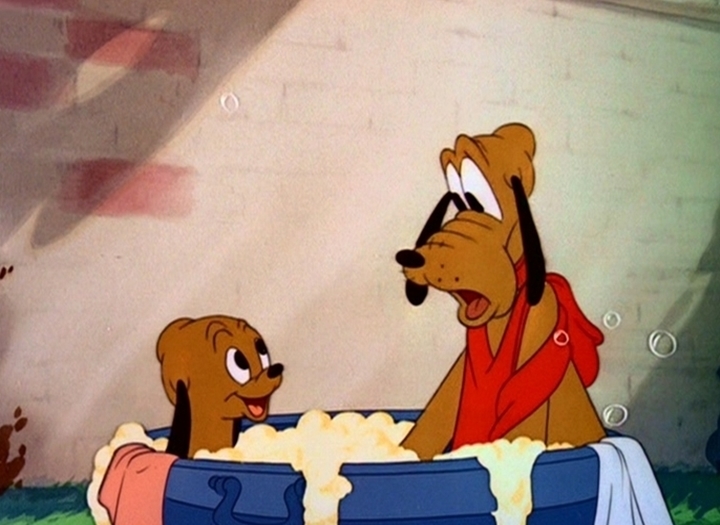
In this cartoon Pluto has only one son (instead of five as in ‘Pluto’s Quin-Puplets’ from 1937).
We watch this pup playing with a ball, a balloon, a caterpillar and a bird, which leads him into a distressful position on a clothes-line. Only then Pluto, who had been asleep all the time, comes into action. Pluto rescues his son and both fall into a wash-tub.
The best sequence of the cartoon involves Pluto’s antics on the clothes-line. It’s clear that he is a far funnier character than his son, which is only cute. Indeed, after this cartoon Pluto jr. was never seen again.
Watch ‘Pluto Junior’ yourself and tell me what you think:
Director: Grigori Lomidze Release Date: 1947 Rating: ★★★ Review:
‘To You, Moscow’ is a long and slow Soviet propaganda film celebrating Moscow’s 800th birthday by depicting its turbulent history.
During the film we watch Moscow’s settlement, the victory of Ivan III over the Tartars (15th century), the revolt against Polish occupation (17th century), the defeat of Napoleon’s army in 1812, the 1905 revolution, the 1917 socialist revolution (‘led by Lenin and Stalin’) and the 1941 defeat of the fascist army to the present day.
The socialist revolution section leads to live-action footage of Moscow, a happy child, flowers, some buildings and street scenes and statues of Lenin and Stalin. The last section, the celebration, shows photographs of heroic inhabitants of the Soviet Union, and not only glorifies Moscow as “our youth, our glory”, “our dear mother” and “our birthday girl”, but also as a “glory to Stalin”.
The different sections are bridged by letters and postcards to comrade Stalin. The sections themselves focus on strives and battles, and are accompanied by alternately realistic and symbolic images. For example, the 1917 revolution is depicted by the czarist double-headed eagle struggling and falling to pieces, while the most impressive part may be that of 1812, with its realistic images of fire.
It may be clear that this film is propaganda at its worst. The film is saved from becoming totally unwatchable by the beautiful animation, the stark images, and the lively patriotic music.
Watch ‘To You, Moscow’ yourself and tell me what you think:
‘To You, Moscow’ is available on the DVD box set ‘Animated Soviet Propaganda’
Director: Alex Lovy Release Date: July 27, 1942 Rating: ★★★ Review:
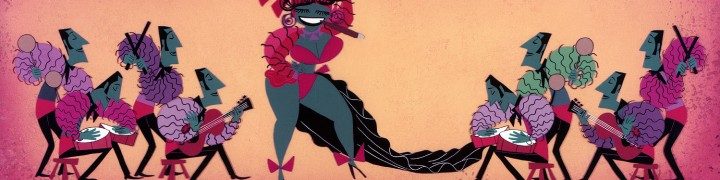
In the deserted ‘Zowie cafe’ a mouse is disturbed a jukebox playing latin music.
In his attempts to stop the machine, the mouse ends in a cocktail and gets drunk. He visions ‘spirits’ coming from the bottles who start a conga beat. A lobster does a Carmen Miranda act, blending Cuban and Brazilian styles, and singing in some kind of mock-Spanish. The mouse happily joins in, until he returns to his home to sleep.
The whole cartoon has a delirious atmosphere, and can be called ‘intoxicating’ without necessarily being really entertaining. The ghosts’ designs, with their red noses and bowler hats, are copied straight from the Mickey Mouse cartoon ‘Lonesome Ghosts’ (1938).
Watch ‘Juke Box Jamboree’ yourself and tell me what you think:
Director: Walter Lantz Release Date: March 4, 1942 Rating: ★★★★ Review:
This short has probably grimmest opening shot of all Hollywood cartoons: that of someone about to be hanged.
It turns out to be the wolf, who will be hanged for harassing the three little pigs. The wolf pleads innocent, however, and tells us “what really happened”. In his own story the wolf is a classical music teacher, loving peace and quiet (the most ridiculous illustration of this is the image of the wolf crocheting a bath tube out of a sheep). He’s visited by the three little pigs who play hot jazz, bullying the wolf, wrecking his instruments, and finally his house.
It’s a bit odd to associate such intoxicating jazz with random violence à la Clockwork Orange, but the result is an entertaining cartoon, although it is clearly tributary to the 1941 Warner Bros. cartoon ‘The Trial of Mr. Wolf’, which features a very similar story idea. Interestingly enough the director of that cartoon, Friz Freleng, would later also direct a cartoon about a wolf and three little pigs playing hot jazz, in ‘The Three Little Bops‘ (1957).
Watch ‘The Hams That Couldn’t Be Cured’ yourself and tell me what you think:
From the early 1930s to the early 1940s Warner Bros. released several cartoons in which books, magazines etc. come to life. Of all these cartoons, ‘Lights Fantastic’ is probably the most extreme and the most dated.
It opens with a real life shot of Times Square in New York, and all sequences after that supposedly take place in neon billboards on this square. This results in little movement, a few gags on Chinese and no laughs.
Present day viewers like me don’t even have a clue how many of these billboards were based on real and familiar ones. I personally could only recognize Mr. Peanut (from Planters). No doubt most of the fun disappeared with the familiarity of the pictured advertising. However, I seriously doubt whether this cartoon has ever been a winner, for its few gags are lame, and don’t build up to a finale, at all.
Watch an excerpt from ‘Lights Fantastic’ yourself and tell me what you think:
Director: Bob Clampett Release Date: April 11, 1942 Rating: ★★★★★ ♕ Review:
‘Horton Hatches The Egg’ is a unique film within Bob Clampett’s oeuvre, and indeed the complete Warner Bros. canon: it’s the studio’s only book adaptation, it lacks sex and violence, and there is nothing of the zany and extreme animation so typical of Clampett’s unit.
Instead, we’re treated on a surprisingly faithful adaptation of Dr. Seuss’s children’s book to the screen. The cartoon uses most of Dr. Seuss’s rhymes, with adding only a little dialogue of its own, which is easily identifiable because of the lack of rhyme. Dr. Seuss’s designs, too, are wonderfully transferred to the animated screen. Especially Horton and the other forest animals have a distinctive Dr. Seuss character.
The Warner Bros. team departs from Dr. Seuss’s drawings, however, in the human designs. The three hunters are rather bland in Dr. Seuss’s children’s book, but Clampett made them a very funny trio in the cartoon. Moreover, some of the wild Warner Brothers humor has crept into the cartoon, most typically two movie star references, which, unfortunately, date the film a little: Lazy Mayzie imitates Katharine Hepburn, and there’s a fish with Peter Lorre’s features, who, after seeing Horton on a ship, shoots itself, exclaiming “Now I’ve seen everything!”.
Today, a gag like this is regarded inappropriate for children, and it might be this gag that is responsible for the little screen time the cartoon gets today. This is very unfortunate, because this animated adaptation of a Dr. Seuss book is not only the first of all, it is also one of the best, being second only to Chuck Jones’s ‘How The Grinch Stole Christmas‘ from 1966.
Watch ‘Horton Hatches the Egg’ yourself and tell me what you think:
Director: Dave Fleischer Release Date: March 13, 1942 Stars: Popeye Rating: ★★★ Review:
‘Fleets of Stren’th’ is the third in a series of cartoons in which Popeye has joined the American navy.
In this cartoon Popeye still is a lousy sailor, but when the battle cruiser is under attack, he once again shows what he’s able to do (see also ‘Blunder Below‘). This time the battle cruiser is attacked by a squad of Japanese dive bombers. It takes some time before Popeye is able to eat his spinach, but when he does, he turns into a plane himself, defeating the complete enemy fleet.
In this process we see only one pilot, the other planes are subtly dehumanized. In this way we’ll never think of the fate of the Japanese pilots, at all. This was a clever device used in many war propaganda films of the time.
Watch ‘Fleets of Stren’th’ yourself and tell me what you think:
This Popeye film No. 104
To the previous Popeye film: Blunder Below
To the next Popeye film: Pip-Eye, Pup-eye, Poop-eye and Peep-eye
Director: Dave Fleischer Release Date: February 13, 1942 Stars: Popeye Rating: ★★★★ Review:
Popeye had joined the navy before the United States entered the war, in ‘The Mighty Navy‘ (November 1941), so in ‘Blunder Below’ he’s ready to fight the enemy, the first major cartoon star to do so on the movie screen.
In the first part of this cartoon Popeye tries to be a normal sailor, among Superman-like sailors, trying to learn gunning. He is no talent, however, blundering away and almost shooting down the captain by accident.
But when a submarine approaches, Popeye shows his real worth: he beats the submarine single-handedly, saving the battle cruiser. It’s this great combination of clumsiness and superhuman powers which make Popeye such an appealing character.
The approaching submarine is accompanied by the music of Franz Schubert’s Erlkönig, indicating a German origin. However, it soon turns out to be Japanese. The submarine is anthropomorphic itself and completely dehumanized, as if it were not manned by people at all. When in August 1942 Popeye changed hands from the Fleischers to Paramount, this would radically change…
Watch ‘Blunder Below’ yourself and tell me what you think:
Director: Alex Lovy Release Date: August 3, 1942 Rating: ★★★ Review:
‘Pigeon Patrol’ is a typical war era cartoon. It tells about Homer Pigeon, a dopey little country pigeon, whose girl Daisy May is impressed by the USA carrier pigeons, who look like American army planes.
Rejected by Daisy May, Homer decides to volunteer, too, but he’s way too small. However when he encounters a crashed carrier, he rescues an important message from an ugly Japanese vulture, beating the enemy saying: “remember Pearl Harbor and Singapore!”. In the end we watch him being decorated and happily married to Daisy May.
‘Pigeon Patrol’ is not too funny, but very propagandistic. It seems to want to emphasize that every man can do his job for the country. The Japanese vulture belongs to the typical stereotyped caricatures of a Japanese in Hollywood cartoons, complete with a suggestion of general Tojo-like glasses.
Two years later, Warner Bros. would tell another tale about a pigeon called Homer in ‘Plane Daffy‘ (1944). Their Homer commits suicide in that film. Walter Lantz’s Homer Pigeon, however, would star one other cartoon, ‘Pigeon Holed’ from 1956.
Watch ‘Pigeon Patrol’ yourself and tell me what you think:
Director: Walter Lantz Release Date: April 13, 1942 Rating: ★★ Review:
Mother Goose on the Loose’ stands in a long tradition of nursery rhyme cartoons, from the Felix the cat cartoon ‘Felix in Fairyland’ (1923) via the Silly Symphony ‘Mother Goose Melodies‘ (1931) and ‘Mother Goose Land‘ starring Betty Boop (1933), to Disney’s ‘Mother Goose Goes to Hollywood’ (1938) featuring caricatures of Hollywood stars.
Unfortunately, ‘Mother Goose on the Loose’ is weaker than any of these, hampered by a slow timing, corny gags and an obnoxious voice over. Even a jazzy tune, setting in after five boring minutes, cannot rescue the cartoon. Its only attraction is its obsession with dames, which are literally all over the cartoon. This makes ‘Mother Goose on the Loose’ a typical cartoon of the World War II era.
Director: Walter Lantz Release Date: September 1, 1941 Rating: ★★★★ Review:
Based on the 1941 hit song by the Andrews sisters, ‘The Boogie Woogie Bugle Boy of Company “B”‘ tells the story of a black trumpeter who gets drafted and has to blow the reveille, which he does in a swinging style, introducing the song.
The song itself is accompanied by various gags on blacks in the army. Even the Andrews Sisters themselves make a cameo, although they do not sing. Typical of the era, the blacks are pretty stereotyped, with huge lips, grammatically incorrect speech, and allusions to gambling. Two of them even die during the cartoon: one black after playing xylophone on some shells, while the other gets eaten by an alligator. So I can understand if some people find it hard to watch this cartoon today. Even so, the cartoon is less offensive than ‘Scrub Me Mama With a Boogie Beat‘ from six months earlier, from which the cartoon reuses some animation.
Indeed, the overall mood of the cartoon is cheerful and rather innocent, emphasizing the swinging mood. In fact, thanks to the catchy song and some flexible animation ‘The Boogie Woogie Bugle Boy of Company “B”‘ is one of the great jazz cartoons. It’s also one of the most enjoyable army cartoons of the era, of which it is probably the first. It’s at least one of the first American cartoon on conscription, which had come in effect in September 1940, as a reaction on the war in Europe. The cartoon thus predates cartoons like the Pluto short ‘The Army Mascot‘, ‘Donald Gets Drafted‘ featuring Donald Duck, and the Woody Woodpecker cartoon ‘Ace in the Hole’ (all from 1942).
Watch ‘The Boogie Woogie Bugle Boy of Company “B”’ yourself and tell me what you think:
‘The Boogie Woogie Bugle Boy of Company “B”’ is available on the DVD-set ‘The Woody Woodpecker and Friends Classic Cartoon Collection’
‘A Corny Concerto’ is a two part spoof on Disney’s most ambitious feature, ‘Fantasia’ (1940), using two waltzes by Johann Strauss jr.
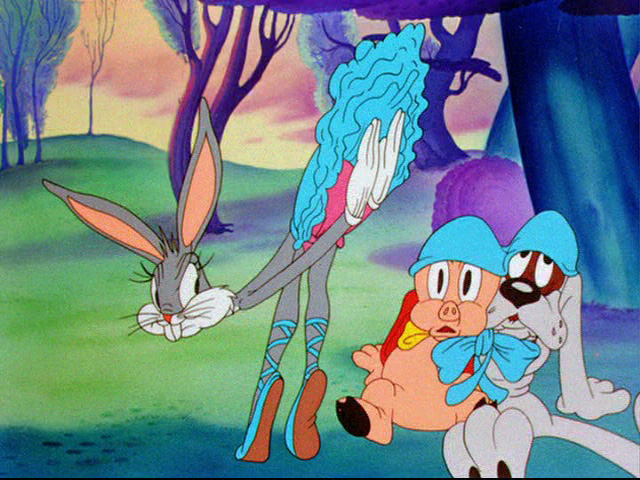
The cartoon features a very Fantasia-like opening, with Elmer Fudd as a clear caricature of Deems Taylor. He announces ‘Tales from the Woods’, which tells about Porky Pig and a dog hunting Bugs Bunny. Porky fills the role of Elmer Fudd in this sequence, and it’s the only cartoon in we can watch him hunting Bugs Bunny. This first part is a classic Bugs Bunny routine, complete with death scene, but now timed to music and acted in pantomime. With its overt mix of high culture and silliness this part is a direct ancestor to Chuck Jones’s later ‘What’s Opera, Doc?‘ (1957).
The second part is a story on ‘The Blue Danube’. It opens with flowers dropping on water, just like in the Nutcracker Suite sequence in Fantasia. This part tells about a little black duck, an infant version of Daffy Duck, trying to join a family of swans, and finally saving them from a vulture by destroying him with TNT. As this story is some kind of inverse of ‘The Ugly Duckling‘ (another acclaimed Disney masterpiece), this could be considered to be a parody within a parody.
Apart from Elmer Fudd’s speeches, the cartoon is completely pantomimed, and full of the wild and zany animation so typical of Bob Clampett’s unit. The backgrounds are lush and colorful, and reminiscent of the the Pastoral Symphony sequence in the original Fantasia. Their designs become overtly ridiculous in ‘The Blue Danube’, with Greek columns placed randomly in the water.
The result is a highly original mix of style and nonsense, and a great testimony of what Leon Schlesinger’s studio could do on a limited budget. In all, the cartoon is an undisputed classic, and very enjoyable, even if you don’t know its topic of parody.
Watch ‘A Corny Concerto’ yourself and tell me what you think:
This is Bugs Bunny cartoon No. 19
To the previous Bugs Bunny cartoon: Wackiki Wabbit
To the next Bugs Bunny cartoon: Falling Hare
This is Porky Pig cartoon No. 102
To the previous Porky Pig cartoon: Porky’s Pig’s Feat
To the next Porky Pig cartoon: Tom Turk and Daffy
Director: Bob Clampett Release Date: October 3, 1942 Rating: ★★★★★ Review:
‘The Hep Cat’ was the first Looney Tune made in color. As the Merrie Melodies already were in color, this cartoon heralded a full color era for the Leon Schlesinger studio.
In ‘The Hep Cat’ the dog Rosebud (Willoughby but with another name) tries to catch a ‘hep cat’, a feline womanizer who, on his turn, tries to get a girl, a.o. by speaking with a deep french voice, anticipating the romancing skunk Pepe Le Pew by three years. Rosebud succeeds to seduce the jive cat by using a sexy kitten-like hand puppet. He looses the chase however, and in the last shot we can see the hep cat stroking the hand puppet, saying, with a Jerry Colonna voice ” I can dream, can’t I?”.
‘The Hep Cat’ does not have much of a story, but who cares? It’s an intoxicating and jazzy cartoon, and from the moment the Hep Cat starts singing ‘Java Jive’ with alternate lyrics, you’re lost. The short is fast and funny, full of uninhibited sex and violence gags and throughout the picture one keeps marveling at the extreme and amazingly flexible animation from Bob Clampett’s unit.
Watch ‘The Hep Cat’ yourself and tell me what you think:
Director: Friz Freleng Release Date: May 18, 1940 Stars: Daffy Duck, Porky Pig, Leon Schlesinger Rating: ★★★★★ ♕ Review:
‘You Ought to Be in Pictures’ is the very first cartoon to bridge two ideas of animation film figures being ‘real’.
First, the idea that cartoon figures can come alive from the drawing board into the real world, an idea that hauls all the way back to Max Fleischer’s first ‘Out of the Inkwell’ cartoons (1915). The second idea is that of cartoon figures being real Hollywood stars, explored in cartoons such as ‘Felix in Hollywood’ (1923), ‘Movie Mad‘ (1931), ‘Mickey’s Gala Premier‘ (1933) and especially ‘The Autograph Hound‘ (1939), with which ‘You Ought to Be in Pictures’ has most in common. ‘You Ought to Be in Pictures’ synthesizes these two ideas, making it a direct ancestor of ‘Who Framed Roger Rabbit‘ (1988).
‘You Ought to Be in Pictures’ was one of the first films director Friz Freleng made after his return from an ill-fortuned move to MGM, and as Jerry Beck points out in the audio commentary track, one can see this film somehow as autobiographical.
In any case, this short marks is Freleng’s first take on Daffy Duck, and he places him firmly as Porky’s rival. In this cartoon Daffy is not necessarily zany, like in Tex Avery’s and Bob Clampett’s cartoons, but overconfident and sneaky, with a tendency to show off; character treats that would be explored more from 1950 on, especially by Chuck Jones. However, by then the relation between Porky and Daffy would be changed completely.
In ‘You Ought to Be in Pictures’ Porky is still an innocent, cute and Boyish character. In the opening scene we watch him being drawn by animator Fred Jones on the drawing board. When all animators have rushed off to lunch (reused footage from a Leon Schlesinger Christmas Party film), Daffy, framed on the wall, addresses the Porky drawing. He convinces Porky to leave Leon Schlesinger’s studio to get a real job in the business of feature films. Leon Schlesinger lets Porky go, saying into the camera “he’ll be back!”. While Porky has a hard time in the neighboring live action studio, Daffy tries to get his plays at Warner Bros. But Porky returns and beats the hell out of the double-crosser.
‘You Ougt to Be in Pictures’ is a lovely cartoon. It mixes animation and live action, partly from other Warner Bros. features, to great effects. The scene in which Porky talks to Leon Schlesinger is very convincing, and Porky’s drive back no less than breathtaking. Besides Leon Schlesinger, the film stars writer Michael Maltese as a guard, animator Gerry Chiniquy as a director, and executive producer Henry Binder as a sound man. However, as the live action footage was shot silently, all are voiced by Mel Blanc, except for Leon Schlesinger who does his own voice.
Watch ‘You Ought to Be in Pictures’ yourself and tell me what you think:
This is Porky Pig cartoon No. 73
To the previous Porky Pig cartoon: Porky’s Poor Fish
To the next Porky Pig cartoon: The Chewin’ Bruin
This is Daffy Duck cartoon No. 9
To the previous Daffy Duck cartoon: Wise Quacks
To the next Daffy Duck cartoon: A Coy Decoy
‘You Ought To Be In Pictures’ is available on the DVD-sets ‘The Looney Tunes Golden Collection Volume Two’, ‘Porky Pig 101’, and the Blu-Ray ‘Looney Tunes Platinum Collection: Volume 2’
Director: Harold Mack Release Date: August 1, 1952 Rating: ★★★★★ Review:
By 1952 the Dutch Toonder studios had been producing animation films for ten years, and now they were ready to produce a ‘free film’, not commissioned, but out of their own ideas.
The first of these free films was ‘De gouden vis’ (The Golden Fish). It was Marten Toonder’s old wish to produce a free film, and the result is clearly a work of love. ‘De gouden vis’ is an astonishing achievement for the Dutch studio: all elements of animation film have matured in this film: its storytelling is original, its designs are gorgeous, the animation is excellent, the effects are convincing and its atmosphere is unique. The result is arguably one of the most beautiful films ever made in The Netherlands.
Based on a story by Marten Toonder’s brother, Jan Gerhard Toonder, the film tells about the Chinese prince Li Pai, who repeatedly asks an old wise fish how to live. The fish tells the prince that his eyes know the answer, but Li Pai misinterprets what he sees, and only in old age he discovers the truth…
The film has a genuinely Chinese atmosphere, thanks to designs by Pamela & Harold Mack and backgrounds by Cees van de Weert and Ling Nan Lung. The film hasn’t aged a bit, except for Nell Knoop’s Dutch narration, which has an unmistakable 1950s diction.
Unfortunately, ‘De gouden vis’, in spite of praise on several film festivals around the world, only returned a mere thousand guilders, while its production had costed about 40,000 guilders. So, during the rest of its existence, the Toonder studios produced only a handful of other ‘free films’, most notably ‘Moonglow’ (1955).
‘De gouden vis’ is available on the DVD inside the Dutch book ‘De Toonder Animatiefilms’
Director: John Hubley Release Date: March 27, 1952 Rating: ★★★★★ ♕ Review:
In a time when most Hollywood animation studios produced chase cartoons featuring anthropomorphized animals, UPA and director John Hubley come with a court drama about a murder…
That we have something different in our hands is underlined when during the opening titles we watch a choreographer being billed. Indeed, ‘Rooty Toot Toot’ is something different, and widely praized as one of the most beautiful cartoons ever produced.
Based on the traditional murder ballad ‘Frankie and Johnny’, it’s set in a court room. We come to know how the jealous girl Frankie shot her lover Johnny down, when she caught him with singer Nellie Bly. Then Frankie’s lawyer, Honest John, comes in with a rather different story…
‘Rooty Toot Toot’ is not a flawless cartoon. Phil Moore’s music is a rather unsuccessful marriage between musical and jump blues, lacking strong melodies. His score even threatens to wear the action down. One can only guess what the cartoon would have sound like in the hands of a more capable composer.
Moreover, Honest John’s account of the murder is a missed opportunity. It’s too silly and too cartoonish to be believed (the following bullets come right out of the chase cartoon). Indeed, the lawyer himself declares it to be fiction, making all claims of ‘Rooty Toot Toot’ being a sort of cartoon ‘Rashomon’ out of place and unfounded. In substance ‘Rooty Toot Toot’ is much more akin to that other great musical court cartoon, ‘Who Killed Cock Robin?‘ from 1935, which is also based on a traditional text.
No, the real attraction of ‘Rooty Toot Toot’ lies in it looks: practically every frame is a beautiful illustration in itself. The colors and designs, by Paul Julian, are elegant and stylish; simple, yet sophisticated. There’s a perfect harmony between characters and backgrounds, and the stark colors enhance both character and mood.
The animation, too, is superb. John Hubley didn’t think much of his colleague’s Bobe Cannon’s ideal of “drawings that moved”. Instead we watch moving characters, and it’s clear where the choreography comes in, for many characters move with a ballet-like elegance, especially Frankie and Honest John. The movement of the characters is often unreal (as in Nellie’s curling arms), but always delicate. It’s no surprise that the animation was done by the able hands of veteran animators like Art Babbitt and Grim Natwick. When the Jury declares Frankie not guilty, the cartoon bursts in a frenzy of bold design that has to be seen to be believed.
Even if ‘Rooty Toot Toot’ is not perfect, it’s a masterpiece nonetheless, and one of the best cartoons UPA ever produced.
Watch ‘Rooty Toot Toot’ yourself and tell me what you think:
In ‘The Oompahs’ a voice over tells a story about a family of musical instruments.
‘The Oompahs’ is one of UPA’s most avantgardistic cartoons. Its story and designs are by caricaturist T. Hee, who went for the extremes. The instruments are very basic paper cut outs, with very little animation on them. Mostly they just move across the screen. It’s almost unbelievable that such a modern cartoon could come from a Hollywood studio, at all.
The cartoon is the prime example of director Bobe Cannon’s wish to let the audience watch “drawings that moved”. Even if the founding idea of humanized musical instruments is the same as in Disney’s ‘Music Land‘ (1936), ‘The Oompahs’ is aesthetically miles away from the earlier cartoon.
Like some other UPA cartoons ‘The Oompahs’ tells about a young character with a free spirit. Young Orville, a trumpet, wants to play and improvize freely with his friends (some other instruments), in a game that is depicted by a baseball match, and which sounds like a dixieland band. But Oompah Pa doesn’t approve and makes young Orville practice boring tunes. Then young Orville loses all spirit, gets sick, and only his friends can revive him.
This message of letting creative energy run free must have appealed a lot to its makers, for creative freedom was the raison d’être of the whole studio.
Watch ‘The Oompahs’ yourself and tell me what you think:
‘The Wonder Gloves’ is one of the more extreme films by the UPA studio: the characters have an extraordinarily thick outline, and Paul Julian’s backgrounds are minimal and very graphic, indeed, using photographic material to indicate textures.
Moreover, the animation is limited, sometimes no more than several poses without movement inbetween. Lou Maury’s music, too, is strikingly modern, more reminiscent of contemporary French music than of classic cartoon music.
In the cartoon Uncle George tells his nephew how he found yellow wonder boxing gloves with which he became a star boxer. The framing story uses dialogue, but Uncle George’s story is told in pantomime.
Unfortunately, the story is less interesting than the designs of the cartoon. At points the limited animation hampers a fluent telling instead of enhancing it.
Watch ‘The Wonder Gloves’ yourself and tell me what you think:
‘Georgie and the Dragon’ is one of those UPA shorts about young people trying to break free, a topic the studio favored (see also ‘Gerald McBoing Boing’ from 1951) and ‘The Oompahs‘ from 1952).
‘Georgie and the Dragon’ is set in Scotland, and tells about the lonesome boy Georgie. His father forbids him to bring pets in the house, but little Georgie befriends a little dragon. When he takes it home it grows larger every minute. Nevertheless Georgie manages to hide the dragon from his parents, even if the dragon’s fire repeatedly damages his father and his surroundings.
‘Georgie and the Dragon’ is a gentle story, but the film is hampered by the tiresome Scottish dialogue and all too present angular backgrounds by Bill Hurtz, against which the fluently animated characters don’t read well.
Watch ‘Georgie and the Dragon’ yourself and tell me what you think:
Directors: Nathan Greno & Byron Howard Release Date: November 24, 2010 Rating: ★★★★½ Review:
With ‘Tangled’ the Walt Disney studio arguably released their first really successful computer animated feature.
Despite the modern techniques with which it has been made, ‘Entangled’ really looks back, even more than the hand-drawn ‘Princess and the Frog’ from one year earlier. First, it’s a musical in the vain of ‘The Little Mermaid’ (1989) and ‘Beauty and the Beast’ (1991), and indeed the songs are by same composer, Alan Menken. Second, it’s based on a classic fairy-tale (Rapunzel), placing it in a tradition looking all the way back to ‘Snow White and the Seven Dwarfs’ (1937) and ‘Cinderella‘ (1950). And third, there’s even an animal sidekick, the chameleon Pascal, something we hadn’t seen since ‘Mulan’ (1998).
Like in all these films the main protagonist is a young female yearning for love. With Ariel from ‘The Little Mermaid’, Rapunzel is the most overtly adolescent of the lot. She displays many behaviors of teenagers: not only is she torn apart between loyalty to her ‘mother’ and the longing for freedom, she also displays the naive and intoxicating excitement typical of her age. It seems like ‘Tangled’ was clearly marketed for this age group.
However, the studio changed the film’s name from ‘Rapunzel’ to ‘Tangled’ to attract other people than teenage girls, and rightly so, for the film has more to offer. However, it’s not necessarily to be found in the male protagonist, Flynn Rider. Flynn is a somewhat cliche overconfident macho, who discovers his softer side, and he is more of interest to young girls than to young men, who may have difficulties relating to him. In fact, I dare say they will more relate to Rapunzel herself.
No, it’s found in a well-told story, in which both the evil witch and Rapunzel’s hair gain new dimensions. Apart from its magical power, it is amazing what Rapunzel can do with her hair. It clearly defines her as a strong, independent and creative character: not submissive and to be won, but active, and with a will of her own.
The story knows plenty of fun, action and romance, but also allows for some deep emotional moments. For example, there is a short scene in which we see Rapunzel’s grieving father, and his emotion is played so well, it breaks your heart. Alan Menken’s songs aren’t the greatest, and can sometimes be missed, but the ‘I have a dream’ sequence in the tavern is acted out with so much bravado, it’s a great fun to watch.
I doubt whether ‘Tangled’ will become a modern classic like e.g. Pixar’s ‘Wall-E’ (2008), ‘Up’ (2009) or Disney’s later ‘Frozen’ (2013), but it seriously showed that the Disney studio still was able to make good animated features, even computer animated ones. That alone was a relief after a series of seriously bad (‘Chicken Little’, 2005), forgettable (‘Meet the Robinsons’, 2007) and average (‘Bolt’, 2008) films.
Watch the trailer for ‘Tangled’ yourself and tell me what you think:
Animation Backgrounds
A blog dedicated to background paintings from animation films. Kept until 2016.
Animation Scoop
Animation historian Jerry Beck’s animation film news blog.
Cartoon Brew
Topical blog on animation film, led by animation historian Amid Amidi.
Cartoon Modern
Amid Amidi’s blog on modern design cartoon art from the forties, fifties and sixties.
Cartoon Research
THE site on classic animation research, hosted by cartoon historian Jerry Beck.
Cartoons Theory
Frank Beef analyzes classic cartoons. Kept until 2020.
Century Film Project
Michael reviews films of 100 years old and older, roughly in chronological order.
Classic Cartoons
A similar blog featuring many stills and comic strips. Kept until 2012.
Comet over Hollywood
Jessica Pickens reviews classic Hollywood films, especially musicals.
Deja View
Top ex-Disney animator Andreas Deja’s own blog.
Disney History
Esteemed Disney historian Didier Ghez on the latest books on Disney history.
Feeling Animated
Paul Astell brings us thorough reviews of animated features.
Flickers in Time
Short and to the point reviews of classic films (lately mostly pre-code talkies) by an anonymous retired Foreign Service Officer from California
 In this cartoon Pluto has only one son (instead of five as in ‘Pluto’s Quin-Puplets’ from 1937).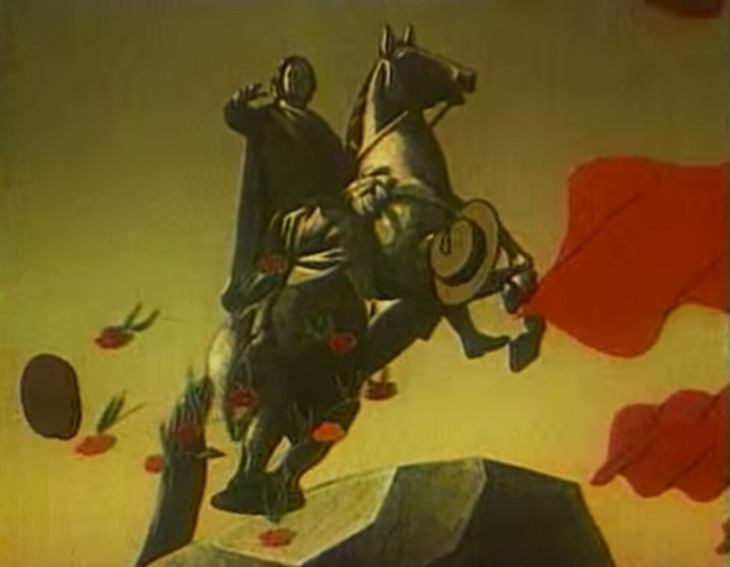






 Dr. Grob's Animation Review