Director: Dick Lundy Release Date: September 27, 1952 Stars: Droopy, The Wolf Rating: ★ Review:
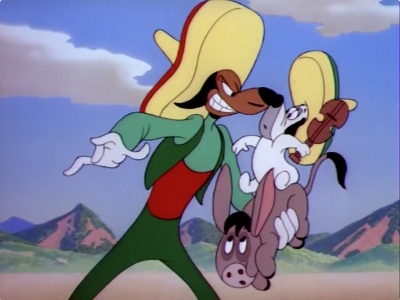
In 1950 Tex Avery left MGM for a sabbatical, most probably due to overwork. Dick Lundy was hired to replace him, and the first cartoon he directed at MGM was ‘Caballero Droopy’.
This short’ is strangely reminiscent of the cartoons of Lundy’s former employer, Walter Lantz, with which it shares a lesser quality: both the designs and the animation are sub-par. It’s really as if this cartoon was made at Walter Lantz instead of at MGM.
For ‘Caballero Droopy’ Lundy revived the wolf, gave him a mustache and placed him into a Mexican setting, in which he tries to outdo Droopy in serenading the phlegmatic dog’s girl. The cartoon is full of Tex Averyanisms, but due to its low production quality it never takes off.
‘Caballero Droopy’ remained the only Droopy cartoon Lundy directed. He moved on to the ailing Barney Bear series, before he had to leave MGM on Tex Avery’s return in October 1951.
Watch ‘Caballero Droopy’ yourself and tell me what you think:
Droopy is a butler in a mansion who invites his incredibly strong brother Drippy to join him at work.
The pair is told to let nobody into the house while the master’s away, but Droopy brings in his old pal, the tramp Spike. What follows is a series of confusion gags, in which Spike is pampered by Droopy and clobbered by Drippy.
The comedy is less inventive than in earlier Droopy shorts, and ‘Droopy’s Double Trouble’ is arguably Avery’s weakest Droopy cartoon. Spike is in no sense the funny, mean cheater he was in earlier cartoons, like ‘The Chump Champ’ (1950) and ‘Droopy’s Good Deed’ (1951). He speaks with a strange, Irish(?) accent and is only a meek and unfunny victim of the confusion gags.
Watch ‘Droopy’s Double Trouble’ yourself and tell me what you think:
Directors: Clyde Geronimi, Wilfred Jackson & Hamilton Luske Release Date: July 26, 1951 Rating: ★★★½ Review:
Of all the classic Walt Disney features, ‘Alice in Wonderland’ had the longest and most troublesome history.
Lewis Carroll’s book had intrigued Walt Disney for years. It had inspired the Alice cartoons, if only in name, and already in 1933 the first ideas appeared to turn the literary classic into an animated feature, starring Mary Pickford as Alice – being Disney’s first feature idea ever. Unfortunately, the idea was dropped because in 1933 Paramount released their version of the classic tale.
More serious work on Alice started in 1939/1940 when illustrator David Hall made numerous, exceptionally beautiful concept drawings. After the failures of ‘Pinocchio‘ and ‘Fantasia’ (both 1940) at the box office, these ideas were shelved, and virtually nothing of Hall’s ideas entered the final film. At one point even novelist Aldous Huxley cooperated, turning in a literary script in 1945, which the Disney studio found useless. Only in 1949 real work on the film began, resulting in Disney’s second feature of the 1950s, after the successful ‘Cinderella‘.
The final film unfortunately was poorly received when it was finally released in 1951. It performed rather badly at the box office, losing the studio almost a million dollars, practically evaporating the profits that ‘Cinderella’ had made the previous year. The film was critisized even by its own animators. Marc Davis said the film “gave us nothing to work it” and called it a “cold film”. Frank Thomas and Ollie Johnston hardly mention the film in their elaborate book ‘The Illusion of Life’. In ‘The Disney Villain’ they reveal why: they felt they “had failed to find the intriguing combination of fantasy, satire and whimsy that made the original book popular”. Even Walt Disney himself denounced the film, saying it lacked heart.
However, ‘Alice in Wonderland’ has aged suprisingly well. In fact, it has turned out to be one of the best adaptations of the book to the screen, its only serious rivals being Jan Švankmajer’s disturbing stop motion film from 1987, and a NBC production from 1999. Certainly not Disney’s feature from 2010, which, although visually stunning, owes very little to the original story.
The film’s most overt weakness, its episodic character (which, of course, it shares with the original book), is also its strong point: none of the Disney story cliches are apparent, and there’s a welcome lack of sentimentality to the film. In fact, the film’s low point is reached when the studio does try to squeak sentimentality into the story: in the Tulgey Wood scene, an invention of the story department and not found in the original book, Alice has enough of nonsense, wants to go home and feels lost. She sings the feature’s weakest and most forgettable song with a sobbing voice, with some fantasy birds sympathizing with her in stereotypical Disney fashion. Despite the inventive bird designs, this scene is wide of the mark.
Luckily, it is one of only two weak scenes (the other one being the flower scene, squeaked in from ‘Through the Looking Glass’) amidst the wonderful series of utter nonsense, which evoke the zany spirit of the book very well. The film is literally stuffed with great characters, most of them voiced by well-known British and American actors: the white rabbit (Bill Thompson, the voice of Droopy), the dodo, Tweedledee and Tweedledum (Pat O’Malley), the caterpillar (Richard Haydn), The Cheshire Cat (Disney favorite Sterling Holloway), The Mad Hatter and the Marc Hare (Ed Wynn & Jerry Colonna), the Queen of Hearts (Verna Felton), and the little king. Eleven year old Kathryn Belmont is a perfect Alice: pleasantly normal, and a little pedantic, just like the one in the book.
Of all Nine Old Men, the Disney animators who worked on the film, Ward Kimball in particular seems in his element, as Lewis Carroll’s work has much in common with his own zany type of humor. Kimball supervised animation on Tweedledee and Tweedledum, the Walrus and the Carpenter, the Mad Tea Party and the Cheshire Cat, and all characters are delightfully loony.
However, the film’s strongest point may be in its design, which is nothing like Sir John Tenniel. In contrast to his gloomy black-and-white engravings, styling artists Mary Blair, John Hench, Claude Coats and Ken Anderson present a vibrant world of colors. The stylized backgrounds are superb with their angular designs and highly original color combinations, evoking a perfect dream world. It’s these designs that give the movie unity. They are matched by the looniest animation within any Disney feature, all bringing the zany Lewis Carroll perfectly to life. Both the animation and the countless visual gags complement the textual madness of the original book. Moreover, the film is surprisingly speedy, and still enjoyable for a 21st century audience.
‘Alice in Wonderland’ may not be Disney’s best or most successful feature, it’s a very pleasant ride through a colorful world, and more of a timeless classic than anyone would have imagined in 1951.
Watch ‘Alice in Wonderland’ yourself and tell me what you think:
Director: Jack Kinney Release Date: October 21, 1951 Stars: Goofy Rating: ★★★★ Review:
This third cartoon of the Mr. Geef-series starts with our hero announcing to his colleagues that he has become a father.
We quickly move to several years later, when his son has become a hyper-active and extremely playful young boy, who troubles his father a lot. Like the other George Geef cartoons the humor of the cartoon stems mostly from its recognisability. Fathers can connect immediately to Mr. Geef’s problems with his son.
Although it’s not brought with great bravado, ‘Fathers are People’ is a milestone within the Disney catalog: for the first time a Disney star becomes a parent. Although it may be debatable whether Mr. Geef really is Goofy, the son is his, he’s not some nephew or whatever, like Huey, Dewey and Louie are. This is a very rare happening in the complete cartoon universe. True, Oswald became a father in ‘Poor Papa’ (1927), but this was a pilot film, and Oswald wasn’t a star, yet. And indeed, Pete was the first Disney cartoon character shown to be a father, having a son in ‘Bellboy Donald‘, 1942, but that cartoon didn’t celebrate a birth.
Anyway, George Geef jr. would return the next year in ‘Father’s Lion’. But in ‘A Goofy Movie’ (1995) Goofy had a very different and older son called Max, so maybe George Geef and Goofy weren’t one and the same, after all…
Watch ‘Fathers are People’ yourself and tell me what you think:
Director: Jack Kinney Release Date: June 29, 1951 Stars: Goofy Rating: ★★★★ Review:
Several of the Goofy cartoons of the 1950s cover everyday problems like driving and smoking, and, in ‘Tomorrow We Diet!’, dieting. These subjects remain remarkably topical, which makes them enjoyable to watch today.
‘Tomorrow We Diet’ features a particular fat type of Goofy with a weird faint voice. This fat Goofy is encouraged to diet by his rather independent mirror image. This unfortunately leads to hallucinations of food and to sleep-walking. When he finally gives in to his hunger he discovers that ‘the man in the mirror’ has eaten everything.
The highlights of the cartoon are a number of fatness gags, and the nightmarish hallucination sequence with its continuous voices saying “eat!”
Watch ‘Tomorrow We Diet!’ yourself and tell me what you think:
This is Goofy cartoon No. 30
To the previous Goofy cartoon: Cold War
To the next Goofy cartoon: Get Rich Quick
Director: Jack Kinney Release Date: April 27, 1951 Stars: Goofy Rating: ★★★ Review:
‘Cold War’ introduces a new name for the Goofy character as the average American, as he had already been portrayed in ‘Goofy Gymnastics‘ (1949) and ‘Hold That Pose‘ (1950).
From now on our hero is known as Mr. George G. Geef, who has a characterless, average voice and who is married to a human wife, of whom we only see her arms and legs. Despite these departures, ‘Cold War’ stills uses the voice over from the sports cartoons, putting the cartoon firmly back into a great tradition. Nevertheless, George G. Geef has little to do with the original Goofy from ‘On Ice‘ (1935), and it’s almost inconceivable that it’s still the same character.
As George Geef Goofy would deal with the troubles of the average American man, like diets, children, and cigarettes. And so, in this first entry of the ‘George Geef’ series within the Goofy series, Mr. Geef catches a cold at work, and is nursed to the max by his over-caring wife…
Watch ‘Cold War’ yourself and tell me what you think:
Director: Jack Kinney Release Date: March 23, 1951 Stars: Goofy Rating: ★★ Review:
In ‘Home Made Home’ Goofy tries to build his own house.
‘Home Made Home’ features the updated design of Goofy, introduced in ‘Tennis Racquet‘ (1949). Nevertheless, this cartoon has an old-fashioned feel to it. Like the sports cartoons from the 1940s, it uses a pompous narrator, and Goofy’s original voice. Moreover, the cartoon consists of three elongated situation gags in a style we had not seen since the 1930s. In the first Goofy is trapped in a blueprint, in the second he has to deal with a glass panel with a will of his own, recalling the piano from ‘Moving Day‘ (1937), and in the third he has to battle a snake-like paint-gun.
The gags are clever at times. Nevertheless, this short is rather slow and unfunny and only a shadow of the 1930s cartoons, the style of which it seems to try to evoke.
Watch ‘Home Made Home’ yourself and tell me what you think:
This is Goofy cartoon No. 28
To the previous Goofy cartoon: Lion Down
To the next Goofy cartoon: Cold War
Director: Walter Lantz Release Date: October 29, 1951 Stars: Woody Woodpecker, Wally Walrus Rating: ★★★½ Review:
‘The Woody Woodpecker Polka’ is one of several cartoons in which Woody Woodpecker tries to get some food.
In this cartoon Woody Woodpecker tries to enter a barn dance, but only for the food that is served there. The usher, Wally Walrus, doesn’t let him in however, for Woody can’t pay the one dollar entrance fee. Luckily, ladies are free of admission, so Woody dresses like one and makes Wally accompany him to the dance floor. What follows is a dancing scene in which Woody tries to eat as much food as he can, a story idea the studio borrowed from Walt Disney’s ‘The Legend of Sleepy Hollow‘ (1949).
The dancing scene is enhanced by the intoxicating title song, sung by the Starlighters, and for a change Clarence Wheeler’s music is inspired during this sequence.
Watch ‘The Woody Woodpecker Polka’ yourself and tell me what you think:
This is Woody Woodpecker cartoon No. 37
To Woody Woodpecker’s debut film: Redwood Sap
To the next Woody Woodpecker cartoon: Destination Meatball
‘The Woody Woodpecker Polka’ is available on the DVS-set ‘The Woody Woodpecker and Friends Classic Cartoon Collection’
Director: Walter Lantz Release Date: October 10, 1951 Stars: Woody Woodpecker Rating: ★★★★ Review:
‘Redwood Sap’ is the fable of the grasshopper and the ants disguised as a Woody Woodpecker cartoon.
Woody Woodpecker plays the role of the grasshopper, being extremely lazy, and stealing food from his neighbors: two beavers, a squirrel and a nest of ants. In the opening shot we watch him reading a book called “work and how to avoid it” by Hans Doolittle, and later we learn that Woody’s motto is “Why worry about tomorrow, I’m gone the day after”.
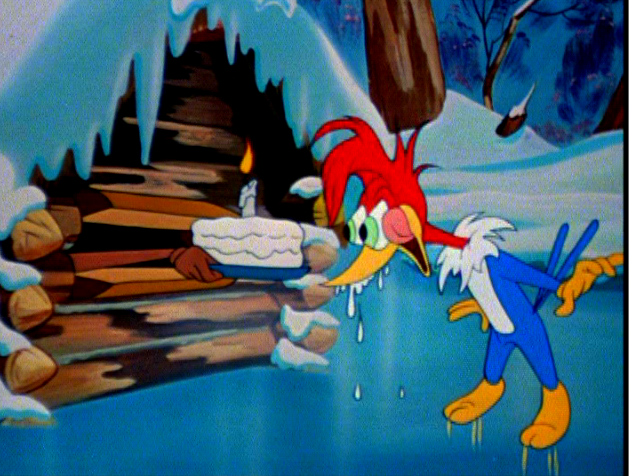
Then winter arrives, and Woody even refuses to join the birds flying South. However, confronted with an empty stomach and an empty cupboard Woody is forced to beg his neighbors for food. They however punish him for their maltreatment. So, when spring arrives they find him trapped inside an ice cube. However, when the animals take pity on Woody and revive him, they soon experience the woodpecker hasn’t learned a bit…
‘Redwood Sap’ is not a gag cartoon like contemporary Woody Woodpecker shorts. With its fable-like story it looks back to cartoons of the 1930s. However, in its speed, its animation and in its dubious moral, it’s clearly a product of its own time. ‘Redwood Sap’ shows the inventiveness of the Walter Lantz studio, who could turn out original cartoons even on a small budget.
Watch ‘Redwood Sap’ yourself and tell me what you think:
This is Woody Woodpecker cartoon No. 36
To the previous Woody Woodpecker cartoon: Sling Shot 6 ⅞
To the next Woody Woodpecker cartoon: The Woody Woodpecker Polka
‘Redwood Sap’ is available on the DVD-set ‘The Woody Woodpecker and Friends Classic Cartoon Collection’
Director: Walter Lantz Release Date: July 23, 1951 Stars: Woody Woodpecker, Buzz Buzzard, Wally Walrus Rating: ★★★ Review:
In ‘Sling Shot 6 ⅞’ Woody Woodpecker enters a shooting contest in a Western town.
Woody wins time after time using his slingshot. His main rival is Buzz Buzzard, who ‘plays’ an evil, but extraordinarily dumb Indian who fails to understand the slingshot’s mechanism. When Buzz steals the prize money, Woody destroys the villain with an H-bomb, a nuclear weapon that would be tested the following year.
Despite the animation being surprisingly good at times, ‘Sling Shot 6 ⅞’ is a rather mediocre cartoon, but it is noteworthy for being the first Woody Woodpecker short to feature both Buzz Buzzard and Wally Walrus, who appears as a sheriff.
Watch ‘Sling Shot 6 ⅞’ yourself and tell me what you think:
This is Woody Woodpecker cartoon No. 32
To the previous Woody Woodpecker cartoon: Wicket Wacky
To the next Woody Woodpecker cartoon: Redwood Sap
‘Sling Shot 6 ⅞’ is available on the DVD-set ‘The Woody Woodpecker and Friends Classic Cartoon Collection’
Director: Walter Lantz Release Date: May 28, 1951 Stars: Woody Woodpecker Rating: ★★½ Review:
‘Wicket Wacky’ opens with Woody Woodpecker playing croquet, disturbing a gopher by doing so.
‘Wicket Wacky’ features the first original story since Lantz’s reopening of his studio in 1950, and it’s way less successful than the leftovers from the 1940s: ‘Puny Express‘ and ‘Sleep Happy’.
The comedy doesn’t work, because it remains unclear whose side we should be on: both Woody and the gopher behave rather unsympathetically. Moreover, Woody remains a totally blank character in this cartoon, showing practically no emotions whatsoever.
‘Wicket Wacky’ only seems to show that gophers are poor comedy material, something we knew from other weak cartoons like the Donald Duck short ‘Donald’s Garden‘ (1942) and the Pluto shorts ‘Bone Bandit‘ (1948) and ‘Pluto and the Gopher‘ (1950).
Watch ‘Wicket Wacky’ yourself and tell me what you think:
This is Woody Woodpecker cartoon No. 34
To the previous Woody Woodpecker cartoon: Sleep Happy
To the next Woody Woodpecker cartoon: Sling Shot
‘The Screwdriver’ is available on the DVD-set ‘The Woody Woodpecker and Friends Classic Cartoon Collection’
Director: Walter Lantz Release Date: January 22, 1951 Stars: Woody Woodpecker, Buzz Buzzard Rating: ★★★★★ Review:
After a squabble with his distributor Universal, and a short fling with United Artists, Walter Lantz was forced to close down his studio in 1948.
Only when Lantz and Universal came to terms again in 1950 Lantz could restart again, with a strongly reduced staff. For example, there was no story department, so the first new cartoon in two years, ‘Puny Express’, was based on storyboards Bugs Hardaway and Heck Allen had left behind in 1948. Worse, Woody Woodpecker was left voiceless.
Lantz himself picked up directing, something he hadn’t done in nine years. The studio owner directed eleven cartoons before Don Patterson took over in 1952. All these cartoons feature Woody Woodpecker; Andy Panda was not revived. Woody himself was redesigned, his looks made simplier and more appealing. It’s this new cute design which remains the best known to viewers today.
Woody’s voicelessness turned out to be a blessing in disguise. In contrast to the dialogue-driven cartoons of rival studios the 1951/1952 Woody Woodpecker shorts feature excellent silent comedy and situation gags, competing with the best of the Pink Panther, who would enter the scene only in 1964.
‘Puny Express’ is a western in which Woody volunteers to deliver the mail, despite the fact that Buzz Buzzard has killed no less than 125 mailmen. What follows is a gag-rich wild chase, full of fast and flexible animation. The humor is overtly Tex Averyan: at one point Woody’s little horse gets a flat hoof, and the cartoon cites the empty road gag from Tex Avery’s own western ‘Wild and Woolfy‘ from 1945.
The cartoon’s only weakness is its music by Clarence Wheeler, which is surprisingly out of tune with the short’s zany character, evoking a mellower 1930s feel.
Watch ‘Puny Express’ yourself and tell me what you think:
This is Woody Woodpecker cartoon No. 32
To the previous Woody Woodpecker cartoon: Drooler’s Delight
To the next Woody Woodpecker cartoon: Sleep Happy
‘Puny Express’ is available on the DVD-set ‘The Woody Woodpecker and Friends Classic Cartoon Collection’
Director: Chuck Jones Release Date: November 17, 1951 Stars: Daffy Duck, Porky Pig Rating: ★★★★★ Review:
Following the premise of ‘The Scarlet Pumpernickel’ (1950), Chuck Jones launched a series of cartoons starring Daffy as a misguided hero and Porky as his calm side-kick. ‘Drip-along Daffy’ is the first of this excellent series, with the others being ‘Duck Dodgers in the 24 1/2th Century‘ (1953), ‘My Little Duckaroo’ (1954), ‘Rocket Squad’ (1956), ‘Deduce You Say’ (1956) and ‘Robin Hood Daffy‘ (1958).
In ‘Drip-along Daffy’ Daffy is a typical Western hero, clad in white, riding a well-groomed horse, with an unshaven (!) Porky as ‘comic relief’, riding a donkey. Daffy wants to clean up ‘Lawless Western Town’, which lawlessness is depicted in a series of Tex Averyan gags. However, Daffy finds a heavy adversary in the villain Nasty Canasta…
‘Drip-along Daffy’ is a delightful and gag-rich cartoon, highlight being the strong drink scene, an elaboration on a gag Avery had made in ‘The Shooting of Dan McGoo‘ (1945). Also noteworthy is the high noon scene, in which Jones and his team indulge in numerous camera angles depicting Daffy and Canasta approaching each other. Such original and devoted cinematography had rarely been seen since the Frank Tashlin days.
Nasty Canasta who would return in two more cartoons: ‘My Little Duckaroo’ from 1954 and ‘Barbary Coast Bunny’ from 1956.
Watch ‘Drip-along Daffy’ yourself and tell me what you think:
This is Porky Pig cartoon no. 136
To the previous Porky Pig cartoon: The Wearing of the Grin
To the next Porky Pig cartoon: Dog Collared
This is Daffy Duck cartoon No. 56
To the previous Daffy Duck cartoon: Rabbit Fire
To the next Daffy Duck cartoon: The Prize Pest
‘Drip-along Daffy’ is available on the Blu-Ray ‘Looney Tunes Platinum Collection: Volume 2’ and on the DVD-set ‘Looney Tunes Golden Collection Volume One’
Director: George Scribner Release Date: November 13, 1988 Rating: ★★ Review:
Oliver and Company’ is the Walt Disney studio’s third film about dogs, after ‘Lady and the Tramp‘ (1955) and ‘One Hundred and One Dalmations’ (1961). Three of the first film’s characters, Peggy, Jock and Trusty, even have a cameo during Dodger’s song.
‘Oliver and Company’ contains some nice and easy looking dog animation, but it is hardly a worthy successor of the two classics. The opening scenes of ‘Oliver & Company’ introduces Oliver, a cute little orange cat to us, in a scene set to an ugly 1980s song. Oliver teams up with a cool dog called Dodger, who appears to be part of a dog gang. Only when the gang’s owner, the poor tramp Fagin (excellently voiced by Dom DeLuise) is visited by the film’s villain, Sykes, some kind of drama begins. By then the film already is 18 minutes underway.
During a totally incomprehensible framing act Oliver is taken sway by a little rich girl called Jenny, much to the dismay of her house’s star dog, poodle Georgette (voiced by Bette Midler). The gang ‘rescues’ Oliver, which leads to the only continuous and songless story part of the complete film. Surprisingly, the upper class world of Jenny and Georgette and the lower class world of Fagin and his dogs don’t seem to clash at all in this film. As soon Jenny is kidnapped, Georgette naturally teams up with the dog gang. The film ends with a wild and totally unbelievable chase, killing Sykes.
Although released five months after ‘Who Framed Roger Rabbit‘ it’s difficult to regard ‘Oliver & Co.’ as part of the Disney renaissance. It’s not as bleak as ‘The Fox and the Hound‘ or as misguided as ‘The Black Cauldron‘, but the film still feels as a continuation of the 1960s and 1970s, instead of something new, making it part of animation’s dark ages.
There are several reasons for this: first, the use of xerox, first used in ‘One Hundred and one Dalmations’ (1961), and defining Disney’s graphic style up to this film. Second, the equally graphic backgrounds, which are uninspired, dull and ugly, as are the all too angular and unappealing cars and machines. Third, the animation, which is erratic and at times downward poor, with the animation of the little girl Jenny, a far cry from the endearing Penny from ‘The Rescuers‘ (1977), being the low point. Fourth, the human designs, which apart from the main characters, look the same as in any generic animated television series from the 1980s. And fifth, the story, which, vaguely based on Charles Dickens’s ‘Oliver Twist’, is ramshackle and formulaic. Moreover, the attempt to ‘modernize’ Disney by moving the setting to contemporary New York is forced, and only a change of setting. There’s no new spirit to the film. And finally, the anonymous 1980s songs have aged the film very quickly.
There are some highlights: the dogs are all good, if not particularly inspired and owing much to ‘Lady and the Tramp’, Jenny’s butler Jenkins is well animated, as is Fagin when he struggles to give Oliver back to Jenny. But overall the film fails to entertain: Oliver himself is not particularly interesting, he is just the straight man, the little girl Jenny is too bland to gain sympathy, the songs are generic and the story (penned by no less than thirteen people) is too erratic to suck the viewer in.
Luckily, ‘Oliver and Company’ was not part of a new era, but the last convulsion of an old one. With its next film, ‘The Little Mermaid’ (1989) Disney would really enter its renaissance.
Watch Dodger’s song from ‘Oliver & Company’ yourself and tell me what you think:
Director: Chuck Jones Release Date: May 9, 1951 Stars: Bugs Bunny, Daffy Duck, Elmer Fudd Rating: ★★★★★ Review:
‘Rabbit Fire’ is the first of three cartoons in which writer Michael Maltese and director Chuck Jones play Bugs Bunny, Daffy Duck and Elmer Fudd against each other.
The cartoon introduces a new incarnation of Daffy: as the jealous and treacherous miser who never wins. This transformation works, because Daffy the trickster was already present, as can be seen in films like ‘You Ought to be in Pictures‘ (1940) and ‘The Ducksters‘ (1950). As we could expect Daffy’s tricks, so successful against Porky Pig, fail when tried on Bugs Bunny, and Daffy’s repeated failures add to the duck’s frustration.
However, with this transformation, Daffy would lose his lunacy altogether, and it was this new frustrated, misguided, loser type of Daffy that would prevail to the present day, combined with Daffy-the-misguided-hero, championed in other Chuck Jones cartoons, like ‘Drip-along Daffy‘ (1951) and ‘Duck Dodgers in the 24 ½ Century‘(1953).
In ‘Rabbit Fire’ the contrast between Bugs and Daffy is played out very well: Bugs is the initial victim, but he remains über-cool and in total control, while Daffy is the treacherous actor, trying to harm Bugs, but biting the dust every time. In fact, this character trait makes Daffy rather similar to an earlier incarnation of that other famous duck, Donald, who, by the early 1950s had more or less evolved into the straight guy.
The team’s streak of genius is that Daffy never turns into rage, but remains cool, as well. When confronted with a string of defeats, he just walks up to Bugs and utters: ‘you’re despicable!’. Elmer Fudd, meanwhile, remains the confused instrument of the feud between the two animals.
‘Rabbit Fire’ is a dialogue-rich cartoon, but the dialogue never wears down the action. In fact, two of the film’s highlights involve a lot of talking: the gun-pointing scene, and a scene in which Bugs and Daffy read aloud several recipes (strangely enough Daffy pulls out a book on rabbit recipes out of Bugs’s rabbit hole…). Other highlights are a gag involving an elephant gun, and the short’s finale, in which it’s suddenly Elmer Season.
The success of ‘Rabbit Fire’ was repeated in ‘Rabbit Seasoning’ (1952) and ‘Duck! Rabbit! Duck! (1953). After this classic trio the studio paired Bugs and Daffy, and even Elmer in a bunch of other cartoons, and the antagonism between rabbit and duck remains intact to the present day, as can be seen in the feature film ”Looney Tunes: Back in Action’ (2003).
Watch ‘Rabbit Fire’ yourself and tell me what you think:
This is Daffy Duck cartoon No. 55
To the previous Daffy Duck cartoon: The Ducksters
To the next Daffy Duck cartoon: Drip-along Daffy
This is Bugs Bunny cartoon No. 82
To the previous Bugs Bunny cartoon: Fair-Hared Hare
To the next Bugs Bunny cartoon: French Rarebit
‘Rabbit Fire’ is available on the Blu-Ray ‘Looney Tunes Platinum Collection: Volume 2’ and on the DVD-set ‘Looney Tunes Golden Collection Volume One’
Director: Chuck Jones Release Date: September 2, 1950 Stars: Daffy Duck, Porky Pig Rating: ★★ Review:
Chuck Jones is famous for directing cute characters, but throughout his career he directed some extraordinarily cruel cartoons, like ‘Fresh Airedale’ (1945), ‘Scaredy Cat‘ (1948) and ‘Chow Hound’ (1951). ‘The Ducksters’ is probably the cruelest of the lot, and in this cartoon the cartoon violence feels more painful than funny.
In ‘The Ducksters’ Daffy Duck is a quizmaster and Porky the unlucky contestant in the radio quiz ‘Truth or Aaagh’, an extreme take on the radio (and later television) show ‘Truth or Consequences’, which had been around since 1940. The cartoon violence starts immediately, as the opening shot features a tied-up Porky slowly approaching a sawmill. A few scenes later, Daffy shoots someone in the audience.
Throughout the picture Daffy remains the ultra-violent trickster, until the tables are turned in the end. However, Daffy is neither loony nor misguided, being in the midst of a transition of character, which renders him ‘just cruel’, and very unsympathetic, indeed.
Luckily, Chuck Jones knew a better a use for the duck, using him as a misguided hero (e.g. ‘The Scarlet Pumpernickel‘ (1950) and ‘Drip-along Daffy‘ (1951), or playing him against the cleverer Bugs Bunny (e.g. ‘Rabbit Fire‘, 1951 and ‘Rabbit Seasoning’, 1952). These cartoons are all far funnier than ‘The Ducksters’.
Watch ‘The Ducksters’ yourself and tell me what you think:
1950 was a transitional year for Daffy Duck: director Robert McKimson still retained Daffy’s old loony self in ‘Boobs in the Woods‘, but Chuck Jones introduced a new version of the character, as the anti-hero in ‘The Scarlet Pumpernickel‘.
However, two other shorts from the same year, ‘Golden Yeggs’ and ‘The Ducksters‘, show that the directors were uncertain where to go with the character. In Friz Freleng’s ‘Golden Yeggs’ a goose lays a golden egg (24 karat solid gold) at Porky’s poultry farm, but she blames Daffy for doing it. Daffy plays along, but the news soon attracts a gang of gangsters, led by Rocky, in his debut*. The gangsters kidnap Daffy, forcing him to lay more eggs.
Daffy Duck is quite an empty character in this cartoon, more a victim than in control. He has lost his loony character traits completely, but his later greed and foul play haven’t entered, yet, leaving the character pretty much in limbo. The result is an erratic cartoon, weak in its comedy, and uncertain in its delivery, despite some great gags, like Daffy opening a ‘door’ which consists of a gangster.
Watch ‘Golden Yeggs’ yourself and tell me what you think:
Director: Chuck Jones Release Date: December 16, 1950 Stars: Bugs Bunny, Elmer Fudd Rating: ★★★★★ ♕ Review:
‘Rabbit of Seville’ is the second of three superb Chuck Jones Bugs Bunny cartoons on opera, bridging ‘Long-Haired Hare‘ (1949) and ‘What’s Opera, Doc?‘ (1957).
The cartoon starts with an open air opera theater setting with the Elmer-Bugs chase quickly entering the scene. When Elmer hits the stage, Bugs quickly opens the curtains, prompting the orchestra to play ‘The Barber from Seville’ by Gioachino Rossini. This leads to a wonderful aria by Bugs, and even Elmer joins in.
But the best part of the film is the silent comedy that follows on the music of the opera’s overture. During this sequence Bugs Bunny’s expressions are priceless, and the action is beautifully staged to the music, leading to a great finale in which Elmer and Bugs get married.
Throughout the picture Jones’s timing and staging are perfect. It improves on both Charlie Chaplin’s barber scene in ‘The Great Dictator’ (1940) and on the vaguely similar Woody Woodpecker cartoon ‘Barber of Seville‘ (1944). The result is no less than a masterpiece.
Surprisingly, this cartoon about ‘The Barber of Seville’ does not feature the famous ‘Largo el factotum’ aria from that opera. This is remarkable, for this aria was a staple in cartoons, and used extensively in e.g. ‘Barber of Seville’, the Tex Avery cartoon ‘Magical Maestro’ and Chuck Jones own Tom & Jerry cartoon ‘The Cat Above, The Mouse Below‘ (1964).
Watch ‘Rabbit of Seville’ yourself and tell me what you think:
Director: Robert McKimson Release Date: June 17, 1950 Stars: Bugs Bunny, Elmer Fudd Rating: ★★★★★ ♕ Review:
‘What’s Up, Doc?’ starts very much like Friz Freleng’s ‘A Hare Grows in Manhattan‘ from 1947: Bugs Bunny is a Hollywood star, interviewed by the press.
However, Writer Warren Foster and director McKimson’s take is much funnier than Freleng’s: instead of turning to an ordinary chase sequence, the duo retains the idea of Bugs being a real actor throughout the picture. The cartoon shows his erratic career in the vaudeville scene.
The most absurd take is when Bugs Bunny is down in the dumps. We seem him hanging out in the park with actors, who, by 1950, belonged pretty much to the has-beens: Al Jolson, Jack Benny, Eddie Cantor and Bing Crosby. At this point, it is Elmer, “the famous vaudeville star”, who turns Bugs into a star. We watch the duo performing in what must be the most terrible vaudeville act ever put on screen. But when Bugs utters “what’s up, doc” the duo hits the jackpot.
This loony, self-satirizing from-rags-to-riches story is entertaining throughout, and leads to a great finale. It may well have inspired the equally tongue-in-cheek opening sequence of ‘Singin’ in the Rain’ (1952), which shows some similarities to McKimson’s short.
‘What’s Up, Doc?’ is without doubt one of McKimson’s best cartoons. Sadly, the film more or less marks the end of McKimson’s most inspired era, for during the 1950s the quality of his cartoons steadily declined, becoming more and more routine, and less and less funny.
Watch ‘What’s Up, Doc?’ yourself and tell me what you think:
‘What’s Up, Doc?’ is available on the DVD set ‘Looney Tunes Golden Collection, Vol. 1’
This is Bugs Bunny cartoon No. 72
To the previous Bugs Bunny cartoon: Big House Bunny
To the next Bugs Bunny cartoon: 8 Ball Bunny
Director: Friz Freleng Release Date: April 22, 1950 Stars: Bugs Bunny, Yosemite Sam Rating: ★★★★★ Review:
To escape some hunters, Bugs Bunny hides inside a prison, where Sam Schultz (Yosemite Sam) is a prison guard.
What follows is a great series of prison gags, including two morbid ones resulting in Sam hanging on the gallows and being electrified in an electric chair. Throughout the cartoon the warden keeps calling for Schultz, not unlike the Nazi officer in the Ernst Lubitsch feature ‘To Be Or Not To Be’ (1942).
‘Big House Bunny’ is full of excellent gags and Freleng’s timing is superb throughout, making ‘Big House Bunny’ one of those little known masterpieces.
Watch ‘Big House Bunny’ yourself and tell me what you think:
Animation Backgrounds
A blog dedicated to background paintings from animation films. Kept until 2016.
Animation Scoop
Animation historian Jerry Beck’s animation film news blog.
Cartoon Brew
Topical blog on animation film, led by animation historian Amid Amidi.
Cartoon Modern
Amid Amidi’s blog on modern design cartoon art from the forties, fifties and sixties.
Cartoon Research
THE site on classic animation research, hosted by cartoon historian Jerry Beck.
Cartoons Theory
Frank Beef analyzes classic cartoons. Kept until 2020.
Century Film Project
Michael reviews films of 100 years old and older, roughly in chronological order.
Classic Cartoons
A similar blog featuring many stills and comic strips. Kept until 2012.
Comet over Hollywood
Jessica Pickens reviews classic Hollywood films, especially musicals.
Deja View
Top ex-Disney animator Andreas Deja’s own blog.
Disney History
Esteemed Disney historian Didier Ghez on the latest books on Disney history.
Feeling Animated
Paul Astell brings us thorough reviews of animated features.
Flickers in Time
Short and to the point reviews of classic films (lately mostly pre-code talkies) by an anonymous retired Foreign Service Officer from California
 In 1950 Tex Avery left MGM for a sabbatical, most probably due to overwork. Dick Lundy was hired to replace him, and the first cartoon he directed at MGM was ‘Caballero Droopy’.




 Dr. Grob's Animation Review