Director: Bob Clampett
Release Date: June 9, 1945
Stars: Tweety
Rating:  ★★★★★ ♕
Review:

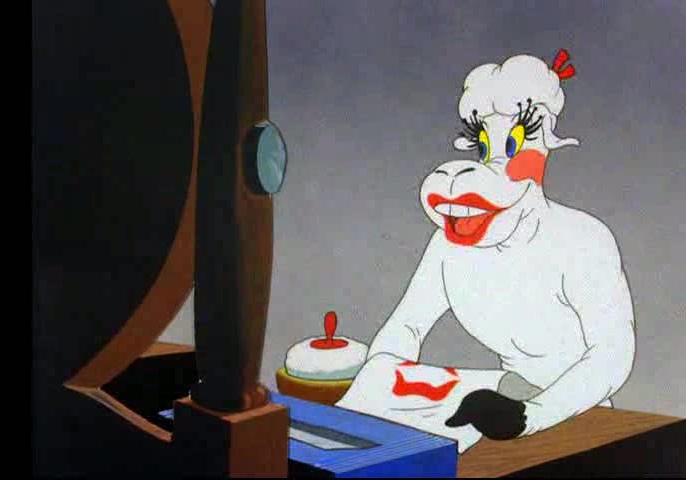
A Gruesome Twosome © Warner BrothersTwo cats, a yellow dopey one and a red one who’s a caricature of Jimmy Durante, fight over a little white kitten.

She tells them that she’ll go out with the first who brings her a little bird. Enter Tweety, who, despite his cute and helpless appearance, finishes with the two cats in no mild manner. On the contrary, ‘A Gruesome Twosome’ is probably the most violent of all classic cartoons. It’s also very beautifully animated, full of wild and zany action, and simply hilarious. The highlights are a dog, who “doesn’t actually belong in the picture” and a very silly pantomime horse costume.

With ‘A Gruesome Twosome’ director Bob Clampett made one of his most extreme cartoons. Its outrageousness splashes from the screen in every scene. Its theme of sex and violence is executed in a much wilder way than Tex Avery would do, let alone any other director of the era. The cartoon’s sheer energy still impresses today. In this way, ‘A Gruesome Twosome’ may be viewed as the ultimate Bob Clampett film.

‘A Gruesome Twosome’ was the last of the three Tweety cartoons Bob Clampett directed (the other two being ‘A Tale of Two Kitties’ from 1942 and ‘Birdy and the Beast’, 1944). The character would reappear in a redesigned, less grotesque and much cuter form in 1947 in ‘Tweety Pie’ to start a much better known career with Sylvester, as directed by Friz Freleng.

Watch ‘A Gruesome Twosome’ yourself and tell me what you think:

http://www.dailymotion.com/video/x1z5zgx_tweety-bird-ep-03-a-gruesome-twosome_fun

Director: Chuck Jones
Release Date: January 5, 1945
Stars: Pepe le Pew
Rating: ★★★★
Review:

Odor-able Kitty © Warner Brothers ‘Odor-able Kitty’, marks the debut of that French-speaking, amorous skunk Pepe le Pew.

In his book ‘Chuck Amuck’ Jones reveals that this character was based on story man Tedd Pierce. In any case, Pierce wrote the story, but how much of himself he had put self-knowingly into this smelly Don Juan remains a mystery.

Oddly enough, in his first cartoon Pepe turns out to be a fraud, being married and having two children. Even his voice changes in the end of the cartoon. But before this surprising finale he’s genuinely Pepe, complete with quasi-French accent, strange hop (including Stalling’s typical theme music), and a love for cats that look like skunks.

Only, in ‘Odor-able Kitty’ this is a male cat, who deliberately disguises himself as a skunk to get a happier life. He has one, until Pepe hops along. In the end, the cat washes himself and returns to his former life as victim of maltreatment, exclaiming “this is the life!”.

Pepe le Pew’s character didn’t really develop after this film, and all his films have more or less the same story as his debut film. Nevertheless Pepe would be one of the most successful of the characters conceived by Chuck Jones, second to the Road Runner and the Coyote, only. He lasted until 1962, starring fourteen more cartoons.

Watch ‘Odor-able Kitty’ yourself and tell me what you think:

http://www.220.ro/desene-animate/12-Odor-Able-Kitty/GcMYA69rME/

Directors: Tex Avery
Release Date: August 3, 1946
Stars: Droopy, The Wolf
Rating:  ★★★★★ ♕
Review:

Northwest Hounded Police © MGM

In ‘Northwest Hounded Police’ Avery revisited the material of ‘Dumb-Hounded‘ (1943) to make a film that is faster, more concise, more extreme, more paranoid and funnier than the original.

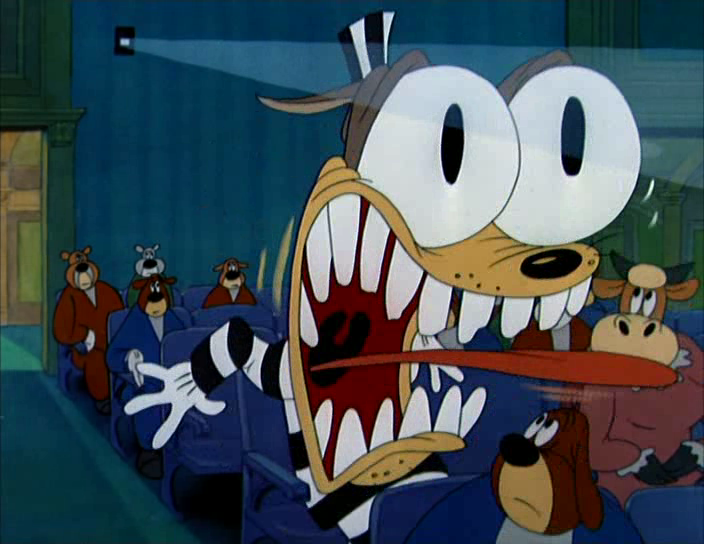
The idea of Droopy being everywhere is quickly established, while the focus lies on the wolf’s double takes, which get more and more extreme during the film, including the famous jaw drop. The cool part is that Droopy (or ‘Sergeant McPoodle’ as he’s called here) only has to be there to scare the wits out of the wolf. He doesn’t do anything but being there.

In the wolf’s double takes Tex Avery explores the limits of cartoon exaggeration. These extreme takes make ‘Northwest Hounded Police the epitome of animated cartoon paranoia, displaying a world of fear that has not been seen on the animated screen since the Fleischer cartoon ‘Bimbo’s Initiation‘ (1931). If there should be only one classic Tex Avery cartoon, this must be it.

Watch ‘Northwest Hounded Police’ yourself and tell me what you think:

http://www.veoh.com/watch/v202943sX3q26aT?h1=Northwest+Hounded+Police+-+Droopy

Directors: Tex Avery
Release Date: November 3, 1945
Stars: Droopy, Red, The Wolf
Rating: ★★★★★
Review:

Wild and Woolfy © MGMAfter the successful ‘The Shooting of Dan McGoo‘ Droopy from earlier that year, Red and the Wolf join forces again in ‘Wild and Woolfy’, a hilarious spoof on the classic western.

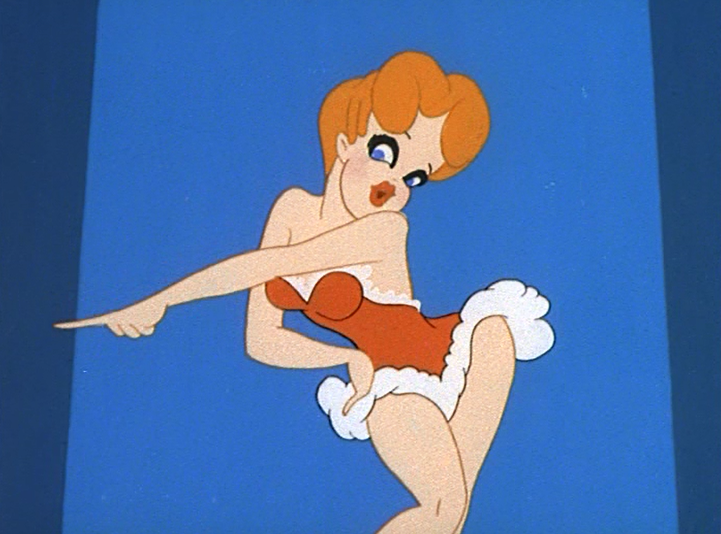
The cartoon has the simple plot of Droopy following the wolf, who has kidnapped Red after her performance of a nice country & western yodeling song. But Tex Avery once again packs the film with gags, including a wonderful and now classic empty road gag.

Film composer Scott Bradley reuses his twelve tone row he had introduced in the Tom & Jerry cartoon ‘Puttin’ on the Dog’ (1944) to accompany Droopy riding his little blue horse, with equally funny results.

Watch ‘Wild and Woolfy’ yourself and tell me what you think:

http://www.dailymotion.com/video/x3sxit_tex-avery-mgm-1945-wild-and-woolfy_fun

Directors: Tex Avery
Release Date: April 14, 1945
Stars: Droopy, Red, The Wolf
Rating: ★★★★★
Review:

The Shooting of Dan McGoo © MGMIn his second film Droopy enters the wolf’s world of sex, joining forces with the ever sexy Red as his lover Lou, while the wolf’s the villain entering the Alaskan saloon and Droopy is ‘dangerous Dan McGoo’ himself.

The cartoon is a hilarious re-telling of the poem ‘The Shooting of Dan McGrew’ by Robert Service. It is simply packed with self-conscious gags and puns. Red is absolutely stunning, when she sings a great army song, displaying her popularity with the armed forces. Her performance remains a tour of the force of animation, courtesy of animator Preston Blair.

‘The Shooting of Dan McGoo’ was Tex Avery’s second take on Service’s poem, the first being the Warner Brothers cartoon ‘Dangerous Dan McFoo‘  from 1939, which phlegmatic dog star anticipates Droopy.

Watch ‘The Shooting of Dan McGoo’ yourself and tell me what you think:

http://www.ebaumsworld.com/video/watch/83894809/

Directors: Tex Avery
Release Date: March 20, 1943
Stars: Droopy, The Wolf
Rating: ★★★
Review:

Dumb Hounded © MGM‘Dumb-Hounded’ marks the debut of Droopy, the first of all cartoon heroes to be deliberately deadpan.

He is introduced as a very slow bloodhound used to catch the escaped convict, the wolf. He manages to do so by being everywhere the wolf flees to.

Droopy’s übercalm contrasts nicely with the wolf’s extreme double-takes. The best gag is when Droopy asks the wolf not to move, whereupon the wolf uses a multitude of vehicles to flee to a very remote log cabin, only to find Droopy there, exclaiming: “you moved, didn’t you?”. This sequence has a lightning fast montage, something that is lacking from the rest of the film, which suffers a little from an inconsistent story line. The result is a film that is not quite satisfying in the end.

Tex Avery may have felt the same, for he would remake ‘Dumb Hounded’ only three years later with ‘Northwest Hounded Police‘, which uses the same or similar gags to a much greater comic effect.

After Bugs Bunny, Droopy would be Tex Avery’s best effort in creating a cartoon star. The phlegmatic dog would last until 1958, starring 24 cartoons in total. The wolf would be his adversary until 1949, after which he was exchanged for the bulldog Spike. Nevertheless, the wolf would return in 1954, in two Western cartoons, ‘Drag-along Droopy’ and ‘Homesteader Droopy’. Unfortunately, Droopy’s popularity would never come near MGM’s superstars Tom and Jerry, let alone win Academy Awards, like the cat and mouse duo did.

Watch ‘Dumb-Hounded’ yourself and tell me what you think:

https://www.dailymotion.com/video/x3f26u0

‘Dumb-Hounded’ is available on the Blu-Ray ‘Tex Avery – Scewball Classics Volume 1’ and the DVD ‘Tex Avery’s Droopy – The Complete Theatrical Collection’

Director: Bob Clampett
Release Date: June 28, 1945
Stars: Porky Pig
Rating: ★★★★★
Review:

Wagon Heels © Warner Brothers‘Wagon Heels’ is one of the least known of Bob Clampett’s masterpieces.

In this short Porky is as a scout of a ‘wagon train’ (a weird mix of a caravan and a train). He has to face ‘Injun Joe the Superchief’, an enormously powerful Indian. In this he’s helped by a very silly blue Hillbilly character called Sloppy Moe.

‘Wagon Heels’ is a remake of the already very funny ‘Injun Trouble’ (1938), but it’s weirder, zanier, wilder and much better timed than the original. ‘The film is extremely rich in nonsensical gags, the highlight being the demonstrations of Injun Joe’s indestructible power. The result is an utterly hilarious film, and an indisputed highlight in the Bob Clampett canon.

Watch ‘Wagon Heels’ yourself and tell me what you think:

https://www.dailymotion.com/video/x2yhp06

This is Porky Pig cartoon no. 110
To the previous Porky Pig cartoon: Trap Happy Porky
To the next Porky Pig cartoon: Baby Bottleneck

Director: Clyde Geronimi
Release Date: December 17, 1943
Rating:  ★★★★★
Review:

Chicken Little © Walt DisneyThis Disney short is an original take on the classic fable. It has a clear war message, even though there’s no direct visible link to World War II.

The villain, Foxy Loxy, uses a psychology book, from which he quotes, to lure the inhabitants of a poultry farm into his cave. The inhabitants of the poultry farm are clear representations of contemporary American society, including the upper class (turkeys), female middle class (chicken), male working class (ducks) and the youth (chickens and roosters, whom we see dancing to hot jazz in a short scene).

Foxy Loxy chooses a simpleton called Chicken Little as his main object, making him believe the sky is falling and encouraging him to spread the rumor. Originally, Foxy Loxy was to read from Adolf Hitler’s book ‘Mein Kampf’. It is not likely that the quotes are really from ‘Mein Kampf’, but they do contain surprisingly true lessons in how to manipulate the masses and how to undermine the present authority.

The film’s clear war message is not to fall for rumors and not to join mass hysteria. The film’s ending is as grim as there ever was one in a classic cartoon. In fact, the vision of a graveyard full of chicken bones is only topped by the similar ending in ‘Education for Death’ from the same year.

‘Chicken Little’ remains a little known Disney film, but its message is surprisingly fresh, and is probably even more valid today in an era in which propaganda and false rumors roam the internet and social media than it was during World War II.

‘Chicken Little’ was to be the last short directed by Clyde Geronimi before his dull comeback in ‘The big wash’ (1948). The Disney studio revisited the fable in 2005 in the feature film ‘Chicken Little’, which has ca. nothing in common with this far more interesting and disturbing short.

Watch ‘Chicken Little’ yourself and tell me what you think:

Director: Charles Nichols
Release Date: December 7, 1945
Stars: Pluto, The Little Turtle
Rating: ★
Review:

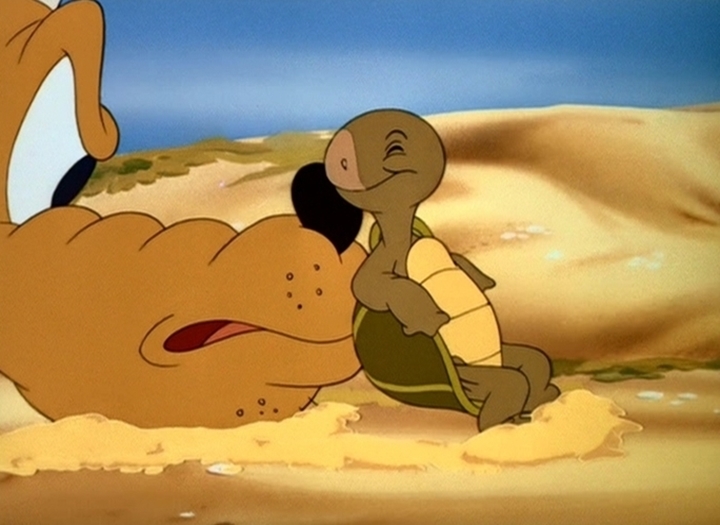
Canine Patrol © Walt DisneyIn this cartoon Pluto is a guard dog at the beach, trying to prevent a little cute turtle from swimming. After the little turtle saves Pluto from quicksand, the two become friends.

‘Canine Patrol’ is a cute, but slow and boring cartoon. It introduces the little turtle, the most popular of all animals Pluto befriended in his solo career. The turtle indeed is cute, but it hardly extracts any comedy out of its interactions with Pluto. Nevertheless, it would reappear in two more Pluto cartoons: ‘Pluto’s Housewarming‘ (1947) and ‘Pluto’s Surprise Package’ (1949), which both have all too similar stories.

Watch ‘Canine Patrol yourself and tell me what you think:

This is Pluto cartoon No. 16
To the previous Pluto cartoon: The Legend of Coyote Rock
To the next Pluto cartoon: Pluto’s Kid Brother

Director: Charles Nichols
Release Date: September 22, 1944
Stars: Pluto, Figaro, Minnie Mouse
Rating: ★★½
Review:

First Aiders © Walt DisneyAfter a cartoon with Cleo, Pinocchio‘s kitten Figaro was coupled to Pluto to co-star in three cartoons, of which ‘First Aiders’ is the first.

In this short both pets want to help Minnie while she’s practicing first aid. Pluto pushes little Figaro away to be the first, a move he regrets when he’s all put in plints and Figaro starts to taunt him.

Even though some of the animation is pretty outlandish, this is a cute, not a funny short. Most interesting are some of the backgrounds, which are kept deliberately vague during the chase scenes. Figaro and Pluto would be together again in ‘Cat Nap Pluto’ (1948) and ‘Pluto’s Sweater’ (1949). Both cartoons are more enjoyable than ‘First Aiders’.

Watch ‘First Aiders’ yourself and tell me what you think:

This is Pluto cartoon No. 12
To the previous Pluto cartoon: Springtime for Pluto
To the next Pluto cartoon: Dog Watch

Directors: William Hanna & Joseph Barbera
Release Date: July 7, 1945
Stars: Tom & Jerry
Rating: ★★★★★ ♕
Review:

Mouse in Manhattan © MGMTired of the country life, Jerry heads for Broadway, where he admires the big city.

Jerry’s luck is short-lived however, and after some bad experiences in the New York dumps (which involves hundreds of alley cats and scary subways), Jerry flees home, kissing a puzzled Tom in his joy.

‘Mouse in Manhattan’ is an outsider within the Tom & Jerry series, as it lacks the typical cat and mouse chase. Instead it focuses on Jerry’s journey, only. Nevertheless, it must be one of the most beautiful Tom and Jerry cartoons ever made. Jerry’s adventures in New York are accompanied by gorgeous and stunning backgrounds (most using a mouse perspective), and Scott Bradley’s particularly lush music. Bradley based his score on Louis Alter’s ‘Manhattan Serenade’ from 1928, which was also used in the MGM 1944 musical ‘Broadway Rhythm’, accompanying acrobatic stunts by the Ross Sisters. The music is so essential to the film, it almost seems the film was made for the score.

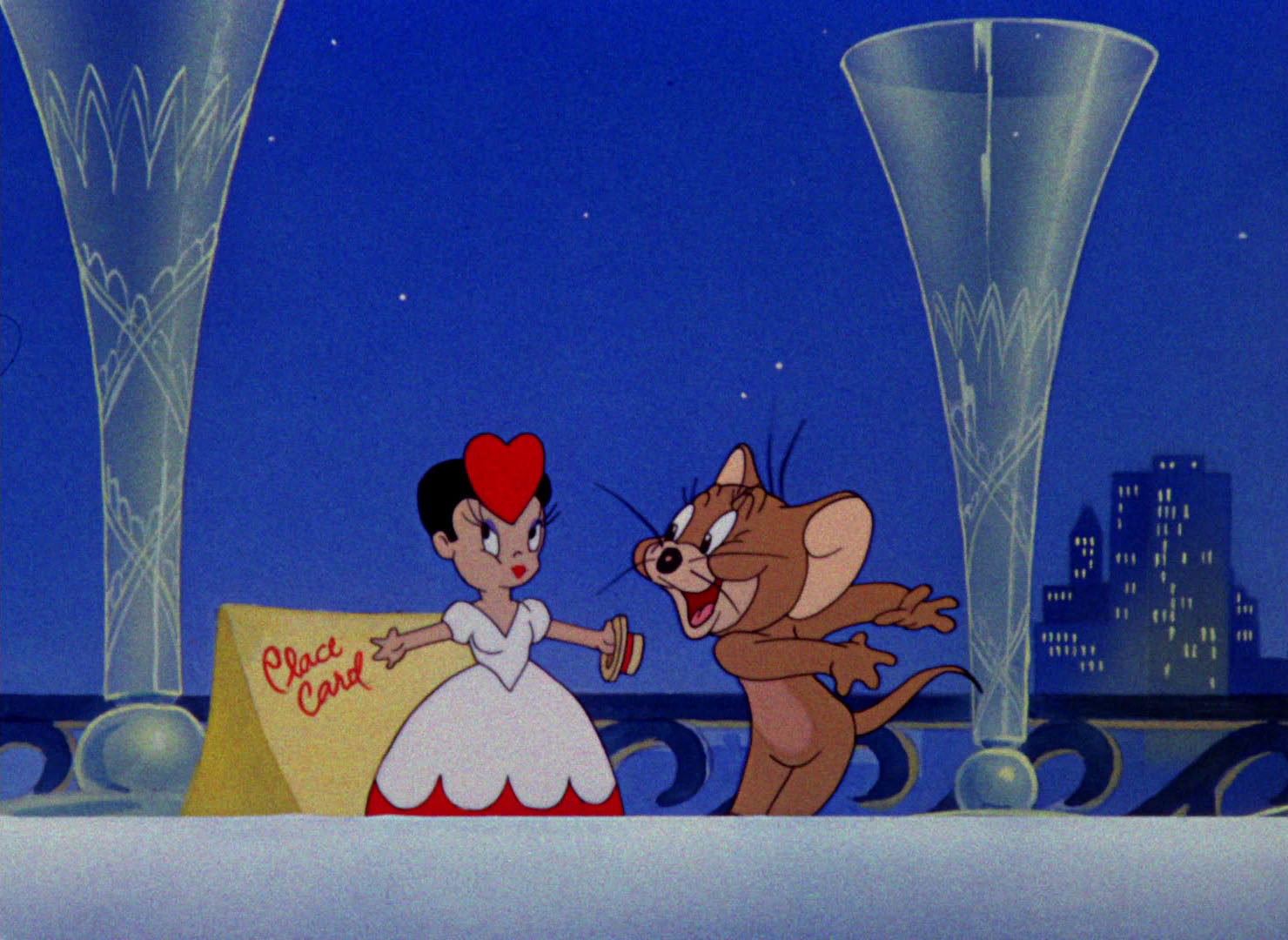
The cartoon is a sheer delight from the beginning to the end, but the highlight is Jerry’s dance with the female table figures on the roof of a very high hotel. This scene has the same class as its source of inspiration, the MGM musical.

Watch ‘Mouse in Manhattan’ yourself and tell me what you think:

https://vimeo.com/90733822

This is Tom & Jerry cartoon No.19

To the previous Tom & Jerry cartoon: The Mouse Comes to Dinner
To the next Tom & Jerry cartoon: Tee for Two

Director: Shamus Culhane
Release Date: October 4, 1944
Rating: ★★★★
Review:

Barber of Seville © Walter LantzWoody Woodpecker enters a barbershop to get a ‘victory’ haircut.

When the barber appears to be gone away, Woody himself steps in, maltreating a large chief and giving an Italian construction worker ‘the works’, singing the complete aria ‘Largo el factotum’ from Gioachino Rossini’s opera ‘The Barber of Seville’.

‘Barber of Seville’ is probably inspired by the barber scene from Charlie Chaplin’s ‘The Great Dictator’ (1940), which is set to a Hungarian dance by Brahms. The cartoon in its turn probably inspired Chuck Jones, who would use the opera’s overture in ‘Rabbit of Seville‘ (1950), with even better results.

‘Barber of Seville’ was the first Woody Woodpecker directed by Shamus Culhane. Culhane was an animation veteran, who had worked at Max Fleischer, Ub Iwerks, Van Beuren, Walt Disney and Warner Bros. Culhane obviously understood the character better than his predecessor Alex Lovy did: the gags in ‘Barber of Seville’ are faster and funnier, and the story is more consistent than in most of the earlier Woody Woodpecker cartoons.

Moreover, Woody Woodpecker looks better than ever before. Layout man and color stylist Art Heinemann redesigned the character to make him less grotesque, and more appealing. Unfortunately, Culhane would direct only ten Woody Woodpecker shorts, before he left the studio to set up one of his own to make animation films for television.

Watch ‘Barber of Seville’ yourself and tell me what you think:

This is Woody Woodpecker cartoon No. 10
To the previous Woody Woodpecker cartoon: Ration Bored
To the next Woody Woodpecker cartoon: The Beach Nut

‘Barber of Seville’ is available on the DVD-set ‘The Woody Woodpecker and Friends Classic Cartoon Collection’

Director: Frank Tashlin
Release Date: October 14, 1944
Rating: ★★★★★
Review:

Plane Daffy © Warner Brothers‘Plane Daffy’ opens with a military squad of pigeons hopelessly awaiting the return of Homer Pigeon, a dopey character, resembling Bob Clampett’s Bashful Buzzard from ‘Bugs Bunny Gets the Boid’ (1942).

This character has fallen into the clutches of Hatta Mari (an obvious reference to Mata Hari, a Dutch exotic dancer and spy during World War I). Hatta Mari appears to be a seductive pin up pigeon and a spy for the axis powers. After he realizes he has revealed his secret, Homer shoots himself (!).

The squad now seeks another for the job, to which Daffy, ‘the woman hater’, happily volunteers. Finally, after a wild chase, he too has to reveal his secret to the Fuehrer. But it turns out to be “Hitler is a stinker”, to which Adolf exclaims “that’s no secret!”, and Goehring and Goebbels add: “Ja! Everyone knows that!”.

‘Plane Daffy’ is one of the best war cartoons the Warner Bros. studio ever made. It may have been inspired by Walter Lantz’s ‘Pigeon Patrol’, but it’s much faster, wilder and zanier. It uses a voice over in rhyme, and citation-rich dialogue, and it’s full of extremely wild and zany animation.

Watch ‘Plane Daffy’ yourself and tell me what you think:

https://www.dailymotion.com/video/x1ykypg_daffy-duck-ep-31-plane-daffy_fun

This is Daffy Duck cartoon No. 27
To the previous Daffy Duck cartoon: Slightly Daffy
To the next Daffy Duck cartoon: The Stupid Cupid

‘My Favorite Duck’ is available on the DVD-set ‘Looney Tunes Golden Collection Volume Four’

Director: Hamilton Luske
Release Date: January 7, 1944
Rating: ★★★½
Review:

The Pelican and the Snipe © Walt DisneyMonte (a pelican) and Video (or Viddy, a snipe) live on top of a lighthouse in Montevideo, Uruguay (hence their names).

Viddy tries to prevent Monte, who’s crazy about the practicing war planes nearby, from ‘sleep-flying’. Unfortunately to no avail…

‘The Pelican and the Snipe’ probably is the cutest cartoon relating to World War II. Told by Sterling Holloway, its story is simple and short, and about friendship instead of sex or violence. Typical in its South American setting, it was originally intended for ‘The Three Caballeros‘,released later that year.

‘ The Pelican and the Snipe’ marks Sterling Holloway’s debut as a voice over artist in a Disney short, after appearing in ‘Dumbo‘ (Mr. Stork, 1941) and ‘Bambi‘ (adult Flower, 1942). Holloway would become Disney’s most  favorite voice actor, providing voices and voice overs for Disney cartoons up to the late 1970s. In fact, he will be most remembered as the voice of Winnie the Pooh (1966-1974).

Watch ‘The Pelican and the Snipe’ yourself and tell me what you think:

‘The Pelican and the Snipe’ is available on the DVD ‘Walt Disney Treasures: Disney Rarities’

Director: Frank Tashlin
Release Date: November 3, 1944
Rating: ★★★★
Review:

I Got Plenty of Mutton © Warner Brothers‘I Got Plenty of Mutton’ opens with a hungry wolf reading in the newspaper that the sheepdog is drafted, leaving the sheep unprotected.

Unfortunately, Killer-Diller, “the wolf destroying ram” is now in charge, giving the wolf a hard time, especially when the wolf dresses up as a sexy female sheep tot lure the ram away. When to get rid of the horny ram, the wolf reveals himself as being a wolf, the ram simply replies “so am I!”.

This cartoon is full of zany silent comedy, with frequent looks into the camera by the poor wolf, anticipating similar looks by Chuck Jones’ Coyote in his Road Runner series.

Watch an excerpt from ‘I Got Plenty of Mutton’ yourself and tell me what you think:

Director: Frank Tashlin
Release Date: December 11, 1943
Rating: ★★★
Review:

Puss 'n Booty © Warner BrothersThis cartoon opens with “Dicky Bird”, the canary, missing.

Rudolph, the cat who ate the bird (!), pretends the poor fellow has flown out of the window, so his mistress orders another one, which turns out to be considerably harder to catch.

The main body of ‘Puss ‘n Booty’ consists of blackout gags that anticipate the Tweety and Sylvester cartoons by four years.

This short was Warner Bros.’ last cartoon in black and white. Nevertheless, its broad use of blacks, greys and white and the startling camera angles (Frank Tashlin’s trademark) make it as modern as any other cartoon of the era.

Watch ‘Puss ‘n Booty’ yourself and tell me what you think:

Director: Jack King
Release Date: December 1943
Rating: ★★★½
Review:

Defense Against Invasion © Walt Disney‘Defense Against Invasion’ is an educational short for the Office of the Coordinator of Inter-American Affairs, the governmental institution, which tried to secure Latin America from the influence of the Axis powers.

The office commissioned quite a few films from Disney, apart from ‘Defense Against Invasion’ e.g. ‘The Grain that built a Hemisphere’ and’The Winged Scourge‘ (both 1943).

Despite its title, ‘Defense Against Invasion’ is not about war, but about vaccination. It uses a voice over to narrate the silent live action sequences of three boys entering a doctor’s office to get vaccinated. This live action part is a little boring, but the principle of vaccination is told with animated sequences in which the human body is depicted as a large city. Here we watch blood cells, ‘little workers’, fight disease (depicted as black creepy crawlers) with modern warfare. Oddly enough, it is the red blood cells, not the white blood cells (who are strangely absent), who are fighting disease.

Despite its peaceful message, the short contains many war metaphors in its fighting sequences, which all have a very science fiction-like look. This makes the short a typical World War II cartoon, after all. The animated sequences are very beautiful. Especially the backgrounds are at times no less than gorgeous.

With its depiction of the body as inhabited by little creatures ‘Defense Against Invasion’ predates Albert Barillé’s successful television series ‘Il était une fois… la vie’ (Once upon a Time… Life, 1987) by over forty years.

Watch ‘Defense Against Invasion’ yourself and tell me what you think:

Director: Bill Roberts
Release Date: August 27, 1943
Rating: ★★★★★
Review:

Reason and Emotion © Walt Disney‘Reason and Emotion’ is a rather odd propaganda short, telling us about Reason and Emotion, who are depicted as two little characters living inside our heads.

The short ‘demonstrates’ where uncontrolled emotion can lead to: a man gets slapped in the face by a woman, while the woman eats too much. This makes ‘Reason and Emotion’ one of the first cartoons about weight and diets.

Then the short shows how reason is destroyed by Adolf Hitler (in an extraordinarily vicious, but wonderfully animated caricature), who uses fear, sympathy, pride and hate to indoctrinate the Nazi mind. This is one of the propaganda shorts, which treat the Germans as victims of their Nazi leaders (see also ‘Education for Death‘ from the same year). This contrary to the Japanese, who, in WWII animated propaganda films, were all treated as despicable, mean and low. The film also warns against panic and falling for false rumors.

Emotion is depicted as a rough, dumb, but fun-loving caveman, while Reason is a bespectacled thin and rather boring character. One cannot resist to love the Emotion-type, especially in its female form, as depicted in the woman’s head. This female character is animated with gusto by Ollie Johnston.

Watch ‘Reason and Emotion’ yourself and tell me what you think:

Director: Chuck Jones
Release Date: July 3, 1943
Stars: Bugs Bunny
Rating: ★★★★★
Review:

Wackiki Wabbit © Warner BrothersTwo castaways on a raft are so hungry they are ready to eat each other.

Then they land on a tropical, quasi-Hawaiian island, which strangely enough is inhabited by Bugs Bunny, and the two hungry men immediately try to catch and eat our hero. Of course they don’t manage to do so, and in a hilarious end scene, it’s Bugs, not they, who sails off on an ocean stormer into the distance.

The two castaways were modeled on the cartoon’s story men, Tedd Pierce (the tall one) and Michael Maltese (the short one), and the two men actually voiced their cartoon counterparts themselves.

The cartoon’s real stars however, are its outrageous backgrounds. Designed by Bernyce Polifka and painted by her husband, Gene Fleury, they are arguably the boldest backgrounds in any cartoon from the pre-UPA-era. The island is depicted in brassy, strangely colored, semi-abstract to abstract images, with no sense of three-dimensionality, whatsoever. Nevertheless, the clearly three-dimensional characters read surprisingly well against the outlandish backgrounds.

Polifka had replaced John McGrew, who had worked with Fleury on experimental backgrounds for Chuck Jones cartoons like ‘Conrad the Sailor‘ (1942) and ‘The Aristo-Cat‘ (1943), but who had joined the navy in 1942. The couple shared McGrew’s boldness, and worked with Jones on ‘Hell-Bent for Election’ (1944), one of UPA’s earliest films. But apparently they left Warner Bros. somewhere in 1943-1944. In 1949 they worked for Lou Bunin’s part live action part stop motion feature ‘Alice in Wonderland’, but after this job, they seemingly disappeared from the animation world. So, ‘Wackiki Wabbit’ remains their most famous and greatest legacy. The backgrounds themselves can be admired on the late Michael Sporn’s excellent blogpost on this cartoon.

Watch ‘Wackiki Wabbit’ yourself and tell me what you think:

This is Bugs Bunny cartoon No. 18
To the previous Bugs Bunny cartoon: Jack Rabbit and the Beanstalk
To the next Bugs Bunny cartoon: A Corny Concerto

Director: Chuck Jones
Release Date: December 12, 1942
Stars: Bugs Bunny
Rating: ★★★★
Review:

Case of the Missing Hare © Warner BrothersBugs Bunny is bullied by a large magician, leading to his catch phrase “Of course you realize this means war”. In the second part of the film Bugs Bunny wrecks the magician’s show, and finally the magician himself.

Bugs’s catch phrase was borrowed from Groucho Marx, an important inspiration on Bugs Bunny’s character anyhow. The line would become typical for Bugs as directed by Chuck Jones. Unlike Bob Clampett, Jones would treat the rabbit not as intrinsically mischievous, but as reacting to injustice placed on him.

The large magician in ‘Case of the Missing Hare’ is the first of many particularly large adversaries Jones gave to Bugs, all bullying the rabbit into action. Thus, the magician is the direct forerunner of e.g. the warehouse keeper in ‘Hare Conditioned‘ (1945), the crusher in ‘Rabbit Punch‘ (1948) and Giovanni Jones in ‘Long-Haired Hare‘ (1949).

‘Case of the Missing Hare’ shows that by the end of 1942 Chuck Jones’s mastery over material had become fully realized. The cartoon features his typical character designs, extravagant key poses, original camera angles and sense of design. The latter is exemplified by background artists Gene Fleury and John McGrew’s very unnatural backgrounds. In the first part we watch pink trees and yellow skies. In the second part they got even bolder, reducing the backgrounds to abstract forms in two colors, only.

In its typical and original design and cinematography ‘Case of the Missing Hare’ looks forward to Jones’ mature work of the late forties and fifties.

Watch ‘Case of the Missing Hare’ yourself and tell me what you think:

This is Bugs Bunny cartoon No. 14
To the previous Bugs Bunny cartoon: The Hare-Brained Hypnotist
To the next Bugs Bunny cartoon: Tortoise Wins by a Hare

Enter your email address to follow this blog and receive notifications of new posts by email.

Join 918 other subscribers
Bookmark and Share

Categories