Director: Friz Freleng
Release Date: March 28, 1942
Stars: Bugs Bunny, Elmer Fudd
Rating: ★★★★
Review:

The Wabbit Who Came to Supper © Warner BrothersElmer Fudd will inherit three million dollars from Uncle Louie, if he doesn’t hurt any animal, especially rabbits. Bugs, of course, takes advantage of the situation.

‘The Wabbit Who Came to Supper’ was Friz Freleng’s second Bugs Bunny cartoon, only, but he understood the brassy character completely. The highlight of the cartoon is the scene in which in the middle of a chase a clock chimes and Bugs bursts into a convincing New Year routine… in July. This scene not only shows the fresh character’s overpowering personality, it also shows Bugs Bunny’s ability to produce necessary attributes out of nowhere, this time confetti and streamers.

Bugs’ design, however, is rather unappealing and uncertain in this cartoon. And Elmer Fudd, too, has the less appealing alternate fatty design, which Robert Clampett had introduced in ‘Wabbit Twouble‘ (1941). Luckily, this design was short-lived and lasted only four cartoons.

Two years later Hanna and Barbera would use the same plot idea in the Tom and Jerry cartoon ‘Million Dollar Cat’ (1944) with even better results.

Watch ‘The Wabbit Who Came to Supper’ yourself and tell me what you think:

This is Bugs Bunny cartoon No. 8
To the previous Bugs Bunny cartoon: Wabbit Twouble
To the next Bugs Bunny cartoon: The Wacky Wabbit


Director: Chuck Jones
Release Date: March 2, 1940
Stars: proto-Bugs Bunny, Elmer Fudd
Rating: ★★
Review:

Elmer's Candid Camera © Warner BrothersIn this slow and only moderately funny cartoon Elmer tries to photograph nature, but he’s hindered by a predecessor of Bugs Bunny.

This goofy rabbit is not quite Bugs, even though he behaves very calmly and does a Bugs-style death act. His looks and sounds are those of the crazy rabbit in ‘Hare-um Scare-um‘ (1939) and he still has the Woody Woodpecker-style laugh introduced in ‘Porky’s Hare Hunt‘ (1938). Jones has toned this loony fellow down, but it was to Tex Avery to introduce a really cool rabbit in ‘A Wild Hare‘ from four months later.

No, the importance of ‘Elmer’s Candid Camera’ lies in the fact that it marks Elmer’s debut. Although he’s still wearing an Egghead suit (the character from which he evolved), he lacks Egghead’s goofiness, and he has received his distinctive voice provided by Arthur Q. Bryan. Moreover, he utters his famous line “wabbit twacks” for the first time here.

Unfortunately, ‘Elmer’s Candid Camera’ is more historically interesting than entertaining, and outside its historical importance, the cartoon is quite forgettable.

Watch ‘Elmer’s Candid Camera’ yourself and tell me what you think:

http://ulozto.net/live/xzv5WBh/bugs-bunny-elmers-candid-camera-1940-avi

This is the last of four cartoons featuring a Bugs Bunny forerunner
To the first Bugs Bunny cartoon: A Wild Hare
To the previous proto-Bugs Bunny cartoon: Hare-um Scare-um


Directors: William Hanna & Joseph Barbera
Release Date: December 25, 1943
Stars: Tom & Jerry, Meathead
Rating: ★★★★★
Review:

Baby Puss © MGMA little girl makes Tom behave like a baby.

Tom only reluctantly cooperates, until he discovers the milk bottle. Jerry mocks him and warns three alley cats of Tom’s baby behavior. They mock him too, all too more violently, which leads to a frantic samba finale in which the little cat does a great Carmen Miranda impersonation, singing her hit song ‘Mamãe eu quero’ from the film ‘Down Argentine Way’ (1940).

Tom’s friends, the red cat from ‘Sufferin’ Cats‘, Meathead (in his debut) and a little cat, would reunite only seven years later in ‘Saturday Evening Puss‘ (1950). Apart from the finale the greatest scene is when Jerry behaves like ‘she’ is caught naked in the bathroom of a doll house.

Watch ‘Baby Puss’ yourself and tell me what you think:

https://vimeo.com/90508001

This is Tom & Jerry cartoon No.11

To the previous Tom & Jerry cartoon: Yankee Doodle Mouse
To the next Tom & Jerry cartoon: Zoot Cat

Directors: William Hanna & Joseph Barbera
Release Date: June 26, 1943
Stars: Tom & Jerry
Rating: ★★★★★
Review:

Yankee Doodle Mouse © MGMIn this Tom and Jerry short their chase routine is pictured as if it were World War II itself.

War references include a periscope, a “jeep”, (paper) planes, a bomber (throwing light bulbs), a parachute (a bra), and lots of fireworks. Tom is the clear villain now, with Jerry acting the role of the brave American soldier. At the end of the cartoon Tom explodes in the sky revealing the American flag to which Jerry salutes.

Although not a real war cartoon (Tom and Jerry do not fight Nazis or anything like that), it is drenched in war spirit. Moreover, the short is extremely fast and furious, with gags coming without any break. No wonder it won an Academy Award.

Watch ‘Yankee Doodle Mouse’ yourself and tell me what you think:

http://www.dailymotion.com/video/x2kxk46

This is Tom & Jerry cartoon No.11

To the previous Tom & Jerry cartoon: The Lonesome Mouse
To the next Tom & Jerry cartoon: Baby Puss

Directors: William Hanna & Joseph Barbera
Release Date: May 22, 1943
Stars: Tom & Jerry, Mammy Two-Shoes
Rating: ★★★½
Review:

The Lonesome Mouse © MGM‘The Lonesome Mouse’ is one of those Tom & Jerry cartoons in which the two enemies work together.

When Mammy throws Tom out of the house, Jerry rejoices. He even paints an Adolf Hitler-mustache and hairdo on Tom’s portrait, But then he gets lonesome, so he and Tom set up a great fake chase to get Tom back into the house.

Highlight of this cartoon are the loony faces Jerry makes to scare Mammy. Tom and Jerry actually talk in this cartoon.

Watch ‘The Lonesome Mouse’ yourself and tell me what you think:

https://www.dailymotion.com/video/x2mb43o

This is Tom & Jerry cartoon No.10

To the previous Tom & Jerry cartoon: Sufferin’ Cats
To the next Tom & Jerry cartoon: Yankee Doodle Mouse

Directors:William Hanna & Joseph Barbera
Release Date: January 16, 1943
Stars: Tom & Jerry, Meathead
Rating: ★★★★★ ♕
Review:

Sufferin' Cats © MGMIn ‘Sufferin’ Cats’ Tom and a red alley cat fight over Jerry.

‘Sufferin’ Cats’ introduces the red alley cat, who was Tom’s first rival in the series. The red cat would return in ‘Baby Puss‘ later that year, but soon he would be replaced by Meathead, a black cat.

‘Sufferin’ Cats’ is a wild and funny cartoon, which is considerably faster than all earlier Tom and Jerry shorts. The gags come in quick and plenty, and are supported by one of Scott Bradley’s all time best scores, in which Tom and Jerry’s musical themes build up to a frantic finale during the cartoon’s main chase. Metamorphosis now reaches greater heights than in ‘The Bowling Alley Cat‘, when the red cat changes into an ironing board when crashing into the gate.

With its increase in speed and violence ‘Sufferin’ Cats’ marks a new era in the Tom & Jerry Series: from now on the duo would be less cute, but much funnier.

Watch ‘Sufferin’ Cats’ yourself and tell me what you think:

https://vimeo.com/90507841

This is Tom & Jerry cartoon No.9

To the previous Tom & Jerry cartoon: Fine Feathered Friend
To the next Tom & Jerry cartoon: The Lonesome Mouse

Directors: William Hanna & Joseph Barbera
Release Date: October 10, 1942
Stars: Tom & Jerry
Rating: ★★★★½
Review:

Fine Feathered Friend © MGMDuring a chase at the barnyard Jerry seeks shelter with a large and angry chicken.

This short contains the very first example of the extreme cartoon violence that would become so typical for the Tom and Jerry series: the scene in which Jerry tries to cut off Tom’s head with a pair of hedge-shears.

The short’s highlight, however, is Jerry’s Josephine Baker-like dance with yellow feathers when he’s trying to disguise himself as a little chick.

‘Fine Feathered Friend’ is the first Tom & Jerry cartoon to start with their familiar opening tune.

Watch ‘Fine Feathered Friend’ yourself and tell me what you think:

https://vimeo.com/89586651

This is Tom & Jerry cartoon No. 8

To the previous Tom & Jerry cartoon: The Bowling Alley Cat
To the next Tom & Jerry cartoon: Sufferin’ Cats

Directors: William Hanna & Joseph Barbera
Release Date: July 18, 1942
Stars: Tom & Jerry
Rating: ★★★★★
Review:

The Bowling Alley-Cat © MGM‘The Bowling Alley Cat’ is the first Tom and Jerry cartoon to take please outside their familiar home setting. In this short the cat and the mouse play at an abandoned bowling alley.

The short is mildly paced, but its timing is excellent and the silent comedy delightful, supported by Scott Bradley’s excellent score.

The film contains an early example of metamorphosis, in which Tom changes into a familiar household object, this time a ninepin. This type of metamorphosis would become a recurrent gag in the Tom & Jerry series. Compared to later entries Tom’s deformation in ‘The Bowling Alley Cat’ is mild, and still a little plausible. This kind of plausibility was abandoned the next year in the more frantic cartoon ‘Sufferin’ Cats‘.

Watch ‘The Bowling Alley Cat’ yourself and tell me what you think:

https://vimeo.com/115542388

This is Tom & Jerry cartoon No. 7

To the previous Tom & Jerry cartoon: Puss ‘n Toots
To the next Tom & Jerry cartoon: Fine Feathered Friend

Director: Juan Antin
Release Date: October 3, 2002
Rating: ★★★
Review:

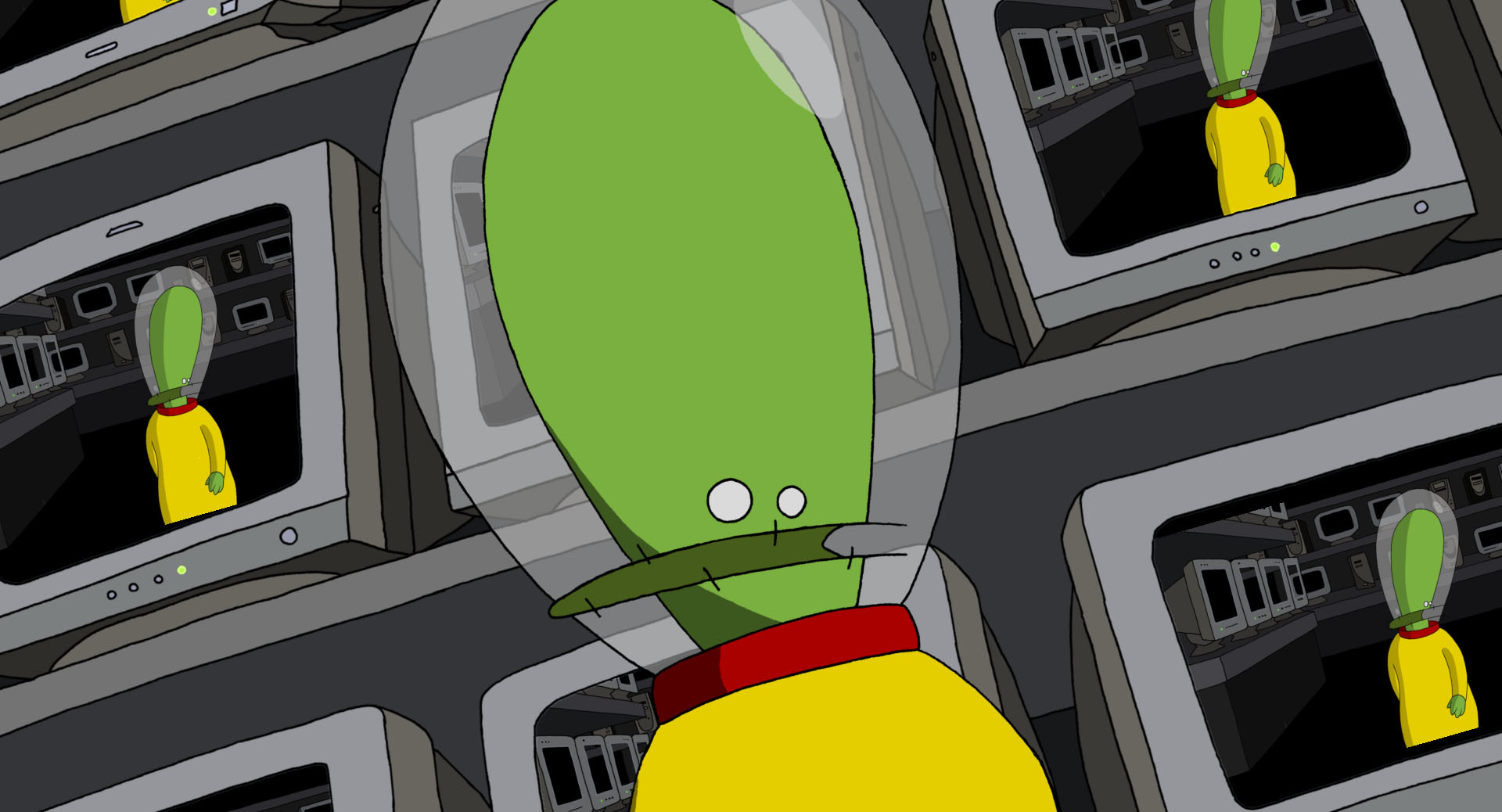
Mercano el marciano © Juan Antin‘Mercano el Marciano’ is a curious feature film from Argentine about an ugly little Martian who gets stranded in the evil city of Buenos Aires, where he ends up living in the sewer.

Here he builds a virtual Mars to play in for himself on the internet, but soon it is discovered and exploited by businessmen. Together with a nerdy boy and a trio of alternatives Mercano takes revenge. This leads to a silly musical finale.

The film uses original designs and is nicely animated. Unfortunately, it is also hampered by slow timing, poor gags, graphic violence, ugly colors and bad sound design. The result is an original, yet mediocre film, which is not too surprising, when one considers the film was made with a budget of only $250,000 (for comparison: a contemporary Hollywood production like ‘Monsters, Inc’ cost $115 million).

‘Mercano el Marciano’ seems to be an early example of an international movement in animation film, which favors urban settings, violence and rather adult material (e.g. ‘The District!’ (2004)  from Hungary, and ‘George the Hedgehog’ (2011) from Poland).

Watch ‘Mercano el Marciano’ yourself and tell me what you think:


Directors: Dean DeBlois & Chris Sanders
Release Date: June 21, 2002
Rating: ★★★★★
Review:

Lilo & Stitch © Walt DisneyStitch is a genetic experiment (called ‘experiment 6-2-6’) designed to destroy, but sentenced into exile by an intergalactic councel.

All too soon our fluffy little mutant escapes and he ends at the Hawaiian island of Kauai, where he befriends lonely little Lilo, who lives a difficult life with her older sister Nani after the death of their parents. Here Stitch learns to tone down his inclination to destruction and how to love and care.

‘Lilo & Stitch’ is a very appealing film. Its designs, based on Chris Sanders’ idiosyncratic story drawings, are round, cuddly and original. Adding to the friendly atmosphere are the lush watercolor backgrounds, the first in a Disney feature since ‘Bambi‘ (1942). The animation is superb throughout, and Lilo, Stitch and Nani are round and instantly likable characters, who have nothing of the wisecracking arrogance of many other animated characters from the era. The film’s familiar family theme never gets cloying and is countered by a lot of humor. The result is a film full of love and joy.

Probably, because it was made in Orlando, Florida, far from the main company, the film also eschews the rather tiresome Disney musical convention, and features an original soundtrack featuring Elvis Presley songs and Hawaiian chants, instead. True, the plot borrows freely from ‘Men in Black’ (1997), and the science fiction setting feels a little awkward in a Disney film, but the story of loneliness, love and acceptance is well-told, and equally appealing to the young and old.

Moreover, the film proves that one can perfectly well make a good movie out of original and typical elements. A film maker like Hayao Miyazaki knows this, off course. But unfortunately, this message has been lost on the American animation studios, as very few of the subsequent American feature films succeeded in displaying this level of originality in characterization, soundtrack and design. Thus ‘Lilo & Stitch’ remains as Disney’s best attempt at an ‘author film’ (not counting the almost forgotten ‘Teacher’s Pet’ from 2004).

Unfortunately, ‘Lilo & Stitch’ seemed to be Disney’s last masterpiece of traditional animation. Even though it was followed by yet two other 2D animation features, it marked an end of an era lasting 65 years. Disney soon jumped the computer animation band wagon with rather mediocre results, arguably only hitting their stride in 2010 with ‘Tangled‘. Luckily, in 2009 the studio made a surprising, but unfortunately isolated return to the traditional medium with the excellent ‘The Princess and the Frog’.

Watch the trailer for ‘Lilo & Stitch’ yourself and tell me what you think:

Director: Chris Wedge
Release Date: March 15, 2002
Rating: ★★★★
Review:

Ice Age © Blue SkySet in the last ice age (ca. 20,000 years ago), a mammoth and a ground sloth try to return a human baby to its tribe, helped by a saber-toothed tiger with a hidden agenda.

The Ice Age itself is depicted well, with lots of crispy ice and snow, and fauna that matches the period. We watch various North-American ice age mammals, like mammoths, ground sloths, saber-toothed tigers, Glyptodonts, and even the South American species Macrauchenia (which looks like a llama with a trunk). The only mishaps are the two Brontotheres, mistakenly referred to as “rhinos”, a group of species that had died out 34 million years earlier. Fortunately, the makers didn’t fall for the trap of making dinosaurs co-exist with early humans (although we see one trapped in the ice, in a scene that is nonsensical anyhow).

‘Ice Age’ was Blue Sky’s first feature film. It was made for 20th Century Fox, who had just dumped Don Bluth’s Phoenix Studio. With this film Blue Sky/20th Century Fox posed serious competition to Dreamworks and Pixar with a different, yet equally interesting style of computer animation, which was more based on caricature, exaggerated animation and angular designs. The latter unfortunately lead to rather ugly designed humans.

The story of ‘Ice Age’ has uncanny similarities to the computer animation successes of 2001, ‘Shrek’ (a moody giant and an annoying chatterbox travel together), and ‘Monsters, Inc.‘ (strange creatures trying to get a little human kid home). So in this respect, the film tells us nothing new. Its extras can be found in the cartoony character Scrat, whose antics bridges the main action, and in the numerous gags on evolution.

The highlight of the film, however, is the 2D animation of mural paintings depicting Mannie the mammoth’s painful memory of the loss of his wife and son. This is a stunning tour-de-force of both daring and emotional animation, still a rare feat in computer animated feature films.

‘Ice Age’ was a huge success, and has spawned a number of sequels, none of witch mastered to keep the lean storytelling of the first film. Moreover, the stories had less and less to do with the ice age setting. Even worse, in ‘Ice Age 3’ dinosaurs had to come along, after all…

Watch the trailer for ‘Ice Age’ yourself and tell me what you think:

Director: Bruno Bozzetto
Release Date: 1983
Rating: ★★
Review:

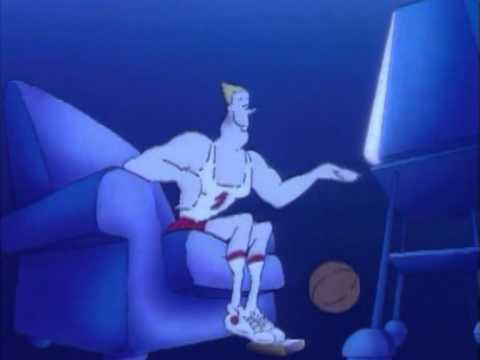
Sigmund © Bruno Bozzetto‘Sigmund’ is a very short cartoon, commissioned for the 1984 Olympic Games in Los Angeles.

The cartoon consists of one scene in a blue room in which a bespectacled little boy imagines himself as the sport stars he watches on television. The little boy’s imagination is shown by metamorphosis: we watch him change into the sport stars, growing with every metamorphosis.

‘Sigmund’ is a sweet short, but neither memorable, funny or one of Bozzetto’s best.

Watch ‘Sigmund’ yourself and tell me what you think:

Director: Bruno Bozzetto
Release Date: October 31, 1968
Rating: ★★★★
Review:

Vip mio fratello superuomo © Bruno Bozzetto

‘Vip mio fratello superuomo’* is Bozzetto’s second feature, and it a great improvement on his first (‘West and Soda‘ from 1965).

The designs are bolder, the pace is higher, the timing sharper, and the story more original. The film starts rightaway with a hilarious history of the VIP superheroes through time. It then introduces our heroes, the superhero SuperVIP and his weak little bespectacled brother, MiniVIP. They end upon an island where a super-villain plans to turn mankind into brainless consumers.

The result is a very nonsensical superhero story, told to a great effect, with the minimum of means and very limited animation.  It also shows Bozzetto’s aversion against consumerism, a theme he would expand upon in his masterpiece ‘Allegro non troppo’ (1976). Unlike that latter feature, ‘Vip mio fratello superuomo’ remains virtually unknown. This is a pity, for this funny film deserves a wider audience.

Watch and excerpt from ‘Vip mio fratello superuomo’ yourself and tell me what you think:

* also known as ‘My Brother Superman’

Director: Bruno Bozzetto
Release Date: 1967
Rating: ★★★★
Review:

Una vita in scatola © Bruno BozzettoThe title of this cartoon can be translated as ‘life in a tin can’ and this is an apt title.

In this cartoon Bozzetto reduces a man’s whole life to several minutes. The main character’s life takes place in and between depressingly tall grey buildings. He is only allowed brief episodes of sheer joy: during is boyhood, when he falls in love, and when he becomes a father. These short episodes are depicted by colorful pictures of nature, accompanied by lyric music.

‘Una vita in scatola’ must be Bozzetto’s most perfectly timed cartoon, and it is his first real masterpiece.

Watch ‘Una vita in scatola’ yourself and tell me what you think:

Director: Friz Freleng
Release Date: December 2, 1961
Stars: Tweety & Sylvester
Rating: ★★★★½
Review:

The Last Hungry Cat © Warner Bros.‘The Last Hungry Cat’ must be one of the best entries in the Tweety and Sylvester series.

The short is a parody of the television show ‘Alfred Hitchcock Presents’, which aired from 1955 to 1965. Luckily, you don’t have to be familiar with this program (I’m not) to enjoy this cartoon.

Introduced by an Alfred Hitchcock-like shadow of a pig, the short tells the story of Sylvester, who for once thinks he has actually eaten Tweety and who is then eaten by guilt.

The cartoon makes use of a conscience-like voice-over and very beautifully colored and a surprisingly large amount of well-staged angular backgrounds (staged by Hawley Pratt, who gets co-directing credits, and painted in beautiful blues and yellows by Tom O’Loughlin). The images succeed in evoking an atmosphere that reflects Sylvester’s inner feelings. Especially the staging of Sylvester’s sleeplessness is very well done: still images of Sylvester lying awake are inter-cut with close-ups of his alarm clock, in rapid succession, zooming in all the time. These scenes are accompanied by Milt Franklyn’s ominous music and insistent ticking of the clock, only.

It’s a surprise such a well-made, beautiful and compelling cartoon could be made as late a 1961. The short is a worthy addition to the very small guilt cartoon canon, which also includes ‘Nursery Scandal‘ from 1933, ‘Pudgy Picks a Fight‘ from and ‘Donalds’ Crime’ from 1945.

Watch ‘The Last Hungry Cat’ yourself and tell me what you think:

https://www.dailymotion.com/video/x5johhj

Director: Walter Lantz or Bill Nolan
Release Date: May 27, 1935
Stars: Oswald
Rating: 
Review:

Springtime Serenade © Walter Lantz‘Springtime Serenade’ features Oswald and his unnamed girlfriend among some cute furry animals.

They all believe spring has come, even though the old groundhog warns them for six more weeks of cold weather. After some joyous spring cleaning (what the &$#?!!), the groundhog turns out to be right after all.

This Cartune Classic is as cloying as it is unfunny. Tex Avery, who was an animator at Lantz’s at the time, would deal with cute furry animals such as these ten years later in ‘The Screwy Truant’ (1945).

Watch ‘Springtime Serenade’ yourself and tell me what you think:

Director: Walter Lantz or Bill Nolan
Release Date: October 1, 1934
Rating: 
Review:

Jolly Little Elves © Walter Lantz‘Jolly Little Elves’ is the first of six Cartune Classics, Walter Lantz’s answer to Disney’s Silly Symphonies. These six cartoons were made in two color technicolor, using red and blue, and all are possible even more cloying than contemporary Silly Symphonies themselves.

‘Jolly Little Elves’, for example, is a practically humorless fairy-tale in song about a poor shoemaker and his wife who help a little elf and get all their shoes repaired by hundreds of elves in return.

The cartoon is corny, overlong and features an irritating song about dunking donuts in coffee. Also featured are two severely caricatured Jewish elves. It’s a wonder that was one of the three Academy Award nominations for 1934. Luckily it lost to Disney’s by all means superior cartoon ‘The Tortoise and the Hare’.

Sixteen years later, Tex Avery, who was an animator at Lantz at the time, would remake and make fun of ‘Jolly Little Elves’ in ‘The Peachy Cobbler’ (1950).

Watch ‘Jolly Little Elves’ yourself and tell me what you think:

Director: Unknown
Release Date: April 30, 1928
Stars: Oswald the Lucky Rabbit, Peg Leg Pete
Rating: ★★★½
Review:

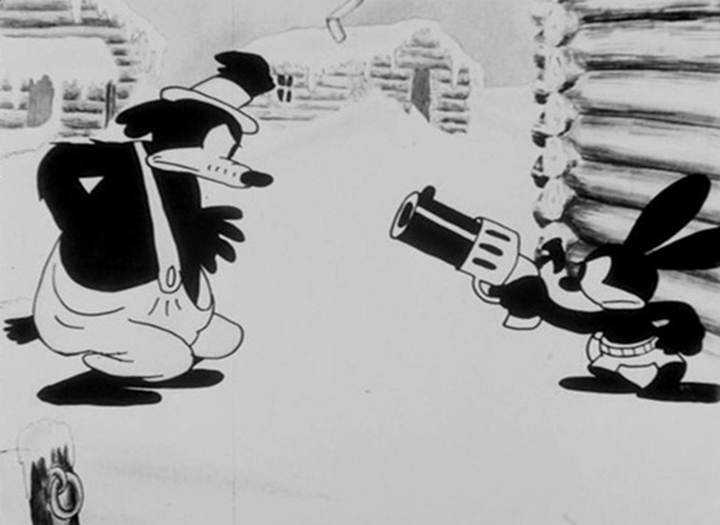
Ozzie of the Mounted © Walt DisneyOswald is a mounted police officer in charge of catching Peg Leg Pete, who, in spite of his name, has two legs here.

Oswald follows Pete on a mechanical horse, but in the end they’re both chased by a bear. Oswald, however, manages to get both Pete and the bear into prison.

‘Ozzie of the Mounted’ feels rather routine, and is less remarkable than say ‘Rival Romeos‘ or ‘Oh, What a Knight‘. The chase scene fills a large part of the cartoon, but contains few clever gags. Nevertheless, the animation of Oswald swinging around on his mechanical horse’s loose spring is still fascinating to watch. It’s also interesting to point out that Oswald’s mechanical horse looks far more mechanical than his mechanical cow in ‘The Mechanical Cow‘ from seven months earlier. This shows the subtle but steady progress the Walt Disney studio was making in animation, even before it became famous for that.

Watch ‘Ozzie of the Mounted’ yourself and tell me what you think:

This is Oswald the Lucky Rabbit cartoon No. 18
To the previous surviving Oswald the Lucky Rabbit cartoon: Bright Lights
To the next Oswald the Lucky Rabbit cartoon: Hungry Hoboes

Director: Unknown
Release Date: March 19, 1928
Stars: Oswald the Lucky Rabbit
Rating: ★★★½
Review:

Bright Lights © Walt DisneyAlthough broke, Oswald tries to enter a vaudeville theater where Mademoiselle Zulu performs her shimmy dancing.

After we watch some cat chorus girls dancing the can-can, Mll. Zulu, a female cat character, is shown doing her erotic shimmy dance, probably inspired by Josephine Baker. Oswald manages to enter the theater by hiding beneath a man’s shadow(!), but he is discovered. He tries to hide in a cage, which contains a fierce leopard. When the leopard breaks loose, and later a couple of lions, the whole theater is emptied.

This rather plotless, yet entertaining short contains many surreal gags and a very flexible use of body parts. Oswald’s body is deformed even more than normal, and in one scene we watch him without his pants on.

The best scene is when Oswald pantomimes his love for Mlle. Zulu. This scene is acted out very well, and this embryonic character animation is far more sophisticated than the animation surrounding it.

Watch ‘Bright Lights’ yourself and tell me what you think:

This is Oswald the Lucky Rabbit cartoon No. 15
To the previous Oswald the Lucky Rabbit cartoon: Rival Romeos
To the next surviving Oswald the Lucky Rabbit cartoon: Ozzie of the Mounted

Director: Unknown
Release Date: March 5, 1928
Stars: Oswald the Lucky Rabbit, Honey, Pete
Rating: ★★★★½
Review:

Rival Romeos © Walt DisneyIn this gag-packed cartoon Oswald and Pete compete over Honey, a female cat character, who was Oswald’s girlfriend in 1928.

Pete and Oswald both ride in their cars to her house in a scene looking forward to the early Mickey Mouse cartoon ‘The Barn Dance‘ from later that year. Oswald serenades her until a goat eats all his sheet music and even his banjo. Then he turns the animal into a hurdy gurdy, like Mickey would do later that year in ‘Steamboat Willie‘. When Pete arrives, he and Oswald fight over Honey, almost tearing her apart. Honey gives them the cold shoulder and leaves with a third guy into the distance. Then our rivals kick each other in remorse, like Donald Duck and Peter Pig would do six years later in ‘Wise Little Hen‘ (1934).

As you may notice, ‘Rival Romeos’ contains quite a lot of embryonic gags that Walt Disney would reuse later in other cartoons. Because of these prophetical gags ‘Rival Romeos’ is a highlight among Disney’s Oswald cartoons.

Watch ‘Rival Romeos’ yourself and tell me what you think:

This is Oswald the Lucky Rabbit cartoon No. 14
To the previous Oswald the Lucky Rabbit cartoon: Africa Before Dark
To the next Oswald the Lucky Rabbit cartoon: Bright Lights

Enter your email address to follow this blog and receive notifications of new posts by email.

Join 918 other subscribers
Bookmark and Share

Categories