Director: Nick Mackie
Release Date: 1999
Rating: ★★
Review:

Minotaur & Little Nerkin © Aardman‘Minotaur & Little Nerkin’ is a curious 2d computer animation, which looks like it is designed for children.

However, its story is rather black. The film features a minotaur who lurks a duck into his home to eat a captivated human hand, only in order to eat the duck himself. Remarkable for its morbid humor and original technique, it is nonetheless an ugly and unfunny film, that fails to entertain, let alone impress the viewer.

Watch ‘Minotaur & Little Nerkin’ yourself and tell me what you think:

‘Minotaur & Little Nerkin’ is available on the DVD ‘Aardman Classics’

Director: Mark Brierley
Release Date: 1998
Rating: ★
Review:

Al dente © Aardman‘Al dente’ is another film by computer animation pioneer at Aardman, Mark Brierley.

This short film looks even more primitive than ‘Owzat’ from the previous year. It doesn’t feature any backgrounds of notice, and the main character, a grumpy waiter who has to serve a vegetarian meal at a meat restaurant, looks primitive and unimaginative. The film is utterly mediocre and, like ‘Owzat’, probably would never have been released were it not an Aardman production.

Watch ‘Al dente’ yourself and tell me what you think:

‘Al dente’ is available on the DVD ‘Aardman Classics’

Director: Mark Brierley
Release Date: 1997
Rating: ★
Review:

Owzat © AardmanIn a graveyard a skeleton plays cricket with some unwilling ghosts.

‘Owzat’ is Aardman’s first endeavor into computer animation and it pales when compared to Pixar films from the same period. The designs look hopelessly primitive, the animation is stiff and the colors are rather ugly. As the film is quite incomprehensible, slow and unfunny, one wonders why it was made in the first place. It looks like a study, and it probably wouldn’t have been released if it had not been an Aardman production.

Watch ‘Owzat’ yourself and tell me what you think:

‘Owzat’ is available on the DVD ‘Aardman Classics’

Director: Boris Kossmehl
Release Date: 1993
Rating: ★★★★
Review:

Not Without My Handbag © AardmanWhen she hasn’t paid her washing machine, a girl’s aunt has to go to hell.

However, she soon returns as a zombie to fetch her handbag. The devil tries to take her once again, this time disguised as the handbag.

Atypical for the Aardman studios, ‘Not Without My Handbag’ features puppet animation and hardly any clay animation. It’s a highly designed film, using stark colors, extreme camera angles and expressionistic decors. Its unique style is somewhat akin to that of Tim Burton, but is even more idiosyncratic. Despite its horror theme, the film is more lighthearted than the earlier Aardman films ‘Adam‘ (1991) or ‘Loves Me, Loves Me Not‘ (1992), because of its zany humor and matter-of-fact dialogue. For example, when her aunt returns as a zombie, the girl suddenly turns to camera and says proudly: “My auntie is a zombie from hell!”.

‘Not Without My Handbag’ is a modest masterpiece: it’s unpretentious, but it combines originality with virtuosity. The animation of the evil handbag is particularly good. Director-animator Boris Kossmehl later moved to 3D computer animation, performing character animation for Dreamworks’ ‘Antz’ and ‘Shrek’.

Watch ‘Not Without My Handbag’ yourself and tell me what you think:


‘Not Without My Handbag’ is available on the DVD ‘Aardman Classics’

Director: Jeff Newitt
Release Date: 1992
Rating: ★★★
Review:

Loves Me, Loves Me Not © AardmanA gentleman uses a flower to determine whether his girl loves him or not.

The contrasts between happiness (she loves him) and pain (she loves him not) get more and more extreme during the film, providing unsettling images of terror.

Like ‘Adam‘, ‘Loves Me, Loves Me Not’ is an example of dark humor, typical for the Aardman Studios at the time. The dark humor is typified by the screams of pain the flower exclaims, when its petals are removed, by the highly disturbing soundtrack and by the images of suicide and threat.

Combining virtuoso clay animation with some cel animation, the film is a technical masterpiece. It also features some great silent comedy, and especially the deft gestures of the Clark Gable-like gentleman are nicely done.

Watch ‘Loves Me, Loves Me Not’ yourself and tell me what you think:

‘Loves Me, Loves Me Not’ is available on the DVD ‘Aardman Classics’

Director: Peter Lord
Release Date: 1991
Rating: ★★★½
Review:

Adam © AardmanA giant hand creates a man on a tiny planet.

His creator orders the man around, but the man soon discovers his barren sphere is too small to do anything, and that he is stuck to it. Luckily, in the end the creator grands him a companion, which turns out to be a penguin (iris out).

‘Adam’ exploits the dark humor typical for the early Aardman films. Its claustrophobia feels real and disturbing, and the film raises inevitable questions about existence and purpose of life. And though ‘Adam’ contains great silent comedy gags, the film is rather unsettling overall. Unfortunately, the film’s comedy is hampered by Stuart Gordon’s rather ugly electronic music. However, Lord’s animation is superb throughout, and a prime example of the more comedy-driven animation style the Aardman studio took from 1989 on.

Watch ‘Adam’ yourself and tell me what you think:

‘Adam’ is available on the DVD ‘Aardman Classics’
Director: Osvaldo Cavandoli
Release Date:
 1991
Stars:
 La Linea
Rating:
 ★★
Review:

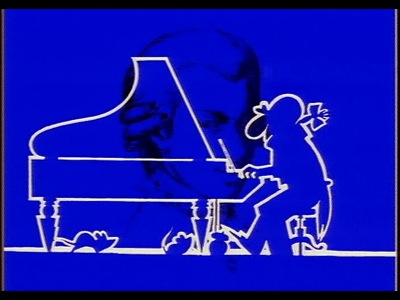
Trazom, A.W. © Oscar CavandoliTrazom, A.W. Is W.A. Mozart spelled backwards and it’s Cavandoli’s hommage to the composer.

We watch La Linea dressed like an 18th century composer playing Mozart’s K545 sonata on the grand piano. Meanwhile he encounters several animals and people.

Unfortunately, the cartoon is slow, repetitive and rather unfunny. La Linea’s irresistible voice is hardly heard and this cartoon lacks the brazen humor of the earlier entries. And it completely pales when compared to classic piano concerto cartoons like ‘Rhapsody Rabbit‘ (1946) or ‘The Cat Concerto‘ (1947).

‘Trazom, A.W.’ is available on the DVD ‘La Linea 3’

Director: René Laloux
Release Date: 1988
Rating: ★★★★½
Review:

La prisonnière © René Laloux‘La Prisonnière’ is a short, rather surrealistic science fiction film about two children.

They visit an extraterrestrial monastery and witness a rescue of a prisoner by naked women who step out of a stranded whale.

The film looks like an animated version of designer Caza’s source comic, Équinoxe (which can be found here), and contains only a limited amount of animation. In his designs Caza’s style is very reminiscent of that of his fellow french comic artist Moebius.

‘La prisonnière’ seems like an etude for Laloux’s and Caza’s much bigger project, the feature film ‘Gandahar‘ (1988). The atmosphere of the short is poetic, if completely incomprehensible.

Watch ‘La Prisonnière’ yourself and tell me what you think:

‘La Prisonnière’ is available on the DVD ‘Gandahar’

Director: Peter Lord
Release Date: 1989
Rating: ★★½
Review:

War Story © AardmanWith ‘War Story’ the Aardman studio returned to their original lip-synch experiments with real dialogue.

This time they use an interview with one Bill Perry, an old man who tells his memories of his life in Bristol during World War II. Unlike the ‘Animated conversations’ series, however, there is room for goofy images exaggerating the tall tales of the voice over, which involve a slant house and lots of coal. The film’s images are very tongue-in-cheek, yet this film once again suffers from a bad soundtrack, and the old man’s mumblings are at times very difficult to follow, indeed.

The blending of real interviews with original and humorous images would be perfected in ‘Creature Comforts’ by Nick Park, who also animated on this film. In this sense ‘War Story’ is an important step towards Aardman’s mature style, which was to become less serious, and more cartoony, and consequently, more commercially successful.

Watch ‘War Story’ yourself and tell me what you think:

‘War Story’ is available on the DVD ‘Aardman Classics’

Director: Richard Goleszowski
Release Date: 1989
Rating: ★★★½
Review:

Ident © Aardman‘Ident’ is a surrealistic film about how we change our identity over the course of a day according to the people we meet.

The film uses highly original and very stylized designs, and jabbering dialogue to an alienating effect. Its claustrophobic labyrinth setting alone is unsettling. The film is not heavy-weighted, however, but keeps a light sense of humor. It also features a flat dog that was to become the direct ancestor of Rex the Runt.

Watch ‘Ident’ yourself and tell me what you think:

‘Ident’ is available on the DVD ‘Aardman Classics’

Director: ?
Release Date: 1987
Rating: ★★★★
Review:

My Baby Just Cares For Me © Aardman‘My Baby Just Cares For Me’ was Aardman Studio’s second video clip, after ‘Sledgehammer’ for Peter Gabriel (1986).

‘My Baby Just Cares For Me’  is not quite as elaborate, however. It’s a sweet little video in mostly black and white. It’s set to Nina Simone’s 1958 recording of the song, which was reissued in 1987 after being used in a successful commercial for Chanel No.5.

The clip features cat characters, including a black female cat singer, and a white cat who’s in love with her. It also features some live action footage showing details of a piano, brushes on a snare drum, and a double bass.

The smoky nightclub atmosphere is captured very well, and the animation, joyful if a little crude, matches the song perfectly. The result is one of the most enjoyable little stop motion films of the 1980s.

Watch ‘My Baby Just Cares For Me’ yourself and tell me what you think:

‘My Baby Just Cares For Me’ is available on the DVD ‘Aardman Classics’

Director: Peter Lord & David Sproxton
Release Date: 1986
Rating: ★★
Review:

Babylon © Aardman‘Babylon’ is an early Aardman film criticizing weapon trade. Unfortunately, despite its sympathetic message, it’s not a successful film.

In it we watch a meeting of weapon dealers. During this gathering one of the guests, a bald Russian-looking guy, is growing in statue to a gargantuan size until it explodes into a flood of blood, destroying all the other guests.

‘Babylon’  impresses with its many detailed human-like plasticine puppets, its virtuoso stop motion animation and its elaborate set. But it suffers from slowness, ugly sound design and a very bad soundtrack, involving an all too long speech by the chairman of the weapon dealers. The end result is too tiresome and too vague to impress.

Watch ‘Babylon’ yourself and tell me what you think:

‘Babylon’ is available on the DVD ‘Aardman Classics’

Director: Paul Driessen
Release Date: 1988
Rating: ★★★★★ ♕
Review:

De schrijver en de dood © Paul DriessenIn an old castle a medieval writer is writing such lively stories, it  attracts Death’s attention.

The writer tells a story about a peddler and his son, who has a touch of magic. All goes well, until Death comes in, and messes with the writer’s stories to ruin them and fill them with death and misery. Nevertheless, he fails to kill the son, who’s the writer’s main protagonist. With his magical powers the young boy escapes certain death several times. However, when in the end, the writer turns out to be same man as the little boy in his stories, Death has the last laugh.

‘De schrijver en de dood’ is one of Paul Driessen’s darkest and gloomiest films. His typical black humor is not absent, and is best visible in the little snapshots, which disrupt the story’s continuity for small morbid gags. But more than in any other of his films death is more disturbing than funny, and the sadness and misery are heartfelt. At the same time, it’s also one of Driessen’s most poetical films. The images are rich and full of fantasy, and in his own way Driessen creates a convincing medieval world to marvel at.

Watch ‘De schrijver en de dood’ yourself and tell me what you think:

‘De schrijver en de dood’ is available on the DVD ‘The Dutch Films of Paul Driessen’

Director: Paul Driessen
Release Date: 1985
Rating: ★★★★★
Review:

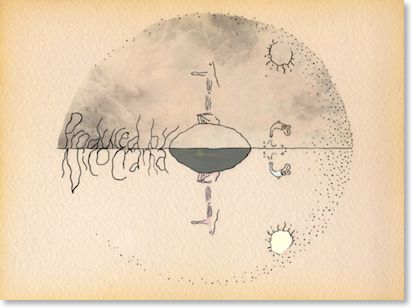
Spiegeleiland © Paul Driessen‘Spiegeleiland’ is a short and stylized animation film, which uses one scene and one perspective only.

We watch a castaway on an island and his reflection. The castaway is visited by a female companion and rescued by a ship. Or is he? The reflection tells another tale…

This simple story is told without dialogue and with the greatest economy. Like ‘Ei om zeep’ (The Killing of an Egg’) and ‘Het treinhuisje’ (Home on the Rails) we watch a single tableau. In ‘Spiegeleiland’ Driessen takes this format even further, limiting his action to a circle with only a tiny island within.

The result is without doubt one of Driessen’s strongest and most poetic films. Driessen would reuse this method of parallel depiction of reality and fantasy to a great effect in the tragic ‘The Boy Who Saw the Iceberg’ from 2000.

Watch ‘Spiegeleiland’ yourself and tell me what you think:

‘Spiegeleiland’ is available on the DVD ‘The Dutch Films of Paul Driessen’

Director: Paul Driessen
Release Date: 1982
Rating: ★★★★
Review:

Oh What A Knight © Paul Driessen‘Oh What a Knight’ is a short and funny gag film in which a knight rescues a princess from a dragon, a cyclope, a snake and a villain, only to watch her fall in love with his empty shiny armor.

Driessen’s unique animation style is most present in this cartoon. For example, the knight has an odd way of falling to pieces and reassembling himself. ‘Oh What a Knight’ is one of Driessen’s funniest films. In fact it would not be surpassed until his ‘3 Misses’ from 1998.

Watch ‘Oh What a Knight’ yourself and tell me what you think:

‘Oh What a Knight’ is avaiable on the DVD ‘The Dutch Films of Paul Driessen’

Director: Georges Schwizgebel
Release Date: 1992
Rating: ★★★★½
Review:

La course à l'abîme © Georges Schwizgebel‘La course à l’abîme’ is a depiction of the final ride into hell from ‘La Damnation de Faust’ (1846) by Hector Berlioz.

The film consists of a very associative series of images, tied together by the two riders, Faust & Méphistophélès. Like in Schwizgebel’s earlier film ‘78 tours‘ (1985) we watch images changing perspective and morphing into each other, to stunning effects. All builds up to a spectacular finale, in which we see all the animation within one frame.

‘La course à l’abîme’is the first film showing Schwizgebel’s interest in classic European stories. It’s a clear precursor of later films, like ‘L’année du daim’ (1995), ‘La jeune fille et les nuages’ (2000) and ‘L’homme sans ombre’ (2004), in which he uses his stunning techniques for narrative purposes.

Watch ‘La course à l’abîme’ yourself and tell me what you think:

‘La course à l’abîme’ is available on the DVD ‘Les Peintures animées de Georges Schwizgebel’

Director: Georges Schwizgebel
Release Date: 1985
Rating: ★★★★½
Review:

78 Tours © Georges SchwizgebelIn ’78 Tours’ Schwizgebel uses his technique of rotating perspectives and metamorphosis, which he had developed in films like ‘Perspectives‘ (1975) to stunning effects.

’78 Tours’ is a short film set to accordion music, which uses circles as a leitmotiv, as well as coffee and a park. The film is completely painted, using deep colors and stark shadows. Schwizgebel’s unique virtuoso style really comes to a full bloom in this film, which must be regarded as his first masterpiece.

Watch ‘78 Tours’ yourself and tell me what you think:

’78 Tours’ is available on the DVD ‘Les Peintures animées de Georges Schwizgebel’

Director: Georges Schwizgebel
Release Date: 1982
Rating: ★★★★
Review:

Le ravissement de Frank N. Stein © Georges Schwizgebel‘Le ravissement de Frank N. Stein’ starts with very abstract images, which resolve into Frankenstein’s laboratory as depicted in the film from 1931.

After 1’40 we become the monster itself, walking through endless chambers and corridors and staircases in an almost computer animation-like long sequence of perspective animation. The rooms, initially filled with abstract shapes, become more and more complex. They contain more and more windows and human forms, and finally moving human forms, ending with multiple copies of the monster’s bride. In the end we watch the monster itself, in his depiction by Boris Karloff. he smiles at his bride, but she only screams…

This film, which is set to very nervous electronic music, is a very impressive study of perspective: we really feel we are walking. The film has a repetitive and dreamlike quality, which is enhanced by its surreal settings, reminiscent of paintings by Giorgio de Chirico.

Watch ‘Le ravissement de Frank N. Stein’ yourself and tell me what you think:

‘Le ravissement de Frank N. Stein’ is available on the DVD ‘Les Peintures animées de Georges Schwizgebel’

Director: Erica Russell
Release Date: 1989
Rating: ★★★★★
Review:

Feet of Song © Erica Russell‘Feet of song’ is a non-narrative film about dance and Russell’s solo debut film.

It uses semi-abstract human forms, akin to those by painter Kazimir Malevich. The human forms feel both futuristic and African at the same time, and have a timeless appeal. The images get more and more abstract as the film progresses, but the sense of dance is never lost.

‘Feet of Song’ features African-sounding world music by Charlie Hart, but the music is in service to the beautiful images, not the other way round. Made for Channel 4, ‘Feet of Song’ is a prime testimony of Erica Russel’s unique style, clearly influenced by Oskar Fischinger, but firmly rooted in both her South African roots and dancer background.

Unfortunately, Russell made only two other independent films, ‘Triangle‘ in 1994, and ‘Soma’ in 2001, devoting most of her time to commissioned work (her images for example appear in the Madonna video-clip ‘Dear Jessie’ from 1989).

Watch ‘Feet of Song’ yourself and tell me what you think:

‘Feet of Song’ is available on the DVD inside the book ‘Animation Now!’

Compiler: Marv Newland
Release Date: 1985
Rating: ★★★★
Review:

Anijam © Marv NewlandAnijam is a compilation cartoon, organized by Marv Newland, and animated by 22 different animators.

The short features a strange yellow fellow on high heels called Foska. All scenes start and end with this character, and most of the animators feature him in their own scenes. The result is a dazzling string of totally unrelated scenes, some funny, some weird and some totally abstract.

A few animators bring their own typical style strongly into their scenes, like Zdenko Gašparović, Sally Cruikshank and Paul Driessen, others turn to abstract patterns, like Kathy Rose, Kazurai Furuya, and Per Lygum. The latter’s contribution is an early computer animation, featuring geometrical forms only. Highlight, however, is Frank Nissen’s contribution, in which a swimming octopus transforms into a naked woman.

The complete film is an ode to the imagination of the animators and the endless possibilities of the medium.

Watch ‘Anijam’ yourself and tell me what you think:

‘Anijam’ is available on the DVD inside the book ‘Animation Now!’

Enter your email address to follow this blog and receive notifications of new posts by email.

Join 918 other subscribers
Bookmark and Share

Categories