Director: Paul Driessen Release Date: 1977 Rating: ★★★ Review:
After working in Canada for the NFB for five years, Driessen experienced a major personal setback, when his marriage failed, and his ex left for The Netherlands with their two children. Driessen soon missed his son and daughter and returned to his native country himself.
In The Netherlands he rented a small attic in The Hague to work and live in. Here he made ‘David’, which he dedicated to his children Anouk and Kaj.
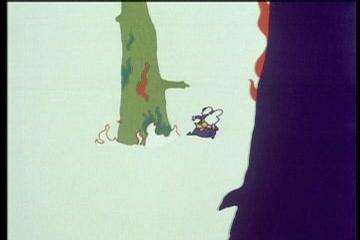
David is the world’s tiniest cartoon star. He’s so small, even the little gnomes can’t see him. During most of the cartoon his presence is only known by his footsteps and his voice. In fact, David is probably the first cartoon star to remain invisible throughout the picture. Nevertheless, Driessen manages to keep the film entertaining, even though most of the time we look at an empty screen.
This film is clearly meant for children and unfortunately, it is hampered by its slowness and large amount of dialogue of David himself (in the Dutch version provided by actor Aart Staartjes). Much of the fun is in David trying to make himself known. Despite its joyful spirit, the film contains a morbid ending, when David, having survived a giant and a predatory bird, is eventually squashed by an unknowing pedestrian…
‘David’ was Driessen’s sixth film, and his idiosyncratic style has matured immensely since his first film, ‘The Story of Little John Bailey‘ (1970). With his next film ‘Killing of an Egg‘ he would animate his first masterpiece.
Watch ‘David’ yourself and tell me what you think:
‘David’ is available on the DVD ‘The Dutch Films of Paul Driessen’
Director: Paul Driessen Release Date: 1970 Rating: ★★½ Review:
Paul Driessen’s very first film is a charming little short for children.
Made largely in Spain with help of small subsidy from the Dutch Ministry of Culture, the film tells about a small boy who accidentally sets a forest on fire, but repays his deed by extinguishing another one with help of an elephant with two trunks.
The simple story is hampered by the childish voice over (the English version is much more enjoyable than the original in that respect), and the film certainly doesn’t belong to Driessen’s best works, but its imaginative colors and weird perspectives are still thrilling. It already shows the film maker’s very distinctive animation style, which he would expand and improve over the years, creating such masterpieces as ‘On Land, at Sea and in the Air‘ (1980) and ‘The Writer‘ (1988).
Watch ‘Het verhaal van Kleine Yoghurt’ yourself and tell me what you think:
Director: Pete Doctor Release Date: November 2, 2001 Rating: ★★★★★ Review:
Pixar’s fourth film can be considered the studio’s best up to that point.
The very idea of monsters needing to scare children to fuel their city is a masterstroke. As is their mutual fright for children. The idea of closet doors leading to a parallel world is used to the max, especially in the breathtaking finale, whose premise is both logical to the plot as strikingly original and totally unexpected. Nothing to the story is predictable, and its lead characters Sully, Mike and Boo and their nemesis, the slithery Randall, are very well developed.
The only two lesser points may be Monstropolis itself, which is a surprisingly unimaginative copy of an average American town, and the film’s humor. Compared to Dreamworks’s ‘Shrek’, released earlier that year, Monsters, Inc.’s humor is rather mild. It heads for steady smiles, not for loud guffaws. Moreover, the loudmouth comic sidekick, the green eyeball Mike (voiced by Billy Crystal), never really gets convincingly funny or very sympathetic, and he pales compared to Eddie Murphy’s Donkey in ‘Shrek’.
No, the main selling point of Monsters Inc. is heart: the endearing ‘love story’ between top scare Sully and the little child Boo is completely convincing. This makes ‘Monsters, Inc.’, apart from being startlingly original, a sweet film. One that is able to move you time and time again.
Besides, ‘Monsters, Inc.’ displays some spectacular effect animation, the highlight being Sully laying in the snow, with his hair blowing in the blizzard, something unseen up to that point.
In 2013 ‘Monsters, Inc.’ fell prey to Hollywood’s sequel mania ,spawning the prequel ‘Monster University’.
Director: John Lounsberry, Wolfgang Reitherman & Art Stevens Release Date: June 22, 1977 Rating: ★★★★½ Review:
‘The Rescuers’ was a joint venture of an old and a new generation of animators at the Disney studio. It is without doubt the best of the three features the studio made in the seventies.
It was Disney’s first feature film since ‘One Hundred and One Dalmatians‘ (1961) in which Wolfgang Reitherman shared the direction duties, and this fact alone arguably improves the end product.
Unlike the earlier features ‘The Aristocats’ (1970) and ‘Robin Hood‘ (1973) it doesn’t contain any reused animation (with a possible exception of animation from ‘Bambi‘ in a minor mood scene). And while ‘The Aristocats’ and ‘Robin Hood’ relied on proven formulas, both being very reminiscent of ‘Jungle Book’ (1967), ‘The Rescuers’ has a fresh story (based on a children’s book by Margery Sharp), and a unique, surprisingly gloomy atmosphere. In Sharp’s book the mice rescue a prisoner, but for the film the Disney story men chose an orphan girl named Penny to be rescued. A masterstroke, for the lovable little girl easily becomes the center of the story, which contains a lot of heart.
However, all the film’s main characters are adorable: the lovely Hungarian mouse Bianca (voiced by Eva Gabor) and her companion, the superstitious yet valiant janitor Bernard are such great characters that they were able to spawn Disney’s first sequel, ‘The Rescuers Down Under’ in 1990. Medusa is a real and wonderful villain. She hasn’t got any special powers and at times she’s portrayed as preposterous, but mostly she’s sly, mean and genuinely scary: a worthy adversary for our heroes to deal with. She was animated by Milt Kahl, the last and arguably best piece of animation he ever did for the studio.
Medusa may steal the show, but even the minor characters like Orville the Albatross, Rufus the cat, Evenrude the damselfly, Snoops and the two Alligators are delightful. They all contribute to a story, which is concise and well-told. It evolves without delays or side-ways, and leads to a great finale in Devil’s Bayou.
‘The Rescuers’ is also the first Disney feature since ‘Bambi’ (1942) not to be a musical, but to use songs to evoke moods only. All these elements contribute to a story which is both thrilling and moving. The film’s opening credits use a song and beautiful oil paintings by Mel Shaw to start the story. Unfortunately, the background paintings in the rest of the movie are more prosaic, mixing moody oil paintings with more graphic backgrounds to an uneven effect. The animation on the other hand is superb throughout.
Unfortunately, ‘The Rescuers’ proved more of a swansong of the old generation of nine old men than the beginning of a new era. The following features were much weaker, and only with ‘The Little Mermaid’ (1989) Disney found a genuinely new and strong voice. Thus stands ‘The Rescuers’ as a beacon of light in the dark ages of animation that were the 1970s and 1980s.
Watch the trailer of’The Rescuers’ and tell me what you think:
A man rescues a harpy from a man who strangles her. He takes her home, but with disastrous results, because he soon discovers that the harpy eats all his food…
‘Harpya’ is a fantastic surreal film, which makes great use of a mixture of animation, live action and pixillation to create a totally unique atmosphere. The film is both funny and uncanny, and its story is Servais’s best since ‘Sirene’ (1968).
With ‘Harpya’ Raoul Servais made his most enduring work. It’s his all-time masterpiece, and a central film in his oeuvre, defining his mature style.
Watch ‘Harpya’ yourself and tell me what you think:
‘Pegasus’ tells about a lonely blacksmith who lives in the countryside.
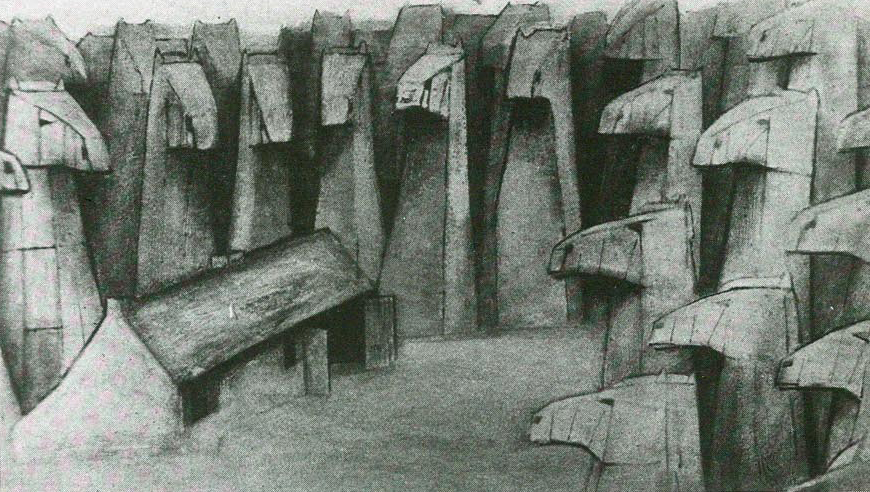
The blacksmith has a love for horses, but unfortunately his surroundings are totally devoid of them. So he builds a horse head out of metal to worship. Unfortunately, the horse head appears to have an ability to grow and reproduce, surrounding his house like a forest.
‘Pegasus’ is a beautiful and surreal film. Unfortunately, it ends quite abruptly, leaving behind a sense that not everything has been said, yet.
Watch ‘Pegasus’ yourself and tell me what you think:
Operation X-70 is a half silly, half scary short by Belgian film maker Raoul Servais.
It tells about a poisonous gas, which turns people into spiritual beings. The gas is advertised as a ‘clean weapon’, because it doesn’t kill people. When the gas is accidentally bombed on the Benelux (Belgium, Holland and Luxemburg), it turns people into angels.
The film impresses with its weird idea, its dark and gloomy atmosphere, and its anti-war message. However, like Raoul Servais’s earlier film ‘Goldframe’ (1968), the film suffers from an all too present dialogue. In the end the short’s images are more lasting than the film itself is.
Watch ‘Operation X-70’ yourself and tell me what you think:
In ‘Hors-jeu’ we watch a soccer match change into a basketball match and into an ice hockey game. When violence enters, however, the game stops.
With this short film Schwizgebel builds on the concepts introduced in his previous film, ‘Perspectives‘. In ‘Hors-jeu’ he incorporates sound-effects and a rather surrealistic play with the rotoscoped images into his style. Surrealism would dominate his next film, ‘Le ravissement de Frank N. Stein‘ (1982), but in its visual style ‘Hors-jeu’ looks more forward to later films, like ‘78 Tours‘ (1985).
Watch ‘Hors-jeu’ yourself and tell me what you think:
As the title implies, this short film is a study in perspectives. It also seems to address the arbitrariness of things, as we see a walking woman change into herself, into skaters and into a running dog, whenever our perspective of her changes. The film uses effective piano music by Bach.
‘Perspectives’ introduces several aspects of Schwizgebel’s mature style: the painted canvas, the rotoscoped movements, the constant changing of perspectives, the prominent shadows and his mastery of metamorphosis. In his next films Schwizgebel would expand on this technique, which would eventually lead to such masterpieces as ‘La jeune fille et les nuages’ (2000) and ‘L’Homme sans ombre’ (2004).
Watch ‘Perspectives’ yourself and tell me what you think:
In ‘le vol d’Icare’ a man wants to fly like the birds. In the end he succeeds.
More important than the plot, however, is the technique of this film, which makes use of huge pixels, giving it a very digital look. Even though the man and the birds are extremely simplified, their motions are instantly recognizable. Even more remarkable is that the film contains some kind of baroque feel, amplified by Louis Couperin’s harpsichord music.
‘Le Vol d’Icare’ was Swiss animator Georges Schwizgebel’s first animated film. It doesn’t resemble his later films. In fact, it doesn’t resemble any other animation film. But it already shows Schwizgebel’s originality and virtuosity, and it can be considered his first masterpiece.
Watch ‘Le vol d’Icare’ yourself and tell me what you think:
‘Le vol d’Icare’ is available on the DVD ‘Les Peintures animées de Georges Schwizgebel’
Director: Osvaldo Cavandoli Release Date: 1974 Stars: La Linea
Rating: ★★★★ Review:
La Linea is an Italian television series, which takes graphic design, introduced by UPA to the animated screen, to the max.
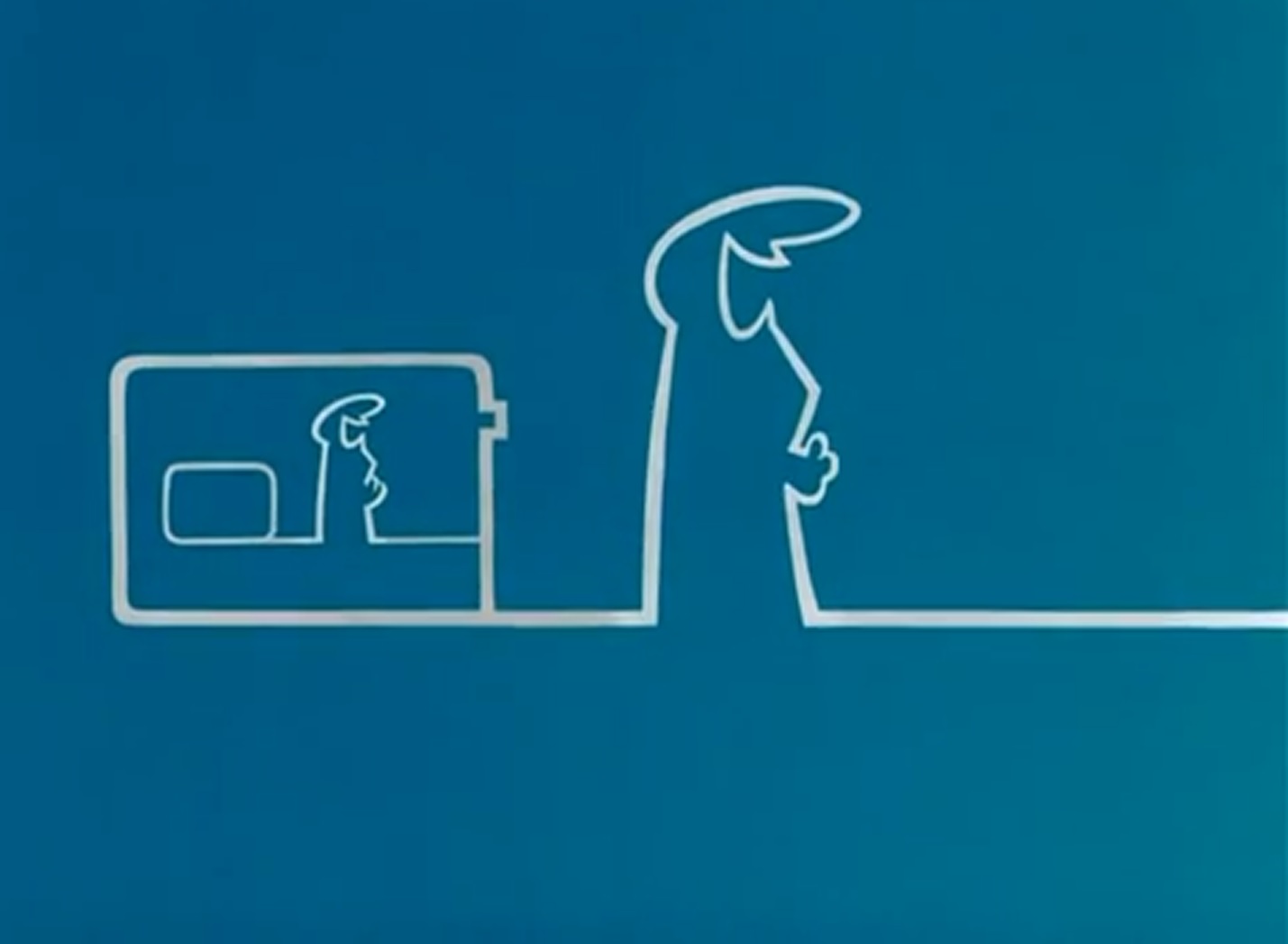
The first of all La Linea shorts defines the complete series: it consists of numerous unrelated gags around the jabbering little man Linea, who lives in a 2-dimensional world, consisting of only one white line, of which he is part.
This cheerful, but temperamental guy has some characteristics that return in every single episode: First, he talks an Italian-sounding sort of gibberish, provided by voice actor Carlo Bonomi. Second, he always walks to the left of the screen. Third, he always encounters at least one interruption of the line during his walk. Fourth, he frequently argues with his off-screen creator, of whom we only see his hand drawing things for the little guy. And Fifth, our hero has also has an intoxicating laugh, which is heard at least once.
All designs are extremely stylized, yet perfectly recognizable, and beautifully animated. The backgrounds are monochromic, changing from green to red to blue etc. All these elements make this series such a classic, even though most of the episodes are completely plotless, and only last about 2 minutes.
In this particular episode La Linea encounters a turtle, a television set, a tap and a woman. He plays golf and takes a rollercoaster ride. It doesn’t make any sense, but it’s fun. Franco Godi’s music in this particular cartoon is more present than in the following ones, using a tune with voices instead of the instrumental background music of later cartoons.
Watch ‘La Linea episode 1’ yourself and tell me what you think:
‘La Linea episode 1’ is available on the DVD ‘La Linea 1’
Director: Wolfgang Reitherman Release Date: November 8, 1973 Rating: ★★★ Review:
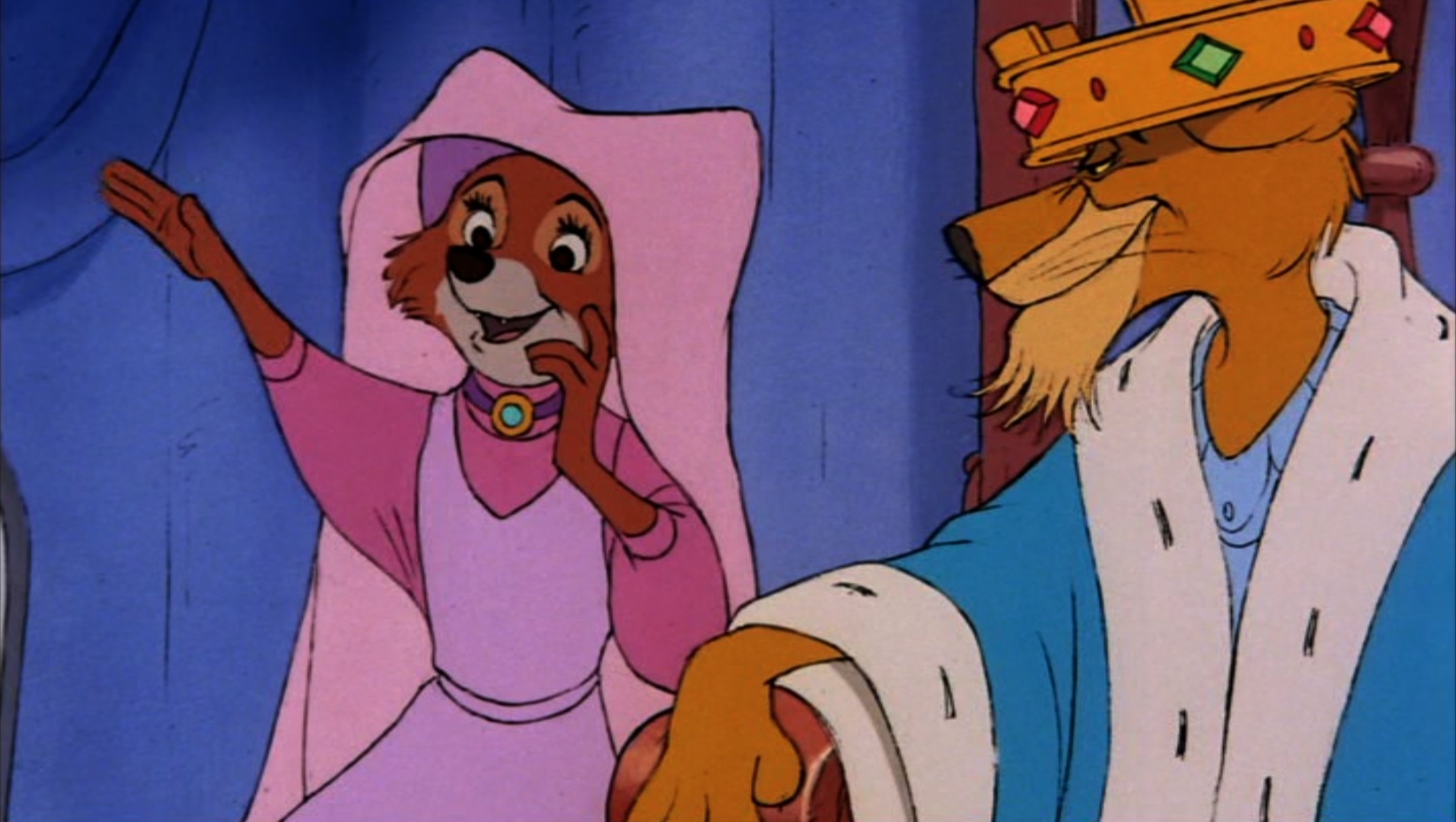
‘Robin Hood’ was Walt Disney studio’s 21st feature. The film’s story and designs lean heavily on the 1938 feature ‘The Adventures of Robin Hood’, starring Errol Flynn.
But by now the characters are portrayed as animals, a relic of an abandoned feature film project about Reynard the fox called ‘Chanticleer’. This great idea doesn’t lead to a great film, however. Despite the fine character designs, the strong voice cast (a nice mix of British and American accents) and the often superb animation, Robin Hood must be placed among the weaker Disney features.
Many of the character designs are so reminiscent of those in ‘Jungle Book’, the film almost feels like a rip-off. There’s a bear, voiced by Phil Harris, the voice of Baloo, there’s a snake with the power of hypnosis and there are some funny vultures. The story evolves at a remarkably slow pace, taking almost half an hour to introduce the characters (first Robin and Little John, then Prince John and Sir Hiss, followed by the Sheriff, and in another scene Maid Marian and Lady Kluck), before some sort of plot sets in.
More than any earlier Disney feature ‘Robin Hood’ seems particularly aimed at children: both great drama and great comedy are absent and danger is never really felt, save for two very short moments. The great finale is anything but that, and King Richard serves as an off-stage deus ex machina, putting an equally welcomed as unsatisfying end to the film.
In a 1973 letter to animator Larry Ruppel, cited in John Canemaker’s book ‘Walt Disney’s Nine Old Men & The Art of Animation’, animator Frank Thomas expressed the film’s shortcomings:
“We obviously decided to keep it on the ‘fun’ side, but I have worried that the audiences would feel it was too flimsy – that we were not being quite serious enough with our characters. For instance, does anyone really fear Prince John? Is Robin ever worried about his ability to achieve something or even how it should be done? Did winning Maid Marian make any difference in Robin’s behavior. In real life it would have.”
The rather tinned music doesn’t help, either. What’s more, the film’s three forgettable songs are all presented within a twelve minutes period of the film (0’46-0’58), with which the film reaches dead waters after the tournament scene, which was less spectacular than it could be in the first place. Even worse, the dance scene blatantly reuses complete dance animation sequences from ‘Snow White and the seven dwarfs’ (1937), ‘Jungle Book’ (1967) and ‘Aristocats’ (1970). All these aspects give the film a cheap feel. It frustrated younger animators like Don Bluth, who thought the film lacked both quality and soul, and it indirectly led to Bluth’s departure in 1979, during the production of ‘The Fox and the Hound‘ (1981).
The film’s best moments are the opening song ‘Oo-De-Lally’, sung by Roger Miller (as Alan-a-Dale), sir Hiss flying around with his head in a balloon and propelling himself like a helicopter, and King John as a whole. This is by all means a marvelous character, perfectly voiced by Peter Ustinov, and animated with gusto. Because of the film’s strong visuals (after all, it’s the only Robin Hood film starring foxes), the film fares better in memory than by actually watching it.
In all, Robin Hood is a timid, rather lifeless and all too safe feature, which makes painfully clear that in the seventies Disney’s glory days lay years behind. Indeed, it would take the studio another fifteen years to crawl out of the uncertain times the studio went through after Walt Disney’s death.
Watch the trailer for ‘Robin Hood’ and tell me what you think:
Director: René Laloux Release Date: May 11, 1973 Rating: ★★★★★ ♕ Review:
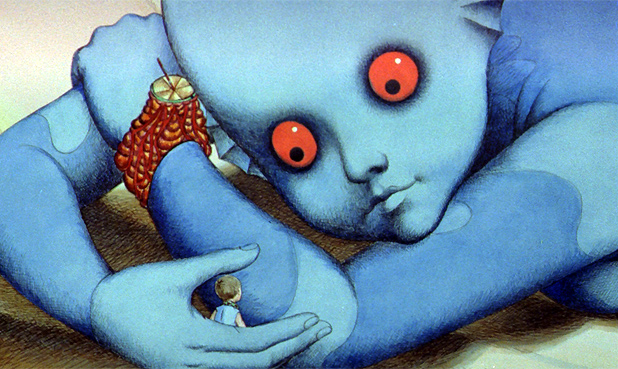
‘La planète sauvage’ is an old love of mine. I first watched it when I was ca. six or seven. It took me fifteen years before I learned which film I had actually watched, and it would take me another ten years before I could watch it again. However, all the time the film’s powerful images never left me.
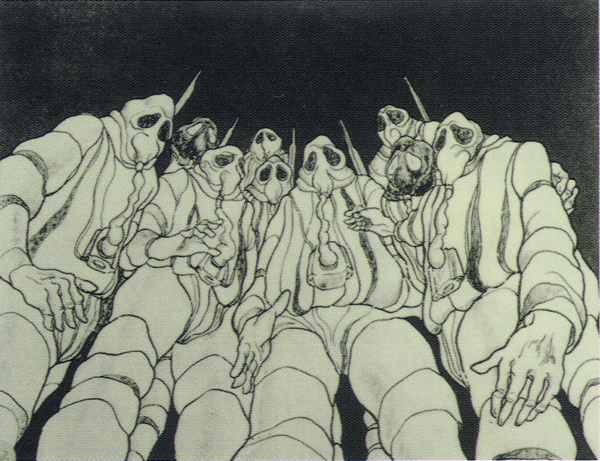
‘La planète sauvage’ is a science-fiction feature, which tells about the life of humans (‘Oms’, which sounds like the french word for humans, ‘hommes’) on a strange planet occupied by story-block-high humanoid giants, called Draags. To them humans are no more than pets and pests. By accident, a pet Om, Terr (symbolically named after the French word for Earth, terre), learns the Draags’ knowledge and he leads his fellow humans into an uprising.
However, ‘La planète sauvage’ is not particularly famous for its straightforward and rather cliche plot. Its strength lies in its effective use of Roland Topor’s very surrealistic designs, which makes the depicted planet incomprehensible, foreign and scary. For example, the Draag’s behavior is so strange, that despite their humanoid form they feel very alien, indeed. The film’s original technique of combining drawn animation with cut-out adds to the surreal atmosphere. Even the space funk music accompanying the action sounds outlandish.
Even though the animation sometimes is rather stiff and at times even ridiculously poor, the graphic imaginary is so strong that these shortcomings never spoil the enjoyment of the film. On the contrary, the film’s totally unique and disturbing atmosphere and its philosophical questions about what makes man human make watching ‘La planète sauvage’ a very rewarding experience.
Together with Bruno Bozzetto’s ‘Allegro non troppo’ (1976) and Martin Rosen’s ‘Watership Down’ (1978) Laloux’s film must be counted among the most outstanding features of the seventies. René Laloux would make two other science fiction features, ‘Les maîtres du temps‘ (1981) and ‘Gandahar‘ (1988), but these do not reach the stunning originality of the visuals in this film.
Director: Jack Hannah Release Date: May 30, 1953 Stars: Donald Duck, Huey, Dewey and Louie Rating: ★★★★ Review:
Donald and the boys are on a holiday in Latin America. But Huey, Dewey and Louie only have eyes for their comic book.
Donald then fools them by pretending a fountain of youth has made him younger. He even uses an alligator egg to make them believe he turned into an egg again. This leads to an encounter with the mother alligator, whose not amused. In the end we watch Donald and the boys fleeing into the distance.
The backgrounds in this cartoon are extraordinarily colorful. The characters don’t really read well against these backgrounds, but their lushness is overwhelming and an extra highlight besides the gags.
Watch ‘Don’s Fountain of Youth’ yourself and tell me what you think:
This is Donald Duck cartoon No. 99
To the previous Donald Duck cartoon: Trick or Treat
To the next Donald Duck cartoon: The New Neighbor
Director: Chuck Jones Release Date: July 25, 1953 Stars: Daffy Duck, Porky Pig, Marvin Martian
Rating: ★★★★★ ♕ Review:
‘Duck Dodgers in the 24½th Century’ is a spoof of the popular pulp magazine science fiction series Buck Rogers, which was made into a television series in 1950-1951. This makes this short one of the earliest theatrical cartoons parodying a television series.
Daffy “Duck Dodgers” and his sidekick “the eager young space cadet” Porky have to claim planet X for planet Earth. Unfortunately, Marvin Martian wants to claim the same planet for Mars. This starts a feud, which ends in both blowing up the entire planet.
Although the story of the cartoon is rather similar to the Bugs Bunny cartoon ‘Haredevil Hare‘ (1948), Daffy’s unique performance gives it an entirely different feel, leading to new and great gags. More than being a typical science fiction cartoon, this short can be regarded the second cartoon in a series which pairs Daffy as a misguided hero to Porky as a more sensible straight man (the first being ‘Drip-along Daffy‘ from 1951). ‘Duck Dodgers’ must be the highlight of the series, as well as a peak in both Daffy’s as Chuck Jones’s career.
Unhampered by conventions, Jones, his layout-man Maurice Noble and background painter Phil DeGuard went totally berserk with the science-fiction theme, creating wild and lushly colored backgrounds, which make ‘Duck Dodgers in the 24½th Century’ one of the most beautiful cartoons ever made at Warner Brothers.
Indeed, so great is its fame, it spawned sequels in 1980, 1996 and 2003. From 2003 to 2005 Cartoon Network even broadcasted a Duck Dodgers series.
Watch ‘Duck Dodgers in the 24½th Century’ yourself and tell me what you think:
This is Porky Pig cartoon no. 142
To the previous Porky Pig cartoon: Fool Coverage
To the next Porky Pig cartoon: Claws for Alarm
This is Daffy Duck cartoon No. 65
To the previous Daffy Duck cartoon: Muscle Tussle
To the next Daffy Duck cartoon: Duck! Rabbit! Duck!
‘Duck Dodgers in the 24½th Century’ is available on the Blu-Ray ‘Looney Tunes Platinum Collection: Volume 2’ and on the DVD-set ‘Looney Tunes Golden Collection Volume One’
Director: Chuck Jones Release Date: February 28, 1953 Stars: Daffy Duck, Bugs Bunny (cameo)
Rating: ★★★★★ ♕ Review:
One of the most self-aware animated cartoons ever made, ‘Duck Amuck’, more than any other cartoon, plays with the conventions of animation and with the frustrations of Daffy Duck.
This cartoon shows how good the character is, because even when drawn awkwardly, even without sound, and even when animated as a small speck in the distance, we know it’s Daffy. His struggles with the off-screen animator (who in the end turns out to be Bugs Bunny) form the zenith of his new frustrated personality, which had replaced his zany personality of the thirties and forties three years earlier. Furthermore he’s the sole character in the entire cartoon, but so strong is his unwilling performance that we become hardly aware of this fact.
The poor Daffy has to deal with disappearing and constantly changing backgrounds, with absent and inappropriate sounds, with deformations of his own body etc. In this cartoon he’s the victim of an omnipotent ‘cartoon god’ whom he cannot escape. In this sense ‘Duck Amuck’ questions the relationship between creator and creation and the responsibility of the creator to the things he created. This makes ‘Duck Amuck’ also one of the most philosophical cartoons ever made. And amazingly, it’s funny, too.
Watch ‘Duck Amuck’ yourself and tell me what you think:
This is Daffy Duck cartoon No. 63
To the previous Daffy Duck cartoon: Fool Coverage
To the next Daffy Duck cartoon: Muscle Tussle
‘Drip-along Daffy’ is available on the Blu-Ray ‘Looney Tunes Platinum Collection: Volume 2’ and on the DVD-set ‘Looney Tunes Golden Collection Volume One’
Directors:William Hanna & Joseph Barbera Release Date: March 21, 1953 Stars: Tom & Jerry Rating: ★★★ Review:
‘Johann Mouse’ is the story of a waltzing mouse, who inhabits the home of Johann Strauss jr. in Vienna.
The mouse (Jerry) only comes out to waltz when the master plays, so when he’s out of town, the cat (Tom) learns to play waltzes to make the mouse waltz. This novelty leads to the two performing for the Austrian emperor.
‘Johann Mouse’ is a cute little fairy tale, told by a quasi-German voice over. However, the cartoon is hampered by all too economic animation. Especially Jerry’s design has become very streamlined and rather stiff in this cartoon, making his dance movements less impressive than in earlier entries.
Watch ‘Johann Mouse’ yourself and tell me what you think:
This is Tom & Jerry cartoon No. 75
To the previous Tom & Jerry cartoon: Jerry and Jumbo
To the next Tom & Jerry cartoon: That’s My Pup
Director: Chuck Jones Release Date: April 19, 1952 Stars: Bugs Bunny
Rating: ★★★★ Review:
Six years after ‘Hair-raising Hare’ (1946) Bugs Bunny faces the orange monster in sneakers again.
‘Water, Water Every Hare’ is a horror cartoon featuring almost everything a horror movie should have: an evil scientist, a monster, a mummy and a robot. This story is rather awkwardly framed, however, by a story about the river flooding Bugs’s home and transporting him to and from the castle. Facing the monster Bugs repeats his manicure-tric from the earlier film, although this time he pretends to be a hair dresser. He also makes himself invisible and he makes the monster shrink.
If not as funny as ‘Hair-raising Hare’, ‘Water, Water Every Hare’ is full of clever gags. It moves at a relatively relaxed pace, which only a very confident film maker could use with such effect. In that respect, ‘Water, Water Evey Hare’ shows the mastery director Chuck Jones had achieved. He needn’t be fast and furious to be funny and he knew it.
Watch ‘Water, Water Every Hare’ yourself and tell me what you think:
Director: Friz Freleng Release Date: May 2, 1953 Stars: Bugs Bunny, Yosemite Sam Rating: ★★★★ Review:
When his home country looks like a desert and he becomes short of carrots, Bugs migrates to Alabama.
Unfortunately, the ‘Mason Dixie Line’, the border between the North (desert) and the South (beautiful green landscape), is protected by Southerner Sam, who isn’t aware that the civil war has ended ages ago. This preposterous idea leads to great gags involving several impersonations by Bugs, a.o. of Abraham Lincoln.
Watch ‘Southern Fried Rabbit’ yourself and tell me what you think:
Director: Chuck Jones Release Date: January 19, 1952 Stars: Bugs Bunny, Wile E. Coyote
Rating: ★★ Review:
The second appearance of the Coyote after his debut film ‘Fast and Furry-ous‘ (1949) was, surprisingly, not another Road Runner cartoon.
Instead, director Chuck Jones decided to place his still fresh carnivore character against Bugs Bunny, a character increasingly in need of worthy opponents.
in ‘Operation: Rabbit’ Wile E. Coyote gets his name (in the Road Runner cartoons he’s never called that way). Wile E. introduces himself to Bugs as ‘genius’, and suddenly he is a talking character, speaking with an eloquent, vaguely British voice. The experiment is not successful. The coyote’s ability to speak floods the action with a lot of superfluous dialogue, and he almost totally lacks the sympathetic frustration so wonderfully demonstrated in the Road Runner cartoons. Moreover, there’s hardly any chemistry between the two overconfident characters, which leads to remarkably unfunny gags, with only the one involving a flying saucer being able to create a chuckle.
Despite the shortcomings, Jones would make Bugs Bunny and Wile E. Coyote co-star in three more cartoons: ‘To Hare is Human’ (1956), ‘Rabbit’s Feat’ (1960), and ‘Compressed Hare’ (1961). Meanwhile the Coyote would have a much more interesting career in the Road Runner cartoons, with the second one, ‘Beep Beep’, appearing four months after ‘Operation Rabbit’.
Watch ‘Operation: Rabbit’ yourself and tell me what you think:
Animation Backgrounds
A blog dedicated to background paintings from animation films. Kept until 2016.
Animation Scoop
Animation historian Jerry Beck’s animation film news blog.
Cartoon Brew
Topical blog on animation film, led by animation historian Amid Amidi.
Cartoon Modern
Amid Amidi’s blog on modern design cartoon art from the forties, fifties and sixties.
Cartoon Research
THE site on classic animation research, hosted by cartoon historian Jerry Beck.
Cartoons Theory
Frank Beef analyzes classic cartoons. Kept until 2020.
Century Film Project
Michael reviews films of 100 years old and older, roughly in chronological order.
Classic Cartoons
A similar blog featuring many stills and comic strips. Kept until 2012.
Comet over Hollywood
Jessica Pickens reviews classic Hollywood films, especially musicals.
Deja View
Top ex-Disney animator Andreas Deja’s own blog.
Disney History
Esteemed Disney historian Didier Ghez on the latest books on Disney history.
Feeling Animated
Paul Astell brings us thorough reviews of animated features.
Flickers in Time
Short and to the point reviews of classic films (lately mostly pre-code talkies) by an anonymous retired Foreign Service Officer from California








 Dr. Grob's Animation Review