Director: John Hubley Release date: 1974 Rating: ★★½ Review:
In ‘Voyage to Next’ mother Earth (voiced by Maureen Stapleton) and father Time (voiced by Dizzy Gillespie, who also provides the jazzy score) discuss humankind, and how its only hope is collaboration and sharing.
‘Voyage to Next’ is directed by John Hubley, but the pleasant designs of the two gods display the huge influence of Faith Hubley, who produced the film. The dialogue is improvised, and to be frank, rather rambling and disjointed, hampering the message. In fact, between an early conclusion that mankind is going nowhere and the final one that only collaboration will help little is happening in between.
‘Voyage to Next’ is very nice to look at, but little else, and one wishes the Hubleys for once would abandon their improvisational style for something more cohesive.
Watch ‘Voyage to Next’ yourself and tell me what you think:
‘Voyage to Next’ was released on the DVD ‘Art and Jazz in Animation’, which has been long out of print
Directors: John & Faith Hubley Release date:1972 Rating: ★ Review:
‘Dig’ is a children’s film about geology and paleontology.
A New York boy called Adam is taking his bike and dog Bones to fetch some milk, but ends up with a Rock called Rocko, who talks with a New York accent, and who takes Adam and Bones into the earth’s crust to tell about e.g. stalactites, volcanoes, earthquakes and types of rocks. In the end the trio journeys through time, from the Precambrian through the Paleozoic, Mesozoic and Cenozoic eras.
‘Dig’ boasts charming animation and a funky score by Quincy Jones, but the four songs are rather tiresome, the pacing is very slow, and the educational value negligible. The information misses context, and the images are often too vague to illustrate the message well enough. In all, ‘Dig’ certainly is not one of John and Faith Hubley’s best.
Watch ‘Dig: A Journey into the Earth’ yourself and tell me what you think:
‘Dig: A Journey into the Earth’ was released on the DVD ‘Art and Jazz in Animation’, which has been long out of print
Avant-garde animator Zbginiew Rybczyński, of later ‘Tango’ fame, brings us a fun little children’s film based on a poem by Julian Tuwim on trains.
The poem is set to lively jazz music by Janusz Hajdan, which Rybczyński accompanies with images of anything but trains. The lyrics are illustrated associatively, with animated pictures of a baby, a dog, an elephant. etc.
The most common element is a fat moustached man, done in pixilation. The pixilated photos are rendered in monochromes, mostly on a monochrome green canvas, which give the film a unique and very avant-garde look. Apart from the pixilation there’s a little, rather cartoony cel animation that convinces less.
‘Locomotive’ may be much less compelling than ‘Tango’, this children’s short already show that Rybczyński was a very original and idiosyncratic film maker.
Watch ‘Locomotive’ yourself and tell me what you think:
‘Locomotive’ is available on the DVD-set ‘Anthology of Polish Children’s Animation’
Director: Ryszard Antoniszczak Release date:1974 Rating: ★★★ Review:
‘Farewell to Steam’ is a Polish children’s film set to a rock song. The short tells about a person who wants to become a train engineer.
This is one of those films from the early seventies that display a huge ‘Yellow Submarine’ influence. This short just breaths groovy seventies design. The man himself is a prototype of a seventies hippie.
The film uses full cell animation to show us images that are cartoony, surreal and weird. The images never cease to amaze, but a story is hardly present, and hard to follow anyway. In the end ‘Farewell to Steam’ succeeds more musically and visually than narratively.
Watch ‘Farewell to Steam’ yourself and tell me what you think:
‘Farewell to Steam’ is available on the DVD-set ‘Anthology of Polish Children’s Animation’
Director: Stefan Janik Release date:1972 Rating: ★★★ Review:
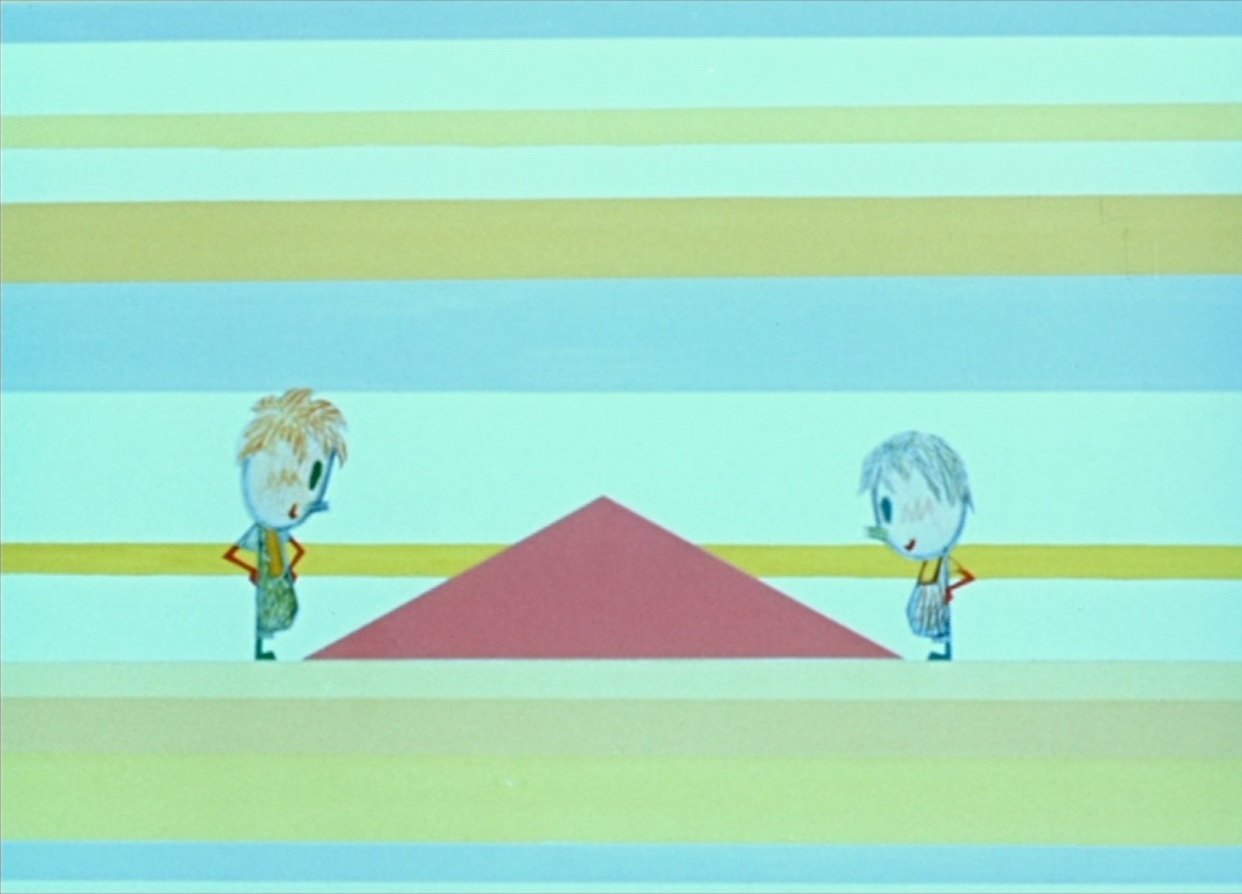
‘Enchanted Triangles’ is a cute children’s films from Poland about triangles. The film makes clever use of the imagination of children to transform triangles into church towers, mountains, pyramids, sailing boats, birds and butterflies.
Two boys explore this triangle world. The film uses a voice over by a girl and cut-out animation. The two boys are charmingly drawn in crayons in a semi-childish style, but the triangles remain abstract. The result is cute if unassuming and rather forgettable.
Watch ‘Enchanted Triangles’ yourself and tell me what you think:
‘Enchanted Triangles’ is available on the DVD-set ‘Anthology of Polish Children’s Animation’
Director: Daniel Szczechura Release date:1971 Rating: ★★ Review:
‘If You Spot a Cat Flying Through the Air’ is a strange little film in bold seventies design and with an avant-garde jazz score by W. Pażyński to tell us that If You Spot a Cat Flying Through the Air, it’s a cat who love birds. These words reappear a few times in the short itself.
Unfortunately, both animation and movement are rather limited, and the short is more interesting as an experiment than entertaining to watch.
Watch ‘If You Spot a Cat Flying Through the Air’ yourself and tell me what you think:
‘If You Spot a Cat Flying Through the Air’ is available on the DVD-set ‘Anthology of Polish Children’s Animation’
The late sixties and early seventies saw some striking experiments in the animated feature film. These films left the tried paths of family film and aimed at a more adult audience. In Europe Walerian Borowczyk arguably made the first experimental animated feature with ‘Théâtre de Monsieur & Madame Kabal (Theatre of Mr & Mrs Kabal)’ (1967), René Laloux made quite an impact with ‘La planète sauvage’ (1973), while in the UK George Dunning’s ‘Yellow Submarine’ (1968) caused a revolution, inspiring for example ‘János Vitéz’ (Johnny Corncob) in Hungary. Meanwhile in the US Ralph Bakshi experimented with more adult themes in ‘Fritz the Cat’ (1972) and ‘Heavy Traffic’ (1973).
In Japan, Osamu Tezuka led the way with his Mushi Productions studio, releasing three more adult themed feature films: first ‘A Thousand and One Nights’ in 1969, followed by ‘Cleopatra’ (1970) and ‘Belladonna of Sadness’ from 1973.
All three were directed by Eiichi Yamamoto, but in contrast to the earlier two features Tezuka had no direct involvement in ‘Belladonna of Sadness’. Even more striking, the great master left his own studio halfway production. Thus, ‘Belladonna of Sadness’ is very, very different from Tezuka’s own rather cartoony creations.
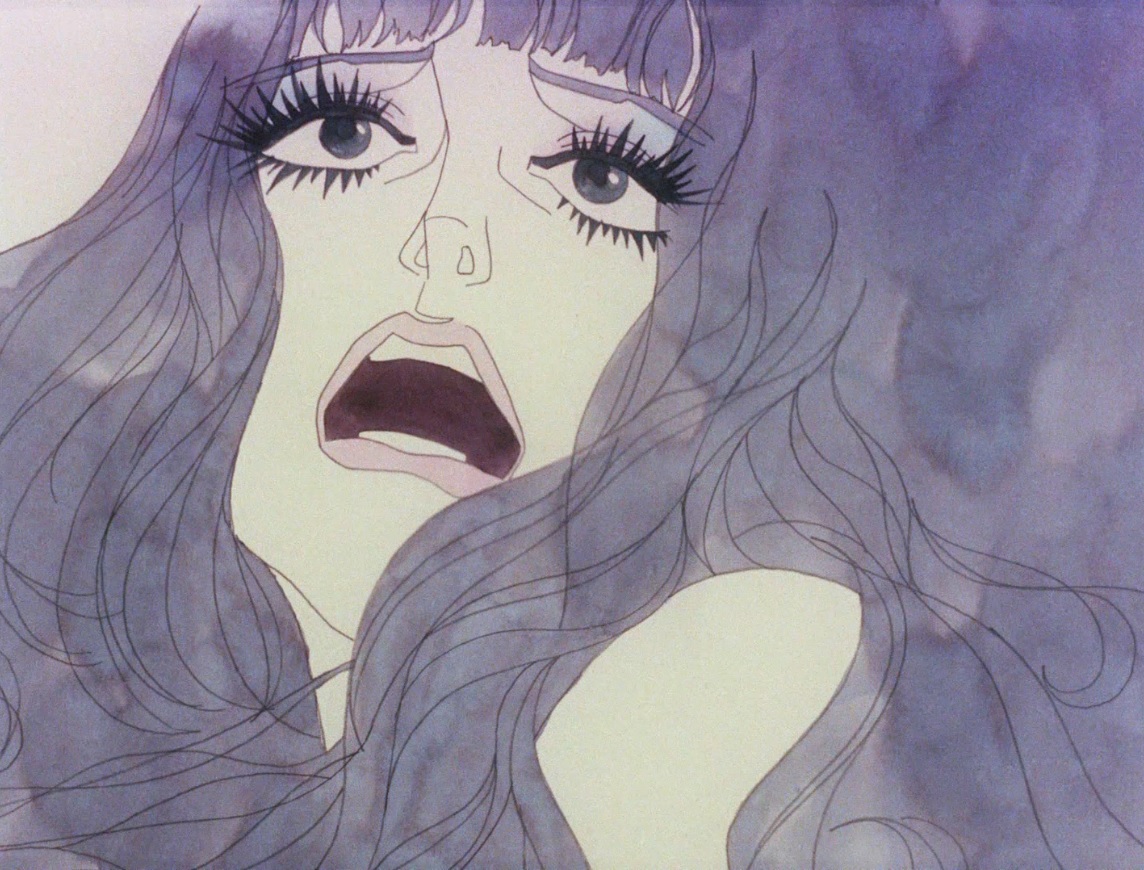
According to Yamamoto he wanted his film to be a Japanese answer to ‘Yellow Submarine’, and to make it one the drew inspiration from the artwork by Kuni Fukai. However, Kunai’s dark and disturbing artwork is quite the opposite from Dunning’s cheerful fantasies. On the Blu-ray Fukai calls his own work from the early seventies ‘decadent’, and that certainly is an apt description. Fukai’s drawings are baroque, graphical, lush, and highly erotic. They have a distinct neo-art-nouveau character, which is both very psychedelic and very seventies. For Belladonna of Sadness’ Fukai functioned as the art director, and his drawings form the base of the complete film, which uses animation only sparingly, often leaving the camera tracking over the static artwork.
And what artwork! ‘Belladonna of Sadness’ sure is a marvel to look at. The watercolor-and-pen drawings are all interesting and of a high artistic quality. Fukai almost always uses a white canvas, in which the drawings more or less disappear, and there’s ample and expressive ornamentation to accentuate the feeling of the scene. There are some odd design choices, however. For example, the villain looks like he has no eyes and as if three bones are stuck into his skull, making him rather grotesque and unbelievable.
Animation, as said, is only used only sparingly. There is no lip-synchronization, whatsoever, and some of the animation is crude and simple. The most interesting animation occurs when the events are not shown directly, but only suggested. For example, in the best erotic scenes more is hinted at than shown, and when the world is struck with the plague, we watch the landscape melt. There are certainly some trippy scenes, full of metamorphosis, which form the best parts of the movie. The undisputed highlight of the film comes when the baroque images are suddenly changed for a rapid-fire delivery of much more cartoony designs in bold seventies colors. This frenzy of animated images is followed by beautiful glass painted animation full of metamorphosis.
The psychedelic images are further enhanced by the soundtrack, which mixes psychedelica, spacefunk and rock into a very seventies-like mix, akin to Alain Goraguer’s soundtrack for ‘La planète sauvage’ from the same year, albeit of a lesser quality. There are even a few songs to enhance the mood.
In contrast to the beautiful art the story of ‘Belladonna of Sadness’ is subpar, and even objectionable. The film is based on ‘La sorcière’ (1862) by Jules Michelet, a non-fiction book on witchcraft, and the film’s story is set in a fictive oppressive kingdom in which a peasant girl becomes a witch. However, Yamamoto’s and Yoshiyuki Fukuda’s screenplay apparently only uses the book as a source of inspiration, as their own tale is as predictable as it is boring.
Yamamoto apparently instructed Fukai that his film was ‘porn but make it a love story’. Well, the movie is certainly porn, but hardly a love story. The two lovers Jean and Jeanne are more vignettes than characters, and if anything, Jean is a weak and will-less coward. Worse, the porn is exploitive, featuring several rapes and a lot of violence. As can be expected, there is a lot of female nudity, but hardly any male one, although penises are omnipresent, especially as the devil takes the shape of a penis himself. Jeanne’s best moment comes when she reveals herself as a full-blown witch, which provides one of the film’s most iconic moments. But during most of the film she’s used and abused by powers beyond her control. The ending, too, is unsatisfying, and all too abrupt, forcingly trying to make the porn story into something political.
Thus, ‘Belladonna of Sadness’ may transcend normal porn (it’s certainly weird and original enough to do so), but not that of a cheap comic. There’s no depth to the story, at all, and the film’s exploitive character gives a bad taste in the mouth. Nevertheless, the movie is a feast of the eye and stands as a great example of the sheer experimentation that were the seventies.
Watch the trailer for ‘Belladonna of Sadness’ yourself yourself and tell me what you think:
‘Belladonna of Sadness’ has been released on Blu-Ray, but this is currently out of print
Hungarian director Marcell Jankovics (1941-2021) is most famous for his second animated feature, the mind-blowing masterpiece ‘Fehérlófia’ (Son of the White Mare) from 1981. But his first feature, ‘János Vitéz’ certainly deserves to be equally famous.
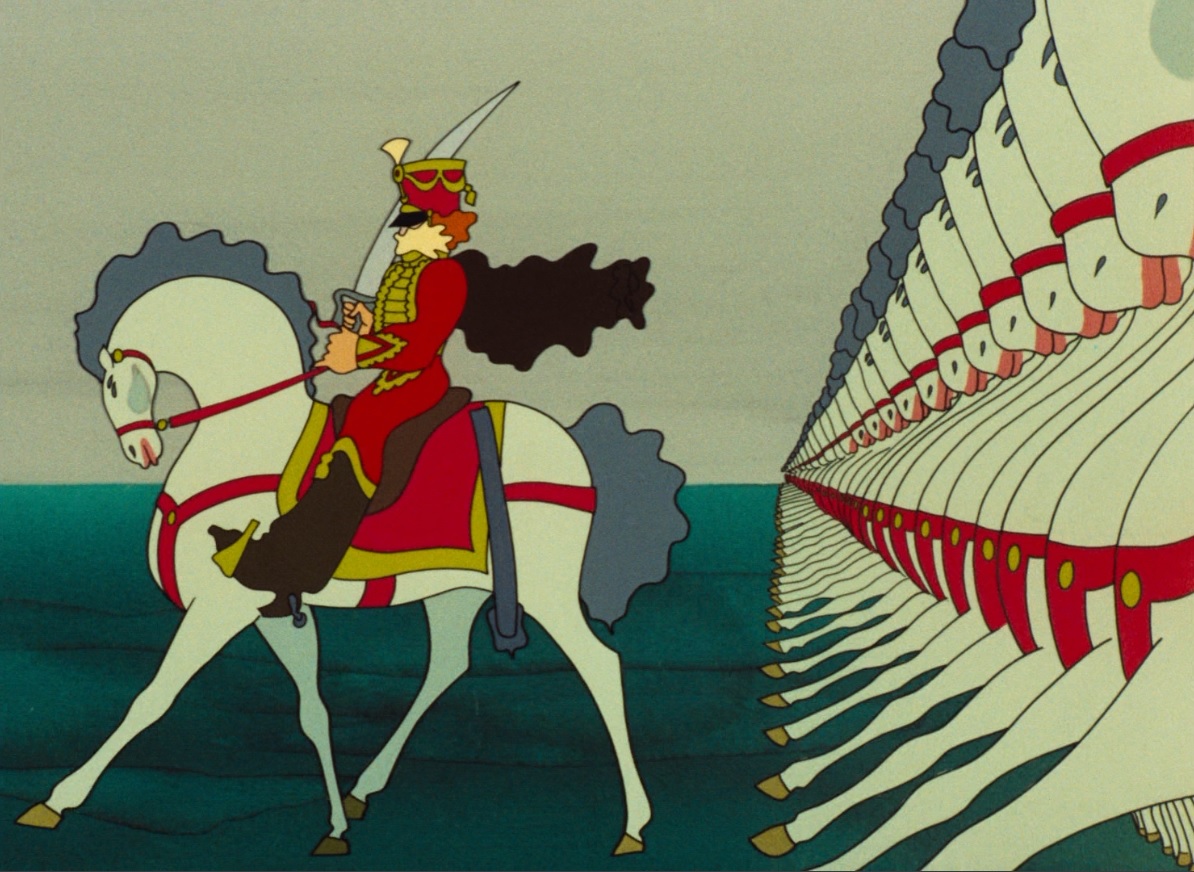
‘János Vitéz’ was Hungary’s ever first animated feature ever, but this doesn’t show, at all. The feature is a remarkably mature product that owes nothing to earlier animation films, save George Dunnings’ ‘Yellow Submarine’ from 1968 (and one scene of a devils’ dance, which harks all the way back to Disney’s Silly Symphony ‘The Goddess of Spring’ from 1934). Like Dunning’s film, ‘János Vitéz’ uses very striking visuals in bold colors, and with a genuine contemporary design. In fact, no movie from the seventies looks so enormously ‘seventies’ as this film.
The film was commissioned by the Hungarian government to commemorate the 150st birthday of Hungary’s national poet Sándor Petőfi (1823-1849), whose stature in Hungary is comparable to that of Pushkin in Russia. Petőfi wrote ‘János Vitéz’, a long epic poem in 1844, and despite the strikingly modern visuals, the film follows the poem quite faithfully. János Gyulai-Gaál’s score is unmistaken Hungarian, akin to the music of Zoltán Kodály’s folk opera ‘Háry János’ from 1926 and contributes greatly to the utterly Hungarian character of the movie. There are also a few charming songs, adding to the experience.
The story is pretty nonsensical and more of a tall tale than a classic epic poem. It tells about the hero János Vitéz who is a sheep herder in love with the neighboring Iluska. Unfortunately, Iluska’s stepmother, the witch Mostoha, doesn’t approve of the young lovers’ romance, and makes János Vitéz’ flock of sheep disappear. Banished from his village, János Vitéz first joins a band of robbers, then joins the army, but keeps longing for his beloved Iluska.
The film retains much of Petőfi’s poetic quality: the dialogue is in rhyme, and the images themselves have a lyric quality. For example, the love of Iluska and János Vitéz is shown by associative images, full of flowers and a radiant sun. Moreover, a lot of the story is told through the images, and more by suggestion than by literally showing what’s happening. For example, when János Vitéz is banished this is shown by a street in which every house shuts its shutters when János Vitéz passes by.
The images are as folkloristic as they are psychedelic, and never cease to please or to amaze. The character designs are more of a mixed bag. János Vitéz and Iluska are drawn as rather bland beautiful people, while Mostoha, the robbers and the Turks are very cartoony. These and other characters provide some small gags. Character animation is absent. For example, when János Vitéz mourns for Iluska, this emotion is indicated more than heartfelt. Nevertheless, there is a clever use of metamorphosis and animation cycles, and it’s clear the animation is in service of the graphics and of the story.
In all, ‘János Vitéz’ is a joy to watch from start to end and deserves a much wider audience than it has now.
Watch an excerpt from ‘János Vitéz’ yourself and tell me what you think:
‘János Vitéz’ is available on the Blu-Ray of ‘Son of the White Mare’
‘There’s No Time for Love, Charlie Brown ‘is the ninth Peanuts television special. This instalment is a nice, quiet little affair, with a rather stream-of-consciousness-like quality to it.
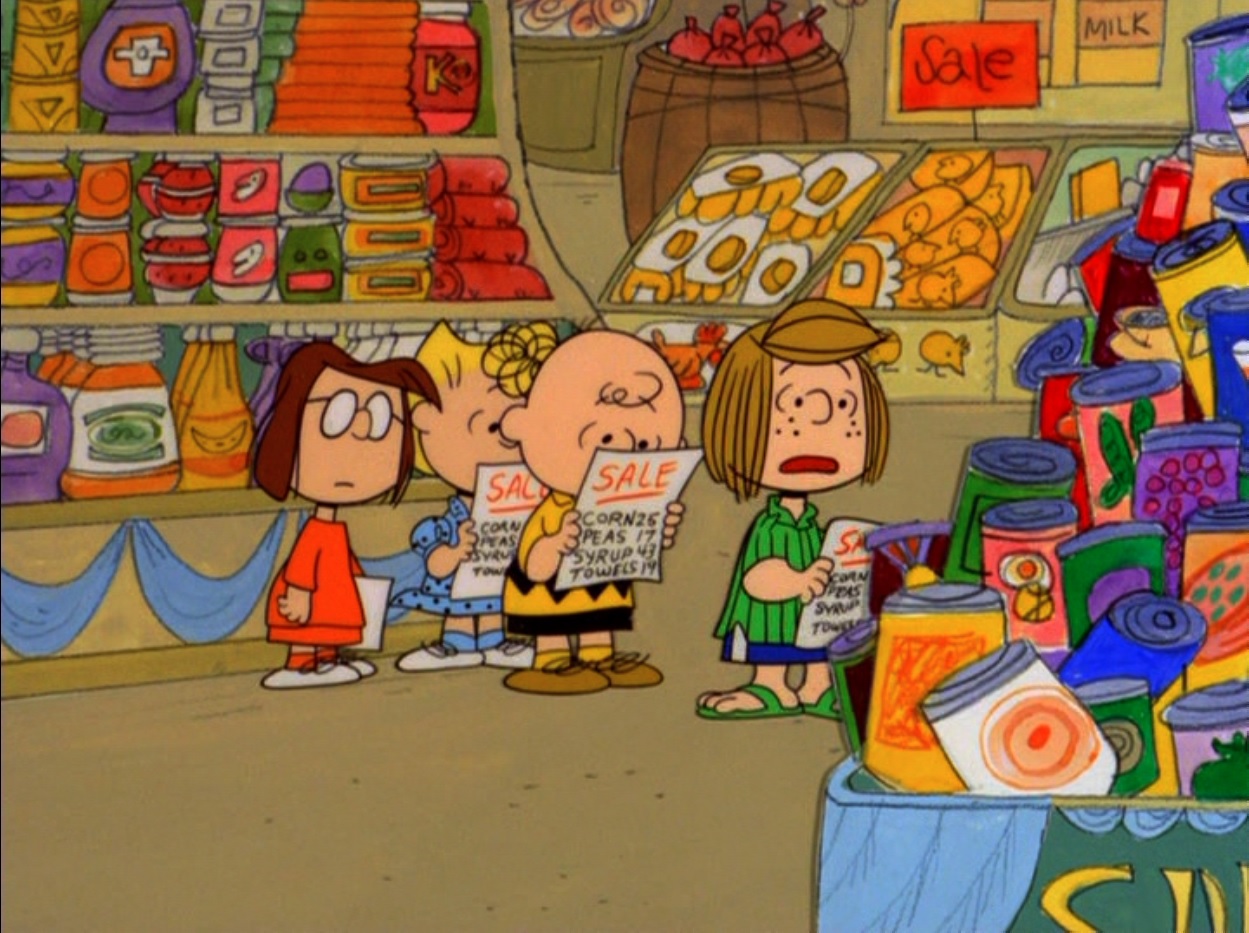
The special starts with several comic-based loose gags on school, most of them starring Sally and Peppermint Party. After seven minutes the main story kicks in, in which the kids have to go on a field trip to a museum and write a report on it. Unfortunately, Charlie Brown, Sally, Peppermint Patty and Marcie end up in a supermarket. What’s worse, Peppermint Patty hurts Charlie Brown’s feelings there, too.
Marcie, who makes her screen debut here, has a particularly young sounding voice (by one Jimmy Ahrens). It’s nice to watch her interaction with Peppermint Patty on screen, as is the interplay between Peppermint Patty and Charlie ‘Chuck’ Brown.
Halfway the supermarket scenes there’s a short song on Snoopy’s Joe Cool character, while the accompanying images show Snoopy imagining himself as a world famous grocery clerk. The rest of the episode features a very attractive jazz score by Vince Guaraldi. Throughout, both the animation and the facial expressions are fair, and the whole episode is a pleasant, if rather understated affair.
Watch ‘There’s No Time for Love, Charlie Brown’ yourself and tell me what you think:
‘There’s No Time for Love, Charlie Brown’ is available on the DVD-set ‘Peanuts 1970’s Collection Vol. 1’
‘The Highway Rat’ is the sixth animated Christmas special by Magic Light Pictures. Like all the others (save ‘Revolting Rhymes’ from 2016) the film is based on a children’s book by Julia Donaldson and Axel Scheffler, and like all, narrated in rhyme.
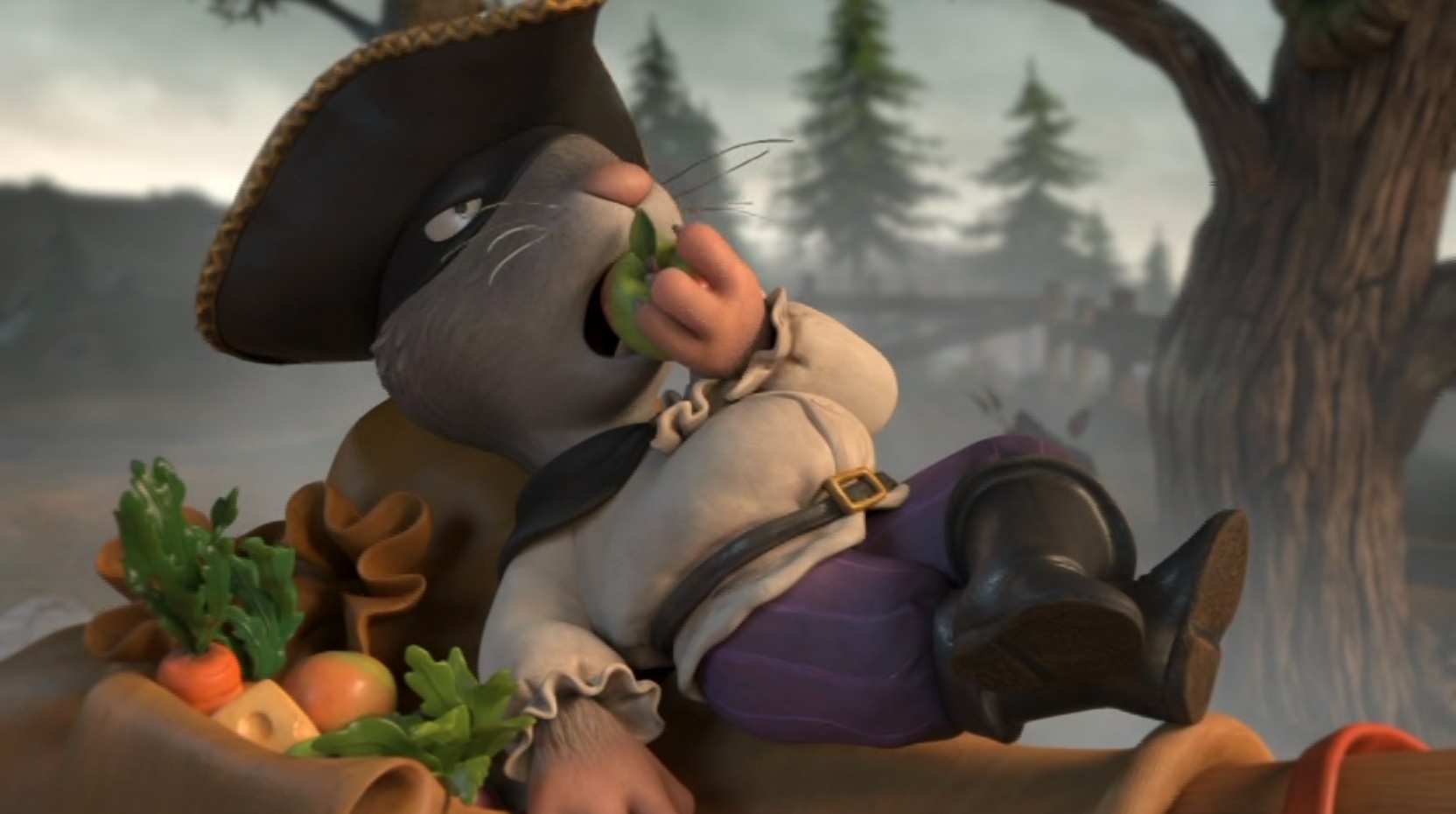
The film boasts the same charming stop-motion-like computer animation and elaborate real sets as the others, and features excellent music by René Aubry, but frankly, the film’s source material is less engrossing than for example ‘The Gruffalo’ (2009) or ‘Room on the Broom‘ (2012). The first half consists of the highway rat taking away food from passing animals only, and the creature’s punishment and reform feel rather obligate and uninspired.
Nevertheless, the film remains a wonderful thing to look at, as neither the animation nor the visuals cease to charm. Especially entertaining is the silent comedy, mostly provided by the Highway Rat’s horse. Done with great subtlety and excellent use of eye expressions this is animation at its very best.
Watch an excerpt from ‘The Highway Rat’ yourself and tell me what you think:
Director: Carlos Saldanha Release date:December 10, 2017 Rating: ★★★ Review:
The classic children’s book ‘The Story of Ferdinand’ by writer Munro Leaf and illustrator Robert Lawson appeared in 1936, and already in 1938 Walt Disney turned, quite faithfully, the story into an animated short called ‘Ferdinand the Bull’.
Of course, for its twelfth feature length film the Blue Sky studio had to expand the story. Like in the book and like Disney’s film Ferdinand is a flower loving bull who refuses to fight, but who ends up in the arena, anyway. There the similarities stop. To this core the studio added a lot of characters and complications. In the process the book’s essentially pacifistic character has been replaced by a more generic message that being gentle, friendly, and helpful doesn’t mean that one is weak, on the contrary. Also added is that all-American dream that one can change the world oneself (“It does not have to be this way” one can hear repeatedly in the movie).
The studio transfers the story to present day Spain and adds a background story of young Ferdinand growing up in a place called ‘Casa del toro’. Young Ferdinand sees his father off into the arena, never to return. This prompts the peaceful calf to escape, and somewhere in the neighborhood of Ronda (the town’s famous Puente Nuevo can be seen in some of the background views from Ferdinand’s flower hill) Ferdinand is found and adopted by a girl called Nina and her father Juan, a flower farmer.
After thirteen minutes young Ferdinand turns into his adult counterpart, and he has grown into a big bull, indeed. When he ends up at ‘Casa del Toro’ again, Ferdinand has a hard time keeping his pacifist ideals, and even worse, he learns a terrible truth about bullfighting, prompting him to rescue his fellow casa inmates.
Woven into this story are a lot of extra characters, rather crowding the story. At Nina’s place there’s a dog called Paco (weakly voiced by Jerrod Carmichael), while ‘Casa del Toro’ features five other bulls, a female “calming” goat called Lupe (a nice voice job by Kate McKinnon), three German horses, and three hedgehogs, which are strange enough rendered in purples and blues. The three German horses add to the fun, but are hardly essential to the plot, and particularly the three hedgehogs come across as stock characters. These three drive a car in a scene that seems directly stolen from ‘Toy Story 2’ in which other small characters manage to drive together.
True, ‘Ferdinand’ is well told, and knows no dead moments. But it doesn’t hold any surprises, either, and the film feels frustratingly run-of-the-mill. Even the gags are disappointingly predictable. The chase scene in Madrid is inspired, but the all too sweet finale is a letdown: there’s absolutely no drama or conflict left in the end. Meanwhile, the charm of the original book gets completely lost in all the antics of Ferdinand’s co-stars, and the sometimes gross out humor (for example, Lupe repeatedly throws up things). It’s also worthwhile to mention that the film is less anti-bullfighting than one would hope.
The film also feels lackluster visually: there are no interesting character designs, and even some ugly ones (some of the humans, a problem troubling the studio since its first Ice Age movie). There is some stylization (for example the bark of the tree on Ferdinand’s hill, a cartoony bee and an almost mechanical butterfly), but this is not carried through consistently. The rendering, too, feels poor, especially when compared to the contemporary ‘Coco’, giving the characters a hard edge and all too saturated colors. The background art, too, is rather simple and uninspired. Even worse, some of the animation is shockingly stiff, especially that of Nina and Juan. On the upside, there are some nicely staged scenes, like Ferdinand entering the slaughterhouse, or Ferdinand entering the ring. In the latter scene, the camera swoops around Ferdinand while he walks into the arena, capturing both the overwhelming scenery and Ferdinand’s reaction to it.
In all ‘Ferdinand’ is not bad, but it’s no classic, either, as the film is as entertaining as it is forgettable.
Watch the trailer for ‘Ferdinand’ yourself and tell me what you think:
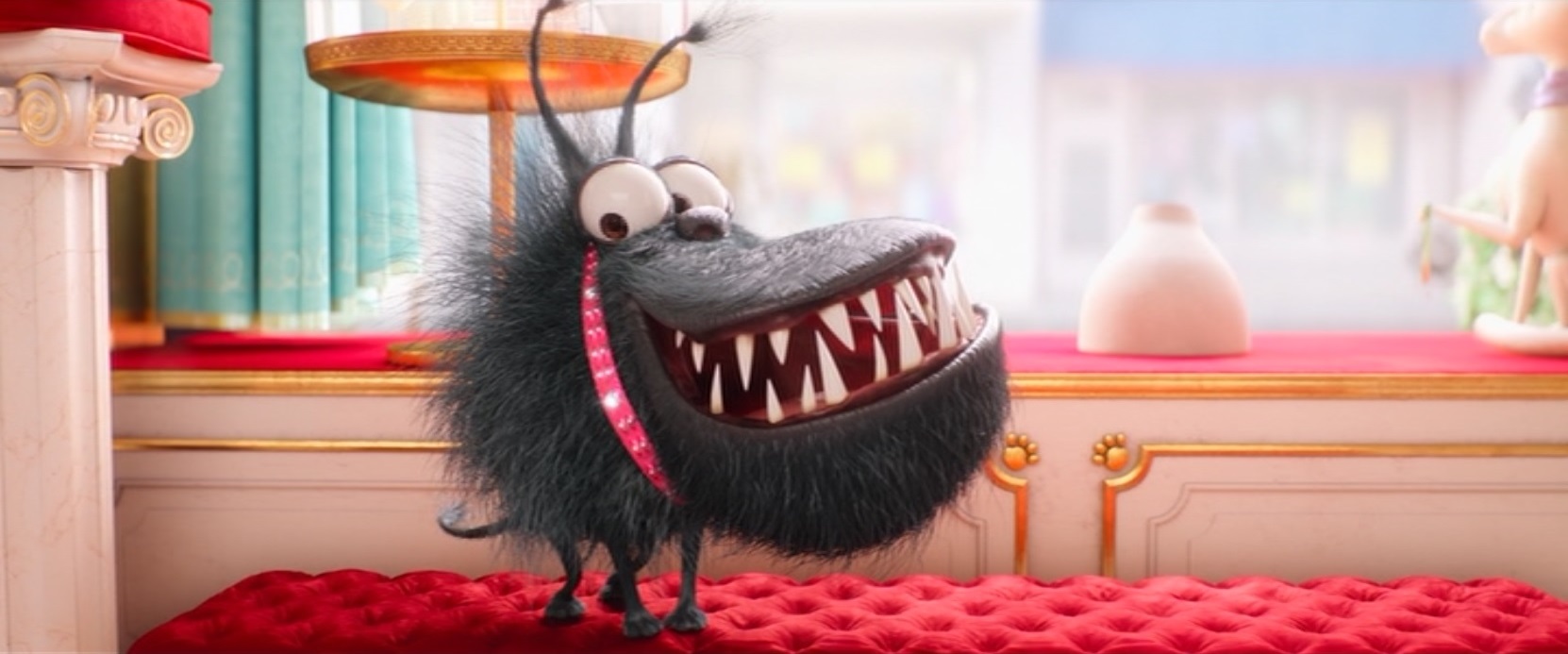
‘The Secret Life of Kyle’ stars Gru’s monstrous dog from the ‘Despicable Me’ films.
In this short Gru’s dog, Kyle, has fallen in love with a neighboring poodle. When he discovers a rival Alsatian Kyle obtains a fancy collar for his love interest, but in the end he wins her over with the squeeky toy he carries around.
‘The Secret Life of Kyle’ is a nice, if forgettable short offering some swell silent comedy in the best cartoon tradition, but without adding anything to it.
Watch ‘The Secret Life of Kyle’ yourself and tell me what you think:
‘The Secret Life of Kyle’ is available on the Blu-Ray and DVD of ‘Despicable Me 3’
Director: Joel Crawford Airing date:November 24, 2017 Rating: ★★★ Review:
I bought this DVD by mistake, mistaking it for ‘Trolls World Tour‘. Oh, well, I might as well watch and review it. ‘Trolls Holiday’ is a television special that features the characters from ‘Trolls’ (2016). The 30 minute short is a holiday special that, refreshingly, is not about Christmas.
The story is extraordinarily simple and straightforward: when Poppy discovers that the Bergens have no holiday left since the abolition of Trollstice, she decides to give them one of the trolls’ own numerous holidays. Unfortunately she gets so carried away she doesn’t realize she distresses her Bergen best friend Bridget during the show. Bridget asks Poppy to leave. Luckily soon Poppy realizes what she has done, while Bridget realizes what Poppy was trying to do. So in the end she invents a holiday of her own, ‘Troll-A-Bration’, celebrating their friendship.
‘Trolls Holiday’ is a nice if unnecessary addendum to the Trolls movie. Both Anna Kendrick and Justin Timberlake reprise their roles, and there’s a lot of singing, especially during Poppy’s presentation. The special ends with both Bergens and Trolls singing Madonna’s ‘Holiday’.
However, the most entertaining parts are the digital cut-out animation sequences telling the background story and Poppy’s plan. During the caterpillar bus ride the trolls shortly change into their real life versions, which is pretty distressing, as this only shows how infinitely more ugly the original toys were when compared to the fluffy versions of the film.
Watch the first four minutes of ‘Trolls Holiday’ and tell me what you think:
Director:James Ford Murphy Release date:October 24, 2017 Rating: ★★½ Review:
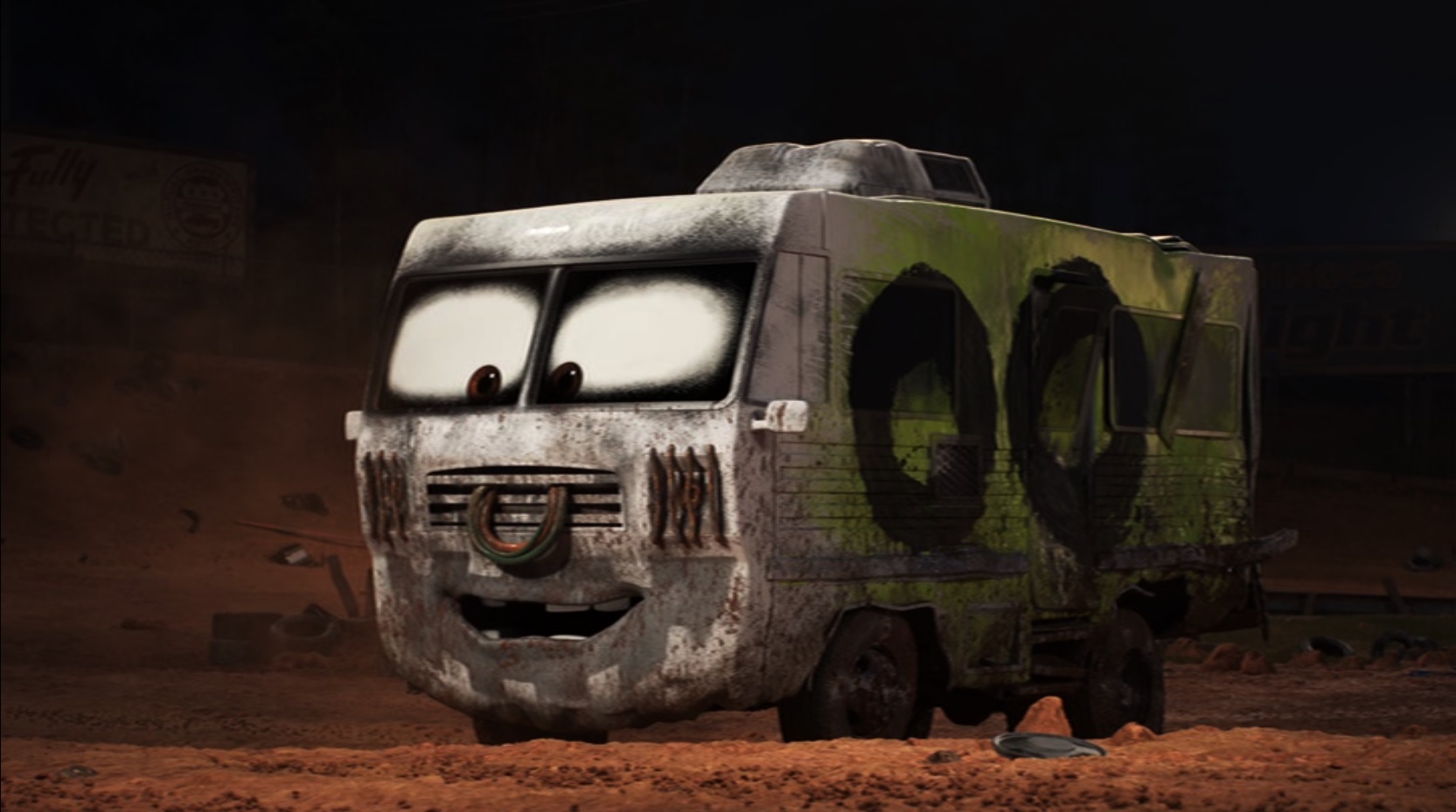
‘Miss Fritter’s Racing Skoool’ is short spin off short from ‘Cars 3‘ and present on the Blu-Ray/DVD of the movie.
The film is a short commercial by Miss Fritter, the modified school bus from ‘Cars 3’, featuring four cars stating how her school changed their lives, and with cars impersonating Lightning McQueen and Cruz Ramirez, with whom we are watching the add.
This short is nothing special, but it does entertain for its three minutes, although it is quickly forgotten afterwards.
Watch ‘Miss Fritter’s Racing Skoool’ yourself and tell me what you think:
‘Miss Fritter’s Racing Skoool’ is available on the Blu-Ray and DVD of ‘Cars 3’ and of the ‘Pixar Short Films Collection: Volume 3’
The 2010s were a disappointing decade for the Pixar studio: the studio largely lost its role as game changer, spitting out a lot of sequels and meagre films that couldn’t stand the comparison with their great movies of the 2000s. Yet, three of their films shone far brighter than the others and showed that the studio still had it: Toy Story 3 from 2010, ‘Inside Out’ from 2015, and ‘Coco’ from 2017.
With ‘Coco’ the studio followed a recent Disney trend to give American minorities their own animated movie. After Afro-Americans (‘The Princess and the Frog’, 2009) and Polynesians (‘Moana’, 2016), ‘Coco’ stars Mexicans only, taking place in Mexico, and focusing on the typically Mexican holiday ‘Día de muertos’, the Mexican variant on All Souls’ Day and All Saints’ Day (1 and 2 November).
Now ‘Coco’ wasn’t the first animated feature film around Día de Muertos, which was 20th Century Fox’s ‘The Book of Life’ (2014), and like the former film ‘Coco’ takes partly place in the land of the dead. But there the comparison stops, and while ‘The Book of Life’ boasts more daring design choices, ‘Coco’ is by far the better film in terms of animation, art direction, background art and storytelling.
Moreover, the animated depiction of the dead as vivid skeletons is even older, as they also appear in ‘Corpse Bride’ (2005) and in the charming stop motion shorts ‘Hasta los huesos’ (René Castillo, 2001) and ‘Día de los muertos’ (Kirk Kelley, 2002). One can safely say, both Mexico’s idiosyncratic holiday and the depiction of the afterlife are of a particular interest to film makers. Let’s not venture into earlier depictions of the afterlife, in cinema or otherwise, although I have to say the concept of the afterlife in Coco has much in common with that of Kevin Brockmeier’s novel ‘The Brief History of the Dead’ from 2006: in both afterworlds one only really dies when he’s not remembered.
‘Coco’ tells about young boy Miguel, who aspires to be a musician, but who grows up in a family of shoemakers in which music is banned. When on ‘Día de muertos’ Miguel steals a guitar from the grave of his idol Ernesto de la Cruz he gets into much more trouble than he had bargained for…
Why the film is called ‘Coco’ instead of ‘Miguel’ only becomes clear at the very end of the film, in a scene that forms the emotional highlight of the movie, and is one of the most moving scenes in animation, overall.
But from the beginning ‘Coco’ evokes wonder. Even the background story is told superbly, with the help of garlands depicting the life of Miguel’s ancestors in attractive 2D animation. Miguel’s own world, too, is of unsurpassed richness. His family house, his village, the graveyard – all are complex and elaborate sets, depicted in the richest detail, which render them instantly believable. But nothing prepares the viewer for the jaw dropping depiction of the netherworld – which is more colorful and more fantastic than anything depicted on the animated screen before. The color designs are superb throughout anyway, with a strong focus on orange. The lighting, too, never ceases to amaze – there’s a beautiful golden glaze in the evening scenes. And yet, the graveyard scenes are even more awe inspiring, with their complex lighting by numerous flickering candles.
But all this would be in vain if the film’s story wasn’t good, as well. But ‘Coco’ can boast a story that is as entertaining as it is emotional. The story is rich and surprising and knows no dead moment at all. Sure, there are a few obligate scenes (like the breakup scene – omnipresent in American feature animation), but for once they do work. For example, the tiring family message, an obligatory Disney feature, is more interesting than usual, because Miguel’s family is actually hindering him in his dreams, and he can only reconcile with them after his family members have changed, too. The only complaints I have is that Miguel runs all too easily into his former ancestor, not only once, but twice. This is a coincidence too good to be true, and one hard to swallow. Moreover, it’s a quite unclear how the gentle romantic Hector changed into the opportunistic bum he apparently became in the afterworld.
The film boasts some great humor, too, for example Miguel runs into a skeleton nude, and there’s a great scene involving the deceased Frida Kahlo. Much of the humor comes from Hector’s antics, and of a street dog called Dante, which mysteriously follows Miguel into the afterlife (the Blu-Ray reveals that Dante is a so-called Xoloitzcuintle, a dog race traditionally guiding the dead to the Aztec underworld – when one sees the real thing one is amazed how well Dante resembles his real-life counterparts). Less successful, especially in a film about the power of music, are the songs, with Miguel’s finale song being particularly annoying. But even the song ‘Remember me’, which takes a very important place in the story, is not half the classic song it supposed to be. That it’s sung in English instead of Spanish is a missed opportunity and contributes to the feeling of a deluded version of the real Ranchera thing.
Nevertheless, this is nit-picking, and these minor flaws hardly hamper a film, which is of a most magical nature. ‘Coco’ takes full advantage of the power of animation, and never ceases to amaze. The film is not only one of Pixar’s best films of the 2010s, but it should also be included into the studio’s all-time best list, as well as being one of the best films of the 2010s by any studio.
Watch the trailer for ‘Coco’ yourself and tell me what you think:
Directors:Charlie Bean, Paul Fisher & Bob Logan Release date:September 22, 2017 Rating: ★★ Review:
One of the biggest feature animation surprises of 2014 was ‘The Lego Movie’. On paper this joint venture between Warner Animation and the famous toy company from Denmark should have been something terrible. After all, it was based on an existing toy line, a recipe for disaster. But the opposite happened and ‘The Lego Movie’ turned out to be one of the funniest, most sophisticated, and deepest animation film of the 21st century. The film was followed in 2017 by the equally funny ‘The Lego Batman Movie’, deepening the title character as he appeared in ‘The Lego Movie’. Warner Animation and Lego were clearly on a roll.
Or were they? Appearing in the very same year as ‘The Lego Batman Movie’, ‘The Lego Ninjago Movie’ uses several of the ingredients of the previous films, but with a remarkably disappointing result. True, there are some good gags, especially those referring to the characters being made of Lego, but more often such gags feel like they have been done before, and better. Even worse, compared to the two earlier films, both the story, the world and the characters are very weakly developed. Apparently, the film was based on a long-lasting television series, but the film hardly betrays that fact. Instead, the movie feels as only half-baked, and assembled too quickly for its own good.
The problems of ‘The Lego Ninjago Movie’ are legion. The film uses elements of both wuxia and mecha films, but can’t satisfy lovers of either genre, as the film makers do very little with these elements. The whole setting of Lloyd being both the leader of the Ninjago squad and the son of Garmadon, the very nemesis they continually combat, is preposterous to start with. That these Ninjago warriors are also some teenager friends at a high school (even though one is a robot) only adds to the implausibility. So does the fact that Garmadon has four hands. The plot gets particularly silly when ‘the monster’ arrives, but when the Ninjago squad goes on a quest in a forest, the film seriously starts to drag. The son-dad relationship becomes a tried and tiresome cliché, and halfway one realizes he doesn’t care for these characters, at all. And then the overlong finale must start, yet…
On the top side the film starts with Jackie Chan, who is always pleasant to watch, even though he’s completely wasted in this film. And the textures of the Lego elements are surprisingly good, rendering them very tactile, indeed. Moreover, the film makes some surprising and rather silly choices in its use of pop music. But it should be clear that none of this can rescue a sloppy, lazy film that seriously lacks the heart and attention given to the first two Lego movies.
Watch the trailer for ‘The Lego Ninjago Movie’ yourself and tell me what you think:
‘The Lego Ninjago Movie’ is available on Blu-Ray and DVD
Just before ‘Blade Runner 2049’ came out, three short films were released to tell of some of the events that happened between the original ‘Blade Runner’ (1982) and the new feature.
The third of these prequel shorts is an anime directed by Shinichirō Watanabe, of Cowboy Bebop fame. The short telles about the great blackout of 2022, which is mentioned in the new feature film. This is by far the weakest of the trio: Watanabe’s way of directing is hilariously heavy-handed, the dialogue frustratingly boring, and the anime designs are ugly, akin to appalling American comic art. What’s worse, we don’t care a bit about the two main replicant protagonists, due to confusing editing, which moves forward and backward in time, and due to the lack of background stories on the characters.
What Luke Scott, director of the other two (live action) shorts, did well: setting a scene in a few seconds and sticking to it, is lost on Watanabe: his tale is overtly complex and meandering within its fifteen minutes. Even the music by Flying Lotus doesn’t amount to anything and is quickly forgotten.
Watch ‘Blade Runner Black Out 2022’ yourself and tell me what you think:
‘Blade Runner Black Out 2022’ is available on the DVD and Blu-Ray of ‘Blade Runner 2049’
However, the most important and most moving animated feature film was the Irish-Canadian-Luxembourgian co-production ‘The Breadwinner’. This was the third feature by the Irish Cartoon Saloon studio, which can be regarded as the most welcome and most original studio additions to the animated feature field of the 21st century, thus far. The Breadwinner’ shares with their previous two films, ‘The Secret of Kells’ (2009) and ‘The ‘Song of the Sea’ (2014) a very charming traditional animation style, and a surprisingly graphic overall design, although the latter is rather toned down in ‘The Breadwinner‘ when compared to the earlier two movies. But unlike the other two, ‘The Breadwinner’ completely lacks the Irish flavor, being set in, of all places, Afghanistan.
Based on the book by Deborah Ellis from 2000 ‘The Breadwinner’ is set in Kabul, the unfortunate country’s capital during the first Islamic Emirate of Afghanistan (better known as the Taliban regime, 1996-2001). By the time the film was made, this extremely oppressive regime was a ghost of the past, at least in Kabul (the Taliban never fully disappeared from the country), but sadly, since August 2021 this misogynist, backward movement is in full charge of the country, once again.
‘The Breadwinner’ makes no mistake how hard it is to live in such a violent, insecure country, where arbitrariness prevails, and where women have no rights, at all, whatsoever. The film follows the eleven-year-old Afghan girl Parvana, who lives with her disabled father, her mother, elder sister Soraya, and a baby brother called Zaki in a tiny house in Kabul. When the father gets arrested and thrown into a prison far outside town, the family quickly get into way more problems than they already had: as women cannot do anything outside without a man, their means to even obtain food completely come to a standstill. At this point Parvana takes an important decision to save her family’s life…
‘The Breadwinner’ is a very believable story, much more subtle than almost anything coming out of the United States. For example, the Afghan people are portrayed as real people, with a rich an ancient culture. Added to the sense of authenticity is the use of Afghan voices (except for the brabbling Zaki), while Mychael and Jeff Danna’s score clearly borrows from the Afghan musical tradition. Thus, the film’s Afghanistan is a convincing one, not a caricature seen through Western eyes. Moreover, although the film makes no mistake about the oppressive and misogynist nature of the Taliban regime, there are many shades of gray between the heroes and villains. Even the villain that causes Parvana’s family’s demise is shown in one last shot as not only evil, but insecure and afraid, too. Moreover, Parvana remains a relatable character, throughout. Despite her courage and adult responsibility, she remains a child, and is shown delighting in childish behavior, especially with her friend Shauzia.
Contrasted with Parvana’s dire circumstances are the images of a story she tells her beloved (her first audience is her baby brother, but she also tells the tale to others, and others even blend in, altering the direction of the story while doing so. These images are rendered in the most colorful, storybook illustration-like, faux cut-out animation, and tell about a boy who goes on a quest to retrieve his village’s seeds from an evil elephant king. This fantastical tale is picked up several times during the movie, and often reflects the events depicted in real life. Especially in the finale, in which the two seem to come together, this dual story telling comes to a harrowing conclusion.
As said, the film’s design is less graphic than that of Cartoon Saloon’s Celtic features. The background art is semi-realistic, with depressing greys, browns and yellows depicting the seemingly treeless town of Kabul. The character design is more graphic, with especially Zaki being an echo of the character designs from the earlier films. Noteworthy is the background art of a rather surreal scene in which Parvana and Shauzia are seen in a field full of abandoned tanks. The traditional animation is a delight, not only the very moving animation of the main characters, but also the cartoony quasi-cut-out animation of Parvana’s story. There’s only a little computer animation present, mostly for crowd scenes.
In all, ‘The Breadwinner’ is one of the best, most adult and most moving animation films to come out of any animation studio, and should be considered a modern classic.
According to director Nora Twomey ‘The Breadwinner’ may be set in Afghanistan but tells a universal story of all children growing up in oppressive countries, everywhere. Yet, we are still waiting for the animated depictions of their stories, while Afghanistan has been the subject of no less than three other animated feature films since then: ‘The Swallows of Kabul’ from 2019 and ‘My Sunny Maad’ and ‘Flee’ from 2021. Surely, the people of say North Korea, Syria, Eritrea, the Central African Republic, or Yemen deserve better.
Watch the trailer for ‘The Breadwinner’ yourself and tell me what you think:
‘Mary and the Witch’s Flower’ is the first film by Studio Ponoc, founded by Yoshiaki Nishimura, who was a producer for Studio Ghibli before. Director Hiromasa Yonebayashi, too, is a Studio Ghibli alumnus, being an animator for the famed studio since 1997, and directing the studio’s 21st feature film ‘When Marnie Was There’ (2014).
It comes to no surprise then that ‘Mary and the Witch’s Flower’ is very, very Ghibli-like. Already the packaging of the DVD would fool anyone. But the similarity doesn’t stop there: even the opening titles emulate Ghibli; the character designs, too, are very Ghibli-like; the film is based on a British children’s book, just like Ghibli’s ‘Howl’s Moving Castle’ (2004), ‘Arrietty’ (2010) and ‘When Marnie Was There’; the film stars a young female protagonist (Mary) who has to survive without her parents, just like ‘Kiki’s Delivery Service’ (1997), ‘Spirited Away’ (2001) and ‘From Up on Poppy Hill’ (2010); Mary is a witch like Kiki; she’s accompanied by a cat who plays an important part just like Kiki and like Shizuku in ‘Whisper of the Heart’ (1995), and the film is partly set in a fantasy world, just like ‘Spirited Away’.
Now, this is immediately the film’s main flaw: studio Ponoc imitates Ghibli very well but doesn’t bring anything original of its own. The final product is practically indistinguishable from the source of inspiration. That doesn’t mean, however, that ‘Mary and the Witch’s Flower’ is a bad movie. The story is told well enough, the animation is top notch, and the fantasy world looks great. I certainly had a good time watching it, and would recommend the movie to all lovers of the Studio Ghibli product. But Studio Ponoc’s debut could and should have been something much more of their own. If you compare, for example, ‘Mary and the Witch’s Flower’ to the idiosyncratic ‘Night Is Short, Walk on Girl’ from the same year, it becomes clear which studio brings something original to the world, and which one does not.
Watch the trailer for ‘Mary and the Witch’s Flower’ yourself and tell me what you think:
‘Mary and the Witch’s Flower’ is available on Blu-Ray and DVD
One of the more pleasant developments of the 21st century was the coming of animated feature films, the whole purpose of which was to make people laugh. One could say this trend started off with the successful ‘South Park, Bigger, Longer & Uncut’ (1999), and like that film these films were mostly off-shoots from series (‘The Simpsons Movie’ and the Spongebob Squarepants movies from 2004, 2015 and 2021) or offshoots from other films (‘Minions’ from 2015, ‘The Lego Batman Movie’ from 2017).
But occasionally, a film comes to you, which is both very funny, and totally original, even if it’s based on an earlier comic strip, like the Franco-Belgian feature ‘Le grand méchant renard et autres contes…’. The film is co-directed by Benjamin Renner, one of the producers of the attractive, if flawed ‘Ernest et Célèstine’ from 2012, and the original author of the comic strip, ‘Le grand méchant renard et autres contes…’. . Both comic strip and movie aim for the laughs, and are highly successful at it, too.
The film is advertised as a children’s film, and it certainly is fit for all ages, but don’t let this fool you. There’s nothing childish about this film. Instead, we get high quality cartoon comedy, perfectly animated and perfectly timed.
Based on three separate stories, ‘Le grand méchant renard et autres contes…’ is an anthology film, bridged by the idea of a play performed by the main characters. As soon as the first tale starts, the backdrop changes into the scenery in which all three stories take place: a farm in the countryside.
In the first film a stork talks a pig, a duck, and a rabbit into delivering a baby for him to his parents. Unfortunately, the baby must be delivered in faraway Avignon, and sadly for the pig both the duck and the rabbit are as incapable as they are optimistic. This tale is chockfull of cartoon slapstick, as the duck and the rabbit keep on thinking more and more outlandish schemes to deliver the baby, while the pig desperately tries to keep the little one safe.
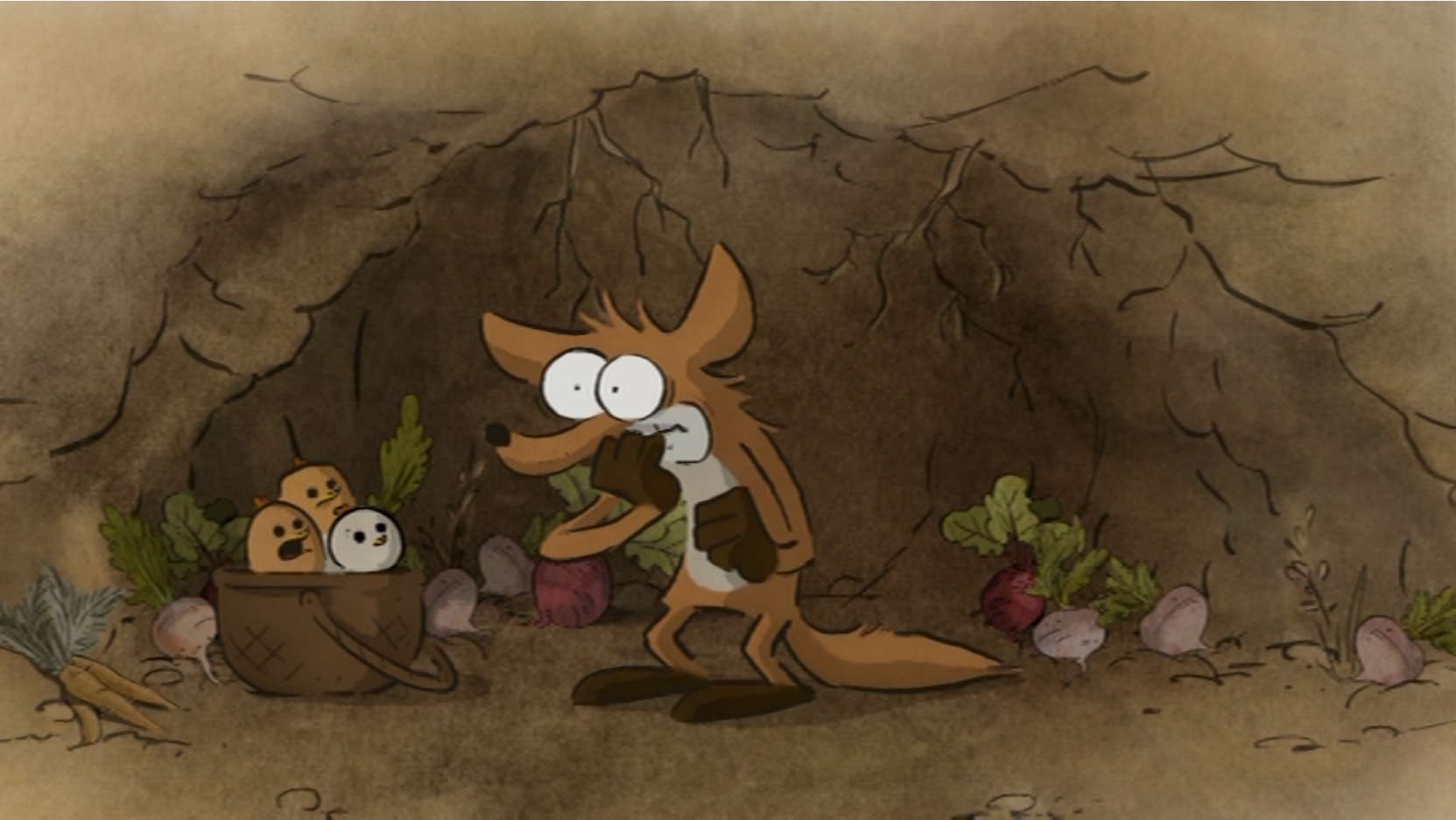
The next story is a little cuter and involves a totally inept fox who teams up with a lazy and selfish wolf. The wolf talks the fox into stealing some eggs to raise them into fat chickens, but of course the fox grows attached to the little ones. Nevertheless, this tale, too, moves and shifts into surprising directions, and is less straightforward than this summary.
The third and final story is a genuine Christmas story, which sees the happy return of the pig, duck, and rabbit trio of the first part. This time, duck and rabbit think they’ve killed Father Christmas, and make resolutions to deliver the presents themselves… General mayhem is ensured.
The film uses a very charming drawing style, which like the earlier ‘Ernest et Célèstine’ consists of watercolor backgrounds and fake watercolor-coloring of characters, open lines and appealing character designs, which more or less fit in a long and diverse Franco-Belgian cartoon style tradition. The film is continuously pleasant to look at, and the attractive score, by Robert Marcel Lepage, adds to the film’s charm, as well. Scored for a small ensemble, Lepage makes excellent use of some familiar themes, like the morning theme from Giachino Rossini’s Overture ‘William Tell’, the wolf theme from Sergei Prokofiev’s ‘Peter and the Wolf’, and in the last story, ‘Jingle Bells’.
In all, ‘Le grand méchant renard et autres contes…’ once again shows that France is one of the most interesting animation film-producing countries around. Recommended to all.
Watch the trailer for Le grand méchant renard et autres contes… (The Big Bad Fox and Other Tales) yourself and tell me what you think:
Le grand méchant renard et autres contes… (The Big Bad Fox and Other Tales) is available on Blu-Ray and DVD
Animation Backgrounds
A blog dedicated to background paintings from animation films. Kept until 2016.
Animation Scoop
Animation historian Jerry Beck’s animation film news blog.
Cartoon Brew
Topical blog on animation film, led by animation historian Amid Amidi.
Cartoon Modern
Amid Amidi’s blog on modern design cartoon art from the forties, fifties and sixties.
Cartoon Research
THE site on classic animation research, hosted by cartoon historian Jerry Beck.
Cartoons Theory
Frank Beef analyzes classic cartoons. Kept until 2020.
Century Film Project
Michael reviews films of 100 years old and older, roughly in chronological order.
Classic Cartoons
A similar blog featuring many stills and comic strips. Kept until 2012.
Comet over Hollywood
Jessica Pickens reviews classic Hollywood films, especially musicals.
Deja View
Top ex-Disney animator Andreas Deja’s own blog.
Disney History
Esteemed Disney historian Didier Ghez on the latest books on Disney history.
Feeling Animated
Paul Astell brings us thorough reviews of animated features.
Flickers in Time
Short and to the point reviews of classic films (lately mostly pre-code talkies) by an anonymous retired Foreign Service Officer from California









 Dr. Grob's Animation Review