Director: Walt Disney
Release Date: March 15, 1929
Stars: Mickey Mouse, Minnie Mouse, Pete
Rating: ★★★★½ Review:
In ‘The Barn Dance’, Mickey Mouse’s fourth cartoon, Pete’s rivaling Mickey for the love of Minnie.
The first scene of this cartoon draws its inspiration from the Oswald cartoon ‘Rival Romeos‘, released only eight months earlier. Pete and Mickey both come to Minnie’s house to court her. Pete has the advantage of having a car above Mickey’s chariot, and like Donna Duck would do nine years later in ‘Don Donald‘ (1937), Minnie (wearing a bra, like she did in ‘Gallopin’ Gaucho‘) falls for it. Luckily, the car falls apart even before they’ve taken a ride, so Mickey and Minnie ride together to a barn dance hall.
Unfortunately, Mickey can’t dance: his shoes grow bigger every step, stepping on Minnie’s leg all the time. So after the dance Minnie’s leg is a long mess. She then ties it in a knot and cuts off the excess! These two gags belong to a surreal type typical of the silent era, which Disney would soon abandon.
After Mickey’s failure as a dancer, Minnie only wants to dance with Pete. Mickey solves the problem with help from a balloon, but Pete wrecks Mickey’s plan, regaining Minnie and leaving Mickey crying on the floor. This is a rather odd ending of a marvelous cartoon, which is still firmly rooted in the silent era with its surreal gags, limited use of sound and absence of dialogue.
‘The Barn Dance’ is far less known than the three Mickey Mouse cartoons preceding it, but with its clear storytelling, funny gags and strong acting it’s still a delightful cartoon to watch.
Watch ‘The Barn Dance’ yourself and tell me what you think:
This is Mickey Mouse cartoon No. 4
To the previous Mickey Mouse cartoon: Steamboat Willie
To the next Mickey Mouse cartoon: The Opry House
Director: Walt Disney
Release Date: August 7, 1928
Stars: Mickey Mouse, Minnie Mouse, Pete
Rating: ★★★★★ ♕ Review:
Although Mickey’s first cartoon, ‘Plane Crazy‘, couldn’t arouse any distributor, Disney made another cartoon with his new character, ‘Gallopin’ Gaucho’. It was to be Mickey’s second and last silent cartoon.
If possible, he is even ruder in this short than in ‘Plane Crazy’: according to a poster in the background, he is a sought-after criminal, we watch him smoking and drinking, and dancing a stout tango with Minnie (who’s wearing a bra in this cartoon).
Nevertheless, this cartoon is also the first in which Mickey shows to be a small, but clever and courageous hero. For when Minnie is abducted by Pete (who, in his first appearance in a Mickey Mouse cartoon, has both his legs), Mickey rescues her in a heroic fight. He then earns the kiss he tried to get by force in ‘Plane Crazy’. It was of course this character trait which was greatly expanded upon in later Mickey Mouse cartoons. Mickey’s nemesis, Pete, was in fact a much older character than Mickey – he already figured in some of the Alice cartoons and he was also Oswald’s adversary. His design was initially more dog- or bearlike, but in the Mickey Mouse cartoons it was settled that Pete was some kind of big cat.
Due to the melodrama ‘Gallopin’ Gaucho’ contains less gags than ‘Plane Crazy’, but it’s still a wonderful and fast cartoon with ingenious gags like the scene in which Mickey uses his own tail as a tackle. ‘Gallopin’ Gaucho’ also set out a storyline that was to be copied a couple of times (e.g. ‘The Cactus Kid‘ (1930), ‘Mickey in Arabia‘ (1932),’ The Klondike Kid‘ (1932)), and self-consciously parodied in ‘Gallopin’ Romance’, the film shown in ‘Mickey’s Gala Premier’ (1933). ‘Gallopin’ Gaucho’ itself was a parody of the 1927 Douglas Fairbanks film ‘The Gaucho’.
This cartoon was de facto the first production of Disney’s new fledgling studio (‘Plane Crazy’ was made secretly when Disney was still under Mintz’s contract). Ub Iwerks, who had animated ‘Plane Crazy’ single-handedly, could now be assisted by the young assistant animators Les Clark and the recently hired Wilfred Jackson to work on ‘Gallopin’ Gaucho’. Both men would have long lasting careers at the Disney studio.
Unfortunately, ‘Gallopin’ Gaucho’ didn’t stir the distributors any more than did ‘Plane Crazy’. Disney had to come with something original, if he would get Mickey on the screen. And with something original he came…
A few final trivial remarks
Mickey has shoes in this cartoon, which he shortly looses while whistling his ostrich in one scene.
Mickey’s eyes change from the goggly to the familiar ones during the same scene.
The bird Mickey’s riding might very well be a Rhea, a relative of the ostrich, that lives on the pampas of Argentina, the place where the cartoon takes place.
Watch ‘Gallopin’ Gaucho’ yourself and tell me what you think:
This is Mickey Mouse cartoon No. 2
To the previous Mickey Mouse cartoon: Plane Crazy
To the next Mickey Mouse cartoon: Steamboat Willie
Director: Walt Disney
Release Date: November 18, 1928
Stars: Mickey Mouse, Minnie Mouse, Pete
Rating: ★★★★★ ♕ Review:
In 1928 Walt Disney was at a low point in his career. He had refused to work for Charles Mintz at lower wages, he had lost most of his staff to Mintz, and he had no distributor for his new cartoon star, Mickey Mouse.
Mickey’s first two cartoons, ‘Plane Crazy‘ and ‘Gallopin’ Gaucho‘, were well-made and entertaining films, but they didn’t impress any distributor. The problem was that despite their high quality, they were not really different from other cartoons, like Disney’s former own Oswald the Lucky Rabbit series. Disney had to think of something.
And he did. Mickey’s third cartoon would have the distinction of sound. Sound was an extremely fresh cinematic feature at the time. The breakthrough feature, ‘The Jazz Singer’ had only been released in October 1927, and the first all talking picture, ‘Lights of New York’ was only released in July 1928, the month in which production on ‘Steamboat Willie’ started.
Using sound creatively
Surprisingly, ‘Steamboat Willie’ was not the first cartoon to use synchronized sound. The Fleischer studio, for example, had experimented with the technique as early as 1924, and in October 1928 Paul Terry would release ‘Dinner Time’, which also used a synchronized soundtrack. However, Fleischer’s films failed to reach complete synchronicity, and Paul Terry’s film (which can be watched here) is essentially a silent and remarkably boring cartoon, which just happens to have sound to it.
‘Steamboat Willie’ on the other hand makes perfect use of the novelty of sound. Already in the opening scene we’re treated on something no less than spectacular: we watch and hear Mickey Mouse whistling a joyful tune. After watching several silent cartoons, this sole scene still has a startling effect. But all scenes in ‘Steamboat Willie’ are there to show us the novelty of sound: we watch and hear whistles blowing, cows mooing, chickens cackling, and Minnie shouting “yoo”-hoo”. And thanks to the invention of the click track all sounds are in perfect synchronization with the moving images.
However, the real treat of ‘Steamboat Willie’ comes after 4 minutes, when a goat swallows Minnie’s sheet music and guitar. What seems a disaster turns out to be a delight, for the goat becomes musical, and Mickey and Minnie turn it into some kind of hurdy-gurdy. This gag, in fact, had already been used in the silent Oswald the Lucky Rabbit cartoon ‘Rival Romeos‘ (released in March), but makes much more sense with the added sound. For now the goat-hurdy gurdy provides an intoxicating soundtrack for Mickey to improvise on, incidentally mostly by torturing animals. This musical number, based on ‘Turkey in the Straw’ is a sheer delight, and entertains even today.
The impact of ‘Steamboat Willie’
Needless to say ‘Steamboat Willie’ boosted both Mickey Mouse’s and Walt Disney’s career and it gave a valuable shot to the ailing animation industry. Yet, it also caused a setback, one that can already be seen in this cartoon. In ‘Steamboat Willie’, sound is the sole raison d’être of some of the shots (chickens cackling, a cow mooing). But more important, storyline has given way to an extensive musical number. While the two Mickey Mouse shorts that were made before, ‘Plane Crazy’ and ‘Gallopin’ Gaucho’, had strong, albeit simple stories, Steamboat Willie has almost none. It wasn’t necessary: simply watching Mickey Mouse dancing and playing to the music was marvelous enough for the audiences of that time.
Therefore, in the years after the success of ‘Steamboat Willie’, Disney would favor often tiring sing and dance routines above great story lines. It took the studio almost two years to bring back strong stories to its cartoons (Mickey’s 19th film, ‘The Fire Fighters’ from 1930, is arguably the first).
Conclusion
Nevertheless, ‘Steamboat Willie’ is a great cartoon, and a lot of fun to watch. It is still deeply rooted in the silent era: because lip synchronization had not been developed yet, the characters’ vocabulary remains rather limited. Therefore, it still uses a comic strip-like visual language to express the characters’ feelings. Yet, the musical number is both fresh and catching.
When you’ve seen Steamboat Willie, you’ll be whistling ‘Turkey in the Straw’ for days, with a smile on your face.
Watch ‘Steamboat Willie’ yourself and tell me what you think:
This is Mickey Mouse cartoon No. 3
To the previous Mickey Mouse cartoon: Gallopin’ Gaucho
To the next Mickey Mouse cartoon: The Barn Dance
Director: Walt Disney
Release Date: May 15, 1928
Stars: Mickey Mouse, Minnie Mouse
Rating: ★★★★★ ♕ Review:
April 1928. Disney has just returned from an ill-fated journey to New York. There he had learned that he had lost his star character Oswald the Lucky Rabbit, and all his crew – all hired away by his distributor, Charles Mintz.
All, save one – only his friend and star animator Ub Iwerks has remained loyal*. And while the rest of the studio is working on the last Disney-produced Oswald cartoons, Iwerks is set to work in a separate office, secretly working on a cartoon, not for Mintz, but for Disney.
Iwerks works at an astonishing speed, and he finishes the animation on the cartoon after two weeks. This is a stunning effort by all standards. But what is even more extraordinary is that the finished product, ‘Plane Crazy’, turns out to be such a fine cartoon!
‘Plane Crazy’ is more consistent than most of the preceding Oswalds. It’s fast, it’s simply packed with gags and very funny. Moreover, it’s full of visual tricks. For example, the film opens with the behind of a cow (!), walking away from the camera. Later there are some great perspective scenes with Mickey’s plane flying under a cow’s udders, and almost crashing into two cars.
The film draws inspiration from the same event as the earlier Oswald cartoon ‘The Ocean Hop‘ (1927): Charles Lindbergh’s flight from New York to Paris on May 20-21 1927, the first non-stop flight across the Atlantic Ocean. A goggle-eyed Mickey Mouse (without shoes or gloves) wants to imitate ‘Lindy’ and builds a plane himself, helped by the other farm animals.
Unfortunately his plane crashes against a tree. Then Mickey transforms a car into a plane, and asks Minnie to fly along. After a breath taking take-off, the plane flies, and up in the air Mickey forces a kiss from Minnie, with disastrous results.
‘Plane Crazy’ is, of course, Mickey’s first cartoon and it hasn’t aged a bit. Yes, it’s a silent cartoon with sound added later. Yes, Mickey looks and behaves rather differently than he would do later, and yes, some of the gags are rather crude. Yet, Plane Crazy is outstanding for its fast-paced gags, its extraordinarily rubbery animation, its awesome use of perspectives and its effective pantomime character animation (its only piece of dialogue is Minnie asking “who, me?”).
The film is a testimony of Ub Iwerks’s extraordinary skill. Not only was he an incredibly fast animator, as this short shows he was also an original artist, with a distinct style and an excellent sense of comic timing.
Unfortunately, in 1928, the distributors didn’t see anything distinctive in Mickey. True, he was not too different from Oswald. Both characters were of more or less the same size (with Mickey being outrageously big for a mouse from the outset). Both characters were kinda likable, had a joyful, adventurous spirit, and were seen courting a love interest. Nevertheless, Disney produced a second cartoon with his new character, ‘Gallopin’ Gaucho‘.
Watch ‘Plane Crazy’ yourself and tell me what you think:
This is Mickey Mouse cartoon No. 1
To the next Mickey Mouse cartoon: Gallopin’ Gaucho
* and, to be fair, animator Johnny Cannon, and the recently hired Les Clark (one of the future Nine Old Men – who was not even approached by Mintz), and some ink and paint girls, and the janitor.
Director: Burt Gillett
Release Date: August 11, 1934
Stars: Clara Cluck, Clarabelle Cow, Donald Duck, Goofy, Horace Horsecollar, Mickey Mouse, the Orphan Mice
Rating: ★★★★★ ♕ Review:
In ‘Orphan’s Benefit’ Mickey and the gang are giving a theatrical performance for the orphan mice we know from ‘Mickey’s Nightmare’ (1932) and other cartoons.
We watch Donald Duck reciting ‘Little Boy Blue’, Horace Horsecollar, Clarabelle Cow and Goofy as acrobats and Mickey and Clara Cluck giving a recital.
‘Orphan’s Benefit’ marks Donald Duck’s second appearance, after his debut in ‘The Wise Little Hen‘ from two months earlier, and his looks are still a bit awkward: he has black feet (because of his transition from color to black and white), an elongated bill and he is very small compared to the rest of the gang. Nevertheless, ‘Orphan’s Benefit’ marks the real birth of Donald Duck: he’s cast outside the Silly Symphonies along Mickey and his co-stars, and he’s really stealing the show. Moreover, for the first time he’s showing his temper and his typical ‘dance of anger’ (created and animated by Dick Lundy).
Besides Donald Duck this cartoon also introduces Clara Cluck, the opera-singing hen. Her career was way less successful than Donald’s: in total she would star in only seven cartoons, and she retired in 1942. Mickey’s role is reduced to a scarcely visible and embarrassingly unfunny straight man. Therefore Orphan’s Benefit marks as much the start of Donald’s career as the beginning of Mickey’s demise.
‘Orphan’s Benefit’ was the only Disney cartoon to be remade. In 1941 it appeared again, now in color and with new designs (especially of Donald Duck).
Watch ‘Orphan’s Benefit’ yourself and tell me what you think:
Director: Wilfred Jackson
Release Date: June 9, 1934
Stars: Donald Duck
Rating: ★★★★ Review:
‘The Wise Little Hen’ is a simple and quite moralistic Silly Symphony carried by a mediocre, yet all too memorable song. I guess it might have fallen into oblivion, were it not for Donald Duck.
In his first appearance Donald Duck is a real sailor, living on a boat and dancing the hornpipe. He’s a strong voice character from the start. When he joyfully shouts ‘oh boy, oh boy, oh boy!’ we all know it’s him, even though his looks are different.
Indeed, like Goofy’s voice, Donald Duck’s voice anticipated the character. When Walt Disney heard Clarence Nash use this particular voice, he really wanted something to do with it. According to animator Bill Cottrell, cited in ‘They Drew As They Pleased’, concept artist Albert Hurter was responsible for the duck’s looks. He gave Donald his trademark sailor suit, which he maintained to the present day.
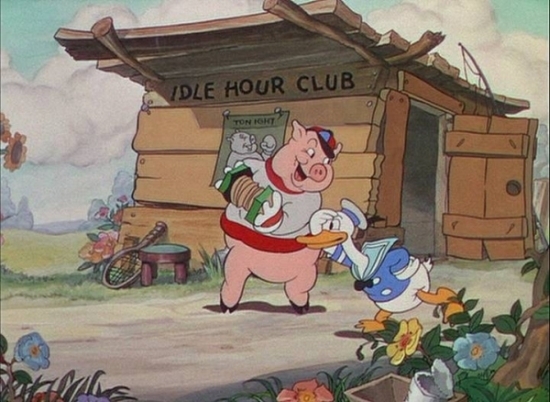
Besides his typical voice and suit, Donald Duck displays two of his typical character traits: egotism and his tendency to trick others. However, he does not yet display his short temper: when ultimately foiled by the hen he’s not breaking down in anger, but joins Peter Pig in remorseful self-chastisement (a gag reused from an early Oswald the Lucky Rabbit cartoon called ‘Rival Romeos‘, 1928). But Donald would show his temper, in his next cartoon: ‘Orphan’s Benefit‘.
Besides Donald Duck this cartoon is interesting for an appetizing and startlingly realistic animation shot of butter melting on hot corn.
Watch ‘The Wise Little Hen’ yourself and tell me what you think:
Director: Burt Gillett
Release Date: April 14, 1934
Stars: the three little pigs, the big bad wolf
Rating: ★★★½ Review:
‘The Big Bad Wolf’ was Disney’s very first sequel.
It was undoubtedly made to satisfy the masses who, after the huge success of ‘Three Little Pigs‘ (1933), demanded for ‘more pigs’. As one can expect, it’s not as great as ‘Three Little Pigs’, but it’s fun to watch.
The title card shows the main characters as if they were playing their parts. The cartoon, however, is named after the wolf, and deservedly so, because not only is he drawn better than in the original cartoon, he’s also the star of this sequel. Clearly being the greatest actor, he not only impersonates grandma, but also “Goldilocks the fairy queen” in a ridiculous and aimless costume, and even Jimmy Durante! Furthermore, he alone shows to be aware of the audience: he often looks into the camera, and even addresses the audience with a Mae West-like “how’m I doing?”.
After this cartoon, the demand for pigs apparently still wasn’t satisfied, for it was followed by even two more sequels: ‘Three Little Wolves‘ in 1936 and ‘The Practical Pig‘ in 1939.
‘The Big Bad Wolf’ might be the first “fairy-tales mixed up” cartoon. It may very well have inspired Tex Avery to make similar, yet more hilarious cartoons like ‘The Bear’s Tale’ (1940) and ‘Swing Shift Cinderella’ (1945), both starring Little Red Riding Hood.
Watch ‘The Big Bad Wolf’ yourself and tell me what you think:
Director: Wilfred Jackson
Release Date: February 10, 1934
Rating: ★★★★★ ♕ Review:
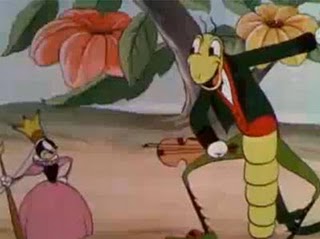
‘The Grasshopper and the Ants’ is easily one of the best Silly Symphonies: it has a catchy song, great use of color and beautiful effect animation. Notice, for instance, the realism of the leaves blowing away during the autumn scene. One can even recognize which trees they’re from!
The grasshopper, too, is a wonderfully designed character, based on concept art by the great Albert Hurter. In contrast, the design of the ants looks a little primitive, still belonging to the black and white era. But, by now, the Disney staff has fully mastered the idea of character animation. This is best shown in the final dance scene: even in a crowd of lookalikes one easily recognizes the joyful ant the Grasshopper had tempted earlier.
Note that morality notwithstanding, the grasshopper is allowed to do what he does best: singing and playing. An encouragement to view art as an important contribution to society. Even so, the way the queen finally invites him is a real cliff-hanger.
This cartoon’s theme song, ‘the world owes me a living’ was composed by Leigh Harline, who would also compose the catchy songs of ‘Pinocchio‘. the grasshopper’s catchy song would become Goofy’s theme song. No wonder, for he and the Grasshopper share the same voice, by Pinto Colvig.
Watch ‘The Grasshopper and the Ants’ yourself and tell me what you think:
This is Silly Symphony No. 42
To the previous Silly Symphony: The China Shop
To the next Silly Symphony: Funny Little Bunnies
Director: David Hand
Release Date: April 20, 1935
Rating: ★ Review:
‘The Robber Kitten’ is one of the more annoying entries in the Silly Symphony series.
Being a Silly Symphony, its animation is top notch, especially the character animation of the little rascal Ambrose (or ‘Butch’ as he prefers to be called) and the experienced robber Dirty Bill. But, the story is slow-paced, childish and dripping with morality.
The setting is vague and pretty unconvincing: Bill is clad in a medieval Robin Hood-like costume, while Ambrose is clad in 17th century fashion. A much sillier world as that of ‘The Cookie Carnival’ was brought with much more bravado.
All too typical for the Silly Symphonies of the mid thirties, ‘The Robber Kitten’ is nothing more than beautifully animated pulp.
Watch ‘The Robber Kitten’ yourself and tell me what you think:
This is Silly Symphony No. 51
To the previous Silly Symphony: The Golden Touch
To the next Silly Symphony: Water Babies
Director:Dave Fleischer Release Date: January 17, 1936 Rating: ★ Review:
Max Fleischer’s first full color cartoon is in the same vein as Disney’s ‘Lullaby Land‘ (1933) and Walter Lantz’s ‘Candy Land’ (1934), depicting little children’s wonderful dreams.
‘Somewhere in Dreamland’ deals with two very poor children who dream that they are in dreamland which is full of candy and toys. Fleischer’s 3D-technique is used with stunning results, and the cartoon must have struck a chord with the audience during the Great Depression era, in which poverty was an all too familiar thing. Indeed, as children the Fleischer Brothers themselves had known hunger like depicted in the film, when their father ran out of business. Unfortunately, the cartoon is remarkably unfunny and sickeningly sweet, following similar sugary outings in Disney’s Silly Symphonies series, like ‘Funny Little Bunnies‘ (1934) and ‘The Robber Kitten‘ (1935).
Unlike those films, however, ‘Somewhere in Dreamland’ suffers from primitive designs. The children’s mother looks like a relative of Olive Oyl, while the little children are drawn in typical thirties kids style resembling Hänsel and Gretel from Disney’s ‘Babes in the Woods‘ from four years earlier. The result is that none of the characters seem to fit within the elaborate 3D-sets.
Watch ‘Somewhere in Dreamland’ yourself and tell me what you think:
Director: Wilfred Jackson Release Date: August 19, 1933 Rating: ★★★★½ Review:
In ‘Lullaby Land’ a baby is lulled to sleep by his mother, singing ‘rock-a-bye baby’. The song takes the baby and his stuffed dog to Lullaby Land, a wonderfully surreal land made of plaids, rattles etc.
There the baby encounters a parade of baby objects, and a forbidden garden, full of sharp things, like knives and scissors. Despite the warnings of the female choir in the soundtrack, the baby enters. He destroys all watches from a watch tree with a hammer, and plays with matches. The smoke evokes three bogey men, which scare the baby away. Finally, the baby meets the Sandman, who puts the baby asleep to the tune of Johannes Brahms’s lullaby.
With cartoons like ‘Lullaby Land’ Disney set new standards for animation that are still thrilling today. Don’t get me wrong, the cartoon is rather patronizing and sugary cute, especially through the soundtrack. But this is compensated by wonderful surrealistic images, beautiful artwork and superb animation. And, hey, this way of warning against sharp things and matches just may work with small children.
Lullaby Land itself is a highly original fantasy world, and especially its first images are stunningly beautiful. The dance of the bogey men contains some striking use of color that anticipates similar surreal images in ‘Dumbo‘ (1941). Moreover, it is the first example of totally unrealistic color use in animated cartoons, and therefore a milestone.
Unfortunately, the cartoon also marks a trend of childishness creeping into the animation world, not only at Disney’s, but at all other studios, as well. For example, ‘Lullaby Land’ is the first of a whole series of Silly Symphonies obsessed with little babies, and their bare behinds in particular, with ‘Wynken, Blynken and Nod‘ from 1938 being the last example.
Anyway, ‘Lullaby Land’ left all competitors far behind. Later, both Walter Lantz (‘Candy Land’, 1934) and Max Fleischer (‘Somewhere in Dreamland‘, 1936) tried to copy the concept with far less convincing results.
Watch ‘Lullaby Land’ yourself and tell me what you think:
This is Silly Symphony No. 38
To the previous Silly Symphony: Old King Cole To the next Silly Symphony: The Pied Piper
Director: Wilfred Jackson Release Date: March 24, 1934 Rating: ★★ Review:
‘Cute Little Bunnies’ would have been a better title for this easter short, for the bunnies are very cute, not funny.
In fact, “Funny Little Bunnies’ is so cute it can only have been meant for children. It makes one wonder what movies it was supposed to support in the theaters (surely no grim gangster thriller!).
Because everybody copied Disney at that time, other studios were copying this ‘new cuteness’ as well. Especially 1934 saw an explosion of Silly Symphonies imitating series, combining the appeal of color with sugary tales. Former Disney associate Ub Iwerks was the first, releasing his first Comicolor cartoon on December 23, 1933. He was followed by Max Fleischer (Color Classics, August 1934), MGM (Happy Harmonies, September), Van Beuren (Rainbow Parade, September), Columbia (Color Rhapsodies, November), and Walter Lantz (Cartune Classics, December). This resulted in a spread of cute (and severely unfunny) cartoons in the mid-thirties.
One is therefore particularly thankful that in the late thirties Tex Avery restored nonsense, wackiness and absurdism in the animated cartoon. These qualities Disney sometimes seemed to have forgotten during his pursuit for greater naturalism and beauty.
Notice how, for example, ‘Funny Little Bunnies’ uses animation to tell a story that cannot be told in live action, but how it tries to tell this story in the most conventional, ‘live action-like’ way. Especially the opening shot of this short is stunning, with two bunnies hopping realistically and lots of birds and butterflies flying around.
Watch ‘Funny Little Bunnies’ yourself and tell me what you think:
‘Just Dogs’ opens with a dog pound, with several dogs howling to the tune of Vernon Dalhart’s 1924 hit ‘The Prisoner’s Song’.
Then a little black dog escapes, and helps Pluto and several other dogs escaping, too. Once outside the little dog repeatedly tries to gain Pluto’s sympathy, to no avail. Not even when it shares a large bone with Pluto. When an annoying little Pekingese warns the other dogs of the bone, trouble starts, but the little dog saves the day with the help of legion of fleas, while Pluto remains busy with an alarm clock. Only then he gains Pluto’s much wanted sympathy.
‘Just Dogs’ is not a particularly funny or beautiful short and its star, Pluto, is most of the time quite unsympathetic, but it does show the advancements in animation Disney was making at the time: we’re not watching ‘just dogs’, we’re watching several recognizable types of dogs, among them a very lifelike St. Bernard.
By now, the Disney animators didn’t need to stick to stereotyped ducks, pigs, cows, horses, or in this case, dogs, but were able to draw and animate real dogs, who looked like dogs, moved like dogs and behaved like dogs. This kind of naturalism is quite unprecedented in earlier films. ‘Just Dogs’ is still a mixed bag: some of the designs are still very primitive, especially during the escape scene, but there are some striking new designs here, not in the least, the small, optimistic black dog, who ‘s the real hero of the short.
The two main protagonists, Pluto and his clever comrade, are two distinct characters, which behave and move differently, a great advancement in character animation. Disney would develop both naturalism and character animation into perfection in the coming seven years.
Two years later the little dog would reappear as Pluto’s rival Terry in Floyd Gottfredson’s Mickey Mouse comics.
Watch ‘Just Dogs’ yourself and tell me what you think:
Director: Walt Disney Release Date: May 10, 1929 Rating: ★★★★★ ♕ Review:
‘Skeleton Dance’ is the first of the Silly Symphonies and easily one of the best. It deservedly even ranks among the best cartoons of all time.
It starts spectacularly to begin with: we first watch lightning crack, immediately followed by an extreme close up of huge eyes, which only after the camera zooms out appear to belong to an owl.
The complete film is simple, yet perfect in its timing and its peculiar mix of eerie atmosphere and silly gags. The animation (which includes a remarkable quantity of repetition) is extraordinary fluent and the skeletons are convincing throughout the picture.
More than in any earlier cartoon the animation and music are a perfect match. This cartoon single-handedly puts Walt Disney, animator Ub Iwerks and composer Carl Stalling to the eternal hall of fame. A masterpiece.
‘The Skeleton Dance’ clearly shows Disney’s ambition. From now on Disney would use the Silly Symphony series to propel the art of animation forward, until the series ended 1939, after becoming a little obsolete, because their role had been taken over by the animated features.
Watch ‘The Skeleton Dance’ yourself and tell me what you think:
Director: Jack Cutting Release Date: April 7, 1939 Rating: ★★★★★ ♕
Review:
The remake of ‘The Ugly Duckling‘ (1931) is the last of the Silly Symphonies and, like the very first (The Skeleton Dance, 1929) one of the best.
Following Hans Christian Andersen’s tale much closer than the original ‘Ugly Duckling’, the 1939 version reaches the apex in animated storytelling. One can even watch it silent and understand the cartoon perfectly, and even more significant, remain emotionally involved, as well.
The Duckling is an instantly likeable character whose emotions are totally convincing and moving. Even the colors of the backgrounds add to the drama, changing from bright greens to blues when the Duckling is expelled. The 1931 version was a milestone in its time, yet it looks crude and primitive today. This 1939 version of The Ugly Duckling, however, is an all time animation masterpiece, and it will doubtless never date.
Watch ‘The Ugly Duckling’ yourself and tell me what you think:
This is Silly Symphony No. 75 (the last in the series)
To the previous Silly Symphony: The Practical Pig
Director: Wilfred Jackson Release Date: December 12, 1931 Rating: ★★★★★ Review:
This is the first of two versions of ‘The Ugly Duckling’ made by Disney.
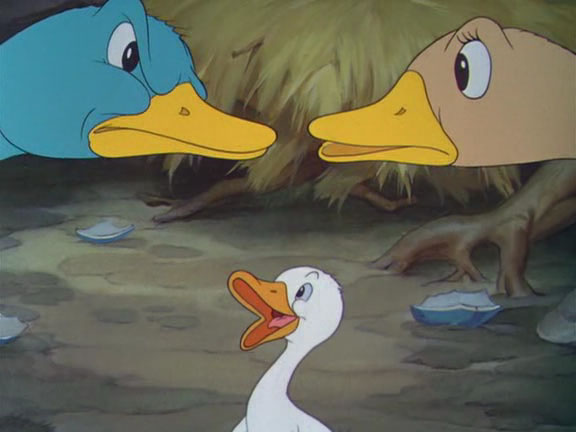
Unlike the latter, more familiar version, this ugly duckling is a real duck, accidentally born to a chicken. He’s rejected until he saves his chick brothers and sisters from drowning in a long, fast and exciting action scene, involving both a tornado and a waterfall.
Although looking crude and primitive when compared to the 1939 short, this first version of The Ugly Duckling is a milestone in Disney’s storytelling: while the earlier Silly Symphonies contain a lot of repetitive animation and dance routines, The Ugly Duckling is the first Silly Symphony to tell a coherent story from the beginning to the end. Even the Mickey Mouse films of that time are not that consistent. There still is some rhythmic movement, especially at the beginning, but most of the animation is there to tell the story.
The duckling (who repeatedly looks to the audience for sympathy – not unlike Oliver Hardy) is a real character who transforms from an outcast to a hero, and gains its well-earned sympathy at last. Its best scenes are when it feels rejected, not only by his ‘family’, but also by a cow, a dog and a frog. There’s some genuine feeling of loneliness and unhappiness in these scenes, unparalleled in any other animated film of the time.
This short, which is neither about gags nor about moving to music, would be the first testimony of Disney’s ambitions in storytelling.
Watch ‘The Ugly Duckling’ yourself and tell me what you think:
This is Silly Symphony No. 25
To the previous Silly Symphony: The Fox Hunt
To the next Silly Symphony: The Bird Store
Directors:Clyde Geronimi, Wilfred Jackson and Hamilton Luske Release Date: February 15, 1950 Rating: ★★★★★ Review:
‘Cinderella’ was Disney’s first fairy tale movie since ‘Snow White and the Seven Dwarfs’ (1937) and Disney’s first real feature animation film in eight years.
With its classic fairy tale story featuring a heroine, whose unhappy fate is turned, Cinderella seems to be like ‘Snow White and the Seven Dwarfs’, Disney’s only million seller feature up to that point, and, indeed, ideas for this film go back as far as 1938. However, it is very clear many things had changed for the studio since then:
First: Gone are the lush water color backgrounds. They’re replaced by way more stylized oil backgrounds, based on the colors and styling of designers Mary Blair and John Hench, who both favored bright and unrealistically vivid colors. Mary Blair’s influence is particularly strong in the dreamlike ‘So This Is Love’ sequence and the chase of Cinderella’s pumpkin couch: here the stunningly beautiful backgrounds lose all sense of realism, in favor of emotional storytelling.
Second: The animation of humans, hardly mastered in 1937, now looks fluent, convincing and even easy. It’s also striking how very realistic humans (Cinderella, the prince, the evil stepmother) blend easily and convincingly with more caricatured humans (the king, the grand duke and the two stepsisters) and anthropomorphic animals. The Disney studio clearly had matured.
Indeed, the animation studio had been greatly streamlined in the forties. Gone were the experimental, time consuming and costly work methods of ‘Snow White’, ‘Pinocchio‘ and ‘Fantasia’. For his new feature Disney would take no chances: all human scenes would be filmed first with live action actors, in order to perfect the staging before it went into animation. Only one short scene with outrageously colored soap bubbles evokes some of the earlier experimentalism.
Disney’s animation unit was now led by a group of younger, highly talented animators, who had matured their skills in the forties, and whom Walt Disney affectionately called his ‘Nine Old Men’. In Cinderella these Nine Old Men are all credited as supervising animators (alongside, like a ghost from the past, pioneer animator Norm Ferguson [see ‘Frolicking Fish‘ and ‘Playful Pluto‘], although his contribution remains unclear). The Nine Old Men would be responsible for Disney Feature animation way up to ‘The Rescuers‘ (1978). The fluent and confident animation in ‘Cinderella’ clearly shows why.
Especially the stepmother (animated by Frank Thomas) is a wonderful character: she’s very nasty, but her evilness is acted out in the subtlest way. She’s only indirectly responsible for the most dramatic scene of the film, in which the two stepsisters tear Cinderella’s dress from her body. The horror of this scene is heartfelt, especially because we had seen that this dress was made for her by some friendly birds and mice in an earlier scene .
These animals star a huge subplot with leading roles for a keen mouse called Jaq, a fat, dumb mouse called Gus, and a mean old cat called Lucifer (all animated by Ward Kimball, who went berserk on the outrageous animation of Lucifer). This subplot provides a funny counterpoint to the familiar fairytale and even completely dominates the first twenty minutes of the film.
Cinderella was a huge success and paid the studio well. Once again Disney’s attention and reputation rested with animated features and the studio would dominate the scene up to the 1980s, being practically the monopolist on animated features in the United States.
In a time when TV would cause the decline and fall of the animated cartoon industry, this was no luxury, at all.
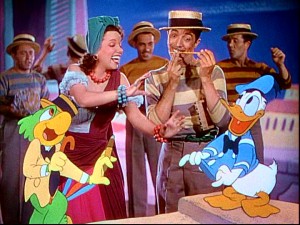
Director: Norm Ferguson Release Date: December 21, 1944 Stars: Donald Duck, Joe Carioca, Panchito, The Aracuan Bird Rating: ★★★ Review:
Donald stars in his first and only very own feature film.
In the opening scene he receives a large package full of presents. When he opens these presents, they lead him to the mild story of Pablo the cold-blooded penguin (narrated by the melancholy voice of Disney-favorite Sterling Holloway), and to the childish story of ‘Gauchito and his flying donkey Burrito’, before it reintroduces Joe Carioca from ‘Saludos Amigos‘ (1942). Joe takes Donald to Baía, where they dance the samba with Aurora Miranda, nicely blending animation with live action, something that occurs throughout the picture.
Another package introduces the Mexican rooster Panchito. Together the trio sings the intoxicating theme song, wonderfully animated by Ward Kimball, who regarded the scene as his best work. Panchito takes Donald and Joe on a magic serape ride over Mexico, visiting Mexico City, Veracruz en Acapulco Beach, where Donald plays blind man’s buff with a bunch of girls in bathing suits. Actually, Donald keeps hunting girls like a hungry wolf throughout the picture.
‘The Three Caballeros’ was the second of two ‘Good neighbor policy’ features, focusing on South America, and the second of six compilation features Disney made until returning to real features with ‘Cinderella‘ in 1950. When compared to ‘Saludos Amigos’, ‘The Three Caballeros’ is brighter, bolder and more nonsensical. It is noteworthy for its bold color design and for its beautiful color book artwork by Mary Blair, which in its modernity looks forward to the 1950s (especially in the opening titles, during the train ride and in the Mexican Christmas episode).
It is most interesting however, because of its zany surrealism, which invades many scenes with associative images, where metamorphosis and abstraction run haywire, not even sparing Donald himself. In this respect ‘The Three Caballeros’ is the boldest feature Disney ever made.
However, its lack of story, its strong touristic content, its outdated live action imagery, its sentimental songs and the two childish stories at the beginning of the feature all harm the picture. Thus watching the movie feels like being on a colorful journey full of beautiful images that nevertheless turns out to be unsatisfactory in the end.
Watch the title song from ‘The Three Caballeros’ below:
Director: Jack Kinney
Release Date: January 1, 1943 Stars: Donald Duck Rating: ★★★★★ ♕ Review:
In ‘Der Fuehrer’s Face’ Donald is apparently a citizen of ‘Nutziland’, a fascist country where even trees and clouds are swastika-shaped.
Donald is awoken by a silly march band singing the sarcastic title song (penned by Disney composer Oliver Wallace and sung with gusto by Spike Jones). Then he has breakfast that consists of only one coffee bean, ‘aroma de bacon & eggs’ and a slice of wooden bread. All too soon he has to work at the assembly line, making shells and saluting to images of Adolf Hitler.
In the end, it appears that it was all just a dream, and Donald, in his Stars and Striped-colored room, sighs, embracing a golden copy of the statue of liberty: “Am I glad to be a citizen of the United States of America”. This closing scene is rather corny and the satire of the film misses some points: most of the (German) citizens of Nazi Germany were not poor and did not have to work like slaves, as is suggested here. Instead, the Nazis used forced labor forces from their occupied territories.
Nevertheless, ‘Der Fuehrer’s Face’ was both artistically and commercially the most successful of the Disney war time propaganda films. It even won an academy award for being the best animated short of 1943. It’s so successful, because, unlike most other propaganda shorts, it’s outrageously funny: its satire is so zany, its depiction of ‘Nutzi land’ so wacky, and the scene at the assembly line so out-to-lunch, that one cannot stop laughing. When Donald goes mad, these segments are even topped by a brightly colored, rather avantgardistic and very surrealistic stream-of-consciousness-like scene, which resembles similar dream sequences in ‘Dumbo‘ (1941) and ‘The three Caballeros‘ (1944).
This short was not directed by any of the two regular Donald Duck directors of the time, Dick Lundy and Jack King, who both preferred a more unassuming type of humor, but by Jack Kinney, who is most famous for directing Goofy, and who was undoubtedly the wackiest of the Disney directors, of which this film certainly is proof.
Watch ‘Der Fuehrer’s Face’ yourself and tell me what you think:
This is Donald Duck cartoon No. 38
To the previous Donald Duck cartoon: Bellboy Donald
To the next Donald Duck cartoon: Donald’s Tire Trouble
Director: Wilfred Jackson Release Date: August 19, 1931 Rating: ★★★ Review:
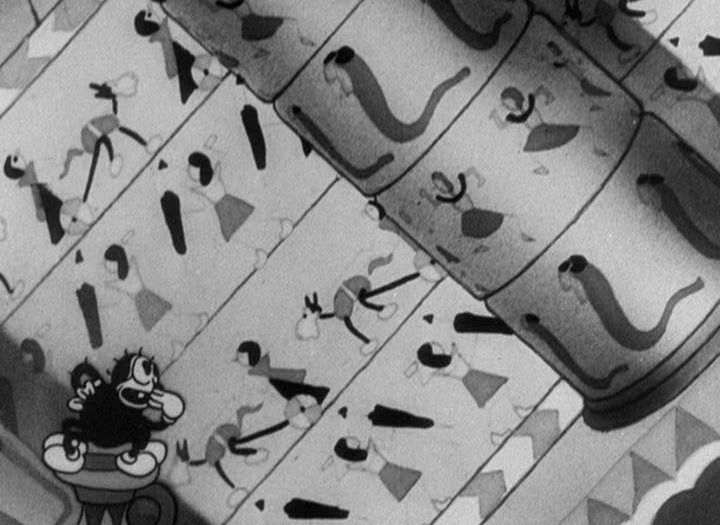
In ‘Egyptian Melodies’ the little six-legged spider from ‘Midnight in a Toy Shop‘ (1930) returns to the animated screen.
The short is one of those early Silly Symphonies that offers quite a dull dance routine only (and no story). Nevertheless, the introduction of the cartoon is well worth watching: when we follow the spider down into the pyramid, we experience some astonishing 3D-effect animation, creating the feeling that the camera wanders with the spider through corridors and staircases.
This unique exercise in perspective would not be repeated in animation until labyrinth computer games were introduced in the 1980s. The Disney Studio itself must have been impressed by this stunning piece of animation, for it was reused two years later in the Mickey Mouse cartoon ‘The Mad Doctor‘ (1933).
Once inside the pyramid, the spider watches four mummies dance, and the drawings on the walls coming to life. These last scenes feature 2-dimensional characters, which can be seen as very early and primitive forerunners of the cartoon modern style of the 1950s. Unfortunately, these scenes are a little bit dull, but they do lead to a great finale. This is one of the earliest nightmare-sequences, in which the montage of images is diffuse and increasingly sped up, in order to suggest the feeling of getting insane. This predates similar sequences in films like ‘Der Fuehrer’s Face‘ (1943) by many years.
The idea for ‘Egyptian Melodies’ may have come from the Van Beuren cartoon ‘Gypped in Egypt‘ (1930), which also features dancing hieroglyphs, nightmarish scenes, and even a corridor scene. Notice that the classic horror film ‘The mummy’ (1932) hadn’t been released, yet, at the time.
This is Silly Symphony No. 21
To the previous Silly Symphony: The Cat’s Out
To the next Silly Symphony: The Clock Store
Animation Backgrounds
A blog dedicated to background paintings from animation films. Kept until 2016.
Animation Scoop
Animation historian Jerry Beck’s animation film news blog.
Cartoon Brew
Topical blog on animation film, led by animation historian Amid Amidi.
Cartoon Modern
Amid Amidi’s blog on modern design cartoon art from the forties, fifties and sixties.
Cartoon Research
THE site on classic animation research, hosted by cartoon historian Jerry Beck.
Cartoons Theory
Frank Beef analyzes classic cartoons. Kept until 2020.
Century Film Project
Michael reviews films of 100 years old and older, roughly in chronological order.
Classic Cartoons
A similar blog featuring many stills and comic strips. Kept until 2012.
Comet over Hollywood
Jessica Pickens reviews classic Hollywood films, especially musicals.
Deja View
Top ex-Disney animator Andreas Deja’s own blog.
Disney History
Esteemed Disney historian Didier Ghez on the latest books on Disney history.
Feeling Animated
Paul Astell brings us thorough reviews of animated features.
Flickers in Time
Short and to the point reviews of classic films (lately mostly pre-code talkies) by an anonymous retired Foreign Service Officer from California
 In ‘The Barn Dance’, Mickey Mouse’s fourth cartoon, Pete’s rivaling Mickey for the love of Minnie.










 Dr. Grob's Animation Review