You are currently browsing the tag archive for the ‘1995’ tag.
Director: Jeff McGrath
Airing Date: May 8, 1995
Stars: Duckman
Rating: ★★★★★
Review:

Season Two of Duckman lasted only nine episodes, much shorter than the other three (13, 20 and 28 episodes respectively).
The season ends with a “cheater”, a cartoon consisting substantially of existing material. But this is done in a surprisingly sophisticated way, resulting in one of the most “meta” of all Duckman episodes. In fact, even the first scene is a cheater, showing the same footage no less than three times, as Duckman, tied to a hospital bed, tries to remember what happened.
It turns out he’s kidnapped by one Harry Medfly, “currently unemployed TV-critic”, who reveals to Duckman that he’s in fact star of a TV-show, which Medfly finds repulsive. Medfly proves his point by showing short clips from previous episodes, showing Duckman at his most sexist, at his most politically incorrect, at his most inapt as a detective, as most cruel to his employees Cornfed, Fluffy and Uranus, and at his most insensitive to his family. These five series of snippets are very entertaining in themselves, but the framing story is interesting, as well.
Highlight, however, is Medfly’s attempt to kill Duckman by signalling a huge mass of television history through his head. At this stage Duckman changes into several very different television personalities in a very rapid succession of metamorphoses. This is by all means great television animation, topped only by the self-aware dialogue at the finale.
Watch ‘Clip Job’ yourself and tell me what you think:
This is Duckman episode no. 22
To the previous Duckman episode: Research and Destroy
To the next Duckman episode: Noir Gang
‘Clip Job’ is available on the DVD-box ‘Duckman – The Complete Series’
Director: John Eng
Airing Date: May 1, 1995
Stars: Duckman
Rating: ★★★
Review:

In this episode Ajax’s English teacher discover that Ajax is a poet. Soon Ajax recites his totally incomprehensible poems to a huge audience at a hip beatnik club called Kolchnik’s.
But then Duckman sells his son away to the ‘Watermark’ company (an obvious parody of Hallmark)… The introduction of the humongous Watermark company is a great little piece of cinema and involves some animated backgrounds, a rare feat since the early 1930s.
‘Research and Destroy’ is one of the most straightforward of all Duckman stories, with a clear story from start to end. Highlight is the screwball image that returns as a running gag throughout the picture, but most interesting is the supercomputer assembling metadata on all customers. In ten years time this would become more than true…
Watch ‘Research and Destroy’ yourself and tell me what you think:
This is Duckman episode no. 21
To the previous Duckman episode: In the Nam of the Father
To the next Duckman episode: Clip Job
‘Research and Destroy’ is available on the DVD-box ‘Duckman – The Complete Series’
Director: Norton Virgien
Airing Date: April 24, 1995
Stars: Duckman
Rating: ★★★
Review:

When Cornfed gets a visit from one Ng claiming to be his son, he has to get back to Vietnam to find out the truth. He asks Duckman to come along. Duckman brings his family with him as Cornfed pays for the trip and the family demands a vacation.
While the Duckman family amuses themselves in the war-themed ‘Euro Asia Land’, Cornfed looks hopelessly for his wartime love interest Mai Ling. The Vietnam setting allows for some spoofs on Vietnam films, like ‘Apocalypse Now,’ ‘Forrest Gump’ and ‘Good Morning Vietnam’. Unfortunately, the pace is rather slow and rambling, hampering the flow of the episode.
Fluffy and Uranus have a larger role than normally: when the two cute teddy bears ask for a vacation for themselves after eleven years of hard work, Duckman makes them explode inside a microwave. Yet, later we watch them entertaining Ng by showing him slides, much to Ng’s distress.
This is the first Duckman episode to use a shortened intro, leaving out the introduction of Duckman’s co-stars.
Watch ‘In the Nam of the Father’ yourself and tell me what you think:
This is Duckman episode no. 20
To the previous Duckman episode: The Germ Turns
To the next Duckman episode: Research and Destroy
‘In the Nam of the Father’ is available on the DVD-box ‘Duckman – The Complete Series’
Director: Bob Hatchcock
Airing Date: April 17, 1995
Stars: Duckman
Rating: ★★★½
Review:

This episode starts with Aunt Bernice finding a crystal in her own backyard and taking the family to a new age fair to let it examine.
Against all odds it’s Duckman who gets the most spiritual journey of his life, when he talks to his late mother, who has reincarnated as a highly infectious germ. It turns out that Duckman was heavily neglected by his mother during his childhood, and in a flashback we see some rare footage of Duckman as a kid. Duckman’s mother explains her son that it’s all about karma, which prompts Duckman to better his life in his own unique way, by stuffing his kids full of bad food, by bribing their teachers, and by building a baseball field right on a railroad track.
Duckman’s encounter with his mother forms the heart of the episode, and this part is surprisingly sincere, despite the occasional joking, making this one of those welcome episodes exposing more of Duckman’s emotional side.
Watch ‘The Germ Turns’ yourself and tell me what you think:
This is Duckman episode no. 19
To the previous Duckman episode: America the Beautiful
To the next Duckman episode: In the Nam of the Father
‘The Germ Turns’ is available on the DVD-box ‘Duckman – The Complete Series’
Director: Paul Demeyer
Airing Date: April 10, 1995
Stars: Duckman
Rating: ★★★
Review:
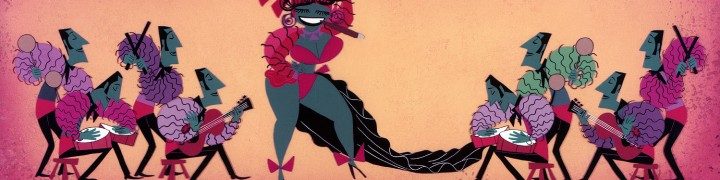
‘America the Beautiful’ starts with a warning sign stating that “the following contains scene of heavy-handed and over-obvious allegories and is not recommended for small children and certain congressmen from the South”.
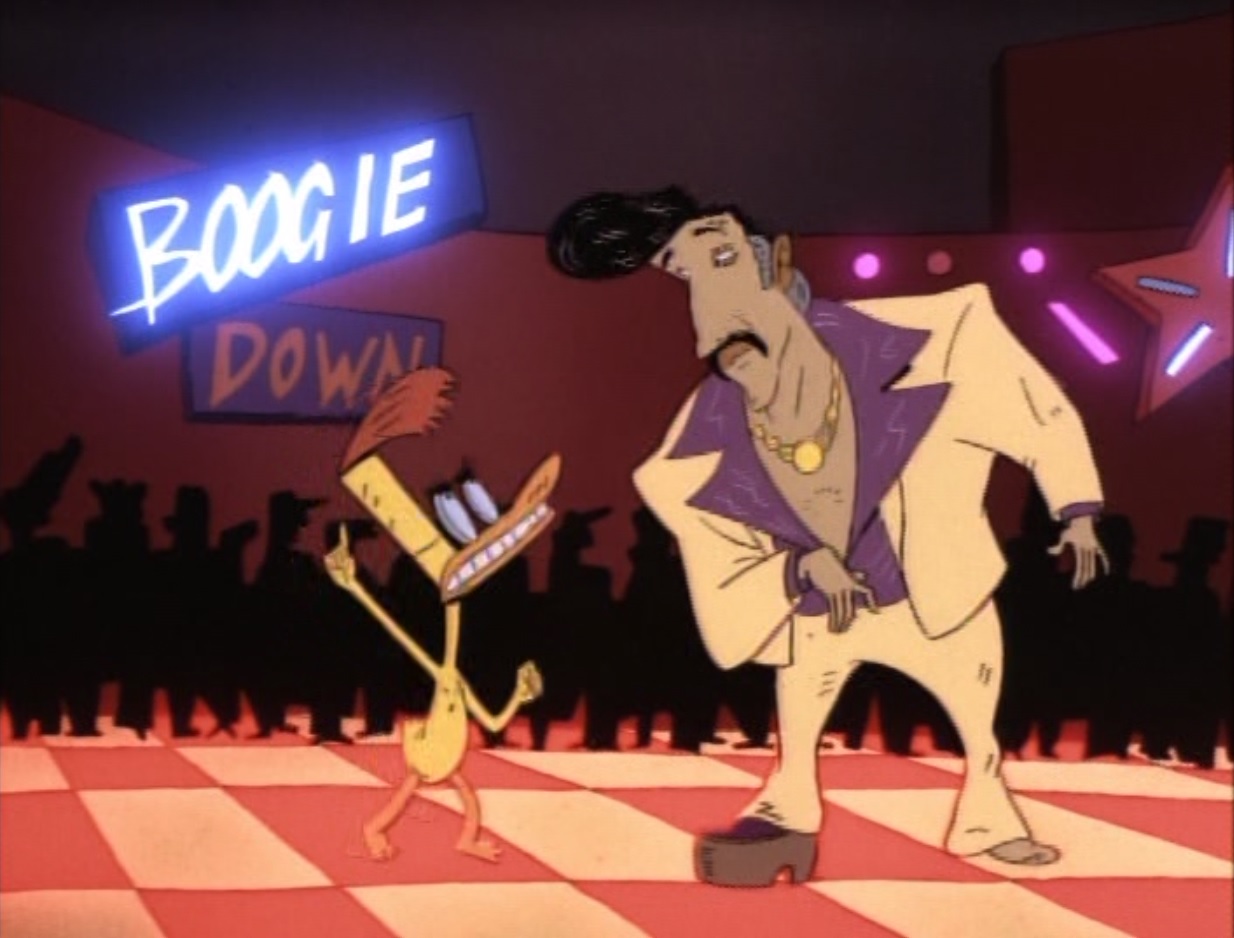
And indeed, this is an allegorical episode, with Duckman and Cornfed in search of America (who has taken form of a beautiful and noble woman) on behalf of some overtly cute little children. The quest takes them to a 1950s suburbia, a 1960s hippie university, a 1970s disco, and 1980s Wall Street. All the four have exploited America, giving nothing in return. Duckman finally finds America at a dump. The episode ends with a corny ‘We Are the World’-like song sung by all protagonists and the children called ‘We Are Here’.
The episode indeed suffers from heavy-handedness, and Duckman in particular, seems quite at loss here. The best part is when Duckman and Cornfed drive into the 1950s suburbia, which changes them from full color into black and white, prompting Cornfed to say “it appears they don’t allow people of color in this community“. Also remarkable, but much less functional is the beauty pageant-turning-into-a-big fight with which the episode opens.
Watch ‘America the Beautiful’ yourself and tell me what you think:
This is Duckman episode no. 18
To the previous Duckman episode: Inherit the Judgement: The Dope’s Trial
To the next Duckman episode: The Germ Turns
‘America the Beautiful’ is available on the DVD-box ‘Duckman – The Complete Series’
Director: Kevin Lima
Release Date: April 7, 1995
Stars: Goofy, Max, Pete
Rating: ★★★
Review:

‘A Goofy Movie’ arguably is the least known of Disney’s theatrical movies from the studio’s Renaissance period. The film is not even in its official canon of animated features. Maybe because it was Disney’s first animated theatrical feature based on a television series, in this case ‘Goof Troop’, which run from September to December 1992.
Now I’ve never seen an episode of this television series myself, but I comprehend that it does resolve around Goofy being a single father of his son, Maximilian (in short Max), and being neighbor to Pete, who is a single father of a son, too, Pete Junior or P.J. in short. ‘A Goofy Movie’ uses exactly this premise, focusing on the relationship between Goofy and his son, with Max being the undisputed main character of the movie.
Now, Goofy’s family life has always been odd, being the classic Disney character that changed the most during his career. And indeed, he has been seen having a son in a few of his classical cartoons, starting with ‘Fathers are People’ from 1951, but by that time Goofy had transformed into everyman George J. Geef, and this son clearly isn’t Max, as he’s called George Geef jr. In both ‘Goof Troop’ and ‘A Goofy Movie’ Goofy once again is his clumsy self, so he has evolved once more. Pete, too, has had a son in earlier entries, most notably in ‘Bellboy Donald’ from 1942. In ‘A Goofy Movie’ he’s not really the villain of the old days of old, but still a disruptive voice, not taking Goofy for full, and giving him ill advice.
Voice artist Bill Farmer reprises his role as Goofy from ‘Goof Troop’ and is an excellent successor to Pinto Colvig. Max is voiced by Jason Marsden, a different voice than in ‘Goof Troop’, in which he was voiced by a woman (Dana Hill). But this is understandable as the events in ‘A Goofy Movie’ take place several years after the ones in ‘Goof Troop’. Max’s singing voice is provided by Aaron Lohr.
Added to the mix, and apparently not present in ‘Goof Troop’, is Max’s love interest Roxanne, and the film starts with Max’s last day at school, on which he tries to impress Roxanne, in which he succeeds, and he manages to ask her on a date to a party. Unfortunately, his father, realizing he might be losing grip on his son, has planned a trip for two to some fishing lake, and Max invents a totally unconvincing lie of why he has to cancel the date, involving both Max’s and Roxanne’s pop idol Powerline (who, voiced by Tevin Campbell, sounds a little like Michael Jackson).
As said, the father-son relationship between Goofy and Max is the focal point of the cartoon, and as such the film is surprisingly realistic and down to earth, with Max being ashamed of his old-fashioned, awkward and clumsy father, and Goofy uncomprehending of Max’s interests as an independent teenager. However, the two learn to know and to respect each other on a rather forced road trip through America. In this respect, one can see ‘A Goofy Movie’ as a forerunner of ‘Finding Nemo’ (2003), which explores a similar theme.
The road trip, which takes place on Route 66, and which takes the two Goofs all through America, forms the main part of the film, and it’s surprising to note that this piece of Americana was animated in studios in Paris, France and Sydney, Australia. Unfortunately, ‘A Goofy Movie’ defies all realism in several scenes, hampering the heartfelt story with outlandish scenes, like the two Goofs encountering Bigfoot, falling off a cliff with their car, and escaping a waterfall in an all too improbable and inconsistent series of events.
Moreover, for a film starring Goofy there’s surprisingly little humor – it’s all not that goofy. Yet, the team has managed to keep Goofy’s optimistic and naive character, while adding some depth to the former simpleton, mostly his struggle in being a father to Max. Indeed, the film is at its best when keeping focus on the relationship between Goofy and Max. This focal point remains interesting despite the deviations from reality.
As a film of the early nineties, ‘A Goofy Movie’ is an obligate musical, and the movie knows three nice if forgettable songs by Carter Burwell, sung by Max, with Goofy joining in in two of them. They at least succeed in not being obnoxious.
The animation is of a very high quality, with considerable attention detail. There are some nice touches, like Max’s reflection in a window, or colors turning blue when Goofy gets sad.
In all, ‘A Goofy Movie’ is a nice little movie with a surprisingly mature theme. The film may not be a masterpiece, it’s of enough quality to be worth a watch.
Watch the trailer for ‘A Goofy Movie’ yourself and tell me what you think:
‘A Goofy Movie’ is available on Blu-Ray and DVD
Director: Jeff McGrath
Airing Date: April 3, 1995
Stars: Duckman
Rating: ★★★½
Review:

‘Inherit the Judgement: The Dope’s Trial’ starts with Duckman and the family driving through the desert in a hot car in search of some idiotic bargain.
They crash into some hick town, which happens to be the home town of Ducman’s rival King Chicken (see ‘Ride the High School‘ and ‘Joking the Chicken‘ from the first season). By exclaiming that the egg came before the chicken Duckman gets imprisoned and is about to be hanged, but he manages to save himself on trial by making King Chicken revealing his own vile scheme.
The episode ends with Cornfed parodying Porky Pig, but the episode’s highlight is King Chicken’s ‘Down with Duckman Carnival’, which is full of crazy rides based on killing Duckman.
Watch ‘Inherit the Judgement: The Dope’s Trial’ yourself and tell me what you think:
This is Duckman episode no. 17
To the previous Duckman episode: Days of Whining and Neurosis
To the next Duckman episode: America the Beautiful
‘Inherit the Judgement: The Dope’s Trial’ is available on the DVD-box ‘Duckman – The Complete Series’
Director: Van Partible
Airing Date: March 26, 1995
Stars: Johnny Bravo
Rating: ★★
Review:

Johnny Bravo was one of the striking characters of the cartoon renaissance happening at Cartoon Network. Together with Dexter’s Laboratory, Cow and Chicken, The Powerpuff Girls, and Courage the Cowardly Dog he was the flagship of the creativity at the network in the second half of the nineties.
Yet, this isn’t immediately visible in the very first short starring the character, aptly titled ‘Johnny Bravo’. This very first Johnny Bravo episode first aired as part of Cartoon Network’s ‘World Premiere Toons’ (later renamed ‘What a Cartoon’), and was re-shown later as the first part of three shorts forming the first Johnny Bravo episode broadcasted on July 7, 1997.
The episode firmly establishes Johnny Bravo as a character obsessed by his own body and presumable attractiveness to women, who don’t care about him in a bit. The short starts at a zoo where Johnny Bravo hopelessly tries to impress passing girls. When a gorilla has escaped he offers the female zookeeper to retrieve the animal.
The gorilla is a badly designed, purple talking beast that is one of the least funny characters to hit the television screen, especially when Partible tries to make him Bugs Bunny-like funny when talking to Johnny Bravo. This is a painful attempt at humor, indeed. Much better are Johnny Bravo’s attempts to show off and to attract women.
The animation overall is limited and very jerky, with especially Bravo jumping from pose to pose, an animation style that was remarkably fresh at the time. The hands mostly are mere paws until the fingers have to be drawn. This style unfortunately gives the character an ugly and cheap look. The color design, too, is far from interesting and arguably non-existent. In all, this debut cartoon hasn’t aged very well. Yet, the character would last four seasons, being on television between 1997 and 2004.
‘Johnny Bravo’ is available on the DVD-set ‘Johnny Bravo Season One: All 13 Episodes’
Director: John Eng
Airing Date: March 25, 1995
Stars: Duckman
Rating: ★★½
Review:

In this mediocre Duckman episode a guy named Milo, owner of a rehab clinic for the rich and famous, asks the help of Duckman to find out who wants to murder him.
Unfortunately, the man is killed even before Duckman can start the case. But Duckman isn’t focused anyway, and it’s up to Cornfed to solve the murder mystery, while Duckman gets ravingly mad in rehab.
Duckman behaves more cartoony than ever in this episode, and his hallucinatory ride in which he has visions of food and women forms the highlight of the cartoon. But he’s playing second base this time, for much screen-time is devoted to his assistant Cornfed at his most serious. There’s also some random violence by Duckman on his cutesy-wootsy assistants Fluffy and Uranus.
Watch ‘Days of Whining and Neurosis’ yourself and tell me what you think:
This is Duckman episode no. 16
To the previous Duckman episode: Married Alive
To the next Duckman episode: Inherit the Judgement: The Dope’s Trial
‘Days of Whining and Neurosis’ is available on the DVD-box ‘Duckman – The Complete Series’
Director: Raymie Muzquiz
Airing Date: March 18, 1995
Stars: Duckman
Rating: ★★★½
Review:

‘Married Alive’ start with Duckman’s house being in the baddest shape imaginable, with everything broken and undefined gore lying in heaps everywhere.
It turns out that aunt Bernice has been away, but when she returns, she’s not even mad, but sings Giacomo Puccini’s aria ‘O mio babbino caro‘, because she’s in love. During her holiday a billionaire and media magnate called Baron von Dillweed proposed to her to star the first infomercial-wedding ever. Duckman only starts to worry when Bernice reveals she’ll move to Switzerland and take the boys with her. At that point Duckman comes into action, and uses his dormant detective skills to unmask the baron in his own unique way.
This episode features a short reference to Indiana Jones, Cornfed doing karaoke, and Duckman grinding Fluffy and Uranus to rice, but the episode’s highlight must be aunt Bernice’s lovesick behavior.
Watch ‘Married Alive’ yourself and tell me what you think:
This is Duckman episode no. 15
To the previous Duckman episode: Papa Oom M.O.W. M.O.W.
To the next Duckman episode: Days of Whining and Neurosis
‘Married Alive’ is available on the DVD-box ‘Duckman – The Complete Series’
Director: Norton Virgien
Airing Date: March 11, 1995
Stars: Duckman
Rating: ★★★
Review:

The second season of ‘Duckman: Private Dick/Family Man’ starts with a rather rambling episode in which Duckman tries to get famous by exploiting the sleazy reputation he got by pinching the butts of two sexy ladies on camera.
The set up of this episode is rather incomprehensible and involves the president visiting town, and three sexy but dumb ladies visiting Duckman’s office for no apparent reason. Also involved is a commercial fellow with shades, a ponytail and an annoying voice, making Duckman sign a contract to get him famous. Nothing is done with this devilish scheme, however.
Highlight of this otherwise disappointing episode is Duckman’s feature film on his life called “Pinch Me, Kiss Me Kill Me: The Duckman Story”. This part is acted out in live action, and includes over the top sexy women falling for the cool Duckman character as well as ridiculous dialogue full of sexual references, and even blatant advertising.
Watch ‘Papa Oom M.O.W. M.O.W.’ yourself and tell me what you think:
This is Duckman episode no. 14
To the previous Duckman episode: Joking the Chicken
To the next Duckman episode: Married Alive
‘Papa Oom M.O.W. M.O.W.’ is available on the DVD-box ‘Duckman – The Complete Series’
Director: Michaela Pavlátová
Release Date: 1995
Rating: ★★★★★ ♕

After the critically acclaimed ‘Words Words Words‘ (1991) Michaela Pavlátová returned with an even better film called ‘Repete’. This film explores daily routines, with a man walking a dog as a bridging elements.
The walking man repeatedly watches a beautiful woman passing by, a cyclist, and a hurried man looking at his watch. These street scenes are interspersed with scenes depicting three couples, all stuck in an unhealthy repetitive relationship. The first shows a woman feeding a man, who doesn’t even look at her, but keeps on reading the newspaper. The second depicts a man threatening to commit suicide the moment his love rejects him. And the third shows a couple about to have sex until a telephone calls the woman away, leaving the man waiting.
At one point the dog refuses to go on, and the repetition stops, allowing the couples to get mixed. It looks like the mingling of these people improves their relationships, but all too soon new repetitions set in…
Like ‘Words Words Words’ Repete is a great work of animated surrealism, making full use of the medium. Pavlátová uses a very crude and scribbly pastel technique, shifting perspectives and no dialogue. Her style is completely her own, and very engaging. No wonder Repete, too, swept many awards.
Watch ‘Repete’ yourself and tell me what you think:
‘Repete’ is available on the DVD ‘Desire & Sexuality – Animating the Unconscious Vol.2’
Director: Andreas Hykade
Release Date: 1995
Rating: ★★★½

‘Wir lebten im Gras’ is the first of three films in which German animator Andreas Hykade explores the loss of innocence, the other two being ‘Ring of Fire’ (2000) and ‘Der Kloane’ (The Runt, 2006).
The film is also the most cryptic of the three, full of images that are very difficult to decipher. The film is set in a rather mythical place, ‘two streets away from the end of the world’ and has a timeless and universal feel.
The story is told by a boy voice over, who reminisces about his father, who told him that “All women is whore and all men is soldier”. Outside the voice over there is no dialogue. The little boy tries to see the world through his father’s eyes, but this conflicts with his softer side, and he’d rather fall in love with the enigmatic ‘dandelion girl’.
The film is less straightforward than this synopsis suggests, however, and the film is more surreal and suggestive than narrative. For example, the boy’s adventures are interjected by nightmarish dream sequences, the meaning of which is never really explained. These dream sequences are rendered in an expressionistic pastel style, reminiscent of Lorenzo Mattotti’s art work. This style contrasts highly with the simple cel animation.
Hykade’s drawing style is highly original. His human designs are simple, almost stickman-like, but genitals are very prominent, and the father is drawn as a more robust, earthly character.
The animation is very virtuoso, with a great feel for timing. Moreover, Hykade uses a lot of changing perspective, and has an admirable command of movement.
‘Wir lebten im Gras’ was Hykade’s last student film, but it certainly is his first major work. With this film Hykade proved to be a strong new voice in the animation world, a fact he consoled with his masterpiece ‘Ring of Fire’ from 2000.
Watch ‘Wir lebten im Gras’ yourself and tell me what you think:
‘Wir lebten im Gras’ is available on the DVD ‘Desire & Sexuality – Animating the Unconscious Vol. 2’
Director: Darko Kreč
Release Date: 1995
Rating: ★
Review:
 In this latter-day Zagreb Film studio short two grains change into a prince and princess who waltz around a remote water mill.
This film combines live action footage of the water mill with cell animation of the prince and princess. Unfortunately, the film is hampered by its poor story, its mediocre designs, and unremarkable music by Ozren Depolo. If anything this film makes clear that in the post-communist era the Zagreb Film studio was severely struggling. With films like these one can feel the Zagreb school dying.
Watch ‘Last Waltz in the Old Mill’ yourself and tell me what you think:
‘Last Waltz in the Old Mill’ is available on the DVD ‘The Best of Zagreb Film: Be Careful What You Wish For and The Classic Collection’
Director: Kōji Morimoto, Tensai Okamura & Katsuhiro Otomo
Release Date: December 23, 1995
Rating: ★★★★
Review:
Seven years after ‘Akira‘, Katsuhiro Otomo returned to the animated screen with ‘Memories’, a package film, which impresses, but fails to reach the heights of ‘Akira’. Indeed, the film is much, much less well known than either Otomo’s previous film, or ‘Ghost in the Shell‘, which was the anime hit of 1995.
Based on his own short stories, ‘Memories’ consists of three unrelated parts: ‘Magnetic Rose’, ‘Stink Bomb’ and ‘Cannon Fodder’, which are discussed separately below.
 Magnetic Rose
Director: Kōji Morimoto
Rating: ★★★★★
‘Magnetic Rose’ starts the Memories trilogy, and it’s arguably the feature’s most satisfying episode. Animated by Morimoto’s own Studio 4°C, it is the only part that clearly deals with memories.
In this episode a rescuing squad of space garbage collectors is ensnared in the memories of a long deceased opera singer, who still seems alive in her remote satellite home in space, blurring the boundaries of reality. This accounts for an exciting story, greatly enhanced by Yoko Kanno’s superb soundtrack, in which she mixes an eerie choir, ambient guitar work and dark electronic with bites of Giacomo Puccini (the famous aria ‘un bel di vedremo’ and the finale from ‘Madame Butterfly’, an opera set in Japan, and a small soundbite from ‘Turandot’, which is set in China). Also featured is a stage set from Puccini’s ‘Tosca’, in which the opera singer, as Tosca, stabs Heinz, one of the rescuers.
Even though the science fiction setting with its touches of horror is typical anime, the underlying drama is very mature and quite unique. This episode’s screenplay was penned by future director Satoshi Kon. Kon certainly established himself with this screenplay, and he would further explore the theme of memory and loss in ‘Millennium Actress’ (2001), and the blurring of reality and fantasy in both that film and ‘Paprika’ (2006) with even more spectacular results. Director Kōji Morimoto, meanwhile, would prove his worth as a director in ‘Beyond’, the best episode of ‘The Animatrix‘ (2003).
In ‘Magnetic Rose’ the characters are from all over the world, and this is one of the few anime, in which the Japanese character looks distinctively Asian compared to the European characters.
 Stink Bomb
Director: Tensai Okamura
Rating: ★★★
Penned by Katsuhiro Otomo, but directed by Tensai Okamura, and animated by the Madhouse animation studio, ‘Stink Bomb’ feels like a comical interlude between the two more serious outer episodes. The story is set in present day Japan and features a very stupid, but surprisingly indestructible protagonist who turns into a nonsensical weapon of mass destruction. The story is simple: Nobue Tanake, our ‘hero’, works in a biochemical laboratory. To cure his cold one of his colleagues suggests he takes a sample of the new medicine they’ve developed at the lab. But Tanake accidentally swallows the wrong pills, which turn him into a lethal weapon, sweating poisonous gasses that kill everything in sight. Although he remains unaware of this, he becomes the cause of the annihilation of Japan.
This story is rather silly – there’s a lot of broad comic acting, and it even ends with a kind of punch-line. And yet, the episode manages to be unnerving at the same time; the short has some disturbing undertones, with the fear of mass destruction weapons and corrupt governments played out well. The unsettling atmosphere is greatly enhanced by Jun Miayke’s score, in which he uses nervous free jazz saxophones to a great effect.
 Cannon Fodder
Director: Katsuhiro Otomo
Rating: ★★★★½
Otomo himself directed the last and most beautiful sequence of Memories. This episode once again is animated by Studio 4°C, but has a distinctive graphic style that doesn’t resemble any other anime. Especially the background art and character design are highly original. But even more startling is the fact that the film is ‘shot’ in one long camera take (with a little bit of smuggling, but very impressive nonetheless). The cinematography is outstanding, and uses a little bit of computer animation. One moving shot of a colonel ascending on a platform is a great piece of character animation. Nevertheless, the boys’ own dream of becoming a colonel himself, done in charming children’s drawings, may be the highlight of the entire film.
‘Cannon Fodder’ deals with an alternative, distinctively European world, where a totalitarian military regime enters every aspect of life. It’s a kind of steam punk, vaguely based on images of the first world war, with its giant cannons, gas masks, and pompous generals. We’re following one day in the life of a single family. They live in a city were all work and school is directed to a war with a mysterious city, which remains unseen throughout the movie. This war is fought entirely by using cannons, fired at the distant enemy.
Despite the caricatured humans, the atmosphere is hardly comical, but dark and disturbing. The unseen foe reminds one of ‘1984’, and one wonders whether the enemy is real – but then, in the end, the air alarm kicks in. ‘Cannon Fodder’ is more a film of concept than of drama, and thus less engaging than ‘Magnetic Rose’. Still, because of its unique style, and strict control of cinematography, ‘Cannon Fodder’ is a small masterpiece.
Watch the trailer for ‘Memories’ yourself and tell me what you think:
‘Memories’ is available on DVD and Blu-Ray


 Dr. Grob's Animation Review