
You are currently browsing the tag archive for the ‘2018’ tag.
Director: Piet Kroon
Release date: October 13, 2018
Rating: ★★
Review:

The Dutch animated feature film industry long consisted of one movie only, ‘Als je begrijpt wat ik bedoel’ (The Dragon That Wasn’t (Or Was He?)) from 1983. But in recent years several other films saw the light, mostly directed at youngsters: ‘Nijntje de film’ (Miffy the Movie) from 2013 , ‘Pim & Pom: Het Grote Avontuur’ and ‘Trippel Trappel – Dierensinterklaas’, which are both from 2014, and more recently ‘Knor’ (‘Oink’) from 2022 and ‘Vos en haas redden het bos’ from 2024. An oddball within this recent canon is ‘Heinz’ from 2018.
‘Heinz’ was a comic strip by René Windig and Eddie de Jong that run in Dutch newspapers from 1987 to 2000 and again from 2004 to 2006. The comic strip was about a cat, Heinz, who quickly got more anthropomorphized until he became a sort of everyman. The strip knew some continuities but remained first and foremost a gag strip. Nevertheless, the authors dreamt of an animation film at least since the early 2000s.
Although film studio Zig Zag film started working on a film already in 2002, Windig’s and De Jong’s dream never amounted to anything. That is, until the project got new backing and new support from veteran animator Piet Kroon in 2015.
Piet Kroon had ample experience in America, having directed the animation for ‘Osmosis Jones’ (2001) and having worked on stories for a wide variety of animated feature films, e.g. ‘The Iron Giant’ (1999), ‘The Tale of Despereaux’ (2008), ‘Rio’ (2011) and ‘Ferdinand’ (2017). Kroon wrote a completely new story for the film, and with this much of the charm of the original comic strip got lost, and I doubt whether Windig and De Jong are pleased with the end result.
The first aspect of the original comic strip that went out of the window was its family-friendly nature, despite being produced by Burny Bos, who produced some of the best Dutch live action children’s movies. The feature film is clearly directed to adults and has little to offer for younger audiences (in the Netherlands the film is advised for 12 years and older, that says enough). The second major change Kroon made was the setting. The original comic strip takes place in an undefined fantasy Netherlands, but the movie Heinz clearly lives in the center of Amsterdam, which incidentally is also the residence of the comic strip’s two authors.
A more profound and more disturbing change than these two is the change of character of the cat himself. In the comic strip Heinz certainly is cranky, and sometimes insufferable, but in the movie, he is a downright irresponsible drunkard and deadbeat. In fact, in the early scenes the cat is so unsympathetic one wonders why he must watch the cat’s immature antics in the first place. Heinz’s voice by Ruben van der Meer, on the other hand, is well-chosen.
Heinz’s girlfriend Dolly fares little better, as she has changed from a sweet love to a working-class shrew, while Heinz’s friend Frits is nastier and more unsympathetic than his comic book counterpart. Frits also suffers from a bad voice choice (Reinder van der Naalt). In fact, one must look hard for any sympathetic character in the film…
Kroon certainly has tried to put as many characters from the original comic strip as possible into the film, and thus the movie is simply crowded with characters, who mostly make little to no sense to anyone not familiar with the source material. These characters and the rather random inclusion of some gags from the original comic strip make the film too much of an inside joke. On the other hand, the story itself is entertaining enough: it involves time travel, takes Heinz to a remote volcano island and to New York, where he must battle an evil scientist from outer space. But the unsympathetic leads, the plethora of characters, and the random, and often repeated gags make the film a tiresome watch.
The film’s stylistic choices don’t help. The background art is pretty ugly and consists of reworked photo material against which the characters don’t read very well. The ocean is even live action footage. Again, with this method much of the original charm of the comic strip gets lost. The computer animation is a mixed bag. There are a lot of animation cycles, and especially the numerous background characters walk around like automatons with little to no life in them.
No doubt, these technical drawbacks result from an all too tight budget, as it’s a marvel that the film came about in the first place. Most charming are the depictions of Heinz’s fantasies, which consist of traditional animation of René Windig’s idiosyncratic drawings. It’s too bad only these little sequences were made this way.
In all, ‘Heinz’ is a disappointing movie that will attract small audiences, neither satisfying fans of the original comic strip nor anyone else. I cannot find any figures, but I am pretty sure the movie turned out to be a box office flop, and I regret to say unsurprisingly so.
Watch the Dutch trailer for ‘Heinz’ yourself and tell me what you think:
‘Heinz’ is available on DVD (Dutch only)
Director: Michel Ocelot
Release date: June 11, 2018
Rating: ★★★
Review:

Michel Ocelot belongs to the great author-directors of animated feature films, bringing us such gems as ‘Kirikou et la Sorcière’ (1998), ‘Azur & Asmar’ (2006) and ‘Les Contes de la nuit’ (2011). But somehow, his latest movie, ‘Dilili à Paris’ from 2018 has escaped international attention.
The most obvious reason for this is that ‘Dilili à Paris’ is first and foremost an ode to Paris of 1900-1901*. It’s thus an utterly French film, simply crowded by famous people, many of which actively play a role in the story. I counted 26 painters, actors, dancers, authors, composers, and scientists, not counting a multitude of more in the background. Luckily, this doesn’t mean that film is a nationalistic one, for Ocelot includes a lot of foreigners in his pantheon of greats, e.g. Polish scientist Marie Curie, Romanian sculptor Constantin Brâncuși, Venezuelan composer Reynaldo Hahn, future British king Edward VII and Brazilian aviation pioneer Alberto Santos-Dumont.
In fact, by centering the film on these great minds in science and art, the film is also an ode to the fantasy and free thought of people. At the same time, the film is a firm statement against narrowmindedness, xenophobia, and oppression. Which brings us to the third theme of the film, which is a strong feminist one. In fact, apart from Dilili’s friend, the Parisian boy Orel, all main players are women, including soprano Emma Calvé (voiced by Natalie Dessay), stage actress Sarah Bernhardt, the aforementioned Marie Curie, and the feminist Louise Michel. Together with these women and many of the other famed people, Dilili and Orel unravel a secret plot in which the mysterious ‘male-masters’ kidnap little girls. Their anti-feminist scheme turns out to be one of nightmarish proportions. It’s clear that to Ocelot one should not underestimate, let alone oppress any human being, whether based on age, sex, color, nationality or whatever. A message that cannot be reinstated enough.
Dilili herself is an original heroine, a tiny Kanak girl from New Caledonia, who speaks French fluently, but who’s only brought to Paris to reenact her lifestyle in the jungle at the Exposition Universelle, a world exhibition that run from April 14 to November 12, 1900. When touring through Paris Dilili is dressed like a prize doll, and she also provides the film running gag, because to every person she meets she repeats the utterly polite sentence of ‘je suis heureuse de vous rencontrer’ (I am delighted to meet you). Of course, she experiences racism during her Parisian journeys, but this is not the film’s main theme.
Paris meanwhile comes to life in the extremely intricate background art, which is clearly based on photo material of contemporary Paris. The computer animation unfortunately is less impressive, and at times downright stiff. Especially Orel is poorly animated. When he makes friends with Dilili his moves and facial expressions are so terribly rigid, it doesn’t transcend puppet theater. The ending, too, leaves much to be desired, as the film’s finale is partly told during the end titles.
In the end the film is a little bit too crowded by famous people and certainly too poorly animated to be a masterpiece, but the mystery plot is a fine one, and the film’s message an important one. Above all ‘Dilili à Paris’ is a fine children’s film that deserves to be seen at least once.
Watch the trailer for ‘Dilili à Paris’ yourself and tell me what you think:
‘Dilili à Paris’ is available on Blu-Ray and DVD
* In fact, we can date the time period of the film pretty well, as Pablo Picasso first set foot in Paris in September 1900, and Edward VII became king on January 22, 1901, thus the events must be placed between September 1900 and January 1901.
Directors: Bob Persichetti, Peter Ramsey & Rodney Rothman
Release date: December 14, 2018
Rating: ★★★½
Review:

For American feature animation 2018 was mostly a rather uneventful year. True, the year started off well with the release of ‘Isle of Dogs’, and it was also the year of Nina Paley’s second animation feature, ‘Seder-Masochism’, but for the rest it was a year of uninventive sequels (Pixar’s ‘Incredibles 2’, Disney’s ‘Ralph Breaks the Internet, Sony’s ‘Hotel Transylvania 3: Summer Vacation’) and mediocre stand-alones (Warner Bros.’ ‘Smallfoot’ and Illumination’s ‘The Grinch’).
But then, at the closing of the year suddenly a complete game-changer entered the scene: ‘Spider-Man into the Spider-Verse’. The film was brought by Sony Animation, the most evasive from all major animation studios, releasing both gruesomely bad movies like ‘The Smurfs’ (2013) and ‘The Emoji Movie’ (2017), as well as more interesting experiments, like ‘Surf’s Up’ (2007). This animated Spider-Man feature certainly falls into the latter category, bringing the animation world a totally new aesthetic.
Like all other films mentioned (sans ‘Seder-Machochism’) ‘Spider-Man into the Spider-Verse’ is a 3D computer-animated film, but unlike all others this feature has a distinct comic book style, complete with clearly visible halftone dots, and even color-shifts that look like misprinting of color layers when the ‘camera’ gets out of focus. The film even adds other stylistic elements from comic books, like page-turning effects, text panels and panel-like split screens to enhance the comic book feel. Even though traditional texturing and rendering is completely in place, never does the art aspire to be realistic, but always to keep the comic book feel intact.
‘Spider-Man into the Spider-Verse’ thus is a delight to watch, and a welcome fresh take on traditional 3D computer animation. In fact, the excitement the film stirred in the animation world is comparable to that of ‘The Matrix’ (1999) in the live action film industry. That its stylistic innovation was not an isolated event was proved by subsequent films like ‘Puss in Boots: The Last Wish’ (Dreamworks, 2022) and ‘Teenage Mutant Ninja Turtles: Mutant Mayhem’ (Paramount, 2023). Certainly the latter took heed of the lessons from ‘Spider-Man’.
The story of ‘Spider-Man into the Spider-Verse’ is another reboot of the then 56 years old comic. This time we follow a black teenager from Brooklyn called Miles, who is a son from an over-protective cop, but who leans more towards his less well-behaved uncle Aaron. The most remarkable event in the film is that the original Spider-Man, Peter Parker, actually dies, and Miles, who due to unexplained events is bitten by a radio-active spider, too, must take his place.
In fact, the plot is much more complicated, and involves villain Kingpin trying to get his deceased wife and son back from a parallel universe opened by a portal devised by Doctor Olivia “Liv” Octavius, another villain who apparently is the successor to Doc Ock (I’m hardly familiar with the Spider-Man world, so these villains are unknown to me).
The portal also imports five spider-men from alternate universes (and I guess, the Alchemax spider that bit Miles), most importantly a less successful middle-aged Peter Parker and a young Spider-Woman called Gwen, but also a manga girl-spider-man, a black and white film-noir Spider-man and even a looney tune-like spider-man-pig called ‘Spider-Ham’. Part of the fun is the play with these alternate universe characters, some of which are gleefully silly, but I must say the main story is told pretty heavy-handedly.
In fact, the film’s story is hardly as good as the visuals: it’s hard to follow, it’s full of plot-holes, it has some rather forced scenes (most notably the utterly improbable scene in May Parker’s basement, and a believe-in-yourself-like scene in which Miles really becomes a Spider-Man), and a large dose of melodrama that I could hardly stand. Moreover, the finale is taking place in such a messy setting, I had no idea what was going on.
No, did ‘Spider-Man into the Spider-Verse’ not have the astonishing looks it has, I wouldn’t have been entertained so much, the fun parallel world plot notwithstanding. But as it is, ‘Spider-Man into the Spider-Verse’ is one of the most important animated features from the 2010s, a status corroborated by its equally praised sequel, ‘Spider-Man: Across the Spider-Verse’ from 2023.
Watch the trailer for ‘Spider-Man into the Spider-Verse’ yourself and tell me what you think:
‘Spider-Man into the Spider-Verse’ is available on Blu-Ray and DVD
Director: Karey Kickpatrick
Release date: September 28, 2018
Rating: ★★½
Review:
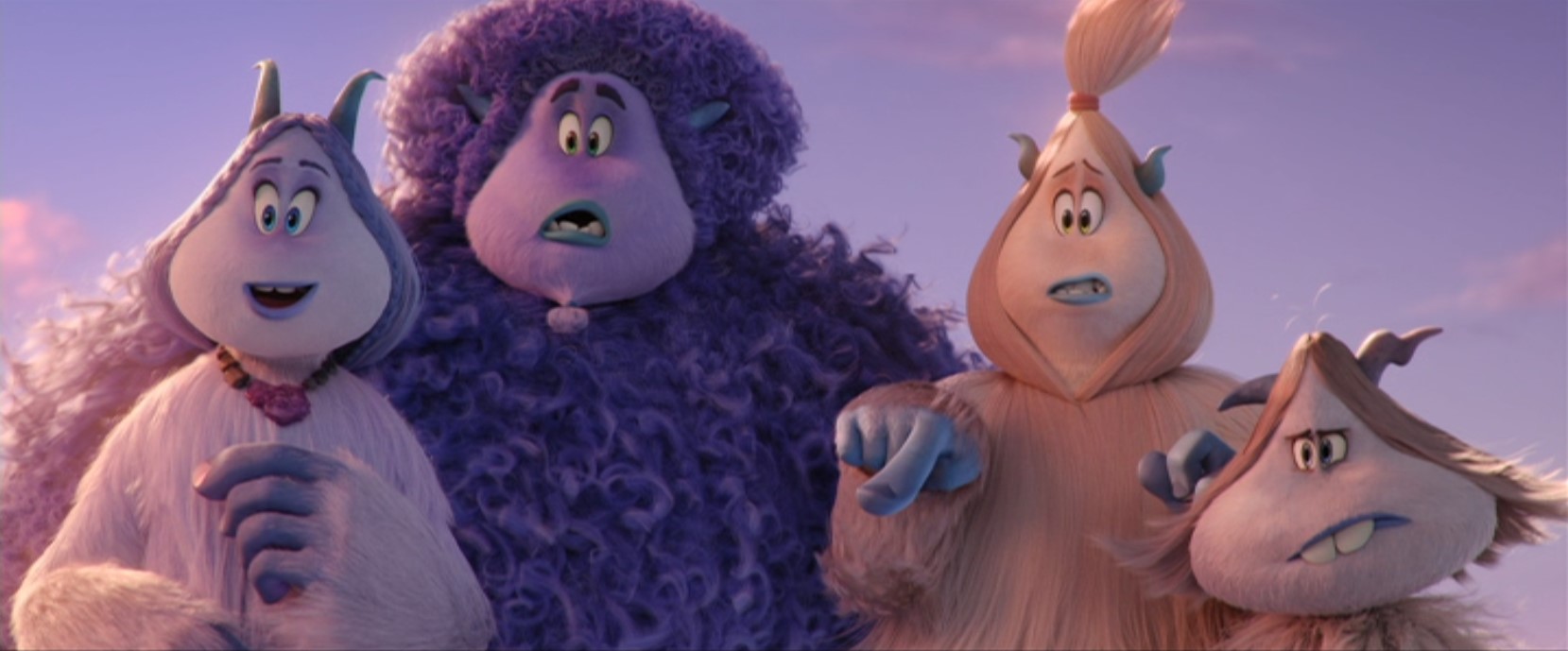
In the strange world of American computer animated feature films, movies with the same story subjects are released at the same time. This phenomenon was particularly striking in the industry’s earliest years, but in 2018-2019 it struck again. This was apparently the year of yetis, with Warner Bros.’ releasing ‘Smallfoot’ in September 2018, Laika ‘Missing Link’ in April and Dreamworks ‘Abominable’ in September 2019.
Of these three ‘Smallfoot’ was thus released first. The film was made by Warner Bros. Pictures Animation, a rather late addition to the American computer animation studio scene, debuting in 2014 with the excellent ‘The Lego Movie’. Since then, the studio has failed to get its own signature (the Lego movies are like a brand of their own, feeling more like Lego movies than Warner Bros. ones), and ‘Smallfoot’ certainly does nothing to change that.
In fact, animation, design, story, and style are all so incredibly generic the film could have been made by any studio save Walt Disney and Pixar, the only studios with a distinct style. The only surprise element of ‘Smallfoot’ is the fact that it’s a musical. And although I’m no musical fan, I must say the songs are rather good. Even better, ‘Smallfoot’ is the first musical with a genuine hip hop number, with alternative rapper Common voicing the Stonekeeper (rappers had voiced animation characters before, like Tone-Lōc voicing the goanna in ‘FernGully: The Last Rainforest’ (1992), but he doesn’t rap there).
‘Smallfoot’ starts with the voice-over of Migo (Channing Tatum), a cheerful young yeti introducing his own village and its rather silly mythology. Immediately thereafter Migo sings a happy song about how perfect his world is, and we know for sure that this character is set up for a major disappointment. And indeed, when Migo is accidentally catapulted outside the village, he sees a supposedly mythical ‘smallfoot’ (a.k.a. human) and from then his world view starts to tilt.
Interestingly, the naive Migo is joined by a group of dissidents, led by a young female yeti called Meechee (voiced by Zendaia), who’s way ahead of our hero. Meechee is such an independent, curious and powerful character that when Meechee sings ‘Wonderful Life’ to Migo this is practically ‘A Whole New World’ from ‘Aladdin’ in reverse. In fact, Meechee is a much more interesting character than Migo and it’s a pity ‘Smallfoot’ isn’t her film.
The third main character is Percy Patterson, a film maker of wildlife documentaries, who apparently has reached a low point in his career. Of all the film’s characters Percy is the most annoying and the least developed. Percy’s story arc is very poor: he remains such a jerk in most of his scenes that his final redemption is utterly unbelievable. Likewise, how Percy manages altitude sickness is beyond any believability.
Unfortunately, Migo’s progress also pushes boundaries of believability. As the filmmakers seem willing to tick all the familiar boxes, Migo undergoes the obligatory breakup scene – but this is an extreme one, with Migo denying his friends and his own views in public. We know why he does it, but the motivation is in fact rather weak, and it’s an enormous breach of character. Likewise, the following reconciliation feels forced and way too easy, given this severe betrayal. And don’t start me on the glorious rainbow finale that defies all we had learned before.
‘Smallfoot’ has a strong message that one should not believe everything, but that one should investigate oneself. But the film also features a ‘deep state’ or ‘fake news’-scheme of epic proportions, so the message is a rather confusing one. If anything, I’d say the film is anti-religion, but I wonder if that is according to the film makers’ intentions.
No, apart from the songs the film’s power is in its humor. Despite all its flaws and cliches ‘Smallfoot’ is an entertaining and funny film. The roasting scene is a particular highlight in that respect. I also like the idea that humans and yetis can’t understand each other at all, and their voices mutually sound like puny squeeks and fearsome growls, respectively. So the film is not a drag, on the contrary. Nevertheless, to carve out its own niche in the crowded feature animation world, Warner Bros. animation certainly will have to do better.
Watch the trailer for ‘Smallfoot’ yourself and tell me what you think:
‘Smallfoot’ is available on Blu-Ray and DVD
Director: Milorad Krstić
Release date: August 9, 2018
Rating: ★★★½
Review:
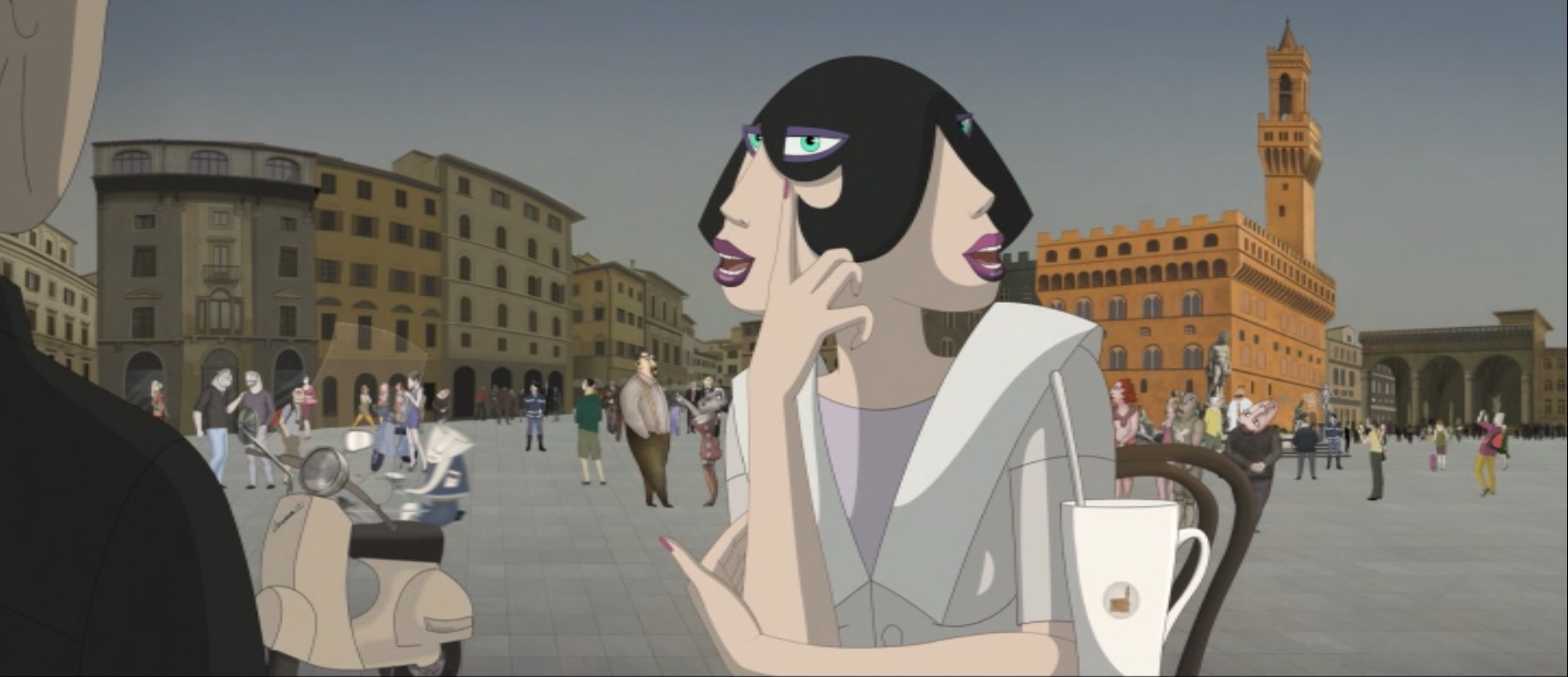
One of the more surprising and more original animated feature films from 2018 was this little gem from Hungary. Conceived and directed by Milorad Krstić, a director of Slovenian origin, ‘Ruben Brandt’ shows that one can make an adult animation film without an immature focus on sex and violence (there is violence in this feature film, because ‘Ruben Brandt’ is a crime thriller, but this violence is part of the plot, and not a gratuitous display of gore).
‘Ruben Brandt’ tells about a psychiatrist treating some criminals, who in turn help him overcome his nightmares by collecting artworks from all over the world. This plot is exciting, but on the flimsy side and as nonsensical as a James Bond movie. Moreover, the film fails to solve all the initiated plotlines, and the all too easy ending is a bit of a letdown.
Nevertheless, ‘Ruben Brandt’ remains an entertaining watch from start to finish, not only because of the surreal atmosphere, enhanced by the depiction of several of the art collector’s nightmares, but because of the film’s idiosyncratic looks.
Being a film on art, the film draws a huge inspiration from its subject, and the film breathes art in almost every frame. According to the end titles the film cites more than fifty art works, and part of the fun of watching the movie is to identify a reference in the background. Moreover, the color schemes, the designs and especially the character designs are very bold and unlike anything in any other animation film.
True, the three main characters Ruben Brandt, Kowalski and Mimi look fairly normal, even if their facial designs are already unique, but their co-stars can have two noses, eyes placed above each other, an eye placed inside an ear, three eyes, three breasts, and so forth and so on. There’s even a character with a Janus head, who is only two-dimensional, a characteristic used in the plot. The background characters are often even more bizarre, let alone the birds and fish depicted, and even if the movie were dull (which it certainly isn’t) one can enjoy the surreal imagery.
The film uses both traditional and computer animation and although the computer animation is less satisfying than the traditional animation, the mix is very well done.
In all, ‘Ruben Brandt’ is a highly authentic film that shows surrealism is far from dead, and with his grotesque designs Krstić shows that even 3D computer animation can be exciting and strikingly original.
Watch the trailer for ‘Ruben Brandt, Collector’ yourself and tell me what you think:
‘Ruben Brandt, Collector’ is available on Blu-Ray and DVD
Director: Shinichiro Ushijima
Release date: July 24, 2018
Rating: ★★★★
Review:

‘I Want to Eat You Pancreas’ is the first of only two animated feature films by the rather obscure Studio VOLN, which at least I had never heard of before. Studio VOLN isn’t even a big player in the television anime world, with only four series produced thus far. Strangely enough the studio made both its feature films in 2018.
The title of this film, which is a literal translation of the Japanese one, is a contender of the strangest film title of all time award, but what it means is revealed soon enough. The film is based on a novel, and as Japanese animation films often go, there’s nothing that implies the need for animation (except, maybe, for the long spiritual finale).
The film is told by a seventeen year old anonymous schoolboy (his name is only revealed in the very end). He tells about his surprising friendship with a fellow classmate, a girl called Sakura Yamauchi. Sakura is an apt name this character, as Sakura means ‘cherry blossom’, which is a symbol of impermanence in Japan, while the Sakura of the film is already dying from a pancreatic disease at her tender age of seventeen.
Sakura is a bit too much of a pixie girl, and although we also follow her own emotions and anxieties, it’s the story teller’s transformation through her influence that is the film’s focus. At the film’s start the unnamed narrator is a phlegmatic loner, always buried in a book, but indifferent to others and unwilling to commit himself to any relationship. Obviously, the extravert Sakura is going to change all that.
Highlight of this journey is a trip by the two to another town. Part of this trip is told in an original way by still images with dialogue on top, but even better are the scenes in the hotel, which are full of erotic tension. The film’s finale, on the other hand, with its overlong diary sequence is overblown and threatens to harm the complete film. Nevertheless, don’t forget to wait after the end titles!
Throughout, the background art and lighting are both of an extraordinary beauty, making the film a pleasant watch. The character designs, animation and soundtrack on the other hand are very generic and leave much to be desired. In fact, often the animation doesn’t transcend that of the average anime television series. There’s a little computer animation, but this is only used functionally on background art, traffic, fireworks, and such.
Even if the film is not the most interesting one in terms of animation, the film is (for most of the time) well-told, and its emotional tale does move. By all means the film shows that feature animation can be so much more than family entertainment, a message that is still lost on the American studio system.
Watch the trailer for ‘I Want to Eat You Pancreas’ yourself and tell me what you think:
‘I Want to Eat You Pancreas’ is available on Blu-Ray and DVD
Director: Kitaro Kosaka
Release date: June 11, 2018
Rating: ★★½
Review:

‘Okko’s Inn’ is an animated feature film by Madhouse based on a children’s novel series Hiroko Reijō. The film stars a little girl, who’s still at elementary school when she survives a terrible car accident in which her parents die. After this tragic incident she goes to live with her grandmother, who runs a ryokan, a traditional inn in a spa town near Mount Ikoma, East of Osaka, where she meets some ghost children and even a boyish demon.
Okko is supposed to help at the inn, and naturally we watch her grow into her new life and role, helped by the ghost children and little demon, whom we learn more about on the way, while Okko must deal with a girl whose family runs a larger rival inn.
The movie thus taps from familiar tropes in Japanese animation, like a girl losing her parents, and having to work, and the glories of traditional rural Japan as opposed to modern city life. The movie thus at times is reminiscent of such masterworks as ‘Spirited Away’ (2001) or ‘A Letter to Momo’ (2011). In content that is, for stylistically ‘Okko’s Inn’ is very poor. The designs are the most generic possible, with Okko herself being a particularly standard wide-eyed manga girl, and the animation is only fair. Moreover, the film lacks the subtleties of its peers. The film almost mechanically goes through the motions, as if ticking the necessary boxes, and the narrative lacks the surprising twists and turns of aforementioned examples.
It doesn’t help that the film’s message is partly told through guests of the inn, whose role seems almost to help Okko further in life. There’s a father with a son, whom Okko helps through their grief, and there’s an independent woman, a fortune teller, who befriends Okko and helps her getting more self-confident. And then there’s a third family staying, containing the biggest surprise of all.
The biggest flaw, however, is that we don’t see anything of Okko’s grief at all until the very end of the movie. Most of the time we don’t feel her trauma, we don’t feel her fear and we don’t feel any sense of readjustment. We see some of it, but we don’t feel it: in fact, Okko grows surprisingly easily into her new role. Nevertheless, there’s a scene in which Okko meets her anxieties, and this is by far the emotional highlight of the movie. Unfortunately, this powerful scene is followed by a mindless one on shopping.
‘Okko’s Inn’ is not a bad movie, but it’s not a stand-out either, and the film feels as a poor man’s version of ‘Spirited Away’. If anything, the feature shows that also the Japanese animation industry can pour out films that feel like run-of-the-mill products.
Watch the trailer for ‘Okko’s Inn’ yourself and tell me what you think:
‘Okko’s Inn’ is available on DVD and Blu-Ray
Director: Nina Paley
Release date: June 11, 2018
Rating: ★★★
Review:

Seder-Masochism is the second feature animation film by independent animation artist Nina Paley (born 1968), who created quite a stir with the lovely ‘Sita Sings the Blues’ (2008) in which she blended events in her personal life with the story of the Ramayana, but from a woman’s view.
Apparently, Paley was criticized for using a myth from another culture for her feminist message, with attackers typically focusing on Paley’s supposed lack of understanding of Hindu religion, an irrelevant argument, as the misogyny that Paley attacked is plainly visible in the source text (especially in the last book). Moreover, the Ramayana is hardly unique in its treatment of women as second rate citizens, which can be found in practically all ancient texts.
To underline this message, for her second feature Paley dived into her own heretical religious culture, that of Jewism. The result is a more vicious and more pamphlet-like feature than ‘Sita Sings the Blues’, mostly because the personal note is hardly present, only in an interview of Paley with her father, recorded years prior, about his stance towards Judaism, and that of the Pesach (or Passover) in particular. In these scenes Paley is shown as a sacrificial goat and her father as God himself.
The Pesach, and the story from the book of Exodus behind it, forms the central element of ‘Seder-Masochism’. The ‘Seder’ in the title apparently is a ritual feast at the beginning of the Jewish Pesach celebration, and contains some questionable elements, like rejoicing over the Egyptian victims of the ten plagues and of the closing of the Red Sea.
Surprisingly, Paley juxtaposes the story of Exodus with the idea that initially human culture was matriarchal and devoted to mother goddesses, a theory popular with feminists, but unsupported by archeological evidence. Paley even goes so far as suggesting the golden calf from the Exodus story was a return to such a mother goddess, and thus to times of more equality between and women. Indeed, Paley seems to blame Moses, or monotheism in general for the misogynist patriarchy that dominates most of human culture in its historical existence. This is pure fantasy and can be easily debunked. But of course, ‘Seder-Masochism’ is no documentary, but Paley’s personal take on monotheism and its approach to women.
Yet, Paley’s clear atheist approach to the biblical story is more vicious than anything in ‘Sita Sings the Blues’, which makes the film less approachable and less a classic than Paley’s first movie. Especially when Paley turns to real life footage of religion-inspired violence the film becomes pure agit-prop. Nevertheless, the scene in which Moses returns from Mount Sinai, commanding a stop to the women’s temporal liberation and forcing them back into their niqab-like clothing remains a painful one, and rightfully evokes anger about religious societies who limit the freedom of women.
Even with its strong message, Paley’s way of storytelling remains highly attractive. Paley’s dry sense of humor permeates much of the film, and her visual style is charming throughout, her command of minimal, but effective animation one of the highest degrees. I especially like the poetic intro in which a female goddess flows through space, and sprouts plants, animals, and eventually men on a soundtrack of the most beautiful Bulgarian female chant. Paley’s dance animation of ancient female statues is also a masterstroke, and an attraction in its own right (Paley offers them as singular GIFs).
Moreover, Paley very skillfully mixes the interview excerpts, an enormous variety of existing music and even a 1950s record in which a man tells about the Seder celebration. In contrast with ‘Sita Sings the Blues’, in which only records by 1920s singer Annette Hanshaw were used, ‘Seder-Masochism’ plunders the Western pop music tradition, often to a very striking effect. Notice, for example the single sample of ‘Helter Skelter’ from The Beatles during the sixth plague, and the earlier mentioned scene in which Moses returns uses Led Zeppelin’s ‘Your Time Is Gonna Come’ to a painful effect. But the film’s highlight in this respect must be the use of 10cc’s ‘The Things We Do for Love’ which accompanies images of Jews gleefully chopping off foreskins, beheading little goats and killing men and women.
The bitter irony of this sequence is topped by the ‘This Land Is Mine’ sequence, which Paley finished first, and which can be watched as a separate video clip. In this utterly bleak section, we watch several nations fight over the land of Israel, killing one another in greater and greater numbers, with Death itself ultimately being triumphant. With Israel raging the war in Gaza today, with its tens of thousands of innocent Palestine victims, this bleak sequence remains as topical as ever.
The ‘This Land Is Mine’ sequence was also one of the last pieces of animation Paley did in Macromedia Flash, before moving over to Moho. But the most surprising piece of animation in the film is not done on either platform but done with embroidery, in a process Paley calls ‘embroidermation’. This is a lovely piece of stop-motion that Paley rightfully saves for the end, just before the ‘This Land Is Mine’ finale.
In all, ‘Seder-Masochism’ is a beautiful, if rather angry film with a strong feminist message. It cannot stand the comparison with ‘Sita Sings the Blues’, which remains the more balanced work, but as author feature films like this remain utterly rare in the animation field, I strongly recommend watching this feature nonetheless. At least it will make you think about the position of women in society. Paley offers her film for free online, and the movie can be downloaded from her site.
Watch the trailer for ‘Seder-Masochism’ yourself and tell me what you think:
‘Seder-Masochism’ can be downloaded for free from Nina Paley’s website
Director: Denis Do
Release date: June 11, 2018
Rating: ★★★½
Review:
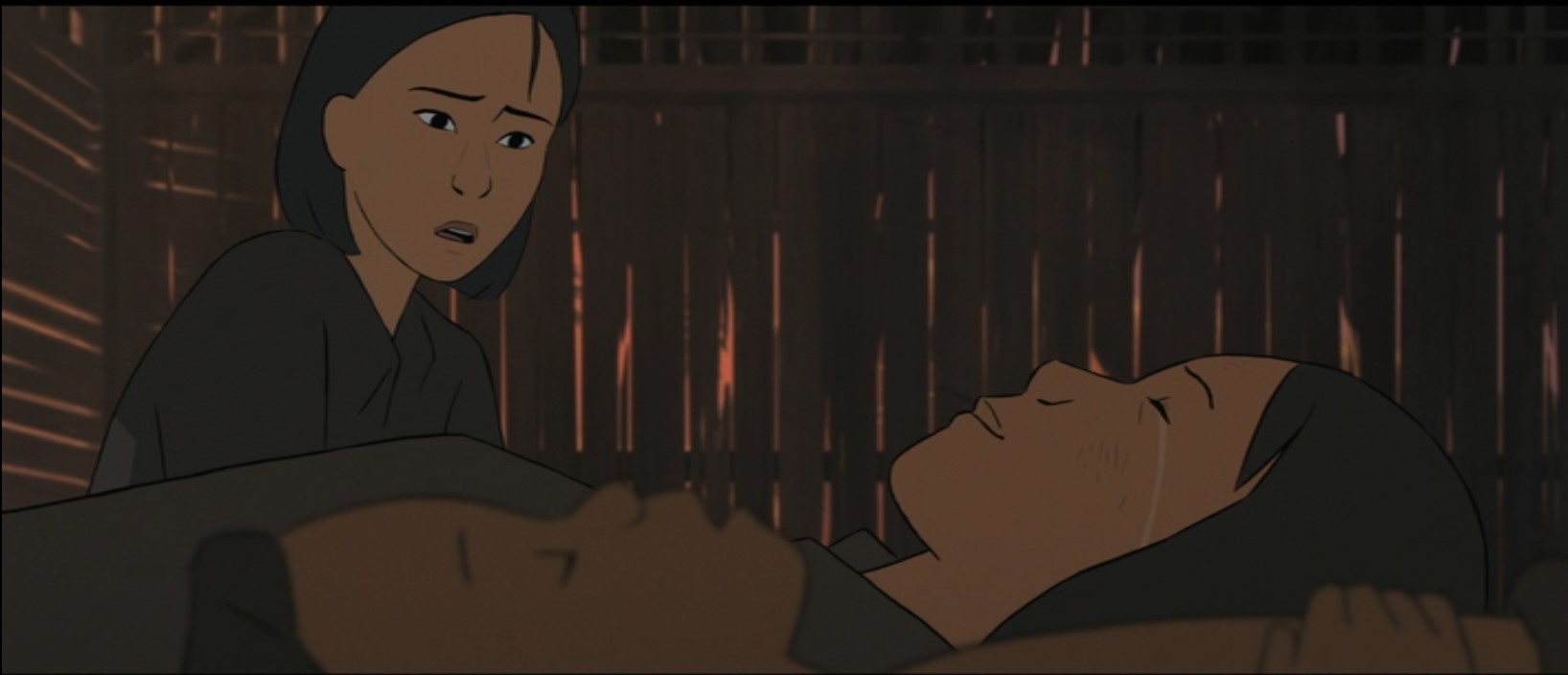
‘Funan’ is a film by Denis Do, a French film maker of Cambodian descent, and the film is partly based on the memories of his own mother.
‘Funan’ means ‘the new people’ in the Khmer language, and this is an apt description of the radical ideology of the Khmer Rouge, an extreme communist movement that took power in Cambodia from 1975 to 1979, only to plunge the nation in one of the severest mass killings in human history, with the ultimate goal to rise as a ‘new nation’ of autarkic, non-intellectual people.
‘Funan’ thus tells about Cambodia’s darkest years, and does so by following one family from Phnom Penh, which almost immediately falls apart, and which succumbs one by one to various aspects of the terror, be it brutal murder, forced labor, famine or rape. We especially follow a couple, Chou and Khuon, and their son Sovanh, who gets separated from his parents near the start of the film.
Luckily, the film eschews gross images, keeping the watch tolerable, but strangely enough, this also means one feels the hardship and sorrow less than one should. The film’s rather episodic nature certainly doesn’t help, and one has a little trouble relating to these people, perhaps because they aren’t introduced very well (the happy bliss of pre-Khmer rouge existence is shown all too shortly), and because the film is told in a plethora of very short scenes, instead of a few well-chosen longer ones. Especially Sovanh’s story is too fragmentary to follow, and his experiences are only hinted at, although it’s clear that the young boy sees a lot of cruelty and death.
The 2D animation is fair, with the human character designs rooted in the French ligne claire tradition, while the background is painted and lineless. Both coloring and lighting are clearly digitally done, and to be frank, rather uninteresting.
I suspect the film could be more daring and more idiosyncratic in its designs and storytelling, especially when compared to Elsa Duhamel’s similar, but far more interesting short ‘Bach-Hong’, which tells of the coming of the communists to Saigon, Vietnam. Duhamel cleverly sticks to a single story, illustrating the regime’s cruelty by one, ostensibly minor detail in the nation’s history.
Do, on the other hand, seems to want to tell everything, and indeed he succeeds in painting a picture of these black years, but I suspect he had better chosen less scenes, and less characters, for now, unfortunately, the film remains at an emotional distance, and that can hardly be the film maker’s purpose. Yet, I am glad personal films like this are being made, for films like ‘Funan’ save tragedies like that of Cambodia from oblivion, and remind us that peace and safety aren’t guaranteed, at all.
Watch the trailer for ‘Funan’ yourself and tell me what you think:
‘Funan’ is available on Blu-Ray and DVD
Director: Mamoru Hosoda
Release date: May 16, 2018
Rating: ★★★
Review:

‘Mirai’ was the third feature film Mamoru Hosoda made for his own studio, Studio Chizu. Hosoda favors rather episodic films about growing up, and ‘Mirai’ is no exception, although the film takes place in a much smaller time frame than ‘Wolf Children’ or ‘The Boy and the Beast’.
Main protagonist of the film is ca. four-year-old boy Kun, who lives in a design house in Yokohama (the town is depicted regularly during the film in swooping bird-eye’s view shots), but more importantly, who gets a baby sister, the Mirai from the title. Mirai also means future, and in fact, the Japanese title is ‘Mirai no Mirai’, or ‘Mirai from the future’. Indeed, Kun meets an older version of his younger sister from the future, as well as some other characters, while he struggles to adapt to the new situation he finds himself in.
Because with the coming of little Mirai a lot changes for the young boy: his parents have less attention for him, focusing more on the new baby, they’re more often tired and crabby, and they struggle with combining working and caring, now there are two children around. Needless to say, Kun has a hard time getting adjusted, and even gets jealous of his innocent baby sister.
The film focuses on some key scenes, in which Kun experiences a setback, at least in his own mind, and then something magical happens in the little courtyard of his house. First the little boy first meets a humanized form of the family dog, and then his younger sister in older form (there’s more, but I won’t spoil it here).
Unfortunately, Hosoda doesn’t stick to the boy-sister relationship, and at some point, the magic scenes also help Kun overcome his fears. Moreover, a four-year-old is a difficult and questionable protagonist of a film that wants to show the hero’s progress. After all, he is just a little boy. It’s little surprising that Hosoda spends considerable time on Kun’s parents, and their development during this crucial part of their lives. And, indeed, to be frank, Hosoda’s honest depiction of the hardships of young parenthood and of raising one’s own children is much more interesting than Kun’s ‘development’ of character.
Main attraction of the film are the five magical scenes, with the first two showing some broad comedy, as the man-dog and Mirai from the future roam around the house. The third and fourth start to feel obligatory, even though the fourth has a nice nostalgic feel to it. But with the fifth, Hosoda goes completely overboard, and one wonders why these nightmarish scenes, taking the film to a altogether other atmosphere, were even necessary. In fact, this finale, in which Hosoda wants to tell us something about family ties, is too overtly self-explanatory and spoils a film that wasn’t perfect to start with.
In fact, ‘Mirai’ drags a little, being mostly confined to the small space of Kun’s house and with Kun’s development of character as an important, but very weak story device. The film’s episodic nature doesn’t really help, spreading the story thin, a problem that also invades ‘Wolf Children’ and ‘The Boy and the Beast’. I wish Hosoda was able to keep his use of time as tight as his use of space in this movie. ‘Mirai’ is not a failure, the film is too original for that, but it’s arguably Hosoda’s weakest feature film so far, never reaching the emotional heights of either ‘Wolf Children’, ‘The Boy and the Beast’ or even his debut film, ‘The Girl Who Leapt Through Time’ from 2006.
Watch the trailer for ‘Mirai’ yourself and tell me what you think:
‘Mirai’ is available on Blu-Ray and DVD
Director: Mari Okada
Release date: February 24, 2018
Rating: ★★★
Review:

The Japanese animation industry apparently is so rich that new interesting films can pop up seemingly out of nowhere. For example, ‘Maquia: When the Promised Flower Blooms’ (from now on ‘Maquia’) is made by the P.A. Works studio, which since its founding in 2000 focused on television series, and which only made four feature films, the first being based on a video game, the second made for television, the third for training purposes, and the fourth based on a television series.
So, their fifth feature film to be a completely original story, not based on a video game, television series or even a manga, comes as a surprise. It seems that ‘Maquia’ was the pet project by its director Mari Okada, who wrote the story herself. Okada, apparently is somewhat of a modern legend as she has written for over fifty television series since 2001, and is called by Wikipedia “one of the most prolific writers currently working in the anime industry”. She’s one of the brains behind ‘Anohana: The Flower We Saw That Day’ (2011), one of only two anime television series I have watched, and it comes to no surprise to me that the ‘Maquia’s’ story style has something in common with that series. Both series and film have a strong focus on human drama, with emotions reigning uncontrolled, and tears flowing frequently. In fact, despite the high fantasy setting, ‘Maquia’ has a strong element of melodrama, and the rather forced emotions, so different from the more restrained style in studio Ghibli, or the films by Yasujirō Ozu for that matter, actually made it harder for me to relate with these people.
‘Maquia’ is a fantasy film, set in a rather Middle Earth-like world, and starts with the depiction of a society of near-immortals called Lorphs, whose surroundings are particularly like the depictions of elven kingdoms in Peter Jackson’s adaptation of The Lord of the Rings. These Lorphs write their memories by weaving cloths and live far away from more mortal men. One of these, a young girl called Maquia (from which the English film title takes its name) rather out of nowhere complaints she is so alone. Shortly after this scene of distress the eternal city is attacked by an army of men, and Maquia soon finds herself in the outside world, where she adopts a baby, whose mother is killed.
From then on, the film takes an episodic nature, showing us various stages of the mother-son relationship until the son, whom Maquia calls Ariel, has matured, while his mother, in contrast, has retained the same teen appearance she had in the beginning.
The film apparently tries to say something about how to love is to lose and to let go, how to find beauty in the short lives we have, and how relationships form the most important part of life, but the film’s messages get deluded in a rather complex story, in which we do not only follow Maquia, but also her childhood friend Leilia, who is forced to become a queen by her abductors, the captain who destroyed the Lorph city in the first place and one Lang, a boy/man with whom Maquia spent her first years in the mortal world. The bigger story, and all its subplots are far less interesting than Maquia’s relationship to her adopted son, and both prolong and distract the film unnecessarily.
Apart from being unfocused and very, very emotional, ‘Maquia’ is also hampered by an overblown score by Kenji Kawai, all too forcefully guiding the viewer in which emotion to feel. Even worse, are the rather lazy and utterly generic human designs, which nowhere transcend your average anime television series. The animation, too, is fair, but not outstanding. There’s also a small dose of computer animation that is used sparingly and effectively. No, the film’s highlights are not the story, music, character designs or the animation, but the background art and the lighting, which are both no less than magnificent, and which both give ‘Maquia’ a splendor that make the film a delight to watch, even when the characters and events themselves don’t.
I like ‘Maquia’ being an original story, and its theme of what it means to be (im)mortal is interesting, but the film is too long, too episodic, too meandering and too dramatic to entertain, and I am pretty sure in the end I will not remember either the film’s story or its characters, but the beautiful background art and superb lighting, which the make the film a standout, after all.
Watch the trailer for ‘Maquia: When the Promised Flower Blooms’ yourself and tell me what you think:
‘Maquia: When the Promised Flower Blooms’ is avaiable on Blu-Ray and DVD
Director: Jan Švankmajer
Release date: January 26, 2018
Rating: ★★
Review:
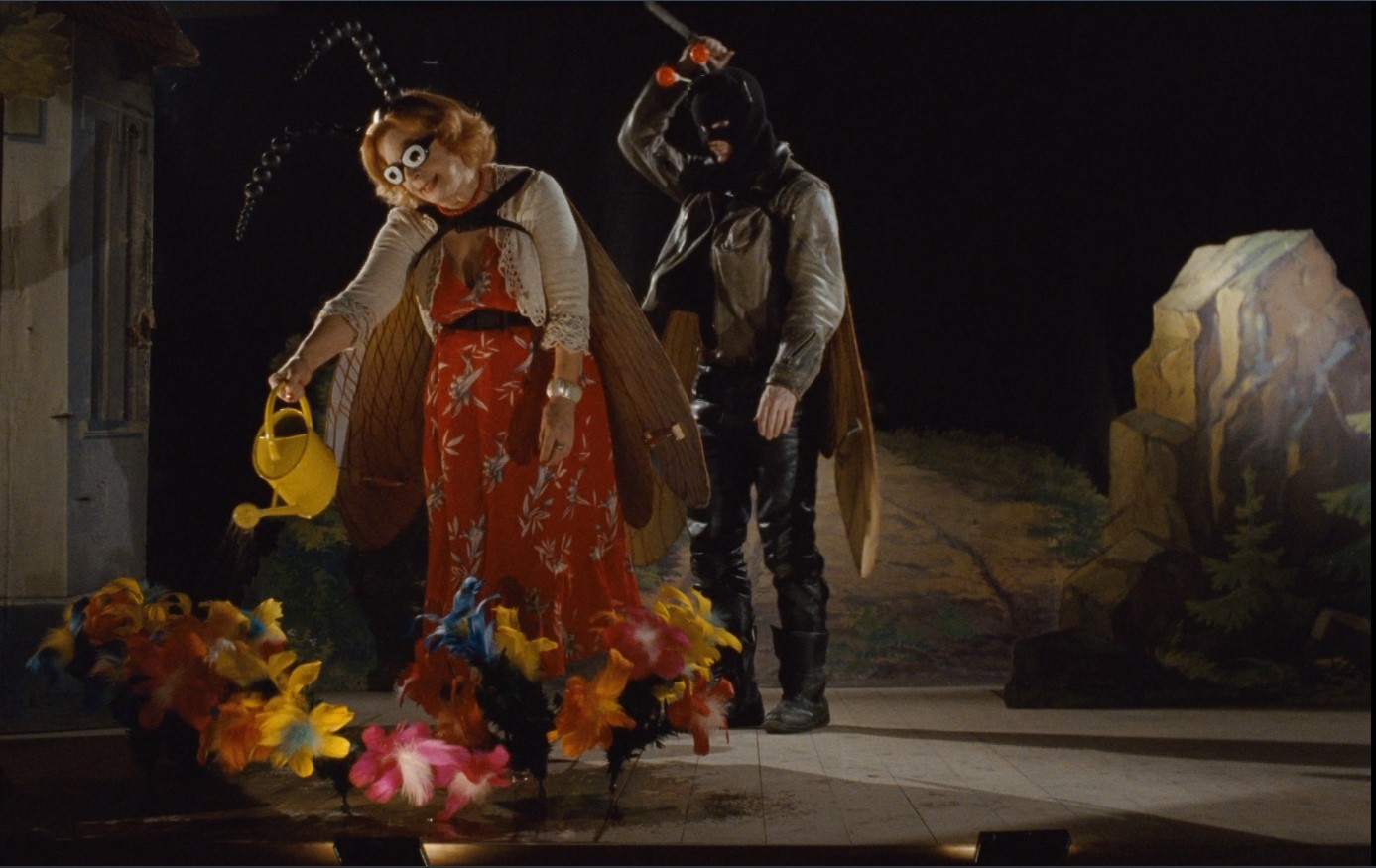
‘Insect’ is Jan Švankmajer’s last film. Even though at the time of writing the Czech master of surrealist cinema is still alive, he announced this film as such. It sure was a difficult film to make, as even crowdfunding was needed to finish the movie.
Unfortunately, the film is not a grand finale to Švankmajer’s glorious oeuvre. Sure, the film’s main story is interesting enough and shows all elements of the Czech director’s idiosyncratic style: surrealist events, morbid humor, extreme close-ups, claustrophobic spaces, a preoccupation with food, and even a splash of stop-motion and cut-out animation, rarely seen since the 1980’s.
In this story an amateur company rehearses the 1921 play ‘Pictures from the Insects’ Life’ by the Čapek brothers. Only part of the troupe is present, and the film features only six characters, who are cramped into a dark, poorly lit space, which give the film an eerie feeling the actors are trapped like insects themselves. Four actors are bullied by an overt ambitious director, while the sixth sleeps through most of the rehearsal. While the inapt actors act out a few scenes from the play, strange events start happening, like insects appearing everywhere, and a dummy coming to life, and several of the actors don’t live through the end of the rehearsing.
This story shows a strong unity of time and space, and is told by Švankmajer with gusto, while his actors delight in portraying the clumsy actors, one even worse on the stage than the other. The actor’s antics are often accompanied by the beginning of Bedřich Smetana’s overture to ‘The Bartered Bride’ (1866), the lively sounds of which contrast heavily with the bad acting on the stage. The sound design, too, is excellent, with its well-chosen unpleasant sounds, as of crawling insects.
However, apparently this main story wasn’t enough material to fill a complete feature length film, and thus the action is constantly interrupted by behind-the-scene footage, showing how the film was made, as well as the real actors telling about their dreams. These scenes often reveal the tricks involved in the film making, and thus spoil the fun of the surrealist main story. But more importantly, they greatly disrupt the main narrative, and the viewer is constantly thrown in and out of the story, which makes the film a frustrating watch, indeed. This choice of adding an extra layer to the film actually makes it a weaker product than it could have been, and although it’s nice to watch Jan Švankmajer at work, it makes the film a sad farewell to his illustrious career.
Watch the trailer for ‘Insect’ yourself and tell me what you think:
‘Insect’ is available on Blu-Ray and DVD
Director: Wes Anderson
Release date: February 15, 2018
Rating: ★★★★★
Review:
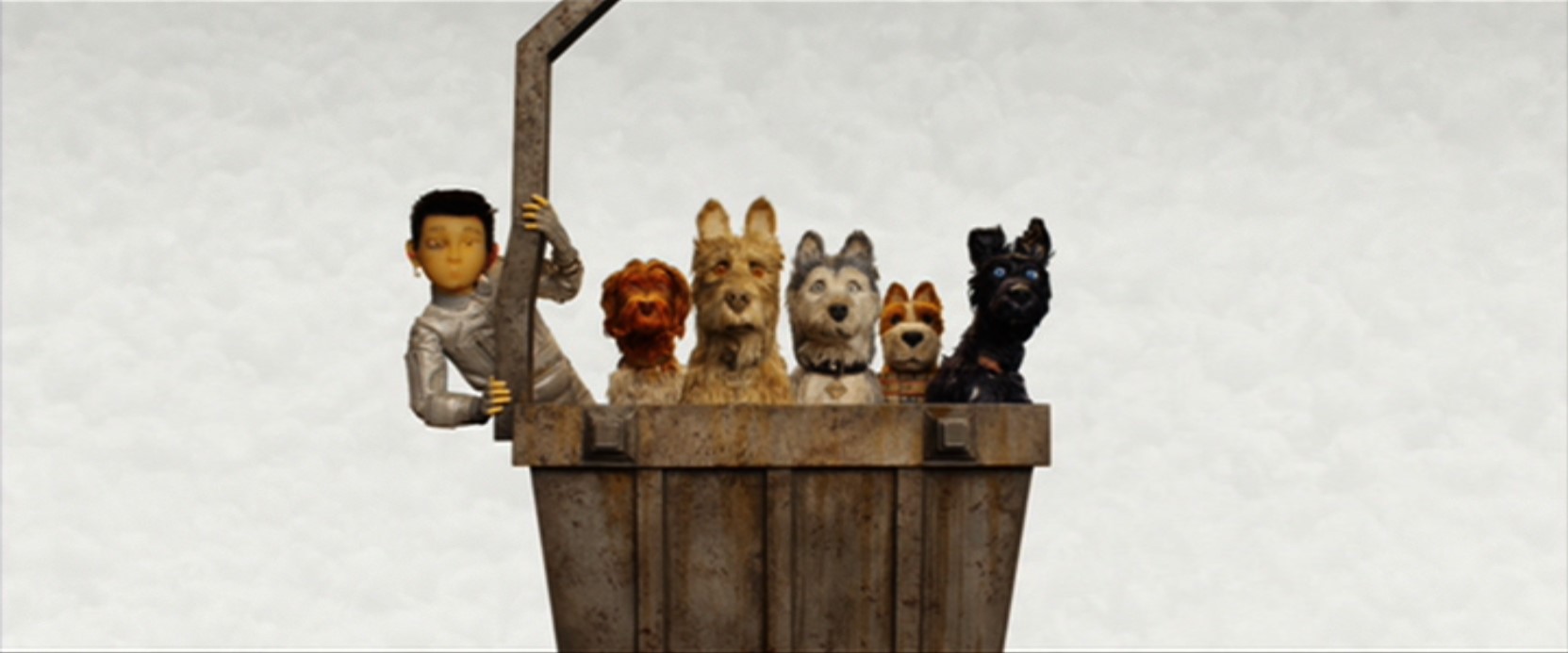
The 21st century saw a few live action directors and film makers crossing over to animation, often with original films that were welcome deviations from the standard family fare of Pixar, Dreamworks, Sony, Illumination and the like. One of these directors was Wes Anderson, whose live action films already have a very distinct flavor, let alone his animation work.
In 2009 Wes Anderson brought us ‘Fantastic Mr. Fox’, his own quirky take of the classic children’s book by Roald Dahl, adding some ‘The Royal Tenenbaums’-like flavor to it. It seemed a one off, like all other animation adventures by live action directors, but in 2018 Wes Anderson surprised everyone by making yet another animation movie, this time with a completely original story of his own.
‘Isle of Dogs’ is a sort of fantasy-dystopia film set in Japan. Surprisingly, much of the dialogue is in Japanese, and not always translated, adding to the film’s idiosyncrasy. The film tells about the cat-loving Kobayashi clan who wants to get rid of all the dogs. When a Kobayashi mayor gets into power in the fictive town of Megasaki, he banishes all dogs to a garbage dump island…
The film knows quite a lot human characters, but uses mostly a dog-viewpoint and is even narrated by a dog (voiced by Courtney B. Vance). The film focuses on a stray dog called Chief, whose life changes when a young boy arrives on the island, looking for his own former pet, Spots.
Where all other film makers would make the boy and the dogs be able to talk with each other, Anderson keeps their languages strictly separated, with the dogs not getting a thing the boy says, and vice versa. As the boy speaks Japanese, we, the audience, too, cannot always follow what the boy tries to say – a bold move.
The dog communication is all in English, and Anderson makes use of a lot of familiar names to voice his animated creatures, like Edward Norton, Jeff Goldblum, Bill Murray and Scarlett Johansson, just to name a few. Even Yoko Ono has a small role as a scientist of the same name.
Like ‘Fantastic Mr. Fox’ ‘Isle of Dogs’ is a stop motion film, and a very virtuoso one, too. The animation, directed by Mark Waring, is superb throughout and there are crowd scenes with tens to hundreds of puppets, and both dog and human characters are very intricately designed. Like in Anderson’s first animated film, all animals have a rather scruffy look, giving the film a very individual look. There are some typical quirks in the animation, like dogs sneezing at random moments. I also like Anderson’s use of cartoony fight clouds. As far as I know he’s the first to use those in a stop-motion film.
As with his other films Anderson employs a very typical use of the camera, often showing symmetrical images, and sometimes using close ups in a rather Spaghetti Western-like fashion. There’s also a little 2D animation to depict events on television. The background art, too, is unique. Apart from elaborate sets, the film uses rather flat background art, with a typical cut-out look. The quasi-Japanese score by Alexandre Desplat, an Anderson favorite, adds to the film’s unique atmosphere.
The film’s story says something about populism, and how misleading information can lead to unjust decisions, but the film is too silly to emphasize this point. Likewise, the film’s heart lies with Chief, but much more interesting than his development are the dry dialogues, and the running gag of one dog hearing a rumor the others never heard of. In fact, apart from the film’s looks, the dialogues form the film’s main attraction, as they are often very funny.
Unfortunately, the film’s finale is not the best part, and the defeat of the villains a little too easy, but otherwise ‘Isle of Dogs’ is a real treat, and with its unique style a very welcome diversion from the often run-of-the-mill fare of American studio animation.
Watch the trailer for ‘Isle of Dogs’ yourself and tell me what you think:
‘Isle of Dogs’ is available on Blu-Ray and DVD
Director: Nick Park
Release date: January 20, 2018
Rating: ★★
Review:
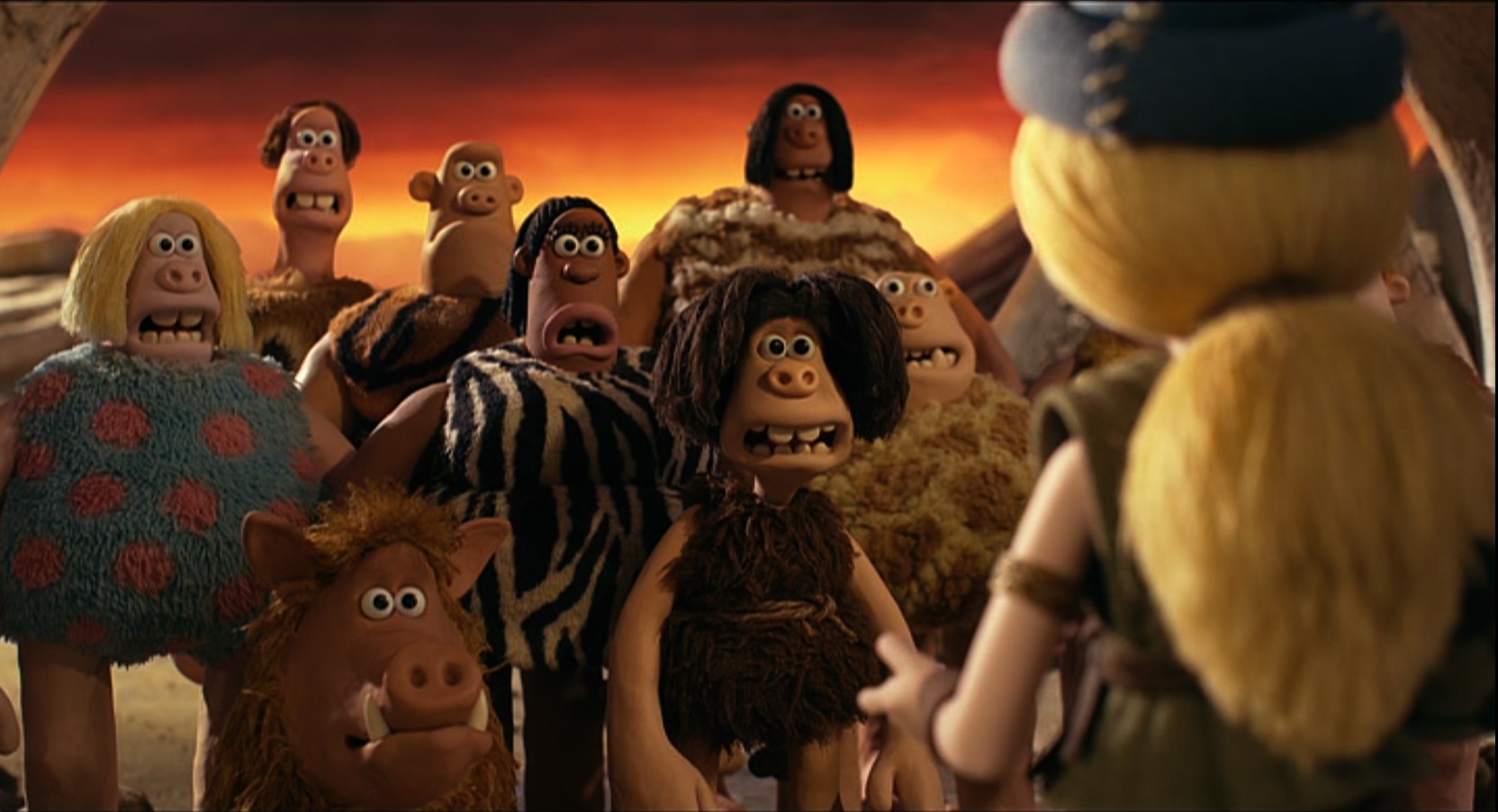
In ‘Early Man’ some cavemen have to play a soccer match to save their village from oblivion. ‘Early Man’ was Aardman’s seventh feature film, and the fifth using the studio’s trademark Claymation, but when compared to the wonderful movies ‘Wallace & Gromit: The Curse of the Were-Rabbit’ (2005) or ‘Shaun the Sheep Movie’ (2015) ‘Early Man’ is frustratingly lackluster.
Sure, the film is wonderfully made, and clearly with a lot of love, and has the charm of fingerprints being visible on the clay puppets. Moreover, by now, the Aardman studio clearly makes its animation style look easy. Then there are the typical Aardman quirks, like the way replays are shown, or some funny side remarks, the best of which is “Sliced bread? That’s the best thing since… well, ever!”. I particularly liked the idea of the message bird, which not only repeats all that is said to him, but all the accompanying actions, as well. These little touches at times made me laugh out loud.
Unfortunately, the story is not half as good: it’s one long sum of cliches, never venturing into new or surprising story ideas, making the film surprisingly dull. Especially, the football match ticks all the familiar boxes of the sports film, and there are team effort scenes and unconventional training scheme scenes as we had seen already a thousand times, most recently in ‘Kung Fu Panda 3’ (2016) and ‘Cars 3’ (2017), which were both also frustrating affairs story-wise. The characters, too, are in no sense original, and feel emblematical, instead of rounded. Even the main hero Dug is appallingly onedimensional.
As said, ‘Early Man’ especially follows the sports film trope of the underdog winning against all odds but it does so in the laziest way. For example, at one point Goona makes clear to the cavemen that they may have a chance because they can be a team while their opponents are just a bunch of individuals. Now, there’s a chance to make the cavemen’s win believable. And what is done with this idea? Absolutely nothing. As soon as the real match starts, the so-called big difference between the behavior of the star players and the cavemen team on the field disappears. It’s disheartening to watch this saving element being left unused.
The world-building, too, leaves a lot to be desired. ‘Early Man’ doesn’t really play in the stone age, or the bronze age, or whatever. It is set in some fantasy sword-and-sorcery world with bare rocks and active volcanoes. Even the time period of the prologue makes no sense, set in the non-existing ‘Neo-Pleistocene’ and showing us cavemen living next to dinosaurs (in a nice little nod to Willis O’Brien, although the two creatures were apparently called Ray and Harry after that other great stop motion monster animator, Ray Harryhausen).
By the time the main story starts, the dinosaurs have disappeared, but some Flintstones-like gags remain, like little crocodiles as clothespins and a beetle as an electric razor. But then the studio adds some creatures that in no world make any sense whatsoever, like a giant woodlouse, a giant spider, a giant duck with teeth and some giant caterpillars. With these the film makers lost all consistency and believability of a world that was rather shaky to start with.
For example, the only green spot in this world is where ages ago a meteorite struck, but it’s in this world the cavemen live. How the other people survived in the highly hostile environment of the rest of the planet remains an utter mystery. It doesn’t help that most of this world is rendered in the ugliest and laziest computer animation, which contrasts greatly with the fine Claymation.
It seems the film makers too much wanted to make a football (soccer) movie, and got blind for the film’s flaws, which are instantly recognizable to any viewer. Instead, they should have thought things over, both about their story and their world, because the final film is a formulaic drag, and, not surprisingly, became a box office bomb.
Watch the trailer for ‘Early Man’ yourself and tell me what you think:
The Dutch Kaboom animation festival is over, but I’ll round up my reviews of the shorts in competition, ending with number six, which turned out to be the most satisfying of the seven programs on independent shorts.

Lèvres bleues (Blue Lips)
Philippe Hamelin
Canada, 2020
★★
A certain Steve tells about one night with his boyfriend. His tale is accompanied by dreamy computer generated images, showing parts of Steve and his boyfriend, interlaced with images of a canary and of Steve’s motor bike. Many of the images are shown in slow motion, and as there’s hardly any action, they are close to film stills. Steve’s tale is a sweet one, but the animated illustrations are rather boring and lifeless, and one gets distracted by images of Steve’s extraordinarily hairy body.

Praćka (Washing Machine)
Alexandra Májová
Czech Republic, 2020
★★★★★
‘Washing Machine’ is a fun little short about a man’s unconventional relationship to his washing machine. Májová uses the simplest designs and shapes on monochrome backgrounds to a great effect. Her animation and timing are spot on and even manage to turn a washing machine into an erotic element.

Jestem tutaj (I’m Here)
Julia Orlik
Poland, 2019
★★★★★ ♕
In ‘I’m Here’ we watch the last days of a dying elderly woman. Orlik explores stop-motion, using puppets of the upmost realism, not seen since the work of Suzie Templeton (e.g. ‘Dog’ of 2001). The dying woman is completely convincing and one of the most real personas I’ve seen in any stop-motion film. The story is told in many very short scenes, all taken from a single point of view, always focusing on the wrinkled lady, who isn’t able to either speak or move anymore. To watch her mostly silent distress is painful enough, but often more drama takes place in the background, as her father and daughter struggle to take care of the terminal patient.
Of the 55 shorts in competition ‘I’m Here’ was the only one that really moved me. When the title words were spoken I burst out in tears. Thus the more surprising that this film about dying was made by a student still in art school. ‘I’m Here’ won the Kaboom student award, and I say it is well deserved, because I’d crown this film the most impressive of the complete festival.

Black Snot & Golden Squares
Irina Rubina
Germany, 2020
★★★
‘Black Snot & Golden Squares’ lasts only one minute and promises us that one day we can hug again. The message is packaged in enjoyable 2D computer animation of Bauhaus-like semi-abstract images of blues, grays, yellows and blacks.

The Great Malaise
Catherine Lepage
Canada, 2018
★★★★★
In ‘The Great Malaise’ we hear a woman describing herself as for a personal ad. Her descriptions are accompanied by illustrative animations in a variety of styles and techniques, one even more original than the other. But halfway the visual metaphors get extra meaning. ‘The Great Malaise’ is a very graphic and highly original film showing the dangers of perfectionism. The film is as authentic as it is funny, and must be counted among the best of the shorts in competition programs.

Average Happiness
Maja Gehrig
Switzerland, 2018
★★★★½
‘Average Happiness’ starts with a Powerpoint presentation on statistics. Soon the graphs start to lead their own life, and the screen gets filled with diagrams, pie charts, bar charts etc. to form some very complex imagery, resembling cities and forests. Gehrig even manages to make graphs sensual. The abstract but mesmerizing mayhem is greatly enhanced by the weird soundtrack by Joy Frempong, and excellent sound design by Peter Bräker. ‘Average Happiness’ won the audience award for best short in competition, no mere feat for an abstract film!

Ja i moja gruba dupa (My Fat Arse and I)
Yelyzaveta Pysmak
Poland, 2020
★★★★½
‘My Fat Arse and I’ is a surreal and rather weird short on dieting. The short starts with the female protagonist not being able to put on her pants. This triggers a heavy diet, but the woman still sees herself as fat. On a dreamy visit to the land of walking butts she manages to beat “the God of the skinny bitches”with help of her fat image in the mirror. Pysmak explores a very rough, sketchy underground style, a modest color palette of blacks on yellow and green, and a rather rudimentary animation style. Pysmak is by no means a great animator, but her images are original and inventive, and her film, which also makes a nod to computer games, is a great joy to watch.

11:11
Alexander Dupuis
United States, 2020
★★★★
11:11 is a computer animated video clip full of ever changing, shiny and glowing abstract shapes, which form very apt images to the electronic R&B music by Raina and Jake Sokolov-Gonzalez.

My Exercise
Atsushi Wada
Japan, 2019
★★★½
‘My Exercise’ is a short comic film, lasting only two and a half minutes, in which a boy is doing exercises with help of his dog. Wada exploits his typical surreal style against a monochrome lemon background. The film is delightfully absurd, but even in these short and simple scenes Wada shows to be an excellent animator.

Hot Flash
Thea Hollatz
Canada, 2018
★★★★
This program of shorts features a lot of animation by female animators, and it’s clear that they can tackle subjects that will never be picked up by men. Thus, ‘Hot Flash’ covers a topic that I’ve never seen before in film, animated or otherwise: the menopause. In this comedy short Ace Naissmith, a weather presenter, experiences hot flashes, which hinder her greatly at her work. Not only is the subject matter highly original (which itself is weird as ca. half of humanity will experience this…), but Hollatz tells her tale very well, too. This means that men like me can relate to Ace’s plight, too. Hollatz exploits a very pleasing cartoon style, with an appealing color design. Her animation is top notch, too, and shows a great sense of comic timing.
The third program of Shorts in Competition of the Dutch Kaboom Animation Festival is called ‘Stranger Things’, and rightly so, because this is quite a bunch of weird animation films. And to think there’s also a program called ‘Bonkers Shorts’… Remember, this festival takes place completely online, and you can tune in and watch endless animation films, anytime (until Sunday the 4th that is).

The Surrogate
Stas Santimov
Ukraine, 2020
★★★
‘The Surrogate’ is a body horror story in the tradition of Charles Burns. Santimov manages to tell his creepy tale without dialogue, and his digital painting animation fits the uncanny, even repulsive narrative very well. Unfortunately, the short seems to end prematurely.

Warum Schnecken keine Beine haben (Why Slugs Have No Legs)
Aline Höchli
Switzerland, 2019
★★★★★
This funny little parable tells us about three very slow slugs (still with arms and legs), who lead a very relaxed life inside the fast and busy insect world. Unfortunately, they grow more and more at odds with their economical surroundings… ‘Why Slugs Have No Legs’ indeed reveals why slugs don’t have legs, and elevates the slug to a life-loving creature, free from the duties of the world. Höchli’s drawing style and traditional animation are both very attractive, and the tale is told very well through the animation only. The fun atmosphere is greatly enhanced by the use of two weird tunes by Bollywood singer Gurpreet Kaur.

Black Sheep Boy
James Molle
France, 2018
★★★
In ‘Black Sheep Boy’ the main protagonist Boy tries to find the meaning of life. On his voyage he meets all kinds of characters, who are all struggling with life in their own way. Molle’s 8bit designs and vintage computer-game style of animation contrast greatly with the philosophical themes of this short. The dialogue is displayed under the scenes, while the characters utter electronic sounds. The result is a cartoon of utter weirdness, but also one that could have used some editing and with its 15 minutes length outstays its welcome.

Elo (Tie)
Alexandra Ramires
France/Portugal, 2020
★★
‘Tie’ is a dark, surreal and wordless tale of a man and a woman finding each other at a swamp. The events are bridged by images of a rotting carcass of a dog. Although ‘Tie’ is essentially a tale of love, the atmosphere is grim and rather unsettling, with Ramires’ scribbly animation taking place on a dark canvas. The result is weird and original, but also a bit tiresome, and not very rewarding, with the weirdness giving way to a fairly conventional ending.

Jo Goes Hunting – Careful
Alice Saey
France/The Netherlands, 2019
★★★★
‘Careful’ is a very attractive videoclip for the otherworldly indietronica music of Jo Goes Hunting. The strange sounds are accompanied by virtuoso 2D computer animation depicting circles, in which all kinds of plants, animals and humans can be detected. Sacy’s employs a handsome graphic style, and a beautiful color design. Both music and images are simply mesmerizing in their strangeness, and this non-narrative short is over before you know it.

Good
Chun-ting Ou
Taiwan, 2020
★★½
In ‘Good’ a little girl tries to be good, in fact, way too much so. Ou’s 2D computer animation is attractive, but at times becomes quite disturbing. Some of the girl’s facial expressions are pretty unsettling. ‘Good’ may show us that mere perfectionism will bring us nowhere, on the contrary.

Strange Occurrences: Bukit Bulabu
Shi Teng Wong, Gloria Yeo & Hana Lee
Singapore 2020
★★★
‘Strange Occurrences: Bukit Bulabu’ is a spoof of ghost hunting programs on television. This ‘episode’ focuses on a supposedly haunted toilet and features interviews with three people. The short never becomes serious, but Wong, Yeo & Lee’s stop motion is top notch, giving the rather simple puppets a very believable presence during their interview sessions, giving their characters natural gestures comparable to the work of Aardman. Nevertheless, it’s nice to watch the use of jiggly pieces of paper as tears. ‘Strange Occurrences: Bukit Bulabu’ makes no sense, and cannot be taken seriously, but it does show that Wong, Yeo & Lee are very able stop-motion animators.

Seoulsori
Kyoung-bae Kim
South Korea, 2020
★★★
Seoulsori is a music video for an instrumental track by South Korean rapper Peejay. The video starts with a bespectacled man looking at a painting. Before soon, he’s immersed into a nightmarish world. Kim’s 2D computer animation is accomplished, if rather derivative, and the constant flow of images is a perfect companion to Peejay’s attractive triphop music.


 Dr. Grob's Animation Review