
You are currently browsing the tag archive for the ‘baby’ tag.
Directors: William Hanna & Joseph Barbera
Airing date: January 25, 1963
Stars: The Flintstones
Rating: ★★★
Review:
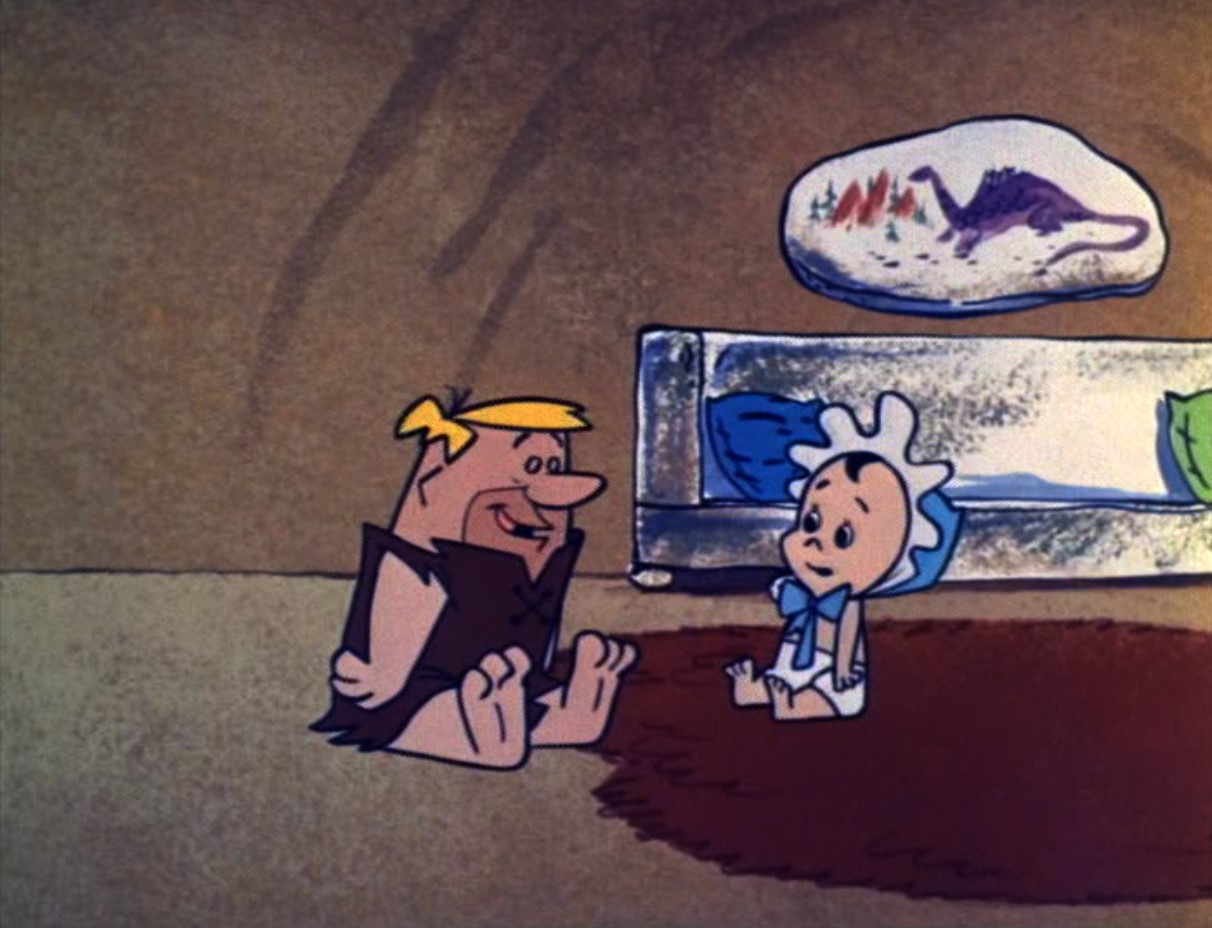
‘The Surprise’ is the first episode in what was to become the first continuum in television animation. The show starts with Betty pushing a baby carriage. The carriage contains little Marblehead, her nephew.
Barney completely falls for the baby, and even forsakes the last game of the bowling tournament, making his team lose. Fred, of course, is not amused, and throughout the episode expresses a disliking of babies. Of course, he softens up as time progresses, and then Wilma indeed has some surprising news.
The whole episode is more gentle and cute than genuinely funny, but Fred’s doubletake when Barney and Betty catch him entertaining little Marblehead is priceless. The episode is also noteworthy for Fred addressing the public directly at the end.
The stone age gags, meanwhile, are modest: a crab and a bird used as scissors, and a mammoth as a water hose. None of these animals speaks, which spares us some lame gags.
Watch an excerpt from ‘The Surprise’ yourself and tell me what you think:
This is The Flintstones Season Three episode 19
To the previous The Flintstones episode: The Hero
To the next Flintstones episode: Mother-in-Law’s Visit
‘The Surprise’ is available on the Blu-Ray ‘The Flintstones – The Complete Series’ and the DVD-box ‘The Flintstones Season 3’
Directors: William Hanna & Joseph Barbera
Airing date: November 9, 1962
Stars: The Flintstones
Rating: ★★★
Review:

After ‘The Little Stranger’ ‘Baby Barney’ is the second Flintstones episode trying out Fred’s attitude to fatherhood, anticipating the great continuity later in the series.
This time Fred’s fatherhood is triggered by the coming of a rich uncle Tex, whom he promised a ‘little Tex’. It’s the unfortunate Barney who has to pose as the improbable baby. This accounts for a lot of slapstick, but in the end it’s Fred acting like a father for the first time that stays most. Stone age gags, meanwhile, are rare, as I can only mention a lawnmower dinosaur.
Watch an excerpt from ‘Baby Barney’ yourself and tell me what you think:
This is The Flintstones Season Three episode 9
To the previous The Flintstones episode: The Little Stranger
To the next Flintstones episode: Hawaiian Escapade
‘Baby Barney’ is available on the Blu-Ray ‘The Flintstones – The Complete Series’ and the DVD-box ‘The Flintstones Season 3’
Directors: William Hanna & Joseph Barbera
Airing date: November 2, 1962
Stars: The Flintstones
Rating: ★★★
Review:
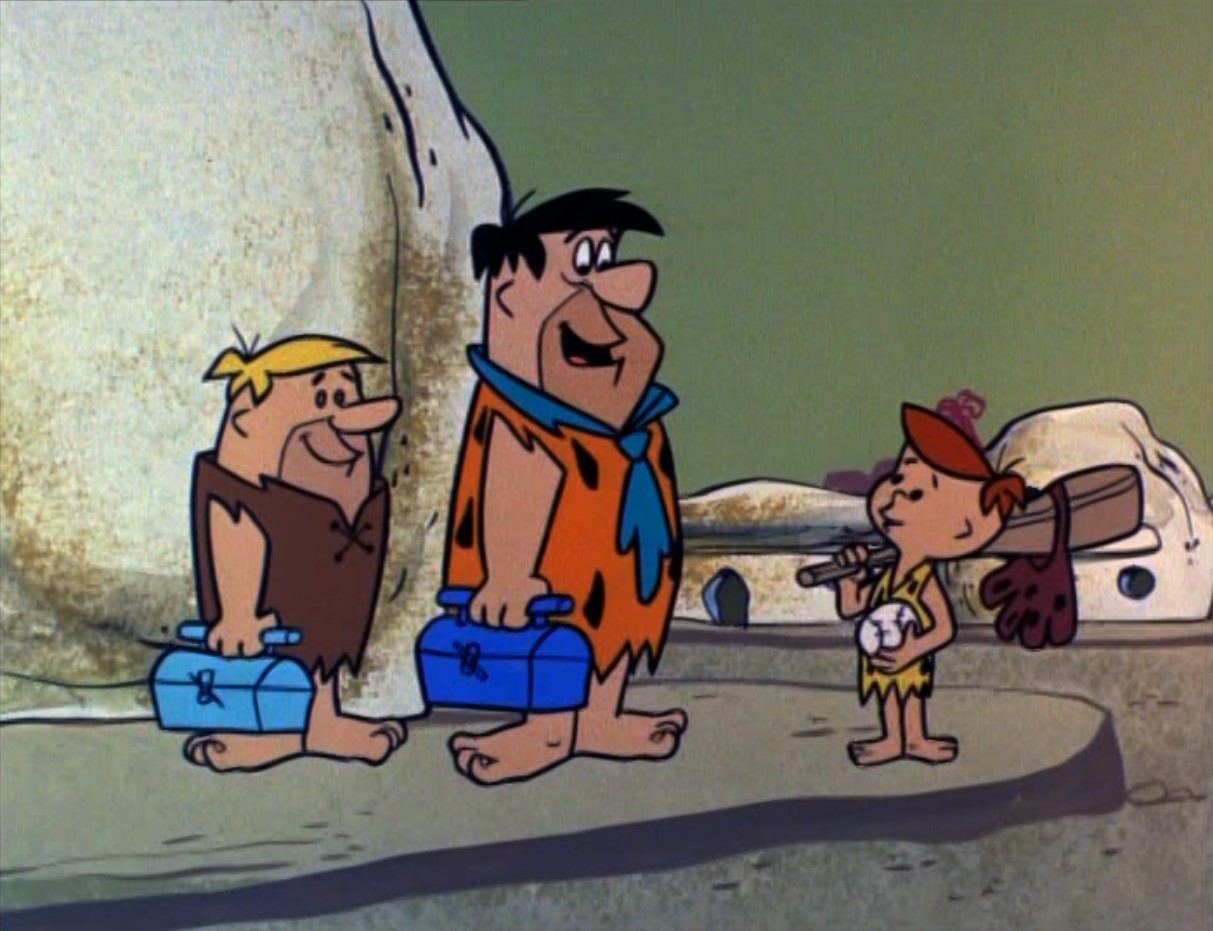
‘The Little Stranger’ starts with a Fred so grumpy Wilma sends him to a doctor to get examined. On the way Fred and Barney repeatedly meet a paper delivering little boy called Arnold, who gets the better of Fred each time. However, we have to wait until the 11th minute before the story really begins.
As with some of the best Flintstones episodes ‘The Little Stranger’ is a comedy of errors, and it is a delight to watch Fred’s sweet side, as well as him running back and forth when he thinks Wilma is expecting a little baby any minute. The best sight gag however, is when the doctor makes Fred inhale and exhale, a breath so powerful it moves Barney, who’s reading on a chair, through the office.
‘The Little Stranger’ feels like a prequel to the continuous story of the Flintstones getting a baby, which makes the third season so unique. It’s the first episode in which the baby idea comes up, and Fred’s reaction indeed is inviting to make the character deal with the real thing.
The stone age gags, meanwhile, are modest, and include a dish washing pelican, the now almost regular mammoth vacuum cleaner, and a bizarre bag-crocodile. Notice that for once, one of the windows is glass-covered, to get a gag with Arnold along.
Watch an excerpt from ‘The Little Stranger’ yourself and tell me what you think:
This is The Flintstones Season Three episode 8
To the previous The Flintstones episode: The Buffalo Convention
To the next Flintstones episode: Baby Barney
‘The Little Stranger’ is available on the Blu-Ray ‘The Flintstones – The Complete Series’ and the DVD-box ‘The Flintstones Season 3’
Director: Mamoru Hosoda
Release date: May 16, 2018
Rating: ★★★
Review:

‘Mirai’ was the third feature film Mamoru Hosoda made for his own studio, Studio Chizu. Hosoda favors rather episodic films about growing up, and ‘Mirai’ is no exception, although the film takes place in a much smaller time frame than ‘Wolf Children’ or ‘The Boy and the Beast’.
Main protagonist of the film is ca. four-year-old boy Kun, who lives in a design house in Yokohama (the town is depicted regularly during the film in swooping bird-eye’s view shots), but more importantly, who gets a baby sister, the Mirai from the title. Mirai also means future, and in fact, the Japanese title is ‘Mirai no Mirai’, or ‘Mirai from the future’. Indeed, Kun meets an older version of his younger sister from the future, as well as some other characters, while he struggles to adapt to the new situation he finds himself in.
Because with the coming of little Mirai a lot changes for the young boy: his parents have less attention for him, focusing more on the new baby, they’re more often tired and crabby, and they struggle with combining working and caring, now there are two children around. Needless to say, Kun has a hard time getting adjusted, and even gets jealous of his innocent baby sister.
The film focuses on some key scenes, in which Kun experiences a setback, at least in his own mind, and then something magical happens in the little courtyard of his house. First the little boy first meets a humanized form of the family dog, and then his younger sister in older form (there’s more, but I won’t spoil it here).
Unfortunately, Hosoda doesn’t stick to the boy-sister relationship, and at some point, the magic scenes also help Kun overcome his fears. Moreover, a four-year-old is a difficult and questionable protagonist of a film that wants to show the hero’s progress. After all, he is just a little boy. It’s little surprising that Hosoda spends considerable time on Kun’s parents, and their development during this crucial part of their lives. And, indeed, to be frank, Hosoda’s honest depiction of the hardships of young parenthood and of raising one’s own children is much more interesting than Kun’s ‘development’ of character.
Main attraction of the film are the five magical scenes, with the first two showing some broad comedy, as the man-dog and Mirai from the future roam around the house. The third and fourth start to feel obligatory, even though the fourth has a nice nostalgic feel to it. But with the fifth, Hosoda goes completely overboard, and one wonders why these nightmarish scenes, taking the film to a altogether other atmosphere, were even necessary. In fact, this finale, in which Hosoda wants to tell us something about family ties, is too overtly self-explanatory and spoils a film that wasn’t perfect to start with.
In fact, ‘Mirai’ drags a little, being mostly confined to the small space of Kun’s house and with Kun’s development of character as an important, but very weak story device. The film’s episodic nature doesn’t really help, spreading the story thin, a problem that also invades ‘Wolf Children’ and ‘The Boy and the Beast’. I wish Hosoda was able to keep his use of time as tight as his use of space in this movie. ‘Mirai’ is not a failure, the film is too original for that, but it’s arguably Hosoda’s weakest feature film so far, never reaching the emotional heights of either ‘Wolf Children’, ‘The Boy and the Beast’ or even his debut film, ‘The Girl Who Leapt Through Time’ from 2006.
Watch the trailer for ‘Mirai’ yourself and tell me what you think:
‘Mirai’ is available on Blu-Ray and DVD
Directors: Patrick Imbert & Benjamin Renner
Release date: June 15, 2017
Rating: ★★★★★
Review:
One of the more pleasant developments of the 21st century was the coming of animated feature films, the whole purpose of which was to make people laugh. One could say this trend started off with the successful ‘South Park, Bigger, Longer & Uncut’ (1999), and like that film these films were mostly off-shoots from series (‘The Simpsons Movie’ and the Spongebob Squarepants movies from 2004, 2015 and 2021) or offshoots from other films (‘Minions’ from 2015, ‘The Lego Batman Movie’ from 2017).
But occasionally, a film comes to you, which is both very funny, and totally original, even if it’s based on an earlier comic strip, like the Franco-Belgian feature ‘Le grand méchant renard et autres contes…’. The film is co-directed by Benjamin Renner, one of the producers of the attractive, if flawed ‘Ernest et Célèstine’ from 2012, and the original author of the comic strip, ‘Le grand méchant renard et autres contes…’. . Both comic strip and movie aim for the laughs, and are highly successful at it, too.
The film is advertised as a children’s film, and it certainly is fit for all ages, but don’t let this fool you. There’s nothing childish about this film. Instead, we get high quality cartoon comedy, perfectly animated and perfectly timed.
Based on three separate stories, ‘Le grand méchant renard et autres contes…’ is an anthology film, bridged by the idea of a play performed by the main characters. As soon as the first tale starts, the backdrop changes into the scenery in which all three stories take place: a farm in the countryside.
In the first film a stork talks a pig, a duck, and a rabbit into delivering a baby for him to his parents. Unfortunately, the baby must be delivered in faraway Avignon, and sadly for the pig both the duck and the rabbit are as incapable as they are optimistic. This tale is chockfull of cartoon slapstick, as the duck and the rabbit keep on thinking more and more outlandish schemes to deliver the baby, while the pig desperately tries to keep the little one safe.
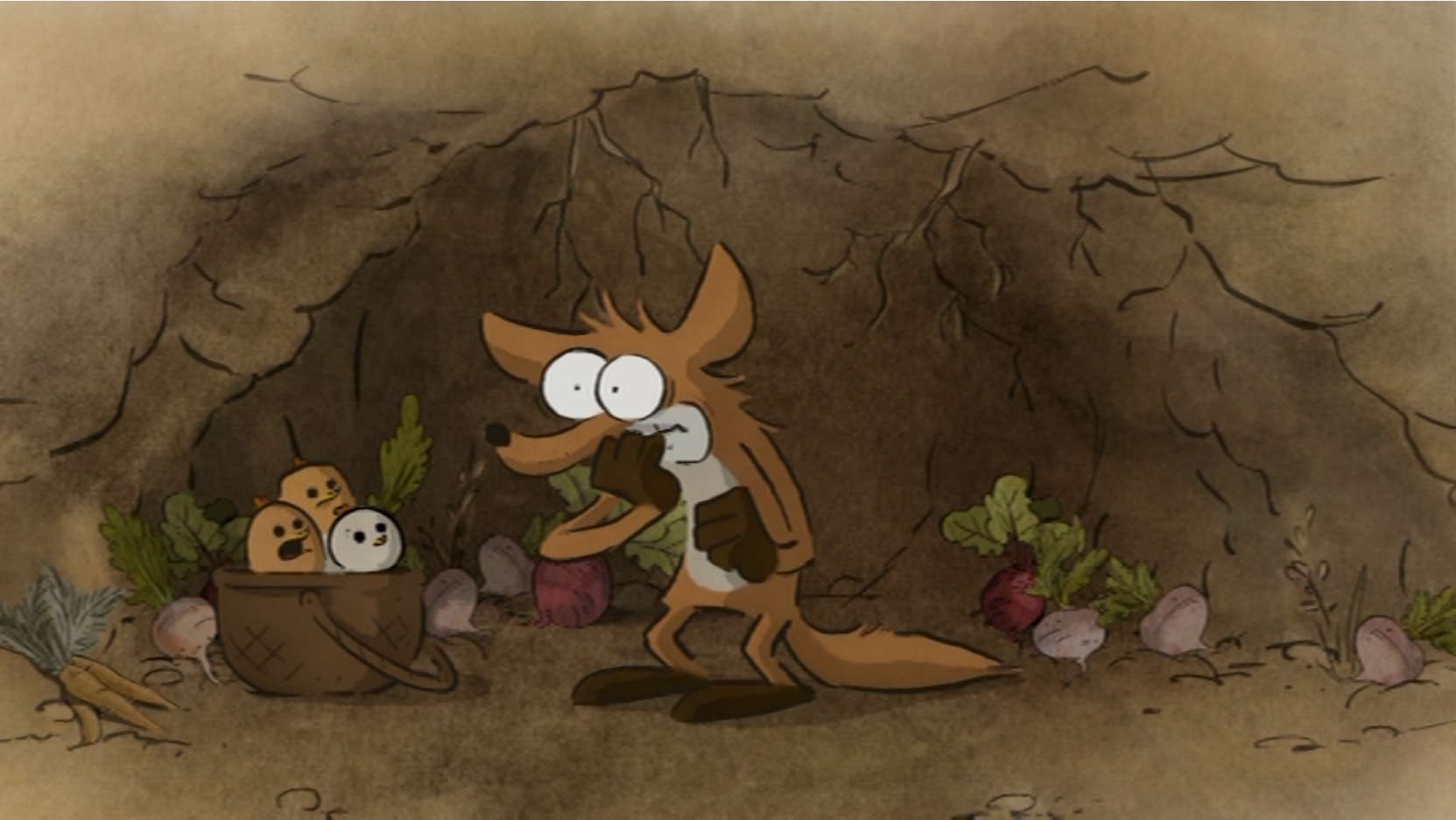
The next story is a little cuter and involves a totally inept fox who teams up with a lazy and selfish wolf. The wolf talks the fox into stealing some eggs to raise them into fat chickens, but of course the fox grows attached to the little ones. Nevertheless, this tale, too, moves and shifts into surprising directions, and is less straightforward than this summary.
The third and final story is a genuine Christmas story, which sees the happy return of the pig, duck, and rabbit trio of the first part. This time, duck and rabbit think they’ve killed Father Christmas, and make resolutions to deliver the presents themselves… General mayhem is ensured.
The film uses a very charming drawing style, which like the earlier ‘Ernest et Célèstine’ consists of watercolor backgrounds and fake watercolor-coloring of characters, open lines and appealing character designs, which more or less fit in a long and diverse Franco-Belgian cartoon style tradition. The film is continuously pleasant to look at, and the attractive score, by Robert Marcel Lepage, adds to the film’s charm, as well. Scored for a small ensemble, Lepage makes excellent use of some familiar themes, like the morning theme from Giachino Rossini’s Overture ‘William Tell’, the wolf theme from Sergei Prokofiev’s ‘Peter and the Wolf’, and in the last story, ‘Jingle Bells’.
In all, ‘Le grand méchant renard et autres contes…’ once again shows that France is one of the most interesting animation film-producing countries around. Recommended to all.
Watch the trailer for Le grand méchant renard et autres contes… (The Big Bad Fox and Other Tales) yourself and tell me what you think:
Le grand méchant renard et autres contes… (The Big Bad Fox and Other Tales) is available on Blu-Ray and DVD
Directors: Fabrice Joubert & Brian Lynch
Release Date: December 8, 2015
Rating: ★★½
Review:

‘Binky Nelson Unpacified’ is the third of three shorts accompanying the Minions feature on its DVD release. Unlike the other two, this short doesn’t star any Minion at all, but focuses instead on the criminal Nelson family the Minions encounter in their feature film.
The short starts with the Nelson just having robbed a museum and returning home. Unfortunately, they’ve left baby Binky’s pacifier at the museum, and the parents tell Binky he has to live with it. But that night, Binky returns to the museum to look for the pacifier, after all.
The best scenes of this comedy short stem from baby Binky’s Mission Impossible-like heist, all done with baby stuff, like diapers, talk powder, and a mobile. Unfortunately, ‘Binky Nelson Unpacified’ is also the most talkative of the three, and Binky’s co-star is a remarkably unfunny night guard with a cowboy hat. Binky quickly gets rid of this night guard, and the film could very well without him.
Watch ‘Binky Nelson Unpacified’ yourself and tell me what you think:
‘Binky Nelson Unpacified’ is available on the Blu-Ray and DVD of ‘Minions’
Directors: Didier Ah-Koon & Régis Schuller
Release Date: December 8, 2015
Rating: ★
Review:

‘Cro Minion’ is the first of three bonus shorts available on the Minions DVD. From their own feature length film we had learned that Minions always have been around, thus ‘Cro Minion’ is set in prehistorical times.
Two minions have eaten the last bananas, so a prehistoric man has to go hunting a large bull he sees in the distance, while the minions have to watch his baby. The baby has a strong will of his own, however, giving the two minions a hard time.
The short is full of wordless slapstick that never becomes really funny, despite all the antics. Also featured is a totally out of place Pterosaur, whose inclusion makes the short a completely backward affair. Not only are the Pterosaur and early man 66 million years apart in time, the Pterosaur looks like a 1950s horror monster, instead of the real thing. The Illumination animators should update their prehistorical knowledge. ‘Cro Minion’ of course is an unpretentious comedy short, but still.
Watch ‘Cro Minion’ yourself and tell me what you think:
‘Cro Minion’ is available on the Blu-Ray and DVD of ‘Minions’
Directors: William Hanna & Joseph Barbera
Airing Date: November 11, 1960
Stars: The Flintstones
Rating: ★

This episode starts with Barney getting tickets to a big fight in town.
Meanwhile, their wives promise one Edna Boulder to make Fred and Barney babysit her little son Egbert, so they can go to the bridge tournament together. So, Fred and Barney stay home to watch the fight on television. Unfortunately, their area is blackened out (the replacement is a recital by Alice Blue Jean and her Magic Banjo), thus Fred decides to watch it at Joe Rockhead’s place, who lives outside the blackened era.
Yet, Joe is not home, and in the least convincing of the story twists, Fred busts in Joe’s door to watch the fight anyway. In another unlikely event little Egbert puts his clothes on Joe’s pooch (a little brontosaur), which promptly jumps out of the window, making Fred and Barney think it’s the baby.
The story of this episode rambles, to say the least, and contains an Irish policeman trope. Worse, the designs of the characters are pretty weird. Fred’s design in particular is very inconsistent and off model. On the upside, there’s a nice primitive elevator, and a bird functioning as a car horn. This bird is the first animal talking to the camera, a Flintstones trope that would occur throughout the series.
This is Flintstones Season One Episode 7
To the previous Flintstones episode: The Monster from the Tarpits
To the next Flintstones episode: At the Races
‘The Baby Sitters’ is available on the DVD-set ‘The Flintstones: The Complete First Season’
Directors: William Hanna & Joseph Barbera
Release Date: August 1, 1958
Stars: Tom & Jerry
Rating: ★★½
Review:

‘Tot Watchers’ was the very last Tom & Jerry cartoon directed by William Hanna and Joseph Barbera.
The short was released in August 1958, but it had already been made in 1956, before MGM closed its animation studio in April 1957. Surprisingly this short was penned by Homer Brightman, instead of Hanna & Barbera themselves.
The cartoon stars a teen-age babysitter who, instead of watching the baby, is hanging on the telephone all the time. It’s up to Tom & Jerry to rescue the baby time and time again, especially when the baby wanders off to a building site. The building site sequence harks back to similar cartoons taking place there, like the Popeye cartoon ‘A Dream Walking’ (1934), the Mickey Mouse cartoon ‘Clock Cleaners’ (1937) and the Bugs Bunny cartoon ‘Homeless Hare‘ (1950).
The baby looks like a Chuck Jones character. Like Jones’ Minah Bird the infant is almost a force of nature, devoid of personality, but with a drive of its own. Unfortunately there’s no conflict between Tom & Jerry themselves in this cartoon (apart from the very beginning), thus ‘Tot Watchers’ lacks the duo’s traditional comedy. Moreover, the short is hampered by the babysitter’s extensive dialogue. In all, this makes ‘Tot Watchers’ a rather disappointing ending to the series.
The short marks Spike’s last screen appearance, who has a very short scene in this cartoon, and only as a cliche bulldog. Tom and Jerry, however, would return to the silver screen, in 1961, with an ill-conceived new series, produced by Gene Deitch’s animation studio in Czechoslovakia. Meanwhile Hanna and Barbera would start a television adventure, founding their now legendary Hanna-Barbera production company in July 1957, and producing television series starring such beloved characters as Huckleberry Hound, Yogi Bear, and the Flintstones, to name just a few.
Watch ‘Tot Watchers’ yourself and tell me what you think:
This is Tom & Jerry cartoon No. 113
To the previous Tom & Jerry cartoon: Robin Hoodwinked
To the next Tom & Jerry cartoon: Switchin’ Kitten
‘Tot Watchers’ is available on the European DVD Box set ‘Tom and Jerry Collection’
Director: Émile Cohl
Release Date: July 27, 1913
Rating: ★
Review:
 ‘He Poses for his Portrait’ is the second of only two surviving Newlyweds cartoons Émile Cohl made in the United States.
Like ‘Zozor ruine la réputation de sa famille‘ the film is based on the comic strip by George McManus, and the film is essentially an animated comic strip, with text balloons playing the most important part in telling the story.
In ‘He Poses for his Portrait’ a couple wants to have a picture painted of their little baby. Unfortunately, the brat drives the painter mad. As in ‘Zozor ruine la réputation de sa famille’ there’s hardly any animation, resulting in a pretty static and remarkably boring film. By all means, Cohl’s animated comic strips should be regarded as a failure, and belong to the weakest films in his enormous output, despite their success at the time. If anything, the series demonstrated that one needed little animation to please an audience, a message which several studios would take at heart in the decades afterwards.
Watch ‘He Poses for his Portrait’ yourself and tell me what you think:
‘He Poses for his Portrait’ is available on the DVDs ‘Émile Cohl – L’agitateur aux mille images’
Director: Clyde Geronimi
Release Date: October 10, 1939
Stars: Donald Duck, Pete
Rating: ★★½
Review:
 ‘Officer Duck’ is the first of nine cartoons co-starring Donald Duck and Pete.
Pete, who in this short is called Tiny Tom and who has a golden tooth, had been a great adversary to the courageous Mickey Mouse, and he also was a strong opponent to Donald Duck. However, he was dropped after 1944, as Donald Duck director Jack Hannah preferred smaller adversaries, making Donald Duck more of a straight man to bees, bugs and chipmunks.
In ‘Officer Duck’ Donald is a policeman ordered to arrest Tiny Tom (ergo Pete). He does so by pretending to be a baby, bringing out Pete’s previously unknown soft side. Apart from being rather unlikely, the comedy also suffers from milking this one idea – in a 1940s Warner Bros. cartoon the baby trick would have been only one of several schemes.
Watch ‘Officer Duck’ yourself and tell me what you think:
This is Donald Duck cartoon no. 14
To the previous Donald Duck cartoon: The Autograph Hound
To the next Donald Duck cartoon: The Riveter
‘Officer Duck’ is available on the DVD set ‘The Chronological Donald Volume 1’
Directors: Frank Sherman & George Rufle
Release Date: May 26, 1933
Stars: Tom and Jerry
Rating: ★
Review:
 ‘In the Park’ takes place in a park, literally.
The short opens with Tom and Jerry reading the newspaper on a park bench. Somewhere else, a policeman seduces a sexy babysitter. Of course, the baby escapes, following a plot all too similar to the Fleischer Screen Song ‘Let Me Call You Sweetheart‘ (1932). Tom and Jerry more or less adopt the little brat, going at lengths in trying to comfort the little kid. In the end the baby is restored to its baby-sitter, and the cop kisses its behind. The cartoon ends with Tom and Jerry laughing at the policeman.
There’s little to enjoy in the rather run-of-the-mill ‘In the Park’, except for Gene Rodemich’s lively score. The designs are remarkably heterogeneous: the baby-sitter is remarkably well-drawn, Tom, Jerry and the policeman have generic early 1930’s designs, while the brat seems stuck in the 1920’s era.
Watch ‘In the Park’ yourself and tell me what you think:
This is Tom & Jerry cartoon No. 24
To the previous Tom & Jerry cartoon: Hook & Ladder Hokum
To the next Tom & Jerry cartoon: Doughnuts
‘In the Park’ is available on the DVD ‘The Complete Animated Adventures of Van Beuren Studio’s Tom and Jerry’
Directors: Frank Sherman & George Stallings
Release Date: March 31, 1933
Stars: Tom and Jerry
Rating: ★★★
Review:
 ‘Puzzled Pals’ opens with a stork trying to deliver his baby, but finding every home hostile to him.
The bird finally manages to drop the baby at Tom & Jerry’s doorstep. They take the baby in, but he turns out to be a tough brat, kicking everybody’s face in, and being a complete nuisance, while Tom and Jerry try to solve a jig-saw puzzle. At one point the brat gets hold of a giant vacuum cleaner, sucking almost everything in the house, including the clothes on Jerry’s tattoo, until Tom saves the day. In the end the stork incomprehensibly returns and takes the baby away.
Vacuum cleaners were still a luxury in the 1930’s, and this cartoon may contain the first animated gags on this domestic device.
Watch ‘Puzzled Pals’ yourself and tell me what you think:
This is Tom & Jerry cartoon No. 22
To the previous Tom & Jerry cartoon: Happy Hoboes
To the next Tom & Jerry cartoon: Hook & Ladder Hokum
‘Puzzled Pals’ is available on the DVD ‘The Complete Animated Adventures of Van Beuren Studio’s Tom and Jerry’
Director: unknown
Release Date: November 26, 1932
Stars: Flip the Frog
Rating: ★★★
Review:
 ‘Nurse Maid’ is a typical cartoon from the Great Depression era, depicting small jobs and poverty.
The short starts very well with Flip as a newspaper boy facing a lot of bad luck destroying his trade. Broke, he sits down on the street to worry. Luckily a woman offers him a dollar if he minds her big-nosed baby. The rest of the cartoon is devoted to Flip’s troubles with the baby, which start immediately when the baby swallows the coin. Thus Flip conjures an unhealthy plan to retrieve it from the baby’s mouth with a fishing rod (!). While Flip sets out to get one, the baby swallows a potion which makes the little fellow strong…
Like ‘The Goal Rush‘, ‘Nurse Maid’ is as gag rich as it is unfunny. Luckily, Carl Stalling’s music is very inspired, following the action so closely that most of the tunes are reduced to snippets (for example, when during a chase a Scotchman is encountered, Stalling inserts a few bars of a Scottish tune before resuming the chase music). In fact, the cartoon is recommended for Stalling’s music only, which is a marvel to listen to.
Watch ‘Nurse Maid’ yourself and tell me what you think:
This is Flip the Frog cartoon No. 30
To the previous Flip the Frog cartoon: The Music Lesson
To the next Flip the Frog cartoon: Funny Face
‘Nurse Maid’ is available on the DVD ‘Cartoons That Time Forgot – The Ub Iwerks Collection Vol. 2’
Director: Dave Fleischer
Release Date: May 20, 1932
Stars: Ethel Merman, Betty Boop, Bimbo
Rating: ★
Review:
 ‘Let Me Call You Sweetheart’ is a Screen Song featuring Ethel Merman singing the 1911 hit song.
The cartoon opens with Betty Boop being a baby sitter in a park where Bimbo is a park warden. Bimbo doesn’t try to hide his lust, panting in front of our female hero. To be with Betty, Bimbo kicks off the baby-carriage. The baby falls into the water, steals a hot dog and plays with a fountain. When he returns to the loving couple, it’s night already. Enter Ethel Merman. At the end cartoon there’s some strange sequence with a chicken hatching three eggs, and the chicks being followed by a cat.
Unfortunately, this scene cannot rescue the short, and the cartoon remains completely forgettable.
Watch ‘Let me Call you Sweetheart’ yourself and tell me what you think:
‘Let me Call you Sweetheart’ is available on the French DVD Box Set ‘Betty Boop Coffret Collector’
Director: Dave Fleischer
Release Date: October 10, 1931
Stars: Betty Boop, Bimbo
Rating: ★★½
Review:
 Betty Boop, who lives in an apartment across the street, invites Bimbo over, but he can’t come, because he has to attend his little baby brother Aloysius.
Nevertheless, he does abandon the mischievous little brat and goes to Betty’s house to skip rope. However, Aloysius sucks them back into his own house, using a particularly powerful vacuum cleaner.
Aloysius is seen smoking a cigar and reading the paper, not unlike Baby Herman in ‘Who Framed Roger Rabbit‘ (1988). The cartoon establishes Bimbo and Betty as lovers, but it doesn’t make much sense, and its gags feel random and misguided.
‘Minding the Baby’ was the last cartoon featuring Betty with dog ears. in her next cartoon ‘Mask-A-Raid‘ she became fully human.
Watch ‘Minding the Baby’ yourself and tell me what you think:
This is Talkartoon No. 25
To the previous Talkartoon: Bimbo’s Express
To the next Talkartoon: In the Shade of the Old Apple Sauce
‘Minding the Baby’ is available on the French DVD Box Set ‘Betty Boop Coffret Collector’
Director: John Lasseter
Release Date: August 1988
Rating: ★★★★½
Review:
 After ‘Luxo Jr.‘ ‘Tin Toy’ is the most important of the early Pixar shorts.
Not only did it win an Academy Award, being the first computer animated film to do so, it was also the source of inspiration to the first computer animated feature length film, ‘Toy Story‘ (1995). Like ‘Toy Story’ it explores the idea of toys being alive.
The short focuses on a little tin one man band toy, who encounters a monstrous baby, much to its dismay. The baby, indeed, looks terribly ugly. It’s an early attempt at the human form, and although it’s animated surprisingly well, it’s not really a success. Being a giant monster in the eyes of the toy, however, the ugly design does succeed. So, although ‘Tin Toy’ demonstrates it was maybe a little too early for the human form, its brave attempt showed the way for much more to come.
Apart from that, it’s a splendid little story, much more elaborate than Pixar’s earlier two films, and perfect in its execution. An excellent example is the scene in which the tin toy flees under the couch, only to discover numerous other toys hiding in fear. This scene is a masterstroke, as it perfectly explains how toys get hidden away far under couches and beds, like they somehow do in real life.
In the short time span the tin toy goes from emotions of hopeful anticipation to dismay and fear, turning into surprise, pity and finally proud stubborness. These emotions are completely convincing and prove that computer animation was perfectly able to tell a moving story. Now the company’s fulfilling of their dream of an animated feature would not be far away anymore.
Watch ‘Tin Toy’ yourself and tell me what you think:
Director: Dave Fleischer
Release Date: July 3, 1942
Stars: Popeye, Olive Oyl, Li’l Swee’Pea
Rating: ★★★★½
Review:
 ‘Baby Wants a Bottleship’ opens with Olive visiting Popeye, whose battleship is stationed at the harbor.
Olive has brought li’l Swee’Pea with her. The baby wants to have a battleship en climbs aboard the cruiser. Popeye has a hard time catching him again.
The result is a cartoon of great comedy and excellent timing. The action includes a musical number in which Popeye is clobbered by a canon. Like in the previous Popeye cartoon, ‘Many Tanks’, Popeye’s design switches between old and new.
Watch ‘Baby wants a Bottleship’ yourself and tell me what you think:
This Popeye film No. 108
To the previous Popeye film: Many Tanks
To the next Popeye film: You’re a Sap, Mr. Jap
Directors: William Hanna & Joseph Barbera
Release Date: December 25, 1943
Stars: Tom & Jerry, Meathead
Rating: ★★★★★
Review:
 A little girl makes Tom behave like a baby.
Tom only reluctantly cooperates, until he discovers the milk bottle. Jerry mocks him and warns three alley cats of Tom’s baby behavior. They mock him too, all too more violently, which leads to a frantic samba finale in which the little cat does a great Carmen Miranda impersonation, singing her hit song ‘Mamãe eu quero’ from the film ‘Down Argentine Way’ (1940).
Tom’s friends, the red cat from ‘Sufferin’ Cats‘, Meathead (in his debut) and a little cat, would reunite only seven years later in ‘Saturday Evening Puss‘ (1950). Apart from the finale the greatest scene is when Jerry behaves like ‘she’ is caught naked in the bathroom of a doll house.
Watch ‘Baby Puss’ yourself and tell me what you think:
This is Tom & Jerry cartoon No.11
To the previous Tom & Jerry cartoon: Yankee Doodle Mouse
To the next Tom & Jerry cartoon: Zoot Cat


 Dr. Grob's Animation Review