
You are currently browsing the tag archive for the ‘island’ tag.
Director: Piet Kroon
Release date: October 13, 2018
Rating: ★★
Review:

The Dutch animated feature film industry long consisted of one movie only, ‘Als je begrijpt wat ik bedoel’ (The Dragon That Wasn’t (Or Was He?)) from 1983. But in recent years several other films saw the light, mostly directed at youngsters: ‘Nijntje de film’ (Miffy the Movie) from 2013 , ‘Pim & Pom: Het Grote Avontuur’ and ‘Trippel Trappel – Dierensinterklaas’, which are both from 2014, and more recently ‘Knor’ (‘Oink’) from 2022 and ‘Vos en haas redden het bos’ from 2024. An oddball within this recent canon is ‘Heinz’ from 2018.
‘Heinz’ was a comic strip by René Windig and Eddie de Jong that run in Dutch newspapers from 1987 to 2000 and again from 2004 to 2006. The comic strip was about a cat, Heinz, who quickly got more anthropomorphized until he became a sort of everyman. The strip knew some continuities but remained first and foremost a gag strip. Nevertheless, the authors dreamt of an animation film at least since the early 2000s.
Although film studio Zig Zag film started working on a film already in 2002, Windig’s and De Jong’s dream never amounted to anything. That is, until the project got new backing and new support from veteran animator Piet Kroon in 2015.
Piet Kroon had ample experience in America, having directed the animation for ‘Osmosis Jones’ (2001) and having worked on stories for a wide variety of animated feature films, e.g. ‘The Iron Giant’ (1999), ‘The Tale of Despereaux’ (2008), ‘Rio’ (2011) and ‘Ferdinand’ (2017). Kroon wrote a completely new story for the film, and with this much of the charm of the original comic strip got lost, and I doubt whether Windig and De Jong are pleased with the end result.
The first aspect of the original comic strip that went out of the window was its family-friendly nature, despite being produced by Burny Bos, who produced some of the best Dutch live action children’s movies. The feature film is clearly directed to adults and has little to offer for younger audiences (in the Netherlands the film is advised for 12 years and older, that says enough). The second major change Kroon made was the setting. The original comic strip takes place in an undefined fantasy Netherlands, but the movie Heinz clearly lives in the center of Amsterdam, which incidentally is also the residence of the comic strip’s two authors.
A more profound and more disturbing change than these two is the change of character of the cat himself. In the comic strip Heinz certainly is cranky, and sometimes insufferable, but in the movie, he is a downright irresponsible drunkard and deadbeat. In fact, in the early scenes the cat is so unsympathetic one wonders why he must watch the cat’s immature antics in the first place. Heinz’s voice by Ruben van der Meer, on the other hand, is well-chosen.
Heinz’s girlfriend Dolly fares little better, as she has changed from a sweet love to a working-class shrew, while Heinz’s friend Frits is nastier and more unsympathetic than his comic book counterpart. Frits also suffers from a bad voice choice (Reinder van der Naalt). In fact, one must look hard for any sympathetic character in the film…
Kroon certainly has tried to put as many characters from the original comic strip as possible into the film, and thus the movie is simply crowded with characters, who mostly make little to no sense to anyone not familiar with the source material. These characters and the rather random inclusion of some gags from the original comic strip make the film too much of an inside joke. On the other hand, the story itself is entertaining enough: it involves time travel, takes Heinz to a remote volcano island and to New York, where he must battle an evil scientist from outer space. But the unsympathetic leads, the plethora of characters, and the random, and often repeated gags make the film a tiresome watch.
The film’s stylistic choices don’t help. The background art is pretty ugly and consists of reworked photo material against which the characters don’t read very well. The ocean is even live action footage. Again, with this method much of the original charm of the comic strip gets lost. The computer animation is a mixed bag. There are a lot of animation cycles, and especially the numerous background characters walk around like automatons with little to no life in them.
No doubt, these technical drawbacks result from an all too tight budget, as it’s a marvel that the film came about in the first place. Most charming are the depictions of Heinz’s fantasies, which consist of traditional animation of René Windig’s idiosyncratic drawings. It’s too bad only these little sequences were made this way.
In all, ‘Heinz’ is a disappointing movie that will attract small audiences, neither satisfying fans of the original comic strip nor anyone else. I cannot find any figures, but I am pretty sure the movie turned out to be a box office flop, and I regret to say unsurprisingly so.
Watch the Dutch trailer for ‘Heinz’ yourself and tell me what you think:
‘Heinz’ is available on DVD (Dutch only)
Director: Wes Anderson
Release date: February 15, 2018
Rating: ★★★★★
Review:
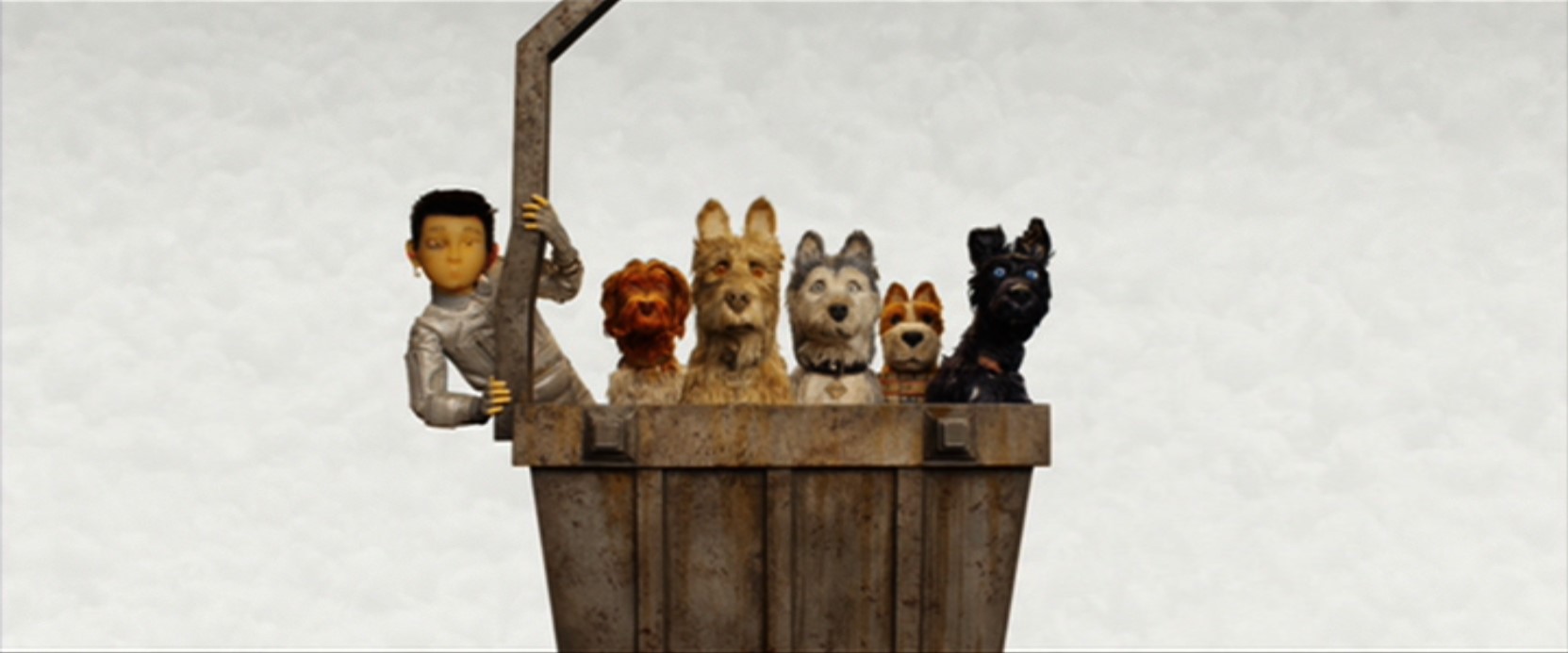
The 21st century saw a few live action directors and film makers crossing over to animation, often with original films that were welcome deviations from the standard family fare of Pixar, Dreamworks, Sony, Illumination and the like. One of these directors was Wes Anderson, whose live action films already have a very distinct flavor, let alone his animation work.
In 2009 Wes Anderson brought us ‘Fantastic Mr. Fox’, his own quirky take of the classic children’s book by Roald Dahl, adding some ‘The Royal Tenenbaums’-like flavor to it. It seemed a one off, like all other animation adventures by live action directors, but in 2018 Wes Anderson surprised everyone by making yet another animation movie, this time with a completely original story of his own.
‘Isle of Dogs’ is a sort of fantasy-dystopia film set in Japan. Surprisingly, much of the dialogue is in Japanese, and not always translated, adding to the film’s idiosyncrasy. The film tells about the cat-loving Kobayashi clan who wants to get rid of all the dogs. When a Kobayashi mayor gets into power in the fictive town of Megasaki, he banishes all dogs to a garbage dump island…
The film knows quite a lot human characters, but uses mostly a dog-viewpoint and is even narrated by a dog (voiced by Courtney B. Vance). The film focuses on a stray dog called Chief, whose life changes when a young boy arrives on the island, looking for his own former pet, Spots.
Where all other film makers would make the boy and the dogs be able to talk with each other, Anderson keeps their languages strictly separated, with the dogs not getting a thing the boy says, and vice versa. As the boy speaks Japanese, we, the audience, too, cannot always follow what the boy tries to say – a bold move.
The dog communication is all in English, and Anderson makes use of a lot of familiar names to voice his animated creatures, like Edward Norton, Jeff Goldblum, Bill Murray and Scarlett Johansson, just to name a few. Even Yoko Ono has a small role as a scientist of the same name.
Like ‘Fantastic Mr. Fox’ ‘Isle of Dogs’ is a stop motion film, and a very virtuoso one, too. The animation, directed by Mark Waring, is superb throughout and there are crowd scenes with tens to hundreds of puppets, and both dog and human characters are very intricately designed. Like in Anderson’s first animated film, all animals have a rather scruffy look, giving the film a very individual look. There are some typical quirks in the animation, like dogs sneezing at random moments. I also like Anderson’s use of cartoony fight clouds. As far as I know he’s the first to use those in a stop-motion film.
As with his other films Anderson employs a very typical use of the camera, often showing symmetrical images, and sometimes using close ups in a rather Spaghetti Western-like fashion. There’s also a little 2D animation to depict events on television. The background art, too, is unique. Apart from elaborate sets, the film uses rather flat background art, with a typical cut-out look. The quasi-Japanese score by Alexandre Desplat, an Anderson favorite, adds to the film’s unique atmosphere.
The film’s story says something about populism, and how misleading information can lead to unjust decisions, but the film is too silly to emphasize this point. Likewise, the film’s heart lies with Chief, but much more interesting than his development are the dry dialogues, and the running gag of one dog hearing a rumor the others never heard of. In fact, apart from the film’s looks, the dialogues form the film’s main attraction, as they are often very funny.
Unfortunately, the film’s finale is not the best part, and the defeat of the villains a little too easy, but otherwise ‘Isle of Dogs’ is a real treat, and with its unique style a very welcome diversion from the often run-of-the-mill fare of American studio animation.
Watch the trailer for ‘Isle of Dogs’ yourself and tell me what you think:
‘Isle of Dogs’ is available on Blu-Ray and DVD
Director: Fyodor Khitruk
Release date: 1973
Rating: ★★★★
Review:
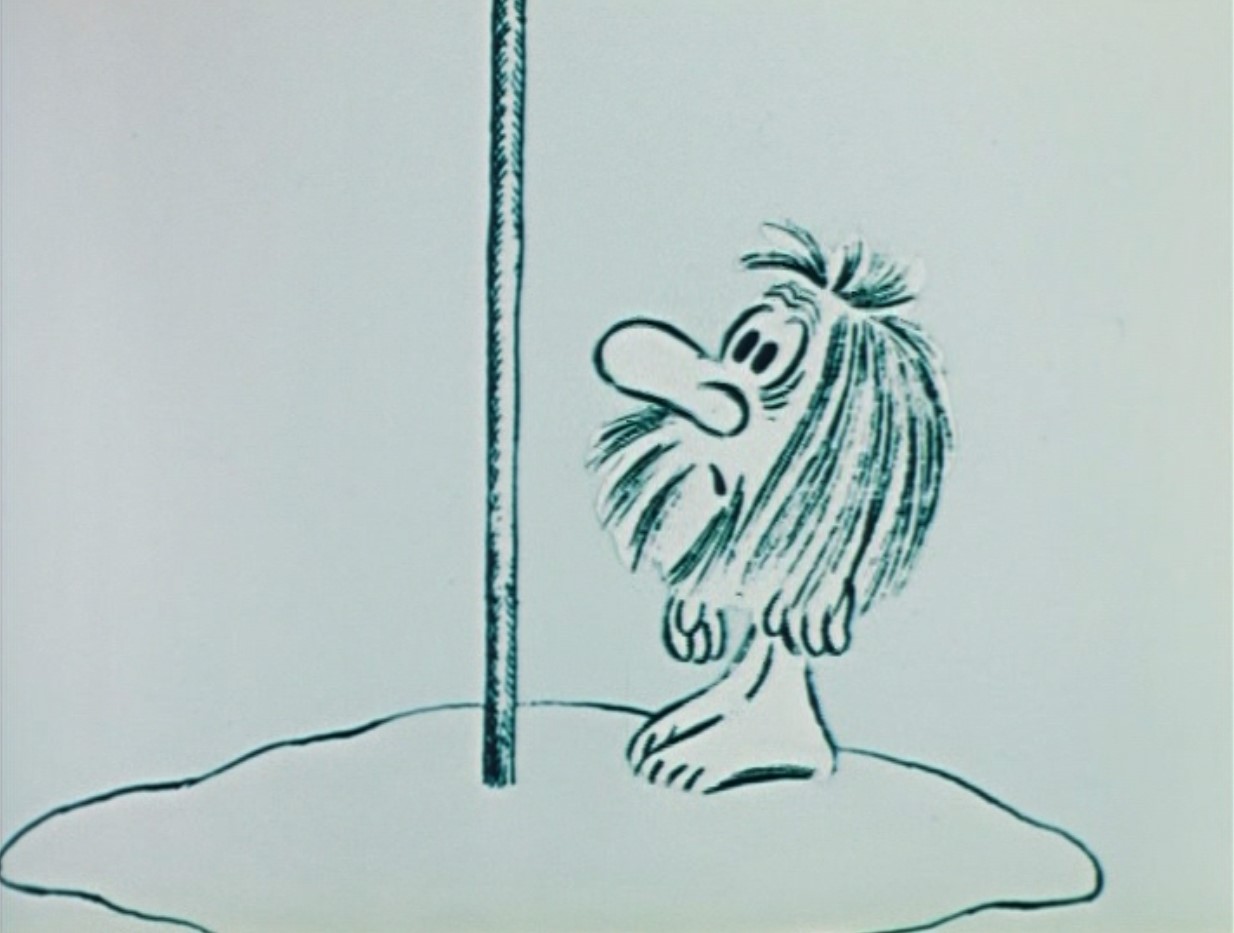
‘The Island’ is a short gag film in which a bearded castaway is stranded on a tiny island.
Khitruk explores this traditional cartoon setting, and brings it into new directions. The man longs to be rescued, but nobody helps him, though the ocean turns out to be very crowded, indeed. In fact, in the end, the man is far worse off than he was in the beginning.
Khitruk’s cell animation is effective, his designs are charming, and his timing is excellent. But the film is more than just a mere series of gags, as Khitruk satirizes man’s aggression, greed, emptiness and folly. It’s signifying that the only person helping the main protagonist, is one who has even less than the castaway he helps. Thus ‘Island’ is more than just a little gag film, it’s a humorous essay on the human condition, and it’s not an optimistic one.
Watch ‘The Island’ yourself and tell me what you think:
‘The Island’ is available on the DVD ‘Masters of Russian Animation Volume 2’
Director: Hiroyuki Okiura
Release date: September 10, 2011
Rating: ★★★★★
Review:
To me the Japanese Production I.G. studio is a company hard to grasp what it’s about. Since 1987 the studio produces television series, OVAs, feature films, video games and even music. With its vast production quantity seems more important than quality, and production more important than vision or style. For example, of its fifty plus feature films only a very few created a stir in the West, and these are as diverse as ‘Ghost in the Shell’ (1995), ‘Jin-Roh: The Wolf Brigade’ (2000), ‘Giovanni’s Island’ (2014) and ‘Miss Hokusai’ (2015).
Of all these ‘A Letter to Momo’ comes closest to an author film. The film was conceived, written and directed by Hiroyuki Okiura, after he had directed the widely acclaimed ‘Jin-Roh: The Wolf Brigade’. The whole film took a staggering seven years to make, but the amount of work visibly pays off, because ‘A Letter to Momo’ can be placed among the best films ever to come out of Japan, being on the same level as the best from Ghibli, Momaru Hosoda or Makoto Shinkai. It’s therefore highly incomprehensible that the film remains Okiura’s only own creation.
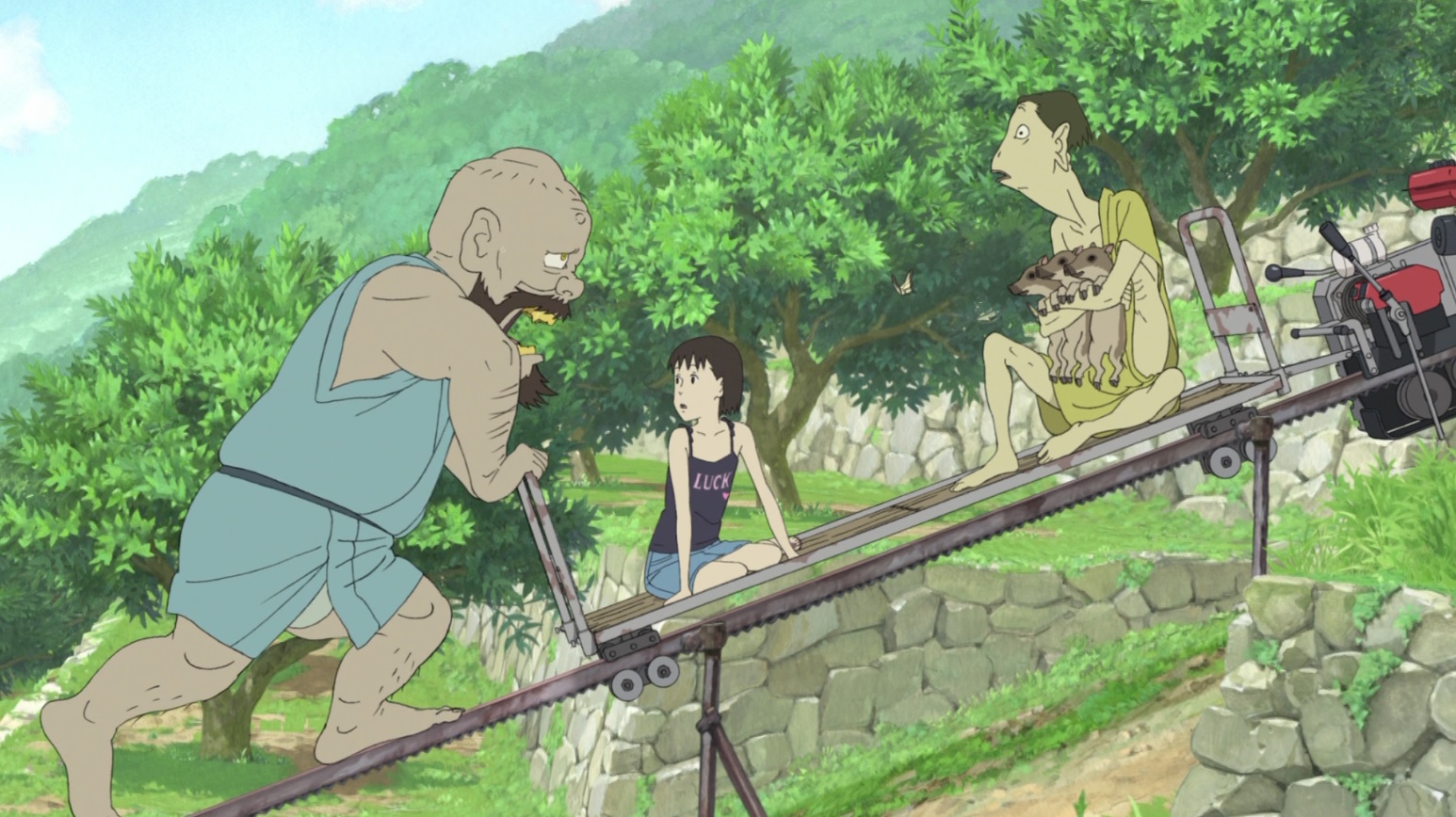
‘A Letter to Momo’ takes place in one hot summer on the island, and tells about Momo, an eleven year old girl whose father has unexpectedly died, and who moves with her mother Ikuko from buzzling Tokyo to the place of her mother’s roots: a quiet rural town on the remote Osaki Shimojima island, somewhere Southeast of Hiroshima in the Seto inland sea. Both events are clearly traumatic experiences to the young teenager, who remains shy, stubborn, withdrawn, and taciturn, despite her mother’s efforts to befriend her with the local children, who surely are willing enough to let her join their group. These early scenes are shown on a leisurely speed, depicting Momo’s boredom, isolation, and loneliness very well.
But things get worse, Momo’s new home turns out to be haunted: there are voices in the attic, and some vague creature seems to follow her mom when she’s off to work. Soon, a trio of goblins manifest themselves to the young girl, and she has a hard time getting used to their presence. During the movie she must learn to live with them, and she finally figures out why they are there in the first place.
The fantasy sequences with the three dimwitted goblins are fun, but throughout the movie Momo’s emotions remain central to the story, especially the loss Momo experiences after her father’s death, her relationship with her mother, who’s also grief-stricken, and her slow opening to the island children. A recurring metaphor of Momo’s transition from being shy, miserable, and scared to a teenager capable of enjoying life once again is shown in a few swimming scenes, in which the island children jump from a high bridge into the sea.
The human drama and the fantasy finally come together in a breathtaking finale when a typhoon visits the island. This sequence is the most Ghibli-like of the whole film. This is the dramatic highlight of a film that otherwise remains modest in how it tells its sweet and moving tale.
The looks of ‘A Letter to Momo’ are no less than gorgeous. The film boasts a rather unique style, with a very high level of realism. The drawings are exceptional for their surprisingly attractive and very thin line work, and the animation, supervised by Masashi Ando, is no less than excellent. Especially, the command of the human form is breathtaking. It apparently took four years to animate the complete film, but every animation drawing of Momo and her mother is a beauty to look at, and absolutely conveys a wide range of emotions and expressions, rarely resorting to anime cliches, if ever. For example, it’s startling to watch someone cough as realistically as Ikuko does in this film. ‘A Letter to Momo’ is also one of those rare Japanese animation film in which the characters actually do look Japanese, with black hair, porcelain to yellow-brown skins and eyes of more realistic proportions than usually encountered in anime.
The background art, supervised by Hiroshi Ôno (who previously worked on ‘Kiki’s Delivery Service’) is gorgeous, too. It does not deviate from artwork of other Japanese animation films, but again, its level of realism is staggering. The documentary on the Blu-Ray I have of this film shows pictures of the real thing, and the film makers have captured the island of Osaki Shimojima astonishingly well. Moreover, they’ve managed to do so, while keeping the background paintings very attractive and always in service of the animated action. There’s a small dose of computer animation, which always remains modest and functional (a boat, a fan, some moving background art), and which doesn’t disrupt the graphic quality of the film.
In all, ‘A Letter to Momo’ is a heart-warming tale on loss and grief, very well made and one of the most gorgeous animation films to come out of Japan to look at. Highly recommended.
Watch the trailer for ‘A Letter to Momo’ yourself and tell me what you think:
‘A Letter to Momo’ is available on Blu-Ray and DVD
Director: John Eng
Airing Date: June 29, 1996
Stars: Duckman
Rating: ★
Review:

In ‘The Amazing Colossal Duckman’ Duckman grows taller each time he has a temper…
It’s hard to say anything positive about this episode, which feels not only uninspired, but even desperate in trying to squeeze some sort of story out of the Duckman character. How one now longs to the deeper and more complex character depictions of season one and two! I’m baffled that after episodes as this series got even another season…
But luckily, the next and last episode turns out to be a much more interesting affair.
Watch ‘The Amazing Colossal Duckman’ yourself and tell me what you think:
This is Duckman episode no. 41
To the previous Duckman episode: The Longest Weekend
To the next Duckman episode: Cock Tales for Four
‘The Amazing Colossal Duckman’ is available on the DVD-box ‘Duckman – The Complete Series’
Directors: The Blackheart Gang
Release Date: March 2006
Rating: ★★½
Review:
 ‘The Tale of How’ is a tale about birds trapped on an island by a large sea monster, but rescued by a mouse.
In this short the Blackheart Gang has used a mix of 2D and 3D computer techniques to make a film that is baroque in its complexity of images and intricate designs. The combination of weird surrealism and quasi-medieval ornamentation give the film its unique atmosphere. Unfortunately, the film’s story is less compelling than the images: the tale is sung in an all too uninteresting quasi-operatic style and very hard to follow, indeed.
Watch ‘The Tale of How’ yourself and tell me what you think:
‘The Tale of How’ is available on the French DVD box set ‘Annecy – Le coffret du 50e anniversaire’
Director: George Pal
Release Date: June 27, 1941
Rating: ★★★½
Review:
 Jim Darcy, the main protagonist in ‘Hoola Boola’, must be the most relaxed castaway in animated history.
In the opening scene we watch him sailing on a series of rafts from his stranded ship, relaxing in his chair, and listening to the radio. Almost immediately he hits an island, where his house builds itself. Soon he meets a native woman called Sarong-Sarong, and the two fall in love instantly. Then a canoe full of cannibals appear, capturing Jim. However, with help of some magic Sarong-Sarong rescues our hero, reuniting the two lovers.
‘Hoola Boola’ is a wonderful example of George Pal’s art, if not among his best films. One can marvel at the lovely decors, the bright colors, the cinematic staging and clever lighting. Yet, the facial expressions of the sailor and Sarong-Sarong are poor and primitive, and, of course, the story is drenched in cliches, with its castaway-meets-noble savage-and-cannibals story. Even Sarong-Sarong’s rescue is a cliche, with the black cannibals fleeing in terror, all too easily. On the other hand, Sarong-Sarong manages to summon five goblins out of nowhere to chase the cannibals away. I’d be scared of them, too…
‘Hoola Boola’ is available on the Blu-Ray ‘The Puppetoon Movie’
Director: Norman McCabe
Release Date: October 11, 1941
Stars: Porky Pig
Rating: ★★★½
Review:
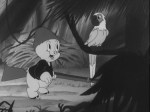 When Tex Avery left Warner Bros., Bob Clampett took over his animation unit. To fill in Clampett’s gap, Norman McCabe was promoted to director.
McCabe had joined the Harman-Ising studio in 1932 as an inbetweener. By 1941 he had become Bob Clampett’s star animator. He had even co-directed two cartoons with Bob Clampett, ‘Timid Toreador’ (1940) and ‘Porky’s Snooze Reel’ (1941).
As a solo director McCabe only made eleven Looney Tunes, all in black and white. And thus, McCabe sadly remains the least known Warner Bros. director from the classic era. This is a pity, because ‘Robinson Crusoe jr.’ , McCabe’s first cartoon, shows that he had fully absorbed his former master’s style, and that he could deliver a fast and funny film.
In ‘Robinson Crusoe, jr.’ Porky Pig plays the starring part. As soon as he’s stranded on the island, he’s awaited by Friday, who carries a sign saying ‘Welcome, Robinson Crusoe’ and who says to Porky in a Southern accent: “Hello Boss, What kept yuh?“. Later we watch Friday singing ‘The Java Jive’, which had been a huge hit for the Ink Spots in 1940.
Most of the cartoon consists of silly spot gags, and is quite entertaining, even if quite a lot of the humor is time-bound. The short ends when Porky encounters a tribe of cannibals, and flees with Friday on a motor boat he has carved out of a log within seconds.
Note that the character Friday is one of those standard representations of the black servant of the period, with his Southern accent. Nevertheless, in this film Friday is neither dumb, nor lazy, fearful, superstitious or overtly dependent on his white benefactor, all character traits normally given to black characters in cartoons. Neither is he given the horrible ape-like mannerisms found in ‘Mickey’s Man Friday‘ (1935). With his huge lips, Friday may be a heavy caricature, he still is one of the more enlightened black representations of the era. The cannibals, on the other hand, are the standard cliche racist fare.
Watch ‘Robinson Crusoe, jr.’ yourself and tell me what you think:
This is Porky Pig cartoon no. 92
To the previous Porky Pig cartoon: Notes to You
To the next Porky Pig cartoon: Porky’s Pooch
‘Robinson Crusoe, jr.’ is available on the DVD-set ‘Porky Pig 101’ and on the Thunderbean DVD ‘Uncensored Animation 2: Cannibals!’
Director: Dave Fleischer
Release Date: March 22, 1940
Stars: Popeye, Olive Oyl, Bluto
Rating: ★★★★
Review:
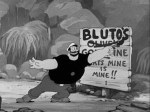 ‘Stealin’ Ain’t Honest’ opens with Popeye and Olive sailing to Olive’s ‘secret gold mine’ on a small island. Bluto is after the gold, too, and soon a fight develops inside the mine.
‘Stealin’ Ain’t Honest’ is a cartoon of delightful nonsense. For example, Olive’s secret gold mine is advertised with arrows on the sea surface, and by a giant neon billboard. The fight itself produces all kinds of gold products from the mine, including coins, and a golden boxing glove. Bluto is a genuine villain in this cartoon and not a mere rival. Unfortunately, his design is very inconsistent, unlike that of Popeye and Olive.
Watch ‘Stealin’ Ain’t Honest’ yourself and tell me what you think:
This Popeye film No. 78
To the previous Popeye film: Females Is Fickle
To the next Popeye film: Me Feelins Is Hurt
‘Stealin’ Ain’t Honest’ is available on the DVD set ‘Popeye the Sailor Volume Two’
Director: Dave Fleischer
Release Date: February 17, 1933
Stars: Betty Boop, Bimbo, Koko
Rating: ★★★★
Review:
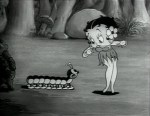 In ‘Is My Palm Read’ Bimbo is a fortune-teller, assisted by Koko the Clown.
Betty drops by to see her future told. Bimbo first sees in his crystal ball Betty as a naked baby, and second as being shipwrecked and washed ashore an island. There she sings ‘All by myself’, only to attract a bunch of evil ghosts. Luckily, he Bimbo himself is there to rescue her, but as soon as he has revealed himself, the ghosts appear out of the crystal ball to chase the duo once again (Koko is completely forgotten at this stage).
‘Is My Palm Read’ is one of the Betty Boop cartoons strongly exploiting her erotic character. For example, when Betty enters the room, Bimbo and Koko use special lighting to see her legs right through her elegant dress. On the island we see Betty undressing and catch her briefly in her underwear, although she remains scantily clothed in a sexy tropical costume throughout the island scenes. The result is an erotic and surrealistic cartoon, which doesn’t make much sense, but which is over before you know it.
Watch ‘Is My Palm Read’ yourself and tell me what you think:
This is Betty Boop cartoon No. 11
To the previous Betty Boop cartoon: Betty Boop’s Crazy Inventions
To the next Betty Boop cartoon: Betty Boop’s Penthouse
‘Is My Palm Read’ is available on the French DVD Box Set ‘Betty Boop Coffret Collector’
Director: Dave Fleischer
Release Date: September 23, 1932
Stars: Betty Boop, Bimbo
Rating: ★★★★★
Review:
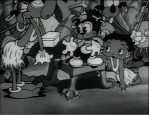 This cartoon features a soundtrack by the Hawaii band ‘The Royal Samoans’, giving the cartoon a lively Hawaii score.
The short starts with Bimbo crashing on an island on a boat, into Betty Boop’s arms. A waterfall throws them into a spot full of singing trees, and later they’re confronted with a bunch of cannibals. Bimbo disguises himself as ‘black’ using mud, and starts singing the Hawaiian war chant. Thus he becomes the natives’ king. The cannibals perform for him, and Betty, too, who dances an extraordinarily sexy hula dance only dressed in a skirt and a flower garland. Unfortunately, the rain washes off Bimbo’s disguise and the two have to flee in a boat.
The movements of the dancing natives and Betty are rotoscoped from the Royal Samoans, rendering them very convincing and lifelike, indeed. Betty Boop’s hula dance is arguably her best scene ever. Apart from this, the cartoon is stuffed with throwaway gags showing the Fleischer’s typical brand of surrealism.
Watch ‘Betty Boop’s Bamboo Isle’ yourself and tell me what you think:
This is Betty Boop cartoon No. 4
To the previous Betty Boop cartoon: Betty Boop , M.D.
To the next Betty Boop cartoon: Betty Boop’s Ups and Downs
‘Betty Boop’s Bamboo Isle’ is available on the French DVD Box Set ‘Betty Boop Coffret Collector’
Director: Jack Hannah
Release Date: April 8, 1949
Stars: Donald Duck, Bootle Beetle
Rating: ★
Review:
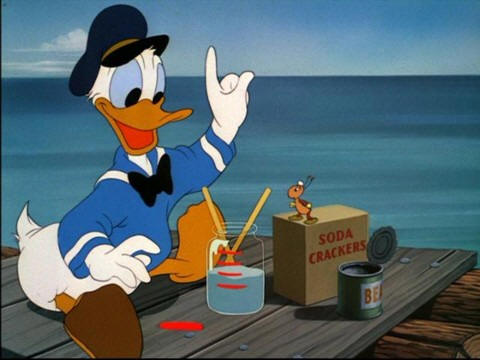 Bootle Beetle, introduced in ‘Bootle Beetle‘ from 1947, returns to tell us about his relationship with ‘the captain’, and old seafaring version of Donald Duck. He relates how he and ‘the captain’ were shipwrecked and stranded on a desert island.
Bootle Beetle never was a funny character, and this cartoon, too, suffers: Bootle beetle is simply too cute. Moreover, his relationship to Donald is never explained, nor the fact why Donald is suddenly a captain. To make things worse, the cartoon is painstakingly slow. For example, it contains a very long gag on a coconut, unfavorably reminiscent of the overlong gags of the earliest character animation-based cartoons of the mid-1930’s, like ‘Mickey Plays Papa‘ (1934) or ‘Moving Day‘ (1936).
Watch ‘Sea Salts’ yourself and tell me what you think:
This is Donald Duck cartoon No. 76
To the previous Donald Duck cartoon: Donald’s Happy Birthday
To the next Donald Duck cartoon: Winter Storage
Director: Paul Driessen
Release Date: 1985
Rating: ★★★★★
Review:
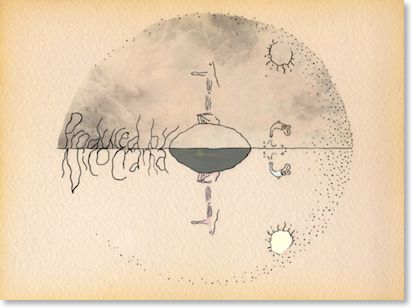 ‘Spiegeleiland’ is a short and stylized animation film, which uses one scene and one perspective only.
We watch a castaway on an island and his reflection. The castaway is visited by a female companion and rescued by a ship. Or is he? The reflection tells another tale…
This simple story is told without dialogue and with the greatest economy. Like ‘Ei om zeep’ (The Killing of an Egg’) and ‘Het treinhuisje’ (Home on the Rails) we watch a single tableau. In ‘Spiegeleiland’ Driessen takes this format even further, limiting his action to a circle with only a tiny island within.
The result is without doubt one of Driessen’s strongest and most poetic films. Driessen would reuse this method of parallel depiction of reality and fantasy to a great effect in the tragic ‘The Boy Who Saw the Iceberg’ from 2000.
Watch ‘Spiegeleiland’ yourself and tell me what you think:
‘Spiegeleiland’ is available on the DVD ‘The Dutch Films of Paul Driessen’
Director: William Hanna & Joseph Barbera
Release Date: July 7, 1951
Stars: Tom & Jerry
Rating: ★★
Review:
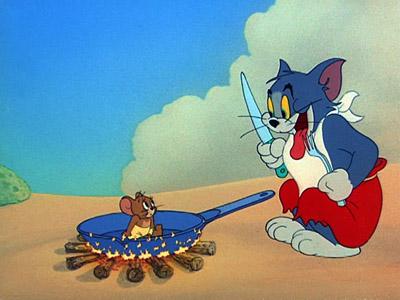 Somehow Tom is shipwrecked. He’s washed ashore a tropical island where he meets a Crusoe-like Jerry, whom he wants to eat.
In what must be the film’s highlight Jerry fools him by pretending to be a cannibalistic native, but in the end both characters have to flee for real cannibals, the first human beings we see in their entirety in a Tom & Jerry film
‘His Mouse Friday’ must be one of the least inspired Tom & Jerry cartoons ever. Not only are the two completely out of place on the tropical island, the comedy feels tired, the humor is offensive, and the designs of our heroes mediocre. Tom’s designs in the opening scene are particularly sloppy. It seems that these designs inspired the Gene Deitch cartoons, because they look remarkably similar, which is no advertisement.
Unfortunately, ‘His Mouse Friday’ is no isolated incident. From mid-1951 on, we see the quality of the series gradually deteriorate: character designs get simpler and sloppier, backgrounds less lush, and stories more routine or uninspired. There were still some great Tom & Jerry cartoons to come, and even two Oscar winners, but one nonetheless gets the impression that by mid-1951 their heyday was over.
Watch ‘His Mouse Friday’ yourself and tell me what you think:
This is Tom & Jerry cartoon No. 59
To the previous Tom & Jerry cartoon: Sleepy Time Tom
To the next Tom & Jerry cartoon: Slicked-up Pup
Director: Dan Gordon
Release Date: April 26, 1943
Stars: Superman
Rating: ★★★★★
Review:
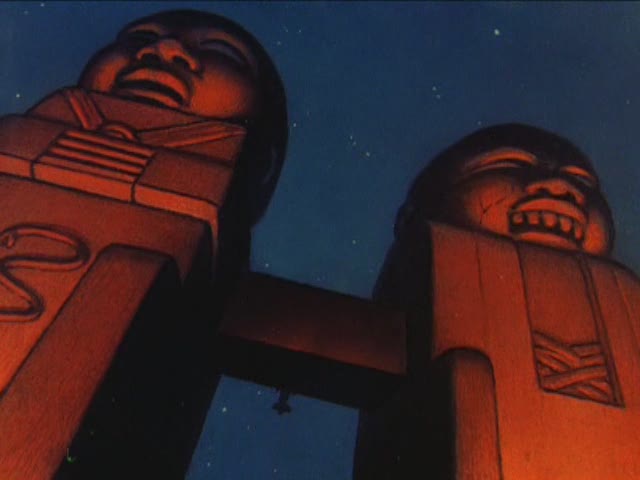 The Superman cartoon ‘Jungle Drums’ blends the war theme with the adventure setting of ‘The Mummy Strikes‘.
This time the setting is a vague African island, populated by scary natives who are under control of some mysterious Nazis. They shoot an American plane out of the sky, which contains Lois and some secrets concerning the American fleet. While the natives try to burn Lois, Clark Kent/Superman only arrives just in time to save her.
Superman beats the Nazis, while Lois warns the US Air Force against Nazi submarines threatening the fleet. The last shot is that of an angered Hitler listening to the radio how his plans were frustrated.
Although this short, like most Superman cartoons, contains a weak and badly built story, it stands out for its great shots of scary natives, with their original camera angles, stark color designs and large shadows. The end result is arguably Superman’s best film.
Watch ‘Jungle Drums’ yourself and tell me what you think:
This is Superman film No. 15
To the previous Superman film: The Mummy Strikes
To the next Superman film: Underground World


 Dr. Grob's Animation Review