You are currently browsing the tag archive for the ‘sex’ tag.
Director: Floor Adams
Release date: February 23, 2019
Rating: ★★★★
Review:
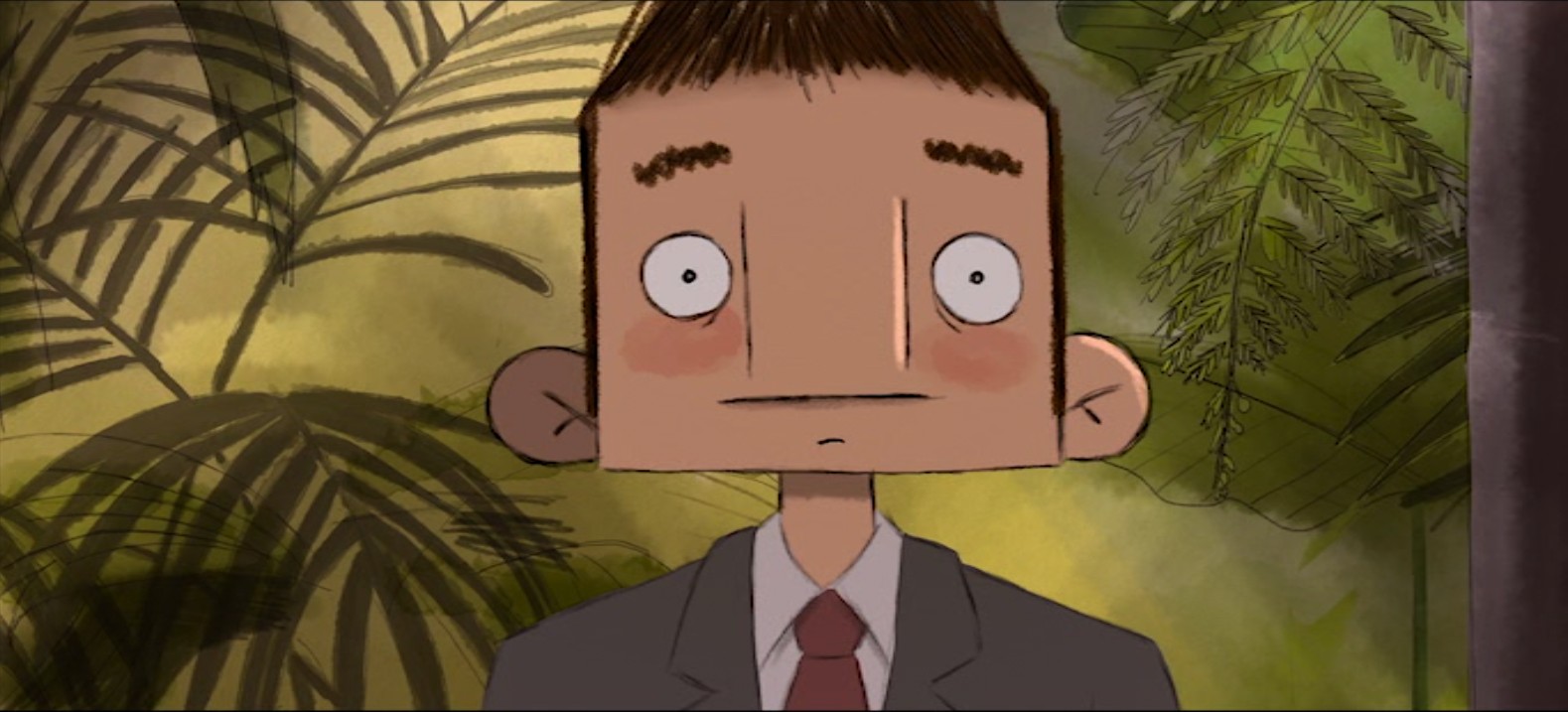
Christopher is a man on the autism spectrum, He loves his model Stuka dive bomber airplanes, but he has difficulties with social relationships. When is older brother invites him along to a party, a whole new adventure for him starts.
Christopher’s autism is shown by a homunculus inside his head who has to look up and memorize everything and thus easily gets an information overload, for example when too much is happening at the same time during the party. Christopher clearly is as sympathetic as he is social awkward, but I cannot help but admire the patience of his love interest Gwen, who has to suffer a lot through Christopher’s erratic behavior.
‘Mind My Mind’ is a nice insight in the mind of a person on the autism spectrum, but succeeds not entirely or convincingly in making the audience believe he can function easily in society.
The designs are pleasant, although I found the homunculus too sketchy a character. The animation meanwhile, is fair, and focuses on the characters’ emotions and relationships. Despite being a Dutch-Belgian co-production, the voices are in English, and thus the film can be enjoyed by a large audience.
Watch the trailer of ‘Mind My Mind’ yourself and tell me what you think:
‘Mind My Mind’ is available on DVD
Director: Eiichi Yamamoto
Release date: September 15, 1970
Rating: ★★½
Review:

The most important development in animation of the late 1960s and 1970s was the coming of animated feature films aimed at adults, instead of children/families. Heralding the new era was George Dunning’s 1968 film ‘Yellow Submarine’, but the two most important film makers pioneering in this new field were Ralph Bakshi in America (with e.g., ‘Fritz the Cat’ from 1972 and ‘Heavy Traffic’ from 1973) and Osamu Tezuka in Japan.
The three adult oriented anime films Tezuka made at his own Mushi Productions studio are called the Animerama trilogy and consist of ‘A Thousand and One Nights’ (1969), ‘Cleopatra’ (1970) and ‘Belladonna of Sadness’ (1973). The three show that Tezuka, like Bakshi, confuses adult oriented with a rather juvenile focus on sex and violence, making the films adult in content indeed, but otherwise rather immature and even exploitative products.
More than its adult orientation, ‘Cleopatra’ stands out for its highly eclectic style. The film tackles a variety of designs and animation styles, none weirder than the opening sequence, which takes place in the future year of 2001, and which starts live action actors with animated faces, an experiment luckily not repeated, for the results are pretty ridiculous, especially because there’s absolutely no lip synchronization, at all.
The film’s plot revolves around an alien planet called Pasatorine, which has a secret plan to wipe out mankind called ‘Cleopatra’. In order to find out the plans a trio of humans, naturally, goes back into time by “psycho-teleportation”, taking the souls of ancient characters in Cleopatra’s time.
Thus, the three main protagonists change identity: Jirov becomes Ionius, a powerful slave, Maria becomes Libya, an Egyptian city girl, and Hal turns into Lupa, a close companion of Cleopatra, who turns out to be a leopard, much to Hal’s chagrin. His character is the most annoying of the film, for the leopard is sex crazed and tries to get laid all the time, despite its animal features.
After ten minutes we’re in Egypt where Tezaku depicts the Roman conquest of the ancient kingdom in a very silly style, accompanied by some attractive space funk music. When we first see Libya, the adult orientation immediately becomes clear, for she’s bare breasted the whole time. The Egyptian plot is bizarre, too, with an ugly freckled girl changing into the sex goddess of Cleopatra with the sole reason to seduce Caesar and to kill him. Adding to the weirdness is the coloring, for Libya is rendered bright red, while Caesar is depicted as a green man.
Stylistically, the film is all over the place, anyhow, altering tiresome silliness and cheap rotoscoping with quite some beautiful graphic imagery, like the stylized fighting of the Romans and the Egyptian conspirators. The animation, too, is a mixed bag, from non-animation and cheating jump takes from pose to pose, without any animation in between, to far more interesting animation done in watercolors. The animation of the horse ride, and the struggle between Ionius and an Egyptian warrior are actually quite good, and even the first two sex scenes are interesting in their semi-abstract and even poetical stylization, while the third is depicted as a broken-down film. At one point the imagery reminds one of UPA or the Zagreb school, and at another point there’s even a cut-out sequence featuring variations on classic paintings.
What the film completely lacks, is character animation. Emotions are just indicated, not felt, and there’s only broad caricature, not character development. The potentially dramatic story is further hampered by random gags, often strange and out of place. Likewise, the story is sloppy and meandering, with the film makers having difficulty on whom to focus. For great chunks of screen time, the three protagonists from the opening sequence aren’t anywhere to be seen, and after the events in ancient Egypt have ended tragically (in that respect the film does follow Cleopatra’s real life), the film ends abruptly, leaving the viewer wondering why the whole ‘psycho-teleportic’ excursion, and thus most of the movie, was needed in the first place.
It must be said: ‘Cleopatra’ is not a good movie. It is more of an experiment than a success, more of a product of its time than a timeless movie, and rather a curio than an essential watch. It is a product of a more experimental era, but after watching the film, one can hardly wonder why this short age of adult oriented experimentalism stopped.
Watch the trailer for ‘Cleopatra’ yourself and tell me what you think:
‘Cleopatra’ has been released on Blu-Ray
Director: Ralph Bakshi
Release date: August 8, 1973
Rating: ★★
Review:
Ralph Bakshi arrived on the scene when American classic studio animation was in steady decline, reaching its low point in the 1970s and early 1980s. In this dry period, Bakshi tried to reinject classic animation with new energy, most notably by ripping it of its association with children. Now, in the golden age animation never had been solely associated with children, but due to the advent of the Saturday-morning cartoon in the mid-1960s American animation more and more became something just for kids.
Bakshi, on the other hand, saw the full potential of the medium, and enriched the animation world with several animated features aimed at adult audiences, thus bypassing the middle ground of the family film, which was Disney’s monopoly at the time, anyway. Thus, Bakshi is sometimes seen as the savior of animation during the medium’s dark ages, but I find it hard to subscribe to that opinion, and that’s because his films are sadly just not good.
Now, I will not talk about the abysmal ‘The Lord of the Rings’ (1977), which is a disgrace to the medium, but even ‘Heavy Traffic’, his supposed masterpiece, fails on several key features.
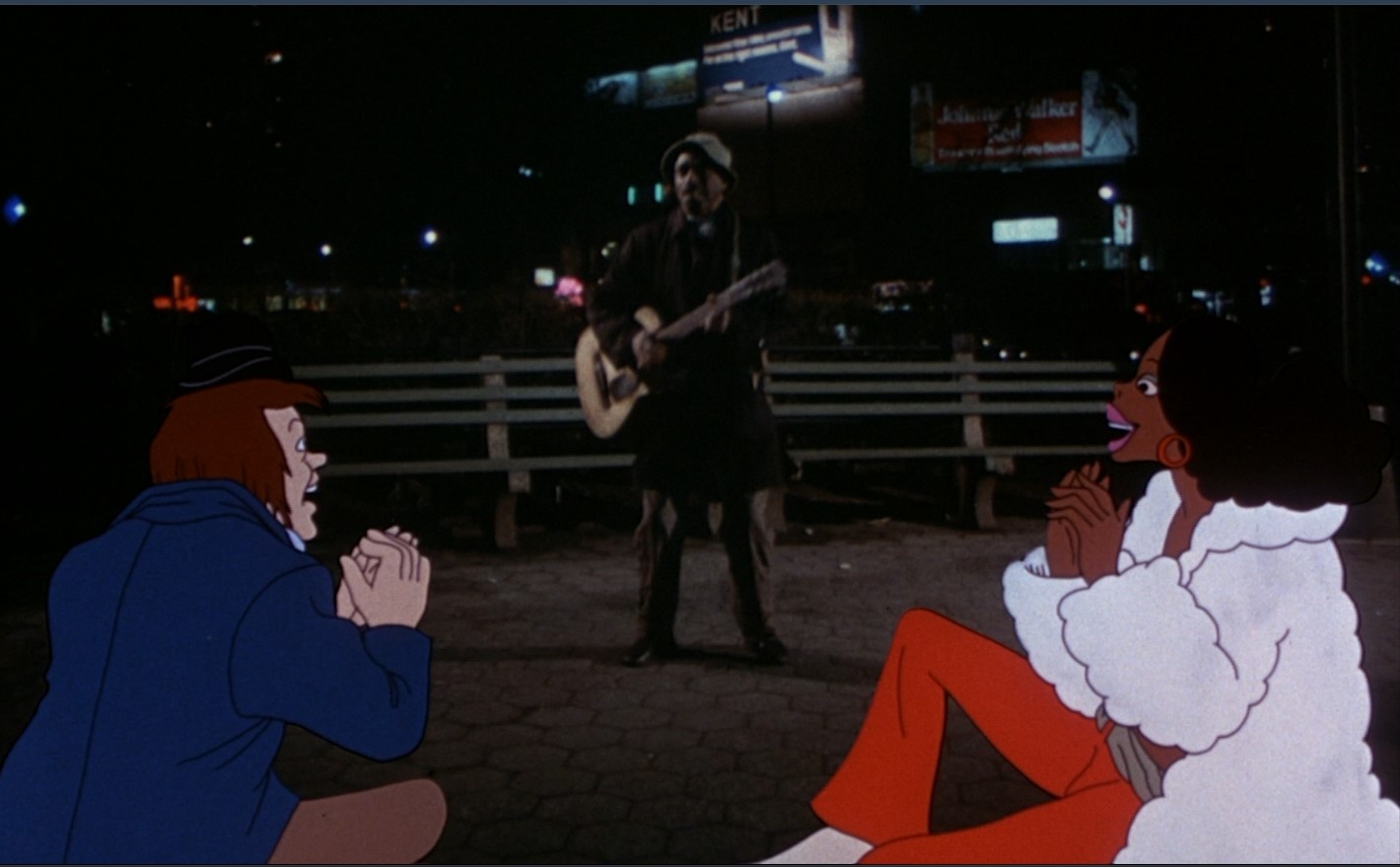
‘Heavy Traffic’ was written by Bakshi himself and has strong autobiographical elements. Set in New York the feature film tells of Michael Corleone, a young and aspiring underground cartoonist, who stills live with his quarreling parents (a Jewish mother and an Italian father), and who dates a black girl called Carole.
The film uses a voice over and the images of a pinball machine as bridging elements, but this cannot hide the fact that the film is a loose bag of scenes, and hardly goes anywhere. Sure, the film is depressing and draws a dark picture of the Big Apple, but its fourteen scenes have little to do with each other and are more about atmosphere than storytelling.
It certainly doesn’t help that none of the characters are remotely sympathetic. Even Michael himself, our supposed hero, is more of a self-centered jerk than anything else. For example, the comics he shows a publisher, wouldn’t interest anyone with a sane mind.
Worse, ‘Heavy Traffic’ falls for the misguided idea that making a film for an adult audience means it must contain sex and violence. ‘Heavy Traffic’ was not the first film to fall into this trap, and certainly not the last one (the unappealing ‘Sausage Party’ from 2016 comes to mind), but Bakshi clearly indulges in both, not only in this film, but also in ‘Fritz the Cat’ from the year before, ‘Wizards’ (1977) and ‘Cool World’ (1992), to name a few, which, to me, only proofs his immaturity. In ‘Heavy Traffic’, for example, bare breasts pop up from everywhere, with little other purpose than arousing the male audience.
Bakshi’s character designs are a mixed bag, sometimes reminiscent of the work of Mort Walker, as in the design of Michael’s father, at other times very cartoony, and reminiscent of DePatie-Freleng (e.g. the gay drag queen Snowflake), at other times quasi-realistic (Carole). Especially ill-conceived is Michael himself, whose quasi-realistic design is as mediocre as it is unappealing.
The background art too is a strange mix of drawings and photographs to a gritty effect. There are even some real live action footage elements from old films, like ‘Red Dust’ (1932) and ‘The Gang’s All Here’ (1943). In the end, the characters change into their live action counterparts, and suddenly one asks himself why this gritty film was not filmed in live action in the first place, as Bakshi’s animation adds surprisingly little.
Now, ‘Heavy Traffic’’s animator list features such illustrious names like Tom Ray, Carlo Vinci, Irv Spence, Manny Gould and Dave Tendlar, and it’s admirable that Bakshi kept these animation greats at work, but I doubt how many people watch ‘Heavy Traffic’ for its beautiful animation, for there’s hardly any. There’s manic animation, there’s outrageous animation, there’s fair animation, and there’s a lot of rotoscoping, but I’d prefer ‘Robin Hood’ from the same year anytime, even if that is the poorest of all classic Disney features.
For a supposed masterpiece, ‘Heavy Traffic’ feels like a sad affair, wasting a lot of animation talent on an egotistical document too heavy-handed for its own good, a film that is as depressing as it is boring and unappealing.
No, to me, Bakshi was more like the wrong guy at the right time: he could not save animation, for he lacked both the talent and the vision to do so. His films never transcend the dark ages, but are firmly rooted in them, and because of Bakshi’s limited view on what an adult film can be, the whole concept never really took off in the United States. This is an infinite pity, for this is one of the reasons we still must deal with the narrowminded view of animation being equal to family entertainment, today.
Watch the theatrical trailer for ‘Heavy Traffic yourself and tell me what you think:
‘Heavy Traffic’ is available on Blu-Ray and DVD
Director: Zlatko Plavinic
Release date: 1973
Rating: ★★
Review:

This is another very short gag cartoon from the Zagreb studio. In this short a man and a woman haggle for paid sex, or are they?
This cartoon features a monochrome ochre background, cartoonish designs, and dialogue in gibberish and loud nos. The single gag unfortunately is too lame for words.
‘Okay!’ is released on the DVD ‘The Best of Zagreb Film: Be Careful What You Wish For and The Classic Collection’
Director: Eiichi Yamamoto
Airing date: June 27, 1973
Rating: ★★★½
Review:
The late sixties and early seventies saw some striking experiments in the animated feature film. These films left the tried paths of family film and aimed at a more adult audience. In Europe Walerian Borowczyk arguably made the first experimental animated feature with ‘Théâtre de Monsieur & Madame Kabal (Theatre of Mr & Mrs Kabal)’ (1967), René Laloux made quite an impact with ‘La planète sauvage’ (1973), while in the UK George Dunning’s ‘Yellow Submarine’ (1968) caused a revolution, inspiring for example ‘János Vitéz’ (Johnny Corncob) in Hungary. Meanwhile in the US Ralph Bakshi experimented with more adult themes in ‘Fritz the Cat’ (1972) and ‘Heavy Traffic’ (1973).
In Japan, Osamu Tezuka led the way with his Mushi Productions studio, releasing three more adult themed feature films: first ‘A Thousand and One Nights’ in 1969, followed by ‘Cleopatra’ (1970) and ‘Belladonna of Sadness’ from 1973.
All three were directed by Eiichi Yamamoto, but in contrast to the earlier two features Tezuka had no direct involvement in ‘Belladonna of Sadness’. Even more striking, the great master left his own studio halfway production. Thus, ‘Belladonna of Sadness’ is very, very different from Tezuka’s own rather cartoony creations.
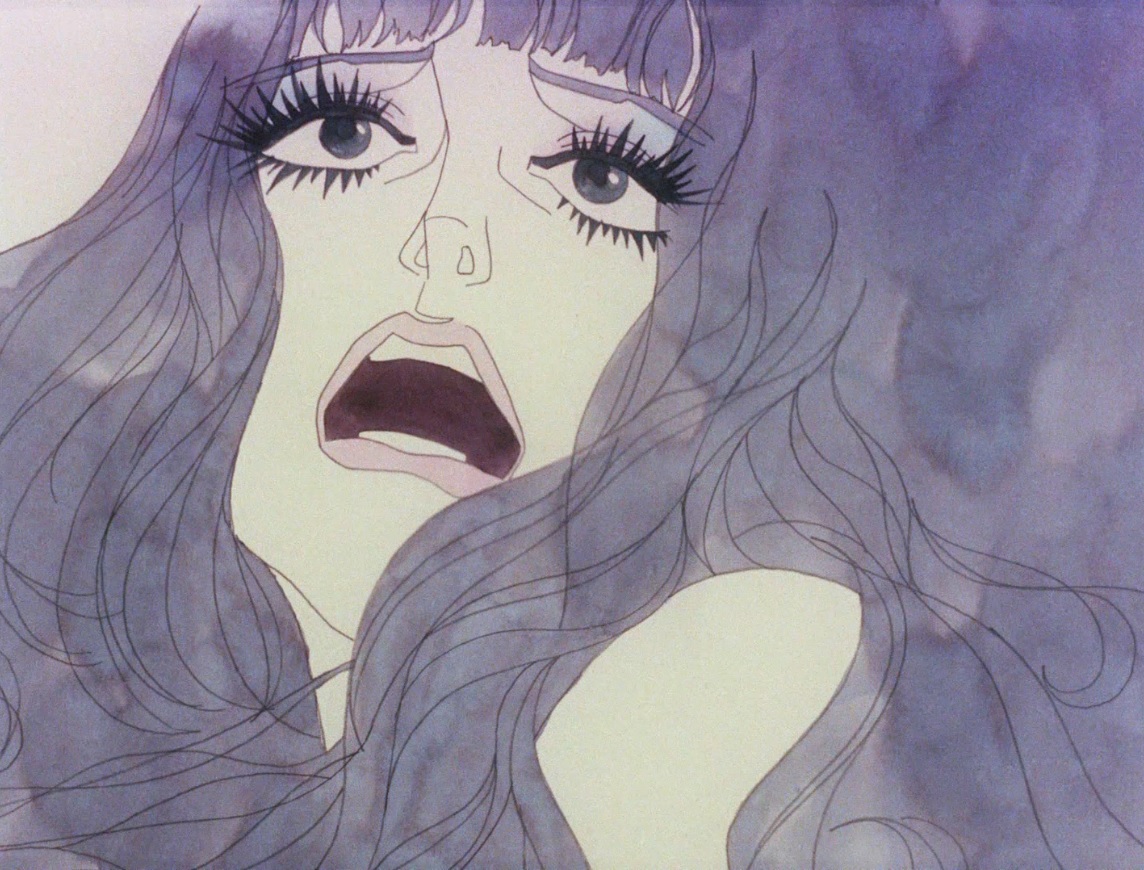
According to Yamamoto he wanted his film to be a Japanese answer to ‘Yellow Submarine’, and to make it one the drew inspiration from the artwork by Kuni Fukai. However, Kunai’s dark and disturbing artwork is quite the opposite from Dunning’s cheerful fantasies. On the Blu-ray Fukai calls his own work from the early seventies ‘decadent’, and that certainly is an apt description. Fukai’s drawings are baroque, graphical, lush, and highly erotic. They have a distinct neo-art-nouveau character, which is both very psychedelic and very seventies. For Belladonna of Sadness’ Fukai functioned as the art director, and his drawings form the base of the complete film, which uses animation only sparingly, often leaving the camera tracking over the static artwork.
And what artwork! ‘Belladonna of Sadness’ sure is a marvel to look at. The watercolor-and-pen drawings are all interesting and of a high artistic quality. Fukai almost always uses a white canvas, in which the drawings more or less disappear, and there’s ample and expressive ornamentation to accentuate the feeling of the scene. There are some odd design choices, however. For example, the villain looks like he has no eyes and as if three bones are stuck into his skull, making him rather grotesque and unbelievable.
Animation, as said, is only used only sparingly. There is no lip-synchronization, whatsoever, and some of the animation is crude and simple. The most interesting animation occurs when the events are not shown directly, but only suggested. For example, in the best erotic scenes more is hinted at than shown, and when the world is struck with the plague, we watch the landscape melt. There are certainly some trippy scenes, full of metamorphosis, which form the best parts of the movie. The undisputed highlight of the film comes when the baroque images are suddenly changed for a rapid-fire delivery of much more cartoony designs in bold seventies colors. This frenzy of animated images is followed by beautiful glass painted animation full of metamorphosis.
The psychedelic images are further enhanced by the soundtrack, which mixes psychedelica, spacefunk and rock into a very seventies-like mix, akin to Alain Goraguer’s soundtrack for ‘La planète sauvage’ from the same year, albeit of a lesser quality. There are even a few songs to enhance the mood.
In contrast to the beautiful art the story of ‘Belladonna of Sadness’ is subpar, and even objectionable. The film is based on ‘La sorcière’ (1862) by Jules Michelet, a non-fiction book on witchcraft, and the film’s story is set in a fictive oppressive kingdom in which a peasant girl becomes a witch. However, Yamamoto’s and Yoshiyuki Fukuda’s screenplay apparently only uses the book as a source of inspiration, as their own tale is as predictable as it is boring.
Yamamoto apparently instructed Fukai that his film was ‘porn but make it a love story’. Well, the movie is certainly porn, but hardly a love story. The two lovers Jean and Jeanne are more vignettes than characters, and if anything, Jean is a weak and will-less coward. Worse, the porn is exploitive, featuring several rapes and a lot of violence. As can be expected, there is a lot of female nudity, but hardly any male one, although penises are omnipresent, especially as the devil takes the shape of a penis himself. Jeanne’s best moment comes when she reveals herself as a full-blown witch, which provides one of the film’s most iconic moments. But during most of the film she’s used and abused by powers beyond her control. The ending, too, is unsatisfying, and all too abrupt, forcingly trying to make the porn story into something political.
Thus, ‘Belladonna of Sadness’ may transcend normal porn (it’s certainly weird and original enough to do so), but not that of a cheap comic. There’s no depth to the story, at all, and the film’s exploitive character gives a bad taste in the mouth. Nevertheless, the movie is a feast of the eye and stands as a great example of the sheer experimentation that were the seventies.
Watch the trailer for ‘Belladonna of Sadness’ yourself yourself and tell me what you think:
‘Belladonna of Sadness’ has been released on Blu-Ray, but this is currently out of print
Director: Tomer Eshed
Release date: June 23, 2011
Rating: ★★
Review:

‘Flamingo Pride’ tells about a flamingo who’s apparently the only straight guy at an enormous gay dance festival. Then he falls in love with a female stork flying by…
‘Flamingo Pride’ turns the tables around, making being straight the minority. That is, in the flamingo community, because outside their own festival all birds seem to be straight and having classic role patterns.
It’s not very clear what the film tries to tell us. For starters it is a bit confusing that apparently all flamingos are gay, and none of the other birds is. Moreover, the gay flamingos pretty much look like gay stereotypes. None of them, not even ‘our hero’ has a grain of personality.
At least the film isn’t as funny as it was meant to be. The short is hampered by some ugly designs (the flamingos have teeth, for example), and odd camera movements, which distract from instead of enhance the main protagonist’s emotions. More problematical was that I couldn’t quite follow its story: the role of the two tigers is puzzling, as is the flamingo’s subsequent move.
I’m afraid I find ‘Flamingo Pride’ to be a rather immature and mediocre animation film about sex with some unwelcome gay stereotyping.
Watch ‘Flamingo Pride’ yourself and tell me what you think:
‘Flamingo Pride’ is available on The Animation Show of Shows DVD Box Set 8
Director: Eric Khoo
Release Date: May 17, 2011
Rating: ★★★
Review:

The film ‘Tatsumi’ celebrates the work of Japanese manga artist Yoshihiro Tatsumi (1935-2015). Tatsumi is the inventor of the gegika manga style, a grittier, more alternative form of manga for adults. The film re-tells five of Tatsumi’s short stories in this this style, all from 1970-1972. These stories are bridged by excerpts from his drawn autobiography ‘A Drifting Life’ from 2008.
Thus, the film is completely drawn (only in the end we see the real Yoshihiro Tatsumi), but to keep the manga style intact the film was animated with Toon Boom Software, specialized in ‘animatics’, which brings story boards to life. Thus, full animation, although present, is rare, and most of the motion is rather basic, often lacking any realism of movement. The animation is enhanced by limited digital effects, and the first and last story are digitally manipulated to make the images look older.
The complete film thus is little more than slightly enhanced comic strips. One wonders if this is the best way to present Tatsumi’s work, as most probably his stories work better in their original manga form, but of course the movie is a great introduction to his work, which without doubt is fascinating and original.
Tatsumi’s manga style clearly deviates from his example, the great Osamu Tezaku. Tatsumi’s style is more raw, sketchier and knows nothing of the big eyes so common in manga. All but one story use a voice over narrator. And all but one are in the first person. The stories themselves are gritty, dark, depressing and bleak. The second story, ‘Beloved Monkey’, in which a factory worker falls in love with a girl at a zoo, is particularly bitter. The outer two take place just after the end of World War II and show the effects of Japan’s traumatic loss. All are about the losers in life, struggling at the bottom of society. As Tatsumi himself says near the end of the movie:
“The Japanese economy grew at a rapid pace. Part of the Japanese population enjoyed the new prosperity. The people had a great time. I couldn’t bear to watch it. I did not share in the wealth, and neither did the common people around me. My anger at this condition accumulated within me into a menacing black mass that I vomited into my stories.”
Surprisingly, the protagonists of all first-person stories, including the autobiography, all look more or less the same, as if Tatsumi couldn’t create more than one type of hero. Only the third story, ‘Just a Man’, the only one to use a third person narrator, stars a different and older man, while the last story, the utterly depressing ‘Good-bye’, is the only one to have a female protagonist. Tatsumi’s own life story is told in full color which contrasts with his short stories, which are mostly in black and white. Tatsumi’s autobiography is less compelling than his story work but adds to the understanding of the artist and his work.
Surprisingly, for such a Japanese film ‘Tatsumi’ was made in Singapore and animated in Indonesia. According to Wikipedia Singaporean director Eric Khoo was first introduced to the works of Yoshihiro Tatsumi during his military service, and immediately was stricken by his stories. When ‘A Drifting Life’ was published in Singapore in 2009, Khoo realized that Tatsumi still was alive and wanted to pay tribute to him. Tatsumi himself was greatly involved in the film and narrates his own life story. The movie is a great tribute to one of the more original voices in Japanese manga, and well worth watching, if you can tolerate a dose of sex and violence.
Watch the trailer for ‘Tatsumi’ yourself and tell me what you think:
‘Tatsumi’ is available on Blu-Ray and DVD
Director: Michèle Cournoyer
Release Date: 1996
Rating: ★★★★
Review:
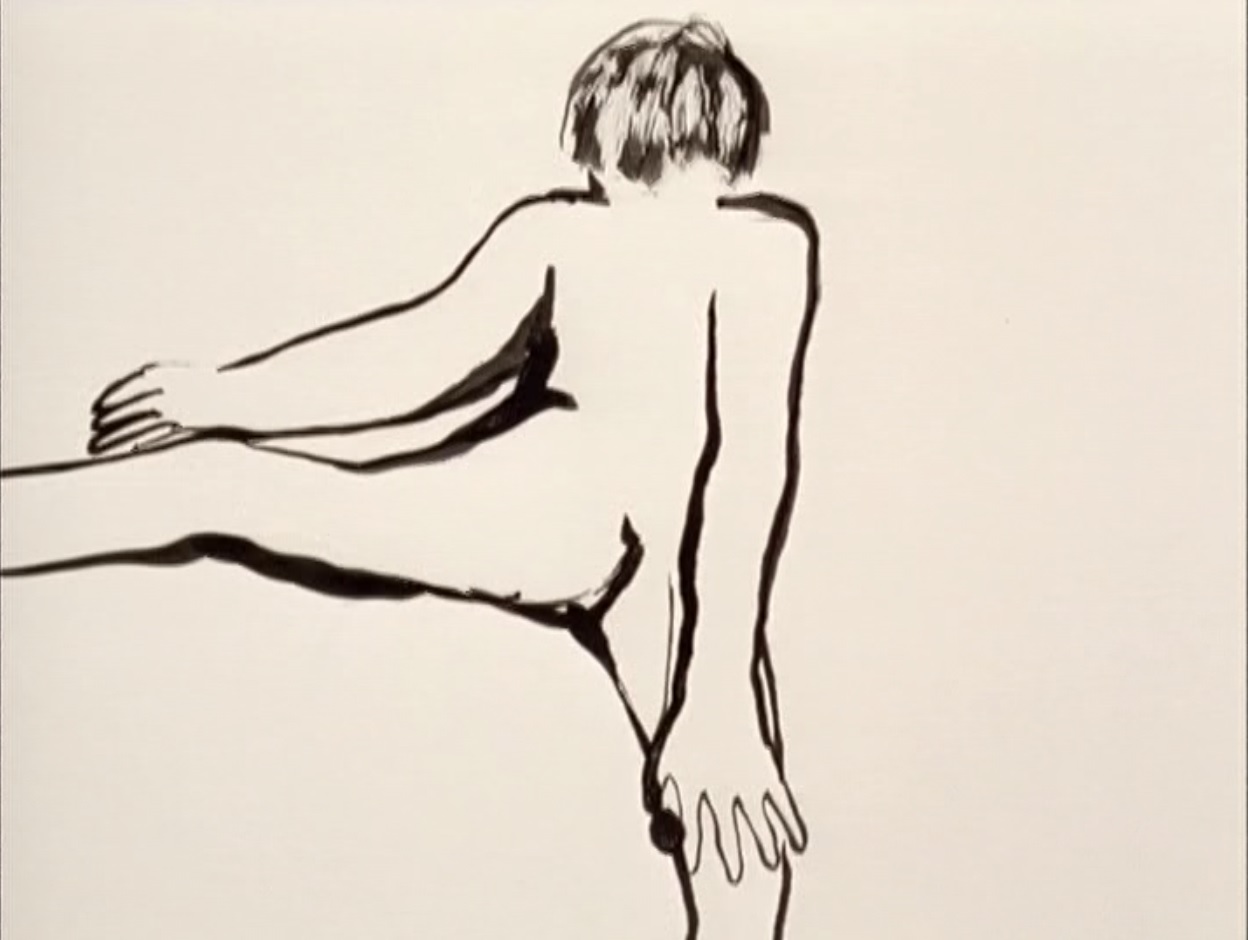
‘Le chapeau’ is a nonlinear, stream-of-consciousness-like film of flowing pen drawings morphing into each other on a white empty canvas, using the hat as a recurring motive.
The film is very associative, but it clearly says something about the male gaze and how it reduces women to mere objects of desire. The images show e.g. a female dancer dancing nude for a male audience, and images of sex. Most disturbing are the images in which the adult woman suddenly changes into a little girl and back, suggesting child abuse.
Cournoyer’s animation is flowing, her pen drawings are rough and sketchy, and her use of metamorphosis is mesmerizing. The result is a powerful, if rather uncomfortable short.
Watch ‘Le chapeau’ yourself and tell me what you think:
‘How Wings Are Attached to the Backs of Angels’ is available on the DVD ‘Desire & Sexuality – Animating the Unconscious Vol.2’
Director: Erica Russell
Release Date: 1994
Rating: ★★★★★
Review:
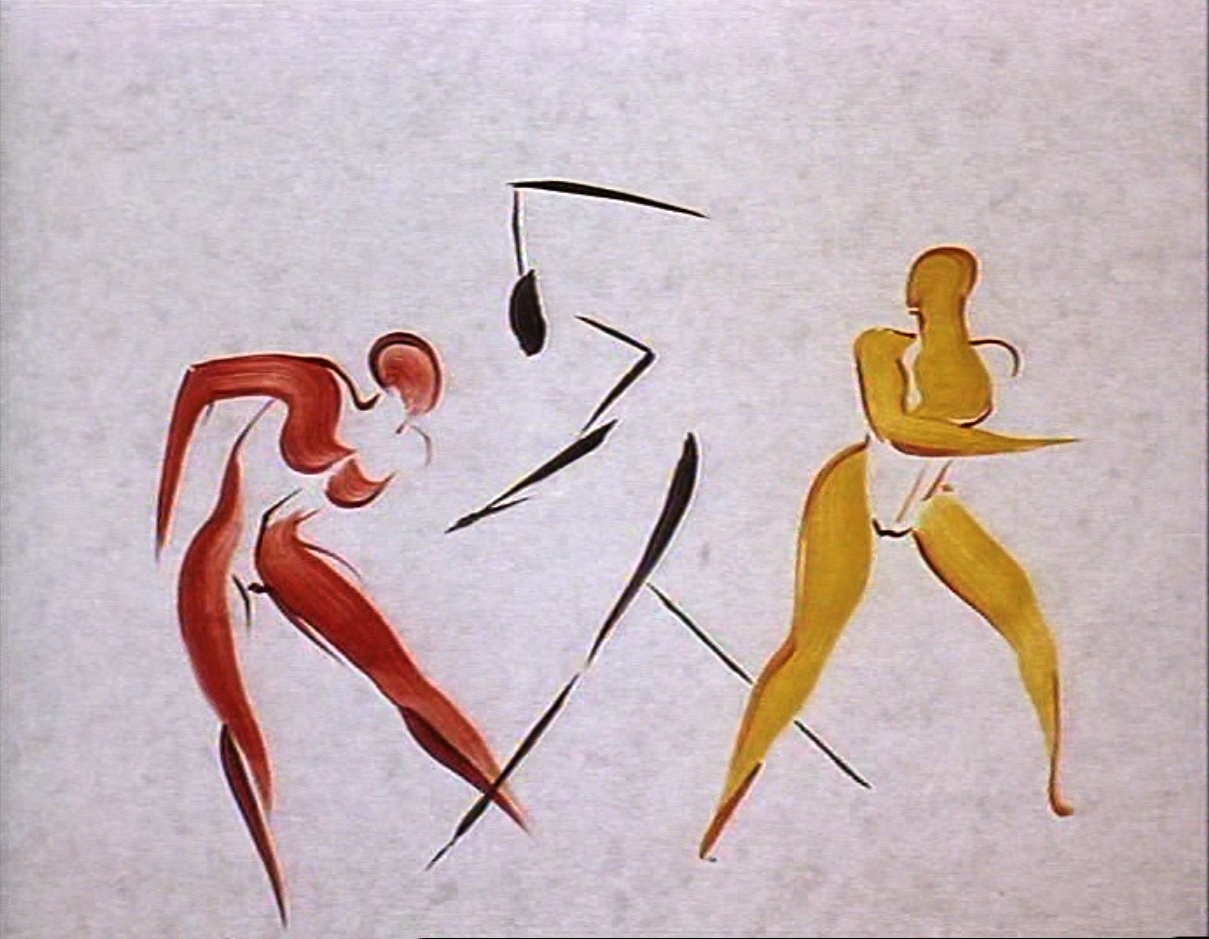
Six years after ‘Feet of Song‘ Erica Russell returned with another extraordinarily beautiful dance film, this time using three dancers in a triangular relationship.
During most of the dance two women compete for a man, and the film features several dances between the man and either one of the women, the two women together, and, in the end, all three together.
The fluency of the movement combined with the elegance of Russell’s paintwork make the film a delight to watch. During most of the film the three dancers remain recognizable as human forms, but at times they change into almost abstract forms, with a strong Bauhaus influence.
Despite the high level of abstraction ‘Triangle’ is a very sensual film, and one never loses the idea that the film is about three characters with solid bodies, no matter how sketchily drawn. Charlie Hart’s score fits the images very well with its quasi-African touch to it.
Watch ‘Triangle’ yourself and tell me what you think:
‘Triangle’ is available on the DVD ‘The Best of British Animation Awards 1’
Director: Phil Mulloy
Release Date: 1994
Rating: ★★★

‘The Invention of Writing (and Its Destruction)’ is the second of only three films in Phil Mulloy’s ‘The History of the World’-series, which apparently should have existed of 140 different shorts.
Like ‘The Discovery of Language‘ this is a film about sex. The short uses the same white characters as ‘The Discovery of Language’, and takes place in 2,000 years B.C. The short tells about a man who doesn’t manage to get sex, because he’s beaten again and again by other men.
Then the man uses his own penis as a pen, writing ‘The penis (pen is) mightier than the sword’. The invention of writing earns him a multitude of women to have sex with, but it won’t last.
Like ‘The Discovery of Language’ ‘The Invention of Writing (and Its Destruction)’ is essentially a silent film, with intertitles. Mulloy’s animation is simple and crude, and makes effective use of cut-out techniques. The result is a strange mix of sex, violence and absurd humor.
Watch ‘The Invention of Writing (and Its Destruction)’ yourself and tell me what you think:
‘The Invention of Writing (and Its Destruction)’ is available on the BFI DVD ‘Phil Mulloy – Extreme Animation’
Director: Phil Mulloy
Release Date: 1994
Rating: ★★★

‘The Discovery of Language’ is ‘episode 10’ of Phil Mulloy’s ‘The History of the World’, which in real life only consists of three films, of which this one is the first.
The film series uses Mulloy’s typical crude black and white style, enhanced by reds to depict blood. But unlike his other films, his characters are not black blots of inks, but white.
The short tells about a primitive tribe of women, 1,000,000 b.c. who discover letters in the soil, which together form the word ‘vagina’. As soon as they realize the meaning of the word they create their own Fall of Man, covering their crotches with skirts, and forbidding masturbation. Meanwhile, the men are on a similar quest to form the word ‘Penis’, but they are too stupid to fulfill the task.
The crude humor of this short is enhanced greatly by the effective soundtrack, featuring excellent music by Alex Balanescu.
Watch ‘The Discovery of Language’ yourself and tell me what you think:
‘The Discovery of Language’ is available on the BFI DVD ‘Phil Mulloy – Extreme Animation’
Director: Andreas Hykade
Release Date: 1995
Rating: ★★★½

‘Wir lebten im Gras’ is the first of three films in which German animator Andreas Hykade explores the loss of innocence, the other two being ‘Ring of Fire’ (2000) and ‘Der Kloane’ (The Runt, 2006).
The film is also the most cryptic of the three, full of images that are very difficult to decipher. The film is set in a rather mythical place, ‘two streets away from the end of the world’ and has a timeless and universal feel.
The story is told by a boy voice over, who reminisces about his father, who told him that “All women is whore and all men is soldier”. Outside the voice over there is no dialogue. The little boy tries to see the world through his father’s eyes, but this conflicts with his softer side, and he’d rather fall in love with the enigmatic ‘dandelion girl’.
The film is less straightforward than this synopsis suggests, however, and the film is more surreal and suggestive than narrative. For example, the boy’s adventures are interjected by nightmarish dream sequences, the meaning of which is never really explained. These dream sequences are rendered in an expressionistic pastel style, reminiscent of Lorenzo Mattotti’s art work. This style contrasts highly with the simple cel animation.
Hykade’s drawing style is highly original. His human designs are simple, almost stickman-like, but genitals are very prominent, and the father is drawn as a more robust, earthly character.
The animation is very virtuoso, with a great feel for timing. Moreover, Hykade uses a lot of changing perspective, and has an admirable command of movement.
‘Wir lebten im Gras’ was Hykade’s last student film, but it certainly is his first major work. With this film Hykade proved to be a strong new voice in the animation world, a fact he consoled with his masterpiece ‘Ring of Fire’ from 2000.
Watch ‘Wir lebten im Gras’ yourself and tell me what you think:
‘Wir lebten im Gras’ is available on the DVD ‘Desire & Sexuality – Animating the Unconscious Vol. 2’
Director: Igor Kovalyov
Stars: Duckman
Airing Date: May 7, 1994
Rating: ★★★½

Russian independent animation master Igor Kovalyov directs this erotically charged episode in which Duckman’s son Ajax falls in love.
The story features a very unlikely undercover investigation by Duckman and Cornfed dressed as ‘teenagers’ in Ajax’s school. More convincing and more importantly to the series is the search for Ajax by Aunt Bernice and Duckman in some honeymoon town in Mexico.
Duckman is more lustful than ever in this episode, which expands on both his relationship with Aunt Bernice as with his son, Ajax. Cornfed, on the other hand, is hardly present. His best gag is when he’s in a tree together with Duckman, spying on Ajax’s vice principle, fooling Duckman with describing erotic images to drive the latter’s lust to a boil.
The whole episode bursts with sex without revealing anything, and certainly is one of the most adult of all Duckman episodes, even if Duckman’s own desires and objectifications of women are rather juvenile.
Watch ‘It’s the Thing of the Principal’ yourself and tell me what you think:
This is Duckman episode no. 9
To the previous Duckman episode: Not So Easy Riders
To the next Duckman episode: Cellar Beware
‘It’s the Thing of the Principal’ is available on the DVD-box ‘Duckman – The Complete Series’
Director: unknown
Release Date: July 16, 1932
Stars: Flip the Frog
Rating: ★★★★★
Review:
 In ‘The Office Boy’ Flips applies to be an office boy, and he’s hired on the post, after he has washed away all his competitors with a fire hose.
Once at work he accidentally starts a record player, and he and the sexy secretary start to dance to some rumba music. Later, a cat and a mouse cause havoc, leading to the secretary losing her dress, and Flip being fired.
‘The Office Boy’ is a gag-packed cartoon, the best of which is the one with a face Flip paints on a dirty window. Flip’s voice is remarkably Mickey Mouse-like in this cartoon, but most of the humor would not fit Mickey, at all, as many gags involve the sexy secretary, repeatedly revealing her underwear.
The secretary would be used again in Flip’s next cartoon, ‘Room Runners‘, which is even more erotic. The secretary is also shown chewing bubble gum, in one of the first animated depictions of this 1928 invention (another contender is the Mickey Mouse film ‘Barnyard Olympics‘ from April).
The erotic secretary seems proof that Iwerks wanted to compete with Fleischer’s sensual Betty Boop cartoons. However, it may also be an example of an increased amount of sex references employed by Hollywood in 1932 in general, for a stronger sexual content can also be noted in live action movies from the era.
This higher level of eroticism in Hollywood cinema remained extant until 1934, when the Hays code kicked in with a vengeance, and the tables were turned exactly the other way: for most of the 1930s cartoons often became ridiculously goody-goody and childish, reaching a low point around 1935/1936.
Watch ‘The Office Boy’ yourself and tell me what you think:
This is Flip the Frog cartoon No. 23
To the previous Flip the Frog cartoon: The Bully
To the next Flip the Frog cartoon: Room Runners
‘The Office Boy’ is available on the DVD Cartoons that Time Forgot – The Ub Iwerks Collection Vol. 2
Director: Dave Fleischer
Release Date: August 31, 1930
Stars: Betty Boop
Rating: ★★★★★
Review:
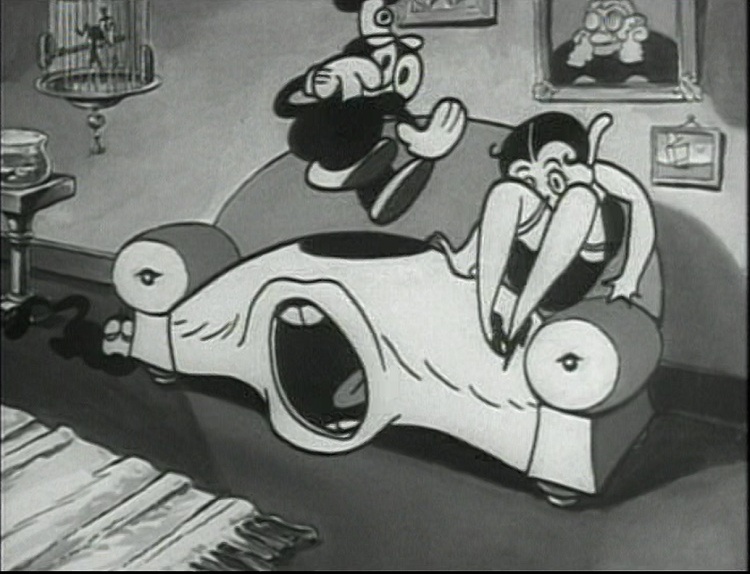
‘Barnacle Bill’ is a literal visual illustration of the folk song of the same name, made famous by Hoagy Carmichael’s 1930 recording.
Barnacle Bill (another version of early Bimbo) is visiting Betty Boop, who’s called Nancy Lee in this cartoon and who apparently is the Captain’s love. All neighbors gossip about it, and when the captain arrives, he chases Barnacle Bill into the sea, where the latter dances with some remarkably humanized mermaids.
‘Barnacle Bill’ is the second cartoon featuring Betty Boop, and it introduces the strong sexual overtones, associated with the character in her early years. One example is Betty’s dress that rolls itself up, exposing her legs. There’s also a couch that itself replaces several chairs when Betty invites Barnacle Bill inside.
‘Barnacle Bill’ uses musical dialogue almost exclusively. It contains some odd perspectives and flexible animation, but most important of all, it is wildly surrealistic, creating a completely original world of utter weirdness. For example, when Barnacle Bill threatens to bust in the door, the door shrinks and hides under the welcome mat. Later, we watch Barnacle Bill swim through the air, and dive into the couch. And when he leaves Nancy Lee’s apartment block, he sails one of the stairs. Touches like these make watching the cartoon a mind-blowing experience. I don’t think it’s considered a classic, but to me it should be.
Watch ‘Barnacle Bill’ yourself and tell me what you think:
This is Talkartoon No. 9
To the previous Talkartoon: Dizzy Dishes
To the next Talkartoon: Swing, You Sinners!
‘Barnacle Bill’ is available on the French DVD Box Set ‘Betty Boop Coffret Collector’
Director: Dave Fleischer
Release Date: May 18, 1934
Stars: Betty Boop, Max Fleischer
Rating: ★★★★½
Review:
 ‘Betty Boop’s Rise to Fame” is a compilation cartoon, but it’s easily one of the best in its kind.
It features Betty Boop and her creator, Max Fleischer in a nice mix of animation and live action. Fleischer asks Betty, who is depicted as a tiny cartoon character, to perform for a reporter. She does three of her finest moments, using footage from ‘Stopping the Show‘ (1932), ‘Betty Boop’s Bamboo Isle‘ (1932) and ‘The Old Man from the Mountain’ (1933).
In between, there’s some lovely interplay between Betty and “uncle Max”. Even these new scenes are sexy, when Betty changes clothes behind an ink pot and some books. This delightful cartoon can be regarded as an ode to Betty’s glorious past. From now on sex and eroticism would be banished from her cartoons due to the censorship of the Hays code.
Watch ‘Betty Boop’s Rise to Fame’ yourself and tell me what you think:
This is Betty Boop cartoon No. 28
To the previous Betty Boop cartoon: Betty in Blunderland
To the next Betty Boop cartoon: Betty Boop’s Trial
‘Betty Boop’s Rise to Fame’ is available on the French DVD Box Set ‘Betty Boop Coffret Collector’
Director: Dave Fleischer
Release Date: September 1, 1933
Stars: Betty Boop, Bimbo, Koko The Clown
Rating: ★★★★
Review:
 Betty Boop works in a tavern near a coal mine, where Koko The Clown and Bimbo are working. The latter discovers some ghosts in the mine.
This short contains an excellent swinging jazz score by Don Redman and his orchestra, who are introduced in the beginning of the picture, playing in a zany cartoon decor. The music includes adapted versions of Don Redman’s hit songs ‘How am I doing?’ (1932) and ‘I Heard’ (1931).
‘I Heard’ was the last Fleischer cartoon to feature a great jazz score. Don Redman, and his predecessors Cab Calloway and Louis Armstrong, where soon replaced by Rubinoff and his orchestra playing sweet semi-classical music in ‘Morning Noon and Night‘ and ‘Parade of the Wooden Soldiers‘ (both late 1933). Even worse, the cartoon marked Bimbo’s last screen appearance. Being an animal he was no longer accepted as being Betty’s suitor in a Hays Code dominated Hollywood which shunned all eroticism and ‘unnatural sexual behavior’, including human-animal relationships.
After Bimbo, Betty would shortly date a human character named Fearless Freddie, but from 1935 on she remained a bachelor apparently with no interest in men whatsoever. In this cartoon, though, she’s still sexy, and she can briefly be seen in her underwear, after the elevator she and Bimbo had taken has crashed.
Thus, in many ways, one can regard ‘I Heard’ as the last of the classic Betty Boop cartoons. After this cartoon, the intoxicating mix of sex and surrealism was only seen once, in the compilation cartoon ‘Betty Boop’s Rise to Fame‘ (1934), a last tribute to Betty’s glory days.
Watch ‘I Heard’ yourself and tell me what you think:
This is Betty Boop cartoon No. 20
To the previous Betty Boop cartoon: The Old Man of the Mountain
To the next Betty Boop cartoon: Morning Noon and Night
‘I Heard’ is available on the French DVD Box Set ‘Betty Boop Coffret Collector’


 Dr. Grob's Animation Review