
You are currently browsing the tag archive for the ‘surrealism’ tag.
Director: René Laloux
Release Date: 1988
Rating: ★★★★½
Review:
 ‘La Prisonnière’ is a short, rather surrealistic science fiction film about two children.
They visit an extraterrestrial monastery and witness a rescue of a prisoner by naked women who step out of a stranded whale.
The film looks like an animated version of designer Caza’s source comic, Équinoxe (which can be found here), and contains only a limited amount of animation. In his designs Caza’s style is very reminiscent of that of his fellow french comic artist Moebius.
‘La prisonnière’ seems like an etude for Laloux’s and Caza’s much bigger project, the feature film ‘Gandahar‘ (1988). The atmosphere of the short is poetic, if completely incomprehensible.
Watch ‘La Prisonnière’ yourself and tell me what you think:
‘La Prisonnière’ is available on the DVD ‘Gandahar’
Director: Georges Schwizgebel
Release Date: 1982
Rating: ★★★★
Review:
 ‘Le ravissement de Frank N. Stein’ starts with very abstract images, which resolve into Frankenstein’s laboratory as depicted in the film from 1931.
After 1’40 we become the monster itself, walking through endless chambers and corridors and staircases in an almost computer animation-like long sequence of perspective animation. The rooms, initially filled with abstract shapes, become more and more complex. They contain more and more windows and human forms, and finally moving human forms, ending with multiple copies of the monster’s bride. In the end we watch the monster itself, in his depiction by Boris Karloff. he smiles at his bride, but she only screams…
This film, which is set to very nervous electronic music, is a very impressive study of perspective: we really feel we are walking. The film has a repetitive and dreamlike quality, which is enhanced by its surreal settings, reminiscent of paintings by Giorgio de Chirico.
Watch ‘Le ravissement de Frank N. Stein’ yourself and tell me what you think:
‘Le ravissement de Frank N. Stein’ is available on the DVD ‘Les Peintures animées de Georges Schwizgebel’
Director: Jan Švankmajer
Release Date: 1971
Rating: ★★★★★ ♕
Review:
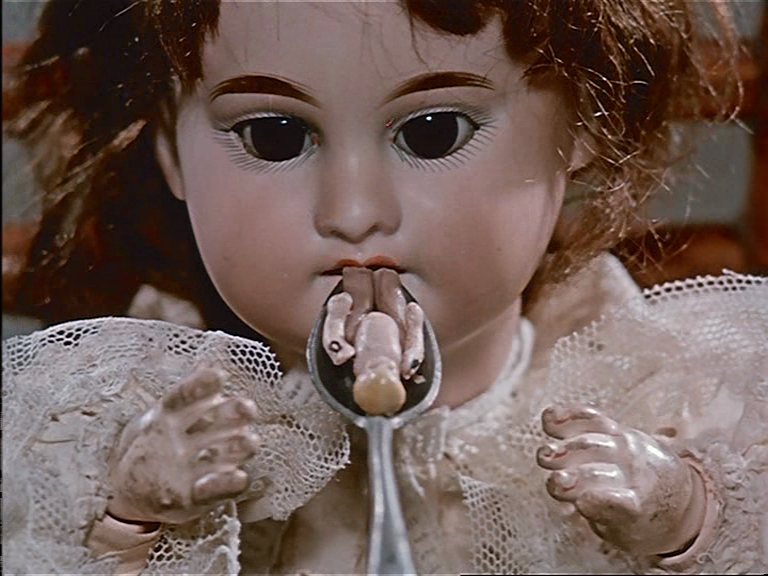 ‘Jabberwocky’ has little to do with the poem from Lewis Carroll’s ‘Through The Looking Glass’, although we hear it being recited by a little girl during the opening sequence.
The film it is Švankmajer’s surrealistic masterpiece on the loss of childhood, depicted by several episodes, which are separated by a box of bricks, a labyrinth and a black cat crushing the box of bricks.
During the episodes we are treated on extremely surrealistic images of very active inanimate objects in a child’s room. First we watch a boy’s suit growing a forest in his room, defying both time and authority (symbolized by the portrait in the room). Then we watch large cannibalistic dolls grinding, ironing and eating little dolls, a china baby in a cradle destroying two tin armies, a pocket knife performing acrobatic tricks until it makes an ill-fated fall and stabs itself, and finally, schoolbooks producing paper boats and planes, which fly out of the window, while the father’s portrait produces pictures of beautiful women.
This last episode shows the child’s changing interests. In the end the labyrinth is solved, the cat – the only living thing in the entire film – is caged, and the boy’s suit is replaced by an adult one. The boy is free from his parent, but the days of imagination are over, the fantasy is gone.
For this film Švankmajer makes excellent use of 19th century imagery (sailor suit, vintage dolls and toys) to create a completely unique world. It’s the film maker’s most typical film, partly expanding on ideas explored in ‘Historia Naturae, Suita‘ (1967), and showing his fascination with fantasy, cruelty and decay, which roam freely in the child’s self-contained room. The rather morbid behavior of the everyday objects is quite unsettling and it shows how a child’s fantasy can be both imaginative and cruel.
‘Jabberwocky’ is without doubt one of Švankmajer’s most powerful films. He would only top it eleven years later, with ‘Dimensions of a Dialogue‘ (1982). Švankmajer would explore the imagination of children further in the moving ‘Down to the Cellar‘ (1983), and in his unique adaptation of Lewis Carroll’s most famous work ‘Alice‘ (1987).
Watch ‘Jabberwocky’ yourself and tell me what you think:
‘Jabberwocky’ is available on the DVD ‘Jan Svankmajer – The Complete Short Films’
Director: Jan Švankmajer
Release Date: 1969
Rating: ★★★
Review:
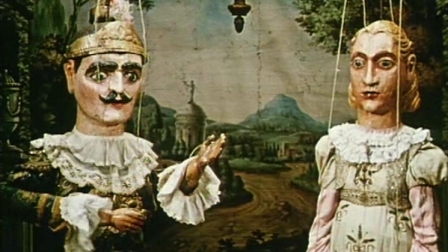 In ‘Don Juan’ Švankmajer’s retells a classic tale from the marionette theater.
The story unfolds in half an hour: Don Juan is a rogue who kills his father, the father of his beloved and his own brother, only to be taken into the depths off hell.
Oddly enough the film is enacted by people dressed as marionettes and behaving accordingly. This allows the marionettes to leave the theater and to perform in the real world, which is strangely intermingled with the marionette theater. This blend of the real and the artificial gives the film a weird and disturbing atmosphere. Švankmajer would reuse and improve upon this mix in his masterpiece, the feature film ‘Faust‘ (1994).
This film contains hardly any animation, and may therefore not be included in this blog. However, it takes a central part in Švankmajer’s oeuvre, who has always blended several different techniques into his works. It’s best to review his oeuvre as a whole, being animated or not.
Watch ‘Don Šajn’ yourself and tell me what you think:
‘Don Šajn’ is available on the DVD ‘Jan Svankmajer – The Complete Short Films’
Director: Jan Švankmajer
Release Date: 1969
Rating: ★★
Review:
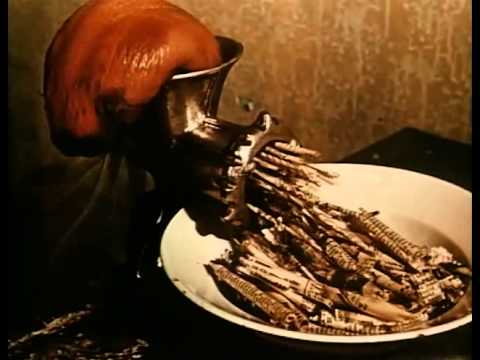 ‘A Quiet Week in the House’ is the last film in a series of four involving people facing surreal settings, which Švankmajer made in 1968-1969.
in this film a fugitive seeks shelter in an abandoned house. Every day he digs a hole in one of the doors of the corridor in which he sleeps. Every day he looks through the hole to watch weird surrealistic images of inanimate things behaving strangely. After a week he sets up a device to blow up all doors.
The live action footage is shot in black-and-white, and is accompanied by the sound of a camera. The surrealistic images, on the other hand, are shot in color and completely silent. Unfortunately, the film is too long, and it fails to be as impressive as related films like ‘The flat’ (1968) or ‘Jabberwocky‘ (1971), being neither completely disturbing nor very entertaining. ‘A Quiet Week in the House’ remains one of Švankmajer’s rare weak films.
Watch ‘A Quiet Week in the House’ yourself and tell me what you think:
http://www.dailymotion.com/video/xpfbvj_a-quiet-week-in-the-house-de-jan-svankmajer_shortfilms
‘A Quiet Week in the House’ is available on the DVD ‘Jan Svankmajer – The Complete Short Films’
Directors: John Halas & Joy Batchelor
Release Date: 1948
Rating: ★★★★
Review:
 ‘Magic Canvas’ is rather pretentiously introduced as “something different (….), new and exciting”.
Luckily, the film is rather original and exciting: using a rather abstract score by Hungarian composer Mátyás Seiber, it consists of associative images with a strong sense of surrealism. It loosely tells the story of man struggling to be free. Even though it has to pay its debts to Disney’s ‘Fantasia’ (1940), ‘The Magic Canvas’ surely is one of the most avant-gardistic films of its time, and a testimony of Halas & Batchelor’s animation ambitions.
Watch ‘Magic Canvas’ yourself and tell me what you think:
‘Magic Canvas’ is available on the DVD inside the book ‘Halas & Batchelor Cartoons’
Director: Paul Driessen
Release Date: 1981
Rating: ★★★★★
Review:
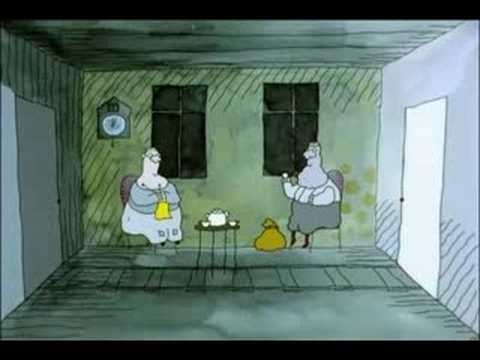 ‘Het treinhuisje’ is one of Paul Driessen’s most beautiful films.
This short builds on the surreal concept of a home built right on a railway track. The daily life of the couple living in the house is dominated by a train passing right through their home at certain times.
With simple and direct storytelling Driessen sets the drama, in which this very train ruins the life of the couple. All the time we stick inside the couple’s home. Only when the man tells of his misfortunes, we shortly cut to the outside world. Ironically, it’s the railway itself that ruins the couple’s life.
The story is told without dialogue, and supported by beautiful country music. The emotions of the couple are depicted well, and are very subtle. However, the film also shows Driessen’s typical animation style at its most radical: the film’s surrealism is enhanced by strange disappearances of the characters when they cross the room and by a ghostly avant-image of the train before it really enters the house.
The film also shares the trademark morbid humor with other Driessen films, especially in the cuckoo clock and in the persistent fly bugging the characters throughout the picture. Nevertheless, the melancholy atmosphere dominates, and its the film’s drama that impresses the viewer time and time again.
Watch ‘Het treinhuisje’ yourself and tell me what you think:
‘Het treinhuisje’ is available on the DVD ‘The Dutch Films of Paul Driessen’
Director: Raoul Servais
Release Date: 1979
Rating: ★★★★★ ♕
Review:
 A man rescues a harpy from a man who strangles her. He takes her home, but with disastrous results, because he soon discovers that the harpy eats all his food…
‘Harpya’ is a fantastic surreal film, which makes great use of a mixture of animation, live action and pixillation to create a totally unique atmosphere. The film is both funny and uncanny, and its story is Servais’s best since ‘Sirene’ (1968).
With ‘Harpya’ Raoul Servais made his most enduring work. It’s his all-time masterpiece, and a central film in his oeuvre, defining his mature style.
Watch ‘Harpya’ yourself and tell me what you think:
Director: Raoul Servais
Release Date: 1973
Rating: ★★★
Review:
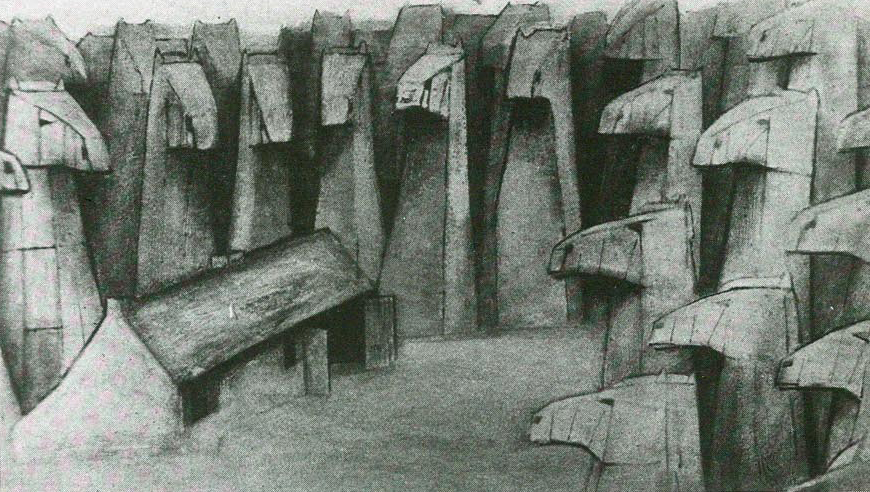 ‘Pegasus’ tells about a lonely blacksmith who lives in the countryside.
The blacksmith has a love for horses, but unfortunately his surroundings are totally devoid of them. So he builds a horse head out of metal to worship. Unfortunately, the horse head appears to have an ability to grow and reproduce, surrounding his house like a forest.
‘Pegasus’ is a beautiful and surreal film. Unfortunately, it ends quite abruptly, leaving behind a sense that not everything has been said, yet.
Watch ‘Pegasus’ yourself and tell me what you think:
Director: Friz Freleng
Release Date: September 2, 1949
Stars: Porky Pig
Rating: ★★★★½
Review:
 ‘Dough for the Do-Do’ is a remake of Bob Clampett’s ‘Porky in Wackyland‘ (1938) in color.
The cartoon is more than a recoloring, however. Porky is reanimated throughout, and several scenes are different from the original. Scenes that are omitted are the paperboy appearing on the title card, Porky showing us a picture of the dodo, and the cat-dog attacking itself. Two scenes are altered: the way the guide ‘leads’ Porky to the dodo, and the finale: in the original Porky dresses as a paperboy announcing that Porky has captured the dodo, in ‘Dough for the Do-Do’, Porky dresses like a do-do, making the bird itself think he has caught the last of the do-dos.
The most conspicious difference between ‘Dough for the Do-Do’ and ”Porky in Wackyland’, however, is found in the backgrounds: where the original had rather undefined, a little George Herriman-like backgrounds, the remake uses clearly Salvador Dalí-inspired settings, full of typical Dalí-rocks, sticks and eyes. The title card even shows Dalí’s melted watches, linking cartoon surrealism to high art surrealism. Dalí-inspired scenery would return two years later in the Porky Pig cartoon ‘Wearing of the Grin’ from 1951.
It is striking to see how different this cartoon is from its contemporaries. ‘Porky in Wackyland’ was a milestone in surrealism, a move forward in wackiness, an innovative cartoon stirring up the childish make-belief world of the 1930s cartoons. However, eleven years later its remake ‘Dough for the Do-do’ feels old-fashioned: its animation is crude, its characters are unrefined, and its zaniness seems to come from another era.
And it does: in the late 1940s, the wild surrealism of the early Warner Bros. cartoons had toned down. It survived in cartoon conventions, which always contained a twist of surrealism, but the outlandishness had disappeared. Now, more emphasis was played on character humor and dialogue, something the Warner Bros. studio excelled at with its numerous stars. Only at MGM and Walter Lantz some of the original zany vibe was retained, but at large the wild era of studio cartoons was clearly over.
Watch ‘Dough for the Do-Do’ yourself and tell me what you think:
http://www.220.ro/desene-animate/16-Porky-Dough-For-The-Do-Do-1949/mL0EVmznKK/
‘Dough for the Do-Do’ is available on the DVD set ‘Looney Tunes Golden Collection, Vol. 1’
This is Porky Pig cartoon no. 128
To the previous Porky Pig cartoon: Often an Orphan
To the next Porky Pig cartoon: Bye, Bye Bluebeard
Director: ?
Release Date: May 27, 1948
Stars: Donald Duck, Joe Carioca, The Aracuan Bird
Rating: ★★★★
Review:
 Sung by Ethel Smith and the Dinning Sisters, ‘Blame it on the Samba’ looks like a lost sequence from ‘The Three Caballeros‘ (1944)
The short, the sixth segment from ‘Melody Time‘, reunites Donald Duck, Joe Carioca and the Aracuan bird. The latter serves as the cartoon’s surreal character, who can cross the three dimensions, not unlike the Do-Do in ‘Porky in Wacky Land’ (1938). It’s this feature that makes ‘Blame It On The Samba’ so enjoyable.
Again, the Mary Blair-inspired backgrounds are highly stylized, even almost abstract, and extremely colorful. It also features some live action footage of Ethel Smith dancing and playing the organ and a pair of conga’s. Unfortunately, the music seems to be more about samba than being it, and it never becomes really hot.
Nevertheless, ‘Blame It On The Samba’ is a welcome diversion after Melody Time’s three tiresome episodes ‘The Legend of Johnny Appleseed‘, ‘Little Toot‘ and ‘Trees‘.
Watch ‘Blame it on the Samba’ yourself and tell me what you think:
Director: Jan Švankmajer
Release Date: 1967
Rating: ★★★★★
Review:
 ‘Historia Naturae, Suita’ is an abstract, yet morbid and disturbing film.
It uses drawings, models, skeletons, stuffed and live animals, which change into each other and which perform morbid dances. Their antics are interspersed with a close up of a man eating meat.
We see molluscs (Aquatilia, foxtrot), insects (Hexapoda, bolero), fish (Pisces, blues), reptiles (Reptilia, tarantella), birds (Aves, tango), mammals (Mammalia, menuet), monkeys (Simiae, polka) and man (Homo, waltz), successively.
It shows us that we, men, are made from the same mortal matter as the rest of the animal kingdom, which in this film appear to us only as collectibles or food. This unsettling reminder is emphasized by the last shot, in which the human is replaced by a skull, eating…
The music is a perfect match to the surrealistic imagery, with its rather abstract, uncanny and atonal renderings of the dance forms mentioned.
Watch ‘Historia Naturae, Suita’ yourself and tell me what you think:
http://www.totalshortfilms.com/ver/pelicula/379
‘Historia Naturae, Suita’ is available on the DVD ‘Jan Svankmajer – The Complete Short Films’
Director: Jan Švankmajer
Release Date: 1966
Rating: ★★★★★
Review:
 In ‘Et Cetera’ three faceless human figures demonstrate repetitive and aimless actions.
The first shows how to fly with wings, only to reach his own starting point. The second transforms himself into the animal he’s training using a whip, and the third keeps on drawing houses he cannot enter or leave.
Unlike most of Jan Švankmajer’s films, ‘Et Cetera’ uses 2d animation. It’s a clever and somehow saddening film: although the three little stories are extremely simple, they seem to tell something about the condition humaine. ‘Et Cetera’ uses great electronic music, which adds to the surrealistic atmosphere.
Watch ‘Et Cetera’ yourself and tell me what you think:
‘Et Cetera’ is available on the DVD ‘Jan Svankmajer – The Complete Short Films’
Director: Jan Švankmajer
Release Date: 1965
Rating: ★★★★
Review:
 In ‘A Game with Stones’ (also known by its German title ‘Spiel mit Steinen’) an odd construction, consisting of a clock, a tap and a bucket, produces stones by the hour. These stones form patterns to the music of a music box until the bucket is emptied, dropping the stones on the floor.
The stones’ abstract patterns are indeed game-like, but they become more and more grim, ending in a destructive game, destroying the stones, and eventually, the bucket, leaving the machine useless. The game is over. It is Švankmajer’s genius that he’s able to give this fairly abstract film a heart and an unsettling, sad ending.
‘A Game with Stones’ is Švankmajer’s first film to use stop motion animation extensively. The fourth game contains faces made of numerous small pebbles, which anticipates similar heads in ‘Dimensions of Dialogue’ (1982), a film in which Švankmajer’s stop motion techniques reach a stunning apex.
Watch ‘A Game with Stones’ yourself and tell me what you think:
‘A Game with Stones’ is available on the DVD ‘Jan Svankmajer – The Complete Short Films’
Director: Jan Švankmajer
Release Date: 1964
Rating: ★★★★★
Review:
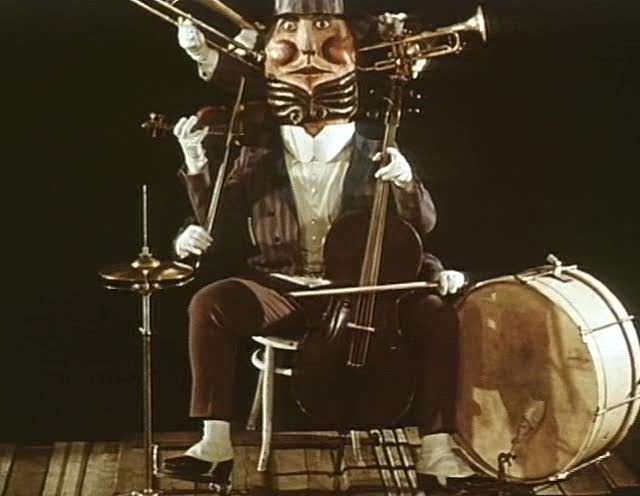 In ‘The Last Trick’ two magicians in large masks perform their impossible tricks one after another against a black, empty background.
Although they stay polite, their congratulationary handshakes between the tricks gradually become more and more violent, ending in a disastrous mutual disembodiment. The last shot is of the only really living organism inhabiting this surrealist world, a beetle, dead.
‘The Last Trick’ is Czech film maker Jan Švankmajer’s first film, and already his obsessions with puppets, body parts and death are full blown. Its humor is dark, its images are grim and its story is very unsettling. Švankmajer’s first film (which contains a little stop motion animation) is also his first masterpiece.
Watch ‘The Last Trick’ yourself and tell me what you think:
‘The Last Trick’ is available on the DVD ‘Jan Svankmajer – The Complete Short Films’
Director: Dave Fleischer
Release Date: December 26, 1930
Stars: Betty Boop, Bimbo
Rating: ★★★★★
Review:

Bimbo is the uncanny phantom-like Mysterious Mose, who visits a frightened Betty Boop at night.
The cartoon has a jazzy score, using the St. James Infirmary Blues. Like ‘Barnacle Bill‘, it is wildly surrealistic, with all kinds of animals appearing out of nowhere and disappearing into nothingness again, and during the title song there’s metamorphosis all over the place.
‘Mysterious Mose’ is the third cartoon featuring Betty Boop, and the first with her in the starring role. She’s still unnamed here, but her development as as sex object is pushed further, when her night shirt flies off twice, leaving her naked in bed. She’s also animated much better than in her earlier two films, ‘Dizzy Dishes‘ and ‘Barnacle Bill‘. Her looks and moves are more stable, more feminine, and thus, more sexy.
Watch ‘Mysterious Mose’ yourself and tell me what you think:
This is Talkartoon No. 14
To the previous Talkartoon: Up to Mars
To the next Talkartoon: The Ace of Spades
‘Mysterious Mose’ is available on the French DVD Box Set ‘Betty Boop Coffret Collector’
Director: Dave Fleischer
Release Date: August 31, 1930
Stars: Betty Boop
Rating: ★★★★★
Review:
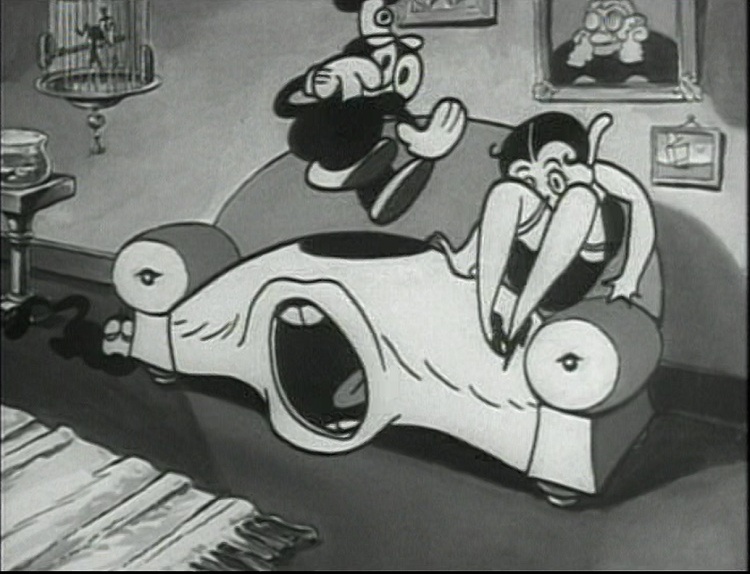
‘Barnacle Bill’ is a literal visual illustration of the folk song of the same name, made famous by Hoagy Carmichael’s 1930 recording.
Barnacle Bill (another version of early Bimbo) is visiting Betty Boop, who’s called Nancy Lee in this cartoon and who apparently is the Captain’s love. All neighbors gossip about it, and when the captain arrives, he chases Barnacle Bill into the sea, where the latter dances with some remarkably humanized mermaids.
‘Barnacle Bill’ is the second cartoon featuring Betty Boop, and it introduces the strong sexual overtones, associated with the character in her early years. One example is Betty’s dress that rolls itself up, exposing her legs. There’s also a couch that itself replaces several chairs when Betty invites Barnacle Bill inside.
‘Barnacle Bill’ uses musical dialogue almost exclusively. It contains some odd perspectives and flexible animation, but most important of all, it is wildly surrealistic, creating a completely original world of utter weirdness. For example, when Barnacle Bill threatens to bust in the door, the door shrinks and hides under the welcome mat. Later, we watch Barnacle Bill swim through the air, and dive into the couch. And when he leaves Nancy Lee’s apartment block, he sails one of the stairs. Touches like these make watching the cartoon a mind-blowing experience. I don’t think it’s considered a classic, but to me it should be.
Watch ‘Barnacle Bill’ yourself and tell me what you think:
This is Talkartoon No. 9
To the previous Talkartoon: Dizzy Dishes
To the next Talkartoon: Swing, You Sinners!
‘Barnacle Bill’ is available on the French DVD Box Set ‘Betty Boop Coffret Collector’
Director: Dave Fleischer
Release Date: August 9, 1930
Stars: Betty Boop (unnamed)
Rating: ★★★
Review:

‘Dizzy Dishes’ is a jazzy cartoon about a waiter in a restaurant who should bring a roast duck to an extremely hungry customer, but who does anything but serving. While the waiter is performing on stage together with the roast duck, the hungry customer eats almost everything in sight.
The cartoon is very typical of Fleischer’s early Talkartoons. The animation is rather crude, and outside the songs there’s no lip synch, but there’s a lot of metamorphosis going on. Apart from that, practically everything can grow hands and feet, creating an urban and surreal world, very different from the merry worlds of nature and farmlands of the rival Walt Disney studio.
‘Dizzy Dishes’ is not too interesting, but it marks the debut of Betty Boop. She’s introduced as an unnamed and rather fat and unappealing dog singer. The animation on her is erratic to say the least, but it already contains some specks of eroticism. She was designed as a caricature of singer Helen Kane, who was the first to sing ‘I Wanna Be Loved By You’, which contains the Boop-Boop-a-Doop-phrases with which Betty Boop became famous.
Betty Boop’s creation is attributed to animator Grim Natwick (1890-1990), a veteran animator, who, according to his fellow animators, was the only animator able to handle the feminine figure. Interestingly enough, Grim Natwick later worked for Walt Disney, animating Snow White, the first realistically animated heroine, in ‘Snow White and the Seven Dwarfs’ (1937).
Betty Boop was in fact the only successful cartoon star conceived by the Fleischer studio after Koko the Clown. Later they had considerable success with Popeye and Superman, but these characters were owned by King Features and DC Comics, respectively.
Betty Boop would become more and more erotic, and she would soon rise to stardom, changing from dog to human in 1931, and getting her own series in 1932, which lasted until 1939. But by then the Fleischer’s years of surrealism and eroticism were long gone.
Watch ‘Dizzy Dishes’ yourself and tell me what you think:
This is Talkartoon No. 8
To the previous Talkartoon: Wise Flies
To the next Talkartoon: Barnacle Bill
‘Dizzy Dishes’ is available on the French DVD Box Set ‘Betty Boop Coffret Collector’
Director: Burt Gillett
Release Date: October 9, 1930
Stars: Mickey Mouse, Minnie Mouse, Pluto (as Rover)
Rating: ★★★
Review:
 Mickey’s driving to Minnie’s house singing his own theme song. They both are going on a picnic. While Mickey and Minnie are singing and dancing across the field to the tune of ‘In the Good Old Summertime’, hundreds of wild animals take their food away. The picnic ends in rain.
‘The Picnic’ is a rather plotless and unremarkable cartoon. It nevertheless contains a nice surreal gag in which a rabbit pulls away a hole. This kind of surrealism was rare at Disney’s at that time, but later, Tex Avery would reuse this gag many times at Warner Brothers and MGM.
‘The Picnic’ would have been forgettable, did it not mark the debut of Pluto. He is called Rover in this cartoon, and appears to be Minnie’s dog rather than Mickey’s, but he’s Pluto alright. At this point there’s no reason to believe that Disney intended to make the dog a regular character. Floyd Gottfredson’s Mickey Mouse comics of January 1931 cover similar grounds, but feature a very large dog called “Tiny”.
Nevertheless, in April 1931 Pluto would return in ‘The Moose Hunt‘. This time to stay*. In fact Pluto would become a more and more important character in the Mickey Mouse cartoons, at times stealing most of the screen time from Mickey, who would become more and more a ‘straight man’. Eventually, Pluto would be given his own series, in 1937.
Watch ‘The Picnic’ yourself and tell me what you think:
This is Mickey Mouse cartoon No. 23
To the previous Mickey Mouse cartoon: The Gorilla Mystery
To the next Mickey Mouse cartoon: Pioneer Days
* Gottfredson’s Mickey Mouse comics followed three months later, introducing Pluto on July the 8th.
Director: unknown
Release Date: December 15, 1925
Stars: Virginia Davis (Alice), Julius
Rating: ★★½
Review:
 Alice (Virginia Davis) and her friend Julius the cat are on a safari in the jungle.
The cartoon consists of several unrelated gags: Julius encounters some crocodiles, two elephants go bathing, Julius makes a barber sign post out of a tiger’s tail, and both Alice and Julius are chased by lions (a scene similar to the finale of Alice’s pilot cartoon).
The cartoon contains many surreal gags, a lot of them unashamedly Felix the Cat-like, especially when Julius uses his comic expressions and balloons as tools. Alice’s role, however, is extremely limited here. This is no surprise, for ‘Alice in the Jungle’ is made around leftover footage of Virginia Davis, who, after some salary problems, had been replaced by Margie Gay in early 1925.
Watch ‘Alice in the Jungle’ yourself and tell me what you think:
‘Alice in the Jungle’ is available on the DVD ‘Walt Disney Treasures: Disney Rarities’


 Dr. Grob's Animation Review