
You are currently browsing the category archive for the ‘France’ category.
Director: Émile Cohl
Release Date: July 10, 1909
Rating: ★★★★½
Review:
 ‘Les joyeux microbes’ is one of Cohl’s most inventive and most creative films.
The short starts with a live action scene of a man visiting a scientist, who claims the man is full of microbes. To prove his point he shows the man his microbes through the microscope. We watch what the man sees: this is where the animation starts, as the microbes under the microscope start moving and morphing, and change into caricatures of politicians, of a car driver, a man drinking, etc.
Cohl’s inspired metamorphosis and readable drawing style come together in this film to entertaining effects. In the end the man exclaims ‘Dieu! Je suis malade!‘ (My God, I’m ill!), and throws a painting over the laughing scientist, before rushing out.
Watch ‘Les joyeux microbes’ yourself and tell me what you think:
‘Les joyeux microbes’ is available on the DVDs ‘Émile Cohl – L’agitateur aux mille images’
Director: Émile Cohl
Release Date: June 12, 1909
Rating: ★★★★
Review:
 Despite its title ‘L’éventail animé’ is not an animated film, but the first of several films by Émile Cohl consisting of tableaux vivants. I’m including the film in this blog because it’s interesting to watch Émile Cohl’s very diverse oeuvre as a whole.
‘L’éventail animé’ shows ladies and their fans throughout the ages, e.g. Eve, Sappho, Cleopatra, empress Messalina, Aude (a character in ‘Chanson de Roland’), and a modern woman. The action is set in a fan-shaped frame, and the tableaux are remarkably beautiful and stylized. On the DVD the film is greatly enhanced by a lovely score using guitar and harp.
Watch ‘L’éventail animé’ yourself and tell me what you think:
‘L’éventail animé’ is available on the DVDs ‘Émile Cohl – L’agitateur aux mille images’
Director: Émile Cohl
Release Date: April 24, 1909
Rating: ★★★
Review:
 ‘Clair de lune espagnol’ is a bizarre live action movie about a toreador who wants to commit suicide.
When he’s about to jump, the toreador gets caught by an airship and is taken to the moon, which he wounds with a rifle and an ax. The celestial creatures then punish him and throw him back to earth, where he’s reunited with his love.
The film has a strange, rather surreal atmosphere, but lacks real wit. Highlight is the scene with the man and the moon, which uses quite some animation on the moon, whose face changes repeatedly.
Watch ‘Clair de lune espagnol’ yourself and tell me what you think:
‘Clair de lune espagnol’ is available on the DVDs ‘Émile Cohl – L’agitateur aux mille images’
Director: Émile Cohl
Release Date: February 9, 1909
Rating: ★★★
Review:
 This stop-motion film consists of a series of twelve ultra-short scenes in which we watch a puppet using various ways of transport and doing some sports.
All actions go wrong: the puppet’s horse throws him off, his car breaks down, he falls with his bicycle, his boat capsizes etc. The film is enriched with witty intertitles. The film is extremely simple: all scenes take place at the same small table setting, without any background art. Nevertheless, the puppet has a grain of a character, as he repeatedly looks at the audience for recognition.
Watch ‘Soyons donc sportifs’ yourself and tell me what you think:
‘Soyons donc sportifs’ is available on the DVDs ‘Émile Cohl – L’agitateur aux mille images’
Director: Émile Cohl
Release Date: October 8, 1908
Rating: ★★★★½
Review:
 ‘L’hôtel du silence’ is Émile Cohl’s answer to J. Stuart Blackton’s influential ‘The Haunted Hotel’ from 1907. Unlike Blackton, Cohl doesn’t employ stop motion in his film, however, making ‘L’hôtel du silence’ an addition to the trick film tradition, not an entry in the animation canon.
The film features a man visiting a hotel without any personnel. The man’s stay at the hotel is far from pleasant, however: his dinner disappears into the floor, his bed throws him on the floor when the alarm clock rings, and a shower soaks him completely. In the end, he’s confronted by an enormous bill. The man tries to sneak away without paying, but he is held inside the lobby by the desk. Even the door refuses to let him go out before he has paid some tips. This last gag is arguably the best of the whole film.
The unknown actor who plays the hapless visitor clearly is a professional clown: he acts out his emotions to the audience with broad gestures, and he’s clearly used to slapstick comedy, making him a forerunner of the American slapstick tradition. The camera remains static, with all the actions taking place in two tableaux: the lobby and the bedroom. Cohl uses a lot of contraptions and quite some trick photography, but no animation to tell his story, which is quite static, but pretty amusing for a film of the 1900s.
Watch ‘L’hôtel du silence’ yourself and tell me what you think:
‘L’hôtel du silence’ is available on the DVDs ‘Émile Cohl – L’agitateur aux mille images’
Director: Émile Cohl
Release Date: 1908
Rating: ★★
Review:
 ‘Le petit soldat qui devient dieu’ is a short film about a little tin soldier.
We watch him and the other tin soldiers leave their box, and perform some antics in front of a childlike drawing of a house. At one point the little soldier is left behind, when the others return to their box. Suddenly we watch him floating on a paper boat down the sewer, and on the Seine.
Apparently the tin soldier floats to the ocean, because in the next scene he’s found by an African boy and taken to his negro tribe, who are about to kill another black man. The chief licks the tin soldier and dies instantly. Then the other tribesman crown the other black man. The end.
‘Le petit soldat qui devient dieu’ is another one of Cohl’s early experiments in stop-motion, blending it with live action. Unfortunately, the short is the weakest of Cohl’s 1908 films: the tin soldier sequences are very static, all taking place against the same backdrop, and consisting of little more than soldiers marching. Moreover, none of the action makes sense. But the end is the worst: not only is this scene totally incomprehensible, the cannibals are but white men in blackface, and their characters are the worst cliche cannibals imaginable.
Watch ‘Le petit soldat qui devient dieu’ yourself and tell me what you think:
‘Le petit soldat qui devient dieu’ is available on the DVDs ‘Émile Cohl – L’agitateur aux mille images’
Director: Émile Cohl
Release Date: December 14, 1908
Rating: ★★★★
Review:
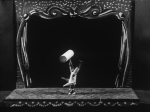 ‘Les frères Boutdebois’ are two wooden puppets who perform some acrobatic tricks against a theatrical backdrop.
The film contains no story and ends abruptly, but the stop-motion is quite good, and an enormous improvement on ‘Japon de faintasie‘. The two puppets seem to have some character, and the trick photography is pretty convincing.
Somehow this short little film seems the direct ancestor of Jan Švankmajer’s stop-motion films, both in animation style and in atmosphere, even though this film lacks Švankmajer’s surrealism (or that of Cohl’s own ‘Fantasmagorie’ for that matter).
Watch ‘Les frères Boutdebois’ yourself and tell me what you think:
‘Les frères Boutdebois’ is available on the DVDs ‘Émile Cohl – L’agitateur aux mille images’
Director: Émile Cohl
Release Date: November 23, 1908
Rating: ★★★★★
Review:
 ‘Le cerceau magique’ starts with a live action sequence taking place in a park.
There a girl brings her broken hoop to her uncle, who conjures a new one, a bigger one, and an even bigger one. The last hoop is a magical hoop, able to change the man’s and girl’s outfits into 16th century costumes.
Happily the girl runs off with the hoop, which leads to a short string of images showing life in 1908 Paris. But at one point she hangs the hoop on a wall, and here the real film starts, because inside the hoop all kinds of images form and move, like origami animals, some dice forming a word, a paper man with a wheelbarrow circling the hoop from the inside, a compass drawing a flowery figure, a moon-face, a clown balancing on his nose, etc. The film ends when the girl takes the hoop from the wall again and bows to the audience, implying that she was the conjurer of these images.
‘Le cerceau magique’ is a unique film because it features both stop-motion and drawn animation. Rarely are these techniques used together. Cohl even adds live action to the mix, leading to a quite enjoyable film, if a rather directionless one. Unfortunately, the surviving print is very bad, and quite a bit of the middle section is indistinguishable through the wearing of the film.
Watch ‘Le cerceau magique’ yourself and tell me what you think:
‘Le cerceau magique’ is available on the DVDs ‘Émile Cohl – L’agitateur aux mille images’
.
Director: Émile Cohl
Release Date: November 12, 1908
Rating: ★★★★½
Review:
 After two drawn animation films of mind-blowing surrealism, Émile Cohl turned down his wild fantasy to tell a much more consistent tale.
‘Un drame chez les fantoches’ tells of a man, who, after being rejected by a woman, enters her house, chases her away and rips off her dress. The woman is rescued by a policeman, who gets awarded for this deed. The evil man gets arrested, but he escapes from jail to beat up another man. In the end the woman declares her love for the policeman, and all four protagonists take a bow to the audience.
‘Un drame chez les fantoches’ is told in the same simple stick man style as ‘Fantasmagorie‘ and ‘Le cauchemar de Fantoche‘, but metamorphosis now is used as a story device to go from one scene to another. At that point the scene devolves into abstract shapes, which then rearrange into another setting. This is a novel and totally unique way of cutting, and it’s a pity it has not been used more often. The cartoon’s clear plot makes ‘Un drame chez les fantoches’ the first drawn film ever to tell a story.
Watch ‘Un drame chez les fantoches’ yourself and tell me what you think:
‘Un drame chez les fantoches’ is available on the DVDs ‘Émile Cohl – L’agitateur aux mille images’
Director: Émile Cohl
Release Date: October 16, 1908
Rating: ★★★★½
Review:
 ‘Le cauchemar de Fantoche’ can be seen as the sequel to ‘Fantasmagorie‘.
Like Cohl’s groundbreaking film, the short consists of a stream-of-consciousness-like series of images, in which metamorphosis and free association run wild. The little clown from ‘Fantasmagorie’ is nowhere to be found, and the hero of this film, despite being called Fantoche as well, is a rather bland stick man, who has to endure quite some body deformations, for example changing into a pumpkin and into an umbrella. At one point he’s even hanged.
Nothing is certain in Cohl’s fantasy world, and ‘Le cauchemar de Fantoche’ is every bit as interesting as ‘Fantasmagorie’, and the only reason it is much, much less known, is because it suffers the fate of simply not being the first.
Watch ‘Le cauchemar de Fantoche’ yourself and tell me what you think:
‘Le cauchemar de Fantoche’ is available on the DVDs ‘Émile Cohl – L’agitateur aux mille images’
Director: Émile Cohl
Release Date: 1907-1909
Rating: ★★½
Review:
 Somewhere before or after his groundbreaking ‘Fantasmagorie’ Cohl explored the older animation technique of stop motion. ‘Japon de faintasie’ is an ultrashort venture into this technique, and the only reason of its existence seems to be the exploration of its possibilities.
Despite its short length of a mere one minute, the film consists of three clear sections: two Japanese figurines moving, a bee moving, and a face changing into a mask that sprouts mice. The film feels like a study, and is not as sophisticated as Cohl’s stop motion films from 1908, like ‘Le cerceau magique‘ or ‘Les frères Boutdebois‘, which points to an early production date.
Watch ‘Japon de fantaisie’ yourself and tell me what you think:
‘Japon de fantaisie’ is available on the DVDs ‘Émile Cohl – L’agitateur aux mille images’
Director: Émile Cohl
Release Date: August 17, 1908
Stars: Fantoche
Rating: ★★★★★ ♕
Review:
 ‘Fantasmagorie’ is without doubt the very first real drawn animation film.
Like Blackton’s films the short starts with a hand drawing a figure. But where Stuart J. Blackton’s ‘Humorous Phases of Funny Faces‘ and ‘Lightning Sketches‘ were pretty static tricks, ‘Fantasmagorie’ is a dazzling series of tableaux, moving into each other through metamorphosis. There’s no plot, but a strong sense of stream-of-consciousness, making this one of the very first surreal films ever.
Apart from the mind blowing images, the film also features the world’s first animated cartoon hero, Fantoche, a clown that starts the film and ends it by riding a horse and waving goodbye. In between, Fantoche keeps appearing, disappearing and changing into things and other characters. At one point he falls and loses his head, and Cohl’s hands have to put him together again. Even though by that time we did know the clown for only a few seconds, this still comes as a rather unsettling event.
Apart from the clown’s death and resurrection, so much is happening on the screen that after a mere two minutes the film leaves the viewer almost exhausted. There’s only one elongated gag, in which a man in a cinema is hindered by the giant head of the lady in front of him. It’s interesting to note that this early experiment of cinema uses its own still fresh medium as a setting.
Cohl’s drawing style is extremely simple, almost naive, and his stick-man-like figures have a child-like charm, which adds to the surrealism of the images. The film is totally devoid of timing, and the fast but steady flow of images give the film its unique character.
By all means ‘Fantasmagorie’ is not only a milestone of animated cinema, it still is a strong film in its own right, perfectly able to mesmerize even after more than a century since its completion.
‘Fantasmagorie’ was most probably Émile Cohl’s first film. He made the short inspired by Blackton’s influential stop-motion film ‘The Haunted Hotel’. Cohl was already 51 when he made this film, yet he would become one of the most prolific animators of all time, completing more than 250 films (not all of them animated) over a span of 13 years. Unfortunately, by the 1930s he was largely forgotten, and in 1938 he died as a poor man, never enjoying a rediscovery like the one that happened to his compatriot and fellow film pioneer Georges Méliès.
Watch ‘Fantasmagorie’ yourself and tell me what you think:
‘Fantasmagorie’ is available on the DVDs ‘Émile Cohl – L’agitateur aux mille images’ and ‘Before Walt’
Director: Berthold Bartosch
Production Date: 1930-1932
Rating: ★★★★★
Review:
 While the cartoon industry flourished in the United States, animation film was developed as an art form in Europe.
In the 1920s Germany had lead the way, with films by Lotte Reiniger, Walter Ruttman and Oskar Fischinger, but by the early 1930’s France had taken over, albeit almost exclusively by foreigners, with great films like ‘Le roman de Renard’ (1929-1930) by Russian animator Władysław Starewicz, ‘Une nuit sur le mont chauve‘ (1933) by his compatriot Alexandre Alexeïeff, ‘La joie de vivre’ (1934) by British artist Anthony Gross and American artist Hector Hoppin, and ‘L’idée’ (1930-1932) by Austro-Hungarian animator Berthold Bartosch (1893-1968).
‘L’idée’ was based on a wordless novel of the same name by Belgian woodcut-artist Frank Masereel (1889-1972), who initially co-operated on the film, until he discovered how laborious animating really was. Masereel’s groundbreaking work has a strong expressionistic quality, which is also very present in Bartosch’s film.
Both the international character and the mood of the wordless film are greatly enhanced by the beautiful musical score by Swiss composer Arthur Honegger, who used the whooping sounds of the Ondes Martenot, an early electronic instrument invented in 1928, to great effects. According to Wikipedia, this makes Honegger’s score for ‘L’idée’ the first film music to employ and electronic instrument.
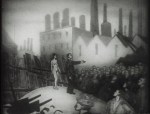
The film tells how an idea can originate and grow, despite dejection, oppression and censorship by the establishment. In practice, Bartosch’s idea has a strong socialist character, becoming an idea of the working class, and being oppressed by clear capitalistic forces. The idea itself is presented as a naked woman, symbol of innocence and purity, and she grows, accompanying the people who become victim of the oppression to the very end. The emotional highlight of the film is when she visits the very person who had invented her the night before his death sentence.
Bartosch had previously worked on Lotte Reiniger’s films, and used her cut-out technique on Frank Masereel’s stark cut-outs to a great effect. The imagery of Bartosch’s film is much more poetic, however, than Masereel’s own work, with a lot of soft-focus, and milky effects, especially on the idea itself, which Bartosch created with the help of soap. The film is also noteworthy for its great sense of depth in some scenes, which can reach a stunning level of complexity. There is for example a scene showing crowds and cars passing by a window, and another with numbers of soldiers marching. Bartosch achieved this sense of depth with a multi-plane camera of his own design, using several glass plates below each other. It’s interesting to note that his device predated Disney’s multiplane camera by five years. True, these soap- and multiplane techniques at times blur the images too much, rendering them too murky to understand what’s happening on the screen, but mostly the film is an excellent example of expressionistic storytelling, and what animation can do.
Unfortunately, the film itself suffered from censorship, delaying its release, which often only happened with an altered, less provocative intro text, and Bartosch never gained any money from it. Nevertheless, it was released in 1934, creating a sensation in Europe, with exception, of course, of Nazi Germany, where it was banned. Bartosch’s second film, ‘Saint Francis: Dreams and Nightmares’ (1933-1938), apparently an anti-war film, was destroyed by the Nazis in World War II. After that Bartosch tried to work on a third film about the Cosmos, but because of his deteriorating health work was abandoned. He devoted the rest of his life to painting. Thus ‘L’idée’ sadly remains his only surviving film, but it’s a great testimony of Bartosch’s art, and without doubt it single-handedly places him in the pantheon of great animation film makers.
Watch ‘L’idée’ yourself and tell me what you think:
‘L’idée’ is available on the Re:Voir DVD ‘Berthold Bartosch – l’idée’
Director: René Laloux
Release Date: January 28, 1988
Rating: ★★½
Review:
 ‘Gandahar’ was to be René Laloux’s last feature, and like his former two feature films, ‘La planète sauvage‘ (1973) and ‘Les maîtres du temps‘ (1982), it’s a science fiction film set on a strange planet.
The film is especially related to ‘Les maîtres du temps’. Not only in visual style, but also with its story line involving mindless oppressors and time travelling. This time we’re on the paradise-like planet Gandahar, which is suddenly attacked by a powerful, yet unknown force. Soldier Sylvain is send away to find out who these enemies are…
‘Gandahar’ is the least successful of Laloux’s features. Its story, based on a 1969 novel by Jean-Pierre Andrevon, is entertaining enough, but the film’s narrative style is terrible. Practically everything that’s happening is explained by the main characters to us, even when we as viewers had come to our own conclusions. This is most preposterous in an early scene in which Sylvain finds his love interest Airelle, who immediately exclaims she’s falling in love with our hero. This must be one of the worst love scenes ever put to the animated screen.
The film’s ultimate villain is rather surprising, as is his downfall, even though he’s killed off ridiculously easily. Strangely enough the creature is given a long death scene, before the film abruptly ends. We don’t even watch Sylvain reunite with his love interest! Not that we did care, anyway, for the film’s main protagonists are as characterless as possible.
It’s a pity, for the film’s aesthetics are quite okay for a 1980s film. The animation, by a North-Korean studio, is fair, if not remarkable, and the designs by French comic book artist Philippe Caza are adequately otherwordly. Sure, he’s no Moebius, let alone a Roland Topor, and he never reaches the strangeness of the latter’s fantastic planet from 1973. In fact the film rarely succeeds in escaping the particularly profane visual style of the 1980s (e.g. ‘Heavy Metal’). Most interesting are the backgrounds, and Gabriel Yared’s musical score, which is inspired and which elevates the film to a higher level.
Watch ‘Gandahar’ yourself and tell me what you think:
Director: Michel Ocelot
Airing Date: December 21, 1983 – ?
Rating: ★★★½
Review:
 After the artistic successes of ‘Les trois inventeurs‘ (1979) and ‘La légende du pauvre bossu‘ (1982) Ocelot turned his skills to a gentle and entertaining television series for children.
The series, called ‘La princesse insensible’ (the insensitive princess), consists of thirteen episodes and has a very simple story line: a princess is so bored that nothing can amuse her. The king declares that when a prince manages to amuse the princess nonetheless, he will win her. In the 4 minute long episodes we watch several young princes, sorcerers in fact, trying to amuse her in her own theater, all in vain.
‘La princesse insensible’ uses a mixture of traditional and cut-out animation. Ocelot’s animation may be simple, no doubt due to a limited budget, but it’s very effective in its pantomimed action. The series’ design is elegant in its recreation of an 18th century atmosphere. The framing story is told in silhouettes, reminiscent of the work by Lotte Reiniger, but the theater scenes are in bright colors. The atmosphere is fairy-like and surreal throughout, helped by Christian Maire’s otherworldly music. In all, ‘La princesse insensible’ is a little charming series, which shows Ocelot’s delicate and unique voice in the animation world.
The separate episodes of ‘La princesse insensible’ are listed below:
1. Le Prince dompteur (The Tamer Prince)
This episode tells the framing story and shows us the first prince. He has a menagerie of trained fairy tale animals: a unicorn, a three-headed dog, a Chinese dragon and a phoenix.
2. Le Prince jardinier (The Gardener Prince)
The second episode, like all following episodes of ‘La princesse insensible’, starts without the framing story. Instead the story is told in the title song. After the intro, we watch the second prince performing right away. He’s a garden prince, able to make plants and flowers grow on the bare floors and pillars of the princess’s theater. When he fails to impress the princess, he disappears on an ever-growing tree.
3. Le Prince à transformations (The Transforming Prince)
The third prince trying to impress the insensible princess is the most interesting to animation fans. Being called the metamorphosis prince, he’s able to transform himself into all kinds of people and things. Ocelot uses some beautiful metamorphosis animation in doing so. The prince’s performance builds up to a great finale, in which the prince transforms himself into seemingly hundreds of things, which is depicted by the rapid showing of random pictures. This simple device works because we’ve seen the process of transformation just before that. It also adds a humorous touch to the fairy-like atmosphere, because many of the objects are anachronisms in the 18th century setting.
4. Le Prince sourcier (The Dowser Prince)
The fourth prince, the ‘diviner prince’, is able to sprout water everywhere, using a divining-rod, turning the princess’s theater into a fountain. One of the more fairy-like episodes of ‘la princesse insensible’, ‘Le prince sourcier’ is less impressive than the first three episodes. After these three, the diviner prince even fails to impress we viewers.
5. Le Prince qui fait semblant (The Pretender Prince)
The fifth prince trying to impress the princess is almost typically french: he’s a mime artist, miming (among others) that he plays the piano, rides a bicycle and even a motorcycle inside the princess’s theater. When he fails to impress the princess he even mimes that he commits suicide. Like ‘le prince à transformation’ this episode has an extra touch because of the anachronisms.
6. Le Prince météorologue (The Meteorologist Prince)
The sixth prince is called the weather prince, and he’s able to make clouds dancing within the princess’s theater. He also makes rain, lightning and a rainbow. When he leaves the princess unimpressed, he covers himself in snow. One of the lesser episodes of ‘la princesse insensible’, ‘le prince météorologue’ nevertheless shows Ocelot’s fantasy. When one doesn’t expect any more meteorological wonders, the prince transforms the rainbow into numbers and patterns.
7. Le Prince sous-marin (The Underwater Prince)
The seventh prince arrives in a fish-like submarine inside an enormous fish-tank. Compared to the other princes, his antics are relatively believable, although he seems to have the ability to make fish forming patterns. This episode is one of the lesser entries in the series, despite the beautiful old-fashioned design of the princes’ submarine.
8. Le Prince volant (The Flying Prince)
The eight prince, the flying prince, looks like a Japanese superhero with wings. During his flight, we see more of the theater than in any other episode. Apparently there’s more public than the princess alone.
9. Le Prince décorateur (The Decorator Prince)
The decorator prince is able to turn the complete theater upside-down, to change its colors by clever lighting. When the princess is unimpressed as ever, he descends into the basements.
10. Le Prince magicien (The Magician Prince)
This prince is called the ‘magician prince’, even though many of the other princess were skilled magicians as well. The prince enters on a flying carpet and turns the pillars of the theater into palm trees, the chandelier into a beach ball and the stone ornaments into butterflies. Then he turns his own hat into a zeppelin and the furniture into a train. Enraged by the princess’s non-reaction, the prince makes everything disappear again, including the theater and himself.
11. Le Prince peintre (The Painter Prince)
The Painter prince episode, unlike the other episodes, has some false starts, as the prince repeatedly forgets something he needs to paint his enormous canvas. The painter exactly copies the theater on his canvas, then paints a happy portrait of the princess. But when she remains unimpressed, he violates his own drawings. It’s charming to see the shadows of Ocelot’s paper figure of the painter, while he’s painting the enormous canvas. It gives the series its handicraft appeal.
12. Le Prince artificier (The Artificer Prince)
The fireworks prince, like the painter prince, knows some false starts, when he has troubles preparing the fireworks in the dark. The fireworks effects are created nicely with kaleidoscope effects into beautiful abstract patterns. The prince also illuminates the theater with neon lights. In the end the prince disappears on a rocket, after which the complete theater explodes.
13. Le Prince écolier (The Schoolboy Prince)
The last prince, ‘the schoolboy prince’, is much less skilled than the other princes, but he immediately solves the princess’s problem: she appears to be terribly nearsighted, and he helps her with his glasses. They are married, and the other princes perform for the princess once again, which leads to a sequence with highlights from the previous episodes.
‘La princesse insensible’ is available on the DVD ‘Les trésors cachés de Michel Ocelot’
Director: Albert Barillé
Airing date: April 2?, 1983
Rating: ★★★★
Review:
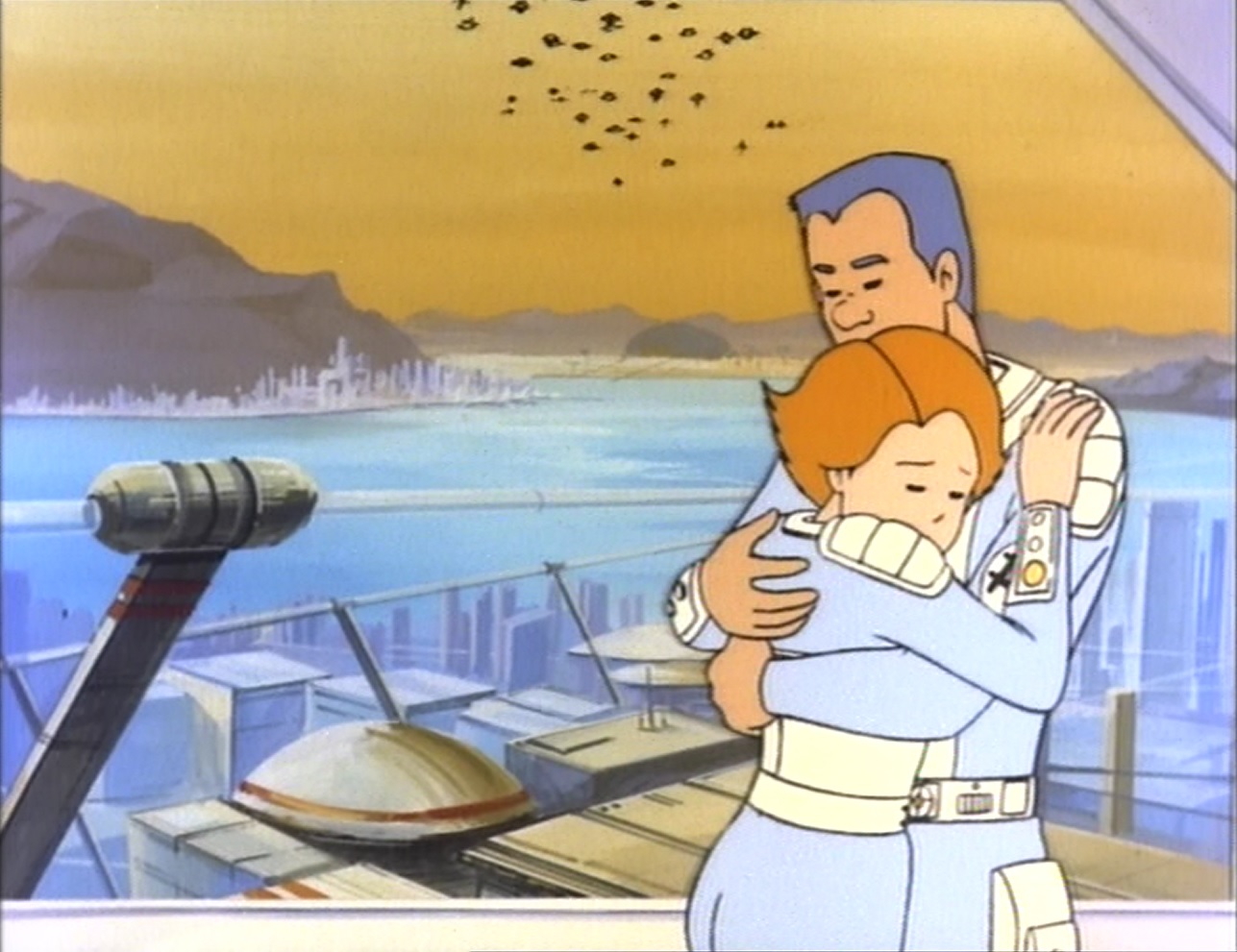 With ‘L’infini de l’espace’ Albert Barillé rounds up his personal science fiction story, which is the series ‘Il était une fois… l’espace’ (Once Upon A Time Space).
After the computer society had brought the constellation of Cassopeia to its knees, it has issued the same ultimatum to Omega. The episode opens with the council of Omega rejecting it, in name of the ‘dignity of man’. Nevertheless, after the gruesome defeat of Cassiopeia in ‘Combat de titans‘ the intergalactic bond knows it doesn’t stand a chance, and most of the episode has an atmosphere of inescapable doom, with an added dose of melodrama.
Maestro and Metro set off to try to find a way to penetrate Yama’s strong defense field, but soon Maestro takes a different path, a spiritual one, in which he apparently meets Psi’s mysterious visitors, who are the possessors of the mysterious vessel in episode 1. It’s these mysterious superbeings that finally pop up as a deus ex machina, destroying Yama’s whole fleet with help of an unstable star in a matter of seconds. After the strong apocalyptic build up of the last three episodes, this announced yet all too easy solution comes a bit as a letdown.
The episode ends with an encounter with the more advanced species, in a scene reminiscent of the great science fiction movies ‘2001: A Space Odyssey’ (1968) and ‘Close Encounters of the Third Kind’ (1977). The aliens tell our heroes that their help in this case was an exception, and that mankind should find its own way to the next, immaterial stage, through a path of kindness, tolerance and wisdom. The series ends with Psi remarking that they themselves had said something of the same kind to the primitive Cro-Magnon people in episode 5.
In a way the ethereal aliens are arguably as patronizing as the emotionless robots of Yama had been, but the aliens’ ways show a confidence in and compassion with mankind, which Barillé strongly juxtaposes to the cold reasoned violence of the computer superpower.
Thus ends ‘Il était une fois… l’espace’. The series probably has known few reruns, if any at all, and is not as well-known as its successor, ‘Il était une fois… la vie’ (Once Upon A Time… Life), let alone contemporary American series like ‘He-Man and the Masters of the Universe’ or ‘The Smurfs’. Unlike the creators of those latter two series, however, Albert Barillé dared to take children seriously, sharing with them his views on more mature subjects like politics, philosophy, spirituality and mankind itself. I was one of those kids, and I thank him for it.
Watch ‘L’infini de l’espace’ yourself and tell me what you think:
This is the 26th and last episode of ‘Il était une fois… l’espace’ (Once Upon a Time… Space)
To the 25th episode: Combat de titans (The Battle of the Titans)
Director: Albert Barillé
Airing date: March 26?, 1983
Rating: ★★★★★
Review:
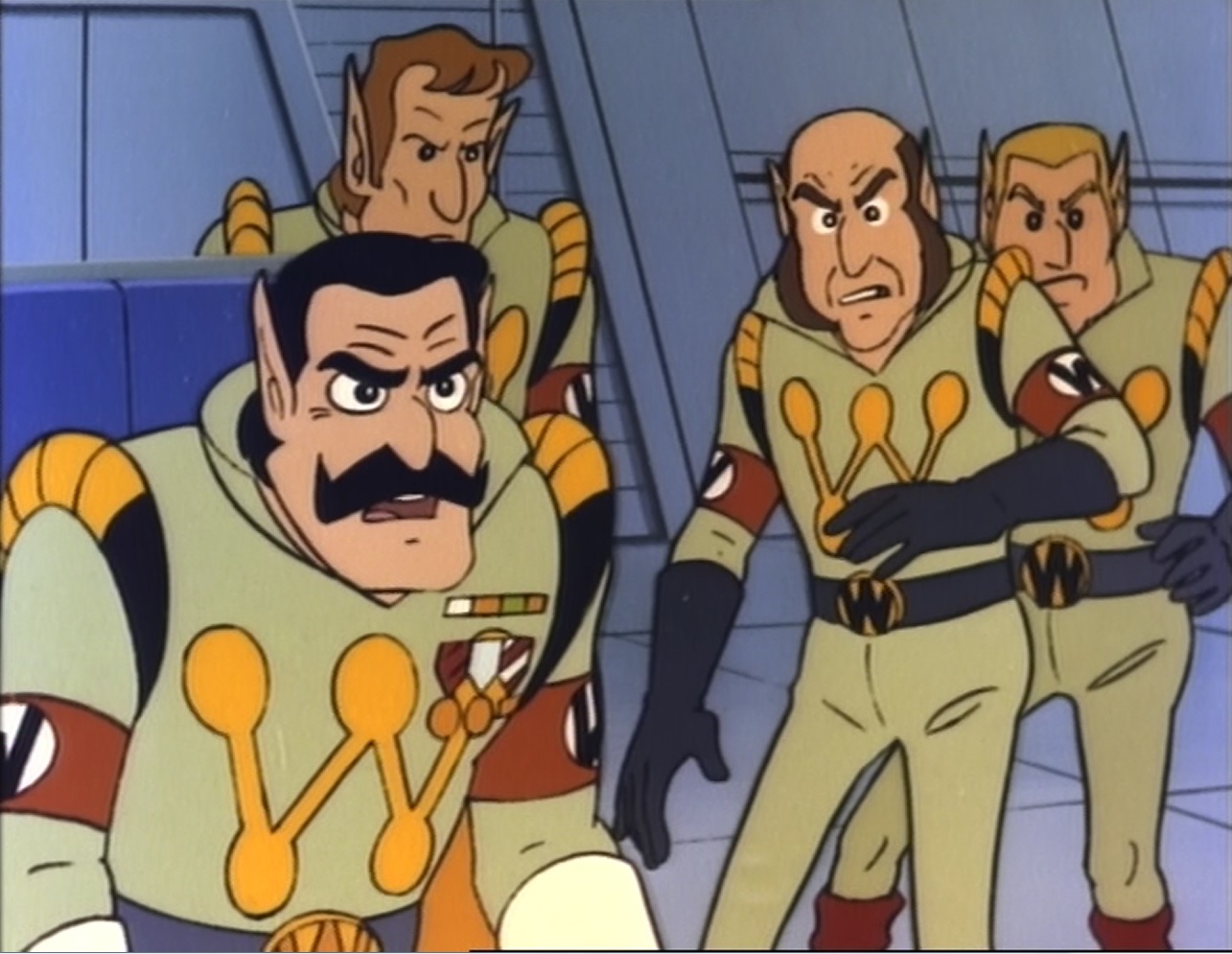 In the opening scene of this next to final episode, Cassiopeian general Teigneux (Pest) convinces his senate to give an ultimatum for unconditional surrender to Omega. But then he himself gets the same ultimatum from his former ally, Yama…
The general’s reaction is to arrest his senate, taking the final step to become a full dictator at last, and to declare war on Yama. Meanwhile on Omega Pierrot conceives a plan to harm the robot enemy from the inside, which he performs not only with the faithful Psi and Metro, but also Le Petit Gros and his girlfriend, Pierrot’s sister. By trickery, the five manage to be brought inside a Yama cruiser, where Pierrot places a bomb.
Some excitement is added, when after having placed the bomb the five are having difficulties leaving the ship, especially when Metro forgets an important code. Nevertheless, it’s the politics and the depressing battle scenes of Cassopeia’s ill-fated war that impress the most, not the antics of our heroes.
Yama’s might is shown by images literally flooded by space ships, and by battle scenes in which Cassiopeian cruisers are shot to pieces with a frightening ease. Nevertheless Le Teigneux persists almost to the very end, with his subordinates obeying with the motto of ‘Befehl ist Befehl‘. Thus Cassopeia heads to its own mass destruction, similar to Germany and Japan in World War II. Only when Yama threatens to blow up the entire planet of Cassiopeia itself, Le Teigneux gives in, and surrenders unconditionally. Now it will be Omega’s turn…
This episode’s images of war and mass destruction are very disturbing, and in no sense Barillé glorifies war, on the contrary. Although they had been the stock enemy in the past, the viewer is invited to sympathize with the Cassiopeians. Teigneux’s admiral is seen repeatedly in utter distress, torn between the general’s bullheadedness and the sheer hopelessness of his own duty, with his subordinates mourning the loss of human lives. Barillé raises the very question what cause would justify such loss, leaving the answer to the viewer. This is a very different take on war than the heroism of Star Wars, and a much more mature one, despite being aimed at children.
Watch ‘Combat de titans’ yourself and tell me what you think:
This is the 25th episode of ‘Il était une fois… l’espace’ (Once Upon a Time… Space)
To the 24th episode: Le grand ordinateur (The Great Computer)
To the 26th episode: L’infini de l’espace (The Infinity of Space)
Director: Albert Barillé
Airing date: March 19?, 1983
Rating: ★★★★★
Review:
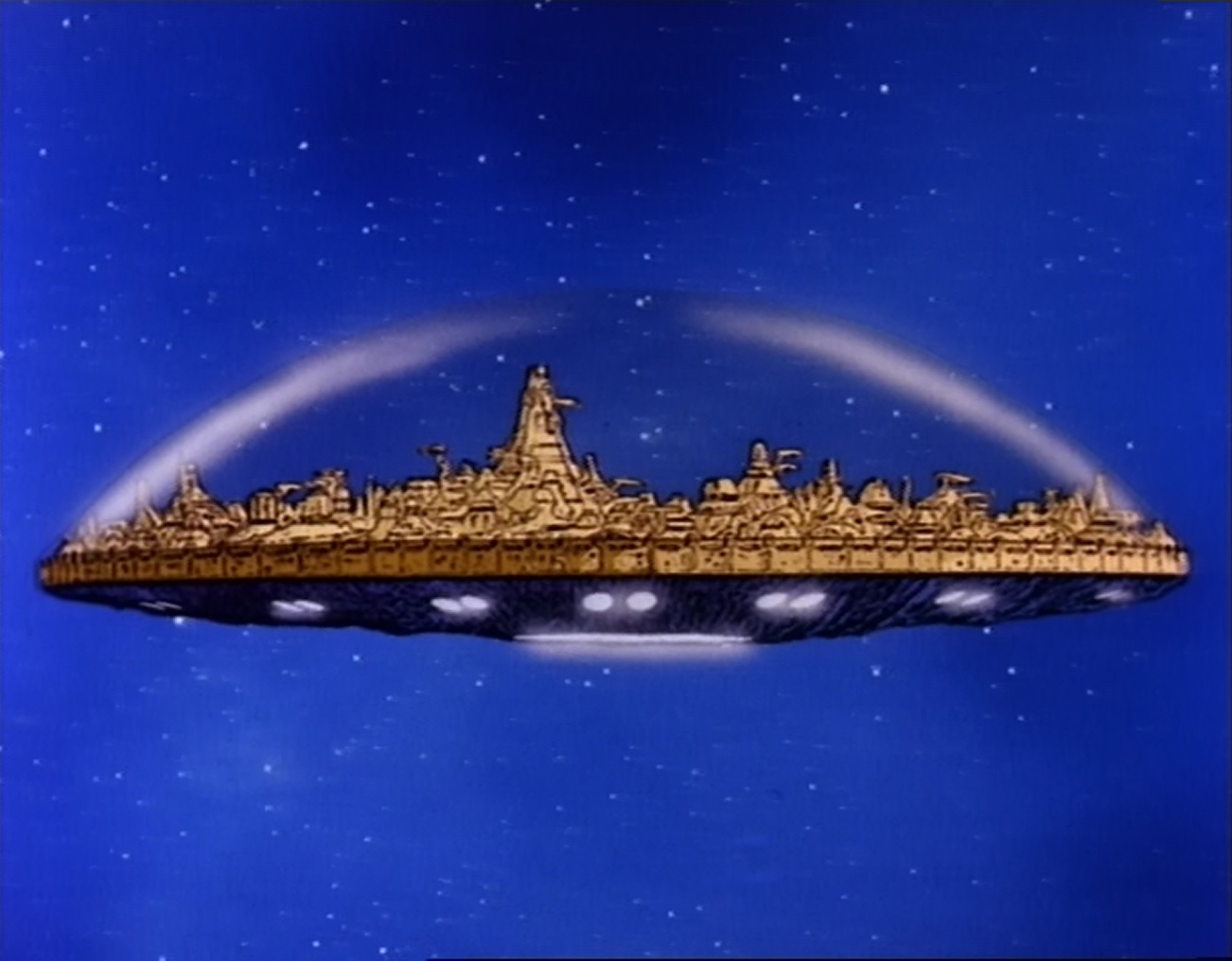 ‘La grand ordinateur’ completely takes place in the robot city that took flight in the previous episode, ‘Cité en vol‘.
First we watch Pierrot and Metro wandering endless corridors in search for Psi. Then the flying city invites Omega’s large space ship inside, which is dwarfed by the gigantic city. Inside, colonel Pierre and Maestro from the ship are soon reunited with Pierrot, Psi and Metro, and we meet the great computer itself at last, which is the robot city of Yama itself.
The great computer tells about its origin and how it has been behind every robot scheme in the series (e.g. the robot revolt in ‘La révolte des robots‘, and the doomsday rocket in ‘L’imparable menace‘). It reveals its ultimate plan, which is to stop man from its own inclination to violence. It does so by taking total control of humanity, so “no man will ever know any pain or sorrow again”. In the end the great computer shows its immense war fleet, and sends our heroes back to Omega with its message.
This episode is hampered by some odd staging, and at times terrible drawings of our heroes, but it’s also arguably Barillé’s most daring episode: a great deal of it is filled with a philosophical discussion on questions like what makes man human? Is it allowed to sacrifice lives for the greater good? And is violence to end all violence ethical? Bold subjects for a children’s series, indeed!
Both the great computer’s reasoning and action are very believable, and its consequences food for thought. It’s ironic how its destructive approach is fueled by a wish to end all violence. It makes it one of the most interesting villains ever put to the screen, especially because it’s not really visible.
Watch ‘Le grand ordinateur’ yourself and tell me what you think:
This is the 24th episode of ‘Il était une fois… l’espace’ (Once Upon a Time… Space)
To the 23rd episode: Cité en vol (City in Flight)
To the 25th episode: Combat de titans (The Battle of the Titans)
Director: Albert Barillé
Airing date: March 12?, 1983
Rating: ★★★★
Review:
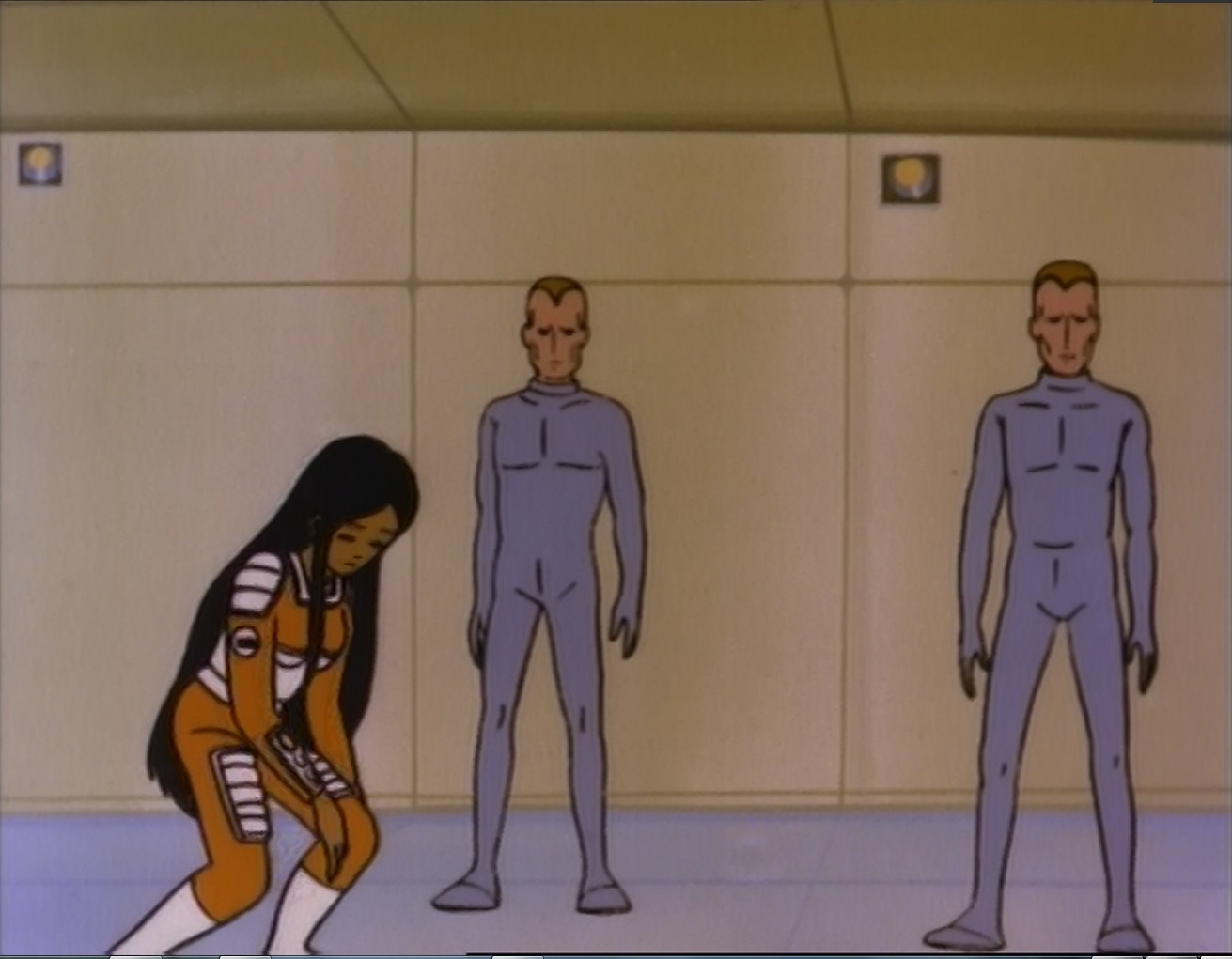 ‘Cité en vol’ is the third of six episodes, which form the finale of ‘Il était une fois… l’espace’.
This episode starts with Pierrot and Murdock flying to the hostile planet of Yama. Yama is overtly similar to Mos Eisley from ‘Star Wars’ (1977), and Pierrot and Murdock walk around like jedis. At Yama they ally with a rebel group, and together they try to enter the center of the city, which is pure robot territorium. Unfortunately, the robot city is well-guarded…
Meanwhile the humanoids try to get to the secrets of Psi’s psychic powers. As Pierrot reveals to Murdock, if they’ll succeed nothing will be able to stop them. At one point they get help from a Cassiopeian telepath, and he and Psi have a telepathic mind battle, which is a nightmarish variation on the battle between Merlin and Madam Mim in ‘The Sword in the Stone’ (1963). This scene, with its continuous metamorphosis, arguably is the most impressive piece of animation of the entire series, even if it’s still nowhere near the Disney animation that might have inspired it.
Although most of this episode is about Pierrot trying to get inside the robot city, it also hints at the real dangers the humanoids form. They call ambassador Le Nabot (Dwarf) a fool behind his back, and continuously refer to a secret plan. At the end of the episode the robot city takes flight, giving the episode its name. This concept Barillé undoubtedly borrowed from James Blish’s science fiction book series ‘Cities in flight’, which appeared between 1955 and 1962.
The importance of this event will only be revealed later, but it’s clear that Pierrot made it inside just in time. Unfortunately, it does kill Murdock, the only human being killed on screen in the entire series, a death that made a strong impression on me when I was a kid.
Watch ‘Cité en vol’ yourself and tell me what you think:
This is the 23rd episode of ‘Il était une fois… l’espace’ (Once Upon a Time… Space)
To the 22nd episode: Un monde hostile (A Hostile World)
To the 24th episode: Le grand ordinateur (The Great Computer)
Director: Albert Barillé
Airing date: March 5?, 1983
Rating: ★★★★
Review:
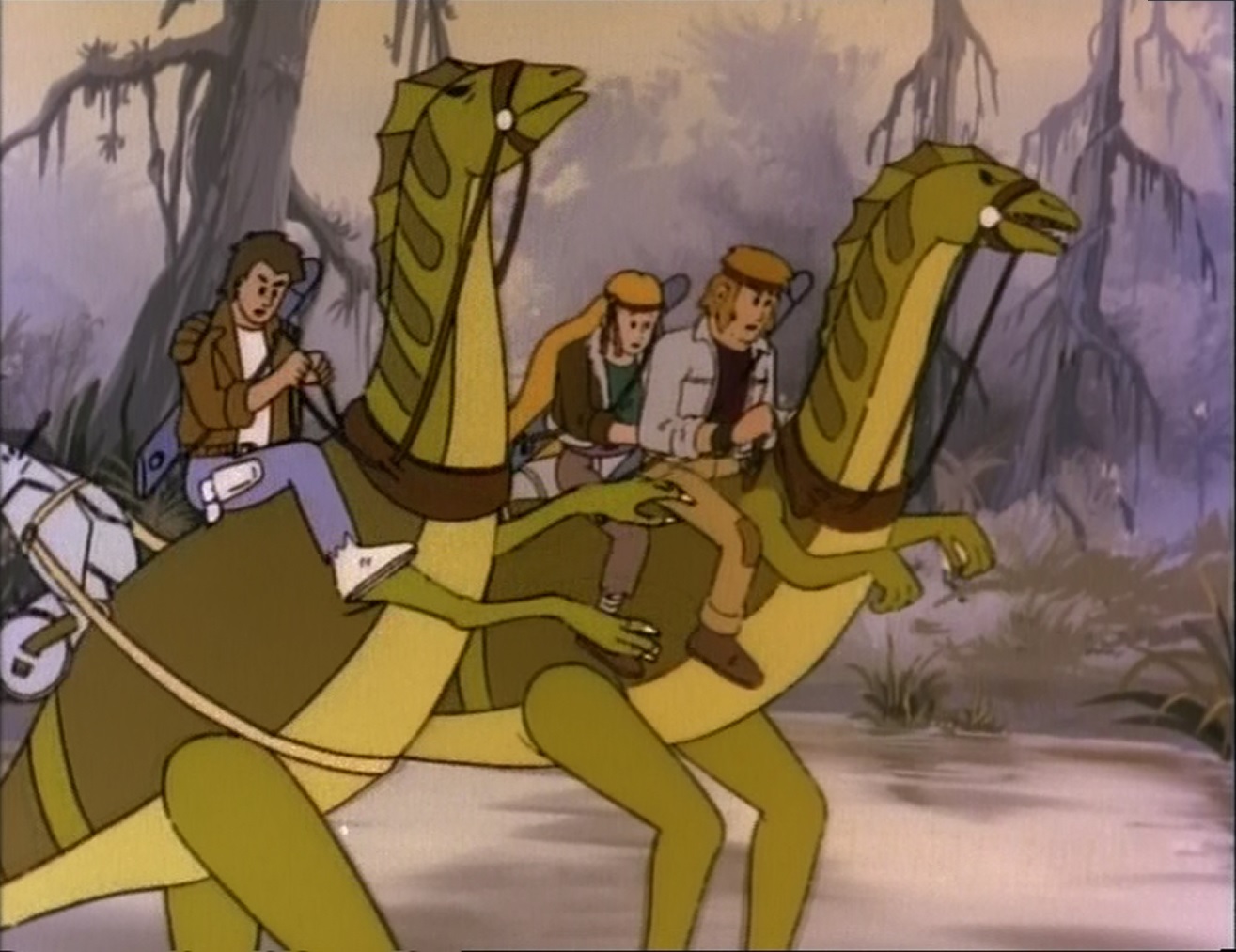 ‘Un monde hostile’ is the exciting second of six episodes, which form the finale of ‘Il était une fois… l’espace’.
It immediately starts where ‘Les humanoïdes‘ left off, with Pierrot’s ride through the hostile world of Apis. Practically the complete episode is devoted to Pierrot’s journey.
Meanwhile Psi is visited by Le Nabot (Dwarf), who’s actually proposing to her. Because Psi’s certain Pierrot will come to rescue her, she accidently reveils that he’s not dead, endangering his life. Le Nabot immediately restarts the search for our hero. He succeeds in destroying their mounts, and Pierrot and his fellow travellers have to continue on foot.
Soon however they’re are captured by bandits, whose captain turns out to be Murdock, the very man they seek. After some discussion, Murdock decides to help our heroes, and the episode ends with them flying to the neighboring planet Yama…
Because of its one-dimensional subject (Pierrot is travelling to Murdock’s place throughout the picture), ‘Un monde hostile’ is a little less compelling than the other final episodes. But on the way Sylva provides some necessary background information, which will be expanded upon in the following episodes.
Watch ‘Un monde hostile’ yourself and tell me what you think:
This is the 22nd episode of ‘Il était une fois… l’espace’ (Once Upon a Time… Space)
To the 21st episode: Les Humanoïdes (The Humanoids)
To the 23rd episode: Cité en vol (City in Flight)


 Dr. Grob's Animation Review