
You are currently browsing the category archive for the ‘European films’ category.
Director: Ryszard Czekała
Release date: 1970
Rating: ★★★★½
Review:

If ‘Syn‘ was an unsettling watch, ‘Apel’ is no less than a grueling. Set in a German concentration camp, the film shows a Nazi officer commanding a large group of prisoners to bow and to rise, over and over again. Then one of them refuses to bow…
‘Apel’ is an extreme film, not only in concept, but also in execution. Czekała uses very original cinematography and extreme ‘depth of field’, with large parts of his drawing being out of focus. Especially the shot in which the Nazi officer walks by rows and rows of people is particularly impressive, and it’s unclear to me how Czekała reached this effect. The film is as bleak as can be, and quite an unpleasant watch, but Czekała’s mastery of the animated form is undeniable.
Watch ‘Apel’ yourself and tell me what you think:
‘Apel’ is available on the DVD-set ‘Anthology of Polish Animation’ and on the DVD box ‘Annecy – Le coffret du 50e Anniversaire’
Director: Daniel Szczechura
Release date: 1970
Rating: ★★★½
Review:
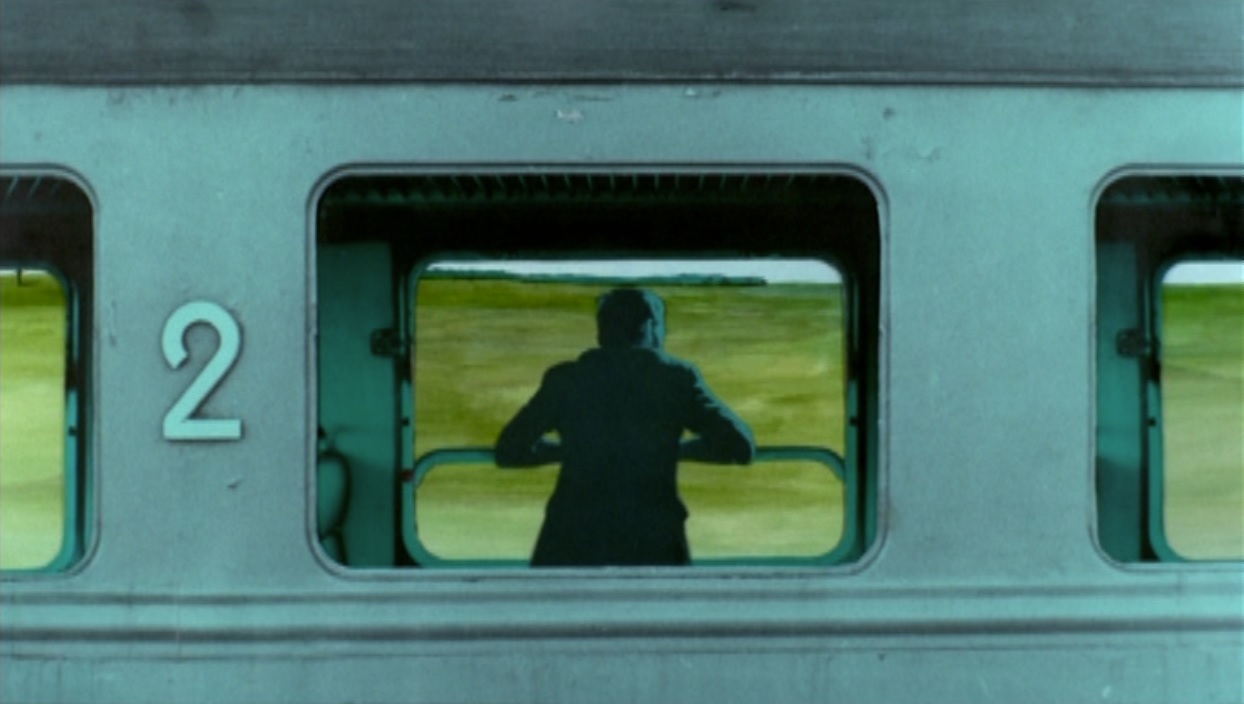
‘Podróż’ (The Journey) is a Polish avant-garde film in which a man makes a rather pointless train trip to a house somewhere in the countryside.
For a large part of the short we watch the man in the train from the back, while he stares at the countryside floating by his window. There’s constant movement, but barely any animation. During the train sequence, for example, the train itself and the man remain completely static. When the man walks towards the house this is done in a sequence of stills, not in animation.
Nevertheless, the film intrigues because of its original visual style and because of its extreme soundtrack by Eugeniusz Rudnik using unsettling mechanical sounds.
Watch ‘The Journey’ yourself and tell me what you think:
‘The Journey’ is available on the DVD-set ‘Anthology of Polish Animation’
Director: Ryszard Czekała
Release date: 1970
Rating: ★★★
Review:
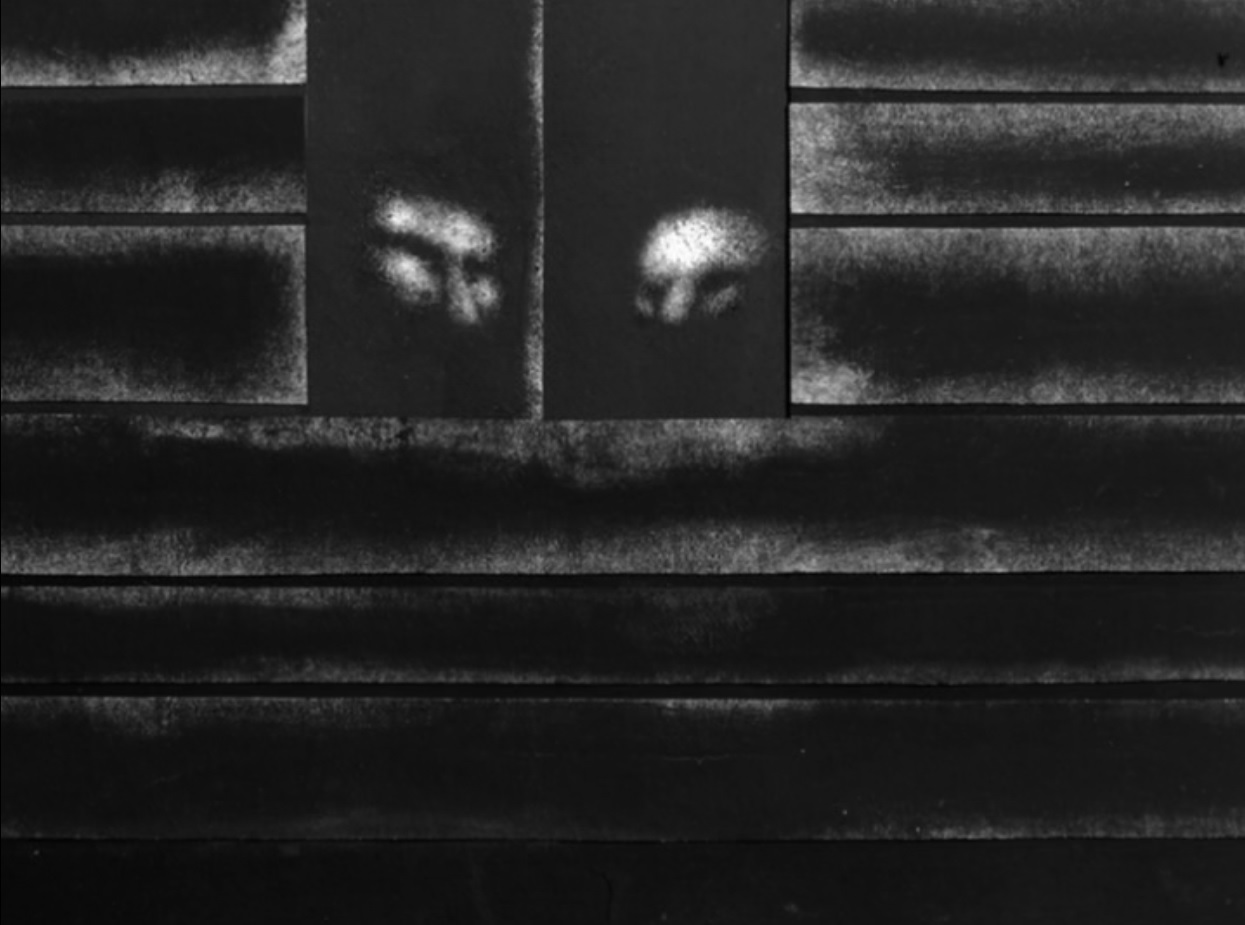
In ‘Syn’ (The Son) an old couple at the countryside wait for their son, who has gone off to lead a different life in the city. But when he arrives at his parental home, his visit turns out to be a deception.
‘Syn’ shows Ryszard Czekała’s original style: the film is in black and white, and features a very original cinematography: altering extreme close-ups of hands, ears and such with strange depictions of the barren wintery landscape, with the ground filling up almost the complete frame.
The story is told without dialogue, and because of Czekała’s extreme graphical style, rather hard to follow. Most striking is the sound design, which arguably is as important as the imagery. The result is a puzzling, but quite unsettling and bleak short.
Watch ‘The Son’ yourself and tell me what you think:
‘The Son’ is available on the DVD-set ‘Anthology of Polish Animation’
Director: Valentin Karavaev
Release date: 1970
Rating: ★★
Review:

‘A Lesson Not Learned’ is a rather blatant and vicious Soviet propaganda film suggesting that West Europe is led by fascists trying to restore the Germany of old.
The film starts with images from World War II, accompanied by the sounds of bombs and gunfire. Then we cut to an old Nazi in sheep’s clothing, who seeks refuge in the American-British zone. Accepted and retired, the old Nazi preaches ‘revanchism’, in order to restore Germany’s borders from before World War II. However, he is stopped by the Berlin wall and the peace treaty signed between the USSR and the DDR, in which the current borders are accepted.
This film uses a satirical style more reminiscent of the forties than of the seventies, rendering an old-fashioned imagery. The best idea is the little Hitler angel helping the old Nazi. There’s no dialogue. For example, when the old Nazi starts to speech, we only hear the sound of guns. There’s pretty little animation and the message is emphasized with writings as in political cartoons.
It’s hard to watch a film so full of lies, which shows that up to its very end the Soviet Union partly based its legitimation on the idea that its existence was the only way to stop fascism. And the saddest thing is that the current Russian regime has revived this falsehood to defend its current war in the Ukraine.
Watch ‘A Lesson Not Learned’ yourself and tell me what you think:
‘A Lesson Not Learned’ is available on the DVD set ‘Animated Soviet Propaganda’
Director: Bibo Bergeron
Release date: October 12, 2011
Rating: ★★★½
Review:

‘Un monstre à Paris’ is a charming and friendly French computer animation film by Bibo Bergeron who not only directed the film, but also wrote both the story and the screenplay.
The film is set in Paris in the winter of 1910 when the river Seine caused an enormous flood in the French capital. During this winter small and timid projectionist Émile and brassy, irresponsible delivery driver and inventor Raoul create a monster by accident. But cabaret singer Lucille discovers that this monster has surprising talents. Meanwhile, arrogant, and ambitious police commissioner Victor Maynott has his own plans with both Lucille, the monster, and the Great Flood. There’s also a proboscis monkey called Charles, who talks with reference cards, an idea that also occurs in Aardman’s ‘The Pirates! In an Adventure with Scientists!’ from a year later.
‘Un monstre à Paris’ knows quite a number of characters and has arguably three main protagonists. But Bergeron plays out his story surprisingly well, giving ample time and background stories to all three of them, even if the one of Raoul and Lucille only arrives during the end titles. The film is very talkative, but not too much so, and has its focus and heart firm in place. The action and drama are further ornamented with several little gags, which never ask too much attention. The best gag may be when Maynott’s balloon starts to lose helium.
In fact, Bergeron envisioned the city of Paris as the film’s main character, and indeed, the movie uses wonderful images of the great city, not only in computer animation, but also by classic matte paintings. Bergeron’s Paris, realized by Sébastian Piquet, is crooked, asymmetrical, and rather ramshackle character, which is always pleasant to look at. In addition, in several scenes the metropolis is clouded in mist, which give the backgrounds and settings an extra poetical atmosphere. Moreover, Bergeron’s Paris is a very, very familiar Paris, also to people who’ve never been there: the film takes mostly place in Montmartre, with the finale taking place on the Eiffel tower, both locations well-known to almost everyone.
Christophe Lourdelet’s character designs are a bit of a mixed bag: the male characters are all firmly rooted in the Franco-Belgian comic tradition, especially Raoul and inspector Pâté. The women Lucille and Maud (Émile’s love interest) on the other hand, have more generic 3D computer animation designs, with all too large eyes and all too slender bodies. The monster is well-designed, being both large and overpowering and delicate and friendly. He looks best when given an Aristide Bruant-like hat and shawl. In that respect the later zoot suit is way off for a film set in 1910.
The animation, directed by Fabrice Joubert, is fair, but not outstanding, and although the film makers are very proud of the dance scenes, the dance moves herein come over as stiff and unnatural. Worse are Lucille’s performances of the song ‘La Seine’. It seems the film makers didn’t know what to do with her long slender arms, which are all over the place. Compare the animation of Lucille with Preston Blair’s animation of Red in e.g., ‘Red Hot Riding Hood’ (1943) and the difference between an approximation of natural movement and natural song and dance animation becomes clear. The effect animation, on the other hand is fine: the water, the clouds and the mist all look very fine.
The songs are quite out of tune with the otherwise faithful 1910 setting, being all too modern and typical products of 2011, not 1910. Composer M (Matthieu Chedid) also provides the monster’s voice, singing in a very high voice, apparently to accentuate the creature’s innocent, childish and fragile nature. Lucille is lovely voiced by Belgian singer Vanessa Paradis of Eurovision Song Contest fame, and her rendering of ‘La Seine’ is very pleasant, even if the song doesn’t sound like a French cabaret song of the 1910s, at all.
In all, ‘Un monstre à Paris’ is not perfect, but certainly well-told and entertaining. The film may be more conventional than contemporary French films like ‘Une vie de chat’ (2010), ‘Le tableau’ (2011) or ‘Ernest & Célestine’ (2012), it still shows the extraordinary rich breeding ground of animation that France has been in the 21st century thus far.
Watch the trailer for ‘A Monster in Paris’ yourself and tell me what you think:
‘A Monster in Paris’ is available on Blu-Ray and DVD
Directors: Kresten Vestbjerg Andersen, Thorbjørn Christoffersen & Philip Einstein Lipski
Release date: September 29, 2011
Rating: ★★★
Review:

Arguably the least serious animated feature to be released in 2011 is a surprising little entry from Denmark called ‘Ronal the Barbarian’. The film is set in a bare fantasy world called ‘Metallonia’, and makes fun of many sword and sorcery tropes, as well as ‘Lord of the Rings’ and several leather metal cliches from the early eighties. Especially fans of Judas Priest should be delighted. In this respect, the end song accompanying the end titles is one of the film’s highlights, spoofing e.g. Led Zeppelin and Queen.
With its men walking around in tiny strings, with its lusty amazonians, with an oracle on a toilet, and with its many references to sex this could be a film too immature for its own good, but actually, the film makers play their story surprisingly straight, and despite all the parody and nonsense the film does have heart. It does help that fun is made of both male and female characters, and neither the overblown machos nor the incapable amazonians can be taken too seriously.
‘Ronal the Barbarian’ tells about Ronal, the only barbarian of ‘the tribe of Kron’ to be feeble, cowardly, and weak. When on one day his whole tribe is kidnapped and taken away, he must go on a dreaded quest, helped by an oversexed teenager bard called Alibert, by a very strong and heroic “shield maiden” called Zandra, and by a rather silly hippie-like elf called Elric.
Unfortunately, the characters are little more than vignettes. Ronal, to begin with, has little to counter his weakness. He seems to be a bit smarter than his fellow tribe members, but he’s far from cunning, and certainly not instantly likeable: during the first half of the film, he’s often whining and moaning, which makes the budding love story between him and Zandra hard to believe. Ronal’s transition to a more heroic character is more believable, especially because he remains clumsy and weak until the very end.
Alibert, too, is a character on the shallow side: his interest in dames is practically his only character trait, and he fails as comic relief, but not as a friend. In the end, he is as loyal to Ronal as Sam to Frodo. Elric isn’t a round character at all, but a pure caricature of everything elfish as depicted in Peter Jackson’s ‘The Lord of the Rings’ trilogy. Most interesting of the four is shield maiden Zandra, because she must deal with a tradition that is a curse to her. Zandra’s subplot is vital to the film and make it into a deeper product than could be expected.
Unfortunately, Zandra is not designed too well. Her eyes remind too often those of South Park characters, and she’s depicted as being quite stout and clearly older than the puny Ronal, making their romance less likely, again.
The quest story ticks all the familiar boxes: there’s an evil and almost invincible opponent, there’s a heavily guarded hidden kingdom, there’s a legend important to the plot, and there’s even room for the all too obligate breakup scene so common in animation films these years. And, of course, Ronal does grow into the hero he has to be in the end. But I must say the film makers tell their tale well, and there are no dead points or superfluous scenes during the film whatsoever. The focus stays with Ronal most of the time, and even when it doesn’t, the scenes still serve the plot completely.
For a European film the 3D computer animation is fair, if not outstanding. The rendering is on the poor side, but it does its job, and the world building is convincing enough for the story. The animation, too, is most of the time okay if nothing to write home about. Especially the animation on lesser characters is visibly mediocre, and there’s little character animation, although the animators do their best in two scenes in which the thought processes of respectively Ronal and Zandra are depicted. But, as most of the action is far from serious, and even rather silly, most of the animation does its job quite nicely. Like the designs, the animation is often broad and jerky, enhancing the comic effect. The effect animation itself, too, is excellent, and helps the world building a lot, especially during the finale.
‘Ronal the Barbarian’ is no masterpiece, but as said, the film is told well, and accounts for 90 minutes of pure fine entertainment. It’s no more than that, but the film clearly doesn’t aspire to. So I’d say: quest fulfilled!
Watch the trailer for ‘Ronal the Barbarian’ yourself and tell me what you think:
‘Ronal the Barbarian’ is available on Blu-Ray and DVD
Director: Robert Proch
Release date: 2010
Rating: ★★★★
Review:

In ‘Galeria’ a woman goes shopping, accompanied by her husband, while their bull terrier has to wait outside.
Robert Proch treats this simple and rather boring subject with the greatest of elegance. His film is rendered in black and white only, with some occasional reds, and the semi-abstract pen drawings burst with animated life.
Add some original stagings, some great metamorphosis, a rather associative way of story-telling, and an excellent score by Tupika, and we can conclude that ‘Galeria’ is one of those shorts that shows what animation can do. Despite its dull subject matter, ‘Galeria’ is a triumph of imagination, and its dance-like quality is a delight to watch throughout.
Watch ‘Galeria’ yourself and tell me what you think:
‘Galeria’ is available on the The Animation Show of Shows Box Set 7
Director: Tomer Eshed
Release date: June 23, 2011
Rating: ★★
Review:

‘Flamingo Pride’ tells about a flamingo who’s apparently the only straight guy at an enormous gay dance festival. Then he falls in love with a female stork flying by…
‘Flamingo Pride’ turns the tables around, making being straight the minority. That is, in the flamingo community, because outside their own festival all birds seem to be straight and having classic role patterns.
It’s not very clear what the film tries to tell us. For starters it is a bit confusing that apparently all flamingos are gay, and none of the other birds is. Moreover, the gay flamingos pretty much look like gay stereotypes. None of them, not even ‘our hero’ has a grain of personality.
At least the film isn’t as funny as it was meant to be. The short is hampered by some ugly designs (the flamingos have teeth, for example), and odd camera movements, which distract from instead of enhance the main protagonist’s emotions. More problematical was that I couldn’t quite follow its story: the role of the two tigers is puzzling, as is the flamingo’s subsequent move.
I’m afraid I find ‘Flamingo Pride’ to be a rather immature and mediocre animation film about sex with some unwelcome gay stereotyping.
Watch ‘Flamingo Pride’ yourself and tell me what you think:
‘Flamingo Pride’ is available on The Animation Show of Shows DVD Box Set 8
Director: Rosto A.D.
Release date: June 10, 2011
Rating: ★★★★
Review:
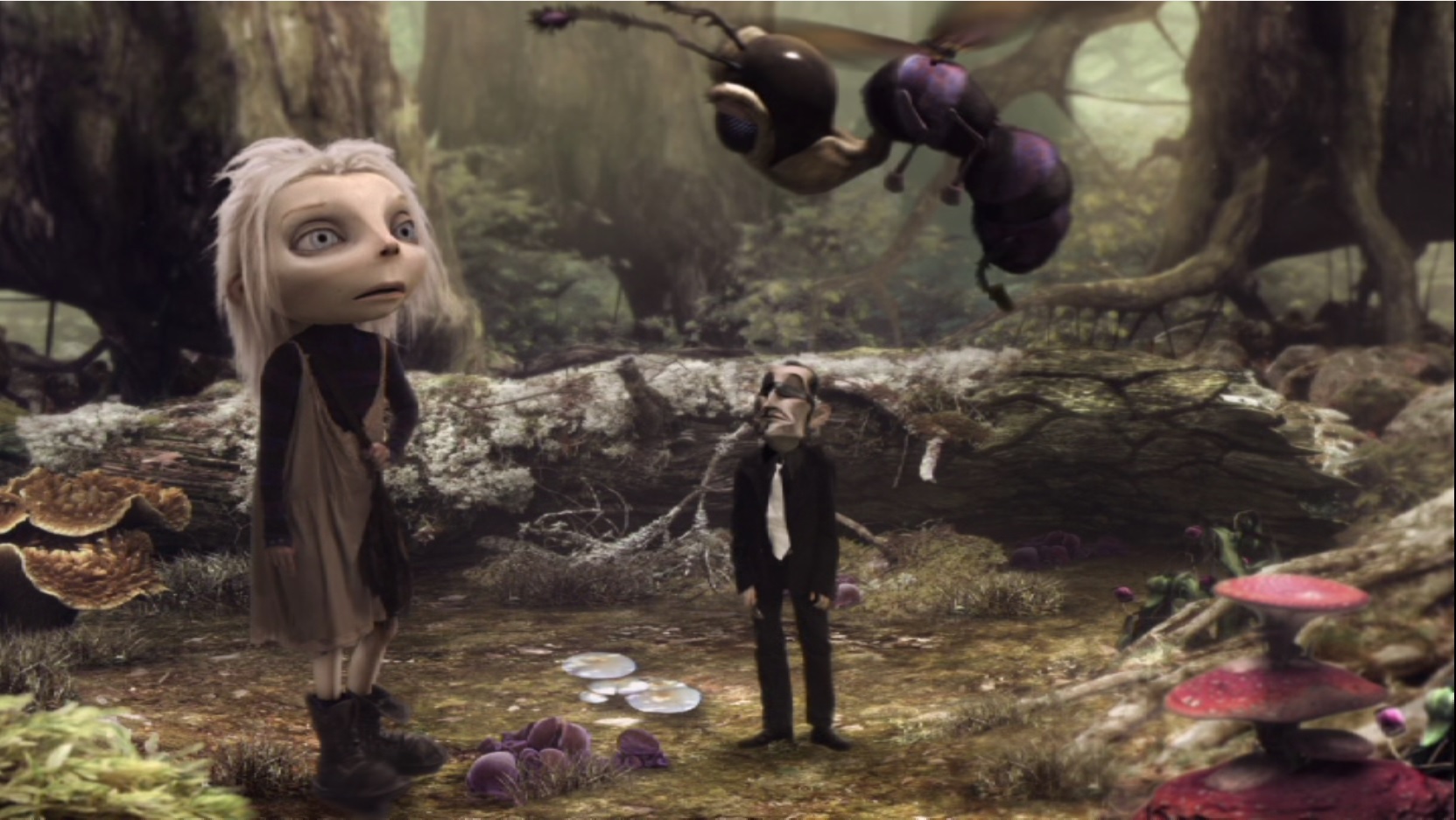
One of the most virtuoso and most idiosyncratic animated film makers ever to emerge from The Netherlands was Rosto (real name Robert Stoces). His films ‘(the rise and fall of the legendary) Anglobilly Feverson’ (2002) and ‘Jona/Tomberry’ created quite a stir, the latter winning the Grand Prix Canal+ prize at the Cannes Film Festival. In these fantastic films Rosto mixed live action, puppetry, and computer animation into a seamless mix. Moreover, they showed a unique if erratic voice that was completely its own.
‘The Monster of Nix’, Rosto’s most ambitious project, is no different. The film lasts half an hour and took six years to make. The short is essentially a musical with a rather post-modern tale-biting story, vaguely reminiscent of ‘The Neverending Story’. The film stars a boy called Willy (based on Rosto’s own son Max and aptly voiced by Joe Eshuis), who lives with his grandmother in a small village, surrounded by woods. Short after the film starts, Willy can’t find his grandmother. Even worse, many villagers have lost people and things, so Willy goes on a quest to seek his grandma and to find the evil monster behind this, finding strange creatures like Virgil, a giant swallow with human hands for claws and the woody “langemen” on his way.
‘The Monster of Nix’ boasts collaborators like Terry Gilliam (voicing a wood ranger), Tom Waits (voicing Virgil) and The Residents (performing two songs), as well as high production values. As expected from a Rosto film, the visuals are very strange, but compelling and overwhelming, seamlessly merging live action and animation to a unique mix. There are several rock music references, which are also typical of Rosto’s style, and there’s a spooky atmosphere akin to Tim Burton.
Rosto even composed the songs himself. Unfortunately, his score is more weird than attractive, and his story isn’t entirely convincing, either, reaching a rather dead point half way, never to recover entirely. But because of its unique atmosphere the film is well worth a watch.
Sadly, Rosto died in 2019, only fifty years old. His death is a grave loss to the Dutch animation world.
Watch the trailer for ‘The Monster of Nix’ yourself and tell me what you think:
‘The Monster of Nix’ is available on DVD
Directors: Joann Sfarr & Antoine Delesvaux
Release date: June 1, 2011
Rating: ★★½
Review:

‘Le chat du Rabbin’ is the film version of the comic strip series of the same name, which comprises eleven volumes thus far. At the time the film was made there were five albums, and the film retells the contents of volume one, two and five very faithfully, with a lot of panels and dialogue being transformed directly from comic strip drawings to film scenes.
Perhaps this is no wonder, as the comic’s author Joann Sfar co-directed the film. He must have had an important vote in the production, because the film flawlessly transcends Sfar’s idiosyncratic drawings to the animated screen.
‘Le chat du rabbin’ is set in Algiers, the capital of Algeria, when it was still a French colony. It’s a little hard to date the time setting of the film, but because carbon dating is mentioned and because of the presence of jazz guitarist Django Reinhardt this limits the time period between 1947 and 1953. In Algiers, the French, Jews, and Muslims all live together harmoniously, and we follow a rabbi of the Sephardic community, and his cat, who turns into a talking creature after swallowing a parrot.
It’s the cat who is the narrator of the film, and we see the events often through his eyes, although, unfortunately, this isn’t maintained consequently. The scenes with the talking cat, mostly recreating the first book, are the film’s best, for the cat turns out to be a skeptic and he asks his master philosophical and theological questions, which are all valid, but drive the poor rabbi mad.
Unfortunately, not only the cat, but the whole movie is rather talkative, and far too dialogue rich, a problem all too common in all French cinema. But this is not the movie’s main problem. No, regrettably, the film also shares the many story problems of the original comic books. Sfar seems to have started his comic book series without a plan, and the volumes are highly different in tone and content. Story ideas are introduced and dropped, and there’s a frustrating lack of focus.
The same accounts for the film. For example, halfway the cat loses his speech again, and with the film immediately loses its main attraction. Even worse, the most interesting character of both the comic books and the film is Zlabya, the rabbi’s daughter, but she lacks a story arc, and is rarely seen, especially during the second half of the film, which focuses on the contents of volume five, in which the attention shifts to a far less interesting character of Russian origin in search of a mythical city of Jews somewhere in Ethiopia. With this part we also leave Algiers and all hope of a consistent story. I actually find the Russian’s quest utterly boring, and I wish the film makers dared to stay in Algiers and tell more about Zlabya. What certainly doesn’t help is an irritating and incomprehensible encounter with famous comic book character Tintin, who turns out to be a complete dork in this film.
The film’s designs are delightful, transferring Sfar’s sketchy comic book’s drawings very well, and applying very attractive color schemes, which evoke the subtropical, Mediterranean, and North African settings excellently. Especially the background art is gorgeous. Although heavily hatched, and thus very graphical, the animation reads very well against those background drawings, and it’s nice to see such a consistency of style from animated drawings to background art. There are even some very attractive Van Gogh influences visible in some of the night scenes.Olivier Davaud’s music, too, attributes to the Arabian atmosphere, with its quasi-Arabic style elements.
The animation, on the other hand, is not always that good. For example, when Zlabya plays the piano, the animation and the music aren’t in tune, at all. The animation is at its best when deviating from realism, as in the cat’s dream. In this dream sequence a bolder style is explored, with a lot of metamorphosis, absent from the rest of the film. The finale, too, explores a bolder style, just like the comic book does in these scenes, and I guess with this Sfar tries to tell us by then we’ve abandoned reality and entered the realm of tall tales. These scenes are certainly interesting to look at, but as said before, by then I at least had lost all interest already.
In all, ‘Le chat du Rabbin’ is a visually very attractive film, showing what traditional animation still can do in terms of original styling, but its rambling tale and its lack of focus make the film a frustrating watch. But to be honest, when reading the original comic strips one will experience the same frustration, thus the original source material is to blame. One wishes Sfar was as good a story teller as a visual artist, but let’s face it, he isn’t.
Watch the trailer for ‘Le chat du Rabbin’ yourself and tell me what you think:
‘Le chat du Rabbin’ is available on Blu-Ray and DVD
Director: Michel Ocelot
Release Date: February 13, 2011
Rating: ★★★½
Review:

This is a review of the 2011 film, not to be confused with the television series from 1992, which explores a similar style.
After two Kirikou movies (1998, 2005) and the praised ‘Azur & Asmar’ (2006) French director Michel Ocelot returned to the silhouette style he had explored in ‘Les trois inventeurs’ (1979) and in ‘Les contes da la nuit’ (1992) in particular. The result was a series of ten episodes for Canal+ called ‘Dragons et princesses’. These were aired in 2010, and more or less compiled in the feature film ‘Les contes de la nuit’ from the next year. This film compiles five of the ten stories from ‘Dragons et princesses’ and adds an extra one, called ‘La Fille-biche et le fils de l’architecte’ (The Young Doe and the Architect’s Son).
All stories are original, conceived by Ocelot himself, including the dialogue. Yet, their style is firmly rooted in ancient storytelling and fairytales. Thus, the heroes are pretty emblematic, a given that is emphasized by the bridging ‘story’. In these bridging episodes an old man teams up with two children to invent the stories. The children then act them out, while the old man does some background research on architecture and clothing and such. The two youngsters are then dressed by robot arms, and the tale can begin.
And so, each tale stars the same two children, and almost of them are about love. To be fair, these bridging parts make very little sense, and after the sixth story we don’t even return to this setting.
Much more interesting are the stories themselves. Set in different times and places, they have a surprising universal character and really feel as a homage to classic storytelling, a form of narrative other modern animation film makers seem to have lost. In fact, Ocelot’s most obvious inspiration is Lotte Reiniger (1899-1981), who also told classic tales in silhouette animation. Ocelot truly is her artistic successor, even though he trades the scissors and cut-out animation for 2D computer graphics.
As all stories are told in silhouette, the story depends greatly on body language and dialogue. It’s a little unfortunate then that the 2D computer animation is often rather stiff and unconvincing. At times the heroes’ faces are seen from the front, showing their eyes, but not their mouths, which makes one depend on the dialogue even more.
The stories themselves nevertheless are entertaining. The first, ‘the night of the werewolf’ takes place at the Burgundian court of the 15th century and tells about two rival sisters. The third, ‘The Chosen One of the Golden City’ takes place in Mexico in the 16th century and tells about a conquistador visiting a city of gold. This story knows some very stylized background art. The fourth, ‘Tom-Tom Boy’ is set in West Africa and takes us back to the world of ‘Kirikou et la sorcière’ (1998), with its bare breasted women. The fifth, ‘The Boy Who Never Lied’ is set in medieval Tibet, and certainly the most tragic of the collection. The mountainous background art in this story has the most 3D-feel to it of the whole lot. The final story, ‘The Young Doe and the Architect’s Son’ returns to France. Set in the 13th century it features very detailed gothic background art and a short piece of 3D computer animation.
The best story, however, is the second, ‘TJ and the Beauty Unknowing’. This story starts in the Caribbean, but soon the hero enters the land of the death, in which he must fulfill three tasks to save his life. This story makes great use of the tropes of ancient fairy tales, without following the classic love story tropes of the other entries.
Watch the trailer for ‘Tales of the Night’ yourself and tell me what you think:
Les Contes de la nuit (Tales of the Night) is available on DVD
Director: Martin Georgiev
Release Date: October 17, 2012
Rating: ★★★
Review:
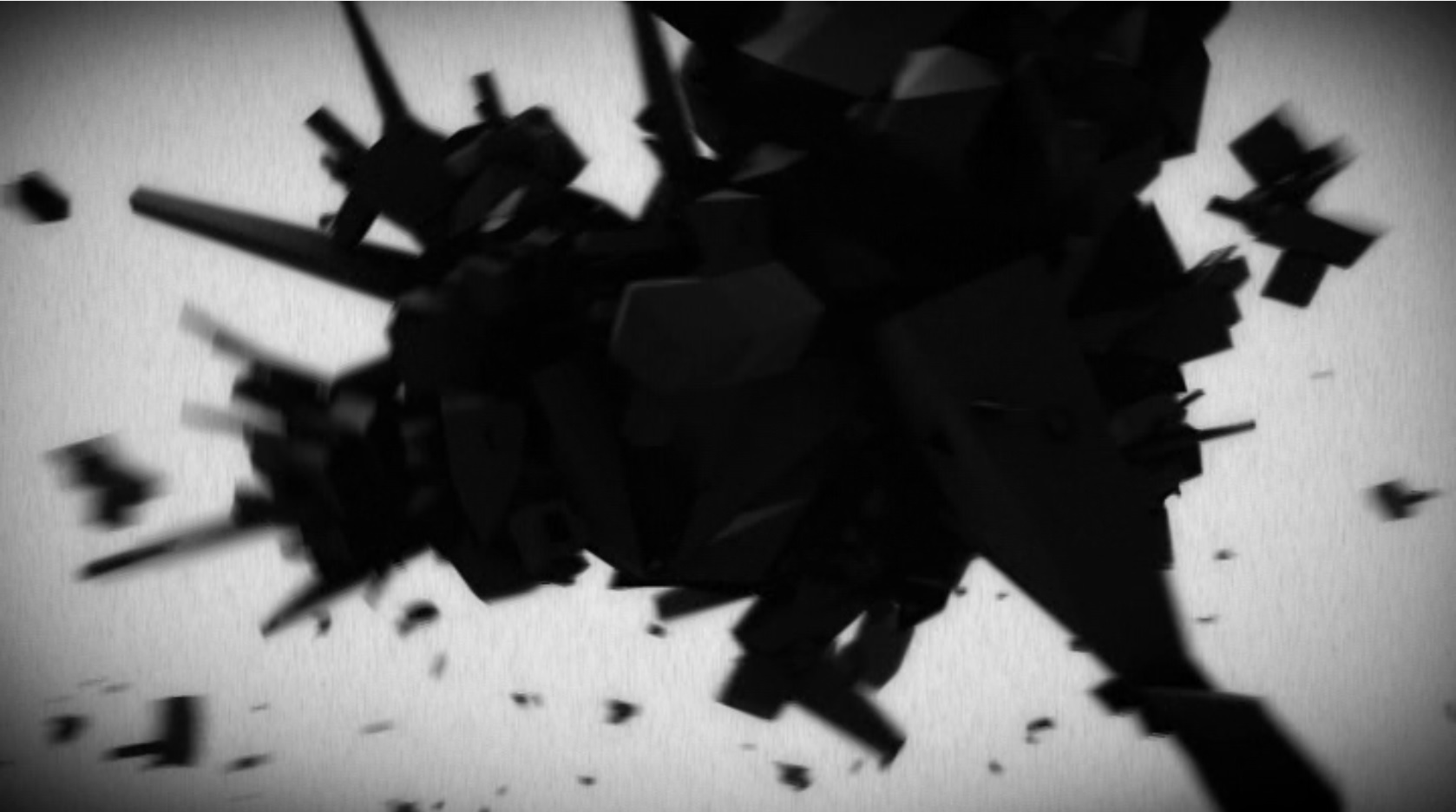
‘7596 Frames’ is a computer animated film taking place in an endless black and white landscape, in which countless abstract black shapes fly by due to an extraordinarily strong current.
One of the abstract shapes crashes amidst the debris already present, and starts to wander against the never changing wind, gaining material as it walks along, as objects keep on flying into him. When the semi-abstract figure has grown too heavy for its legs to carry it collapses, but manages to become a more dragon-like shape. At this point it comes under attack, and in the end its struggle is in vain.
At points Martin Georgiev manages to give his semi-abstract forms real character, allowing the viewer to sympathize with the creature’s helpless struggle and its suffering before its final defeat. The camera is never still, and takes some striking positions to show the creature’s efforts, e.g. taking a worm’s-eye view to show the thing towering above. Less successful is the industrial music, which unfortunately adds nothing to the animation.
Watch a preview of ‘7596 Frames’ yourself and tell me what you think:
‘7596 Frames’ is available on The Animation Show of Shows Box Set 9
Directors: Frank Braun & Claudius Gentinetta
Release Date: July 16, 2010
Rating: ★★★★½
Review:
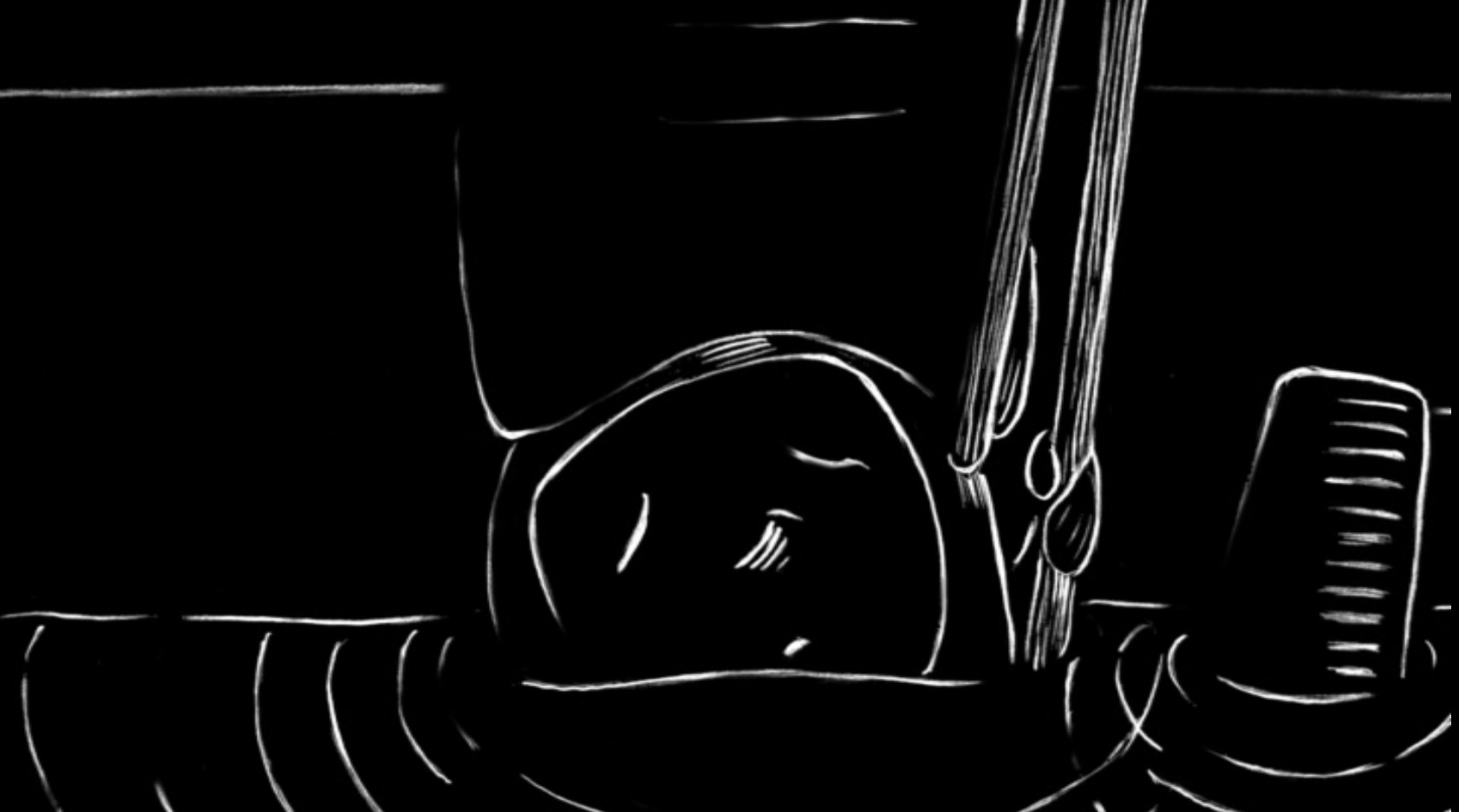
‘Schlaf’ is a black and white film using white lines on a black canvas. The film is very poetic and follows the rhythm of a snoring person, with images alternatingly speeding past the camera, or being more or less calm, allowing the viewer to register what’s in them.
Once one realizes he watches an enormous ocean liner full of people with oars, one also notes the ship is sinking, as if the ship depicts the sleeping person’s consciousness drowning into a sea of sleep. The idea is so strikingly original and its execution so well done, ‘Schlaf’ easily holds the attention throughout, despite the puzzling imagery.
Watch ‘Schlaf’ yourself and tell met what you think:
‘Schlaf’ is available on The Animation Show of Shows Box Set 9
Director: Andreas Hykade
Release Date: February 24, 2010
Rating: ★★★★★
Review:

After a sublime narrative trilogy on the loss of innocence (consisting of ‘Wir lebten im Gras‘ from 1995, ‘Ring of Fire’ from 2002, and ‘The Runt‘ from 2006), Andreas Hykade made a surprising move to a non-narrative film with ‘Love & Theft’.
In this film Hykade uses many animation cycles and continuous metamorphosis, not to tell a story, but to bring a homage to the great characters of animation and comics in mesmerizing and hallucinating images that never fail to entertain.
Greatly helped by Heiko Maile’s score, ‘Love and Theft’ knows an almost perfect build-up, starting very modestly in black and white, and with the simplest drawings. The first recognizable characters morphing into each other are Charlie Brown and Hello Kitty, soon followed by Mickey Mouse, Goofy and Spiderman, and later e.g. Spongebob Squarepants, Bert from Sesame Street, Tweety, Blossom from the Powerpuff Girls, Betty Boop, Ryan Larkin (as depicted in Chris Landreth’s animated short ‘Ryan’ from 2004), Gromit, Droopy, Koko, Donald Duck, the penguin from ‘The Wrong Trousers‘, Barbapapa, and countless others, including even Karl Marx, Che Guevara and Adolf Hitler.
Once changed into color, the animation goes completely berzerk, as one long psychedelic kaleidoscope. This particular sequence seems to owe something to Jim Woodring’s Frank, and somehow Andreas Hykade manages to capture the comic’s surreal atmosphere very well in this otherwise semi-abstract film.
Rarely were animation cycles and metamorphosis employed so creatively and entertainingly. ‘Love & Theft’ is a film that can be watched over and over again, without losing its gripping power.
Watch ‘Love & Theft’ yourself and tell met what you think:
‘Love & Theft’ is available on The Animation Show of Shows Box Set 9
Directors: Stefan Fjeldmark & Karsten Kiilerich
Release Date: 1996
Rating: ★★★★★ ♕
Review:

‘When Life Departs’ is a cute little Danish film in which eight children share their thoughts on death.
Their musings include ideas on the soul, on heaven, on hell, on God and reincarnation. These are illustrated with very simple, but very charming color pencil drawings on monochrome backgrounds. The drawing deliberately have a childlike, pseudo-clumsy quality, but the animation is, in fact, of a very high degree. Especially the depiction of the children talking is very well done. Despite the simplicity of the drawings these scenes betray a wide range of emotions and involuntary gestures in a short time span.
One stunning scene is one child’s view of heaven, illustrated by an ever in-zooming background animation, as if one flies through the endless heavenly landscapes. At times the pleasant animation helps to keep the subject light. Nevertheless, the story of a boy who has lost his baby brother remains poignant and infinitely sad.
Watch ‘When Life Departs’ yourself and tell met what you think:
‘When Life Departs’ is available on The Animation Show of Shows Box Set 3
Directors: Alain Gagnol & Jean-Loup Felicioli
Release Date: 1996
Rating: ★★★★½
Review:
The cinematic duo of Alain Gagnol and Jean-Loup Felicioli belong to France’s most interesting animation film makers.
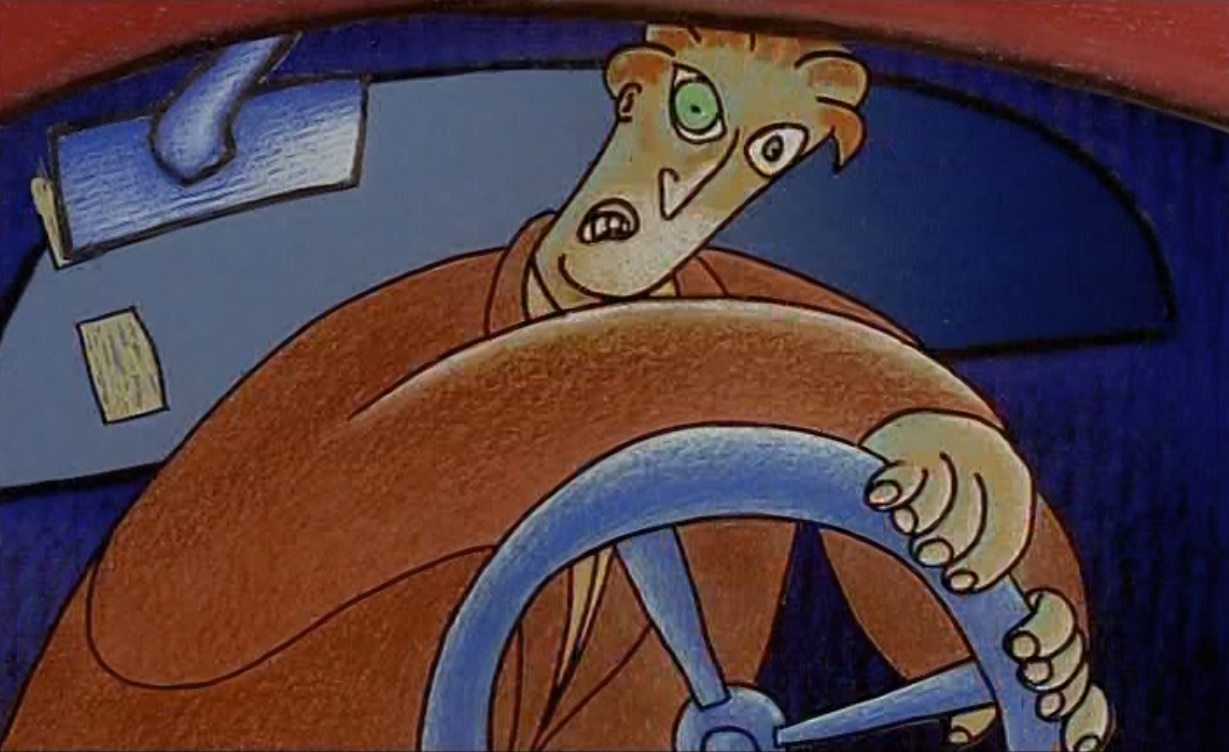
In the 2010s the two came to prominence with the equally idiosyncratic as entertaining animated feature films ‘Une vie de chat’ (A Cat in Paris, 2010) and ‘Phantom Boy‘ (2015). But even way back in 1996 they made an impression at animation festivals with ‘L’égoïste’ (The Egotist), a very short film about a man only loving himself. When the man falls in love with a woman, it’s because she resembles himself. All’s well until…
‘L’égoïste’ was made at the Folimage studio, which would be associated with Gagnol and Felicioli from then on. While Gagnol provided the scenario and the animation, Felicoli was responsible for the graphic design, which is a charming and very colorful type of expressionism. Both characters and background art is heavily distorted, with houses and furniture being skewed and crooked. The animation is relatively sparse but effective.
The film uses a narrator, being the voice of the egotist and unfortunately all too present music by Serge Besset. As the music hardly comments on the images this is the weakest aspect of a film that otherwise impresses because of its original visual style and very lean story telling.
‘L’égoïste’ is available on the DVD ‘Pris de Court – 14 films courts de Alain Gagnol & Jean-Loup Felicioli’ which features English soundtracks
Director: Phil Mulloy
Release Date: 1996
Rating: ★★★★½
Review:

‘Thou Shalt Not Covet Thy Neighbours Wife’ is the tenth and last of Phil Mulloy’s Ten Commandment films. This installment is the longest of the ten, clocking nine minutes compared to the usual four to five, and also the funniest.
In this short we follow Buck, who falls in love with his dog-loving married neighbor Sally-Ann. In order to be with her he swaps places with the dog…
Mulloy’s tale is more sophisticated than this synopsis, but it’s best not to reveal too much, lest not to spoil the fun. Joel Cutrara’s voice over is only heard in the beginning. During the rest of the cartoon the fun is greatly enhanced by the cartoony voices and silly images. Mulloy’s Ten Commandment series may be a mixed bag, the series at least ends with a bang.
‘Thou Shalt Not Covet Thy Neighbours Wife’ is available on the DVD ‘Phil Mulloy Extreme Animation’
Director: Phil Mulloy
Release Date: 1996
Rating: ★★★
Review:
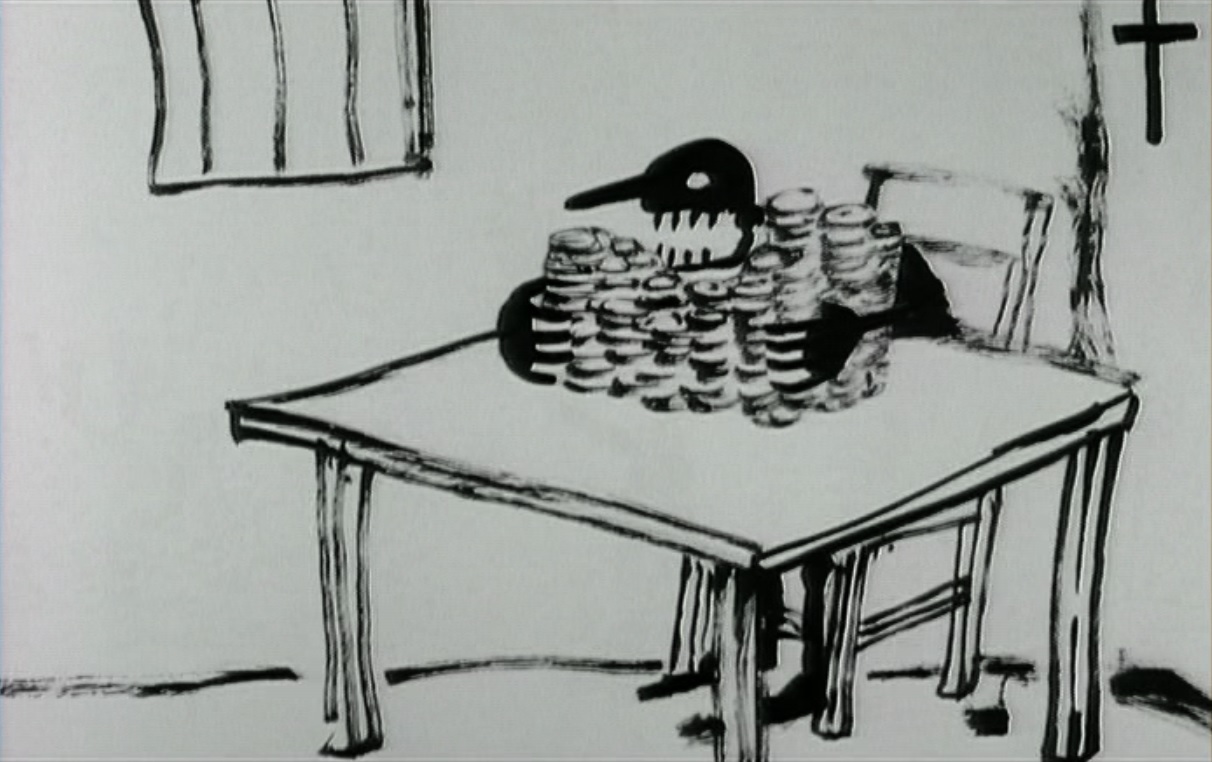
‘Thou Shalt Not Covet thy Neighbours Goods’ is the ninth installment of Phil Mulloy’s The Ten Commandments series.
Once again the short is told by Joel Cutrara and this time he tells about Cisco, who builds a commercial success out of electronic torture devices. Cisco is presented as the hero of the movie, but his story is a cynical one, involving exploitation of workers and suppression of the masses.
Despite the bleak images, Cutrara’s voice over remains joyful, and the happy atmosphere is enhanced by some particularly cartoony vocalisations.
‘Thou Shalt Not Covet Thy Neighbours Goods’ is available on the DVD ‘Phil Mulloy Extreme Animation’
Director: Phil Mulloy
Release Date: 1996
Rating: ★★★
Review:

Based on the reminiscences of violinist and composer Alex Balanescu ‘The Wind of Changes’ is one of Phil Mulloy’s longest and most poetical films.
Balanescu’s portrait of communist Romania is a dark one, but his impressions of New York and London are hardly any better. Balanescu’s remarks are wry and depressing, and Mulloy illustrates these with associative and sombre pictures in his typical crude cut-out animation style.
The film jumps forward and back into time and has a stream-of-consciousness-like feel. Some of the images are very powerful, like a snowman being shot. But it’s Balanescu’s score that despite Mulloy’s powerful imagery, is the most beautiful aspect of the film. Unfortunately, Balanescu’s music almost drowns out the voice-over, making the narrative hard to follow.
Watch the first part of ‘The Wind of Changes’ yourself and tell me what you think:
‘The Wind of Changes’ is available on the DVD ‘Phil Mulloy Extreme Animation’
Director: Jan Švankmajer
Release Date: August 1996
Rating: ★★★½
Review:
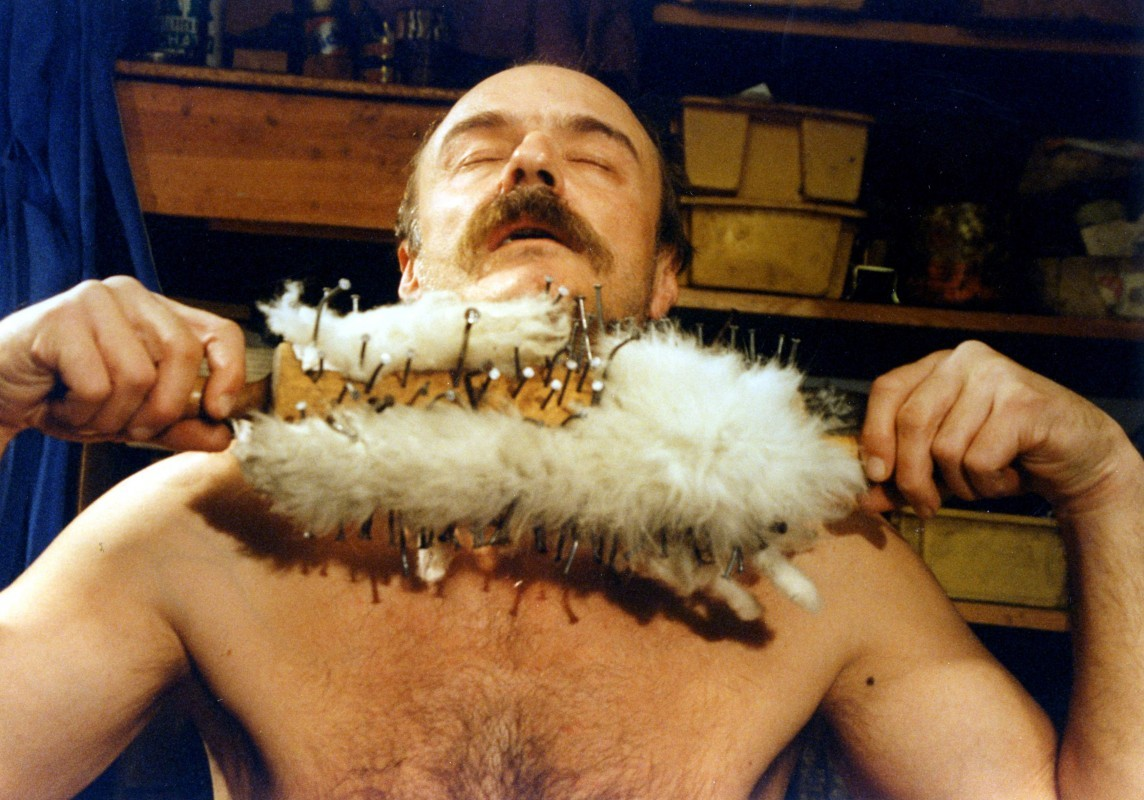
Although the move from animation to live action clearly was a gradual one (after all, ‘Alice‘ contained quite a bit of live action, while ‘Faust‘ was a live action film augmented with puppetry and animation), ‘Spiklenci slasti’ (Conspirators of Pleasure) can be regarded Jan Švankmajer’s first non-animated film, even if it stills contains a few bits of stop-motion and pixilation.
The change of technique doesn’t mean a change of style, however. The film is 100% Švankmajer throughout, with its complete lack of dialogue, its sound design (which is very reminiscent of that of animated films, indeed, with its emphatic sounds – we even hear the nonexistent sound of blinking of eyes), its idiosyncratic use of music (each individual has his/her own accompanying piece of music), its extreme close-ups, its sets of old buildings in a state of decay, and of course, a high dose of surrealism.
‘Spiklenci slasti (Conspirators of Pleasure)’ is an erotic film without sex. The titles are shown on a background of 18th century pornography, but the movie itself contains very little nudity, which is male only.
Main protagonist of the film is an unnamed bearded bachelor (played by Petr Meissel and identified as Mr. Pivoňka by Švankmajer). The film starts with him buying a sex magazine, but soon the magazine makes way for far more disturbing and puzzling acts of pleasure, involving a cupboard and a chicken. Mr. Pivoňka’s antics are interlaced with that of a postwoman, a mustached man, his lonely and abandoned wife, who’s a newsreader (Anna Wetlinská, who really was a newsreader), and the shop owner from the first scene, who’s secretly in love with Anna Wetlinská, and who builds an elaborate contraption around the television set she appears on.
The first 45 minutes are one big build-up to the pleasure acts themselves, and this is the most satisfying part of the film, because Švankmajer keeps the viewer puzzled where all the efforts of these people go to. Unfortunately, the acts of pleasure themselves are less compelling, as they’re not necessarily perverse as well as weird, and maybe this section is a bit overlong.
The shopkeeper’s machine is the absolute highlight, but the postwoman’s actions are absolutely grotesque, and that of Mr. Pivoňka and his neighbor, Mrs. Loubalová, sadomachistic, very violent and even morbid. Their acts involve the most animation, as their acts involve animated stuff dolls coming to life. But by now one could argue that the animation is more of a special effect than an element of style, although the pixilation still is used as a mean of surrealist story telling.
As the film comes to a finale, the boundary between reality and fantasy gets crossed. Anna Wetlinská seemingly takes over the shopkeeper’s machine, and comes to a climax herself. In the end the people’s fetishes get mixed, while Mr. Pivoňka’s mysterious ritual appears to have severe real life consequences indeed…
Nevertheless, one would like to know more about the postwoman and her incomprehensible rituals, as she seems to be some kind of facilitator of the desires of others. Also Anna Wetlinská’s bad marriage deserved a little bit more attention.
‘Conspirators of Pleasure’ is a very original and entertaining movie, but the film remains on the shallow side and lacks the layered surrealism of ‘Alice’ or ‘Faust’.
Watch the trailer for ‘Conspirators of Pleasure’ yourself and tell me what you think:
‘Conspirators of Pleasure’ is available on Blu-Ray and DVD


 Dr. Grob's Animation Review