You are currently browsing the category archive for the ‘Feature films’ category.
Director: Mari Okada
Release date: February 24, 2018
Rating: ★★★
Review:

The Japanese animation industry apparently is so rich that new interesting films can pop up seemingly out of nowhere. For example, ‘Maquia: When the Promised Flower Blooms’ (from now on ‘Maquia’) is made by the P.A. Works studio, which since its founding in 2000 focused on television series, and which only made four feature films, the first being based on a video game, the second made for television, the third for training purposes, and the fourth based on a television series.
So, their fifth feature film to be a completely original story, not based on a video game, television series or even a manga, comes as a surprise. It seems that ‘Maquia’ was the pet project by its director Mari Okada, who wrote the story herself. Okada, apparently is somewhat of a modern legend as she has written for over fifty television series since 2001, and is called by Wikipedia “one of the most prolific writers currently working in the anime industry”. She’s one of the brains behind ‘Anohana: The Flower We Saw That Day’ (2011), one of only two anime television series I have watched, and it comes to no surprise to me that the ‘Maquia’s’ story style has something in common with that series. Both series and film have a strong focus on human drama, with emotions reigning uncontrolled, and tears flowing frequently. In fact, despite the high fantasy setting, ‘Maquia’ has a strong element of melodrama, and the rather forced emotions, so different from the more restrained style in studio Ghibli, or the films by Yasujirō Ozu for that matter, actually made it harder for me to relate with these people.
‘Maquia’ is a fantasy film, set in a rather Middle Earth-like world, and starts with the depiction of a society of near-immortals called Lorphs, whose surroundings are particularly like the depictions of elven kingdoms in Peter Jackson’s adaptation of The Lord of the Rings. These Lorphs write their memories by weaving cloths and live far away from more mortal men. One of these, a young girl called Maquia (from which the English film title takes its name) rather out of nowhere complaints she is so alone. Shortly after this scene of distress the eternal city is attacked by an army of men, and Maquia soon finds herself in the outside world, where she adopts a baby, whose mother is killed.
From then on, the film takes an episodic nature, showing us various stages of the mother-son relationship until the son, whom Maquia calls Ariel, has matured, while his mother, in contrast, has retained the same teen appearance she had in the beginning.
The film apparently tries to say something about how to love is to lose and to let go, how to find beauty in the short lives we have, and how relationships form the most important part of life, but the film’s messages get deluded in a rather complex story, in which we do not only follow Maquia, but also her childhood friend Leilia, who is forced to become a queen by her abductors, the captain who destroyed the Lorph city in the first place and one Lang, a boy/man with whom Maquia spent her first years in the mortal world. The bigger story, and all its subplots are far less interesting than Maquia’s relationship to her adopted son, and both prolong and distract the film unnecessarily.
Apart from being unfocused and very, very emotional, ‘Maquia’ is also hampered by an overblown score by Kenji Kawai, all too forcefully guiding the viewer in which emotion to feel. Even worse, are the rather lazy and utterly generic human designs, which nowhere transcend your average anime television series. The animation, too, is fair, but not outstanding. There’s also a small dose of computer animation that is used sparingly and effectively. No, the film’s highlights are not the story, music, character designs or the animation, but the background art and the lighting, which are both no less than magnificent, and which both give ‘Maquia’ a splendor that make the film a delight to watch, even when the characters and events themselves don’t.
I like ‘Maquia’ being an original story, and its theme of what it means to be (im)mortal is interesting, but the film is too long, too episodic, too meandering and too dramatic to entertain, and I am pretty sure in the end I will not remember either the film’s story or its characters, but the beautiful background art and superb lighting, which the make the film a standout, after all.
Watch the trailer for ‘Maquia: When the Promised Flower Blooms’ yourself and tell me what you think:
‘Maquia: When the Promised Flower Blooms’ is avaiable on Blu-Ray and DVD
Director: Jan Švankmajer
Release date: January 26, 2018
Rating: ★★
Review:
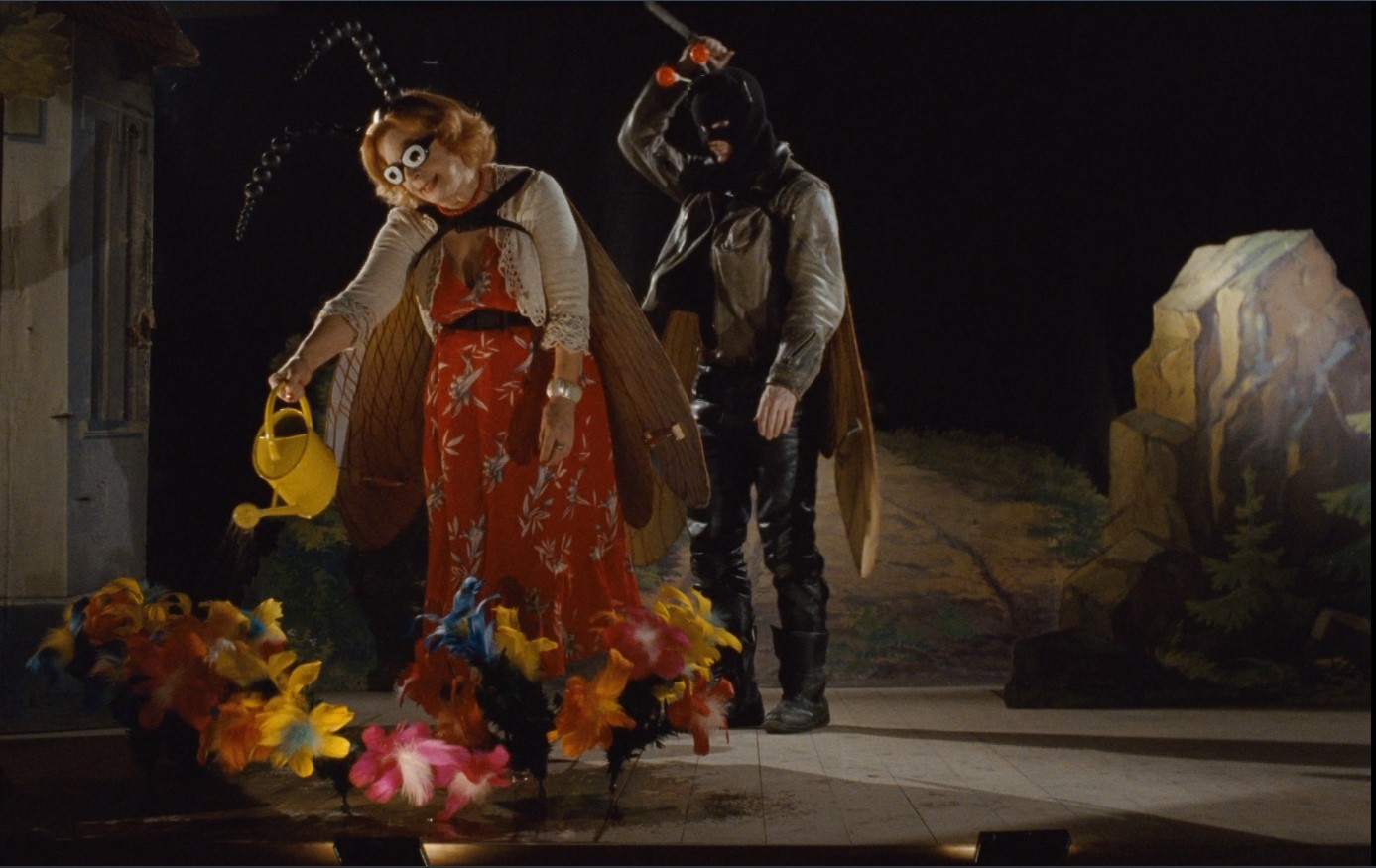
‘Insect’ is Jan Švankmajer’s last film. Even though at the time of writing the Czech master of surrealist cinema is still alive, he announced this film as such. It sure was a difficult film to make, as even crowdfunding was needed to finish the movie.
Unfortunately, the film is not a grand finale to Švankmajer’s glorious oeuvre. Sure, the film’s main story is interesting enough and shows all elements of the Czech director’s idiosyncratic style: surrealist events, morbid humor, extreme close-ups, claustrophobic spaces, a preoccupation with food, and even a splash of stop-motion and cut-out animation, rarely seen since the 1980’s.
In this story an amateur company rehearses the 1921 play ‘Pictures from the Insects’ Life’ by the Čapek brothers. Only part of the troupe is present, and the film features only six characters, who are cramped into a dark, poorly lit space, which give the film an eerie feeling the actors are trapped like insects themselves. Four actors are bullied by an overt ambitious director, while the sixth sleeps through most of the rehearsal. While the inapt actors act out a few scenes from the play, strange events start happening, like insects appearing everywhere, and a dummy coming to life, and several of the actors don’t live through the end of the rehearsing.
This story shows a strong unity of time and space, and is told by Švankmajer with gusto, while his actors delight in portraying the clumsy actors, one even worse on the stage than the other. The actor’s antics are often accompanied by the beginning of Bedřich Smetana’s overture to ‘The Bartered Bride’ (1866), the lively sounds of which contrast heavily with the bad acting on the stage. The sound design, too, is excellent, with its well-chosen unpleasant sounds, as of crawling insects.
However, apparently this main story wasn’t enough material to fill a complete feature length film, and thus the action is constantly interrupted by behind-the-scene footage, showing how the film was made, as well as the real actors telling about their dreams. These scenes often reveal the tricks involved in the film making, and thus spoil the fun of the surrealist main story. But more importantly, they greatly disrupt the main narrative, and the viewer is constantly thrown in and out of the story, which makes the film a frustrating watch, indeed. This choice of adding an extra layer to the film actually makes it a weaker product than it could have been, and although it’s nice to watch Jan Švankmajer at work, it makes the film a sad farewell to his illustrious career.
Watch the trailer for ‘Insect’ yourself and tell me what you think:
‘Insect’ is available on Blu-Ray and DVD
Director: Wes Anderson
Release date: February 15, 2018
Rating: ★★★★★
Review:
The 21st century saw a few live action directors and film makers crossing over to animation, often with original films that were welcome deviations from the standard family fare of Pixar, Dreamworks, Sony, Illumination and the like. One of these directors was Wes Anderson, whose live action films already have a very distinct flavor, let alone his animation work.
In 2009 Wes Anderson brought us ‘Fantastic Mr. Fox’, his own quirky take of the classic children’s book by Roald Dahl, adding some ‘The Royal Tenenbaums’-like flavor to it. It seemed a one off, like all other animation adventures by live action directors, but in 2018 Wes Anderson surprised everyone by making yet another animation movie, this time with a completely original story of his own.
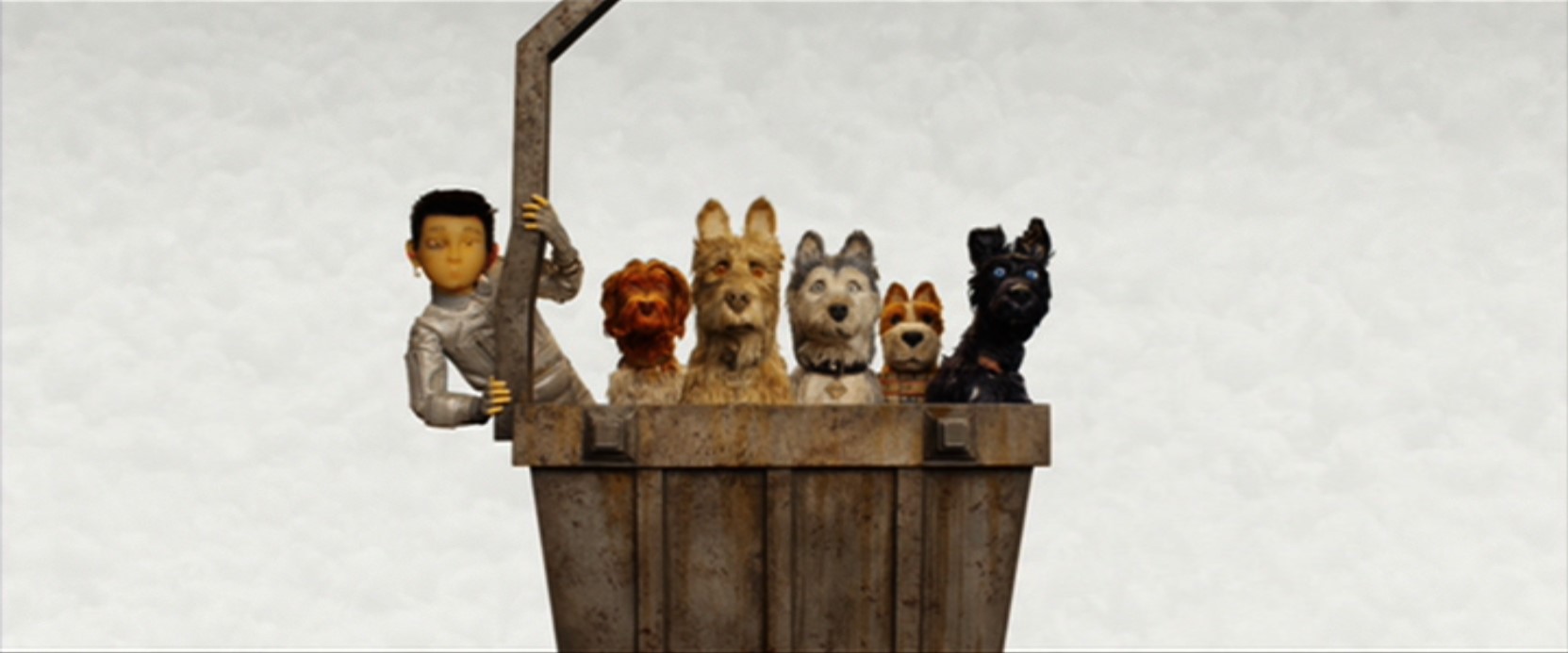
‘Isle of Dogs’ is a sort of fantasy-dystopia film set in Japan. Surprisingly, much of the dialogue is in Japanese, and not always translated, adding to the film’s idiosyncrasy. The film tells about the cat-loving Kobayashi clan who wants to get rid of all the dogs. When a Kobayashi mayor gets into power in the fictive town of Megasaki, he banishes all dogs to a garbage dump island…
The film knows quite a lot human characters, but uses mostly a dog-viewpoint and is even narrated by a dog (voiced by Courtney B. Vance). The film focuses on a stray dog called Chief, whose life changes when a young boy arrives on the island, looking for his own former pet, Spots.
Where all other film makers would make the boy and the dogs be able to talk with each other, Anderson keeps their languages strictly separated, with the dogs not getting a thing the boy says, and vice versa. As the boy speaks Japanese, we, the audience, too, cannot always follow what the boy tries to say – a bold move.
The dog communication is all in English, and Anderson makes use of a lot of familiar names to voice his animated creatures, like Edward Norton, Jeff Goldblum, Bill Murray and Scarlett Johansson, just to name a few. Even Yoko Ono has a small role as a scientist of the same name.
Like ‘Fantastic Mr. Fox’ ‘Isle of Dogs’ is a stop motion film, and a very virtuoso one, too. The animation, directed by Mark Waring, is superb throughout and there are crowd scenes with tens to hundreds of puppets, and both dog and human characters are very intricately designed. Like in Anderson’s first animated film, all animals have a rather scruffy look, giving the film a very individual look. There are some typical quirks in the animation, like dogs sneezing at random moments. I also like Anderson’s use of cartoony fight clouds. As far as I know he’s the first to use those in a stop-motion film.
As with his other films Anderson employs a very typical use of the camera, often showing symmetrical images, and sometimes using close ups in a rather Spaghetti Western-like fashion. There’s also a little 2D animation to depict events on television. The background art, too, is unique. Apart from elaborate sets, the film uses rather flat background art, with a typical cut-out look. The quasi-Japanese score by Alexandre Desplat, an Anderson favorite, adds to the film’s unique atmosphere.
The film’s story says something about populism, and how misleading information can lead to unjust decisions, but the film is too silly to emphasize this point. Likewise, the film’s heart lies with Chief, but much more interesting than his development are the dry dialogues, and the running gag of one dog hearing a rumor the others never heard of. In fact, apart from the film’s looks, the dialogues form the film’s main attraction, as they are often very funny.
Unfortunately, the film’s finale is not the best part, and the defeat of the villains a little too easy, but otherwise ‘Isle of Dogs’ is a real treat, and with its unique style a very welcome diversion from the often run-of-the-mill fare of American studio animation.
Watch the trailer for ‘Isle of Dogs’ yourself and tell me what you think:
‘Isle of Dogs’ is available on Blu-Ray and DVD
Director: Nick Park
Release date: January 20, 2018
Rating: ★★
Review:
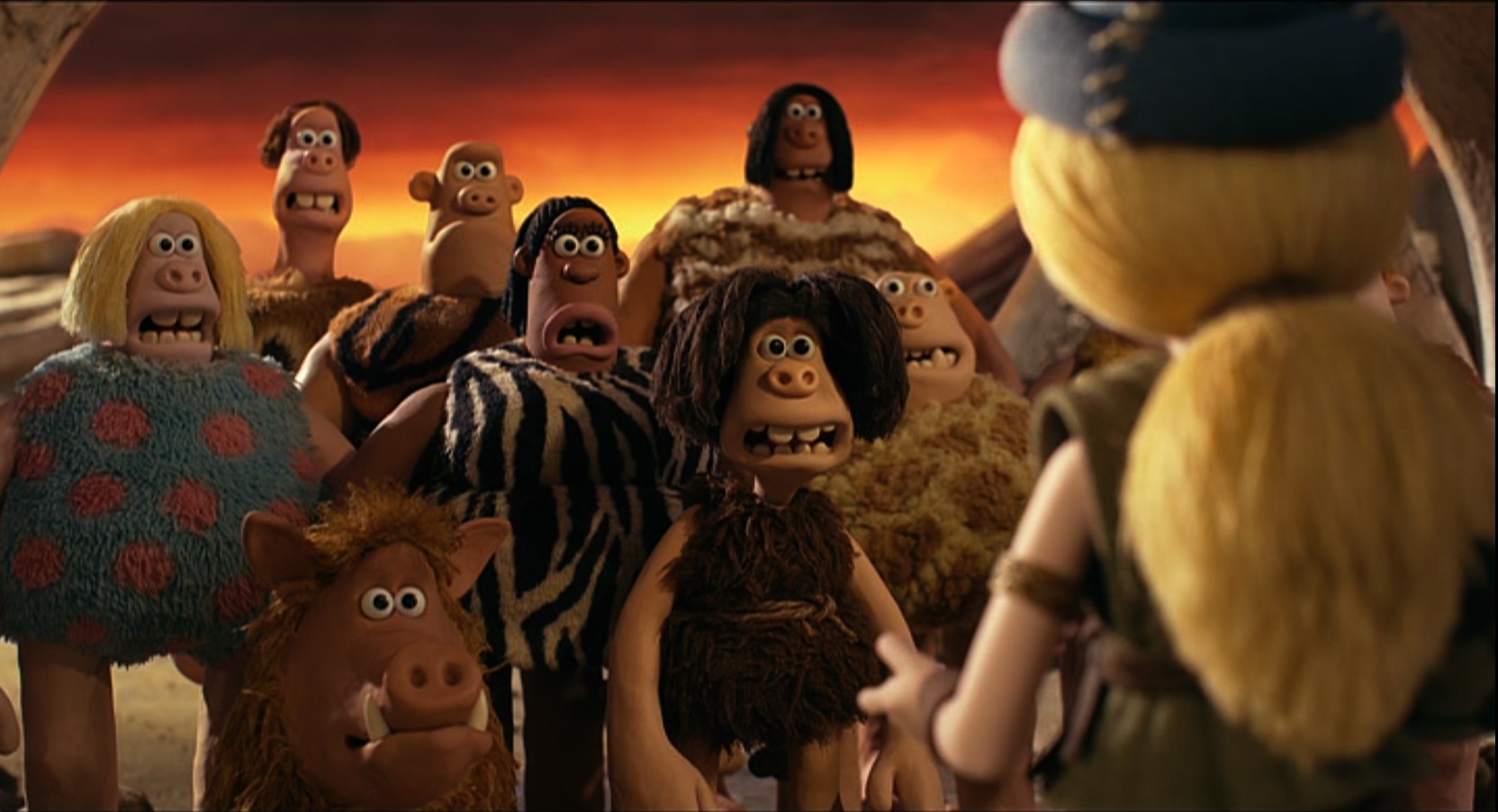
In ‘Early Man’ some cavemen have to play a soccer match to save their village from oblivion. ‘Early Man’ was Aardman’s seventh feature film, and the fifth using the studio’s trademark Claymation, but when compared to the wonderful movies ‘Wallace & Gromit: The Curse of the Were-Rabbit’ (2005) or ‘Shaun the Sheep Movie’ (2015) ‘Early Man’ is frustratingly lackluster.
Sure, the film is wonderfully made, and clearly with a lot of love, and has the charm of fingerprints being visible on the clay puppets. Moreover, by now, the Aardman studio clearly makes its animation style look easy. Then there are the typical Aardman quirks, like the way replays are shown, or some funny side remarks, the best of which is “Sliced bread? That’s the best thing since… well, ever!”. I particularly liked the idea of the message bird, which not only repeats all that is said to him, but all the accompanying actions, as well. These little touches at times made me laugh out loud.
Unfortunately, the story is not half as good: it’s one long sum of cliches, never venturing into new or surprising story ideas, making the film surprisingly dull. Especially, the football match ticks all the familiar boxes of the sports film, and there are team effort scenes and unconventional training scheme scenes as we had seen already a thousand times, most recently in ‘Kung Fu Panda 3’ (2016) and ‘Cars 3’ (2017), which were both also frustrating affairs story-wise. The characters, too, are in no sense original, and feel emblematical, instead of rounded. Even the main hero Dug is appallingly onedimensional.
As said, ‘Early Man’ especially follows the sports film trope of the underdog winning against all odds but it does so in the laziest way. For example, at one point Goona makes clear to the cavemen that they may have a chance because they can be a team while their opponents are just a bunch of individuals. Now, there’s a chance to make the cavemen’s win believable. And what is done with this idea? Absolutely nothing. As soon as the real match starts, the so-called big difference between the behavior of the star players and the cavemen team on the field disappears. It’s disheartening to watch this saving element being left unused.
The world-building, too, leaves a lot to be desired. ‘Early Man’ doesn’t really play in the stone age, or the bronze age, or whatever. It is set in some fantasy sword-and-sorcery world with bare rocks and active volcanoes. Even the time period of the prologue makes no sense, set in the non-existing ‘Neo-Pleistocene’ and showing us cavemen living next to dinosaurs (in a nice little nod to Willis O’Brien, although the two creatures were apparently called Ray and Harry after that other great stop motion monster animator, Ray Harryhausen).
By the time the main story starts, the dinosaurs have disappeared, but some Flintstones-like gags remain, like little crocodiles as clothespins and a beetle as an electric razor. But then the studio adds some creatures that in no world make any sense whatsoever, like a giant woodlouse, a giant spider, a giant duck with teeth and some giant caterpillars. With these the film makers lost all consistency and believability of a world that was rather shaky to start with.
For example, the only green spot in this world is where ages ago a meteorite struck, but it’s in this world the cavemen live. How the other people survived in the highly hostile environment of the rest of the planet remains an utter mystery. It doesn’t help that most of this world is rendered in the ugliest and laziest computer animation, which contrasts greatly with the fine Claymation.
It seems the film makers too much wanted to make a football (soccer) movie, and got blind for the film’s flaws, which are instantly recognizable to any viewer. Instead, they should have thought things over, both about their story and their world, because the final film is a formulaic drag, and, not surprisingly, became a box office bomb.
Watch the trailer for ‘Early Man’ yourself and tell me what you think:
Director: Nina Paley
Release date: February 11, 2008
Rating: ★★★★★
Review:
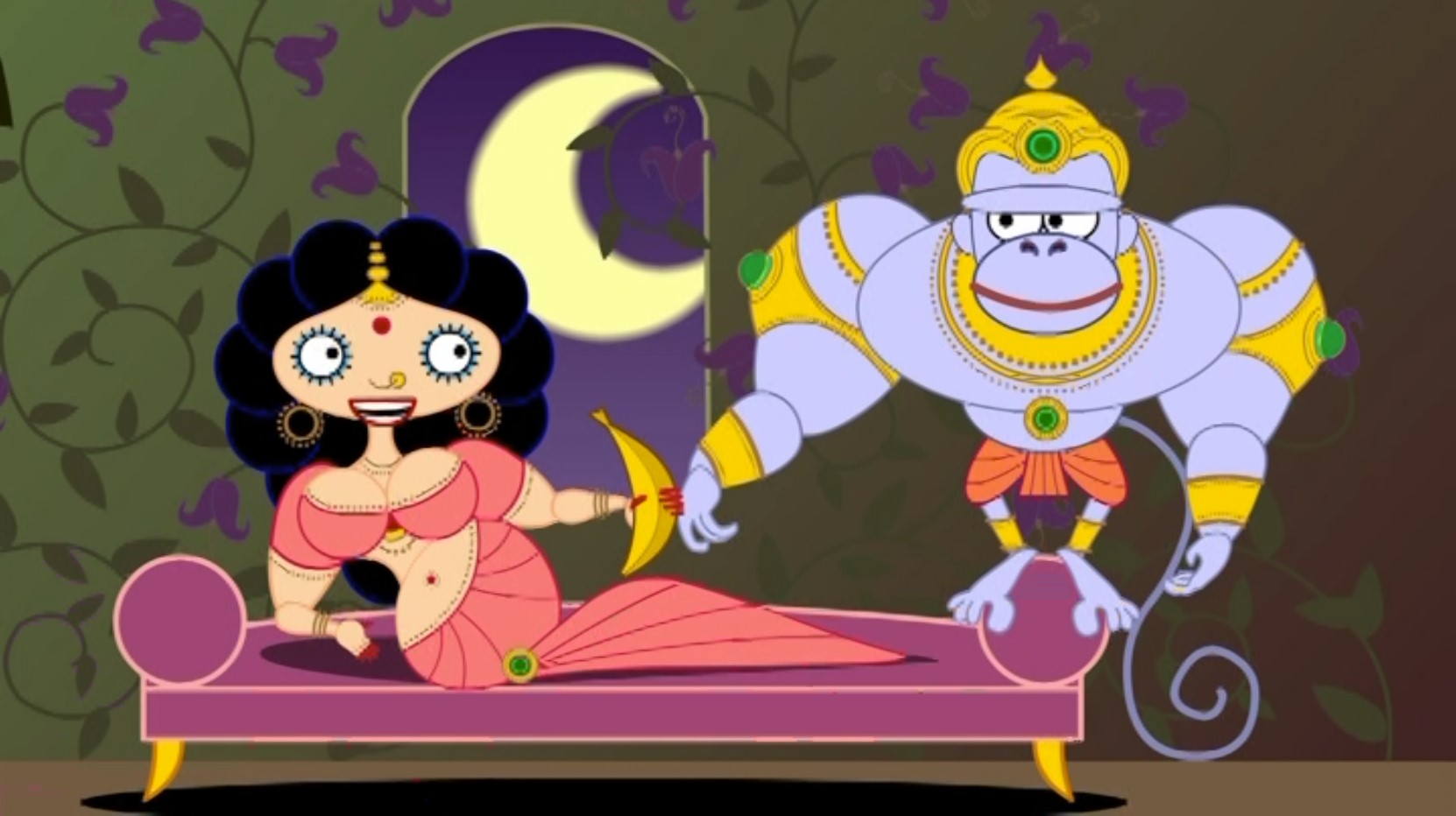
Unlike the European and Japanese animation field, the American animation studio system is unkind to author films. Walt Disney’s ‘Lilo & Stitch’ (Chris Sanders, 2002) probably comes closest, apart from several feature films based on animated television series. Thankfully, some individual artists have filled this gap, most notably Bill Plympton, releasing no less than seven features. Other notable artists are Don Hertzfeldt (‘It’s Such a Beautiful Day’ from 2012), and Nina Paley. Amazingly, all these artists mostly work totally alone, which makes their accomplishments even more stunning.
Nina Paley ‘Sita Sings the Blues’ for example, is written, directed and produced by Paley alone, which took her five to six years, and which could only be finished with help from crowd-funding, being one of the first animated projects to use this type of fund raising.
‘Sita Sings the Blues’ retells the Indian epic ‘The Ramayana’, but it’s also a personal film, in which Paley links her own situation to that of Sita, the perfect wife to the hero Rama. The most incongruous element are the eleven songs by 1920s jazz singer Annette Hanshaw, an artist sadly almost forgotten, whom Paley had discovered prior to the film making. The linking of these sweet and gentle tin pan alley songs to the Ramayana is as odd as it is effective, and the pairing certainly contributes to the uniqueness of the film.
The film uses several different animation styles: Nina Paley’s own personal story is told in a traditional scribbly animation style, with sets based on photographic material. These parts are the least attractive of the lot, even though Paley shows to be a very able animator in this classic cartoon style. The Ramayana is retold by three Indians (Aseem Chhabra, Bhavana Nagulapally and Manish Acharya) who are depicted as traditional shadow puppets of Hanuman, Sita, and Rama, respectively. The story they are telling together is shown in tongue-in-cheek cut-out animation.
The ‘official’ story is also told in cut-out animation, using very attractive recreations of traditional Indian paintings. But the best parts to look at are the songs, which are done in a most attractive cartoon modern design. In these song parts Paley reuses a lot of animation cycles, but actually she makes excellent use of the flash medium, and she makes the most of her limited animation.
Apart from these five alternating styles, there’s also a short sequence using rotoscope and a much more pop-art influenced videoclip-like filming style. All these are apparently done in Macromedia flash.
As said, ‘Sita Sings the Blues’ retells the Ramayana, reducing the huge epic to its barest elements. For example, Lakshmana is hardly mentioned, and the monkey king Sugriva not at all. Moreover, unlike the traditional poem, the focus is on Sita, not Rama, and Paley highlights the questionable parts from the original poem (one at the end of the Yuddha Kanda, and another in the Uttara Kanda), in which Rama treats Sita very unfairly indeed, just like Paley’s own partner does in real life. This makes ‘Sita Sings the Blues’ a feminist film, which sheds a welcome critical light on the traditional depiction and treatment of women, then and now.
As the story is told by three people, who remember the story differently and interpret it in different ways, this leads to some very funny moments. But Paley adds some humor, too, in the ‘official’ story part, for example when the female rakshasa (a sort of demon) Shurpanakha tells her brother Ravana about the beauty of Sita, comparing all her body parts with lotuses.
As said, the Annette Hanshaw songs boast the most attractive designs, and like traditional opera arias, they shed an emotional light on the events. However, Paley cleverly propels the story forward even during these sequences. Yet, as the songs are featured in their entirety, typically lasting ca. 3 minutes, they also drag the film down. As there are eleven of them, one tends to grow a little weary of them as the film progresses. Nevertheless, ‘Sita Sings the Blues’ does a great job in restoring interest in this almost forgotten singer. Unfortunately, the Hanshaw songs were not free from copyright, causing Paley a lot of trouble, and eventually causing her to release the film completely free from copyright.
The Annette Hanshaw songs are juxtaposed to some Indian pop music, mostly by artist Masaladosa. Particularly strong is the angry song which follows the scene in which Paley gets dumped by email. The complete soundtrack is as attractive as the film’s visual designs, and the two complement each other very well.
In all, ‘Sita Sings the Blues’ is not without its flaws, but as it is made by a single woman, it’s no less than a tour-de-force, and the result is a very interesting personal film, which makes one think. Moreover, the film shows the great power and endless possibilities of animation, and single-handedly puts Paley into the pantheon of the medium’s greats. In 2018 Paley made yet another feature called ‘Seder-Masochism’, which unfortunately has attracted much less attention.
Watch the trailer for ‘Sita Sings the Blues’ yourself and tell me what you think:
‘Sita Sings the Blues’ is available on DVD
Director: Trey Parker
Release date: June 30, 1999
Rating: ★★★★★ ♕
Review:
The South Park television series was only midway in its third season when its first (and only!) theatrical feature film was released. Thus, the film contains many of the quirks so typical of the earliest seasons but long since forgotten, like Kenny’s obligatory death, Kyle performing the act of ‘kick the baby’ with his little brother Ike or Stan compulsory vomiting on meeting Wendy.
Also prominent are characters that years ago have disappeared from the sitcom like Chef and Mr. Hat. Moreover, Cartman’s personality as a complete and pretty evil ass is not yet defined here, and although he’s already a jerk, he’s just one of the gang here.
The animation, too, retains much more of its cut-out origins than later seasons, although in the feature film the all too primitive animation is juxtaposed to a swirling 3D computer animation, especially in the hell scenes, which gives the film extra grandeur, but which would become more of a style element in later seasons of the series.
The South Park series always was at its best in social commentary, and it that respect, ‘South Park: Bigger, Longer & Uncut’ delivers big time. The film painfully clearly shows America’s obsession to prevent their children to experience anything subversive, except gun violence (incidentally by now the major death cause of American youth). It’s best not to reveal the plot, but it’s enough to know that when the kids go see the new Philip and Terrance movie ‘Asses on Fire’, things quickly go out of hand.
The film also introduces the idea that Terrance and Philip are Canadian, and that all Canadians have disjointed heads and square hands, so the difference between the designs of the main characters and that of their favorite television show turns out not be one of style, but one of ‘nature’. This ridiculous idea is played out well, and was continued in the television series, too.
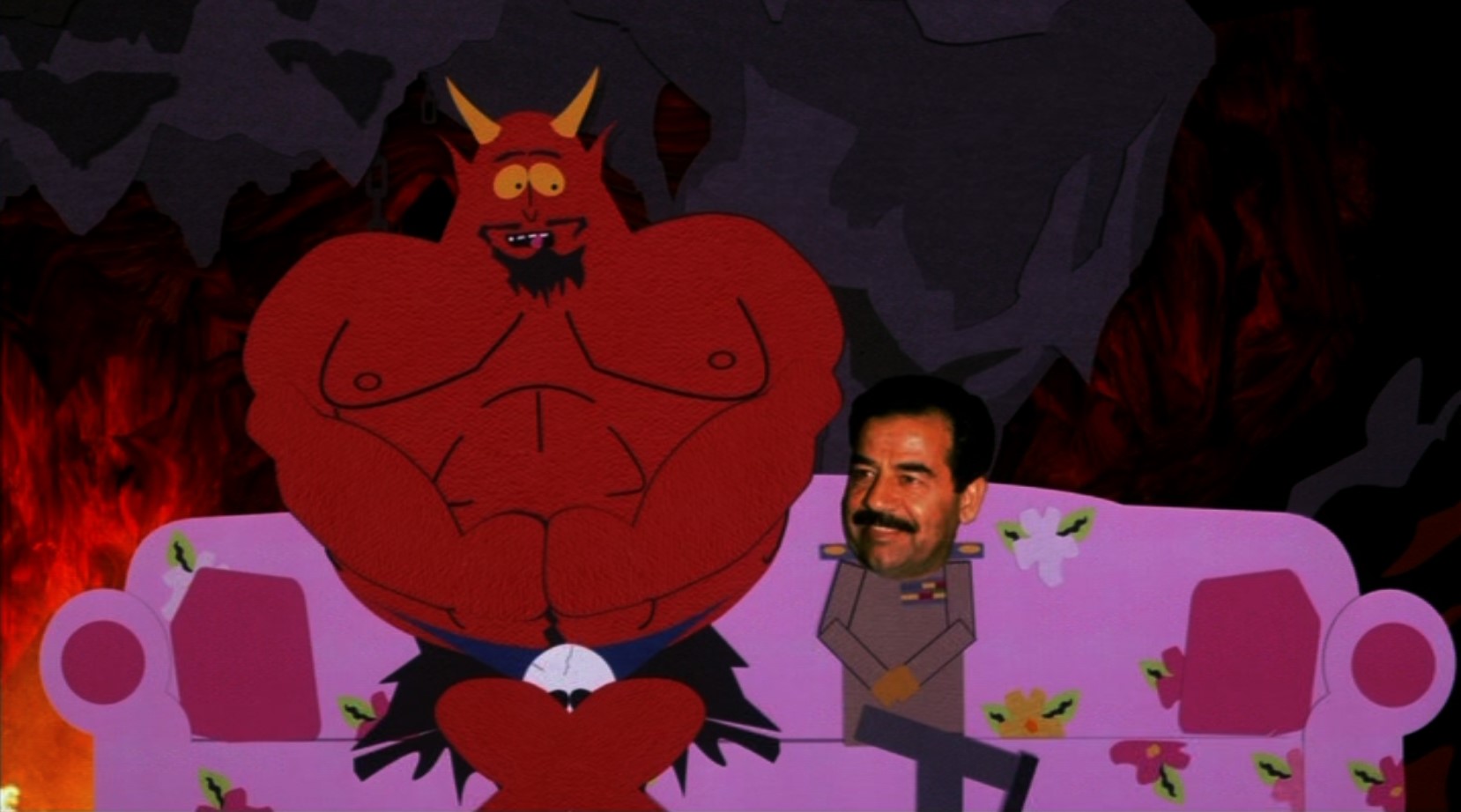
Kenny dies, of course, but for the first time we see what happens to him after his death, and quite a bit of the action takes place in hell, where Satan and Saddam Hussein get involved in the plot. Now, the Iraqi dictator was very much alive back then, and the film is a testimony of the US’ frustration they didn’t remove the villain from the office in the first Gulf War (1990-1991).
Because of Hussein Iraq was included in George Bush jr.’s nonsensical ‘Axis of evil’ (together with its arch enemy Iran), which ultimately lead to the misguided and very questionable invasion of Iraq in 2003. In ‘South Park: Bigger, Longer & Uncut’ Saddam Hussein is shown as being even more evil than Satan himself, dominating the prince of darkness in a toxic relationship. Of course, the inclusion of Saddam Hussein ages the film more than necessary, as do other references to real people, like Brian Boitano (whom I as a non-American had never heard of).
Yet, the biggest surprise of ‘South Park: Bigger, Longer & Uncut’ is not its high level of satire, nor its excellent plot, nor the introduction of elements that would become more familiar later on in the series. No, the biggest surprise of the film is that it is in fact, a musical, and a very good one at that, too. The film literally bursts with songs (there are fourteen of them), all ranging from good to excellent.
It seems Trey Parker knew exactly how to write a musical song: yes, practically all his songs are parodies of musical tropes, but his own creatures have such beautiful and memorable melodies they perfectly stand on their own. Absolutely top are ‘What would Brian Boitano do?’ and Satan’s Jesus Christ Superstar-like ‘Up there’. And then there’s a great musical moment when the Les misérables-like song ‘La résistance’ suddenly gets intermixed by four other songs, including a new one sung by soldiers, and the outstanding ‘Blame Canada’. This latter song, which was introduced much earlier in the film, is the undisputed highlight of the feature and was nominated for an academy award for best original song (which it unjustly lost to the bland ‘You’ll Be in My Heart’ Phil Collins composed for Disney’s ‘Tarzan’).
In fact, ‘South Park: Bigger, Longer & Uncut’ is so good at being a musical that it can easily be counted among the best animated musicals ever. Main composer Trey Parker, at least got on a new career as a musical writer. No, there were no other South Park movies to come, but not only did more and more songs creep into the South Park series itself, but Parker made another musical with the bizarre puppet movie ‘Team America: World Police’ (2004) and even hit Broadway with the stage musical ‘The Book of Mormon’ (2011).
In all, South Park: Bigger, Longer & Uncut’ is great satire, it’s a great musical, and it’s a great proof that feature films based on television series could (and should) be an improvement on the original series.
Watch the trailer for ‘South Park: Bigger, Longer & Uncut’ yourself and tell me what you think:
‘South Park: Bigger, Longer & Uncut’ is available on Blu-Ray and DVD
Director: Ralph Bakshi
Release date: August 8, 1973
Rating: ★★
Review:
Ralph Bakshi arrived on the scene when American classic studio animation was in steady decline, reaching its low point in the 1970s and early 1980s. In this dry period, Bakshi tried to reinject classic animation with new energy, most notably by ripping it of its association with children. Now, in the golden age animation never had been solely associated with children, but due to the advent of the Saturday-morning cartoon in the mid-1960s American animation more and more became something just for kids.
Bakshi, on the other hand, saw the full potential of the medium, and enriched the animation world with several animated features aimed at adult audiences, thus bypassing the middle ground of the family film, which was Disney’s monopoly at the time, anyway. Thus, Bakshi is sometimes seen as the savior of animation during the medium’s dark ages, but I find it hard to subscribe to that opinion, and that’s because his films are sadly just not good.
Now, I will not talk about the abysmal ‘The Lord of the Rings’ (1977), which is a disgrace to the medium, but even ‘Heavy Traffic’, his supposed masterpiece, fails on several key features.
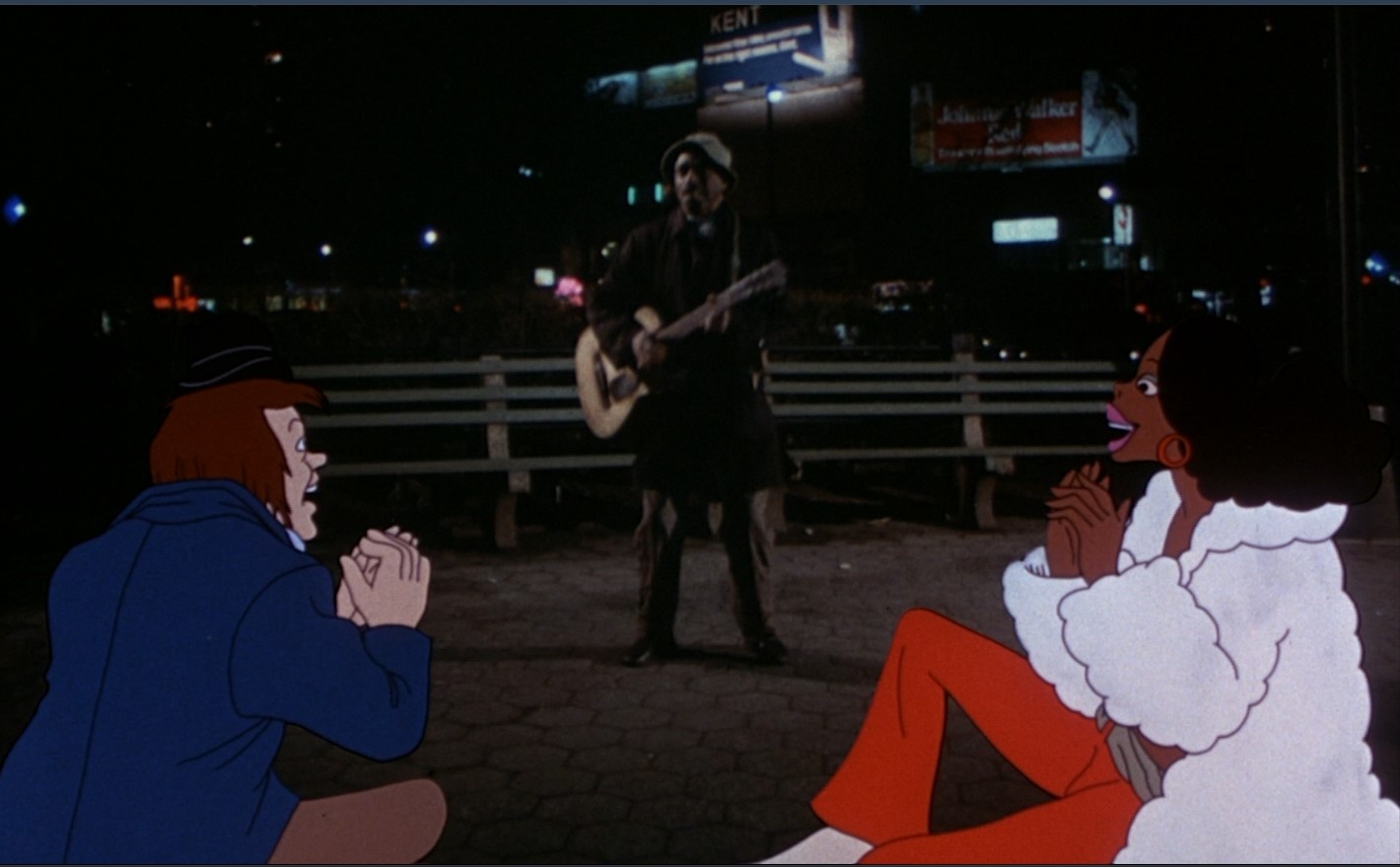
‘Heavy Traffic’ was written by Bakshi himself and has strong autobiographical elements. Set in New York the feature film tells of Michael Corleone, a young and aspiring underground cartoonist, who stills live with his quarreling parents (a Jewish mother and an Italian father), and who dates a black girl called Carole.
The film uses a voice over and the images of a pinball machine as bridging elements, but this cannot hide the fact that the film is a loose bag of scenes, and hardly goes anywhere. Sure, the film is depressing and draws a dark picture of the Big Apple, but its fourteen scenes have little to do with each other and are more about atmosphere than storytelling.
It certainly doesn’t help that none of the characters are remotely sympathetic. Even Michael himself, our supposed hero, is more of a self-centered jerk than anything else. For example, the comics he shows a publisher, wouldn’t interest anyone with a sane mind.
Worse, ‘Heavy Traffic’ falls for the misguided idea that making a film for an adult audience means it must contain sex and violence. ‘Heavy Traffic’ was not the first film to fall into this trap, and certainly not the last one (the unappealing ‘Sausage Party’ from 2016 comes to mind), but Bakshi clearly indulges in both, not only in this film, but also in ‘Fritz the Cat’ from the year before, ‘Wizards’ (1977) and ‘Cool World’ (1992), to name a few, which, to me, only proofs his immaturity. In ‘Heavy Traffic’, for example, bare breasts pop up from everywhere, with little other purpose than arousing the male audience.
Bakshi’s character designs are a mixed bag, sometimes reminiscent of the work of Mort Walker, as in the design of Michael’s father, at other times very cartoony, and reminiscent of DePatie-Freleng (e.g. the gay drag queen Snowflake), at other times quasi-realistic (Carole). Especially ill-conceived is Michael himself, whose quasi-realistic design is as mediocre as it is unappealing.
The background art too is a strange mix of drawings and photographs to a gritty effect. There are even some real live action footage elements from old films, like ‘Red Dust’ (1932) and ‘The Gang’s All Here’ (1943). In the end, the characters change into their live action counterparts, and suddenly one asks himself why this gritty film was not filmed in live action in the first place, as Bakshi’s animation adds surprisingly little.
Now, ‘Heavy Traffic’’s animator list features such illustrious names like Tom Ray, Carlo Vinci, Irv Spence, Manny Gould and Dave Tendlar, and it’s admirable that Bakshi kept these animation greats at work, but I doubt how many people watch ‘Heavy Traffic’ for its beautiful animation, for there’s hardly any. There’s manic animation, there’s outrageous animation, there’s fair animation, and there’s a lot of rotoscoping, but I’d prefer ‘Robin Hood’ from the same year anytime, even if that is the poorest of all classic Disney features.
For a supposed masterpiece, ‘Heavy Traffic’ feels like a sad affair, wasting a lot of animation talent on an egotistical document too heavy-handed for its own good, a film that is as depressing as it is boring and unappealing.
No, to me, Bakshi was more like the wrong guy at the right time: he could not save animation, for he lacked both the talent and the vision to do so. His films never transcend the dark ages, but are firmly rooted in them, and because of Bakshi’s limited view on what an adult film can be, the whole concept never really took off in the United States. This is an infinite pity, for this is one of the reasons we still must deal with the narrowminded view of animation being equal to family entertainment, today.
Watch the theatrical trailer for ‘Heavy Traffic yourself and tell me what you think:
‘Heavy Traffic’ is available on Blu-Ray and DVD
Director: Eiichi Yamamoto
Airing date: June 27, 1973
Rating: ★★★½
Review:
The late sixties and early seventies saw some striking experiments in the animated feature film. These films left the tried paths of family film and aimed at a more adult audience. In Europe Walerian Borowczyk arguably made the first experimental animated feature with ‘Théâtre de Monsieur & Madame Kabal (Theatre of Mr & Mrs Kabal)’ (1967), René Laloux made quite an impact with ‘La planète sauvage’ (1973), while in the UK George Dunning’s ‘Yellow Submarine’ (1968) caused a revolution, inspiring for example ‘János Vitéz’ (Johnny Corncob) in Hungary. Meanwhile in the US Ralph Bakshi experimented with more adult themes in ‘Fritz the Cat’ (1972) and ‘Heavy Traffic’ (1973).
In Japan, Osamu Tezuka led the way with his Mushi Productions studio, releasing three more adult themed feature films: first ‘A Thousand and One Nights’ in 1969, followed by ‘Cleopatra’ (1970) and ‘Belladonna of Sadness’ from 1973.
All three were directed by Eiichi Yamamoto, but in contrast to the earlier two features Tezuka had no direct involvement in ‘Belladonna of Sadness’. Even more striking, the great master left his own studio halfway production. Thus, ‘Belladonna of Sadness’ is very, very different from Tezuka’s own rather cartoony creations.
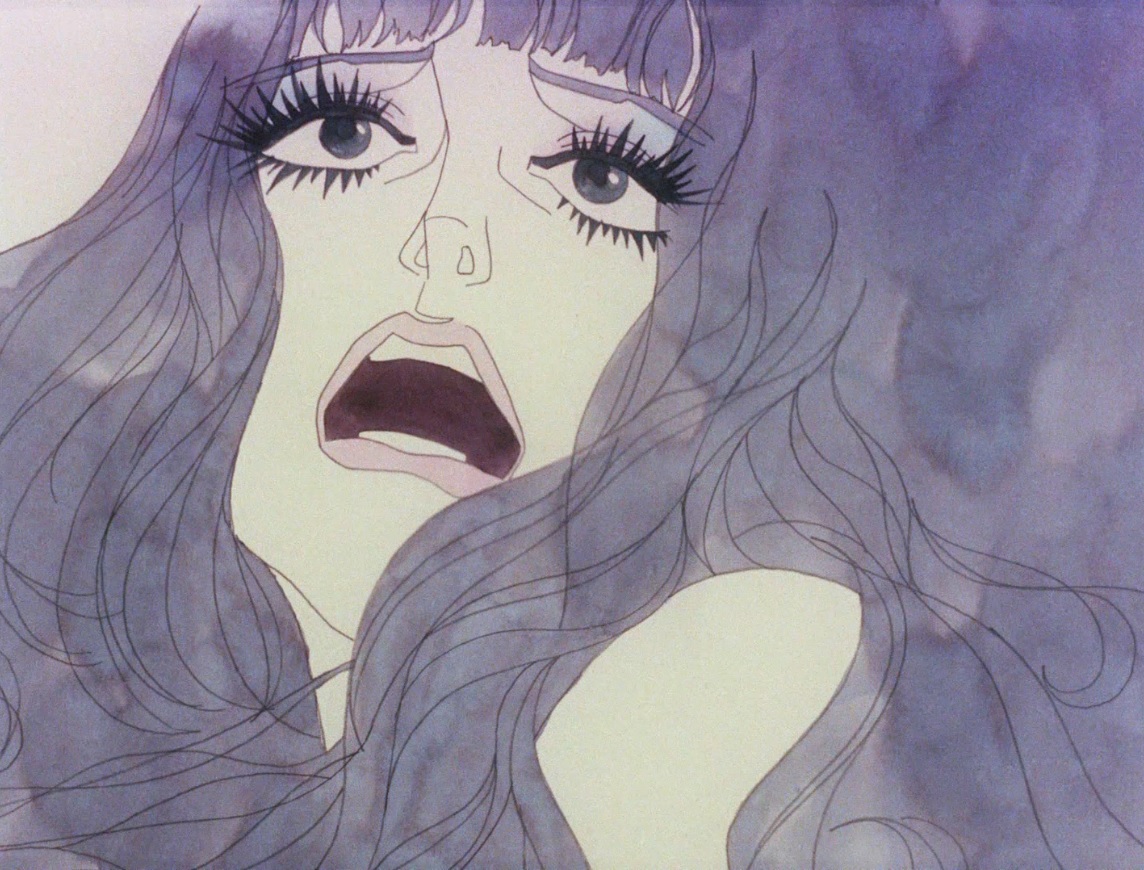
According to Yamamoto he wanted his film to be a Japanese answer to ‘Yellow Submarine’, and to make it one the drew inspiration from the artwork by Kuni Fukai. However, Kunai’s dark and disturbing artwork is quite the opposite from Dunning’s cheerful fantasies. On the Blu-ray Fukai calls his own work from the early seventies ‘decadent’, and that certainly is an apt description. Fukai’s drawings are baroque, graphical, lush, and highly erotic. They have a distinct neo-art-nouveau character, which is both very psychedelic and very seventies. For Belladonna of Sadness’ Fukai functioned as the art director, and his drawings form the base of the complete film, which uses animation only sparingly, often leaving the camera tracking over the static artwork.
And what artwork! ‘Belladonna of Sadness’ sure is a marvel to look at. The watercolor-and-pen drawings are all interesting and of a high artistic quality. Fukai almost always uses a white canvas, in which the drawings more or less disappear, and there’s ample and expressive ornamentation to accentuate the feeling of the scene. There are some odd design choices, however. For example, the villain looks like he has no eyes and as if three bones are stuck into his skull, making him rather grotesque and unbelievable.
Animation, as said, is only used only sparingly. There is no lip-synchronization, whatsoever, and some of the animation is crude and simple. The most interesting animation occurs when the events are not shown directly, but only suggested. For example, in the best erotic scenes more is hinted at than shown, and when the world is struck with the plague, we watch the landscape melt. There are certainly some trippy scenes, full of metamorphosis, which form the best parts of the movie. The undisputed highlight of the film comes when the baroque images are suddenly changed for a rapid-fire delivery of much more cartoony designs in bold seventies colors. This frenzy of animated images is followed by beautiful glass painted animation full of metamorphosis.
The psychedelic images are further enhanced by the soundtrack, which mixes psychedelica, spacefunk and rock into a very seventies-like mix, akin to Alain Goraguer’s soundtrack for ‘La planète sauvage’ from the same year, albeit of a lesser quality. There are even a few songs to enhance the mood.
In contrast to the beautiful art the story of ‘Belladonna of Sadness’ is subpar, and even objectionable. The film is based on ‘La sorcière’ (1862) by Jules Michelet, a non-fiction book on witchcraft, and the film’s story is set in a fictive oppressive kingdom in which a peasant girl becomes a witch. However, Yamamoto’s and Yoshiyuki Fukuda’s screenplay apparently only uses the book as a source of inspiration, as their own tale is as predictable as it is boring.
Yamamoto apparently instructed Fukai that his film was ‘porn but make it a love story’. Well, the movie is certainly porn, but hardly a love story. The two lovers Jean and Jeanne are more vignettes than characters, and if anything, Jean is a weak and will-less coward. Worse, the porn is exploitive, featuring several rapes and a lot of violence. As can be expected, there is a lot of female nudity, but hardly any male one, although penises are omnipresent, especially as the devil takes the shape of a penis himself. Jeanne’s best moment comes when she reveals herself as a full-blown witch, which provides one of the film’s most iconic moments. But during most of the film she’s used and abused by powers beyond her control. The ending, too, is unsatisfying, and all too abrupt, forcingly trying to make the porn story into something political.
Thus, ‘Belladonna of Sadness’ may transcend normal porn (it’s certainly weird and original enough to do so), but not that of a cheap comic. There’s no depth to the story, at all, and the film’s exploitive character gives a bad taste in the mouth. Nevertheless, the movie is a feast of the eye and stands as a great example of the sheer experimentation that were the seventies.
Watch the trailer for ‘Belladonna of Sadness’ yourself yourself and tell me what you think:
‘Belladonna of Sadness’ has been released on Blu-Ray, but this is currently out of print
Director: Marcell Jankovics
Release date: May 3, 1973
Rating: ★★★★
Review:
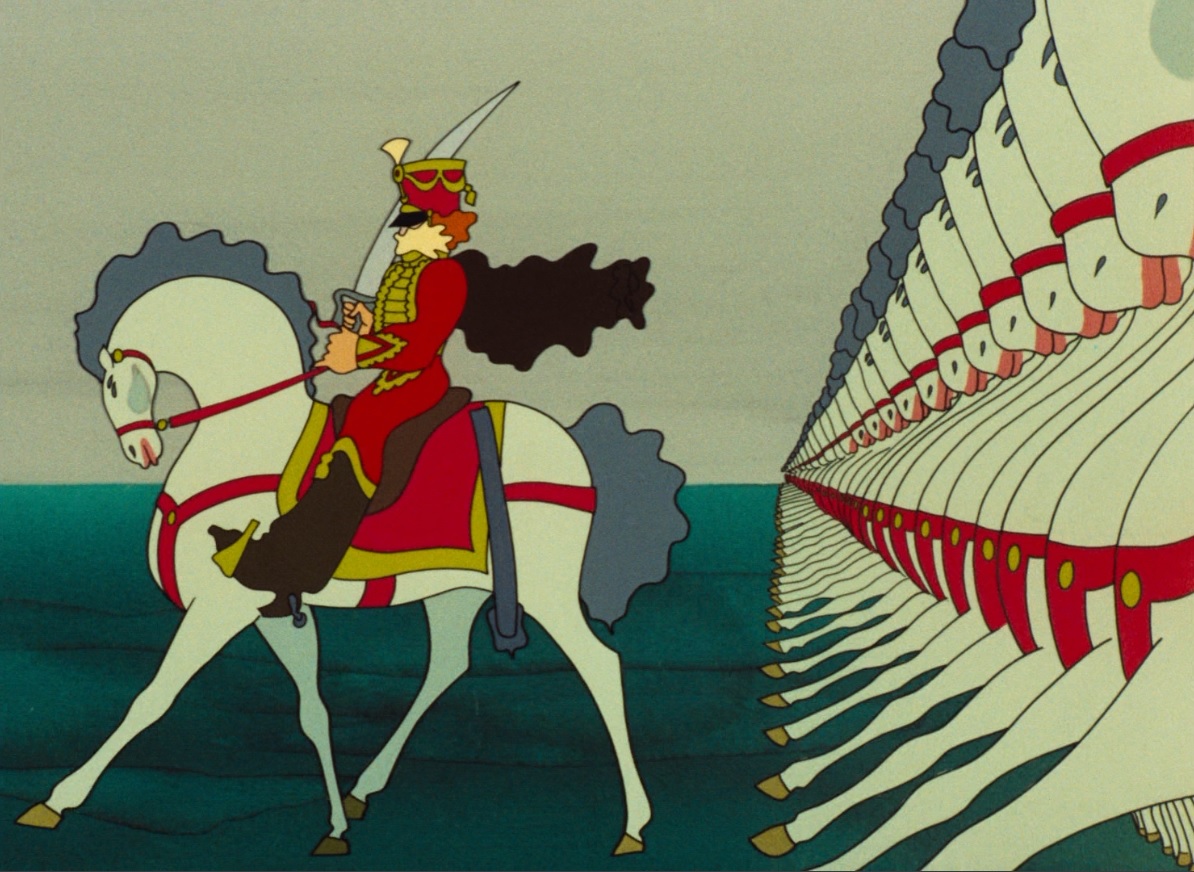
Hungarian director Marcell Jankovics (1941-2021) is most famous for his second animated feature, the mind-blowing masterpiece ‘Fehérlófia’ (Son of the White Mare) from 1981. But his first feature, ‘János Vitéz’ certainly deserves to be equally famous.
‘János Vitéz’ was Hungary’s ever first animated feature ever, but this doesn’t show, at all. The feature is a remarkably mature product that owes nothing to earlier animation films, save George Dunnings’ ‘Yellow Submarine’ from 1968 (and one scene of a devils’ dance, which harks all the way back to Disney’s Silly Symphony ‘The Goddess of Spring’ from 1934). Like Dunning’s film, ‘János Vitéz’ uses very striking visuals in bold colors, and with a genuine contemporary design. In fact, no movie from the seventies looks so enormously ‘seventies’ as this film.
The film was commissioned by the Hungarian government to commemorate the 150st birthday of Hungary’s national poet Sándor Petőfi (1823-1849), whose stature in Hungary is comparable to that of Pushkin in Russia. Petőfi wrote ‘János Vitéz’, a long epic poem in 1844, and despite the strikingly modern visuals, the film follows the poem quite faithfully. János Gyulai-Gaál’s score is unmistaken Hungarian, akin to the music of Zoltán Kodály’s folk opera ‘Háry János’ from 1926 and contributes greatly to the utterly Hungarian character of the movie. There are also a few charming songs, adding to the experience.
The story is pretty nonsensical and more of a tall tale than a classic epic poem. It tells about the hero János Vitéz who is a sheep herder in love with the neighboring Iluska. Unfortunately, Iluska’s stepmother, the witch Mostoha, doesn’t approve of the young lovers’ romance, and makes János Vitéz’ flock of sheep disappear. Banished from his village, János Vitéz first joins a band of robbers, then joins the army, but keeps longing for his beloved Iluska.
The film retains much of Petőfi’s poetic quality: the dialogue is in rhyme, and the images themselves have a lyric quality. For example, the love of Iluska and János Vitéz is shown by associative images, full of flowers and a radiant sun. Moreover, a lot of the story is told through the images, and more by suggestion than by literally showing what’s happening. For example, when János Vitéz is banished this is shown by a street in which every house shuts its shutters when János Vitéz passes by.
The images are as folkloristic as they are psychedelic, and never cease to please or to amaze. The character designs are more of a mixed bag. János Vitéz and Iluska are drawn as rather bland beautiful people, while Mostoha, the robbers and the Turks are very cartoony. These and other characters provide some small gags. Character animation is absent. For example, when János Vitéz mourns for Iluska, this emotion is indicated more than heartfelt. Nevertheless, there is a clever use of metamorphosis and animation cycles, and it’s clear the animation is in service of the graphics and of the story.
In all, ‘János Vitéz’ is a joy to watch from start to end and deserves a much wider audience than it has now.
Watch an excerpt from ‘János Vitéz’ yourself and tell me what you think:
‘János Vitéz’ is available on the Blu-Ray of ‘Son of the White Mare’
Director: Carlos Saldanha
Release date: December 10, 2017
Rating: ★★★
Review:

The classic children’s book ‘The Story of Ferdinand’ by writer Munro Leaf and illustrator Robert Lawson appeared in 1936, and already in 1938 Walt Disney turned, quite faithfully, the story into an animated short called ‘Ferdinand the Bull’.
Of course, for its twelfth feature length film the Blue Sky studio had to expand the story. Like in the book and like Disney’s film Ferdinand is a flower loving bull who refuses to fight, but who ends up in the arena, anyway. There the similarities stop. To this core the studio added a lot of characters and complications. In the process the book’s essentially pacifistic character has been replaced by a more generic message that being gentle, friendly, and helpful doesn’t mean that one is weak, on the contrary. Also added is that all-American dream that one can change the world oneself (“It does not have to be this way” one can hear repeatedly in the movie).
The studio transfers the story to present day Spain and adds a background story of young Ferdinand growing up in a place called ‘Casa del toro’. Young Ferdinand sees his father off into the arena, never to return. This prompts the peaceful calf to escape, and somewhere in the neighborhood of Ronda (the town’s famous Puente Nuevo can be seen in some of the background views from Ferdinand’s flower hill) Ferdinand is found and adopted by a girl called Nina and her father Juan, a flower farmer.
After thirteen minutes young Ferdinand turns into his adult counterpart, and he has grown into a big bull, indeed. When he ends up at ‘Casa del Toro’ again, Ferdinand has a hard time keeping his pacifist ideals, and even worse, he learns a terrible truth about bullfighting, prompting him to rescue his fellow casa inmates.
Woven into this story are a lot of extra characters, rather crowding the story. At Nina’s place there’s a dog called Paco (weakly voiced by Jerrod Carmichael), while ‘Casa del Toro’ features five other bulls, a female “calming” goat called Lupe (a nice voice job by Kate McKinnon), three German horses, and three hedgehogs, which are strange enough rendered in purples and blues. The three German horses add to the fun, but are hardly essential to the plot, and particularly the three hedgehogs come across as stock characters. These three drive a car in a scene that seems directly stolen from ‘Toy Story 2’ in which other small characters manage to drive together.
True, ‘Ferdinand’ is well told, and knows no dead moments. But it doesn’t hold any surprises, either, and the film feels frustratingly run-of-the-mill. Even the gags are disappointingly predictable. The chase scene in Madrid is inspired, but the all too sweet finale is a letdown: there’s absolutely no drama or conflict left in the end. Meanwhile, the charm of the original book gets completely lost in all the antics of Ferdinand’s co-stars, and the sometimes gross out humor (for example, Lupe repeatedly throws up things). It’s also worthwhile to mention that the film is less anti-bullfighting than one would hope.
The film also feels lackluster visually: there are no interesting character designs, and even some ugly ones (some of the humans, a problem troubling the studio since its first Ice Age movie). There is some stylization (for example the bark of the tree on Ferdinand’s hill, a cartoony bee and an almost mechanical butterfly), but this is not carried through consistently. The rendering, too, feels poor, especially when compared to the contemporary ‘Coco’, giving the characters a hard edge and all too saturated colors. The background art, too, is rather simple and uninspired. Even worse, some of the animation is shockingly stiff, especially that of Nina and Juan. On the upside, there are some nicely staged scenes, like Ferdinand entering the slaughterhouse, or Ferdinand entering the ring. In the latter scene, the camera swoops around Ferdinand while he walks into the arena, capturing both the overwhelming scenery and Ferdinand’s reaction to it.
In all ‘Ferdinand’ is not bad, but it’s no classic, either, as the film is as entertaining as it is forgettable.
Watch the trailer for ‘Ferdinand’ yourself and tell me what you think:
‘Ferdinand’ is available on Blu-Ray and DVD
Director: Lee Unkrich
Release date: October 20, 2017
Rating: ★★★★★ ♕
Review:

The 2010s were a disappointing decade for the Pixar studio: the studio largely lost its role as game changer, spitting out a lot of sequels and meagre films that couldn’t stand the comparison with their great movies of the 2000s. Yet, three of their films shone far brighter than the others and showed that the studio still had it: Toy Story 3 from 2010, ‘Inside Out’ from 2015, and ‘Coco’ from 2017.
With ‘Coco’ the studio followed a recent Disney trend to give American minorities their own animated movie. After Afro-Americans (‘The Princess and the Frog’, 2009) and Polynesians (‘Moana’, 2016), ‘Coco’ stars Mexicans only, taking place in Mexico, and focusing on the typically Mexican holiday ‘Día de muertos’, the Mexican variant on All Souls’ Day and All Saints’ Day (1 and 2 November).
Now ‘Coco’ wasn’t the first animated feature film around Día de Muertos, which was 20th Century Fox’s ‘The Book of Life’ (2014), and like the former film ‘Coco’ takes partly place in the land of the dead. But there the comparison stops, and while ‘The Book of Life’ boasts more daring design choices, ‘Coco’ is by far the better film in terms of animation, art direction, background art and storytelling.
Moreover, the animated depiction of the dead as vivid skeletons is even older, as they also appear in ‘Corpse Bride’ (2005) and in the charming stop motion shorts ‘Hasta los huesos’ (René Castillo, 2001) and ‘Día de los muertos’ (Kirk Kelley, 2002). One can safely say, both Mexico’s idiosyncratic holiday and the depiction of the afterlife are of a particular interest to film makers. Let’s not venture into earlier depictions of the afterlife, in cinema or otherwise, although I have to say the concept of the afterlife in Coco has much in common with that of Kevin Brockmeier’s novel ‘The Brief History of the Dead’ from 2006: in both afterworlds one only really dies when he’s not remembered.
‘Coco’ tells about young boy Miguel, who aspires to be a musician, but who grows up in a family of shoemakers in which music is banned. When on ‘Día de muertos’ Miguel steals a guitar from the grave of his idol Ernesto de la Cruz he gets into much more trouble than he had bargained for…
Why the film is called ‘Coco’ instead of ‘Miguel’ only becomes clear at the very end of the film, in a scene that forms the emotional highlight of the movie, and is one of the most moving scenes in animation, overall.
But from the beginning ‘Coco’ evokes wonder. Even the background story is told superbly, with the help of garlands depicting the life of Miguel’s ancestors in attractive 2D animation. Miguel’s own world, too, is of unsurpassed richness. His family house, his village, the graveyard – all are complex and elaborate sets, depicted in the richest detail, which render them instantly believable. But nothing prepares the viewer for the jaw dropping depiction of the netherworld – which is more colorful and more fantastic than anything depicted on the animated screen before. The color designs are superb throughout anyway, with a strong focus on orange. The lighting, too, never ceases to amaze – there’s a beautiful golden glaze in the evening scenes. And yet, the graveyard scenes are even more awe inspiring, with their complex lighting by numerous flickering candles.
But all this would be in vain if the film’s story wasn’t good, as well. But ‘Coco’ can boast a story that is as entertaining as it is emotional. The story is rich and surprising and knows no dead moment at all. Sure, there are a few obligate scenes (like the breakup scene – omnipresent in American feature animation), but for once they do work. For example, the tiring family message, an obligatory Disney feature, is more interesting than usual, because Miguel’s family is actually hindering him in his dreams, and he can only reconcile with them after his family members have changed, too. The only complaints I have is that Miguel runs all too easily into his former ancestor, not only once, but twice. This is a coincidence too good to be true, and one hard to swallow. Moreover, it’s a quite unclear how the gentle romantic Hector changed into the opportunistic bum he apparently became in the afterworld.
The film boasts some great humor, too, for example Miguel runs into a skeleton nude, and there’s a great scene involving the deceased Frida Kahlo. Much of the humor comes from Hector’s antics, and of a street dog called Dante, which mysteriously follows Miguel into the afterlife (the Blu-Ray reveals that Dante is a so-called Xoloitzcuintle, a dog race traditionally guiding the dead to the Aztec underworld – when one sees the real thing one is amazed how well Dante resembles his real-life counterparts).
Less successful, especially in a film about the power of music, are the songs, with Miguel’s finale song being particularly annoying. But even the song ‘Remember me’, which takes a very important place in the story, is not half the classic song it supposed to be. That it’s sung in English instead of Spanish is a missed opportunity and contributes to the feeling of a deluded version of the real Ranchera thing.
Nevertheless, this is nit-picking, and these minor flaws hardly hamper a film, which is of a most magical nature. ‘Coco’ takes full advantage of the power of animation, and never ceases to amaze. The film is not only one of Pixar’s best films of the 2010s, but it should also be included into the studio’s all-time best list, as well as being one of the best films of the 2010s by any studio.
Watch the trailer for ‘Coco’ yourself and tell me what you think:
‘Coco’ is available on Blu-Ray and DVD
Directors: Charlie Bean, Paul Fisher & Bob Logan
Release date: September 22, 2017
Rating: ★★
Review:

One of the biggest feature animation surprises of 2014 was ‘The Lego Movie’. On paper this joint venture between Warner Animation and the famous toy company from Denmark should have been something terrible. After all, it was based on an existing toy line, a recipe for disaster. But the opposite happened and ‘The Lego Movie’ turned out to be one of the funniest, most sophisticated, and deepest animation film of the 21st century. The film was followed in 2017 by the equally funny ‘The Lego Batman Movie’, deepening the title character as he appeared in ‘The Lego Movie’. Warner Animation and Lego were clearly on a roll.
Or were they? Appearing in the very same year as ‘The Lego Batman Movie’, ‘The Lego Ninjago Movie’ uses several of the ingredients of the previous films, but with a remarkably disappointing result. True, there are some good gags, especially those referring to the characters being made of Lego, but more often such gags feel like they have been done before, and better. Even worse, compared to the two earlier films, both the story, the world and the characters are very weakly developed. Apparently, the film was based on a long-lasting television series, but the film hardly betrays that fact. Instead, the movie feels as only half-baked, and assembled too quickly for its own good.
The problems of ‘The Lego Ninjago Movie’ are legion. The film uses elements of both wuxia and mecha films, but can’t satisfy lovers of either genre, as the film makers do very little with these elements. The whole setting of Lloyd being both the leader of the Ninjago squad and the son of Garmadon, the very nemesis they continually combat, is preposterous to start with. That these Ninjago warriors are also some teenager friends at a high school (even though one is a robot) only adds to the implausibility. So does the fact that Garmadon has four hands. The plot gets particularly silly when ‘the monster’ arrives, but when the Ninjago squad goes on a quest in a forest, the film seriously starts to drag. The son-dad relationship becomes a tried and tiresome cliché, and halfway one realizes he doesn’t care for these characters, at all. And then the overlong finale must start, yet…
On the top side the film starts with Jackie Chan, who is always pleasant to watch, even though he’s completely wasted in this film. And the textures of the Lego elements are surprisingly good, rendering them very tactile, indeed. Moreover, the film makes some surprising and rather silly choices in its use of pop music. But it should be clear that none of this can rescue a sloppy, lazy film that seriously lacks the heart and attention given to the first two Lego movies.
Watch the trailer for ‘The Lego Ninjago Movie’ yourself and tell me what you think:
‘The Lego Ninjago Movie’ is available on Blu-Ray and DVD
Director: Nora Twomey
Release date: September 8, 2017
Rating: ★★★★★
Review:

2017 was a good year for the animated feature film: Warner Bros., Dreamworks and the French Polivari and Panique studios gave us great laughs with ‘The Lego Batman Movie’, ‘Captain Underpants: The First Epic Movie’, and ‘ Le grand méchant renard et autres contes…’ (The Big Bad Fox and Other Tales), respectively; Pixar amazed us with the magnificent ‘Coco’, and the Japanese Science Saru studio made quite an impression with the mind-blowing film‘Night Is Short, Walk on Girl’.
However, the most important and most moving animated feature film was the Irish-Canadian-Luxembourgian co-production ‘The Breadwinner’. This was the third feature by the Irish Cartoon Saloon studio, which can be regarded as the most welcome and most original studio additions to the animated feature field of the 21st century, thus far. The Breadwinner’ shares with their previous two films, ‘The Secret of Kells’ (2009) and ‘The ‘Song of the Sea’ (2014) a very charming traditional animation style, and a surprisingly graphic overall design, although the latter is rather toned down in ‘The Breadwinner‘ when compared to the earlier two movies. But unlike the other two, ‘The Breadwinner’ completely lacks the Irish flavor, being set in, of all places, Afghanistan.
Based on the book by Deborah Ellis from 2000 ‘The Breadwinner’ is set in Kabul, the unfortunate country’s capital during the first Islamic Emirate of Afghanistan (better known as the Taliban regime, 1996-2001). By the time the film was made, this extremely oppressive regime was a ghost of the past, at least in Kabul (the Taliban never fully disappeared from the country), but sadly, since August 2021 this misogynist, backward movement is in full charge of the country, once again.
‘The Breadwinner’ makes no mistake how hard it is to live in such a violent, insecure country, where arbitrariness prevails, and where women have no rights, at all, whatsoever. The film follows the eleven-year-old Afghan girl Parvana, who lives with her disabled father, her mother, elder sister Soraya, and a baby brother called Zaki in a tiny house in Kabul. When the father gets arrested and thrown into a prison far outside town, the family quickly get into way more problems than they already had: as women cannot do anything outside without a man, their means to even obtain food completely come to a standstill. At this point Parvana takes an important decision to save her family’s life…
‘The Breadwinner’ is a very believable story, much more subtle than almost anything coming out of the United States. For example, the Afghan people are portrayed as real people, with a rich an ancient culture. Added to the sense of authenticity is the use of Afghan voices (except for the brabbling Zaki), while Mychael and Jeff Danna’s score clearly borrows from the Afghan musical tradition. Thus, the film’s Afghanistan is a convincing one, not a caricature seen through Western eyes. Moreover, although the film makes no mistake about the oppressive and misogynist nature of the Taliban regime, there are many shades of gray between the heroes and villains. Even the villain that causes Parvana’s family’s demise is shown in one last shot as not only evil, but insecure and afraid, too. Moreover, Parvana remains a relatable character, throughout. Despite her courage and adult responsibility, she remains a child, and is shown delighting in childish behavior, especially with her friend Shauzia.
Contrasted with Parvana’s dire circumstances are the images of a story she tells her beloved (her first audience is her baby brother, but she also tells the tale to others, and others even blend in, altering the direction of the story while doing so. These images are rendered in the most colorful, storybook illustration-like, faux cut-out animation, and tell about a boy who goes on a quest to retrieve his village’s seeds from an evil elephant king. This fantastical tale is picked up several times during the movie, and often reflects the events depicted in real life. Especially in the finale, in which the two seem to come together, this dual story telling comes to a harrowing conclusion.
As said, the film’s design is less graphic than that of Cartoon Saloon’s Celtic features. The background art is semi-realistic, with depressing greys, browns and yellows depicting the seemingly treeless town of Kabul. The character design is more graphic, with especially Zaki being an echo of the character designs from the earlier films. Noteworthy is the background art of a rather surreal scene in which Parvana and Shauzia are seen in a field full of abandoned tanks. The traditional animation is a delight, not only the very moving animation of the main characters, but also the cartoony quasi-cut-out animation of Parvana’s story. There’s only a little computer animation present, mostly for crowd scenes.
In all, ‘The Breadwinner’ is one of the best, most adult and most moving animation films to come out of any animation studio, and should be considered a modern classic.
According to director Nora Twomey ‘The Breadwinner’ may be set in Afghanistan but tells a universal story of all children growing up in oppressive countries, everywhere. Yet, we are still waiting for the animated depictions of their stories, while Afghanistan has been the subject of no less than three other animated feature films since then: ‘The Swallows of Kabul’ from 2019 and ‘My Sunny Maad’ and ‘Flee’ from 2021. Surely, the people of say North Korea, Syria, Eritrea, the Central African Republic, or Yemen deserve better.
Watch the trailer for ‘The Breadwinner’ yourself and tell me what you think:
‘The Breadwinner’ is available on Blu-Ray and DVD
Director: Hiromasa Yonebayashi
Release date: July 8, 2017
Rating: ★★★½
Review:

‘Mary and the Witch’s Flower’ is the first film by Studio Ponoc, founded by Yoshiaki Nishimura, who was a producer for Studio Ghibli before. Director Hiromasa Yonebayashi, too, is a Studio Ghibli alumnus, being an animator for the famed studio since 1997, and directing the studio’s 21st feature film ‘When Marnie Was There’ (2014).
It comes to no surprise then that ‘Mary and the Witch’s Flower’ is very, very Ghibli-like. Already the packaging of the DVD would fool anyone. But the similarity doesn’t stop there: even the opening titles emulate Ghibli; the character designs, too, are very Ghibli-like; the film is based on a British children’s book, just like Ghibli’s ‘Howl’s Moving Castle’ (2004), ‘Arrietty’ (2010) and ‘When Marnie Was There’; the film stars a young female protagonist (Mary) who has to survive without her parents, just like ‘Kiki’s Delivery Service’ (1997), ‘Spirited Away’ (2001) and ‘From Up on Poppy Hill’ (2010); Mary is a witch like Kiki; she’s accompanied by a cat who plays an important part just like Kiki and like Shizuku in ‘Whisper of the Heart’ (1995), and the film is partly set in a fantasy world, just like ‘Spirited Away’.
Now, this is immediately the film’s main flaw: studio Ponoc imitates Ghibli very well but doesn’t bring anything original of its own. The final product is practically indistinguishable from the source of inspiration. That doesn’t mean, however, that ‘Mary and the Witch’s Flower’ is a bad movie. The story is told well enough, the animation is top notch, and the fantasy world looks great. I certainly had a good time watching it, and would recommend the movie to all lovers of the Studio Ghibli product. But Studio Ponoc’s debut could and should have been something much more of their own. If you compare, for example, ‘Mary and the Witch’s Flower’ to the idiosyncratic ‘Night Is Short, Walk on Girl’ from the same year, it becomes clear which studio brings something original to the world, and which one does not.
Watch the trailer for ‘Mary and the Witch’s Flower’ yourself and tell me what you think:
‘Mary and the Witch’s Flower’ is available on Blu-Ray and DVD
Directors: Patrick Imbert & Benjamin Renner
Release date: June 15, 2017
Rating: ★★★★★
Review:
One of the more pleasant developments of the 21st century was the coming of animated feature films, the whole purpose of which was to make people laugh. One could say this trend started off with the successful ‘South Park, Bigger, Longer & Uncut’ (1999), and like that film these films were mostly off-shoots from series (‘The Simpsons Movie’ and the Spongebob Squarepants movies from 2004, 2015 and 2021) or offshoots from other films (‘Minions’ from 2015, ‘The Lego Batman Movie’ from 2017).
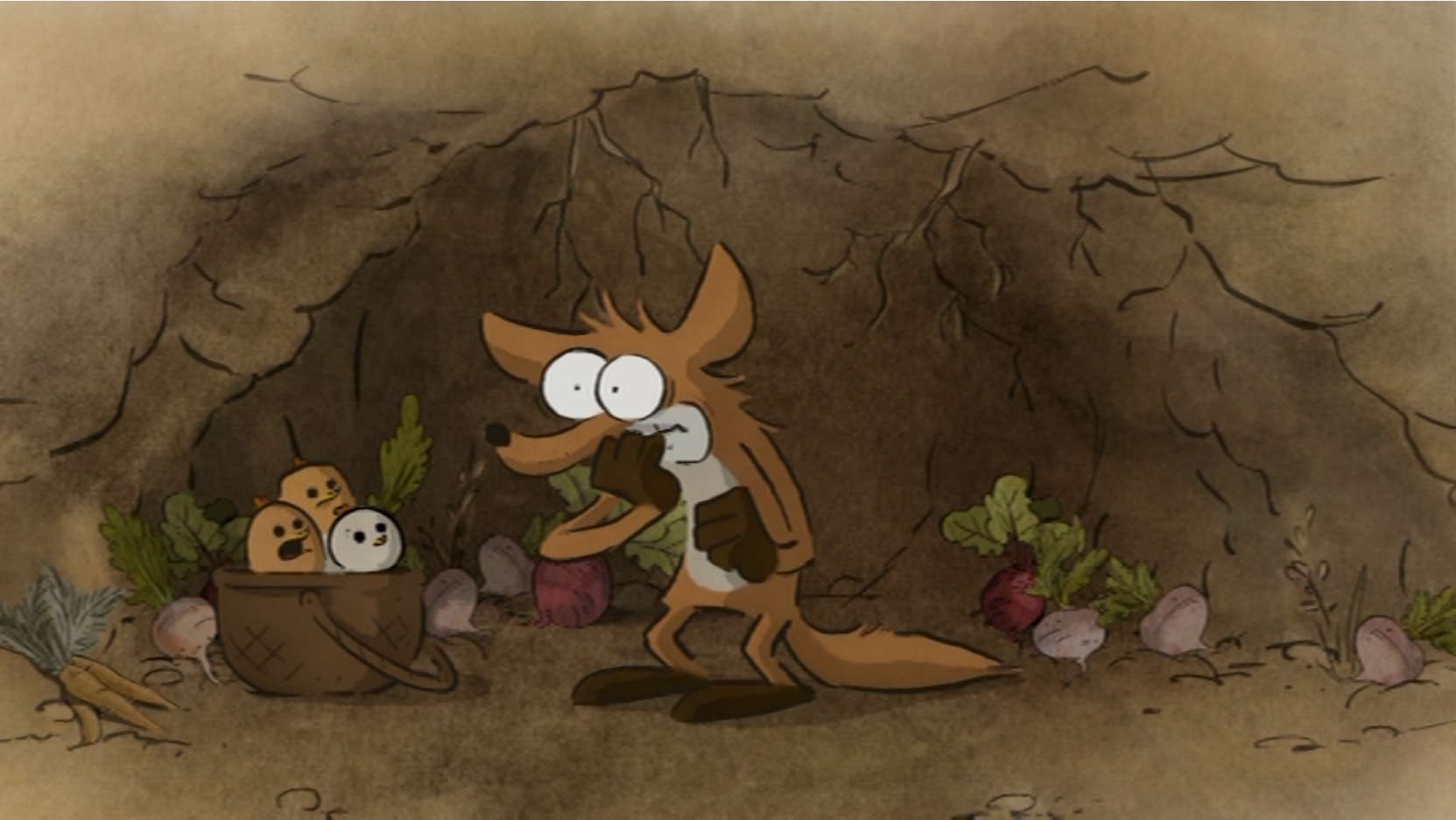
But occasionally, a film comes to you, which is both very funny, and totally original, even if it’s based on an earlier comic strip, like the Franco-Belgian feature ‘Le grand méchant renard et autres contes…’. The film is co-directed by Benjamin Renner, one of the producers of the attractive, if flawed ‘Ernest et Célèstine’ from 2012, and the original author of the comic strip, ‘Le grand méchant renard et autres contes…’. . Both comic strip and movie aim for the laughs, and are highly successful at it, too.
The film is advertised as a children’s film, and it certainly is fit for all ages, but don’t let this fool you. There’s nothing childish about this film. Instead, we get high quality cartoon comedy, perfectly animated and perfectly timed.
Based on three separate stories, ‘Le grand méchant renard et autres contes…’ is an anthology film, bridged by the idea of a play performed by the main characters. As soon as the first tale starts, the backdrop changes into the scenery in which all three stories take place: a farm in the countryside.
In the first film a stork talks a pig, a duck, and a rabbit into delivering a baby for him to his parents. Unfortunately, the baby must be delivered in faraway Avignon, and sadly for the pig both the duck and the rabbit are as incapable as they are optimistic. This tale is chockfull of cartoon slapstick, as the duck and the rabbit keep on thinking more and more outlandish schemes to deliver the baby, while the pig desperately tries to keep the little one safe.
The next story is a little cuter and involves a totally inept fox who teams up with a lazy and selfish wolf. The wolf talks the fox into stealing some eggs to raise them into fat chickens, but of course the fox grows attached to the little ones. Nevertheless, this tale, too, moves and shifts into surprising directions, and is less straightforward than this summary.
The third and final story is a genuine Christmas story, which sees the happy return of the pig, duck, and rabbit trio of the first part. This time, duck and rabbit think they’ve killed Father Christmas, and make resolutions to deliver the presents themselves… General mayhem is ensured.
The film uses a very charming drawing style, which like the earlier ‘Ernest et Célèstine’ consists of watercolor backgrounds and fake watercolor-coloring of characters, open lines and appealing character designs, which more or less fit in a long and diverse Franco-Belgian cartoon style tradition. The film is continuously pleasant to look at, and the attractive score, by Robert Marcel Lepage, adds to the film’s charm, as well. Scored for a small ensemble, Lepage makes excellent use of some familiar themes, like the morning theme from Giachino Rossini’s Overture ‘William Tell’, the wolf theme from Sergei Prokofiev’s ‘Peter and the Wolf’, and in the last story, ‘Jingle Bells’.
In all, ‘Le grand méchant renard et autres contes…’ once again shows that France is one of the most interesting animation film-producing countries around. Recommended to all.
Watch the trailer for Le grand méchant renard et autres contes… (The Big Bad Fox and Other Tales) yourself and tell me what you think:
Le grand méchant renard et autres contes… (The Big Bad Fox and Other Tales) is available on Blu-Ray and DVD
Directors: Pierre Coffin & Kyle Balda
Release date: June 14, 2017
Rating: ★★★
Review:

The third installment of the Despicable Me franchise (not counting the spin-off ‘Minions‘ from 2015) is also the weakest of the trio. Like the other two the film is a fun ride, full of humor and action, but this time the film makers simply wanted to tell too much in one film. There are no less than six plot lines in this film divided over different main characters.
The first, and most enjoyable one considers Gru and his apparent arch nemesis Evil Bratt, a former child-actor from the 1980s gone bad. Evil Bratt, excellently voiced by Trey Parker of South Park fame, is a delightful villain, and the film makers indulge in 1980s tropes to make this character. For example, Evil Bratt sports a mustache and a mullet, and his weapons are based e.g., on bubblegum, Rubik’s cube, and a keytar. Moreover, whenever he appears, he’s accompanied by a 1980s hit, e.g., ‘Jump’ by Van Halen, ‘Take on Me’ by A-Ha, ‘Into the Groove’ by Madonna, and even ’99 Luftballons’ by German star Nena. The film immediately starts with this character, and it’s thanks to this wonderful villain that ‘Despicable me 3’ keeps on the right side between failure and entertainment, if barely so.
Much less interesting are the other story lines: Gru and Lucy are fired, and Gru desperately tries to get his former job back. In a third and totally unexpected twist Gru suddenly discovers he has a twin brother (also voiced by Steve Carrell, voice of Gru), who wants to be a villain, like Gru used to be, but who clearly lacks the skills. The fourth story line involves the minions, who walk out of Gru, a fifth involves Agnes (the youngest of Gru’s three adopted children) and her wish to see a unicorn. And the sixth is about Lucy, and how she tries to be a substitute mom for the girls, especially to Margo, the eldest of the three.
Now, the first three plot lines, all involving Gru, at least intertwine into one, albeit rather loose narrative, but the other three feel forced and superfluous: they’re only there to give the other characters something to do. And even then, Judith, the middle one, is lost in the plot.
Much of the action takes place in ‘Freedonia’ (a clear nod to the Marx Brothers), while the finale takes place in Hollywood. Freedonia clearly is modelled as some French Mediterranean island, and betrays the Illumination studio’s French origin.
The character animation, like in the other installments, is delightfully cartoony and over the top, and better suited for the broad comedy than for the more subtle moments, and only Margo is animated straight, acting like a normal girl, and not like a cartoon character. By now, the effect animation is so good that one hardly notices. For example, the water and smoke animation is excellent and feels so natural, one easily forgets it’s animated, too. I also liked how the film makers made the 1980s Evil Bratt episodes look like old video recordings. The cinematography, too, is top notch, throughout.
But all the quality cannot rescue an overcrowded film that scores high on action, but very low on originality and heart. There’s even an obligatory breakup scene, which feels extra unnecessary, because it lasts so shortly. ‘Despicable Me 3’ is well made, but also mediocre, and with the exception of Evil Bratt, forgettable.
Watch the trailer for ‘Despicable Me 3’ yourself and tell me what you think:
‘Despicable Me 3’ is available on Blu-Ray and DVD
Director: Brian Fee
Release date: March 28, 2017
Rating: ★★★
Review:

‘Cars’ was the first Pixar film after Toy Story to get a sequel in 2011. Unfortunately, ‘Cars 2’ was as much as a digression from the original narrative as it was disappointing. With ‘Cars 3’ the studio returned to the original source material, once again focusing on Lightning McQueen.
The film takes a brave step in showing the effects of getting older and realizing that you’re not young anymore, and thus is a film more appealing to parents than to youngsters. The whole idea of characters getting older is a bold one in animation land, and the film does a good job in the depiction of passing the torch from one generation to a new one.
Unfortunately, Lightning McQueen never was a wholly sympathetic character, and he certainly isn’t in this film. When his reign on the racetrack is threatened by a new generation of rookies, he desperately tries to stay in place. But his reckless and selfish behavior leads to disaster, and when he’s offered a training program, he’s too impatient and too self-centered to follow the rules, wrecking some expensive equipment and putting his younger trainer into danger.
In fact, this trainer, the female car Cruz Ramirez (wonderfully voiced by Cristela Alonzo), by far is the most interesting character of the movie. She’s apparently from a humbler background and shows McQueen that some people must struggle hard to achieve the confidence and success he took for granted. But the film is not her story, and this important message is pushed aside by McQueen’s struggle with his own ageing and mortality.
In this, the film relies heavily on McQueen’s relation to his own mentor, Doc Hudson. This character was voiced by Paul Newman, who passed away in 2008, so his dialogue comes from unused recordings for the first film. This mentor-theme is pushed rather forcefully and heavy-handedly into the story, with a series of flashbacks in which McQueen realizes how he has mistreated Cruz as a low point of stating the obvious.
Moreover, for a large part the film blindly follows the rules of the sports film, with an unlikely outsider winning from the established and unsympathetic competitor thanks to an unconventional training scheme. This training part, under the auspices of Smokey, Doc Hudson’s former partner, is by far the weakest part of the film. This cliché path fills most of the second part of the film, hampering a story that could have been more daring and more original.
The characters from the first film are hardly present in ‘Cars 3’. Even Mater’s role is surprisingly modest, considering he was the leading character of ‘Cars 2’. Especially disappointing is the role of Sally, McQueen’s girlfriend. In fact, McQueen hardly behaves as if he were in a relationship, at all. There’s no conflict at all between him and Sally when he goes training at the other side of the continent, nor when he sees the younger woman Cruz more than he sees her. This somehow feels like a missed opportunity.
Meanwhile, the effect animation, the background art, the scene setting, and lighting are all of the highest quality. The world building of ‘Cars 3’ feels so effortless, one can focus on the characters and forget how well it is done. In fact, the character animation of the cars themselves remain the weakest element of the animation, as the car-living-being-combination remains a bit uncanny and unconvincing, with those large continuous eyes filling the front window, and those odd mouths in the bumper regions.
‘Cars 3’ pleasantly rounds up McQueen’s story, from an all too hasty rookie in ‘Cars’ to a veteran who realizes his days are over, but who manages to pass his knowledge to a new generation. I certainly hope Pixar does not make the same mistake as with ‘Toy Story’ and leaves the franchise with a perfect ending after three films.
Watch the trailer for ‘Cars 3’ yourself and tell me what you think:
Director: David Soren
Release date: May 21, 2017
Rating: ★★★★★
Review:

In Captain Underpants two boys, George Beard and Harold Hutchins, write and draw comic book stories together. Unfortunately, their elementary school is the dullest, most depressing place on earth, thanks to the mean principal, Mr. Krupp. But then one day, somehow their comic book hero, Captain Underpants, comes alive, and he is even dumber than George and Harold had imagined…
This movie was one of the surprises of 2017. I saw this movie in a plane, not expecting much from a film with such a childish title, but boy, was I pleasantly surprised! Compared to this film most of the American computer-animated output of the 2010s feels pretty generic. Dreamworks’ ‘Captain Underpants: The First Epic Movie’, on the other hand, boasts visuals that are incomparable to any other animated feature.
Moreover, the film’s story is delightfully unpredictable, and knows neither dull moment nor any of the cliches invading almost every American animated feature of the era. Even the moral, the value of laughter and that of friendship, is played rather casually, and never takes over from the sheer mayhem put on the screen. On the contrary, a lot of what’s happening on the screen is pleasantly over the top. I liked the use of Yello’s song ‘Oh Yeah’ when the two children make a particularly cool entrance, and when later an Einstein-like villain from ‘New Switzerland’ joins in, mayhem is ensured.
Most of the film is genuinely silly, and even though its target audience obviously is about as old as George and Harold, the film is enjoyable to everyone. What certainly helps is the great voice cast. Both George and Harold are voiced by adults (Kevin Hart and Thomas Middleditch), and Ed Helms does a great job as both Mr. Krupp and Captain Underpants. It’s also interesting to note that Mr. Krupp isn’t only bad, he’s depicted as a shy and lonesome human, too.
Of course, much of the charm of ‘Captain Underpants: The First Epic Movie’ comes from the original source material, the illustrated children’s book series by American author and illustrator Dav Pilkey, which already counted twelve volumes by the time this movie was made. The film is apparently based on the first and fourth volume first four volumes [thanks Jonathan Wilson for the correction]. During production Pilkey worked closely together with director David Soren, and that certainly has paid off.
The film has translated Pilkey’s charming drawing style into 3D computer animation surprisingly well. What’s better, several parts are animated in 2D, in the children’s comic book style, there’s even a sequence in cut-out animation. Even the animation during the end titles is nice to watch. But the most outlandish sequence comes when Harold’s imagination of the future runs away with him. This scene was done by Screen Novelties in live action, with sock puppets, with hilarious results.
In all, ‘Captain Underpants: The First Epic Movie’ is a pleasant and very welcome diversion from Dreamworks, and one of the best animated movies of 2017, which with e.g., ‘Coco’ and ‘The Breadwinner’ was a strong animated feature year, anyway.
Watch the trailer for the ‘Captain Underpants: The First Epic Movie’ yourself and tell me what you think:
‘Captain Underpants: The First Epic Movie’ is available on Blu-Ray and DVD
Director: Masaaki Yuasa
Release date: April 7, 2017
Rating: ★★★★★
Review:

Japan knows several distinguished animation directors, from Hayao Miyazaki to Mamoru Hosoda, but perhaps no feature director* is so original as Masaaki Yuasa. He created quite a stir with ‘Mind Game’ (2004) and kept on pouring out original work since then.
What’s striking about Yuasa’s films is that they don’t follow the general anime aesthetic, at all, on the contrary. ‘Night Is Short, Walk on’ is an excellent example in that respect. This mind-blowing feature film boasts human designs that are very different from your typical anime, highly original color schemes, more offbeat background art, interludes in a line-less style with vibrant digital coloring, wild, even grotesque animation (for example, watch people swallow in the first scene), and a highly original, almost stream-of-consciousness-like way of storytelling, using unpredictable editing techniques, and an occasional split screen, surprising camera angles, extreme perspectives, and moving background art, when necessary (there’s a very impressive example when Senpai runs up an exterior staircase).
Apart from Yuasa’s way of storytelling the plot of ‘Night Is Short, Walk on’ is highly original in its own right. The two main protagonists don’t even have names but are referred to as Otome (maiden) and Senpa (senior). We follow the two for one night, a night in which apparently anything can happen. Otome, a young woman, is ready to discover the adult world, while Senpa, who’s madly in love with her, has decided to finally express his feelings to her. Meanwhile, during this one night, both people meet a plethora of strange people, bizarre situations, and odd gatherings in a free-flowing narrative that nevertheless can be cut into four parts, which naturally flow into each other. Nevertheless, it’s best not to know anything about the plot, and just let it come to you. You’ll be in for quite a ride. What’s more, despite all its weirdness, ‘Night Is Short, Walk on Girl’ is essentially a film about love, and unexpectedly gentle despite all the mayhem surrounding the main story.
Surprisingly for such a visually stunning film, ‘Night Is Short, Walk on Girl’ is based on a novel, by Tomihiko Morimi. His novel was divided into four seasons, which explains the high number of events in the film version. Morimi was also responsible for the novel on which Yuasa’s earlier series ‘The Tatami Galaxy’ (2010) was based, and the series and ‘Night Is Short, Walk on Girl’ are very similar in visual style and general atmosphere.
In all ‘Night Is Short, Walk on Girl’ is hardly like anything you’ve seen before, and a great testimony of what can be done in animation. In my opinion this is one of the most important animation films of the decade. Highly recommended.
* There are also several highly original independent Japanese directors of shorts, e.g. Kōji Yamamura, Atsushi Wara & Mirai Mizue. Check them out!
Watch the trailer for ‘Night Is Short, Walk on Girl’ yourself and tell me what you think:
‘Night Is Short, Walk on Girl’ is available on Blu-Ray and DVD
Director: Chris McKay
Release date: January 29, 2017
Rating: ★★★★★
Review:

After the successful and surprisingly intelligent ‘The Lego Movie’ it was only natural for Warner Bros. to make another Lego themed movie. This time they took the character of Batman, who also co-stars ‘The Lego Movie’ and made the dark knight the star of a very funny sequel.
Compared to ‘The Lego Movie’, ‘The Lego Batman Movie’ is less deep and less layered, and the film wears its family theme on its sleeve, but like ‘The Lego Movie’ this sequel is really, really funny. The film makers play with all the batman tropes, and never take the superhero too seriously. In that respect, the film immediately starts off greatly, with Batman himself commenting on the opening titles. Another hilarious scene arrives a little bit later when we watch Batman waiting for the microwave.
Batman is a superhero, but pretty much a loser, as well. In fact, during most of the film, Batman is an ass, more of a self-centered, egotistic obligate loner than the usual tormented superhero. The Joker, too, is not just a supervillain, but one who longs for a special love-hate relationship with his foe. The film also introduces Robin and kickass female character Barbara Gordon (who’ll later turn into Batgirl). Part of the success of all these characters and how they are presented lies in the great voice acting. Especially, Will Arnett is a treat as the over-serious, pompous, self-important gravelling voice of Batman himself. Zach Galifianakis is a surprisingly emotional Joker, while Michael Cera shines as the overenthusiastic, geeky Robin. Rosario Dawson gives us a strong Barbara Gordon, and Ralph Fiennes a worthy Alfred, Batman’s butler.
Apart from the family theme, the plot revolves around the Joker letting all supervillains free from the Phantom Zone (a prison inside another dimension, borrowed from the Superman world). Because the film makers could browse the complete Warner Bros. catalogue, the villains include King Kong, the Wicked Witch from the West, Sauron, Voldemort, the Gremlins, the dinosaurs from Jurassic Park, Agent Smith from ‘The Matrix’, and the Dalek from Dr. Who. Like Batman none of these villains are treated with respect. For example, the Dalek are introduced as “British Robots! (ask your nerd friends)”.
Being a Lego movie, the character animation is pretty jumpy, while some of the special effects are done in Lego, too (flames, lava). But both the world building, the textures, the lighting and camera movements are top notch, and together with Lorne Balfe’s epic score contribute to the action part of the movie. The result is a deft combination of exciting adrenaline-rich action and plain silliness. In any case, the film moves at a reckless speed, pouring gags over the audience almost non-stop, while retaining the family theme at heart. Even if it’s not as good as ‘The Lego Movie’ was, this is a fun film all the way. In fact, I prefer ‘The Lego Batman’ over the all too dark and serious recent Batman movies any time.
Watch the trailer for the ‘The Lego Batman Movie’ yourself and tell me what you think:
‘The Lego Batman Movie’ is available on Blu-Ray and DVD


 Dr. Grob's Animation Review