
You are currently browsing the category archive for the ‘★★½’ category.
Director: Wilfred Jackson
Release Date: August 28, 1929
Stars: Mickey Mouse, Minnie Mouse
Rating: ★★½
Review:

‘Mickey’s Follies’ is the first Mickey Mouse film with his own name in the title – a clear indication that the mouse himself now was star enough to sell his own cartoons by name only.
In ‘Mickey’s Follies’ Mickey and his friends are giving a concert on the barnyard. First we see five dancing ducks, then a rather tough ‘French Apache dance’ between a rooster and a hen, followed by a pig singing in an ugly operatic voice. This pig is probably the first character in animation history to be funny because of a typical voice.
Highlight, of course, is Mickey himself performing his own theme song, titled ‘Minnie’s Yoo Hoo!’. This theme song clearly is the raison d’être of the cartoon, and it is even announced as such. No doubt this song was introduced as part of Mickey’s merchandising – and meant to be sold as sheet music, being the first Disney song to do so. An instrumental version of ‘Minnie’s Yoo Hoo!’ would indeed become Mickey’s theme song and accompany the intro’s of many Mickey Mouse cartoons to follow. ‘Minnie’s Yoo Hoo!’ was Disney’s first hit song, and the start of a long tradition, which hasn’t ended yet, as manifested by the huge hit ‘Let It Go’ from ‘Frozen’ (2013). Disney’s attention for merchandizing made him a lot of money, and allowed him to invest more money in his cartoons than his competitors, enabling him to maintain the lead in the animation film world throughout the 1930’s.
Unfortunately, the cartoon’s focus on Mickey’s song makes it rather one-dimensional and dull. It’s an early example of a Disney song-and-dance routine cartoon, one of the first of seemingly countless such cartoons the studio produced between 1929 and 1931.
‘Mickey’s Follies’ is Disney’s second serious attempt at lip synch, after ‘The Karnival Kid’. Mickey sings much more than in the former cartoon, and the all too literal mouth movements give him many awkward facial expressions. Later the animators would learn to tone down the mouth movements, keeping Mickey’s face more consistent without losing the illusion of speech.
‘Mickey’s Follies’ marks the director’s debut of Wilfred Jackson, who had joined the Disney Studio as an assistant animator in April 1928. He was the first to replace Walt himself as a director. Jackson would have a long career at Disney’s studio: he directed his last film, ‘Lady and the Tramp’ in 1955, 26 years later. He retired in October 1961.
Watch ‘Mickey’s Follies’ yourself and tell me what you think:
This is Mickey Mouse cartoon No. 10
To the previous Mickey Mouse cartoon: The Karnival Kid
To the next Mickey Mouse cartoon: Mickey’s Choo-Choo
Director: René Laloux
Release Date: January 28, 1988
Rating: ★★½
Review:
 ‘Gandahar’ was to be René Laloux’s last feature, and like his former two feature films, ‘La planète sauvage‘ (1973) and ‘Les maîtres du temps‘ (1982), it’s a science fiction film set on a strange planet.
The film is especially related to ‘Les maîtres du temps’. Not only in visual style, but also with its story line involving mindless oppressors and time travelling. This time we’re on the paradise-like planet Gandahar, which is suddenly attacked by a powerful, yet unknown force. Soldier Sylvain is send away to find out who these enemies are…
‘Gandahar’ is the least successful of Laloux’s features. Its story, based on a 1969 novel by Jean-Pierre Andrevon, is entertaining enough, but the film’s narrative style is terrible. Practically everything that’s happening is explained by the main characters to us, even when we as viewers had come to our own conclusions. This is most preposterous in an early scene in which Sylvain finds his love interest Airelle, who immediately exclaims she’s falling in love with our hero. This must be one of the worst love scenes ever put to the animated screen.
The film’s ultimate villain is rather surprising, as is his downfall, even though he’s killed off ridiculously easily. Strangely enough the creature is given a long death scene, before the film abruptly ends. We don’t even watch Sylvain reunite with his love interest! Not that we did care, anyway, for the film’s main protagonists are as characterless as possible.
It’s a pity, for the film’s aesthetics are quite okay for a 1980s film. The animation, by a North-Korean studio, is fair, if not remarkable, and the designs by French comic book artist Philippe Caza are adequately otherwordly. Sure, he’s no Moebius, let alone a Roland Topor, and he never reaches the strangeness of the latter’s fantastic planet from 1973. In fact the film rarely succeeds in escaping the particularly profane visual style of the 1980s (e.g. ‘Heavy Metal’). Most interesting are the backgrounds, and Gabriel Yared’s musical score, which is inspired and which elevates the film to a higher level.
Watch ‘Gandahar’ yourself and tell me what you think:
Directors: Ted Berman & Richard Rich
Release Date: July 24, 1985
Rating: ★★½
Review:
 ‘The Black Cauldron’ was the first new Disney animation film I saw when I was a kid. At the age of twelve I found it an exciting and scary adventure. Unfortunately, watching it again many years later my views have changed.
‘The Black Cauldron’ was a clear attempt by a young team to bring something new to the screen. It was to be Disney’s first and only step in the realm of ‘epic fantasy’, a genre explored before by Ralph Bakshi in the unsuccessful features ‘Wizards’ (1977), ‘The Lord of the Rings’ (1978) and ‘Fire and Ice’ (1983), by Jim Henson’s much more interesting puppet movie ‘The Dark Crystal’ (1982), and by the then popular television series ‘He-Man and the Masters of the Universe’ (1983-1985), whose evil character, Skeletor, looks remarkably similar to the Horned King in ‘The Black Cauldron’.
The film’s source however, is much older, and lies in the first two novels of the children’s fantasy series ‘The Chronicles of Prydain’ (1964-1968) by Lloyd Alexander, and the Disney studio already started working on it in 1971. The film tries to squeeze the contents of Alexander’s two books into 77 minutes and it shows.
The Disney studio clearly is at unease with the serious atmosphere of the epic fantasy. It’s the only animated Disney feature not to feature any song at all, and even the comic reliefs Gurgi and Flweddur Fllam are hardly funny. Instead, the studio follows ex-Disney artist Don Bluth into a much darker realm. With ‘The secret of NIMH.’ (1982) Bluth had shown that an animated feature could contain a more serious and darker tone, and ‘The Black Cauldron’ is clearly Disney’s own attempt at it.
This is exemplified most by the Horned King, and his army of skeletons. The horned king is nothing more than a skull himself, and remarkably scary for a Disney film. Not only this villain, but most of ‘The Black Cauldron’ is drawn in grim tones, however, and there is hardly any air from the gloomy atmosphere.
The story, on the other hand, is remarkably light. And here lies the main problem with ‘The Black Cauldron’. Despite his evil appearance, the Horned King never tries to harm our heroes, and his castle is leaky as a sieve. Taran and princess Eilonwy can wander about in the dungeons of the castle undisturbed, where Taran absurdly easily finds a magic sword. The escape, too, is an easy one. And it seems that outside his castle the horned king has no power, at all. And when he finally has his army of the dead, it is destroyed when it’s still crossing the drawbridge. Ironically, the feature’s scariest scene is when the horned king dies.
The story is hampered by its episodic character. Most of what happens is a result of chance, and our heroes wander around cluelessly throughout the film. The film’s hero, Taran, suffers from a badly cast voice and remains a bland character, who, unlike Gurgi, fails to steal the audience’s heart. Moreover, the character animation wanders at times, sometimes becoming over-excessive, and the film contains one conflict scene that feels utterly forced and superfluous. The film’s message only appears at 56 minutes, with an almost gratuity ‘you must believe in yourself’, which hardly forms a turning point in the series of events.
The film’s undisputed highlight lies in its inspired soundtrack by Elmer Bernstein and in the character of the furry creature Gurgi, who, with hindsight, looks like the inspiration for Gollum in Peter Jackson’s ‘The Lord of the Rings’, in his speech and behavior. The cowardly Gurgi for example attaches to Taran half-heartedly, calling him ‘master’, just like Gollum does with Frodo in ‘The Lord of the Rings’.
‘The Black Cauldron’ was a failure at the box office. And thus it proved to be an experiment the studio never repeated. The next year, Disney returned to much more familiar territory with ‘The Great Mouse Detective’ with much better results. Indeed, the studio’s final breakthrough in its attempts to rejuvenate, ‘The Little Mermaid’ (1989), was the result of a return to the successful princess films ‘Snow White and the Seven Dwarfs’ (1937), ‘Cinderella’ (1950) and ‘Sleeping Beauty’ (1959).
Watch the trailer for ‘The Black Cauldron’ yourself and tell me what you think:
‘The Black Cauldron’ is available on DVD and Blu-Ray
Director: Ub Iwerks
Release Date: 1942
Rating: ★★½
Review:
 ‘Stop That Tank!’ was the first commission that resulted from the showing of the pilot instruction film ‘Four Methods of Flush Riveting‘. In that respect it was Disney’s very first commissioned animated instruction film.
The film was made for the Canadian army to show the working of the Boys MK-1 anti-tank rifle. Unlike ‘Four Methods of Flush Riveting’ it features full animation and humor, as well as live action sequences, to educate the soldiers. Most of the film consists of (very boring) instructions, but the film starts very nicely with the full animation sequence of a squad of rattling tanks led by a caricature of Adolf Hitler, jabbering in mock-German, being shot to hell by Tommies and their anti-tank-rifles. In hell we watch Hitler raging in distress. The devil explains to us that Hitler says that “against your anti-tank rifles he simply can’t win”.
During the instruction film which follows we still have four incidents of full animation: three involving a goofy soldier, who 1) tries to carry an anti-tank rifle on his own, 2) opens the magazine the wrong way and 3) goes to bed with his gun, the film’s last shot. The fourth incident is that of a cow being shot instead of a tank.
No doubt these four comic reliefs were very welcome during the otherwise extremely dry and boring instruction film. However, for contemporary audiences only the opening sequence remains of interest. Its strong and rather vicious propaganda was going to be echoed in a lot of cartoons during the war era.
Interestingly, this film was directed by Ub Iwerks, Disney’s old friend, who, after the end of his own animation studio adventure, had recently rejoined the Disney studio. Iwerks went to work at the technical department, and ‘Stop That Tank’ is the only film he directed during his second stay at Disney’s I know of.
Watch ‘Stop That Tank!’ yourself and tell me what you think:
Director: James Algar
Release Date: 1942
Rating: ★★½
Review:
 Of all milestones of Disney animation, ‘Four Methods of Flush Riveting’ is the most unassuming and certainly the most boring.
It was made in early 1941, thus before The United States had entered the war, for the Lockheed Aircraft Corporation, which was located nearby the Disney studio at Burbank. The film was “produced under the technical direction of the Lockheed Aircraft Cop.”, and without doubt very useful, but it was in fact a pilot film. As the title card states:
“The following film uses a simplified technique developed by the Walt Disney studio to demonstrate the quickest and cheapest method whereby the animation medium can be applied to National Defense Training”.
Both 1940 features ‘Pinocchio‘ and ‘Fantasia’ had lost money, and Disney was looking for new opportunities to earn some. In World War I J.R. Bray had demonstrated that animation film could be used perfectly for training the troops, thus pioneering the educational animation film. Nevertheless, between World War I and World War II only few educational films were made.
Disney’s new technique is in fact limited animation. As such it is the mother of all animated instruction films up to the present day, but even more of limited animation as an art, which would be explored more and more during the 1950s and 1960s.
The immediate effect on the Disney studio was that it sprouted commissions for several instruction films, mostly for the army and the navy, starting with ‘Stop That Tank!‘ for the National Film Board of Canada.
During World War II the Disney studio produced no less than 200 different training films for the armed forces. Moreover, limited animation immediately entered propaganda shorts, like ‘The Thrifty Pig‘ (1941) and such, as well as features, like ‘The Three Caballeros‘ (1944).
The film itself is very dry, and as educational as it is dull. Its most interesting feature is the use of a structured blue monochrome background against which the clean, airbrushed objects read very well. The idea of using monochromes and structures in backgrounds was going to be of as much importance as limited animation to the more forward looking forces in the animation field, and the UPA studio, which sprouted from the 1941 Disney strike, in particular.
Watch ‘Four Methods of Flush Riveting’ yourself and tell me what you think:
Director: Clyde Geronimi
Release Date: August 14, 1942
Stars: Pluto, Butch
Rating: ★★½
Review:
 ‘T-Bone for Two’ is one of those Clyde Geronimi directed Pluto shorts about bones (other examples are ‘The Sleep Walker‘ and ‘Pluto at the Zoo‘ from the same year). It’s also Pluto’s second attempt to get a bone from vicious bulldog Butch, after ‘Bone Trouble‘ from 1940.
This time Pluto gets the bone by making Butch think he has buried a gigantic bone somewhere else. The second half is devoted to Pluto’s problems with a car horn. The horn make him lose his bone to Butch again, but he regains it with it, too.
Despite some great comedy (Pluto’s fake steps to his supposed hiding place and Butch’s flight into the air), Clyde Geronimi’s interplay between Pluto and Butch is less successful than Jack Kinney’s was in ‘Bone Trouble’. The cartoon never becomes really funny, resulting in one of the weaker entries in the Pluto series.
Watch ‘T-Bone for Two’ yourself and tell me what you think:
This is Pluto cartoon No. 8
To the previous Pluto cartoon: The Sleep Walker
To the next Pluto cartoon: Pluto at the Zoo
Director: Clyde Geronimi
Release Date: July 3, 1942
Stars: Pluto
Rating: ★★½
Review:
 In the first scene of this cartoon a female black dachshund tries to steal Pluto’s bone, but she fails.
Then, strangely enough, Pluto delivers her his bone in his sleep, but when he awakes he thinks she has stolen it. After some chasing, he finally destroys her home in his wrath, only to discover that she’s a mother of five pups. When it starts to rain, too, he repents and lends her his own house and collection of bones.
Director Clyde Geronimi favored food-themed Pluto cartoons, and this short is no exception. Unfortunately, the premise of Pluto sleepwalking is very unlikely and the execution more aimed at sighs than at laughs. The result is yet another cute and rather unfunny Pluto entry. Its best feature is its music (unfortunately uncredited), which uses an effective muted trumpet during the chase scenes, and a weird melody for woodwinds during Pluto’s sleepwalking.
The female dachshund is an early forerunner of Pluto’s later love interest, Dinah, who would first appear in the 1945 cartoon ‘Canine Casanova’.
Watch ‘The Sleep Walker’ yourself and tell me what you think:
This is Pluto cartoon No. 7
To the previous Pluto cartoon: The Army Mascot
To the next Pluto cartoon: T-Bone for Two
Director: Tex Avery
Release Date: November 17, 1951
Stars: Droopy, Spike
Rating: ★★½
Review:
 Droopy is a butler in a mansion who invites his incredibly strong brother Drippy to join him at work.
The pair is told to let nobody into the house while the master’s away, but Droopy brings in his old pal, the tramp Spike. What follows is a series of confusion gags, in which Spike is pampered by Droopy and clobbered by Drippy.
The comedy is less inventive than in earlier Droopy shorts, and ‘Droopy’s Double Trouble’ is arguably Avery’s weakest Droopy cartoon. Spike is in no sense the funny, mean cheater he was in earlier cartoons, like ‘The Chump Champ’ (1950) and ‘Droopy’s Good Deed’ (1951). He speaks with a strange, Irish(?) accent and is only a meek and unfunny victim of the confusion gags.
Watch ‘Droopy’s Double Trouble’ yourself and tell me what you think:
Director: Walter Lantz
Release Date: May 28, 1951
Stars: Woody Woodpecker
Rating: ★★½
Review:
 ‘Wicket Wacky’ opens with Woody Woodpecker playing croquet, disturbing a gopher by doing so.
‘Wicket Wacky’ features the first original story since Lantz’s reopening of his studio in 1950, and it’s way less successful than the leftovers from the 1940s: ‘Puny Express‘ and ‘Sleep Happy’.
The comedy doesn’t work, because it remains unclear whose side we should be on: both Woody and the gopher behave rather unsympathetically. Moreover, Woody remains a totally blank character in this cartoon, showing practically no emotions whatsoever.
‘Wicket Wacky’ only seems to show that gophers are poor comedy material, something we knew from other weak cartoons like the Donald Duck short ‘Donald’s Garden‘ (1942) and the Pluto shorts ‘Bone Bandit‘ (1948) and ‘Pluto and the Gopher‘ (1950).
Watch ‘Wicket Wacky’ yourself and tell me what you think:
This is Woody Woodpecker cartoon No. 34
To the previous Woody Woodpecker cartoon: Sleep Happy
To the next Woody Woodpecker cartoon: Sling Shot
‘The Screwdriver’ is available on the DVD-set ‘The Woody Woodpecker and Friends Classic Cartoon Collection’
Director: Ideya Garanina
Release Date: 1981
Rating: ★★½
Review:
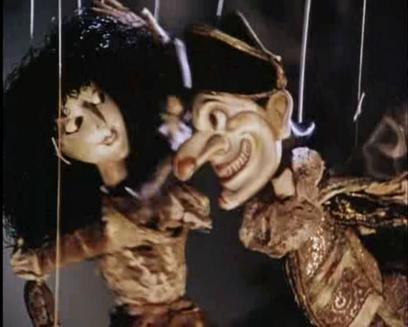 Based on plays by Federico García Lorca, Cabaret (a better translation would be ‘farce’) is a puppet animation film, using puppets in a puppet theater.
The film is something of a musical and tells about the love between Donna Rosita and Don Cristobál. The music, by world famous composer Sofia Gubaidulina is odd and rather unconvincing in its avant-garde version of the musical genre.
The film falls into two parts: the first part looks most like an ordinary puppet play: it’s fast, hectic, humorous, and even vulgar, with a strong sense of eroticism. Halfway the film, however, the mood changes drastically. Don Cristobál gets rid of his strings and tears off his grotesque mask to reveal a more noble face. With that the film enters the second part, a dreamlike, lyrical one. Unfortunately, the narrative gets lost in this part, and in the end the film suffers from its length, from its meandering music and beautiful, but vague imagery.
‘Cabaret’ was Garanina’s Fourth film, and her third after she had joined Soyuzmultfilm in 1976. In 1988 Garanina and Gubaidulina would work together again on “The Cat That Walked by Itself”, a feature film based on Rudyard Kipling’s ‘Just So Stories’. Unfortunately she came to a tragic end, as she was murdered in her own house in 2010.
Watch ‘Cabaret’ yourself and tell me what you think:
http://www.dailymotion.com/video/x27btal_08-ideya-garanina-1981-cabaret_shortfilms
Director: Yuri Norstein
Release Date: 1979
Rating: ★★½
Review:
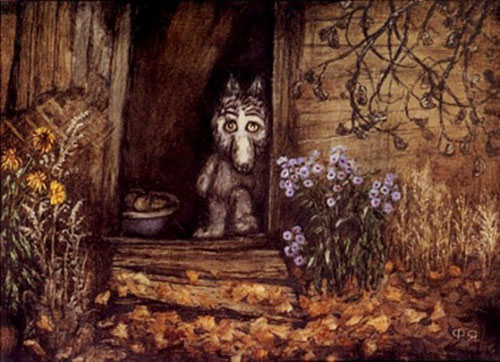 In ‘Tale of Tales’ we’re watching a wolf cub trying to survive his loneliness in an old house, relying on his memories.
These images are altered with images of a river scene with a.o. a fisherman, his wife and his children, and a giant Picasso-like minotaur skipping rope. Two other recurring images are that of dancing wives losing their men to war, and that of a little boy eating apples in the snow.
‘Tale of Tale’s is regarded as Yuri Norstein’s masterpiece and as one of the best animation films of all time. This does not mean it is the most accessible of all films, on the contrary. ‘Tale of Tales’ is a poetic film, but a confusing one. The nostalgic images seem unrelated, and are shown in a non-linear fashion. In fact, it is very difficult to render a ‘tale’ out of the images, which are intrinsically very strong, especially those of the melancholy wolf cub and of the iconic river scene.
Most of the film is made of muddy images in sepia-tones, rendering a dreamy atmosphere. Many images return, bridged by the wolf cub character, who, alone, seems to live in the present, outside of the images of a childhood long past. There’s some vague sense of a happy childhood being shattered by war and being lost in time.
The film uses no dialogue, and even the music is timid in its evocation of mood. Some of the cut-out animation is superb, however, and the overall imagery one of great virtuosity. The end result is as beautiful as it is overlong and frustratingly incomprehensible.
Watch ‘Tale of Tales’ yourself and tell me what you think:
Director: Albert Barillé
Airing date: October 9, 1982
Rating: ★★½
Review:
 After the success of ‘Il était une fois… l’homme’ (Once upon a Time… Man) Albert Barillé returned with the boldest and most artistic children series of his entire career.
Largely abandoning education, the raison d’être of his last series, he embarked on a fictional and after a while remarkably integrated story, set in the far future, telling about a United Nations-like intergalactic union, and its problems.
Even more than the previous series, ‘Il était une fois… l’espace’ (Once upon a Time… Space) is a vehicle of Barillé’s highly personal views on the world and mankind. The series expresses a strong love for nature and mutual understanding, and an aversion to imperialism, war and, to a certain extent, technology.
New is a strong spirituality, embodied by the mild, and vaguely South American-looking girl Psi, who possesses psychic powers. Unlike the other main characters, she had not been in the original series, and she is less stereotypical than the rest of the cast. Her role in this first episode (in which she’s introduced as ‘Mercedes’, but everyone calls her ‘Psi’) is still minor, but soon she would become as important as Pierrot (Peter), the series’ main hero.
Pierrot, like all other good guys from ‘Il était une fois… l’homme’ has been redesigned and fixed into a single role. Pierrot now is a guy in his early twenties. Petit Gros (Jumbo), too, has changed. He is less dim, less strong and less obese than in the original series. In fact, he’s only recognizable by his red hair. His dad is equally slender and has grown a blonde mustache, while a stern-looking Pierre, head of the intergalactic police, is fixed at an older age (say 50).
The most surprising transformation may be that of Pierrette, who is head of the Union, and who has received a modern hairdo and some fancy glasses. By placing her as head of the union Barillé makes a strong feminist statement that was still pretty bold in the early 1980s. The only characters to remain the same are Maestro, and the two villains Le Nabot (The Dwarf) and Le Teigneux (The Pest). Remarkably, children are totally absent from the series.
In this first episode of ‘Il était une fois… l’espace’ Maestro conceives the little robot Metro, who would play a major part in the series, eclipsing his master, while Le Teigneux and le Nabot are introduced as the ambassador and general of Cassiopeia, a galaxy with militaristic ambitions, but which is part of the Union nonetheless. Taking time in introducing all these characters, there is very little action in ‘La planète Omega’. Nevertheless, the stage is set when the Union is confronted by an unknown spaceship of some supreme alien race…
Apart from Barillé’s original story and its classic characters, ‘Il était une fois… l’espace’ is a highlight of television animation because of its great music by Michel Legrand and its superb backgrounds by Philippe Bouchet, Manchu and Afrula Hadjiyanakis. This trio clearly draws inspiration from contemporary science fiction illustrators like Lukas Foss, Colin Hay, Angus McKie and Tony Roberts.
The animation itself, by the Japanese Eiken studio, is better than in ‘Il était une fois… l’homme’, but it’s still mediocre and uneven, and especially the designs of Psi are far from consistent. This would remain a problem throughout the series, together with a sometimes terribly slow narration. These drawbacks, however, do not overcome the series’ merits, and ‘Il était une fois… l’espace’ may be praised as Barillé’s masterpiece.
Watch an excerpt from ‘La planète Omega’ yourself and tell me what you think:
This is the 1st episode of ‘Il était une fois… l’espace’ (Once Upon a Time… Space)
To the 2nd episode: Les Sauriens (The Saurians)
Director: Abe Levitow
Release date: May 5, 1967
Stars: Tom & Jerry
Rating: ★★½
Review:
 In this short, Tom and Jerry are apparently on a cruise somewhere in the Pacific.
When Tom sees people surf, he naturally wants to join in. This leads to a cartoon full of gags, one of which is reused from the Disney classic ‘Hawaiian Holiday'(1937), then thirty years old. It also contains one gag that would have made Hanna and Barbera proud if it had been timed better. Now, most of the action is plain tiresome, resulting in yet another mediocre entry in Chuck Jones’s Tom & Jerry series.
Watch ‘Surf-Bored Cat’ yourself and tell me what you think:
http://www.dailymotion.com/video/x47z2e0
This is Tom & Jerry cartoon No. 159
To the previous Tom & Jerry cartoon: The Mouse from H.U.N.G.E.R.
To the next Tom & Jerry cartoon: Shutter Bugged Cat
Director: Chris Wedge
Release Date: March 11, 2005
Rating: ★★½
Review:
 2005 was to be the first weak year in the history of computer animated features. This was a year in which no films were made that felt as if they were better than the last ones.
In fact, both Blue Sky’s ‘Robots’ and Dreamworks’s ‘Madagascar’ are mediocre in the whole catalog of computer animation. Surprisingly, the two most interesting features of 2005 were stop motion films: Aardman’s ‘Wallace and Gromit and the Curse of the Were-Rabbit‘ and Warner Brothers’ ‘Tim Burton’s Corpse Bride‘. This age-old technique defeated the modernity of computer animation, as both films topped the computer animated features in originality and consistency of story and design.
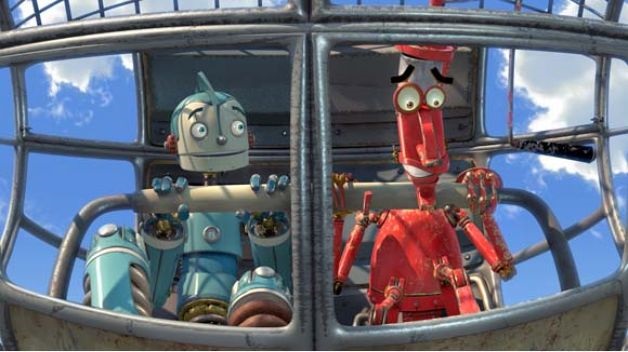
‘Robots’ is unfortunately typical for the regression in the computer animated field. First the animation: the robots are a good excuse for rather jerky motions, and its colorful setting never feels real. This setting is similar to that of ‘Monsters, Inc.‘ (2001): a totally different world, this time inhabited with robots, which at the same time is an exact copy of our own modern urban world. Also, main protagonist Rodney’s arrival in Robot City is very reminiscent of a similar scene in ‘A Bug’s Life’ (1998), and the all too obligatory ‘follow your dream’ story line had already become stale by 2005, too. In all, the film’s story is much more standard than its exotic setting would suggest.
Blue Sky’s storytelling is also very inconsistent and has many flaws in its timing. For example, the big finale never pays off and his topped by a very cloying ending. Worse, Rodney has no less than two love interests, one of which is suddenly dropped, while the love between him and Cappy, the other, is hardly shown. In effect it seems non-existent. Then there are way too many side characters, none of which is well-developed. Most of them are wise-crackers, who place their one-liners in a nasty, unpleasant way. Robin Williams’s character Fender is as tiresome as his genie was delightful in ‘Aladdin’ (1992). Even Rodney’s hero Bigwald is unappealing in his first scene. And it remains unclear why he has retreated in the first place.
All these flaws are such a pity, for one can feel the great joy in the making of ‘Robots’, especially in the transport sequence, where Rodney and Fender are travelling in a giant Rube Goldberg machine. This scene, although unimportant to the story, is the highlight of this otherwise very disappointing film.
Unfortunately, 2006 would be hardly better, with Blue Sky’s weak ‘Ice Age 2: The Meltdown’, and the entertaining, but a little too routine films ‘Over The Hedge‘, ‘Flushed Away’ (Dreamworks) and ‘Open Season‘ (Sony’s debut in the field). Even Pixar would release its then weakest picture with ‘Cars’…
Watch the trailer for ‘Robots’ yourself and tell me what you think:
Director: Charles Nichols
Release Date: September 22, 1944
Stars: Pluto, Figaro, Minnie Mouse
Rating: ★★½
Review:
 After a cartoon with Cleo, Pinocchio‘s kitten Figaro was coupled to Pluto to co-star in three cartoons, of which ‘First Aiders’ is the first.
In this short both pets want to help Minnie while she’s practicing first aid. Pluto pushes little Figaro away to be the first, a move he regrets when he’s all put in plints and Figaro starts to taunt him.
Even though some of the animation is pretty outlandish, this is a cute, not a funny short. Most interesting are some of the backgrounds, which are kept deliberately vague during the chase scenes. Figaro and Pluto would be together again in ‘Cat Nap Pluto’ (1948) and ‘Pluto’s Sweater’ (1949). Both cartoons are more enjoyable than ‘First Aiders’.
Watch ‘First Aiders’ yourself and tell me what you think:
This is Pluto cartoon No. 12
To the previous Pluto cartoon: Springtime for Pluto
To the next Pluto cartoon: Dog Watch
Directors: various
Release Date: June 3, 2003
Rating: ★★½
Review:
The enormous success of ‘The Matrix’ (1999) not only spawned two sequels, but also a direct-to-video release with several animation films, expanding the film’s theme and providing some background history.
‘The Animatrix’ is an American/Japanese/South Korean co-production and consists of nine parts, produced by four different animation film studios (Square, Studio 4°C, Madhouse Studios and DNA). The nine parts differ a lot in style, content and quality, and the end result is pretty uneven to say the least. However, for fans of ‘The Matrix’ it contains very welcome background material to The Matrix universe.
 1. Final Flight of the Osiris
Director: Andy Jones
Rating: ★★★½
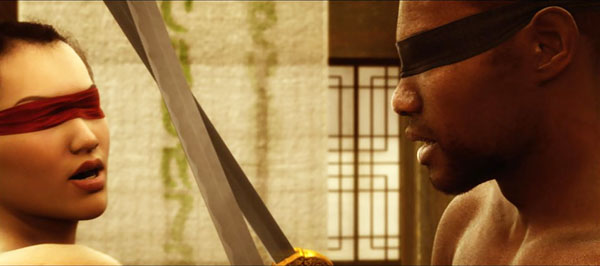
The first of the nine segments of The Animatrix is the most straightforward. It’s a dark action episode that tells what happened to the Osiris, a human vessel that shortly appears in ‘The Matrix’. The Square Studio, then already famous for the groundbreaking animation in ‘Final Fantasy: The Spirits Within’ (2001), tops itself with for 2003 ultra-realistic computer animation, with human characters of a then unsurpassed realism. Especially its opening sequence, an erotic martial arts fight, is impressive and made many viewers doubt whether it was real or not they were looking at.
 2. & 3. The second Renaissance
Director: Mahiro Maeda
★★★½
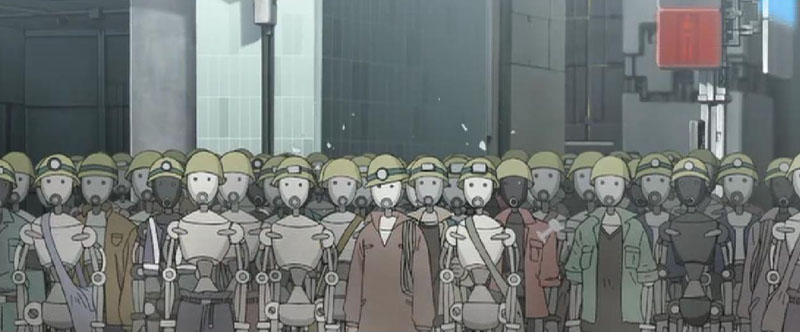
Made by Studio 4°C and brought in two episodes, The Second Renaissance tells us what happened before the Matrix in an American anime-style. It uses a robotic female voice-over to tell us about a robotic revolution and a human-robot-war which ends in defeat for the human population, which is then used as an energy source for the robots. These episodes are the most satisfying as an addition to The Matrix trilogy.
 4. Kid’s Story
Director: Shinichirô Watanabe
Rating: ★
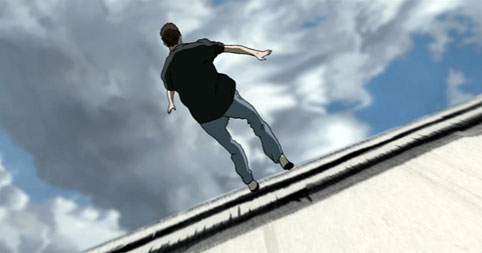
‘Kid’s Story’ is the first of four episodes dealing with people who discover the matrix. This episode is about a teenager who doubts reality and who wakes up in the real world. The episode uses a very realistic, yet graphic style that is very American and rather ugly. Especially the animation (by Studio 4°C) is slow, unsightly and unsteady, making it one of the most unappealing parts of ‘The Animatrix’ to watch.
 5. Program
Director: Yoshiaki Kawajiri
Rating: ★★
‘Program’ is another weak entry in ‘The Animatrix’. Animated by Madhouse Studios and drawn in a rather American comics/anime-style and using sharp shades, it tells about a treacherous character trying to persuade a girl to join him in a Japanese samurai setting (the program the two are in). The whole episode is rather melodramatic and forgettable.
 6. World Record
Director: Takeshi Koike
Rating: ★
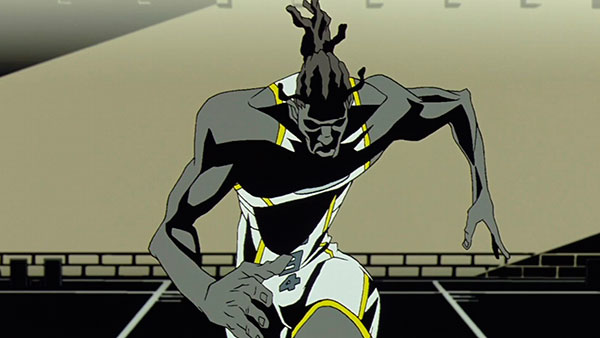
By far the most unappealing of all episodes of ‘The Animatrix’, ‘World Record’, by Madhouse studios, is drawn in a a gruesomely ugly comics design to tell the story of an athlete who discovers the matrix and who has to pay for it.
 7. Beyond
Director: Kôji Morimoto
Rating:★★★★
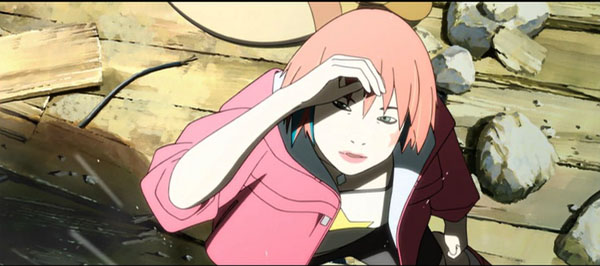
Studio 4°C’s ‘Beyond’ is the third of four Animatrix episodes about people who discover the matrix, and it is easily the best of the lot. Set in Japan, it tells about a young woman, who is looking for her cat Yuki, and who’s led by some kids to a house where the ‘program’ has gone haywire, resulting in some wonderful surreal effects (like objects defying gravity). Unlike the rest, the episode has a lighthearted feel to it, which is enhanced by its appealing graphic anime design and its excellent animation, which makes clever use of 3D-effects. More than in any other part of the Animatrix one has the feeling that this episode is about real people in a real environment. The short is another showcase for Morimoto’s great direction skills, which he had already shown with the ‘Magnetic Rose’ sequence in the compilation feature ‘Memories‘ (1995).
 8. A Detective Story
Director: Shinichirô Watanabe
Rating: ★
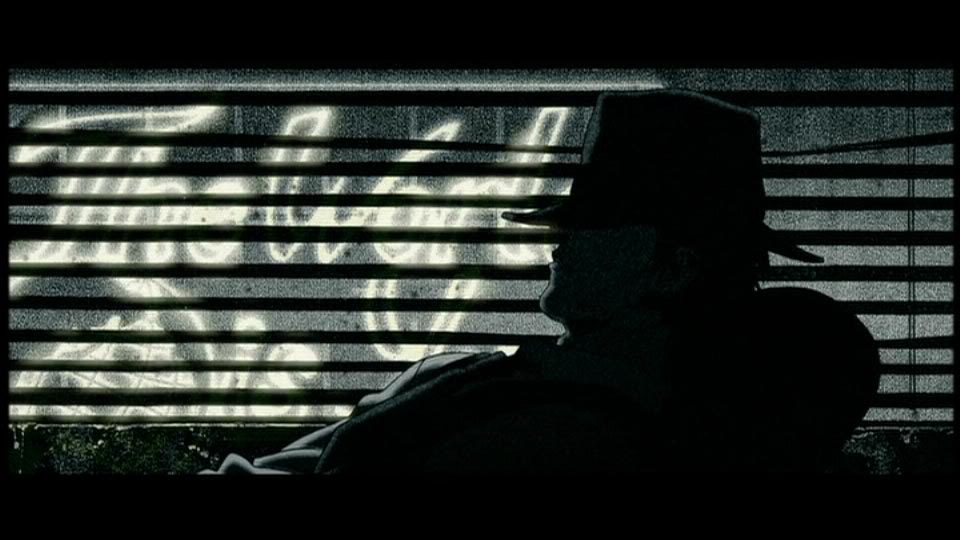
‘A Detective Story’ is the fourth and last episode about people who discover the matrix. This episode is about a private detective and it uses all film noir cliches, including a very trite voice over. The nice black and white backgrounds evoke a forties atmosphere, even though the story is about hackers and chat rooms. But they cannot hide Studio 4°C’s very limited animation or the corny story, making ‘A Detective Story’ one of the weakest episodes of this package film.
 9. Matriculated
Director: Peter Chung
Rating: ★★★★
Penned and directed by Æon Flux-director Peter Chung and produced by the Korean DNA studio, ‘Matriculated’ is the most philosophical of the nine episodes of ‘The animatrix’. The story is set in the ‘real’ world. It deals with humans who try to make robots defending them by making them dream. Although its angular human designs are once again quite unattractive, this episode’s clever story makes it one of the highlights of ‘The Animatrix’.
Watch the trailer for ‘The Animatrix’ yourself and tell me what you think:
Director: Hu Jinqing
Release Date: 1983
Rating: ★★½
Review:
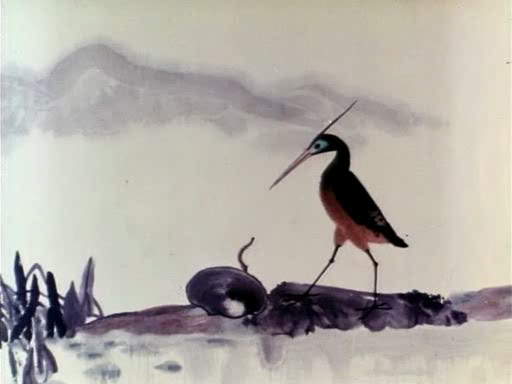 ‘The Snipe and the Clam’* is one of many Chinese films based on ancient tales.
And like many other Chines films it has a look based on ancient Chinese paintings, it’s set in nature, and it deals with a fisherman.
In this film, a fisherman, a kingfisher and a snipe try to open a giant clam. When the snipe gets stuck, it’s the fisherman who wins the day. The film is based on an ancient Chinese proverb, which can be translated into “two dogs fight for a bone, and a third one runs away with it”.
In ”The Snipe and the Clam’ Hu Jinqing excels in gorgeous watercolor backgrounds, beautiful designs, great silent acting and remarkably naturalistic cut out-animation of the animals. In comparison, the animation of the fisherman is simple and rather crude. The film unfolds at an unhurried, almost meditative speed, which can make it difficult to enjoy.
Watch ‘The Snipe and the Clam’ yourself and tell me what you think:
‘The Snipe and the Clam’ is available on the French DVD ‘Impression de montagne et d’eau’
* this film is also known as ‘Snipe-Clam Grapple’, and by its French title: ‘l’aigrette et j’huitre’
Director: Alain Ughetto
Release Date: June 10, 2013
Rating: ★★½
Review:
 After ‘Persepolis’ (2007) ‘Jasmine’ is the second animation film about the Iranian revolution of 1979.
In his strongly autobiographical film Ughetto rediscovers his love relationship with Jasmine, a young woman from Iran, whom he visited during the turmoils of 1978/1979, and whom he left behind, to return to France, alone.
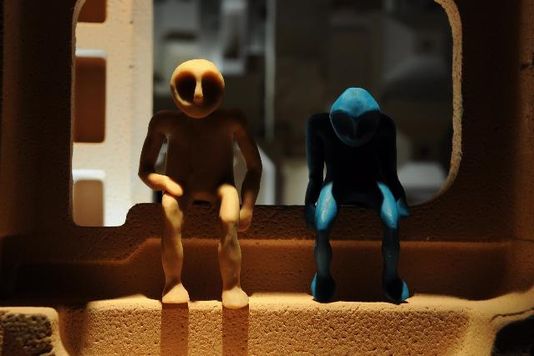
Ughetto doesn’t spare himself, and realizes leaving her was a big mistake on his part. To tell his story he uses love letters from the time, 8mm film images he shot during the Iran revolution and clay animation. He also shows the clay animation process, his elaborate sets made from styrofoam packaging material and collections of clay figures.
Unfortunately, Ughetto’s clay animation is very limited. His plasticine figures are devoid of any facial expression, and they all look the same. The only difference between the Alain and Jasmine puppets is their color (caramel vs. blue – reflecting the color of her eyes). There’s only a limited amount of animation, and little of it is expressive.
Because of this, the film relies heavily on the voice overs, Alain telling his story, a woman reading Jasmine’s love letters. Without the soundtrack the film becomes utterly incomprehensible. Only at one point in the film, the animation images leave a strong impression themselves: when the oppressive forces of the new Islamic regime strike down and kill the former revolutionaries. This is shown by giant floating turbans suddenly falling down and crushing discussing people.
‘Jasmine’ is an intimate, very personal and honest film, and the story of the Iranian revolution and its effects on the everyday lives of people remains moving. But ‘Jasmine’ is no ‘Persepolis’ and in the end falls short as an animation film. It could easily have been a live action film, a documentary, or even a novel, instead.
Watch the trailer for ‘Jasmine’ and tell me what you think:
Director: Ben Sharpsteen
Release Date: September 12, 1936
Stars: Donald Duck, Pluto
Rating: ★★½
Review:
 While Donald is plumbing, Pluto accidentally swallows a magnet, attracting all kinds of metallic objects, like his dish, a pendulum, a watch and eventually Donald’s monkey-wrench.
This short features elaborate gags based on character animation, surely building to a grand finale. One can admire the inevitable ‘logic’ of the film, yet the result is only mildly funny, and neither one of Donald’s or Pluto’s best films.
Although advertised as a Mickey Mouse cartoon, in ‘Donald and Pluto’ Mickey Mouse is not present at all. On the contrary, for both Donald and Pluto this is their first cartoon without Mickey (if we disregard the Silly Symphonies ‘Just Dogs‘ from 1932 and ‘The Wise Little Hen‘ from 1934). After getting more and longer sequences of their own within the Mickey Mouse series, this step was inevitable.
Pluto had come a long way, sharing five years and 33 films with Mickey before standing on his own, but Donald received his independence already within two years, after only twelve films with Mickey.
Both Pluto and Donald would get their own series in 1937. They would appear together in five more films, all within Donald’s series: ‘Beach Picnic‘ (1939), ‘Donald’s Dog Laundry‘, ‘Put-Put Troubles‘, ‘Window Cleaners‘ (all 1940) and finally ‘The Eyes Have It’ (1945).
Watch ‘Donald and Pluto’ yourself and tell me what you think:
This is Mickey Mouse cartoon No. 88
To the previous Mickey Mouse cartoon: Mickey’s Circus
To the next Mickey Mouse cartoon: Mickey’s Elephant
Director: David Hand
Release Date: October 10, 1936
Stars: Mickey Mouse, Pluto
Rating: ★★½
Review:
 ‘Mickey’s Elephant’s opens with Mickey receiving a cute young elephant from the Rajah of Ghaboon as a playmate for Pluto. Unfortunately Pluto is not amused, and he thinks ‘Bobo’ is an intruder with intentions to replace him.
‘Mickey’s elephant’ is similar to ‘Mickey’s Pal Pluto‘ (1933) and to ‘Mickey’s Kangaroo‘ (1935), in which Pluto is also jealous of an intruder and which also feature his evil side. Like in ‘Mickey’s Pal Pluto’ Pluto’s evil consciousness has materialized into a little devilish persona, who talks with a strong New York accent and who persuades Pluto to fix Bobo using red pepper. Sneezing along Bobo blows is own new house down, but unfortunately Pluto’s too…
‘Mickey’s Elephant’ is a rare example of a Mickey Mouse film inspired by the Mickey Mouse comic strip. Most of the time the influence was reversed. But in this case Bobo the elephant had made his entrance in Floyd Gottfredson’s strip two years earlier. Bobo is a completely innocent character, and Pluto’s little devil notwithstanding, the cartoon is more cute than funny.
Watch ‘Mickey’s Elephant’ yourself and tell me what you think:
This is Mickey Mouse cartoon No. 89
To the previous Mickey Mouse cartoon: Donald and Pluto
To the next Mickey Mouse cartoon: The Worm Turns


 Dr. Grob's Animation Review