You are currently browsing the category archive for the ‘★★★★½’ category.
Director: Jack Hannah
Release Date: January 23, 1948
Stars: Goofy
Rating: ★★★★½
Review:
 ‘They’re Off’ was the last of four Goofy cartoons directed by Jack Hannah, and the most Jack Kinney-like of them all.
In this cartoon we follow two Goofy characters who both bet on a horse race. One of them is a typical Hannah-style underdog, and decidedly a gay stereotype. The gay Goofy’s favorite, Old Moe, wins from the other Goofy’s favorite, star horse Snapshot, because the latter just can’t resist the camera.
In one frantic scene ‘They’re off’ uses footage from ‘How to Ride a Horse’ (1941), ‘Fantasia’ (the unicorns from the Pastoral Symphony sequence) and ‘Hockey Homicide‘ (1945).
Watch ‘They’re Off’ yourself and tell me what you think:
This is Goofy cartoon No. 21
To the previous Goofy cartoon: Foul Hunting
To the next Goofy cartoon: The Big Wash
Director: Bob Clampett
Release Date: October 5, 1946
Stars: Bugs Bunny, Elmer Fudd
Rating: ★★★★½
Review:
 ‘The Big Snooze’ (a pun on the Bacall-Bogart vehicle ‘The Big Sleep’) opens with Elmer quitting after a short chase routine involving a tree trunk on a cliff.
He tears his contract with Warner apart and decides to enter a career of fishing only ‘and no more wabbits!’. When he rests at the riverside, Bugs enters his serene dream to create a nightmare. This involves e.g. nightmare paint, rendering Elmer in Adam’s costume, making a girl out of him, followed by wolves and a great fall, which typically ends the nightmare. At the end Elmer returns to the scene, reassembling the contract and ready for another routine with the tree.
‘The Big Snooze’ is one of those great cartoons that play with their characters as being real stars (others being the Mickey Mouse cartoon ‘Mickey’s Gala Premier’ (1933), the Donald Duck cartoon ‘The Autograph Hound‘ (1939) and ‘You Ought to Be in Pictures’ (1940, starring Porky and Daffy).
The opening scene was taken from Tex Avery’s ‘All This and Rabbit Stew’ (1941), with Elmer replacing the original black caricature. The rest of the film has a disjointed feel, and features weird cuts and odd cinematographic choices. For example, when Elmer tears up the contract, this is shown in five different shots, following each other in rapid succession: 1) a medium shot of Elmer tearing up the contract, 2) a close-up of only his hands tearing, 3) a close-up of the paper snippets flying into the air above Elmer’s head, who’s hardly seen in this shot, 4) a very strange perspective shot of Elmer smashing the contract into the camera, and 5) a close-up of his boots stamping on what remains of the paper.
Another noteworthy scene is when Bugs Bunny is ‘multiplying’: in this scene Elmer is the only traditionally looking character, placed on a black canvas, overrun by rabbits, only drawn in red, yellow and pink outlines and mixing with the green outlines of some plants. This short scene is a startling piece of early cartoon modernism, and looks forward to the work of the UPA studio in the 1950s. On the other hand, the gag in which Bugs pulls away a hole harks all the way back to the Mickey Mouse cartoon ‘The Picnic‘ (1930).
Bugs sings excerpts from three songs in this short: ‘Beautiful Dreamer’, ‘Someone’s Rocking My Dreamboat’ and ‘September in the Rain’.
The Big Snooze’ was to be Bob Clampett’s last cartoon at Warner Bros. He was fired before he could finish it, and the short was completed by Art Davis, who succeeded him as a director. The film’s look and feel is still that of the war era, while contemporary cartoons by Chuck Jones and Friz Freleng show the studio was heading into other directions, with milder humor and more sophisticated designs. In contrast, in ‘The Big Snooze’ Clampett’s animation style is extremely flexible, as usual for him, and his backgrounds are as vague as ever.
‘The Big Snooze’ is a hilarious cartoon that marks the end of an era, where the wildest and the zaniest gags were possible. Only Tex Avery at MGM would continue the extreme style. Bob Clampett left Warner Bros. in May 1945 to join the Screen Gems studio. He was succeeded by Art Davis, who would direct some great cartoons until his unit was closed down in 1949.
In the years following Clampett’s leave, his zany style was continued for a while by his master animator Robert McKimson, who had been promoted to director only a few months earlier. However, McKimson soon toned down both animation and humor, and he would never achieve the same level of originality as Bob Clampett did during his Warner Bros. days.
Watch ‘The Big Snooze’ yourself and tell me what you think:
https://www.dailymotion.com/video/x6n3yac
This is Bugs Bunny cartoon No. 40
To the previous Bugs Bunny cartoon: Racketeer Rabbit
To the next Bugs Bunny cartoon: Rhapsody Rabbit
‘The Big Snooze’ is available on the DVD-set ‘Looney Tunes Golden Collection Volume Two’
Director: Isadore Sparber
Release Date: Oct 16, 1942
Stars: Superman
Rating: ★★★★½
Review:
 In an original twist to the Superman formula, a sneaky fake Superman steals jewelry for his gangster boss.
Meanwhile Lois and Clark have to report an opera performance. Luckily, the fake superman is there, too, pickpocketing the attendants. Superman captures his look-alike and his boss.
‘Showdown’ clearly has the most original story line of all superman cartoons, and this makes the short arguably the best entry of the series. At least the cartoon contains the funniest line in the series, when Lois makes Clark Kent the sarcastic remark “fine Superman you‘d make”.
Watch ‘Showdown’ yourself and tell me what you think:
This is Superman film No. 11
To the previous Superman film: Japoteurs
To the next Superman film: Eleventh Hour
Director: Ford Beebe
Release Date: 1941
Stars: The Three Little Pigs
Rating: ★★★★½
Review:
 Before The United States were dragged into the war by Japan’s attack on Pearl harbor, December 7, 1941, Walt Disney Studio already had made four propaganda shorts for the Canadian government.
Canada, had declared war on Nazi Germany on September 10, 1939, a week after the United Kingdom, following Germany’s invasion of Poland, September 1.
‘The Thrifty Pig’ is the first of Disney’s four propaganda films commissioned by the Canadian government to persuade their citizens to buy war bonds to invest in the war effort. The other three being ‘7 Wise Dwarfs‘ (1941), ‘Donald’s Decision‘ (1942) and ‘All Together‘ (1942). It’s also Disney’s first propaganda cartoon.
‘The Thrifty pig’ consists of two parts, The first part cleverly reuses animation from Walt Disney’s most famous short, ‘Three Little Pigs‘ (1933), but in this shortened version the wolf wears a Nazi costume, the bricks are made of war bonds and the union jack is waving at the wise pig’s house. The only new animation is when the wolf’s blows reveal war bonds beneath the plaster and when the wise pig says “these bricks not only stop his blowing, they will also get him going”.
The second part is more overtly propagandistic and uses limited animation of war machines and slogans to persuade the public to buy “more and more war certificates”. The end shot, where a plane shoots the words ‘Invest in Victory’ on the screen’ is the most powerful image of the complete film.
This two part formula would be reused in all succeeding propaganda films that had to persuade the public to invest in the governmental war industry. Apart from the Canadian commissions, we see this structure in ‘The New Spirit‘ (1942) and ‘The Spirit of ’43‘ (1943), which had to persuade American citizens to pay their income taxes in time.
Watch ‘The Thrifty Pig’ yourself and tell me what you think:
Director: Jack King
Release Date: December 18, 1942
Stars: Donald Duck, Pete
Rating: ★★★★½
Review:
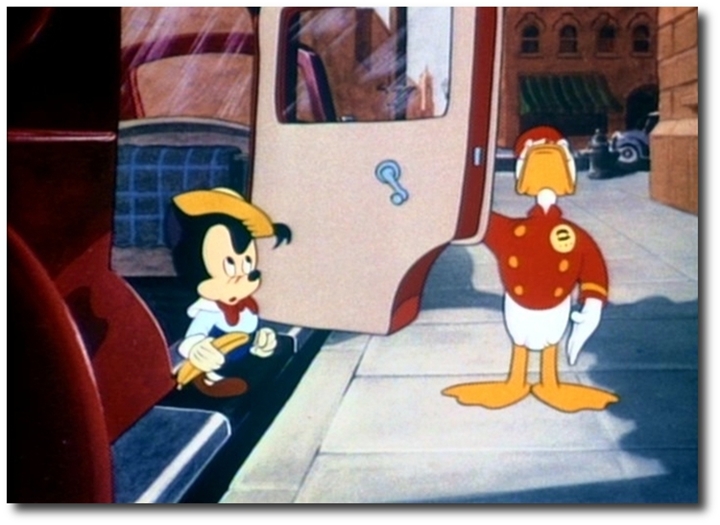 Donald is a bellboy at a chic hotel. He’s hindered in doing his job by Pete’s mischievous son (yes, Pete has got a son in this cartoon).
Pete manages to stay calm, but not Donald. In the end, Donald is fired, but he gets his chance to spank the wicked brat.
‘Bellboy Donald’, penned by Duckmen Carl Barks and Jack Hannah, is one of the better Donald Duck cartoon of the early forties. You won’t find any better interplay between Donald and Pete, with the exception maybe of ‘Trombone Trouble’ (1944).
Moreover, the cartoon contains some remarkably flexible animation of a type rarely seen in a Disney cartoon.
Watch ‘Bellboy Donald’ yourself and tell me what you think:
This is Donald Duck cartoon No. 37
To the previous Donald Duck cartoon: Sky Trooper
To the next Donald Duck cartoon: Der Fuehrer’s Face
Director: Clyde Geronimi
Release Date: February 19, 1943
Stars: Mickey Mouse, Pluto
Rating: ★★★★½
Review:
 ‘Pluto and the Armadillo’ is one of the South American films Disney released in the forties after a visit to South America in 1941 (other examples are ‘The Pelican and the Snipe‘ and ‘Contrary Condor’ from 1944).
‘Pluto and the Armadillo’ is actually an outtake from Disney’s first South American ensemble feature ‘Saludos Amigos‘ (1942). This explains its use of a narrator introducing the armadillo and its Brazilian setting.
As the title suggests, this Mickey Mouse cartoon is actually devoted to Pluto. While playing with Mickey during a stop at an airport near a jungle, he mistakes the armadillo for his own ball. As in many other Pluto cartoons (e.g. ‘Pluto’s Playmate‘ from 1941 and ‘Canine Patrol‘ from 1945), Pluto is first suspicious of this new little animal, but then grows in love with it. This standard scenario would have led to a routine Pluto entry, if it were not for the armadillo itself.
The South American mammal is not drawn very lifelike, but looks like a very cute, feminine armed little dog. Her moves are accompanied by metallic and rattling sounds, as if her armor consists of loose mechanical parts, and she walks to an irresistible samba tune, which provides the theme music for the complete cartoon.
Because of her charming presence ‘Pluto and the armadillo’ is very cute and joyful, and a delight to watch, even though it’s not very funny.
Watch ‘Pluto and the Armadillo’ yourself and tell me what you think:
This is Mickey Mouse cartoon No. 117
To the previous Mickey Mouse cartoon: Symphony Hour
To the next Mickey Mouse cartoon: Squatter’s Rights
Director: Walt Disney
Release Date: May 1, 1924
Stars: Virginia Davis (Alice)
Rating: ★★★★½
Review:
 Alice organizes a wild west show for the kids in the neighborhood.
All goes well until the bully Tubby O’Brien and his gang show up. Her fellow actors chicken out, so Alice has to improvise some stories about her experiences in the ‘wild and woolly west’. Enter the cartoon sequence.
In her first story she defeats some Indians. In the second one she’s a sheriff in a saloon, smoking a cigar and attending a bad performance of ‘Sweet Adeline’. Meanwhile, the villain, “Wild Bill Hiccup” tries to steal the safe. He and Alice end up in a gunfight in which every other person in the saloon gets killed. She chases the villain by car, returning the safe in the end.
The gang of bullies is not impressed and they pelt her with vegetables. But Alice chases them all out of her humble theater, beating up Tubby O’Brien herself. The cartoon ends with her triumphant smile.
The live action footage, with the instantly lovable Virginia Davis as Alice and a bunch of local children, is highly entertaining. None of the animation, by Ham Hamilton and Walt Disney himself, is particularly interesting, however. Indeed, two months later, Disney would quit animating himself, leaving that to his more skilled employees, like Ub Iwerks.
Watch ‘Alice’s Wild West Show’ yourself and tell me what you think:
‘Alice’s Wild West Show’ is available on the DVD ‘Walt Disney Treasures: Disney Rarities’
Director: Winsor McCay
Release Date: April 8, 1911
Stars: Little Nemo, Flip, The Imp
Rating: ★★★★½
Review:
 ‘Little Nemo’ was master comic artist Winsor McCay’s first animation film. It’s also one of the first drawn animation films ever made.
Indeed, one of the title cards boldly states that Winsor McCay is “the first artist to attempt drawing pictures that will move.” This is obviously untrue: Stuart J. Blackton had made the first drawn animated film five years earlier, with ‘Humorous Phases of Funny Faces‘ (1906) and since then Frenchman Émile Cohl had produced more than a hundred animated films, of which a substantial part was (at least partially) drawn. Nevertheless, McCay seems to be the first artist to pick up the glove from Blackton and Cohl.
Star of McCay’s film is his world-famous comic hero Little Nemo, the little boy who always dreamed to be in Slumberland, only to awake abruptly at the end of each comic. He’s joined by Flip, the Imp, the princess and the doctor from the same comic. Nevertheless, they’re not the stars of the narrative, because that is their creator, Winsor McCay himself.
‘Little Nemo’ is a film with two clear sections:
the first half is filmed in live action and tells in three scenes about Winsor McCay’s plan to make moving drawings. In the first scene he proposes his idea to make 4,000 drawings in only one month. This only makes his friends laugh at him. In the second scene he orders three barrels of ink and two enormous packages of drawing paper, and in the third scene he can be seen in his drawing room, between huge piles of drawings and a primitive flipbook-like apparatus to preview his film. A young man, who has come to dust the place makes the piles of drawings fall.
In all, these scenes are rather slow and only mildly funny. Above all, they look as from an era long passed. But when the result is shown, one’s opinion changes completely…
The actual animation itself, completely hand-colored, is as startling and fresh as it was almost a hundred years ago. After an infectious “watch me move!” we watch Little Nemo, Flip and the imp move in 3D, Flip and the imp stretching like distorting mirror images (a gag that has his origin in the February 2, 1908 episode of the comic), Nemo drawing the princess himself, Nemo and the princess riding a dragon that disappears into the distance (inspired by three Sunday Pages from July/August 1906), and Flip and the imp crashing with a car, landing on the doctor.
The animated part may not make any sense, it certainly makes a great watch. McCay likely had seen some of Cohl’s films, because ‘Little Nemo’ displays some of Cohl’s trademark metamorphosis techniques, especially when introducing characters: the imp is made out of falling building blocks, while several small lines finally come together to form Little Nemo. But McCay goes beyond Cohl in command of drawing: his mastery of form, perspective and movement is astonishing.
Although some of the movement is awkwardly slow (a feature the film shares with the comic strip), McCay displays a displays a tremendous control of form and material. For example, he’s the first animator to make his drawings move in perfect perspective, which he shows when Little Nemo and the princess ride off in the dragon’s mouth. After McCay no one would surpass this high quality of animation, until Walt Disney’s innovative strive to realism during the second half of the 1930s.
Watch ‘Little Nemo’ yourself and tell me what you think:
This is Winsor McCay’s first film
To Winsor McCay’s second film: How a Mosquito Operates
Director: Dave Fleischer
Release Date: May 18, 1934
Stars: Betty Boop, Max Fleischer
Rating: ★★★★½
Review:
 ‘Betty Boop’s Rise to Fame” is a compilation cartoon, but it’s easily one of the best in its kind.
It features Betty Boop and her creator, Max Fleischer in a nice mix of animation and live action. Fleischer asks Betty, who is depicted as a tiny cartoon character, to perform for a reporter. She does three of her finest moments, using footage from ‘Stopping the Show‘ (1932), ‘Betty Boop’s Bamboo Isle‘ (1932) and ‘The Old Man from the Mountain’ (1933).
In between, there’s some lovely interplay between Betty and “uncle Max”. Even these new scenes are sexy, when Betty changes clothes behind an ink pot and some books. This delightful cartoon can be regarded as an ode to Betty’s glorious past. From now on sex and eroticism would be banished from her cartoons due to the censorship of the Hays code.
Watch ‘Betty Boop’s Rise to Fame’ yourself and tell me what you think:
This is Betty Boop cartoon No. 28
To the previous Betty Boop cartoon: Betty in Blunderland
To the next Betty Boop cartoon: Betty Boop’s Trial
‘Betty Boop’s Rise to Fame’ is available on the French DVD Box Set ‘Betty Boop Coffret Collector’
Director: Wilfred Jackson
Release Date: November 5, 1937
Rating: ★★★★½
Review:
 ‘The Old Mill’ is a milestone in effect animation.
From the first scene on special effects seem to be the sole raison d’être of the film. The cartoon is literally stuffed with them: dew on a cobweb, ripples in the water, light beams, fireflies, wind, rain and a thunderstorm.
Disney’s famous multiplane camera, with which the feeling of depth could be realized, makes its debut here. Together these effects create an astonishing level of realism, necessary for the upcoming first animated feature, ‘Snow White and the Seven Dwarfs’. In ‘The Old Mill’ even the animal characters are more or less realistic, a rare feat in Disney cartoons until then.
All this realism leads to awe-inspiring images, based on concept art by Danish illustrator Gustaf Tenggren, who had joined the studio in 1936. Unfortunately, the images do not lead to much of a story. The film is more of a series of moods from dusk to dawn. Despite its clever pacing, reaching a climax in the thunderstorm sequence, ‘The Old Mill’ is an overly romantic depiction of nature, and less enjoyable as a cartoon than as a showcase of Disney animation.
Watch ‘The Old Mill’ yourself and tell me what you think:
This is Silly Symphony No. 68
To the previous Silly Symphony: Little Hiawatha
To the next Silly Symphony: Moth and the Flame
Director: Burt Gillett
Release Date: April 8, 1933
Stars: Clarabelle Cow, Goofy, Mickey Mouse, Minnie Mouse
Rating: ★★★★½
Review:
 Mickey and the gang are staged in many different times and places in their cartoons. Yet, this medieval short is the only cartoon in which they are introduced as actors performing their parts.
This idea of Mickey being an actor was first coined in ‘The Wayward Canary’ (1932) and played out to the max in ‘Mickey’s Gala Premier’ (1933). This cartoon nevertheless is played without any awareness of the public.
Minnie is the princess of Lalapazoo, and forced by her father to marry prince Goofy from Pupupadoo. Minnie refuses and is locked up in the high tower. Fortunately, there is minstrel Mickey to save her and to battle the evil prince, chasing him through the window, and marrying the princess himself. This adventure film cliche Disney already had visited in the Oswald cartoon ‘Oh, What A Knight‘, but it is expanded and improved in ‘Ye Olden Days’.
Like ‘Building a Building’ and ‘The Mad Doctor’ from the same year, this cartoon is partly a musical with lots of parts sung. It also contains a very anachronistic guillotine and an elaborately designed horse that shows the aspirations of the studio to master more lifelike designs and animation.
Goofy, who is introduced as Dippy Dawg, is quite miscast here, playing the villain, whom he acts out more sillily than threateningly. It seems that the animators didn’t really know what to do with the character, so far only funny because of his typical voice. So, after this film they dropped him for more than a year.
Watch ‘Ye Olden Days’ yourself and tell me what you think:
This is Mickey Mouse cartoon No. 55
To the previous Mickey Mouse cartoon: Mickey’s Mellerdrammer
To the next Mickey Mouse cartoon: The Mail Pilot
Director: Burt Gillett
Release Date: December 5, 1931
Stars: Mickey Mouse, Minnie Mouse, Pluto
Rating: ★★★★½
Review:
 It’s Christmas and a poor lady drops by Mickey and Minnie’s house to leave a box at their doorstep.
This box contains an endless quantity of little kittens, which are taking over the house within seconds. Soon, the house is near complete destruction. This is partly Mickey’s own fault, because dressed up as Santa he gives the little brats toys like hammers, saws, drills, axes, and even guns and canons.
‘Mickey’s Orphans’ is a real gag cartoon from the outset and the first of several Mickey Mouse shorts in which many brats cause havoc. No musical routine is involved, and as soon as the box of kittens is opened, the gags roll in like they never did before. The kittens even manage to give the ever cheerful Mickey and Minnie a dismayed look, albeit only at the end of the cartoon. The little kittens would cause havoc again in ‘Mickey’s Revue‘ (1932) before being replaced by the little mice in ‘Mickey’s Nightmare‘ later that year. Maybe the idea of giant mice dealing with little kittens was a little too awkward for the makers…
‘Mickey’s Orphans’ is the first of no less than four Mickey Mouse Christmas cartoons, the others being ‘Mickey’s Good Deed‘ (1932), ‘Pluto’s Christmas Tree’ (1952) and ‘Mickey’s Christmas Carol‘ (1983). It was nominated for the very first Academy Award for animated short film, but it understandably lost to the first technicolor short ‘Flowers and Trees‘ (1932), although Walt Disney did get a special Academy Award for the creation of Mickey Mouse.
Watch ‘Mickey’s Orphans’ yourself and tell me what you think:
This is Mickey Mouse cartoon No. 36
To the previous Mickey Mouse cartoon: Mickey Cuts Up
To the next Mickey Mouse cartoon: The Duck Hunt
Director: Wilfred Jackson
Release Date: May 16, 1931
Rating: ★★★★½
Review:
 Although this cartoon is one of those Silly Symphonies from 1931 using the half dance-routine half story formula, it is one of the most beautiful and most entertaining Silly Symphonies of the era.
The film is inspired by a Western view on a mythical ancient China. The film is without any dialogue and makes effective use of Albert Ketèlbey’s musical piece ‘In a Chinese Temple garden’ to create an oriental atmosphere. It tells a simple story of a little fisherman who saves a girl from drowning, falls in love with her and rescues her from an evil mandarin and a large (Western and fire-breathing) dragon.
After ‘Mother Goose Melodies‘ this is the studio’s second take at the human figure. The result is a mixed bag. The heroin’s movements are still cartoony, for example, and she walks with her knees sideways. Even worse, the long-legged China-man has no hint of realism at all. Moreover, the hero’s size is quite inconsistent, suddenly becoming very small when fighting the evil mandarin. On the other hand, the boy and girl are elegantly drawn, especially their hands. The two easily gain the audience’s sympathy and transcend the stereotypes that occupy most of the film.
Together with ‘Mother Goose Melodies’, ‘The China Plate’ is the most elaborate of the early Silly Symphonies. It’s surprisingly fast-paced and full of action. The complete cartoon is one of sheer delight.
Watch ‘The China Plate’ yourself and tell me what you think:
This is Silly Symphony No. 18
To the previous Silly Symphony: Mother Goose Melodies
To the next Silly Symphony: The Busy Beavers
Director: Walt Disney
Release Date: March 15, 1929
Stars: Mickey Mouse, Minnie Mouse, Pete
Rating: ★★★★½
Review:
 In ‘The Barn Dance’, Mickey Mouse’s fourth cartoon, Pete’s rivaling Mickey for the love of Minnie.
The first scene of this cartoon draws its inspiration from the Oswald cartoon ‘Rival Romeos‘, released only eight months earlier. Pete and Mickey both come to Minnie’s house to court her. Pete has the advantage of having a car above Mickey’s chariot, and like Donna Duck would do nine years later in ‘Don Donald‘ (1937), Minnie (wearing a bra, like she did in ‘Gallopin’ Gaucho‘) falls for it. Luckily, the car falls apart even before they’ve taken a ride, so Mickey and Minnie ride together to a barn dance hall.
Unfortunately, Mickey can’t dance: his shoes grow bigger every step, stepping on Minnie’s leg all the time. So after the dance Minnie’s leg is a long mess. She then ties it in a knot and cuts off the excess! These two gags belong to a surreal type typical of the silent era, which Disney would soon abandon.
After Mickey’s failure as a dancer, Minnie only wants to dance with Pete. Mickey solves the problem with help from a balloon, but Pete wrecks Mickey’s plan, regaining Minnie and leaving Mickey crying on the floor. This is a rather odd ending of a marvelous cartoon, which is still firmly rooted in the silent era with its surreal gags, limited use of sound and absence of dialogue.
‘The Barn Dance’ is far less known than the three Mickey Mouse cartoons preceding it, but with its clear storytelling, funny gags and strong acting it’s still a delightful cartoon to watch.
Watch ‘The Barn Dance’ yourself and tell me what you think:
This is Mickey Mouse cartoon No. 4
To the previous Mickey Mouse cartoon: Steamboat Willie
To the next Mickey Mouse cartoon: The Opry House
Director: Wilfred Jackson
Release Date: August 19, 1933
Rating: ★★★★½
Review:
 In ‘Lullaby Land’ a baby is lulled to sleep by his mother, singing ‘rock-a-bye baby’. The song takes the baby and his stuffed dog to Lullaby Land, a wonderfully surreal land made of plaids, rattles etc.
There the baby encounters a parade of baby objects, and a forbidden garden, full of sharp things, like knives and scissors. Despite the warnings of the female choir in the soundtrack, the baby enters. He destroys all watches from a watch tree with a hammer, and plays with matches. The smoke evokes three bogey men, which scare the baby away. Finally, the baby meets the Sandman, who puts the baby asleep to the tune of Johannes Brahms’s lullaby.
With cartoons like ‘Lullaby Land’ Disney set new standards for animation that are still thrilling today. Don’t get me wrong, the cartoon is rather patronizing and sugary cute, especially through the soundtrack. But this is compensated by wonderful surrealistic images, beautiful artwork and superb animation. And, hey, this way of warning against sharp things and matches just may work with small children.
Lullaby Land itself is a highly original fantasy world, and especially its first images are stunningly beautiful. The dance of the bogey men contains some striking use of color that anticipates similar surreal images in ‘Dumbo‘ (1941). Moreover, it is the first example of totally unrealistic color use in animated cartoons, and therefore a milestone.
Unfortunately, the cartoon also marks a trend of childishness creeping into the animation world, not only at Disney’s, but at all other studios, as well. For example, ‘Lullaby Land’ is the first of a whole series of Silly Symphonies obsessed with little babies, and their bare behinds in particular, with ‘Wynken, Blynken and Nod‘ from 1938 being the last example.
Anyway, ‘Lullaby Land’ left all competitors far behind. Later, both Walter Lantz (‘Candy Land’, 1934) and Max Fleischer (‘Somewhere in Dreamland‘, 1936) tried to copy the concept with far less convincing results.
Watch ‘Lullaby Land’ yourself and tell me what you think:
This is Silly Symphony No. 38
To the previous Silly Symphony: Old King Cole
To the next Silly Symphony: The Pied Piper


 Dr. Grob's Animation Review