You are currently browsing the category archive for the ‘★★★★★’ category.
Director: Dave Fleischer
Release Date: March 11, 1932
Stars: Betty Boop, Bimbo, Cab Calloway
Rating: ★★★★★
Review:
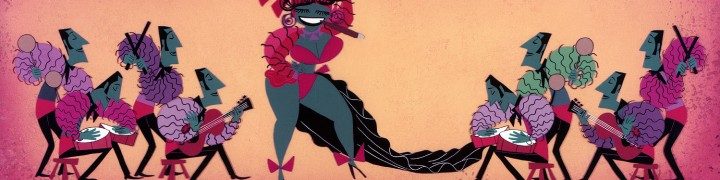
 This talkartoon is completely built around the title song, Cab Calloway’s huge 1931 hit ‘Minnie the Moocher’, which is sung by the great jazz singer himself.
In fact, the cartoon opens with a live action shot of Calloway showing some of his extraordinary dance moves in front of his orchestra. We then cut to a home setting with Betty Boop and her parents, which are apparently of German Jewish descent. Her father scorns her, his jabbering head suddenly changing into a cylinder phonograph. Betty flees crying to her room, and decides to leave home, and she rings Bimbo to come along. This sequence is accompanied by the 1929 hit song ‘Mean to Me’.
The couple flees to the countryside, which quickly becomes very scary, so they hide inside a cave, where the theme song starts. Inside the cave they encounter a walrus-shaped ghost (a rotoscoped Cab Calloway) giving an almost complete rendering of ‘Minnie the Moocher’. During the song we watch images of e.g. skeletons drinking and some prisoner ghosts getting the electric chair. In the end, the ghosts chase the couple back home to the tune of ‘Tiger Rag’.
‘Minnie the Moocher’ makes little sense, and is not as good as the later ‘Snow White’, which also stars Calloway. However, Calloway’s performance is so intoxicating, and the Fleischers’ sense of humor so mesmerizing, it remains a joy to watch the cartoon throughout.
‘Minnie the Moocher’ was the first of handful Fleischer cartoons featuring popular jazz stars, the others being ‘Snow-White‘ and ‘The Old Man of the Mountain‘ from 1933, also featuring Calloway, ‘I’ll Be Glad When You’re dead you Rascal You‘ (1932) featuring Louis Armstrong, and ‘I Heard‘ (1933) featuring Don Redman and his Orchestra.
Watch ‘Minnie the Moocher’ yourself and tell me what you think:
This is Talkartoon No. 33
To the previous Talkartoon: The Robot
To the next Talkartoon: S.O.S.
‘Minnie the Moocher’ is available on the French DVD Box Set ‘Betty Boop Coffret Collector’
Director: Dave Fleischer
Release Date: December 12, 1931
Stars: Betty Boop, Bimbo
Rating: ★★★★★
Review:
 Following Van Beuren’s ‘Red Riding Hood‘ earlier that year, the Fleischer’s did there own take on Perrault’s famous fairy tale.
In this short Betty Boop is a particularly sexy Little Red Riding Hood. Bimbo wants to accompany her on her journey, but she rejects him twice. Nevertheless he follows her secretly. He disposes of the wolf first, reaping its skin off to disguise himself as the wolf to win Betty over.
This short simply bubbles over with surrealism and strange animation cycles. The cartoon is brought as a children’s story, but rarely did a cartoon have such strong sexual content. The best part in that respect is a close-up of Betty Boop’s legs, while her garment falls off several times.
The original mix of sex and surrealism makes ‘Dizzy Red Riding Hood’ a highlight of the pre-code era, and it certainly deserves to be seen.
Watch ‘Dizzy Red Riding Hood’ yourself and tell me what you think:
This is Talkartoon No. 29
To the previous Talkartoon: Jack and the Beanstalk
To the next Talkartoon: Any Rags
‘Dizzy Red Riding Hood’ is available on the French DVD Box Set ‘Betty Boop Coffret Collector’
Director: unknown
Release Date: December 21, 1931
Stars: Flip the Frog
Rating: ★★★★★
Review:
 ‘Spooks’ opens with Flip seeking shelter from a rain storm in an old mansion.
There he encounters a skeleton who invites him to dinner of a skeleton of a roasted chicken. Later Flip dances with a female skeleton, while the deceased owner of the house plans to add flip to his skeleton collection.
‘Spooks’ is one of the best of the Flip the Frog cartoons. Featuring a much more consistent story than the earlier ‘The Cuckoo Murder Case’, the cartoon manages to provide a genuine feeling of horror, only matched by Disney’s ‘The Mad Doctor‘ (1932). When confronted with the homicidal skeleton, Flip is in real peril. Moreover, outside the mansion the nightmare continues, when even Flip’s own horse has turned into some living bones.
The scenes inside the haunted house feature distorted angles, which add to the claustrophobic feel. Strangely enough the curved backgrounds can also be seen in subsequent Flip the Frog cartoons, like ‘The Milkman‘ and ‘What A Life‘, where they don’t contribute to the atmosphere, at all. In fact, they would become a unique style element in the Ub Iwerks cartoons.
The complete cartoon is well-animated, with the opening scene, in which Flip and his horse battle the elements, being particularly outstanding.
Watch ‘Spooks’ yourself and tell me what you think:
This is Flip the Frog cartoon No. 16
To the previous Flip the Frog cartoon: Africa Squeaks
To the next Flip the Frog cartoon: The Milkman
‘Spooks’ is available on the DVD ‘Cartoons that Time Forgot – The Ub Iwerks Collection Vol. 2’
Directors: John Foster & Mannie Davis
Release Date: September 14, 1931
Rating: ★★★★★
Review:
 By 1931, Van Beuren’s ‘Aesop’s Fables’ had become the studio’s answer to Walt Disney’s Silly Symphonies, being the first studio clearly trying to copy Disney’s format (Warner Bros’ Looney Tunes and Merrie Melodies were only variations on the Silly Symphonies in name, being very different otherwise).
Given the studio’s animation output up to 1931, ‘The Family Shoe’ is a remarkably consistent and forward-looking product. With its consistent storytelling ‘The Family Shoe’ actually predates Walt Disney’s breakthrough short ‘The Ugly Duckling‘ by three months.
Merging the nursery rhyme of the old woman who lived in a shoe with the fairy tale of Jack and the beanstalk, the film anticipates Mickey’s ‘Giantland’ (1933) by two years, and the cute and childish cartoons of the Hays code era by three years. Also, the opening scenes, with hundreds of brats running around and causing mischief predate similar scenes in Walt Disney’s ‘Mickey’s Orphans‘ (December 1931) and ‘Mickey Nightmare’ (1932).
The cartoon retells the story of Jack and the beanstalk quite faithfully, and the cartoon may be a little low on gags. Yet, there are some typical Van Beuren throwaways present, like the bean planting itself, and the ending, in which the golden eggs transform the old lady into a classy aristocrat overnight.
Van Beuren is often described as merely an also-run studio, but this short shows that at least in 1931 it was more ambitious and more capable than one would expect.
Watch ‘The Family Shoe’ yourself and tell me what you think:
‘The Family Shoe’ is available on the DVD ‘Aesop’s Fables – Cartoon Classics from the Van Beuren Studio’
Director: Oskar Fischinger
Release Date: December 1933
Rating: ★★★★★
Review:
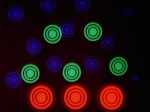 ‘Kreise’ is most probably the first full color film made in Europe.
Made with ‘Gaspar Color’ it certainly makes clever use of color’s new possibilities. ‘Gaspar Color’ required too much exposure time for live action, but for Fischinger’s animations it was perfect.
Color certainly added a great deal to Fischinger’s films. ‘Kreise’, for example, literally explodes with color. As its title implies, the film is composed of circles, only, which move and grow in various ways on an instrumental excerpt from Richard Wagner’s Tannhäuser.
The film ends with a slogan: “Alle Kreise erfasst Tolirag” (Tolirag reaches all circles [of society]), revealing that this totally abstract film is actually a commercial for an advertising agency. This was Fischinger’s trick to get the film past the Nazi censors, who in 1933 had come to power, and who were strongly opposed to abstract art.
Later the film also advertised other companies, like the Dutch Van Houten chocolate company. The film clearly shows that Walt Disney was not the only one who knew how to deal with color, but one wonders whether Tolirag (or Van Houten for that matter) did get a lot of new customers out of it.
Watch an excerpt from ‘Kreise’ yourself and tell me what you think:
‘Kreise’ is available on the DVD ‘Oskar Fischinger: Ten Films’
Director: Oskar Fischinger
Production Date: 1930
Rating: ★★★★★
Review:
 In this short study we watch white shapes moving on a black canvas to upbeat dance music (‘Los Verderones’ by Jacinto Guerrero).
Made with charcoal on paper, the result looks like a filmed sketch by Wassily Kandinsky. The only recognizable shape is an eye, which reoccurs a few times.
The twirling shapes are elegantly drawn, their movements match the jolly music perfectly, and there’s a feeling of gaiety that transcends the film’s abstraction.
In 1931 Oskar Fischinger’s friend Paul Hindemith and some of his students made new scores for this film, but unfortunately they were all lost in World War II.
Watch ‘Studie nr. 6’ yourself and tell me what you think:
http://www.tudou.com/listplay/R8qsaMltb9Y.html
‘Studie nr. 6′ is available on the DVD ‘Oskar Fischinger: Ten Films’
Director: Burt Gillett
Release Date: August 7, 1931
Stars: Mickey Mouse, Minnie Mouse, Horace Horsecollar, Clarabelle Cow, Pluto?
Rating: ★★★★★
Review:
 ‘Blue Rhythm’ is a genuine concert cartoon, in the vain of ‘The Opry House‘ (1929), ‘The Jazz Fool‘ (1929), ‘Just Mickey‘ (1930) and ‘The Barnyard Concert‘ (1930).
Something has happened however, for now Mickey and the gang are not performing for their own fun or at the barnyard, but they are giving a concert in a large theater. It thus predates similar concert cartoons like ‘The Band Concert (1935), Bugs Bunny’s ‘Rhapsody Rabbit‘ (1946), and Tom & Jerry’s ‘The Cat Concerto‘ (1947), introducing several piano and conductor gags.
This is one of those rare Disney cartoons in which the music performed can be unmistakably identified as jazz (in the earlier ‘The Jazz Fool’ this is not the case, despite the cartoon’s name). In fact, the cartoon is one great rendering of the St. Louis Blues (and not ‘Blue Rhythm’, a composition also popular in 1931, and recorded by Fletcher Henderson and Mills Blue Rhythm Band).
W.C. Handy’s classic song is first performed by Mickey on the piano, borrowing some tricks from Chico Marx. Then it is sung by Minnie, followed by some scatting by the both of them. Then Mickey and Minnie leave the stage, the curtain opens to reveal a big band, to which Mickey returns to conduct. And finally the blues is performed by Mickey on the clarinet, imitating bandleader Ted Lewis, complete with the entertainer’s typical top hat.
Minnie’s blues singing resembles contemporary female vaudeville blues singers (e.g. Gertrude Lawrence, Ethel Levey and Victoria Spivey) and the pig trumpeter performs in the growling jungle style of Bubber Miley, who was a trumpeter in Duke Ellington’s band. Mickey shows to be an all round entertainer, performing as a stride pianist, a scat singer, a conductor and a clarinetist. Horace Horsecollar and Clarabelle Cow, on the other hand, are clearly a percussionist and flutist, respectively, roles they would also have in ‘The Band Concert‘ (1935), the greatest of Mickey’s concert cartoons. Also featured in Mickey’s band is a dog who may or may not be Pluto, and who plays the trombone, disturbing Mickey while doing so.
Blue Rhythm is a great cartoon, from the opening scene, in which Mickey casts a huge shadow on the curtains to the grand finale in which the excited performance makes the stage collapse. This cartoon may have few gags, it is a delightful ode to music, and to jazz in particular.
Watch ‘Blue Rhythm’ yourself and tell me what you think:
https://www.dailymotion.com/video/x3hwk77?GK_FACEBOOK_OG_HTML5=1
This is Mickey Mouse cartoon No. 31
To the previous Mickey Mouse cartoon: Mickey Steps Out
To the next Mickey Mouse cartoon: Fishin’ Around
‘Blue Rhythm’ is available on the DVD ‘Walt Disney Treasures: Mickey Mouse in black and white’
Director: Burt Gillett
Release Date: June 20, 1930
Stars: Mickey Mouse, Minnie Mouse, Horace Horsecollar
Rating: ★★★★★
Review:
 In ‘The Fire Fighters’ Mickey is a fire chief who rushes to a burning building, losing almost his complete team on the way.
Together with Horace Horsecollar he rather pitifully tries to extinguish the fire. But he saves the day when he rescues Minnie from the flames.
‘The Fire fighters’ is the first Mickey Mouse cartoons since ‘The Gallopin’ Gaucho‘ to tell a straightforward story. The cartoon is simply packed with gags, which lead to an exciting finale, showing Mickey’s heroic character.
Among Mickey’s team mates is a primitive Horace Horsecollar who is only half anthropomorphized. ‘The Fire Fighters’ is also notable for its use of animals as objects (an ostrich as a pole, a cat as a siren), while objects are very much alive, indeed, most notably the ladder, which is shown sleeping in bed.
The cartoon makes clever use of animation cycles, especially in the scenes depicting the burning building. Some of the gags are quite unique, like Mickey milking a fire hydrant and a ladder that climbs itself down, a gag that has to be seen to be believed.
In all, ‘The Fire Fighters’ is one of the best of the early Mickey Mouse cartoons, and certainly Mickey’s best short of 1930.
Mickey would fighting fire again five years later in the equally inspired ‘Mickey’s Fire Brigade‘ (1935).
Watch ‘The Fire Fighters’ yourself and tell me what you think:
This is Mickey Mouse cartoon No. 19
To the previous Mickey Mouse cartoon: The Cactus Kid
To the next Mickey Mouse cartoon: The Shindig
‘The Fire Fighters’ is available on the DVD ‘Walt Disney Treasures: ‘Mickey Mouse in black and white’
Director: Burt Gillett
Release Date: March 7, 1931
Stars: Mickey Mouse, Minnie Mouse, Peg Leg Pete
Rating: ★★★★★
Review:
 In 1931 Mickey’s cartoons slowly but surely got better. ‘Traffic Troubles’ in particular is a gem, arguably being Mickey’s first great gag cartoon since his first cartoon, ‘Plane Crazy‘ (1928).
In this film Mickey is a cab driver driving an anthropomorphized car, resembling Flip the Frog’s car in ‘The Cuckoo Murder Case’ from five months earlier. His first customer is a fat pig, but he loses his passenger on a road, full of potholes and bumps. Mickey’s horror and surprise when he realizes his customer is gone, is priceless.
Mickey’s second customer is Minnie. When they get a flat tire, Peg Leg Pete makes an odd cameo as ‘Dr. Pep’ who revives Mickey’s car with some kind of potion, with disastrous results. This part leads to a great end scene in which Mickey’s car ends on a cow, rides through a barn, and crashes into a silo.
‘Traffic Troubles’ is a genuine gag cartoon without any songs or dances, but with fast action, plenty of gags building to a grand finale, and spectacular and flexible animation. It also contains a very funny scene in which a police officer asks Mickey many questions while silencing him at the same time. In short, ‘Traffic Trouble’ is arguably the best Mickey Mouse film from 1931, and Mickey’s first really great cartoon since ‘Steamboat Willie‘. But by now the Disney studio was making faster and faster strides, and Mickey’s best cartoons were still to come.
Watch ‘Traffic Troubles’ yourself and tell me what you think:
This is Mickey Mouse cartoon No. 26
To the previous Mickey Mouse cartoon: The Birthday Party
To the next Mickey Mouse cartoon: The Castaway
‘Traffic Troubles’ is available on the DVD ‘Walt Disney Treasures: Mickey Mouse in Black and White Volume Two’
Director: Unknown
Release Date: June 11, 1928
Stars: Oswald the Lucky Rabbit, Honey, Peg Leg Pete
Rating: ★★★★★
Review:
 Where ‘Oh, What a Knight‘ was a forerunner of ‘Ye Olden Days‘, ‘Sky Scrappers’ is the blueprint for the Mickey Mouse cartoon ‘Building a Building‘ (1933).
Like the later cartoon, ‘Sky Scrappers’ opens spectacularly with a fantastic opening shot zooming out of Oswald’s excavator. Both feature Honey/Minnie bringing Oswald/Mickey lunchboxes and Pete kidnapping Honey/Minnie. Like in ‘Oh What A Knight’ Honey is shown without her pants.
The opening shot shows a lot of animation cycles, effectively suggesting a lot of working on the building. There’s also a great perspective gag with Pete punching right into the camera. However, the most remarkably animation achievement is that of Oswald pulling up a heavy barrel. The idea of weight and muscle stretch is very convincing, and stands out amidst the more formulaic animation of the rest of the cartoon.
Watch ‘Sky Scrappers’ yourself and tell me what you think:
This is Oswald the Lucky Rabbit cartoon No. 21
To the previous Oswald the Lucky Rabbit cartoon: Oh, What A Knight
To the next Oswald the Lucky Rabbit cartoon: The Fox Chase
Director: Priit Pärn
Release Date: 1987
Rating: ★★★★★
Review:
 Made directly after ‘Time Out’, ‘Breakfast on the Grass’ is one of Priit Pärn’s most powerful films.
It’s also one of his most difficult, and its message is at times hard to decipher. Pärn doesn’t tell straightforward stories, and much remains unexplained. Most importantly, it’s one of the few films showing insight in Eastern European life under the communist oppression. Its atmosphere is gloomy, its graphic style crude and scratchy, its humor dark, and its surrealism disturbing.
In ‘Breakfast on the Grass’ we follow four people, two men and two women, who struggle in their daily life. The first, Anna, strongly feels she’s an outcast in the society. She’s not really part of the system, and misses out on its benefits, as exemplified by her search for rare apples. The second, Georg, imagines himself a playboy, but reality is harder. In pursuit of a suit, with which he can fulfill his playboy dreams he has to go through a grind of corruption. Everyone wants something rare in exchange for offered service. Berta has lost her face as soon she became a mother. She only regains it when she finds the attention of a man. And finally, Eduard shrinks when he needs a paper signed from a very high official. Luckily he gets help from a female friend…
Also starring in these stories is an anonymous artist, who is constantly followed by a flock of crows or dragged around by two state officials. A clearer statement of oppression is hard to find in any Soviet film.
In the end, the four people succeed in their aim, and together they go to a park, where they form a life tableau of Edouard’s Manet’s painting ‘Déjeuner sur l’herbe‘ (1863) which lends its name to the film’s title. This hopeful statement of beauty, freedom and art is as quickly dismantled, however, and the final shot is for the artist, whose arm is smacked by a steam roller…
Like few other films ‘Breakfast on the Grass’ shows what life is like in an oppressed state, where food is scarce, where bureaucracy and corruption run freely, and where the role you play is more important than your personal preferences. Even though the Glasnost was in full flight in 1987, it’s a wonder such a dark accusation was possible in the Soviet Union, of which Estonia was then still part.
Watch ‘Breakfast on the Grass’ yourself and tell me what you think:
Director: Jan Švankmajer
Release Date: 1989
Rating: ★★★★★
Review:
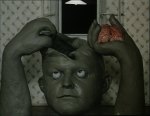 In ‘Darkness Light Darkness’ we watch several body parts entering a small room in order to assemble a complete man.
Together with ‘The Death of Stalinism in Bohemia’ (1990), ‘Darkness Light Darkness’ is Švankmajer’s last classic animated short film before he embarked on a career of directing features, which featured less and less animation.
‘Darkness Light Darkness’ is on the same level of virtuosity as ‘Dimensions of Dialogue‘ (1982): its stop motion animation, by star animator Bedřich Glaser, and its sound design, by Ivo Špalj, are both no less than perfect. However, it’s much lighter of tone than the earlier film. In this short film Švankmajer and Bedřich Glaser use a particularly cartoony type of animation. For example, the entry of the genitalia is a hilarious highlight.
Nevertheless, even this film has a darker side: when the man is complete, he completely fills the room, which is way too small for him. We hear him breathing heavily, and can assume he his in great pain in his cramped position. The cartoon ends with this claustrophobic image before darkness enters again. So, somehow, even this enjoyable film tells something about the human condition, how during our lifetimes we can develop ourselves only to end in the eternal dark again…
Because of its unity of space and time, and because of its unique inner logic, ‘Darkness Light Darkness’ is one of the best told animated shorts ever. It shows Švankmajer’s mastery. In that respect it’s unfortunate that in the 1990s he moved on to live action films.
Watch ‘Darkness Light Darkness’ yourself and tell me what you think:
‘Darkness Light Darkness’ is available on the DVD ‘Jan Svankmajer – The Complete Short Films’ and on the DVD ‘Alice’
Director: Mark Baker
Release Date: 1988
Rating: ★★★★★
Review:
 ‘The Hill Farm’ is a long animation film exploring man’s relation to nature.
First we watch the inhabitants of the hill farm themselves: simple farmers, who know the dangers and hardships of nature, and who treat their livestock without romanticism (as exemplified by the farmer’s wife killing chicken without ado).
At one point the hill farm is visited by tourists, who are completely alienated from nature. One of them faints at the sight of the farmer’s wife killing a chicken. When confronted by nature’s dangers (as embodied by a gigantic bear-like beast) they don’t recognize the danger at all. To them nature is something to visit, something to make snapshots from. The third party is a group of huntsmen, who (try to) kill everything in sight, including even the farmer’s bees.
The whole film takes place at a leisurely speed, without dialogue. Mark Baker’s visual style is simple, but very effective. His angular designs and graphic backgrounds are beautiful, and his animation has a unique timing, which is as comical as it is to the point. The narration is very open, leaving the interpretation to the viewer. The end result is one of the most beautiful animation films of the 1980’s.
Watch ‘The Hill Farm’ yourself and tell me what you think:
‘The Hill Farm’ is available on the DVD Box Set ‘Annecy – Le coffret du 50e Anniversaire’
Director: Osamu Tezuka
Release Date: 1987
Rating: ★★★★★
Review:
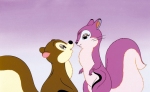 ‘Legend of the Forest’ is Tezuka’s longest and most ambitious short film.
Like many of his films it shows Tezuka’s concern with environmental issues. However, foremost, this film is Tezuka’s answer to Disney’s ‘Fantasia’ (1940). Based on the first and last movement of Pyotr Ilyich Tchaikovsky’s 4th Symphony it portraits the fight of forest creatures against the demolition of their forest.
The first movement tells about the struggle of a lone flying squirrel against one lumberjack and against the jealous fellow-forest animals. This part is the most extraordinary for its diversity in styles. It is as if Tezuka wanted to show the evolution of animation itself within his emotional story. At first, the story is told in manga-images only. There’s no movement, even though the realistic images are very lively. The next episode is in Émile Cohl’s style, followed by a very convincing homage to Winsor McCay’s ‘Gertie the Dinosaur‘ (1914). This is followed by a scene in which the little squirrel looks like Otto Messmer’s Felix the Cat or as an early Disney character. This episode is particularly beautifully animated. When a man comes into the forest with a chainsaw, Tezuka’s jumps to the style of Fleischer’s Popeye, including Fleischer’s tabletop-technique for 3d effects.
It’s followed by the first episode in color, in which the squirrel finds a female companion. This part starts as a clear tribute to the very first animation film in technicolor, Disney’s ‘Flowers and Trees‘ (1932), but is mostly drawn like a 1940s cartoon. The final episode of the first part, in which the man shoots his girl and the squirrel sacrifices himself, is quite Bambi-like. Interestingly, throughout the episode, the backgrounds and the staging retain a typical anime-like character.
The second part, using the symphony’s final movement, is less impressing than the first part. It starts with a very Fantasia-like fairy scene, but when we watch very anime-like breasted foxes, we know we’re in a different film. This part tells how magical forest characters (including a few dwarfs) win a war over a forest from a Hitler-like foreman. This part in particular resonates in several Ghibli-films with similar themes, like ‘Pom Poko‘ (1994) or ‘Princess Mononoke’ (1997).
The complete film is an original and unique statement, which deserves to be much more famous than it actually is. Tezuka’s animated output was of a high quality anyhow, but this film may stand as a particularly artistic highlight within his extraordinary career.
Watch ‘Legend of the Forest’ yourself and tell me what you think:
Director: John Lasseter
Release Date: March 17, 1989
Rating: ★★★★★
Review:
 After three impressive short films, the fledgling Pixar company decided to relax a little bit.
The result is ‘Knick Knack’, in which boundaries are pushed much less clearly, but which demonstrates like no other short that Pixar animation is rooted deeply in an animation tradition.
‘Knick Knack’ features toy souvenirs, focusing on a snowman trying to escape the prison of his snow globe to join some sunny souvenirs. Harking back to the Warner Bros. cartoons of the 1940s and 1950s, ‘Knick Knack’ is self-consciously cartoony. For example, the snowman is able to produce various tools out of nowhere. Moreover, his actions are driven by a sexual desire, induced by the rather grotesque female souvenir from Miami*. These traits are typical of classic cartoon characters, like Daffy Duck and Bugs Bunny.
Unlike these, however, the snowman is a silent character, and his fanatism is more reminiscent of the equally silent Coyote in Chuck Jones’s Road Runner cartoons. Like the Coyote, the snowman is conscious of the camera, and shares his emotions directly with us, the audience.
‘Knick Knack’ only clocks 3 minutes, but its gag story is perfectly executed in this short time to a wonderful finale. The result is a very entertaining and funny cartoon, with an excellently matching soundtrack by Bobby McFerrin.
However, it was to be the last short Pixar would make in eight years. After its release, the company suffered some changes: it ditched its hardware department, making the studio department suddenly the core of the business. Now the studio could focus on its first feature length film, ‘Toy Story‘…
Watch ‘Knick Knack’ yourself and tell me what you think:
* Upon the film’s rerelease as a short for ‘Finding Nemo’ (2003) the Miami souvenir and the mermaid were redesigned, losing their bulbous boobs. With this step they became less obviously stereotyped objects of male desire, making the snowman’s actions less overtly sex-driven. Unfortunately, with this removal the film lost a little of its bite.
Director: Jan Švankmajer
Release Date: 1983
Rating: ★★★★★
Review:
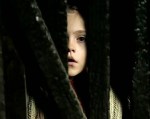 In ‘Down to the Cellar’ Jan Švankmajer explores the fears of a child.
The film’s story is pretty straightforward: we watch a little girl (engagingly played by young Monika Belo-Cabanová) descending the stairs. She has to fetch some potatoes in a deep, dark cellar. However, her task will not be an easy one. Already her way down the stairs to the cellar is frightening, when she’s hindered by two adults who regard her all too knowlingly.
In the cellar, the girl sees strange things happening, like old shoes fighting over her croissant, and a cat growing to gigantic proportions. Even the potatoes won’t cooperate, rolling back into the case she picked them from. Worse, the cellar appears to be inhabited by the same two adults, who perform strange rites for her very eyes. Their invitations to the girl are dubious, and luckily the girl declines. Unfortunately, at the end of the short, she has to face her fears, once again.
‘Down to the Cellar’ contains a hard to define, but strong and disturbing threat of child abuse. The short is mostly shot in live action, and contains only a little stop motion animation. However, it’s arguably Švankmajer’s most moving film. Švankmajer keeps the child’s perspective throughout the movie, and we immediately sympathize with the little girl and her plight, sharing her state of wonder, fear and despair.
Švankmajer would explore the film’s theme again in his fourth feature film, ‘Otesánek’ (2000).
Watch ‘Down the Cellar’ yourself and tell me what you think:
https://vk.com/video5061134_164400011
‘Down the Cellar’ is available on the DVD ‘Jan Svankmajer – The Complete Short Films’
Director: Tex Avery
Release Date: July 5, 1941
Stars: Bugs Bunny, Willoughby
Rating: ★★★★★
Review:
 The dumb dog Willoughby was a minor Warner Brothers character, created by Tex Avery, and starring a few cartoons in the early 1940s.
The dog kept changing names, and that’s probably one of the reasons he never got famous. ‘The Heckling Hare’ was his third cartoon, and in it he remains nameless. Tex Avery puts him against his much more famous creation, Bugs Bunny. Penned by Michael Maltese, the result is an inspired cartoon, full of gags.
Willoughby swaps places with Elmer Fudd in hunting rabbits. He’s of course no more successful than Elmer, and Bugs tricks him a lot. The best scene is when Bugs makes the dumb dog making faces, while he puts forward a sign to the audience reading “Silly, isn’t he?”.
However, the cartoon is most famous for its finale: for it ends with a lengthy fall from a cliff by both characters. This scene is obviously cut short in the final version. Producer Leon Schlesinger didn’t like the original ending, which apparently involved no less than two other falls, and ordered the cut. Rumors have it that this was the reason for Tex Avery to leave Warner Bros. This isn’t true. Tex Avery wanted to do a series combining live action animals with animated mouths. Schlesinger wasn’t interested, so Avery ended up doing this series, Christened ‘Speaking of the Animals’ at Paramount. However, this was not a success, and by September 1941 Avery was making cartoons again, now at MGM, where he would direct his greatest shorts.
In his book ‘Chuck Amuck’ Chuck Jones argues that ‘The Heckling Hare’ was the cartoon that re-established Bugs Bunny’s character, after three somewhat misguided cartoons by himself, Tex Avery and Friz Freleng. Bugs Bunny certainly is much more himself and in any of the previous cartoons. In any case, he would meet Willoughby again in the dog’s very last cartoon, ‘Hare Force’ (1944), directed by Friz Freleng, in which the dog is called ‘Sylvester’.
Watch ‘The Heckling Hare’ yourself and tell me what you think:
https://www.dailymotion.com/video/x612jad
This is Bugs Bunny cartoon No. 5
To the previous Bugs Bunny cartoon: Hiawatha’s Rabbit Hunt
To the next Bugs Bunny cartoon: All This and Rabbit Stew
Director: Bob Clampett
Release Date: October 3, 1942
Rating: ★★★★★
Review:
 ‘The Hep Cat’ was the first Looney Tune made in color. As the Merrie Melodies already were in color, this cartoon heralded a full color era for the Leon Schlesinger studio.
In ‘The Hep Cat’ the dog Rosebud (Willoughby but with another name) tries to catch a ‘hep cat’, a feline womanizer who, on his turn, tries to get a girl, a.o. by speaking with a deep french voice, anticipating the romancing skunk Pepe Le Pew by three years. Rosebud succeeds to seduce the jive cat by using a sexy kitten-like hand puppet. He looses the chase however, and in the last shot we can see the hep cat stroking the hand puppet, saying, with a Jerry Colonna voice ” I can dream, can’t I?”.
‘The Hep Cat’ does not have much of a story, but who cares? It’s an intoxicating and jazzy cartoon, and from the moment the Hep Cat starts singing ‘Java Jive’ with alternate lyrics, you’re lost. The short is fast and funny, full of uninhibited sex and violence gags and throughout the picture one keeps marveling at the extreme and amazingly flexible animation from Bob Clampett’s unit.
Watch ‘The Hep Cat’ yourself and tell me what you think:
Director: Harold Mack
Release Date: August 1, 1952
Rating: ★★★★★
Review:
 By 1952 the Dutch Toonder studios had been producing animation films for ten years, and now they were ready to produce a ‘free film’, not commissioned, but out of their own ideas.
The first of these free films was ‘De gouden vis’ (The Golden Fish). It was Marten Toonder’s old wish to produce a free film, and the result is clearly a work of love. ‘De gouden vis’ is an astonishing achievement for the Dutch studio: all elements of animation film have matured in this film: its storytelling is original, its designs are gorgeous, the animation is excellent, the effects are convincing and its atmosphere is unique. The result is arguably one of the most beautiful films ever made in The Netherlands.
Based on a story by Marten Toonder’s brother, Jan Gerhard Toonder, the film tells about the Chinese prince Li Pai, who repeatedly asks an old wise fish how to live. The fish tells the prince that his eyes know the answer, but Li Pai misinterprets what he sees, and only in old age he discovers the truth…
The film has a genuinely Chinese atmosphere, thanks to designs by Pamela & Harold Mack and backgrounds by Cees van de Weert and Ling Nan Lung. The film hasn’t aged a bit, except for Nell Knoop’s Dutch narration, which has an unmistakable 1950s diction.
Unfortunately, ‘De gouden vis’, in spite of praise on several film festivals around the world, only returned a mere thousand guilders, while its production had costed about 40,000 guilders. So, during the rest of its existence, the Toonder studios produced only a handful of other ‘free films’, most notably ‘Moonglow’ (1955).
‘De gouden vis’ is available on the DVD inside the Dutch book ‘De Toonder Animatiefilms’
Director: Bobe Cannon
Release Date: January 24, 1952
Rating: ★★★★★
Review:
 In ‘The Oompahs’ a voice over tells a story about a family of musical instruments.
‘The Oompahs’ is one of UPA’s most avantgardistic cartoons. Its story and designs are by caricaturist T. Hee, who went for the extremes. The instruments are very basic paper cut outs, with very little animation on them. Mostly they just move across the screen. It’s almost unbelievable that such a modern cartoon could come from a Hollywood studio, at all.
The cartoon is the prime example of director Bobe Cannon’s wish to let the audience watch “drawings that moved”. Even if the founding idea of humanized musical instruments is the same as in Disney’s ‘Music Land‘ (1936), ‘The Oompahs’ is aesthetically miles away from the earlier cartoon.
Like some other UPA cartoons ‘The Oompahs’ tells about a young character with a free spirit. Young Orville, a trumpet, wants to play and improvize freely with his friends (some other instruments), in a game that is depicted by a baseball match, and which sounds like a dixieland band. But Oompah Pa doesn’t approve and makes young Orville practice boring tunes. Then young Orville loses all spirit, gets sick, and only his friends can revive him.
This message of letting creative energy run free must have appealed a lot to its makers, for creative freedom was the raison d’être of the whole studio.
Watch ‘The Oompahs’ yourself and tell me what you think:
http://www.dailymotion.com/video/x1s2jq4_the-oompahs_shortfilms


 Dr. Grob's Animation Review