Directors: Laurent Boileau & Jung
Release Date:
June 4, 2012
Rating:
 ★★★
Review:

One of the striking developments of the 21st century was the advent of the animated documentary. Of course, the genre is much, much older, arguably going back to Winsor McCay’s ‘The Sinking of the “Lusitania“’ (1918), but the animated documentary film remained a scarcity throughout the 20th century, and never went beyond the length of shorts.

All that changed with the highly influential Israeli film ‘Waltz with Bashir’ (2008), arguably the very first feature length animated documentary. Subsequent films of this type often told personal stories, if not only told with, then at least augmented with animation, e.g. ‘Tatsumi’ (2011), ‘Kurt Cobain: Montage of Heck’ (2015, with added animation by Hisko Hulsing) or ‘Tower’ (2016).

‘Couleur de peau: miel’ is such a personal story. The film is based on an autobiographical graphic novel by Belgian author Jung, who is of Korean descent, and who was adopted at a young age. His story is told with an all too prominent voice over, and in live action, depicting the present Jung, now 44 years old, visiting Korea, with the use of 8mm films shot by his father in the 1970s, and with computer animation, depicting several of Jung’s childhood memories.

The film succeeds in showing the troubled existence of adopted children, and their struggling with their identity. Jung, for example, doesn’t feel entirely part of the family, and indeed, his parents sometimes snap that they see him differently from their own natural children. Worse, he feels uprooted, feeling neither completely Belgian nor Korean, and feeling alienated from both. This leads to a troubled youth, with Jung being far from a good boy. This unfortunately makes it rather more difficult to identify with him, for he often acts as a real jerk, being full of mischief, for example falsifying his school report.

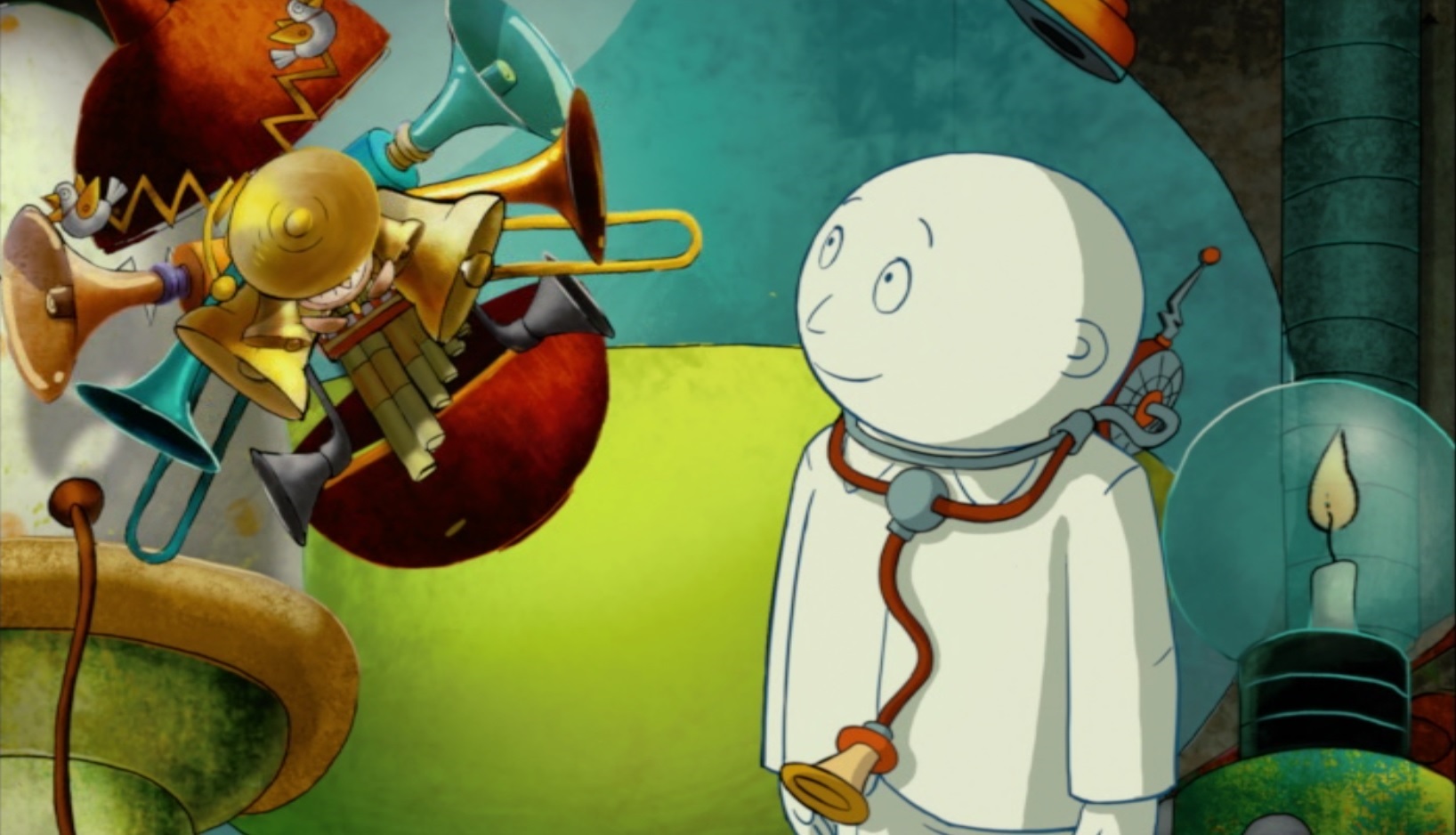
The French title literally translates as ‘Skin Color: Honey’, and the animated sequences certainly use yellows, together with browns and grays as their principal coloring. Jung also has some dire memories of his early Korean days, which are rendered in more depressing grays than the Belgian sequences. These colors dominate the beautiful, two-dimensional background art.

For the animation the film makers have resorted to 3D computer animation, because it was cheaper. Unfortunately, it also looks cheaper, hampering an otherwise fine film. The characters are a strange hybrid of drawn images projected on three-dimensional models, and never become convincing characters. Instead, they look like wandering marionettes, uncannily devoid of life. In fact, the character animation is so ugly to look at that the emotions of Jung’s memories never really come off. I certainly wonder what a better film ‘Couleur de peau: miel’ could have been, if the film makers had made in traditional 2D animation… Now, we’re stuck with a film that certainly is interesting, but falls short in moving its audience.

Watch the trailer for ‘Couleur de peau: miel (Approved for Adoption)’ yourself and tell me what you think:

‘Couleur de peau: miel'(Approved for Adoption) is available on Blu-Ray and DVD

Director: Roman Klochkov
Release Date:
2012
Rating:
 ★
Review:

In ‘Natasha’ a huge Russian bear called Nicolaï lives in a fridge in a Zoo in Belgium as an illegal immigrant. One day another Russian bear called Gennady arrives, who turns out to be the new husband of Nicolaï’s former love, Natasha.

In ‘Natasha’ Klochkov apparently tries to say something about immigration, but his message is lost in a rambling story that leaves the viewer completely flat. In fact, there hardly is a story, but certainly a lot of dialogue. Klochkov’s cartoony style doesn’t help, either, although Nicolaï himself is wonderfully designed and animated, emphasizing his enormous size – Nicolaï literally doesn’t fit in. Also appealing are Klochkov’s bold ink strokes, which turn virtually abstract during the crowd scenes. But these don’t rescue a film, which is too unsure and too dialogue-rich to entertain, let alone move.

Watch ‘Natasha’ yourself and tell me what you think:

https://vimeo.com/108782575

‘Natasha’ is available on the DVD ‘Framed – De beste Vlaamse korte animatiefilms 2010-2015’

Director: Gert Driessen
Release Date:
October 3, 2012
Rating:
 ★★½
Review:

In this short student animation film a man who has recently lost his wife, draws her with chalk on the wall. The chalk wife takes him into her chalk world full of memories.

‘Crayon d’amour’ is a gentle film, but hampered by rather ugly computer animation. The simple, cartoony character design doesn’t really match the 3D animation, nor the far more realistic settings. In fact, the traditional animation of the chalk scenes, not by director Gert Driessen himself, but by Florian de Hoes, Cederic Neven and Olivier vanden Busche, is far more impressive. One certainly wonders why not the whole film was made that way. Nevertheless, the 3D scenes have an attractive color design, consisting mostly of cardboard browns.

Watch ‘Crayon d’amour’ yourself and tell me what you think:

‘Crayon d’amour’ is available on the DVD ‘Framed – De beste Vlaamse korte animatiefilms 2010-2015’

Directors: Emma de Swaef & Marc James Roels
Release Date:
January 28, 2012
Rating:
 ★★★★½
Review:

One of the most striking animation films to come from Belgium in the 2010s was ‘Oh Willy…’ by Emma de Swaef and Marc James Roels. The film immediately catches attention with its soft puppets and sets – everything is fluffy and velvety, even a rotting carcass. But ‘Oh Willy’ also impresses with its poetic way of story telling.

‘Oh Willy…’ tells about a middle-aged man who returns to the naturalist colony of his youth to visit his dying mother. The man is lonely and withdrawn, and clearly unable to blend in with the naturalists, even if he wants to. One night he gets lost in the woods, which sets him to an all new adventure…

‘Oh Willy…’ uses no dialogue, but the soft puppets breath a lot of animation. Moreover, De Swaef and Roels know how to show, don’t tell, and they leave it to the viewer to connect the dots between the scenes. Interestingly, some of the scenes are pretty raw, even if they’re rendered in the fluffiest animation conceivable. From these scenes one can guess why the man feels so awkward and lost without his mother.

True, when summarized, the story of ‘Oh Willy…’ makes little sense, but as told by De Swaef and Roels in their fluffy animation it absolutely accounts for a heart-warming experience. ‘Oh Willy…’ is one of those films showing the unique power of animation, and it certainly belongs to the best shorts of the 2010s. And yet, in 2018 the duo topped it with their 44 minute tour-de-force ‘Ce Magnifique Gâteau!’ (This Magnificent Cake!), employing the same soft visual style, combined with brutal scenes, and poetic story telling to dive into the dark corners of Belgium’s colonial past.

Watch ‘Oh Willy…’ yourself and tell me what you think:

‘Oh Willy…’ is available on the DVD ‘Framed – De beste Vlaamse korte animatiefilms 2010-2015’

Directors: Benjamin Renner, Stéphane Aubier & Vincent Patar
Release Date:
May 23, 2012
Rating:
 ★★½
Review:

In a time in which American studio animation has discarded traditional animation practically altogether, only to embrace a rather generic post-Disney 3D computer style (Laika being the notable exception), one must look elsewhere for animation films in a more unique visual style.

In the 21st century France, especially, has emerged as a producer of animation films with an interesting visual style, using traditional means, with films as different as ‘Les Triplettes de Belleville’ (2003), ‘Persepolis’ (2007), ‘Une vie de chat’ (2010) and ‘Le tableau’ (2011) emerging from that country.

One of such films is ‘Ernest & Célestine’, which immediately draws attention with its gentle, children book-like watercolor style. Produced not only in France, but also in Belgium and Luxembourg, ‘Ernest & Célestine’ is based on a children book series by Belgian author Gabrielle Vincent (1928-2000). Vincent’s Ernest & Célestine stories were modest affairs, with the bear and mouse duo singing, picnicking, going to the circus, or celebrating Christmas. But ‘Ernest & Célestine’ the movie is a very different affair, telling a rather Romeo and Juliet-like story of the two heroes bridging two worlds that live in fear of each other. It remains a bit mystifying why producer Didier Brunner didn’t opt for an intimate story, fitting the source material. As such ‘Ernest & Célestine’ could have been a delightfully little film like ‘My Neighbor Totoro’ (1988).

Instead, Brunner asked French writer Daniel Pennac for a scenario. Now, Pennac is best known for his social satire. I’ve read his novel ‘The Scapegoat’ from 1985 and his graphic novel ‘La débauche’ (with Jacques Tardi, 2000) and both combine sharp social criticism with great humor. Yet, Pennac’s urban settings seem miles away from Vincent’s nostalgic worlds, and, indeed, the film doesn’t really bridge those.

In fact, the film’s story is its weakest link, as the film doesn’t entirely succeed in both setting this world and introducing both characters before the main story starts. Pennac makes it over-complicated with little mice gathering the teeth from the bear children, an invention completely superfluous to the main plot. Moreover, as soon as Ernest and Célestine meet each other, the latter suddenly turns into a brave, smart-alecky, rather dominating, and talkative character, something we would never have guessed from the earlier scenes.

It doesn’t help that initially neither she nor Ernest come off as very likable. Ernest, for example is introduced as lazy and well-known to the police, and he absolutely sees no problem in breaking in into somebody else’s cellar. Also, his treatment of Célestine is rude, while Célestine comes over as pushy, popping up rather uninvited in Ernest’s home. Only when the two rescue each other from nightmares, they grow towards each other. But this occurs apparently overnight, and the change isn’t entirely convincing.

Worse, when the story finally comes to the subject of Vincent’s books, with scenes of Ernest & Célestine living together, and having fun together, the film enters still water. Likewise, the finale feels forced and fails to convince. Directors Benjamin Renner, Stéphane Aubier & Vincent Patar (the latter two of ‘A Town Called Panic’ fame) should have known better.

Nevertheless, the film’s message that friendship and understanding can bridge two very different worlds and cultures, is a welcome one, and as said in the intro, ‘Ernest & Célestine’ employs a very pleasant visual style. All background art is painted in watercolors, and the digital coloring of the characters successfully mimics the watercolor style. Moreover, the linework is open, and the edges of the backgrounds dissolve into nothingness, emphasizing the story book feel.

Strikingly, the animation, supervised by Patrick Lambert and done by Les Armateurs and Blue Spirit in France and Studio 352 in Luxembourg, comes across as rather Japanese. Several moves and facial expressions are copied directly from Japanese tropes and are at odds with the European visual style. Indeed, the film makers admit being highly influenced by Ghibli, but unfortunately, story-wise, ‘Ernest & Célestine’ doesn’t reach the Japanese studio’s great heights. This is a pity, for now ‘Ernest & Célestine’ remains a film which is extremely pleasant to look at, but which is also highly frustrating to watch, with its rambling plot, and plodding pace.

Watch the US trailer for ‘Ernest & Célestine’ and tell me what you think:

‘Ernest & Célestine’ is available on Blu-Ray and DVD

Director: Peter Lord
Release Date:
March 28, 2012
Rating:
 ★★★★
Review:

Aardman’s fifth feature film was, after two computer animated films, a welcome return to the stop-motion the studio is most famous for. It had been seven years since their last stop-motion feature film, ‘Wallace & Gromit: The Curse of the Were-Rabbit’, and meanwhile the studio had exchanged partnership from Dreamworks to Sony Pictures Animation.

Not that that is visible in ‘The Pirates! In an Adventure with Scientists!’ (also known as The Pirates! Band of Misfits’), however, as the film is one hundred percent Aardman. More precisely, even though Nick Park was not involved in this project, his recognizable style now had become the trademark general Aardman style, thus ‘The Pirates! In an Adventure with Scientists!’ explores characters with the same googly eyes and large teeth, if slightly more ‘realistic’ than in the Wallace & Gromit universe.

Unlike Aardman’s earlier features, ‘The Pirates! In an Adventure with Scientists!’ is not an original story, but an adaptation of a children’s novel by British writer Gideon Defoe. I haven’t read the book, so I can’t comment on any differences, but the film certainly is a pretty silly affair, and much of it must have been present in the original writing.

The film takes place in some fantasy take on the 19th century, and stars several historical figures, like Queen Victoria (here depicted as a furious pirate-hating monarch and the villain of the film), Charles Darwin (depicted as a whiny and cowardly character, longing for a girlfriend, and having an all too intelligent chimpanzee as a butler), and, in a small cameo, Jane Austen (the latter’s inclusion is particularly odd, as she died twenty years before Victoria became queen).

The pirates of the title have more in common with Gilbert and Sullivan’s operetta ‘Pirates of Penzance’ (1879)* than with the real thing and are depicted with all the present day cliches imaginable. They’re all dressed in 17th century fashion, belying the 19th century setting, there are wooden legs, flags with skulls, several ‘arrrr’s etc. The modern take on this time period in emphasized by a soundtrack of modern British pop music featuring songs by e.g. Tenpole Tudor, The Clash, The Beat and Supergrass. Thus historicity clearly isn’t the film’s main goal.

On the contrary, the film is self-consciously loony, and chock full of gags and pure nonsense. For example, there’s a pirate festival in which one pirate will be awarded ‘pirate of the year’; one of those pirates makes his entrance from the insides of a giant sperm whale landing on the small harbor; queen Victoria’s dress turns out to be a military killing machine, and so on and so forth.

The story tells about ‘The Pirate Captain’ (he nor his crew do carry names), who dreams of winning ‘the pirate of the year’ award, but who’s actually the laughing stock of the pirate community. In one of his puny attempts to loot a ship he meets Charles Darwin (on his voyage on ‘The Beagle’, which in reality also occurred before Queen Victoria was crowned). Darwin takes interest in the Pirate Captain’s parrot Polly, who’s actually a dodo, and persuades the captain to hand her over for science…

‘The Pirate Captain’, excellently voiced by Hugh Grant, is a round character, dim but enthusiastic, incapable but ambitious, and the story’s focus rests on the tension field between his own ambitions and the love for his crew, mostly personified by pirate ‘Number Two’, who acts as the conscience of the ship. The other six crew members are less well-developed, but allow for a lot of laughs, especially ‘Albino Pirate’ and ‘Surprisingly Curvaceous Pirate’ (an obvious woman with a false orange beard).

In the end the story is less interesting than the general silly atmosphere and the multitude of gags. In fact, the plot is disappointingly generic, containing the obligate break-up scene in which the ambitions of the main protagonist lead to an alienation of his friends (also present in e.g. ‘Up’ from 2009 and ‘Cloudy with a Chance of Meatballs 2’ from 2013), and an equally generic gravity-defying finale, once again bringing back memories to ‘Up’.

The animation is outstanding throughout, and one quickly forgets it’s all done in laboring stop motion. There’s way too much action, and even a breathtaking chase scene (inside Darwin’s London home) to stand still and marvel at the animation itself – it’s simply too fluent, and seemingly effortless – a testimony of the enormous talent present at the British studio. There’s even some traditional animation, when the Pirates’ voyages are depicted on a map of the world. Likewise, there’s hardly time to gape at the sets, which are magnificent in their elaboration and made with so much love and care that one gets immediately submerged into the pirates’ world. I’ve seen the pirate ship at an Aardman exhibition in Groningen, The Netherlands, and that alone is a prop of 3 meters high(!). The captain’s room, too, was something to marvel at – containing a lot of subtle jokes you’ll hardly notice in the movie – if at all. Look for the captain’s log!

In all, ‘The Pirates! In an Adventure with Scientists!’ is great fun, brought to you with bravado and a virtuosity that will leave you breathless.

* the whole concept of Pirate King seems to come from this operetta.

Watch the trailer for ‘The Pirates! In an Adventure with Scientists!’ yourself and tell me what you think:

‘The Pirates! In an Adventure with Scientists!’ is available on Blu-Ray and DVD
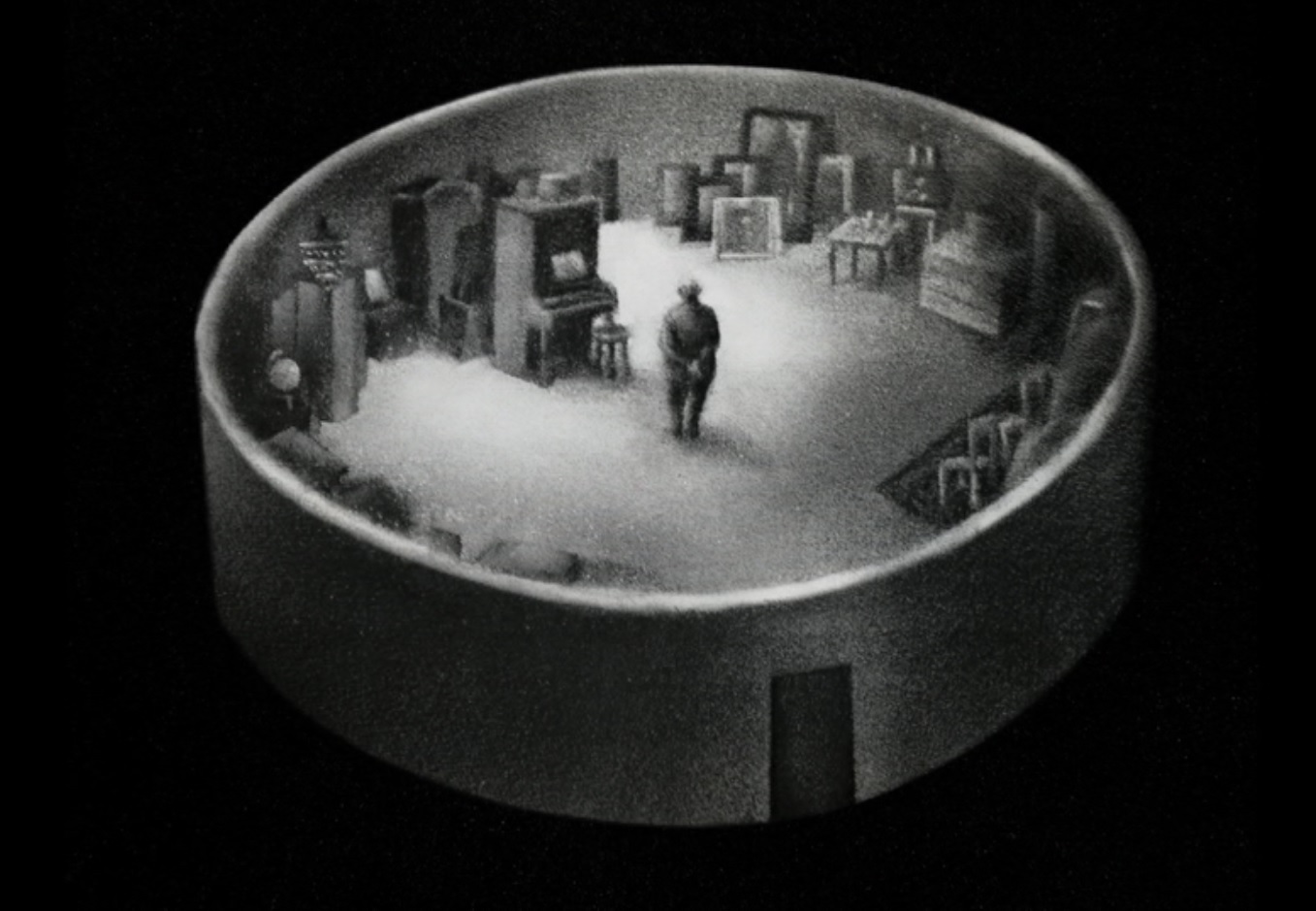
Director: Michèle Lemieux
Release Date:
February 15, 2012
Rating:
 ★★★★½
Review:

One of the most original devices for animation is the pinscreen, deviced by Alexandre Alexeïeff and his wife Claire Parker in the 1930s. Already in 1933 Alexeïeff himself demonstrated the power of this instrument with ‘Une nuit sur le mont chauve‘. However, it almost seemed that the use of machine would die with the great master.

Luckily, Canadian animator Jacques Drouin has continued this tradition, and passed it on to Michèle Lemieux. With its soft black and white images the pinscreen is especially fit for poetical images, and Lemieux’s film certainly is very lyrical. The film is subtitled ‘four meditations on space and time’, and consists of four parts, only bridged by the short’s protagonist, a piano playing man, living in a round chamber.

There’s no traditional story and no dialogue, and little music (which can only be heard during one episode and the finale). But the images are very absorbing, and the sound design is superb. The first episode, in which the man watches some strange phenomenons in the sky, is most intriguing, as is the second episode, which makes great use of metamorphosis. The third, however, is rather static, and relies a little too much on the music to evoke mood. Most disturbing is the fourth chapter, ‘The return of Nothingness’, in which a flying object sucks all objects in the man’s room away from him.

Lemieux ends her beautiful, if rather puzzling film with the pinscreen itself, and she cleverly uses the device to depict the man’s transfiguration. In all, Lemieux proves a very capable animator on this intriguing device, and one hopes she’ll make more animation films this way.

Watch an excerpt from ‘Here and the Great Elsewhere’ yourself and tell me what you think:

‘Here and the Great Elsewhere’ is available on The Animation Show of Shows DVD Box Set 8

Director: Till Nowak
Release Date:
January 28, 2012
Rating:
 ★★★★
Review:

‘The Centrifuge Brain Project’ is a mockumentary in which a professor (Leslie Barnaby) of “the institute for centrifugal research, Florida” tells us about his research.

It’s best to let the film surprise you, so I’m not going to tell you too much, but the film’s main attraction is that Nowak has tried to hide the fact that any animation has been involved in the footage. The film makes clever use of live action shots of rides on fairs, ingeniously manipulated with computer animation, sometimes with quite ridiculous results. But as all experiments shown are based on real rides, the images remain stunningly convincing, even an extended Ferris wheel that seems to fill the complete sky.

The result is a fun short, with understated humor, which is over before you know it.

Watch ‘The Centrifuge Brain Project’ yourself and tell me what you think:

‘The Centrifuge Brain Project’ is available on The Animation Show of Shows DVD Box Set 7

Director: Earl Hurd
Release Date:
January 28, 1923
Stars: Bobby Bumps & Fido
Rating:
 ★★★★★ ♕
Review:

I was already impressed with ‘Fresh Fish’, but Earl Hurd’s next Bobby Bumps picture, ‘Chicken Dressing’ is even better.

Earl Hurd, jr. again is a director at a “large film company”, in which Bobby Bumps and Fido co-star a live action cat, rabbit and chicken. These real animals interact marvelously with the cartoon starts, and one immediately believes they’re movie stars, as well.

Only after 4 minutes the ‘real’ picture starts, with Bobby Bumps and Fido being firefighters, rushing to the fire on a live action-rabbit pulled cart, and assisted by the real life cat, while the chicken plays the damsel in distress. Highlight is when Bobby Bumps takes out one of the smoke drawings, handles it as if it were a spring, and complains to the director about this badly drawn smoke.

Soon some real smoke enters the picture, making Bobby faint. The director asks Bobby whether he wants to go to a real life hospital or a cartoon hospital. After imagining the first (also starring two live action children as a doctor and nurse, respectively) , Bobby wisely chooses the latter. In the end the whole cartoon appears to have been the chicken’s dream.

‘Chicken Dressing’ is an absolute delightful cartoon, mixing live action and animation to a satisfying end, and providing some great gags along the way. Earl Hurd makes great use of the animals, sometimes superimposing drawings on them. This cartoon shows that Earl Hurd should be counted among the animation greats, and not only remembered for his cel patent.

Watch ‘Chicken Dressing’ yourself and tell me what you think:

‘Chicken Dressing’ is available on the Blu-Ray/DVD-combo ‘Cartoon Roots: Bobby Bumps and Fido’

Director: Earl Hurd
Release Date:
August 26, 1922
Stars: Bobby Bumps & Fido
Rating:
 ★★★★½
Review:

Earl Hurd left Paramount for Educational Pictures, and with this move his style changed from pure cartooning to a very inventive and entertaining blend of live action and animation, starring his own little son as a live action director directing the cartoon stars Bobby and Fido.

‘Fresh Fish’ is a perfect example. The opening title card is already promising, reading “Bobby Bumps Film co. Feetures & Comydies. No admitence. Aplie at Offis.” Inside, we watch Hurd jr. filming Bobby and Fido, who are on a fishing boat. First the cartoon concentrates on the cartoon gags, e.g. with Fido pitying the poor fish, before the fish tantalizes the poor dog. This sequence ends when a live action cat catches the fish and runs away with it.

But then Bobby accidentally stands on the water, a fact Hurd jr. has to point out to him. At this point Bobby falls into the water after all. The idea that gravity only works when one is aware it should work is of course a familiar cartoon trope, but this is the oldest instance of this gag type I know of.

After the fall, Bobby blames the poor scenery, which, indeed, hardly indicates the presence of water. Thus, the young director places the scenery in a tub. At first Bobby and Fido are very pleased with the added realism, but they almost drown in it.

This cartoon features quite some very effective special effects, making us easily believe the cartoon Bobby and Fido are in the same room as the cat and the director. Especially the water splashing when Bobby and Fido jump into the tub is very convincing. The result is no less than delightful, and ‘Fresh Fish’ should be regarded as one of the highlights from the silent cartoon era.

‘Fresh Fish’ is available on the Blu-Ray/DVD-combo ‘Cartoon Roots: Bobby Bumps and Fido’

Director: Earl Hurd
Release Date:
August 21, 1921
Stars: Bobby Bumps & Fido
Rating:
 ★★★
Review:

In ‘Hunting an’ Fishing’ Bobby Bumps does exactly that, and in an area where it’s prohibited, too. But how he’s supposed to know? He has blasted off the ‘no’ from a ‘no hunting allowed’ sign while trying to hit a rabbit. In any case, soon the gamekeeper is on his tail…

‘Hunting an’ Fishing’ looks uncommonly cheap for a Bobby Bumps cartoon: the background art is extremely limited, and Hurd uses quite some animation cycles. More interesting is the fact that this short seems like a very early ancestor of the chase cartoon. A great deal of the cartoon features the gamekeeper chasing Bobby, and Bobby and Fido trying to get rid of the fellow in various ways.

Yet, the best gag is reserved for a completely different set of characters: a bird and a frog using a sleeping rabbit’s stomach to rock themselves to sleep as well. This is an inventive, unique and surprisingly well staged gag.

‘Hunting an’ Fishing’ is available on the Blu-Ray/DVD-combo ‘Cartoon Roots: Bobby Bumps and Fido’

Director: Earl Hurd
Release Date:
November 9, 1919
Stars: Bobby Bumps & Fido
Rating:
 ★★★½
Review:

In this short film, little boy Bobby Bump jumps out of the inkwell, together with his dog Fido, and calls his master, who hasn’t arrived at work, yet, on the phone.

Their creator Earl Hurd invites them at his home. What follows is a funny smoke gag, but shortly after Bobby and Fido start packing, the cartoon ends, cutting short a promising premise.

As ever with the Bobby Bump cartoons, the designs are very appealing, but the animation is very limited and a bit crude. Yet, the simple gags have their own charm, and this cartoon is particularly interesting for starring the master Earl Hurd, himself.

Watch ‘Their Master’s Voice’ yourself and tell me what you think:

‘Their Master’s Voice’ is available on the Blu-Ray/DVD-combo ‘Cartoon Roots: Bobby Bumps and Fido’

Director: Earl Hurd
Release Date:
January 24, 1919
Stars: Bobby Bumps & Fido
Rating:
 ★★★
Review:

‘Bobby Bumps’ Last Smoke’ starts with Earl Hurd’s hand drawing Bobby Bumps, tickling him on the way. Then finished he gives the boy a cigarette, and immediately the scenery sets in.

Bobby starts smoking enthusiastically, but soon gets dizzy and throws the cigarette away. The cigarette smoke transfers him and Fido to a sultan’s palace in a 1001 Arabian night version of Turkey. The duo rescue a lady from the Sultan’s dungeons, with Bobby knocking out all the guards, and some lions, with the lady’s former ball and chain. He earns the damsel’s kiss in reward, which turns out to be Fido licking him.

Now, one would suspect that ‘Bobby Bumps’ Last Smoke’ is a typical anti-smoking cartoon, with Bobby giving up smoking after this trippy experience. But no, the one thing he’ll never do again isn’t smoking, but “insulting a sultan”. And so, with this pun, the short ends.

‘Bobby Bumps’ Last Smoke’ boasts elaborate human designs and intricate background art, but as with most animated cartoons from the 1910s, the animation is limited and jumpy.

‘Bobby Bumps’ Last Smoke’ is available on the Blu-Ray/DVD-combo ‘Cartoon Roots: Bobby Bumps and Fido’

Director: Władysław Starewicz
Release Date: 1920
Rating: ★★★★
Review:

In ‘Dans les griffes de l’araignée’ Starewicz tells his own, quite elaborated version of the classic ‘Spider and the Fly’ tale.

In Starewicz’s version the fly is called Dame Aurélie, a simple fly living at the countryside with her uncle, Beetle Anatole, and being in love with a longhorn beetle. One day a famous Paris star, a butterfly called Phalène, crashes in the fly’s village, and stays at her home. Phalène paints an all too rosy picture of Parisian life, and soon after her departure, Aurélie goes to the capital, as well.

First all goes well, as Aurélie works as Phalène’s house maid. But when she’s fired because of seeing a secret lover, things go downhill, indeed. The tale ends rather gruesomely with quite a spectacular finale, and in the epilogue we watch Aurélie returning to the village…

‘Dans les griffes de l’araignée’ is quite a tragic tale, but it’s hard to call it very engaging. Starewicz’s puppets are quite sophisticated, e.g. capable of rolling their eyes, but they don’t transgress the emotions very well, which remains emblematic. The emotional scenes are augmented by close-ups of the insect characters, in which live action puppets are used. Most spectacular is the finale, in which the title cards make place for a long action scene. The surviving print is gorgeous with its hand-painted colors, which certainly add to the film’s unique atmosphere.

‘Dans les griffes de l’araignée’ is available on the DVD-box ‘Starewitch 1882-1965 DVD Cinquantième anniversaire’

Directors: Max & Dave Fleischer
Release Date: July 6, 1920
Stars: Ko-Ko the Clown
Rating: ★★★½
Review:

‘The Clown’s Little Brother’ is one of the Fleischer brothers’ earliest films, when they were still working at Bray Studio.

The film stars Max Fleischer as the artist drawing Ko-Ko the clown, who’s only known as ‘the inkwell clown’ in this cartoon. Interestingly, as soon as Max tries to draw the character, his pen fails and Ko-Ko jumps out of the glass in which Max washes his pen. Immediately thereafter Max gets his mail, which strangely enough contains a live kitten. The Inkwell Clown gets a letter, too, stating that his kid brother arrives in another mail package. But Ko-Ko’s kid brother turns out to be a cheeky brat and Max leaves.

Undeterred, Ko-Ko tries to entertain the little kid with his antics, but the boy easily outperforms the clown, not in the least because he’s 100% animated, while Ko-Ko is partly rotoscoped. Thus the kid’s movements are wilder, less realistic and more impossible than Ko-Ko’s. At one point Ko-Ko falls off the piece of paper, and on the kitten, who plays with the poor cartoon character. At that point the kid brother shows his kinder side, and rescues Ko-Ko from the clutches of the feline foe. Yet, their antics end when Max returns, and the bottle of ink falls on the floor.

‘The Clown’s Little Brother’ is by all means an action rich and entertaining short, and shows that the Fleischers brothers were very competent players in the field. Fleischer’s inkwell clown was a sensation back then because of his fluid movements, based on Max Fleischer’s rotoscope invention. But in this cartoon Max Fleischer shows to be a competent animator without the aid of rotoscope, as well. For example, when the kid brother tries to pull Ko-Ko out of the inkwell, one can sense some pulling force.

Watch ‘The Clown’s Little Brother’ yourself and tell me what you think:

‘The Clown’s Little Brother’ is available on the DVD-set ‘Popeye the Sailor 1941-1943’

Director: Max Fleischer
Release Date:
1920
Rating:
 ★★★★½
Review:

‘All Aboard for a Trip to the Moon’ is a very early educational animation short. The short was animated by Max Fleischer at the Bray Studios, and apparently part of a series called ‘Goldwyn Bray Pictograph – The Magazine on the Screen’. For this short Fleischer got assistance of the Popular Science Monthly for the scientific details.

In less than 8 minutes ‘All Aboard for a Trip to the Moon’ tells about a hypothetical trip to the moon, telling us how far the moon is, and how to overcome the Earth’s gravity by using a radium-propelled rocket. Fleischer depicts quite a hard, bouncing landing of the rocket on the moon, and it’s never revealed how the vessel would be able to return to Earth, but we get some nice and convincing shots of the moon’s landscape and earth from the moon itself.

Fleischer’s drawings and animations are combined with live action footage, e.g. of a man handling radium, and another one getting dressed for the trip. Apparently in 1920 the scientists deemed a thick fur coat and a gas mask enough protection in outer space…

The short also states that radium alone can create the force to overcome the Earth’s gravity, while the Saturn V rockets that eventually would put man on the moon were fueled by a modified form of kerosene, and in 1920 kerosene itself was already well-known…

Anyhow, scientific errors aside, ‘All Aboard for a Trip to the Moon’ is an entertaining piece of infotainment. It not only predates Disney’s similar futurist television specials, like ‘Man and the Moon‘ (1955) with a staggering 35 years, it also gives an insight look in how space travel was perceived in the 1920s.

‘All Aboard for a Trip to the Moon’ is available on the Thunderbean Blu-Ray ‘Fleischer Rarities’

Director: Walter Lantz
Release Date: February 27, 1920
Stars: Jerry on the Job
Rating: ★★★★
Review

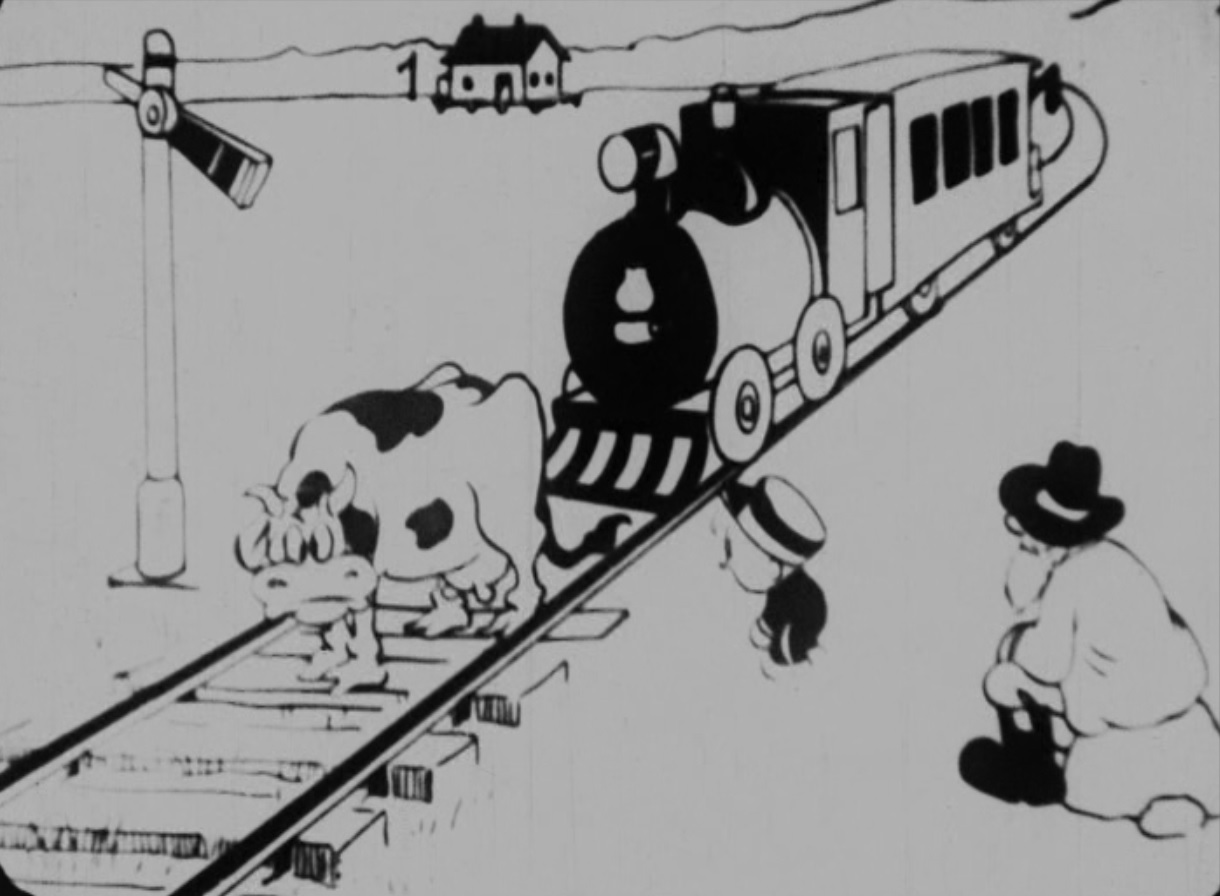
‘The Wrong Track’ is a short gag cartoon featuring ‘Jerry on the Job’, apparently a little kid doing all kinds of jobs.

In this short he’s a train engineer, who’s scolded by his boss of killing too many animals on the train track. And indeed, only a few seconds after leaving the train station Jerry encounters a cow, which after some action is killed.

The short features quite some funny gags and ends with a great punchline. The designs are simple, but pleasant and Walter Lantz’s animation is fair and effective. ‘The Wrong Track’ may not be a masterpiece, it’s a fun bit of early animation, and certainly one of the better shorts from this era.

The Wrong Track’ is available on the Thunderbean Blu-Ray/DVD-combo ‘Technicolor Dreams an Black & White Nightmares’

Director: Howard S. Moss
Release Date: 1917
Rating: ★
Review

‘Dolly Doings’ is an entry in the ‘Motoy Comedies’ series, which was apparently based on the book series ‘Motoys in Life’.

The short mixes live action and stop motion to tell the story of a little girl who dreams that her dolls come to life. One particularly mischievous doll called Jimmy taunts the others with a needle.

The dolls lack any character and are very poorly animated, not exceeding the amateur level. The action is hard to comprehend, and the ‘story’ too trite to be of any interest. The intertitles, too, are painfully unfunny. I’ve no idea how many Motoy Comedies have been made, but based on the judgement of this entry this series can’t hardly have been successful.

Dolly Doings’ is available on the Thunderbean Blu-Ray/DVD-combo ‘Techicolor Dreams an Black & White Nightmares’

Director: Dick Huemer?
Release Date: July 14, 1918
Stars: Mutt and Jeff
Rating: ★★★½
Review:

In this Dick Huemer-animated short Mutt and Jeff appear to own a lunchroom. Mutt is the waiter, and Jeff the cook.

There are essentially three gags: a bearded customer wants some ox-tail soup, another costumer some pie, and the third, a beautiful woman, the best flapjacks they have. When she notes that the flapjacks don’t look so good, Mutt places one on the grammophone player and promptly starts to dance with her to the music. The dance ends when a policeman shows up, knocking out both Mutt and Jeff, but taking the dance with the beautiful dame himself.

While seating the lady looks like from another picture, when compared to the cartoony design of Jeff, but this feeling vanishes during the dance scene, and one must admit Dick Huemer does quite a good job in animating this particular scene. Another fine piece of early character animation are Mutt’s deft hand movements while handling the second customer.

Watch ‘The Extra-Quick Lunch’ (Flapjacks) yourself and tell me what you think:

‘The Extra-Quick Lunch’ (Flapjacks) is available on the DVD ‘Mutt and Jeff – The Original Animated Odd Couple’

Directors: Jennifer Yuh Nelson & Alessandro Carloni
Release Date: January 23, 2016
Rating: ★★★ ½
Review:

Kung Fu Panda 2’ had suggested a background story for Po, an extermination of all Pandas by the evil peacock Lord Shen. So, it would have been logical to expand this story line in ‘Kung Fu Panda 3’.

And indeed, this is the movie in which Po finally meets more pandas, not to say even his very own family. And yet, virtually nothing is done with the plot elements of ‘Kung Fu Panda 2’. Po’s natural father pops up in Po’s village, virtually out of nothing – there’s no quest whatsoever.

Instead, ‘Kung Fu Panda 3’ introduces a completely new background story, involving the spirit realm, and introducing Po’s most powerful opponent thus far, master Oogway’s former friend, the bull Kai. Kai returns from the spirit world to the mortal world, creating havoc and changing all kung fu masters into his own mindless army of jade. And being immortal he’s a tough one to take. It’s up to Po to fight off this formidable foe.

Despite this splendid super villain, ‘Kung Fu Panda 3’ is quite a disappointing sequel, stretching the all too American dream-like messages of ‘believe in yourself’ and ‘if you want to, you can achieve everything’ way beyond believability. Po’s transition of his lazy, food-loving parent village into a gang of fearless fighters, able to battle the greatest kung fu masters of China, in only a matter of days, is stretching the imagination, to say the least. Traditional wuxia cinema emphasizes that true mastery only comes with hard and long training, but in the American Kung Fu Panda universe, you get it for free if you only believe in yourself. If only. One wonders what entered the makers’ minds to send off a phony message like that.

Unfortunately, there are more story problems. There’s an all too obligate break up scene, when Po’s father appears to have lied to Po. Moreover, for a village that is supposed to be secretly hidden, the Panda settlement is found surprisingly easily by both Tigress and Kai. And the story line of the pandas having forgotten how to use Qi, only to remaster that in an instant, is, again, quite unconvincing. True, Po never was an entirely convincing character, but he certainly isn’t in this film.

Meanwhile, Po’s former co-stars are reduced to minor players, uttering only a few lines, if any, while none of the new players, save Kai, show the same charm. Only Po’s duck father, Mr. Ping (voiced by James Hong) thrives as the jealous father.

No, the main attraction of ‘Kung Fu Panda 3’ is not its story, or its characters, but its design. The film makes great use of wuxia imaging, including gravity defying runs and jumps. Even better, the feature at times becomes surprisingly graphical: for example, the film occasionally uses the split screen to a great effect, Oogway’s story is rendered in gorgeous 2D, and the learning sequence employs a bold and very beautiful color scheme.

In addition, ‘Kung Fu Panda 3’ is noteworthy for introducing the utterly Chinese concept of Qi to Western audiences. Qi roughly translates as ‘life energy’ and forms the central theme of the film, making ‘Kung Fu Panda 3’ an interesting blend of Western (the individualistic tropes stated above) and Eastern concepts. Nevertheless, one cannot help but feeling that there could have been more to ‘Kung Fu Panda 3’, and that it in fact is more run-of-the-mill than the film could have been.

Watch the trailer for ‘Kung Fu Panda 3’ yourself and tell me what you think:

‘Kung Fu Panda 3’ is available on Blu-Ray and DVD

Enter your email address to follow this blog and receive notifications of new posts by email.

Join 915 other subscribers
Bookmark and Share

Categories