Director: unknown
Release Date:
 December 21, 1931
Stars: Flip the Frog
Rating: ★★★★★
Review:

Spooks © Ub Iwerks‘Spooks’ opens with Flip seeking shelter from a rain storm in an old mansion.

There he encounters a skeleton who invites him to dinner of a skeleton of a roasted chicken. Later Flip dances with a female skeleton, while the deceased owner of the house plans to add flip to his skeleton collection.

‘Spooks’ is one of the best of the Flip the Frog cartoons. Featuring a much more consistent story than the earlier ‘The Cuckoo Murder Case’, the cartoon manages to provide a genuine feeling of horror, only matched by Disney’s ‘The Mad Doctor‘ (1932). When confronted with the homicidal skeleton, Flip is in real peril. Moreover, outside the mansion the nightmare continues, when even Flip’s own horse has turned into some living bones.

The scenes inside the haunted house feature distorted angles, which add to the claustrophobic feel. Strangely enough the curved backgrounds can also be seen in subsequent Flip the Frog cartoons, like ‘The Milkman‘ and ‘What A Life‘, where they don’t contribute to the atmosphere, at all. In fact, they would become a unique style element in the Ub Iwerks cartoons.

The complete cartoon is well-animated, with the opening scene, in which Flip and his horse battle the elements, being particularly outstanding.

Watch ‘Spooks’ yourself and tell me what you think:

This is Flip the Frog cartoon No. 16
To the previous Flip the Frog cartoon: Africa Squeaks
To the next Flip the Frog cartoon: The Milkman

‘Spooks’ is available on the DVD ‘Cartoons that Time Forgot – The Ub Iwerks Collection Vol. 2’

Director: Burt Gillett
Release Date:
 October 1, 1932
Rating: ★★★
Review:

Bugs in Love © Walt Disney‘Bugs in love’ was the very last of the black and white Silly Symphonies, being even released after  the technicolor films ‘Flowers and Trees‘ and ‘King Neptune‘.

The short’s story is almost a copy of that of ‘The Spider and the Fly‘ (1931) and features two bugs in love, who are threatened by a mean crow. Luckily their fellow flies come to the rescue, in an elaborate battle scene, in which the flies use e.g. ink, false teeth, shoe polish, an eggbeater, a mousetrap and castor oil to defeat the crow.

The ingenuity of this particular battle scene is intriguing, but unfortunately it follows all too similar scenes in films like ‘The Spider and the Fly’, ‘The Bird Store‘ and ‘The Bears and the Bees‘. The result is a rather traditional Silly Symphony, with its repetitious animation and rhythmical sequences. Luckily, with its two color Silly Symphonies Disney had demonstrated it could do much better, and the studio did not return to this formula, until the elaborate ‘The Moth and the Flame’ from 1938.

‘Bugs in love’ is clearly related to the successful comic strip ‘Bucky Bug’, begun earlier the same year. However, it’s not entirely clear to me whether the hero bug in ‘Bugs in Love’ is Bucky himself, or not.

Watch ‘Bugs in Love’ yourself and tell me what you think:

This is Silly Symphony No. 31
To the previous Silly Symphony: King Neptune
To the next Silly Symphony: Babes in the Woods

‘Bugs in Love’ is available on the DVD ‘Walt Disney Treasures: More Silly Symphonies’

Director: Wilfred Jackson
Release Date:
 July 9, 1932
Rating:
Review:

The Bears and the Bees © Walt Disney‘The Bears and the Bees’ follows the adventures of two little bear cubs, who encounter a large mean bear and a bee colony.

The two cubs eat the bees’ honey, but luckily it’s the old mean bear who gets all the stings, in an elaborate battle scene, comparable to those in ‘The Spider and the Fly‘ (1931) and ‘Bugs in Love‘ (1932).

The story of ‘The Bears and the Bees’ is consistent, but remarkably boring. The two little bears look like early forerunners of Mickey’s nephews Morty and Ferdy, who would make their screen debut two years later in ‘Mickey’s Steamroller‘ (1934). It’s interesting to see how the animators tried to render these two cubs partly as animals and partly as little brats. This way of animating animals halfway anthropomorphism would become a Disney specialty, leading to masterpieces like ‘Bambi‘ (1942) and ‘Lady and the Tramp‘ (1956). In this short it can be watched in its embryonic form.

Watch ‘The Bears and the Bees’ yourself and tell me what you think:

This is Silly Symphony No. 27
To the previous Silly Symphony: The Bird Store
To the next Silly Symphony: Just Dogs

‘The Bears and the Bees’ is available on the DVD ‘Walt Disney Treasures: More Silly Symphonies’

Director: Wilfred Jackson
Release Date:
 January 5, 1932
Rating: ★★★
Review:

The Bird Store © Walt Disney‘The Bird Store’ follows earlier Mickey Mouse films and Silly Symphonies in presenting half a song-and-dance routine and half a story.

This short starts quite boringly with endless bird song routines, but after 4 minutes of this a cat enters, which leads to a small story when the cat captures a small canary and all other birds free the canary and chase the cat away to a city dog pound.

The bird designs are still pretty primitive, and much more akin to those in ‘Birds of a Feather‘ from one year earlier than to ‘Birds in the Spring‘ from one year later. Most birds are clearly drawn from fantasy, and make no sense at all. The provisional realism of the canary in ‘Mickey Steps Out‘ hardly gets any follow-up here. A small highlight form the four ‘Marx Birds’, which mark the earliest instance of Hollywood caricatures in a Disney film.

Watch ‘The Bird Store’ yourself and tell me what you think:

This is Silly Symphony No. 26
To the previous Silly Symphony: The Ugly Duckling
To the next Silly Symphony: The Bears and the Bees

‘The Bird Store’ is available on the DVD ‘Walt Disney Treasures: More Silly Symphonies’

Director: Wilfred Jackson
Release Date:
 November 10, 1931
Rating: ★★★
Review:

The Fox Hunt © Walt Disney.jpg‘The Fox Hunt’ is the most atypical Silly Symphony of the black and white era. It’s not devoted to music at all, and it features human characters.

These human hunters ride rather cartoony horses, and much of the fun comes from the silly ways the hunters ride their horses. One even rides a cow, a pig, a porcupine and a log with four dogs in it. The cartoon opens most spectacularly, with the morning sun’s beaming rays lighting a few forest scenes. A little later there’s a beautiful scene of the hunters and their horses casting long shadows on a hill. A scene like this looks all the way forward to the Ave Maria sequence of ‘Fantasia’ (1940).

The human figures are a bit of a mixed bag, but generally more convincing than those in ‘Mother Goose Melodies‘ or ‘The China Plate‘ from earlier that year. Thus, ‘The Fox Hunt’ is one of those films showcasing Disney’s ambition, even though it’s by no means a classic.

The fox hunt theme was revisited nine years later in the Donald Duck & Goofy short of the same title (1938), which uses the same skunk end gag, which itself was copied from the Oswald cartoon ‘The Fox Chase‘ (1928).

Watch ‘The Fox Hunt’ yourself and tell me what you think:

This is Silly Symphony No. 24
To the previous Silly Symphony: The Spider and the Fly
To the next Silly Symphony: The Ugly Duckling

‘The Fox Hunt’ is available on the DVD ‘Walt Disney Treasures: More Silly Symphonies’

Director: Wilfred Jackson
Release Date:
 October 13, 1931
Rating: ★★★½
Review:

The Spider and the Fly © Walt DisneyAfter ‘The Cat’s out‘ of three months earlier ‘The Spider and the Fly’ is the second silly symphony focusing on a story instead of a musical routine.

In this short a mean spider lures two flies into his web by playing harp on it, recalling a similar scene in Max Fleischer’s ‘Wise Flies‘ from 1930. The female fly is captured, but the male fly summons all the other flies to help him rescue her, which they do in a long battle scene on the music of Franz von Suppé’s overture ‘Die leichte Kavalerie’ and Franz Schubert’s Erlkönig. Here we watch flies riding horseflies and using dragonflies as bombers and shoes on caterpillars as tanks. There’s also a spectacular scene in which the flies set fire to the spider’s web, with the poor female fly still in it. Ironically, the spider’s finally captured with flypaper.

‘The Spider and the Fly’ is more melodramatic than funny, but there’s a lot going on, and one doesn’t get the time to get bored. The basic story line of this cartoon would be followed in two other Silly Symphonies: ‘Bugs in Love‘ (1932) and ‘The Moth and the Flame’ (1938), also featuring insects.

Watch ‘The Spider and the Fly’ yourself and tell me what you think:

This is Silly Symphony No. 23
To the previous Silly Symphony: The Clock Store
To the next Silly Symphony: The Fox Hunt

‘The Spider and the Fly’ is available on the DVD ‘Walt Disney Treasures: More Silly Symphonies’

Director: Wilfred Jackson
Release Date:
 September 16, 1931
Rating: ★★
Review:

The Clock Store © Walt Disney‘The Clock Store’ was the last of the Silly Symphonies solely devoted to a dance routine.

This time, the traditional dance routine is performed by clocks and watches to Frank Churchill’s music. The cartoon ends with two alarm clocks fighting each other to pieces. Unfortunately, before this final scene there is no story, whatsoever, and by now the dance routine had become very tiresome, indeed.

Nevertheless, the short is beautifully made: the opening scene shows a lamplighter lighting the street lights to stunning effects. Furthermore, halfway the cartoon we watch two 18th century human figures dancing an elegant minuet. This short dance scene was the studio’s most realistic take on the human form, yet, and a spectacular sight for a 1931 cartoon.

Watch ‘The Clock Store’ yourself and tell me what you think:

This is Silly Symphony No. 22
To the previous Silly Symphony: Egyptian Melodies
To the next Silly Symphony: The Spider and the Fly

‘The Clock Store’ is available on the DVD ‘Walt Disney Treasures: More Silly Symphonies’

Director: Walter Lantz or Bill Nolan
Release Date: January 18, 1932
Stars: Oswald the Rabbit
Rating: ★★
Review:

Grandma's Pet © Walter LantzBy 1932 Oswald had changed into a cute little boy. And yet, in the opening scene of ‘Grandma’s Pet’ he’s shown reading the fairy tale of Little Red Riding Hood to his three nephews(?).

Soon Oswald falls asleep himself and he dreams that he’s inside the fairy tale himself. Apart from Oswald’s presence, the cartoon quite faithfully follows the fairy tale until the wolf kidnaps Little Red Riding Hood, and out of nowhere produces a magic wand, which changes the complete scenery several times. In the end, Oswald uses the magic wand to change the wolf into a roast.

‘Grandma’s Pet’ is one of the Lantz films in which Tex Avery is billed as an animator. It may have inspired his own mix-up fairy tale films, like ‘Little Red Walking Hood’ (1937) and ‘The Bear’s Tale‘ (1940). It pales when compared to those latter cartoons, however, suffering from erratic animation and sloppy timing.

Watch ‘Grandma’s Pet’ yourself and tell me what you think:

‘Grandma’s Pet’ is available on the DVD ‘The Woody Woodpecker and Friends Classic Cartoon Collection’

Directors: John Foster & Mannie Davis
Release Date:
 March 26, 1932
Rating: ★★
Review:

The Cat's Canary © Van BeurenIn ‘The Cat’s Canary’ we watch a cat swallowing a bird. Surprisingly the bird remains alive, and makes the cat produce chirping sounds.

The cat goes to a doctor, to no avail, he then joins a quartet of alley cats serenading a kitten. He joins in chirping. But when he gets hit with a cage, the bird escapes. The bird takes revenge on the cat with help from some fellow birds, including a pelican.

After watching such ambitious films by Van Beuren as ‘The Family Shoe‘, ‘Toy Time‘ and ‘Fly Frolic‘, the Aesop Fable ‘The Cat’s Canary’ feels pretty backward. The designs of the cat are highly inconsistent and primitive, looking back to the Waffles and Don films from 1930. The complete short lacks the Silly Symphony-like quality of the preceding Aesop Fables. Moreover, it’s storytelling is weak and inconsistent: there’s a complete throwaway scene, in which the cat is visited by sympathizing birds, and although the cat is the main protagonist throughout the whole film, he suddenly changes into a villain in the end.

The final scene is clearly inspired by the finale of Disney’s ‘Birds of a Feather‘ (1931), and perhaps ‘The Bird Store‘ (1932), but it adds nothing of its own.

Watch ‘The Cat’s Canary’ yourself and tell me what you think:

‘The Cat’s Canary’ is available on the DVD ‘Aesop’s Fables – Cartoon Classics from the Van Beuren Studio’

Directors: John Foster & Harry Bailey
Release Date:
 March 5, 1932
Rating: ★★★★½
Review:

Fly Frolic © Van Beuren‘Fly Frolic’ quite shamelessly puts its inspiration from films like Fleischer’s ‘Wise Flies‘ (1930) and Disney’s ‘The Spider and the Fly‘ (1931), visiting exactly the same theme of the spider and the fly.

In Van Beuren’s version, two flies go to the ‘Coffee Pot Cabaret’ for a night out. At one point an old spider enters, scaring the flies to death. He goes into a Cab Calloway routine, singing the bandleader’s 1931 hit ‘Kickin’ The Gong Around’, Calloway’s second song about Minnie the Moocher. Interestingly, this film was released a week before Cab Calloway himself appeared in an animation film in Fleischer’s ‘Minnie the Moocher‘.

After some scatting the spider kidnaps the female fly and takes her to his secret laboratory. At this point the film suddenly changes into a parody of the 1931 horror film ‘Dr. Jekyll and Mr. Hyde’, with the spider changing into a handsome dandy. This doesn’t fool anyone, however, and the hero fly beats him, joined by his fellow flies.

‘Fly Frolic’ is a quite consistent film with a lot of melodrama. The designs are pretty primitive, however, and the spider changes completely from the nightclub scene to the laboratory scene, even before drinking his potion!

Watch ‘Fly Frolic’ yourself and tell me what you think:

‘Fly Frolic’ is available on the DVD ‘Aesop’s Fables – Cartoon Classics from the Van Beuren Studio’

Directors: John Foster & Harry Bailey
Release Date:
 January 27, 1932
Rating: ★★★½
Review:

Toy Time © Van Beuren‘Toy Time’ is another typical Silly Symphony-like short by Van Beuren, trying to beat Disney at his own game.

The cartoon features two mice, Oscar and his girlfriend, who resemble Mickey and Minnie less than Van Beuren’s ill-fated stars Milton and Rita had done (see e.g. ‘Circus Capers‘ and ‘The Office Boy‘).

In fact, the two are portrayed as real mice, having fun in the toy shop at night. This premise comes directly from the Silly Symphony ‘Midnight in a Toy Shop‘, but the Van Beuren studio adds some drama, when a cat appears, and the two mice battle him with help of several toys. Strangely enough the cartoon doesn’t end at that point, but also features a scene in which Oscar serenades his girlfriend on the piano. Only then he earns his sweetheart’s kiss.

Like ‘The Family Shoe‘ (1931), ‘Toy Time’ is highly ambitious. For example, it features a splendid score by Gene Rodemich, and elaborate and quite beautifully painted backgrounds. Unfortunately, the animation is still pretty awkward, and the designs of the two mice primitive and bland. Nevertheless, it shows that the Van Beuren Studio was trying very hard.

Four months later, Warner Bros. would cover similar grounds in ‘It’s Got Me Again!‘, but with much more satisfying results.

Watch ‘Toy Time’ yourself and tell me what you think:

‘Toy Time’ is available on the DVD ‘Aesop’s Fables – Cartoon Classics from the Van Beuren Studio’

Directors: John Foster & Mannie Davis
Release Date:
 September 14, 1931
Rating: ★★★★★
Review:

The Family Shoe © Van BeurenBy 1931, Van Beuren’s ‘Aesop’s Fables’ had become the studio’s answer to Walt Disney’s Silly Symphonies, being the first studio clearly trying to copy Disney’s format (Warner Bros’ Looney Tunes and Merrie Melodies were only variations on the Silly Symphonies in name, being very different otherwise).

Given the studio’s animation output up to 1931, ‘The Family Shoe’ is a remarkably consistent and forward-looking product. With its consistent storytelling ‘The Family Shoe’ actually predates Walt Disney’s breakthrough short ‘The Ugly Duckling‘ by three months.

Merging the nursery rhyme of the old woman who lived in a shoe with the fairy tale of Jack and the beanstalk, the film anticipates Mickey’s ‘Giantland’ (1933) by two years, and the cute and childish cartoons of the Hays code era by three years. Also, the opening scenes, with hundreds of brats running around and causing mischief predate similar scenes in Walt Disney’s ‘Mickey’s Orphans‘ (December 1931) and ‘Mickey Nightmare’ (1932).

The cartoon retells the story of Jack and the beanstalk quite faithfully, and the cartoon may be a little low on gags. Yet, there are some typical Van Beuren throwaways present, like the bean planting itself, and the ending, in which the golden eggs transform the old lady into a classy aristocrat overnight.

Van Beuren is often described as merely an also-run studio, but this short shows that at least in 1931 it was more ambitious and more capable than one would expect.

Watch ‘The Family Shoe’ yourself and tell me what you think:

‘The Family Shoe’ is available on the DVD ‘Aesop’s Fables – Cartoon Classics from the Van Beuren Studio’

Director: Walter Lantz or Bill Nolan
Release Date: May 27, 1931
Stars: Oswald the Rabbit
Rating: ★★★
Review:

The Bandmaster © Walter LantzIn ‘The Bandmaster’ Oswald is the leader of a three-piece brass band.

This idea is dropped after three minutes, however, and after that there’s some kind of story with Oswald trying to comfort a crying hippo baby with music. This part features dancing flowers, rag dolls, and musical notes. The latter dance to the song ‘Happy Feet’, a huge hit for Paul Whiteman in 1930. The cartoon ends with the mother hippo hitting Oswald hard, and the baby hippo laughing.

Several animators worked on ‘The bandmaster’ who would later become famous in the field, like Clyde Geronimi, Tex Avery and Pinto Colvig. Could it be possible that the baby hippo’s laugh was provided by Tex Avery himself?

The cartoon contains some lovely flexible animation in a style also fashioned at Walt Disney and Warner Bros. The cartoon doesn’t make any sense, however, and the gags pop in almost randomly. Thus the Walter Lantz cartoon falls short in matching the quality of those other studios.

Watch ‘The Bandmaster’ yourself and tell me what you think:

‘The Bandmaster’ is available on the Blu-Ray ‘Technicolor Dreams and Black & White Nightmares’ and the DVD ‘Lantz Studio Treasures Starring Oswald’

Director: Rudolf Ising
Release Date: October 31, 1931
Stars: Piggy, Fluffy
Rating: ★★★★½
Review:

You Don't Know What You're Doin'! © Warner Bros.With Foxy gone, Harman and Ising conceived a new star, Piggy, who, like Foxy is exactly Mickey Mouse (including the trousers), but now in Pig form. As with his predecessor, the plagiarism is most visible in Piggy’s girlfriend Fluffy, who is as Minnie as Piggy is Mickey.

Piggy was even more short-lived than Foxy, lasting only two cartoons, of which this is the first. In it we watch Piggy and Fluffy visiting a theater. At a certain point Piggy hits the stage to perform ‘Silver Threads Among The Gold’, a 1873 hit song that by 1931 had become synonymous with old-fashionedness. No wonder he’s booed away. At that point three drunkards burst into the title song. Piggy gets drunk, too, and leaves the theater and his girlfriend.

Outside he provides his car with some booze, a story idea borrowed from ‘Traffic Troubles‘ (Mickey Mouse) and ‘The New Car’ (Flip the Frog) from earlier that year. Unlike the earlier two films, though, this leads to a wonderfully drunken scene, in which the whole background becomes wobbly. This is one of the most memorable scenes of all early Warner Bros. cartoons, making ‘You Don’t Know What You’re Doin’!’a must-see, despite the rather mediocre scenes preceding it. Moreover, the cartoon features some particularly hot jazz music, provided by Gus Arnheim’s Brunswick Recording Orchestra.

Watch ‘You Don’t Know What You’re Doin’!’ yourself and tell me what you think:

‘You Don’t Know What You’re Doin’!’ is available on the DVD ‘Looney Tunes Golden Collection Volume Six’


Director: Rudolf Ising
Release Date: October 3, 1931
Stars: Foxy
Rating: ★★★½
Review:

One More Time © Warner Bros.‘One More Time’ is an aptly titled short, as it marks the third and last cartoon to star Foxy, Warner Bros.’ fox-like Mickey Mouse rip-off.

In this cartoon he’s a police officer, fining a hippo lady for driving too fast, and rescuing his Minnie Mouse-like girlfriend from some thugs. He does so riding a mechanical horse, a relic from the Oswald the Lucky rabbit cartoons (e.g. ‘Ozzie of the Mounted‘, 1927), on which Harman and Ising had worked previously. Strangely enough, Foxy is machine-gunned by one of the gangsters in the end. Perhaps this is why he never returned to the animated screen…

The short has a strong urban setting, uncommon in the Hollywood cartoons of the time, and it features some dazzling perspective animation, but otherwise it’s just another mediocre entry in the early Merrie Melodies canon.

Watch ‘One More Time’ yourself and tell me what you think:

‘One More Time’ is available on the DVD ‘Looney Tunes Golden Collection Volume Six’

Director: Rudolf Ising
Release Date: September 5, 1931
Stars: Foxy
Rating: ★★★
Review:

Smile, Darn ya, Smile © Warner Bros.‘Smile, Darn Ya, Smile!’, the second of the Merrie Melodies, is also the second to feature that short-lived early star of Warner Bros., Foxy.

The film is practically a remake of Oswald’s first cartoon, ‘Trolley Troubles’ (1927), on which Harman and Ising had worked themselves: Foxy rides a trolley, inviting his very, very Minnie Mouse-like girlfriend along. Like in the former Oswald film, the ride ends with Foxy losing control of the trolley, which leads to some spectacular perspective animation. Unlike the earlier film, however, ‘Smile, Darn ya, Smile!’ ends rather cornily, when it’s revealed it was all a dream.

The title song is sung several times during the cartoon, e.g. by four hobos. It was revived more than fifty years later in ‘Who Framed Roger Rabbit‘ (1988), when Eddie Valiant enters Toontown.

Watch ‘Smile, Darn Ya, Smile’ yourself and tell me what you think:

‘Smile, Darn Ya, Smile’ is available on the DVD ‘Looney Tunes Golden Collection Volume Six’

Director: Oskar Fischinger
Release Date:
 December 1933
Rating: ★★★★★
Review:

Kreise © Oskar Fischinger‘Kreise’ is most probably the first full color film made in Europe.

Made with ‘Gaspar Color’ it certainly makes clever use of color’s new possibilities. ‘Gaspar Color’ required too much exposure time for live action, but for Fischinger’s animations it was perfect.

Color certainly added a great deal to Fischinger’s films. ‘Kreise’, for example, literally explodes with color. As its title implies, the film is composed of circles, only, which move and grow in various ways on an instrumental excerpt from Richard Wagner’s Tannhäuser.

The film ends with a slogan: “Alle Kreise erfasst Tolirag” (Tolirag reaches all circles [of society]), revealing that this totally abstract film is actually a commercial for an advertising agency. This was Fischinger’s trick to get the film past the Nazi censors, who in 1933 had come to power, and who were strongly opposed to abstract art.

Later the film also advertised other companies, like the Dutch Van Houten chocolate company. The film clearly shows that Walt Disney was not the only one who knew how to deal with color, but one wonders whether Tolirag (or Van Houten for that matter) did get a lot of new customers out of it.

Watch an excerpt from ‘Kreise’ yourself and tell me what you think:

‘Kreise’ is available on the DVD ‘Oskar Fischinger: Ten Films’

Director: Oskar Fischinger
Production Date:
 1930-1931
Rating: ★★★★★ ♕
Review:

Studie Nr. 7 © Oskar FischingerIn Fischinger’s study No. 7 , made in 1930-1931, the shapes of Study No. 6 move to the 5th Hungarian dance by Johannes Brahms.

Like Study No. 6 Fischinger made this film with charcoal on paper. In this short the synchronization of music and movement is even better than in Study No. 6. Fischinger uses less diverse shapes than in No. 6, making the film more consistent. Some of them look like fluttering and folding pieces of paper.

According to William Moritz this particular film prompted four film makers into animation: Norman McLaren, Alexandre Alexeieff, Claire Parker and Len Lye. These four all became major players in avant-garde animation. This fact makes Study No. 7 one of the most important animation films in history.

Watch ‘Studie nr. 7’ yourself and tell me what you think:

‘Studie nr. 7′ is available on the DVD ‘Oskar Fischinger: Ten Films’

Director: Oskar Fischinger
Production Date:
 1930
Rating: ★★★★★
Review:

Studie Nr. 6 © Oskar FischingerIn this short study we watch white shapes moving on a black canvas to upbeat dance music (‘Los Verderones’ by Jacinto Guerrero).

Made with charcoal on paper, the result looks like a filmed sketch by Wassily Kandinsky. The only recognizable shape is an eye, which reoccurs a few times.

The twirling shapes are elegantly drawn, their movements match the jolly music perfectly, and there’s a feeling of gaiety that transcends the film’s abstraction.

In 1931 Oskar Fischinger’s friend Paul Hindemith and some of his students made new scores for this film, but unfortunately they were all lost in World War II.

Watch ‘Studie nr. 6’ yourself and tell me what you think:

http://www.tudou.com/listplay/R8qsaMltb9Y.html

‘Studie nr. 6′ is available on the DVD ‘Oskar Fischinger: Ten Films’

Director: Burt Gillett
Release Date:
 January 21, 1932
Stars: Mickey Mouse, Pluto
Rating: ★★½
Review:

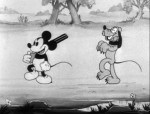
The Duck Hunt © Walt DisneyIn ‘The Duck Hunt’ Mickey and Pluto are hunting ducks.

Their attempts are quite circumstantial and fail due to the inferior quality of Mickey’s gun. When the ducks discover that the female duck is only Pluto in disguise, they take revenge by taking Pluto by the ears and drag him and Mickey, who has gripped Pluto’s tail, into the air.

‘The Duck Hunt’ is a gag cartoon similar to ‘The Moose Hunt‘. Unfortunately it isn’t very funny. A lot of screen time is devoted to Mickey and Pluto marching to civil war tunes, and Pluto’s and Mickey’s flight through the air fails to become the intended great finale, because of a lack of great gags, although I liked the gag of Pluto’s flees leaving his fall by parachuting from his behind.

‘The Duck Hunt’ shows that not every Disney cartoon was a winner, despite the studio’s obvious efforts.

Watch ‘The Duck Hunt’ yourself and tell me what you think:

This is Mickey Mouse cartoon No. 37
To the previous Mickey Mouse cartoon: Mickey’s Orphans
To the next Mickey Mouse cartoon: The Grocery Boy

‘Blue Rhythm’ is available on the DVD ‘Walt Disney Treasures: Mickey Mouse in black and white’

Enter your email address to follow this blog and receive notifications of new posts by email.

Join 918 other subscribers
Bookmark and Share

Categories