Director:Shinichiro Ushijima Release date: July 24, 2018 Rating: ★★★★ Review:
‘I Want to Eat You Pancreas’ is the first of only two animated feature films by the rather obscure Studio VOLN, which at least I had never heard of before. Studio VOLN isn’t even a big player in the television anime world, with only four series produced thus far. Strangely enough the studio made both its feature films in 2018.
The title of this film, which is a literal translation of the Japanese one, is a contender of the strangest film title of all time award, but what it means is revealed soon enough. The film is based on a novel, and as Japanese animation films often go, there’s nothing that implies the need for animation (except, maybe, for the long spiritual finale).
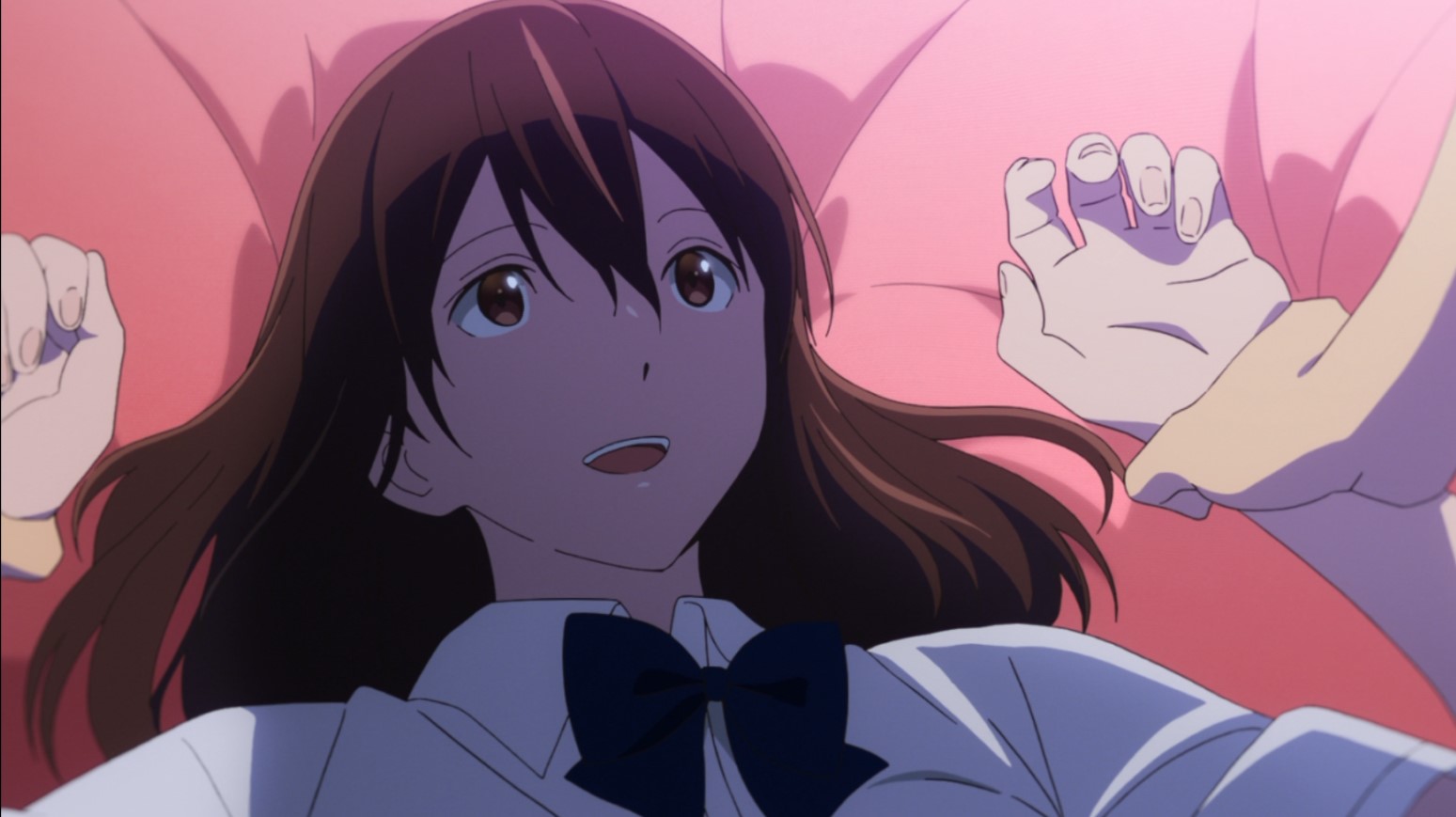
The film is told by a seventeen year old anonymous schoolboy (his name is only revealed in the very end). He tells about his surprising friendship with a fellow classmate, a girl called Sakura Yamauchi. Sakura is an apt name this character, as Sakura means ‘cherry blossom’, which is a symbol of impermanence in Japan, while the Sakura of the film is already dying from a pancreatic disease at her tender age of seventeen.
Sakura is a bit too much of a pixie girl, and although we also follow her own emotions and anxieties, it’s the story teller’s transformation through her influence that is the film’s focus. At the film’s start the unnamed narrator is a phlegmatic loner, always buried in a book, but indifferent to others and unwilling to commit himself to any relationship. Obviously, the extravert Sakura is going to change all that.
Highlight of this journey is a trip by the two to another town. Part of this trip is told in an original way by still images with dialogue on top, but even better are the scenes in the hotel, which are full of erotic tension. The film’s finale, on the other hand, with its overlong diary sequence is overblown and threatens to harm the complete film. Nevertheless, don’t forget to wait after the end titles!
Throughout, the background art and lighting are both of an extraordinary beauty, making the film a pleasant watch. The character designs, animation and soundtrack on the other hand are very generic and leave much to be desired. In fact, often the animation doesn’t transcend that of the average anime television series. There’s a little computer animation, but this is only used functionally on background art, traffic, fireworks, and such.
Even if the film is not the most interesting one in terms of animation, the film is (for most of the time) well-told, and its emotional tale does move. By all means the film shows that feature animation can be so much more than family entertainment, a message that is still lost on the American studio system.
Watch the trailer for ‘I Want to Eat You Pancreas’ yourself and tell me what you think:
‘I Want to Eat You Pancreas’ is available on Blu-Ray and DVD
Director:Kitaro Kosaka Release date: June 11, 2018 Rating: ★★½ Review:
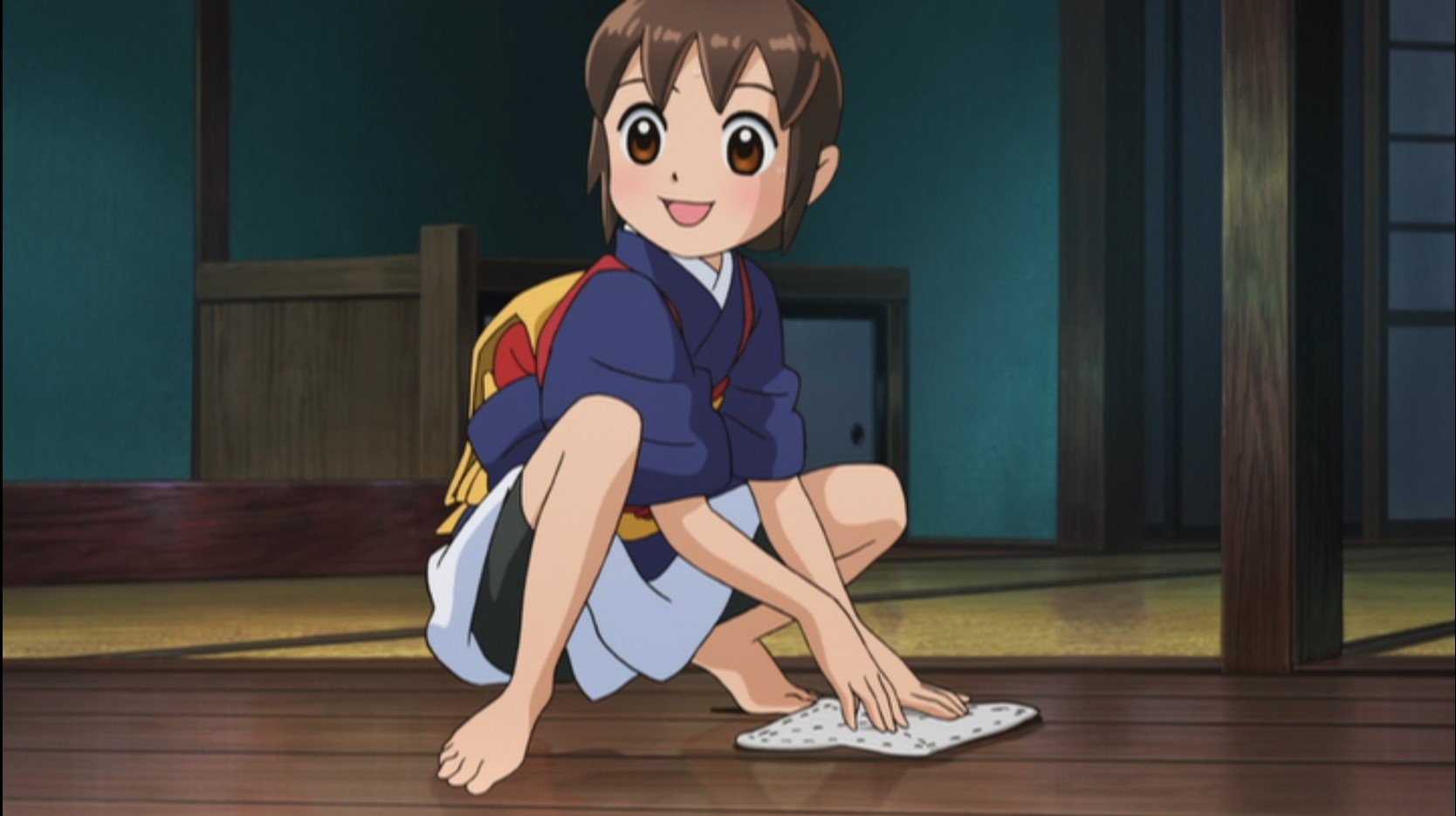
‘Okko’s Inn’ is an animated feature film by Madhouse based on a children’s novel series Hiroko Reijō. The film stars a little girl, who’s still at elementary school when she survives a terrible car accident in which her parents die. After this tragic incident she goes to live with her grandmother, who runs a ryokan, a traditional inn in a spa town near Mount Ikoma, East of Osaka, where she meets some ghost children and even a boyish demon.
Okko is supposed to help at the inn, and naturally we watch her grow into her new life and role, helped by the ghost children and little demon, whom we learn more about on the way, while Okko must deal with a girl whose family runs a larger rival inn.
The movie thus taps from familiar tropes in Japanese animation, like a girl losing her parents, and having to work, and the glories of traditional rural Japan as opposed to modern city life. The movie thus at times is reminiscent of such masterworks as ‘Spirited Away’ (2001) or ‘A Letter to Momo’ (2011). In content that is, for stylistically ‘Okko’s Inn’ is very poor. The designs are the most generic possible, with Okko herself being a particularly standard wide-eyed manga girl, and the animation is only fair. Moreover, the film lacks the subtleties of its peers. The film almost mechanically goes through the motions, as if ticking the necessary boxes, and the narrative lacks the surprising twists and turns of aforementioned examples.
It doesn’t help that the film’s message is partly told through guests of the inn, whose role seems almost to help Okko further in life. There’s a father with a son, whom Okko helps through their grief, and there’s an independent woman, a fortune teller, who befriends Okko and helps her getting more self-confident. And then there’s a third family staying, containing the biggest surprise of all.
The biggest flaw, however, is that we don’t see anything of Okko’s grief at all until the very end of the movie. Most of the time we don’t feel her trauma, we don’t feel her fear and we don’t feel any sense of readjustment. We see some of it, but we don’t feel it: in fact, Okko grows surprisingly easily into her new role. Nevertheless, there’s a scene in which Okko meets her anxieties, and this is by far the emotional highlight of the movie. Unfortunately, this powerful scene is followed by a mindless one on shopping.
‘Okko’s Inn’ is not a bad movie, but it’s not a stand-out either, and the film feels as a poor man’s version of ‘Spirited Away’. If anything, the feature shows that also the Japanese animation industry can pour out films that feel like run-of-the-mill products.
Watch the trailer for ‘Okko’s Inn’ yourself and tell me what you think:
Director:Nina Paley Release date: June 11, 2018 Rating: ★★★ Review:
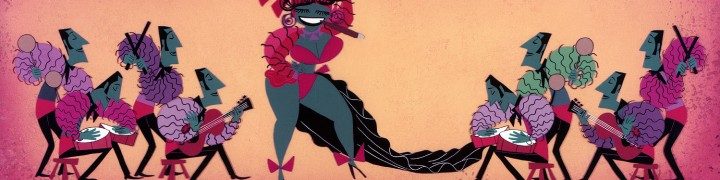
Seder-Masochism is the second feature animation film by independent animation artist Nina Paley (born 1968), who created quite a stir with the lovely ‘Sita Sings the Blues’ (2008) in which she blended events in her personal life with the story of the Ramayana, but from a woman’s view.
Apparently, Paley was criticized for using a myth from another culture for her feminist message, with attackers typically focusing on Paley’s supposed lack of understanding of Hindu religion, an irrelevant argument, as the misogyny that Paley attacked is plainly visible in the source text (especially in the last book). Moreover, the Ramayana is hardly unique in its treatment of women as second rate citizens, which can be found in practically all ancient texts.
To underline this message, for her second feature Paley dived into her own heretical religious culture, that of Jewism. The result is a more vicious and more pamphlet-like feature than ‘Sita Sings the Blues’, mostly because the personal note is hardly present, only in an interview of Paley with her father, recorded years prior, about his stance towards Judaism, and that of the Pesach (or Passover) in particular. In these scenes Paley is shown as a sacrificial goat and her father as God himself.
The Pesach, and the story from the book of Exodus behind it, forms the central element of ‘Seder-Masochism’. The ‘Seder’ in the title apparently is a ritual feast at the beginning of the Jewish Pesach celebration, and contains some questionable elements, like rejoicing over the Egyptian victims of the ten plagues and of the closing of the Red Sea.
Surprisingly, Paley juxtaposes the story of Exodus with the idea that initially human culture was matriarchal and devoted to mother goddesses, a theory popular with feminists, but unsupported by archeological evidence. Paley even goes so far as suggesting the golden calf from the Exodus story was a return to such a mother goddess, and thus to times of more equality between and women. Indeed, Paley seems to blame Moses, or monotheism in general for the misogynist patriarchy that dominates most of human culture in its historical existence. This is pure fantasy and can be easily debunked. But of course, ‘Seder-Masochism’ is no documentary, but Paley’s personal take on monotheism and its approach to women.
Yet, Paley’s clear atheist approach to the biblical story is more vicious than anything in ‘Sita Sings the Blues’, which makes the film less approachable and less a classic than Paley’s first movie. Especially when Paley turns to real life footage of religion-inspired violence the film becomes pure agit-prop. Nevertheless, the scene in which Moses returns from Mount Sinai, commanding a stop to the women’s temporal liberation and forcing them back into their niqab-like clothing remains a painful one, and rightfully evokes anger about religious societies who limit the freedom of women.
Even with its strong message, Paley’s way of storytelling remains highly attractive. Paley’s dry sense of humor permeates much of the film, and her visual style is charming throughout, her command of minimal, but effective animation one of the highest degrees. I especially like the poetic intro in which a female goddess flows through space, and sprouts plants, animals, and eventually men on a soundtrack of the most beautiful Bulgarian female chant. Paley’s dance animation of ancient female statues is also a masterstroke, and an attraction in its own right (Paley offers them as singular GIFs).
Moreover, Paley very skillfully mixes the interview excerpts, an enormous variety of existing music and even a 1950s record in which a man tells about the Seder celebration. In contrast with ‘Sita Sings the Blues’, in which only records by 1920s singer Annette Hanshaw were used, ‘Seder-Masochism’ plunders the Western pop music tradition, often to a very striking effect. Notice, for example the single sample of ‘Helter Skelter’ from The Beatles during the sixth plague, and the earlier mentioned scene in which Moses returns uses Led Zeppelin’s ‘Your Time Is Gonna Come’ to a painful effect. But the film’s highlight in this respect must be the use of 10cc’s ‘The Things We Do for Love’ which accompanies images of Jews gleefully chopping off foreskins, beheading little goats and killing men and women.
The bitter irony of this sequence is topped by the ‘This Land Is Mine’ sequence, which Paley finished first, and which can be watched as a separate video clip. In this utterly bleak section, we watch several nations fight over the land of Israel, killing one another in greater and greater numbers, with Death itself ultimately being triumphant. With Israel raging the war in Gaza today, with its tens of thousands of innocent Palestine victims, this bleak sequence remains as topical as ever.
The ‘This Land Is Mine’ sequence was also one of the last pieces of animation Paley did in Macromedia Flash, before moving over to Moho. But the most surprising piece of animation in the film is not done on either platform but done with embroidery, in a process Paley calls ‘embroidermation’. This is a lovely piece of stop-motion that Paley rightfully saves for the end, just before the ‘This Land Is Mine’ finale.
In all, ‘Seder-Masochism’ is a beautiful, if rather angry film with a strong feminist message. It cannot stand the comparison with ‘Sita Sings the Blues’, which remains the more balanced work, but as author feature films like this remain utterly rare in the animation field, I strongly recommend watching this feature nonetheless. At least it will make you think about the position of women in society. Paley offers her film for free online, and the movie can be downloaded from her site.
Watch the trailer for ‘Seder-Masochism’ yourself and tell me what you think:
Director:Eiichi Yamamoto Release date: September 15, 1970 Rating: ★★½ Review:
The most important development in animation of the late 1960s and 1970s was the coming of animated feature films aimed at adults, instead of children/families. Heralding the new era was George Dunning’s 1968 film ‘Yellow Submarine’, but the two most important film makers pioneering in this new field were Ralph Bakshi in America (with e.g., ‘Fritz the Cat’ from 1972 and ‘Heavy Traffic’ from 1973) and Osamu Tezuka in Japan.
The three adult oriented anime films Tezuka made at his own Mushi Productions studio are called the Animerama trilogy and consist of ‘A Thousand and One Nights’ (1969), ‘Cleopatra’ (1970) and ‘Belladonna of Sadness’ (1973). The three show that Tezuka, like Bakshi, confuses adult oriented with a rather juvenile focus on sex and violence, making the films adult in content indeed, but otherwise rather immature and even exploitative products.
More than its adult orientation, ‘Cleopatra’ stands out for its highly eclectic style. The film tackles a variety of designs and animation styles, none weirder than the opening sequence, which takes place in the future year of 2001, and which starts live action actors with animated faces, an experiment luckily not repeated, for the results are pretty ridiculous, especially because there’s absolutely no lip synchronization, at all.
The film’s plot revolves around an alien planet called Pasatorine, which has a secret plan to wipe out mankind called ‘Cleopatra’. In order to find out the plans a trio of humans, naturally, goes back into time by “psycho-teleportation”, taking the souls of ancient characters in Cleopatra’s time.
Thus, the three main protagonists change identity: Jirov becomes Ionius, a powerful slave, Maria becomes Libya, an Egyptian city girl, and Hal turns into Lupa, a close companion of Cleopatra, who turns out to be a leopard, much to Hal’s chagrin. His character is the most annoying of the film, for the leopard is sex crazed and tries to get laid all the time, despite its animal features.
After ten minutes we’re in Egypt where Tezaku depicts the Roman conquest of the ancient kingdom in a very silly style, accompanied by some attractive space funk music. When we first see Libya, the adult orientation immediately becomes clear, for she’s bare breasted the whole time. The Egyptian plot is bizarre, too, with an ugly freckled girl changing into the sex goddess of Cleopatra with the sole reason to seduce Caesar and to kill him. Adding to the weirdness is the coloring, for Libya is rendered bright red, while Caesar is depicted as a green man.
Stylistically, the film is all over the place, anyhow, altering tiresome silliness and cheap rotoscoping with quite some beautiful graphic imagery, like the stylized fighting of the Romans and the Egyptian conspirators. The animation, too, is a mixed bag, from non-animation and cheating jump takes from pose to pose, without any animation in between, to far more interesting animation done in watercolors. The animation of the horse ride, and the struggle between Ionius and an Egyptian warrior are actually quite good, and even the first two sex scenes are interesting in their semi-abstract and even poetical stylization, while the third is depicted as a broken-down film. At one point the imagery reminds one of UPA or the Zagreb school, and at another point there’s even a cut-out sequence featuring variations on classic paintings.
What the film completely lacks, is character animation. Emotions are just indicated, not felt, and there’s only broad caricature, not character development. The potentially dramatic story is further hampered by random gags, often strange and out of place. Likewise, the story is sloppy and meandering, with the film makers having difficulty on whom to focus. For great chunks of screen time, the three protagonists from the opening sequence aren’t anywhere to be seen, and after the events in ancient Egypt have ended tragically (in that respect the film does follow Cleopatra’s real life), the film ends abruptly, leaving the viewer wondering why the whole ‘psycho-teleportic’ excursion, and thus most of the movie, was needed in the first place.
It must be said: ‘Cleopatra’ is not a good movie. It is more of an experiment than a success, more of a product of its time than a timeless movie, and rather a curio than an essential watch. It is a product of a more experimental era, but after watching the film, one can hardly wonder why this short age of adult oriented experimentalism stopped.
Watch the trailer for ‘Cleopatra’ yourself and tell me what you think:
Directors:William Hanna & Joseph Barbera Airing date: September 28, 1962 Stars: The Flintstones Rating: ★★ Review:
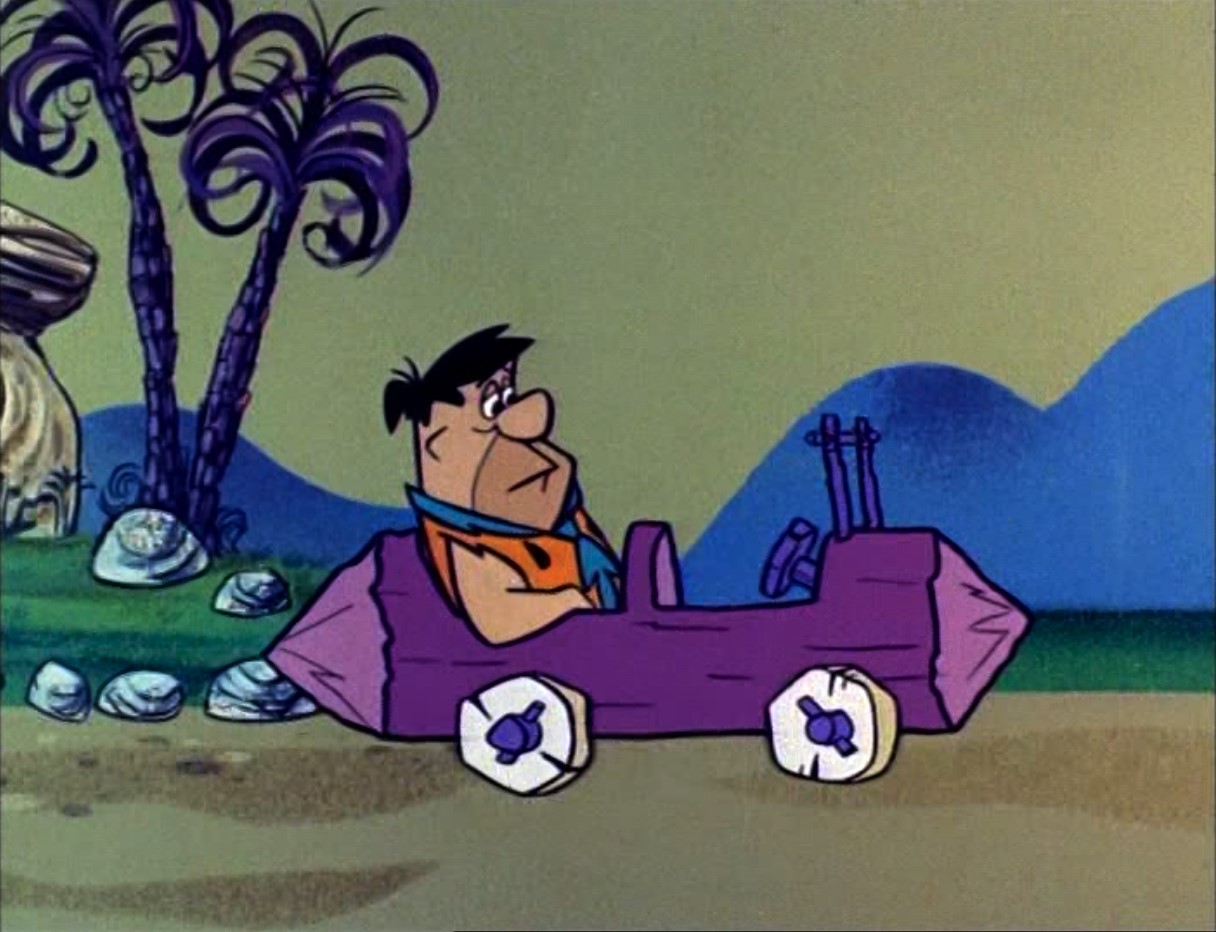
This Flintstones episode starts with Barney having the hiccups, while Fred Flintstone is trying to invent a new soda drink in his garage. When Barney drops by, Fred tries to cure Barney’s hiccups with his potion no. 412, which does the trick and renders Barney invisible.
The rest of the episode fails to cash in on this premise, with all invisibility routines being rather lazy and uninspired. Fred even wins a bowling contest using Barney’s invisibility, without any repercussions.
There are a few prehistoric gear gags, like a mammoth and a seal acting like a washing machine, and birds functioning as clothes pins, but for the most part this is a lackluster affair.
‘Barney the Invisible’ is noteworthy, however, for being the first episode starting and ending with the new title song ‘meet the Flintstones’, which is a great improvement on the earlier intro. The accompanying images, too, are much more fun, luckily dumping the rather questionable images of Fred eating dinner for the television without Wilma, which accompanied the original intro.
Watch ‘Barney the Invisible’ yourself and tell me what you think:
This is The Flintstones Season Three episode 3 To the previous The Flintstones episode: Fred’s New Boss To the next Flintstones episode: Bowling Ballet
‘Barney the Invisible’ is available on the Blu-Ray ‘The Flintstones – The Complete Series’ and the DVD-box ‘The Flintstones Season 3’
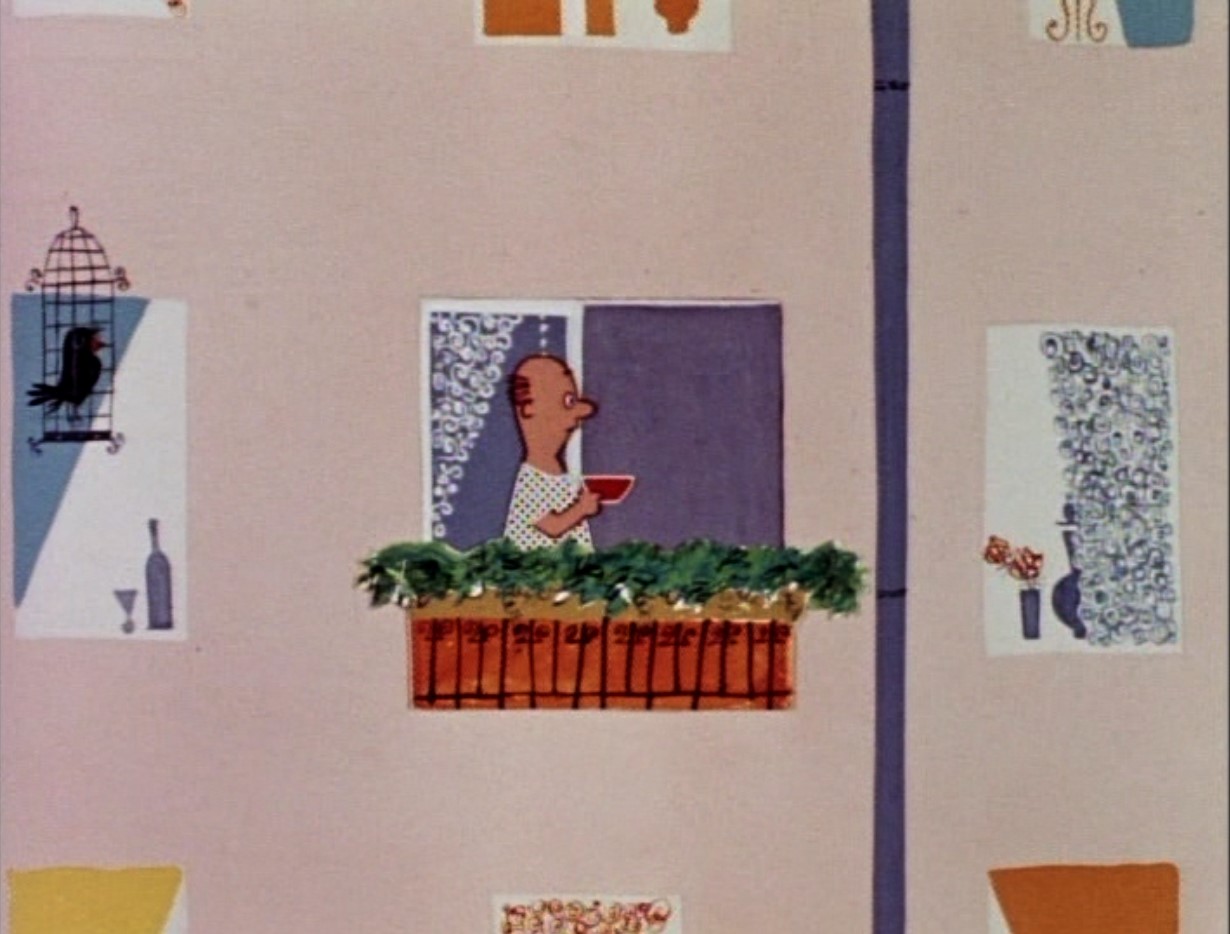
‘Story of One Crime’ was the first film directed by acclaimed film maker Fyodor Khitruk (1917-2012). Khitruk was one of the best comic talents in the Soviet era, as is already visible in this delightful early film.
The short starts with a man sneaking upon two talking ladies and hitting them with a large pan. At that point the narrator interrupts and takes us viewers 24 hours back. The rest of the film is told wordlessly, and shows the criminal, comrade Manin, to be a nice, gentle and hard working man. We watch him going to work, and working at the office.
All seems well, but as soon as he returns to his home, in an apartment block, the problems start. When he wants to rest on his balcony, he’s disturbed by ridiculously loud domino players playing in the courtyard. When he returns inside to watch some television, a neighbor turns on some loud jazz music, and later, when he tries to sleep, more neighbors deprive him of a good night’s rest in various ways. The film ends with a message to the viewers themselves, no doubt, more often than not living in such noisy apartments themselves.
Khitruk tells his tale with an understated sense of humor, and a relaxed, but effective sense of timing. The animation is limited, and far from fluent, but as Khitruk knows how to pose, very effective. The designs by Sergei A. Alimov, too, are a delight: the film is a rare example of Soviet cartoon modern design, and both characters and backgrounds are gorgeous throughout the film. They are partly made by snippets from magazines, and especially the neighbor’s gargantuan stereo installation is a great example of good cut and paste work.
With ‘Story of One Crime’ Khitruk took Soviet animation away from the classic fairy tale worlds of the 1950s into the modern age. The film contains some criticism on Soviet society, which is depicted as less than ideal, but the film was an enormous success, nonetheless.
With this short Khitruk immediately became one of the Soviet Union’s most important animation film makers, as he would prove, e.g. by delivering the world his delightful ‘Vinnie Puch’ (Winnie the Pooh) films of 1969-1972.
Watch ‘Story of One Crime” yourself and tell me what you think:
‘Story of one Crime’ is available on the DVD ‘Masters of Russian Animation Volume 1’
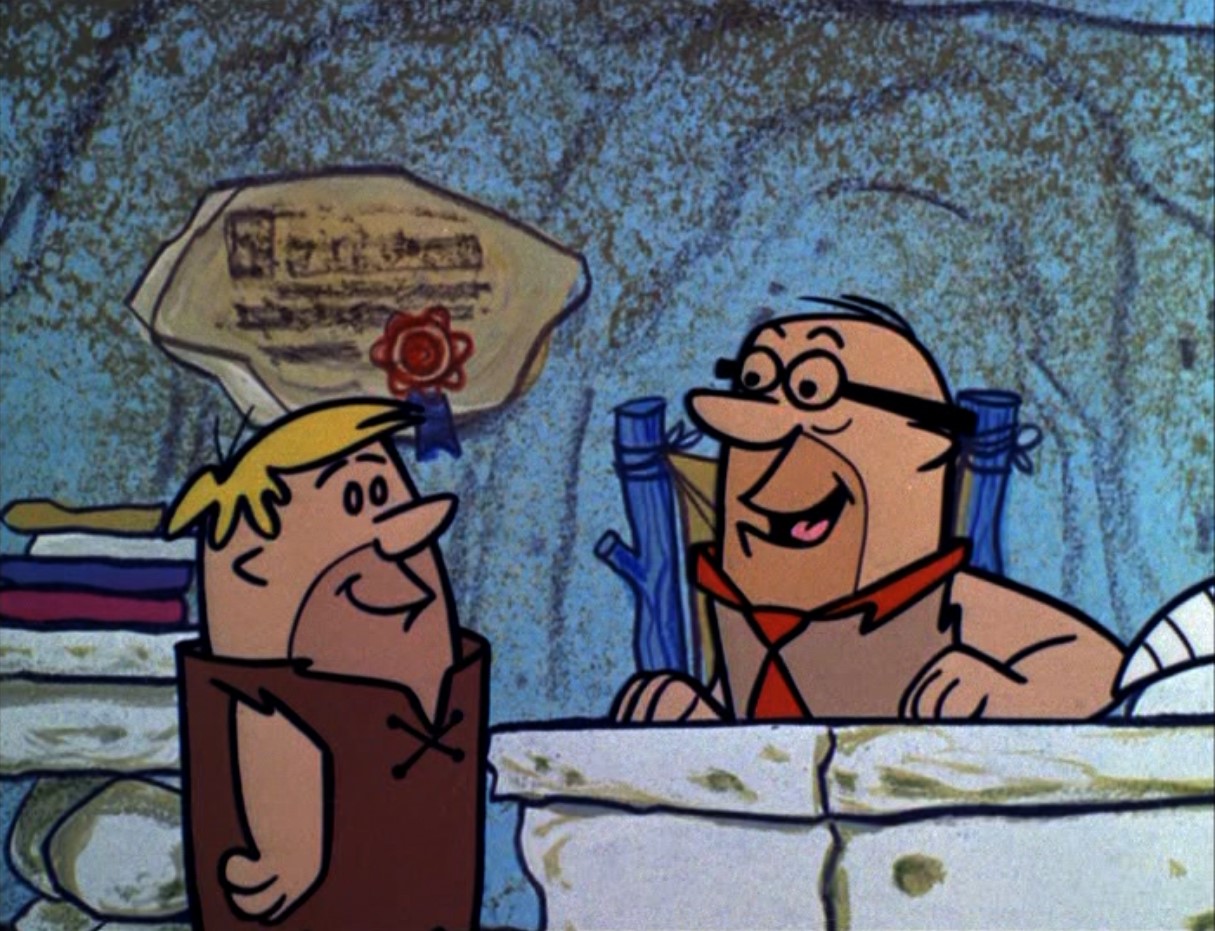
Directors:William Hanna & Joseph Barbera Airing date: September 21, 1962 Stars: The Flintstones Rating: ★★★ Review:
Although this episode starts with Wilma and Betty watching an add on television and going to the barbers to get a new haircut, it is really centered on the friendship of Barney and Fred.
When Barney is laid off, Wilma forces Fred to ask his boss to get his friend a job. Fred fails, but does not to dare tell Barney. But when Barney reports himself at Fred’s Boss, Mr. Slate, he turns out to be the director’s nephew, and is promptly promoted to executive vice president. Unfortunately, this means he has become Fred’s boss, and this puts a strain on their relationship.
The best scene may be Wilma joining Fred in bowling to make up for Barney’s absence, even though this feels like a missed opportunity for more gags. Meanwhile Barney tries to blend in with other executives, in an all too short scene, which also fails to deliver on its potential.
In fact, the whole episode is low on gags, and the few prehistoric creatures that act as garbage bins and parking meters get some really lame lines. The animation, too, is sometime ridiculously poor. Watch for example the reaction of Barney, Betty and Wilma when Fred returns from his boss’s house. The trio looks more like a mechanical device than as human beings.
This is The Flintstones Season Three episode 2 To the previous The Flintstones episode: Dino Goes Hollyrock To the next Flintstones episode: Barney the Invisible
‘Fred’s New Boss’ is available on the Blu-Ray ‘The Flintstones – The Complete Series’ and the DVD-box ‘The Flintstones Season 3’
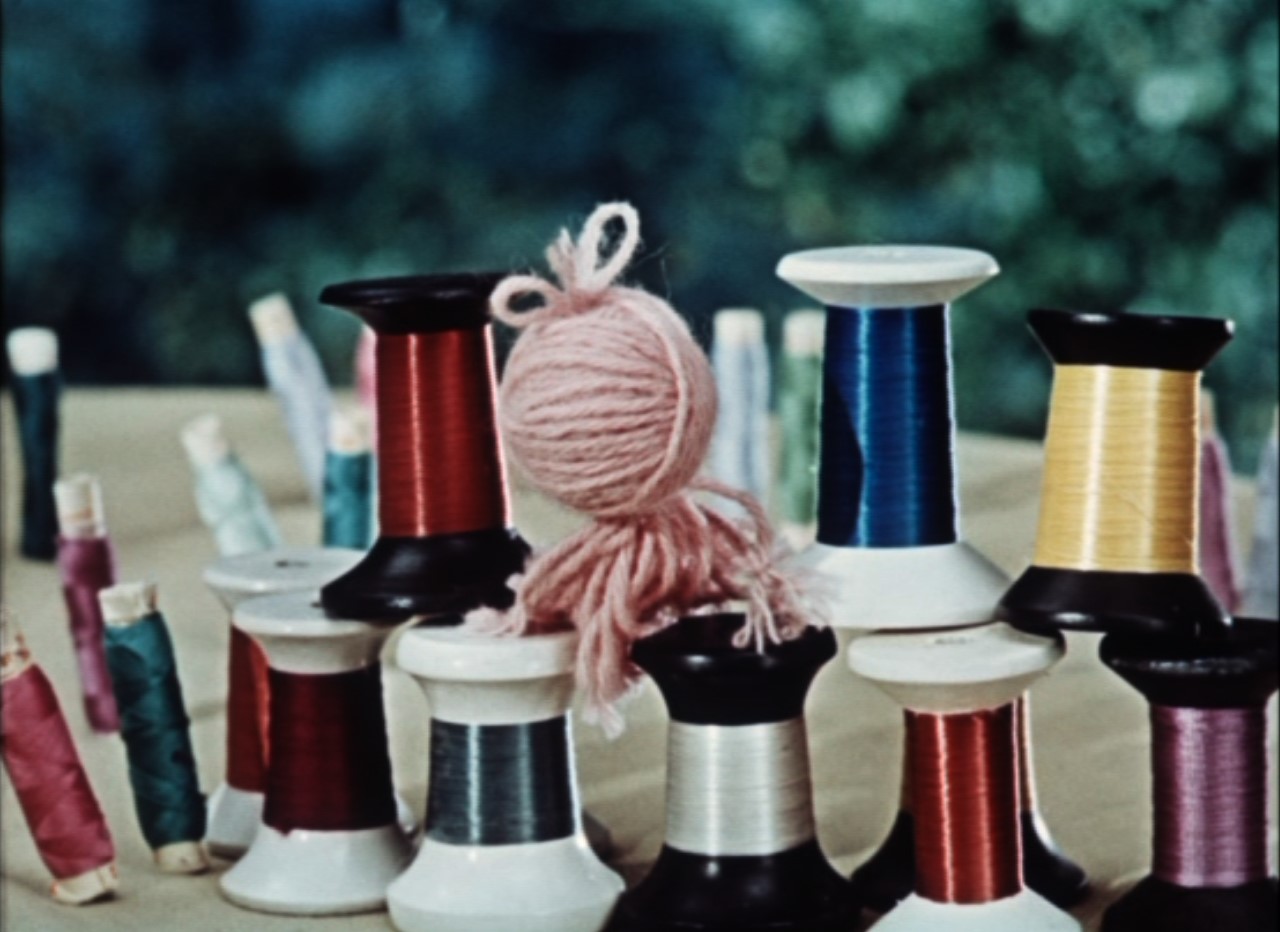
In ‘Two Balls of Wool’ the insides of a sewing box come to life, including a scissors, a measuring tape, thread spools, a horse-like pincushion, and, most importantly, two balls of wool.
The pink ball of wool turns into a girl, while the blue one turns into a boy. The boy plays the flute on a needle, charming the measuring tape, who acts like a snake. When the snake captures the girl, the boy comes to the rescue, riding the pincushion horse. The two also perform some acrobatic tricks, and accidentally unwind a knitted piece, until the scissors forces them to knit the piece back again
The film has a rather weak story, but it’s a marvel how Týrlová spins a film out of such ordinary material, making use of the properties of these objects. The animation is top notch. For example, note how Týrlová manages to turn the scissors (which can’t do anymore than the scissors in your drawer) into an authority figure, imposing on the other objects. ‘Two Balls of Wool’ thus is a charming little short, showing Týrlová’s great talent as an animator.
Watch ‘Two Balls of Wool’ yourself and tell me what you think:
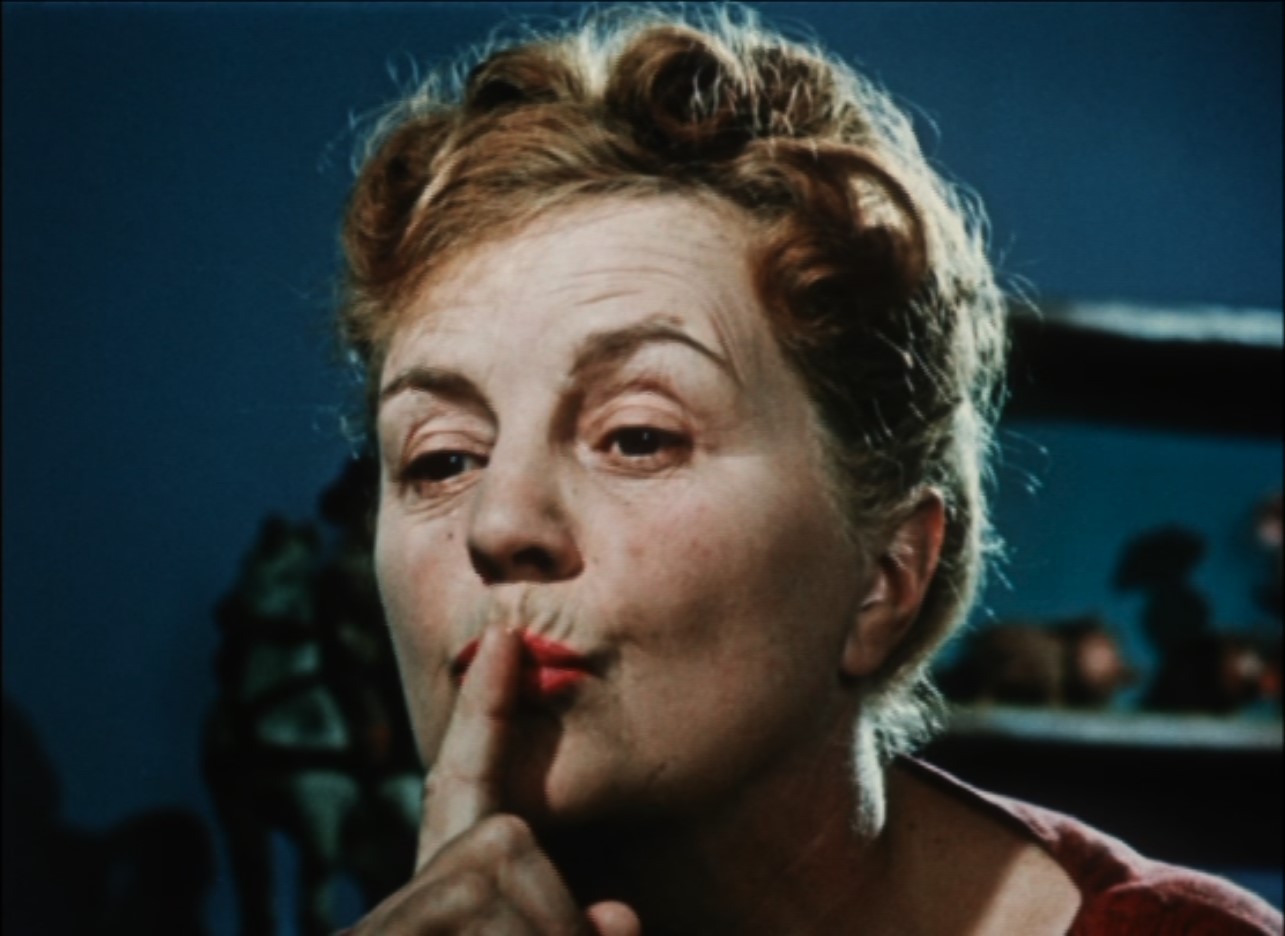
This a gentle documentary film made in honour of the Czech animation pioneer’s sixtieth birthday.
The film showcases excerpts from quite a few of Hermína Týrlová’s films, including her first, ‘Ferda the Ant’ (1944), Czechoslowakia’s first stop motion film anyhow. Other excerpts are from ‘Revolt of the Toys’ (1945), apparently an anti-fascist film, ‘The Knot in the Handkerchief’ (1958) and ‘Badly Made Toy-Man’ (1951), which is revealed as Týrlová’s favorite character.
Indeed, it’s the Badly Made Toy-Man who stars the bridging stop-motion sequences, for this documentary features quite some original animated material, made by Týrlová especially for this film. Especially, the short sequence starring the two balls of whool-characters for her upcoming ‘Two Balls of Wool’ (1962) are a delight, for this cannot be found in the final film, and is presented as a depiction of Týrlová’s imagination.
The film is narrated, and although we watch Týrlová acting out herself, e.g. recreating the painstaking ways with which she made ‘Ferda the Ant’ and interacting with children, her main audience, we do not hear her, and there are no interviews, only images. Nevertheless, the documentary succeeds in showing where Týrlová’s greatest talent lies: in creating charming animation films for children in which ordinary toys and objects come to life.
‘Hermína Týrlová’ is available on the DVD box ‘Hermína Týrlová Výběr z tvorby/Selected Works’
Directors:William Hanna & Joseph Barbera Airing date: September 14, 1962 Stars: The Flintstones Rating: ★★★ Review:
The third season of The Flintstones kicks off with an episode devoted to Dino, Fred and Wilma’s purple pet dinosaur. The dog-like dinosaur appears to have a favorite television program called Sassie, starring a female dinosaur with a wig.
When Fred discovers that the show looks for a new star, he goes on an audition with Dino. Dino, however, only shows to be a great performer after discovering he will be in a love scene with Sassie. After one scene, Dino is hired, and Fred paid off and sent home, much to his own regret, but then Dino discovers something…
This episode has a rather slow start and is surprisingly low on gags, but its finale has a nice emotional touch. The cheap and old-fashioned melodrama of the tv show is fun, but the highlight of the episode is Dino’s reaction to his manager’s and director’s plans with him.
Watch an excerpt from ‘Dino Goes Hollyrock’ yourself and tell me what you think:
This is The Flintstones Season Three episode 1 To the previous The Flintstones episode: Take Me Out to the Ball Game To the next Flintstones episode: Fred’s New Boss
‘Dino Goes Hollyrock’ is available on the Blu-Ray ‘The Flintstones – The Complete Series’ and the DVD-box ‘The Flintstones Season 3’
Director:Friz Freleng Release date: September 1, 1962 Stars: Yosemite Sam Rating: ★★ Review:
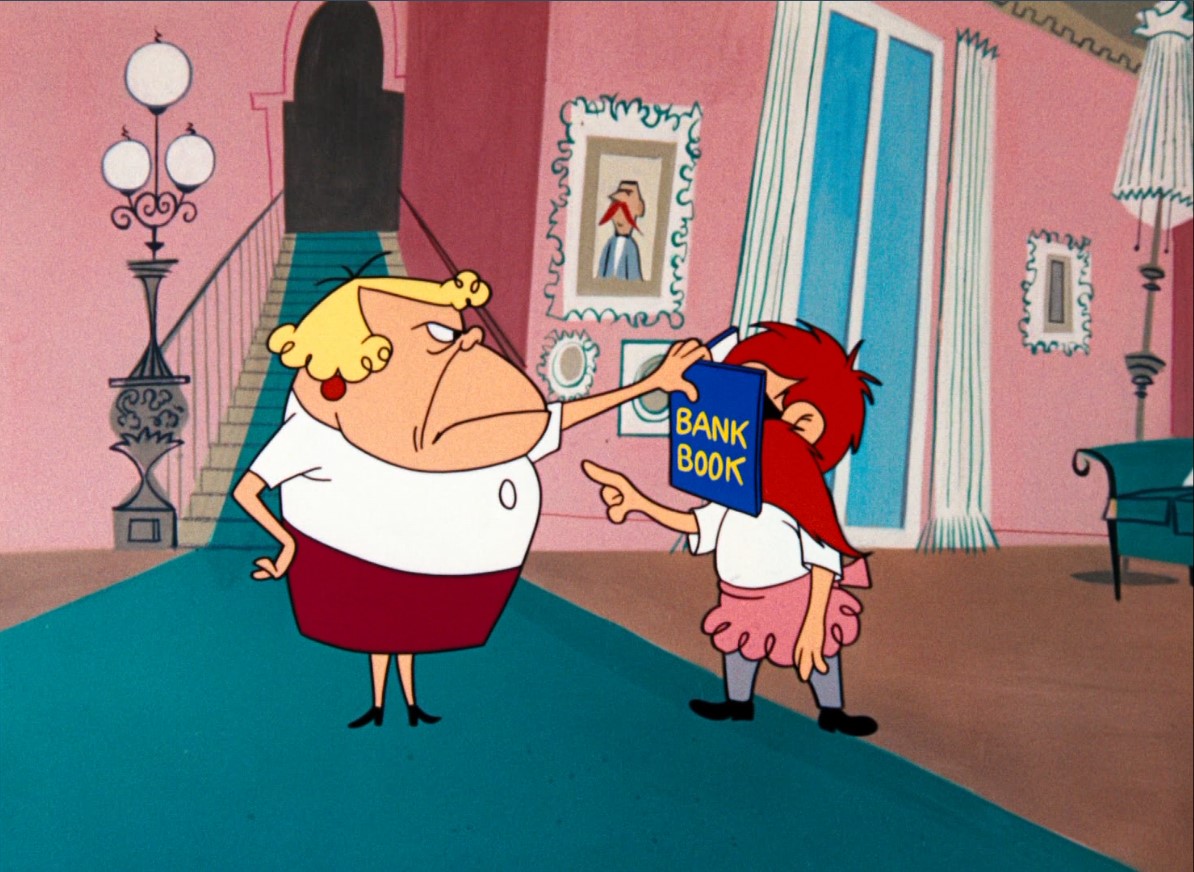
‘Honey’s Money’ opens with Yosemite Sam reading about a local widow inheriting five million dollars. He sets out to court the lady immediately, and marries her too, despite the fact that she is ugly. But married life isn’t what Sam had expected, and then he has to meet his oversized baby son Wentworth…
‘Honey’s Money’ is a remake of the earlier Friz Freleng cartoons ‘His Bitter Half’ (1950) and ‘Hare Trimmed’ (1953). The short is noteworthy for being Yosemite Sam’s only solo cartoon, and only one of two not co-starring Bugs Bunny, the other one being ‘Along Came Daffy’ from 1947.
Unfortunately, the short can hardly be called a classic within the Looney Tunes canon: Yosemite Sam is particularly unpleasant in this short, his sole motive being greed. And as he apparently can’t even spend the money, this motive becomes a muddled one. Moreover, the character designs and animation are only fair, and the gags mediocre.
One thus has ample time to admire Hawley Pratt’s layouts and Tom O’Loughlin’s background art, which form the highlight of an otherwise run-of-the-mill cartoon. Another highlight is the card crediting Friz Freleng, which features a caricature of the director on a dollar bill.
Watch ‘Honey’s Money’ yourself and tell me what you think:
‘Honey’s Money’ is available on the Blu-Ray and DVD ‘Looney Tunes Platinum Collection Volume Three’
‘The Chair’ is another film subtly criticizing communist society as it was imposed on Poland at the time. Apart from the intro, the film is completely filmed from above, and features a conference.
At one point one of the conference leader’s chairs remains unoccupied, and members from the audience are invited to fill the spot. But the other audience members don’t allow each other to get to the stage, and the volunteers are hindered and blocked everywhere. Yet, one does make it, and is accepted due to his clever entrance.
The idea of ‘The Chair’ is as simple as it is well executed. Again, I am surprised the film got past the censors, as it clearly criticizes the oppressive system.
Watch ‘The Chair’ yourself and tell me what you think:
‘The Chair’ is available on the DVD-set ‘Anthology of Polish Animated Film’
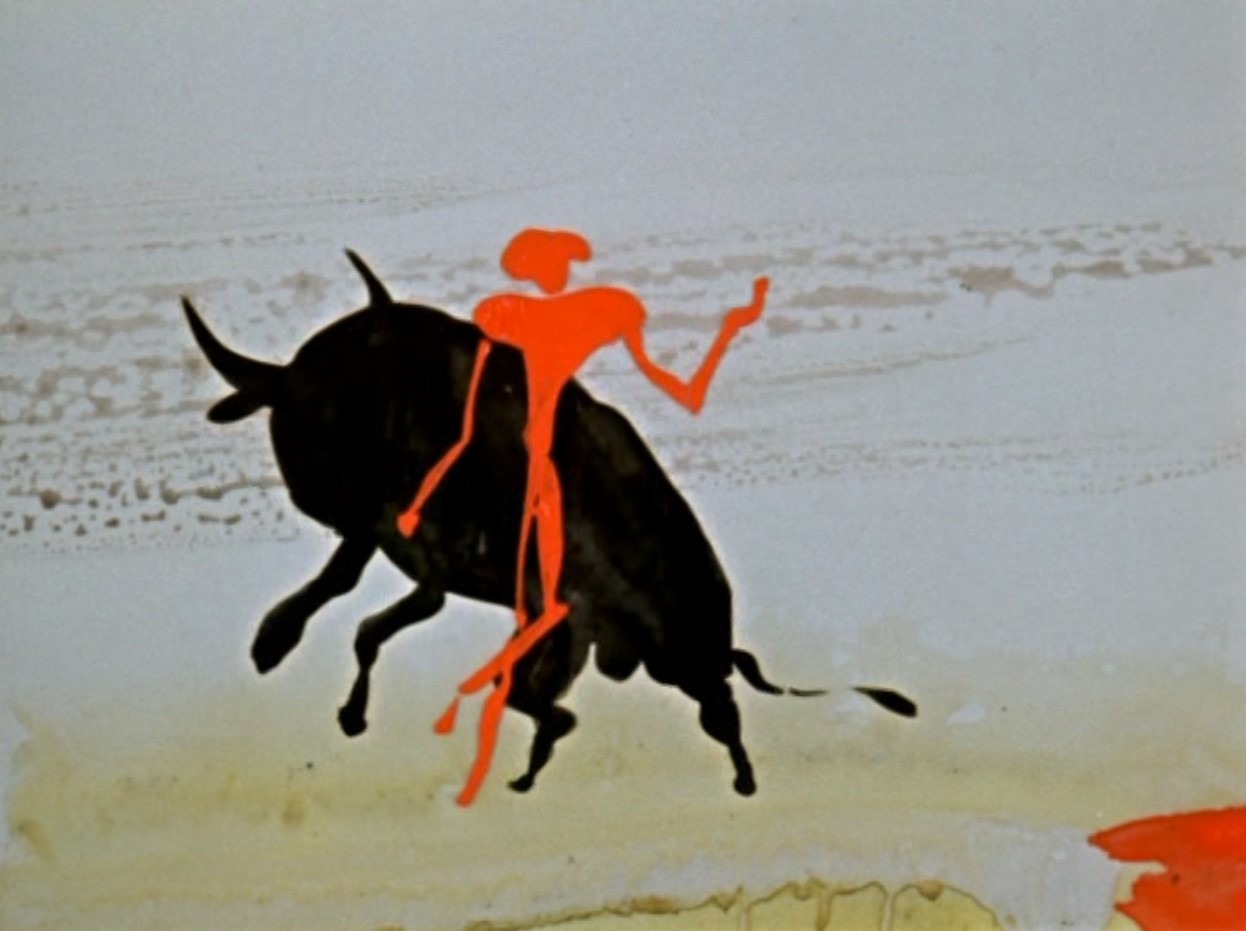
‘The Red and the Black’ is a rare attempt at a gag cartoon in a Polish studio. True, the film’s designs are no less avant-garde as that of other contemporary films from the era, this time featuring highly abstracted painted characters, but unlike his countrymen, Witold Giersz aims at laughs.
The film is an addition to a long canon of bullfighting cartoons, with the Red being the bullfighter, and the black being the bull. There are some fine gags, like the two drinking beer together, or the bull suddenly revealing the film makers, but the characters and the action remain emblematic, and Giersz has no sense of timing, so the gags all fall flat. Thus, despite some clever ideas, ‘The Red and the Black’ is a rather tiresome watch, and the film well overstays its welcome.
Watch ‘The Red and the Black’ yourself and tell me what you think:
‘The Red and the Black’ is available on the DVD-set ‘Anthology of Polish Animated Film’
‘Playthings’ is a film on fighting. The film knows only monochrome yellow and red backgrounds and silhouetted, abstracted human figures and weapons.
The film starts with some designs based on ancient cave paintings. We watch a group of human figures hunt a deer. When one is killed, another group of more tangram-like humans, arrives, and the fighting starts, with more and more advanced weaponry, like cannons, machine guns, tanks, bomber planes. As can be expected, in the end everybody is killed by a giant, probably nuclear explosion. The message of ‘Playthings’ is crystal clear, but the short is too one-dimensional to make a lasting impression.
Watch ‘Playthings’ yourself and tell me what you think:
‘Playthings’ is available on the DVD-set ‘Anthology of Polish Animated Film’
In ‘Labirynt’ a man flies into a seemingly abandoned city, only to find it to be a dangerous place, terrorized by strange creatures and machines, alike.
This is one of those rare animation films from Eastern Europe depicting what it’s like to live in an oppressive communist state. The film is highly surreal, featuring strange creatures, often mixes of animal and human parts, but I am still surprised the film got past the censors. For example, at one moment the man is captured by a bearded machine-man and thoroughly examined. At one key scene we watch is thoughts roaming freely inside his head, only to get barred by a strange contraption. The end, too, in which the man tries to escape the paranoid city is telling enough.
Jan Lenica’s world is based on partly colored old photographs and engravings. His animation is emblematic, but at one point we surely feel the man’s fear, as he tries to flee from his oppressors. The surrealist atmosphere is enhanced by Jan Radlicz’s sound design and by Włodzimierz Kotoński’s score.
Watch ‘Labirynt’ yourself and tell me what you think:
‘Labirynt’ is available on the DVD-set ‘Anthology of Polish Animated Film’
Director:Chuck Jones Release date: November 30, 1963 Stars: Bugs Bunny Rating: ★ Review:
‘Transylvania 6-5000’ is one of those late Warner Bros. Cartoons, which are equally beautiful to look at as they are boring to watch.
In this short Bugs Bunny wanted to travel to Pittsburgh, Pennsylvania, only to end up in Transylvania, where he encounters a vampire with the name Count Bloodcount.
The cartoon is very talkative, and features an annoying female two-headed bird. Worse are the central gags, which are all constructed around the words Abacadabra, which turn the count into a vampire, and ‘hocus pocus’, which turn him back to a human form, again. These sequences suffer from a lack of inner logic and sloppy timing, and are hardly as funny as intended. Bill Lava’s canned music doesn’t help, either.
Despite its gorgeous settings, one cannot conclude but that the Warner Bros. studio ran out of inspiration and of ideas quickly in the early 1960s, contributing to its own shutdown after only one other cartoon, ‘Señorella and the Glass Huarache‘ (which, incidentally, is more fun than this jaded Bugs Bunny cartoon). And yet, already in 1964 Warner Bros. cartoons appeared again, now produced by the DePatie-Freleng cartoon studio of Pink Panther fame. And thus four more Bugs Bunny cartoon were released in 1964, before the character was retired.
Watch ‘Transylvania 6-5000’ yourself and tell me what you think:
This is Bugs Bunny cartoon No. 164 To the previous Bugs Bunny cartoon: Mad as a Mars Hare To the next Bugs Bunny cartoon: Dumb Patrol
‘Transylvania 6-5000’ is available on the DVD-box ‘Looney Tunes Golden Collection Volume Five’
Director:Chuck Jones Release date: May 20, 1961 Stars: Bugs Bunny, Daffy Duck Rating: ★★ Review:
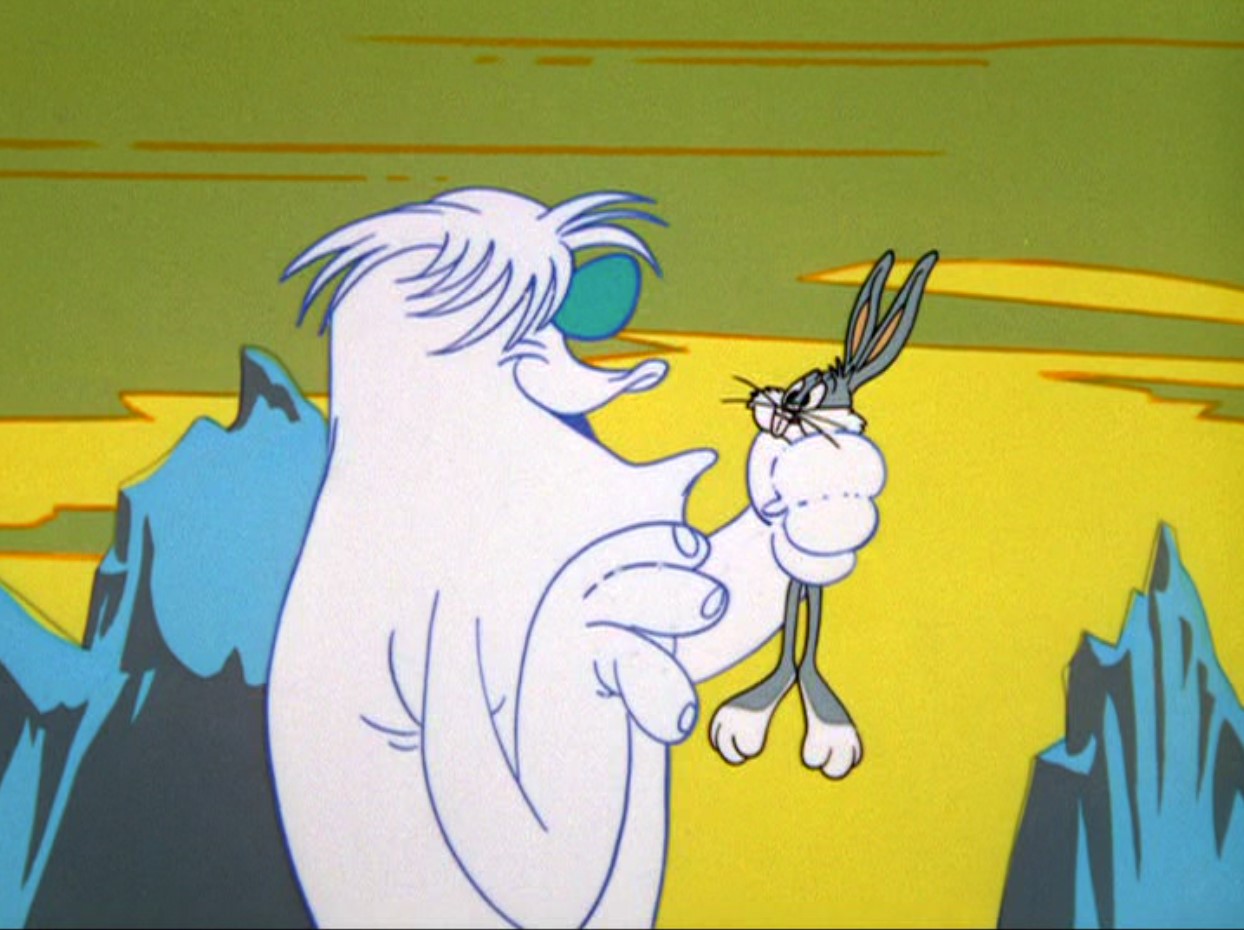
By the early 1960s the classic age of animated cartoons was clearly over. ‘The Abominable Snow Rabbit’ clearly shows the insipid state of affairs. Although both animation and background art are still top notch, and a delight to watch, the gags are uninspired and stale, and never reach the heights from similar films of the early 1950s.
In this cartoon Bugs and Daffy both travel underground, apparently on their way to Palm Springs, only to end up in the Himalayas, where they encounter a very cartoony and blue-nosed abominable Snowman. The Snowman is a late addition to a plethora of characters based on Lon Cheney’s depiction of Lenny in ‘Of Mice and Men’ from 1939, without adding anything. Apart from the jaded gags, the cartoon suffers from a large amount of dialogue, rendering the cartoon almost like the “illustrated radio” Chuck Jones detested in contemporary television animation.
Watch ‘The Abominable Snow Rabbit’ yourself and tell me what you think:
Director:Denis Do Release date: June 11, 2018 Rating: ★★★½ Review:
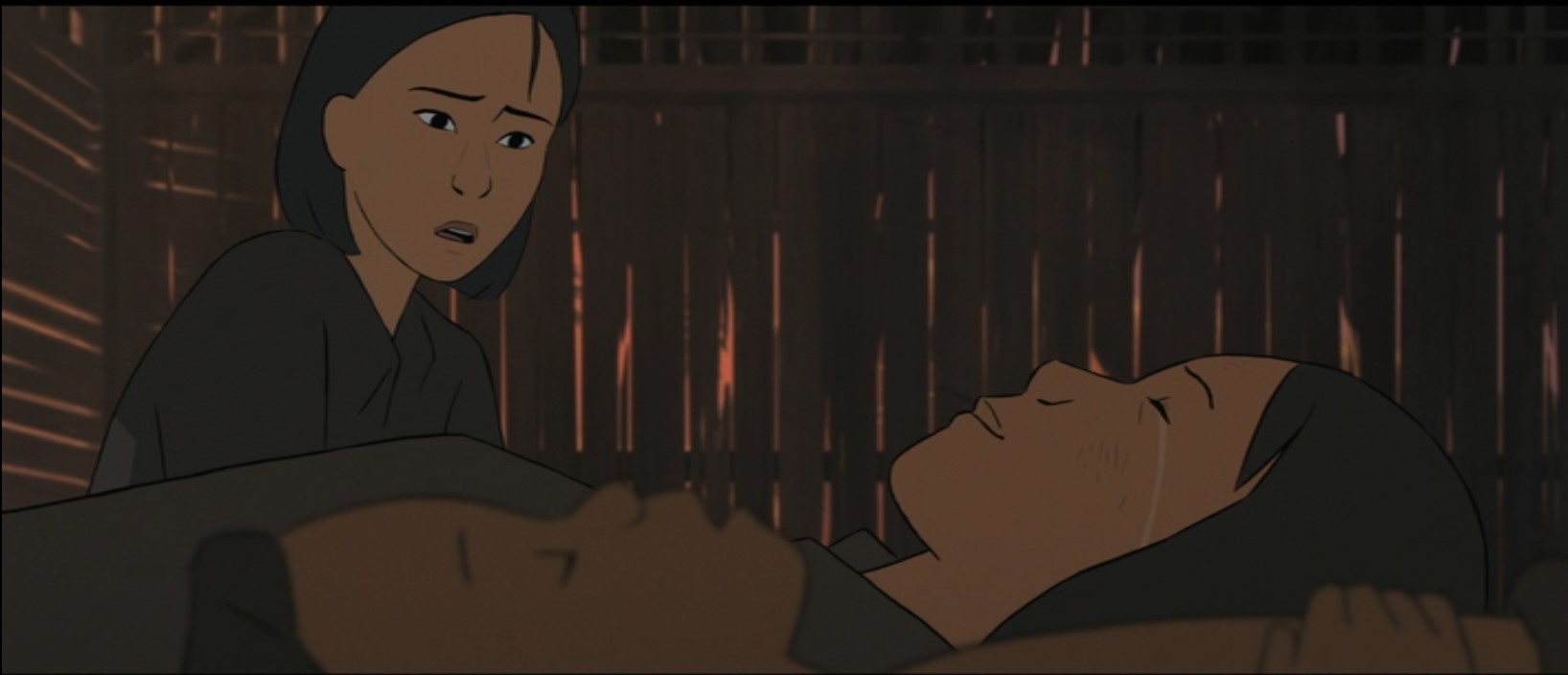
‘Funan’ is a film by Denis Do, a French film maker of Cambodian descent, and the film is partly based on the memories of his own mother.
‘Funan’ means ‘the new people’ in the Khmer language, and this is an apt description of the radical ideology of the Khmer Rouge, an extreme communist movement that took power in Cambodia from 1975 to 1979, only to plunge the nation in one of the severest mass killings in human history, with the ultimate goal to rise as a ‘new nation’ of autarkic, non-intellectual people.
‘Funan’ thus tells about Cambodia’s darkest years, and does so by following one family from Phnom Penh, which almost immediately falls apart, and which succumbs one by one to various aspects of the terror, be it brutal murder, forced labor, famine or rape. We especially follow a couple, Chou and Khuon, and their son Sovanh, who gets separated from his parents near the start of the film.
Luckily, the film eschews gross images, keeping the watch tolerable, but strangely enough, this also means one feels the hardship and sorrow less than one should. The film’s rather episodic nature certainly doesn’t help, and one has a little trouble relating to these people, perhaps because they aren’t introduced very well (the happy bliss of pre-Khmer rouge existence is shown all too shortly), and because the film is told in a plethora of very short scenes, instead of a few well-chosen longer ones. Especially Sovanh’s story is too fragmentary to follow, and his experiences are only hinted at, although it’s clear that the young boy sees a lot of cruelty and death.
The 2D animation is fair, with the human character designs rooted in the French ligne claire tradition, while the background is painted and lineless. Both coloring and lighting are clearly digitally done, and to be frank, rather uninteresting.
I suspect the film could be more daring and more idiosyncratic in its designs and storytelling, especially when compared to Elsa Duhamel’s similar, but far more interesting short ‘Bach-Hong’, which tells of the coming of the communists to Saigon, Vietnam. Duhamel cleverly sticks to a single story, illustrating the regime’s cruelty by one, ostensibly minor detail in the nation’s history.
Do, on the other hand, seems to want to tell everything, and indeed he succeeds in painting a picture of these black years, but I suspect he had better chosen less scenes, and less characters, for now, unfortunately, the film remains at an emotional distance, and that can hardly be the film maker’s purpose. Yet, I am glad personal films like this are being made, for films like ‘Funan’ save tragedies like that of Cambodia from oblivion, and remind us that peace and safety aren’t guaranteed, at all.
Watch the trailer for ‘Funan’ yourself and tell me what you think:
Director:Mamoru Hosoda Release date: May 16, 2018 Rating: ★★★ Review:
‘Mirai’ was the third feature film Mamoru Hosoda made for his own studio, Studio Chizu. Hosoda favors rather episodic films about growing up, and ‘Mirai’ is no exception, although the film takes place in a much smaller time frame than ‘Wolf Children’ or ‘The Boy and the Beast’.
Main protagonist of the film is ca. four-year-old boy Kun, who lives in a design house in Yokohama (the town is depicted regularly during the film in swooping bird-eye’s view shots), but more importantly, who gets a baby sister, the Mirai from the title. Mirai also means future, and in fact, the Japanese title is ‘Mirai no Mirai’, or ‘Mirai from the future’. Indeed, Kun meets an older version of his younger sister from the future, as well as some other characters, while he struggles to adapt to the new situation he finds himself in.
Because with the coming of little Mirai a lot changes for the young boy: his parents have less attention for him, focusing more on the new baby, they’re more often tired and crabby, and they struggle with combining working and caring, now there are two children around. Needless to say, Kun has a hard time getting adjusted, and even gets jealous of his innocent baby sister.
The film focuses on some key scenes, in which Kun experiences a setback, at least in his own mind, and then something magical happens in the little courtyard of his house. First the little boy first meets a humanized form of the family dog, and then his younger sister in older form (there’s more, but I won’t spoil it here).
Unfortunately, Hosoda doesn’t stick to the boy-sister relationship, and at some point, the magic scenes also help Kun overcome his fears. Moreover, a four-year-old is a difficult and questionable protagonist of a film that wants to show the hero’s progress. After all, he is just a little boy. It’s little surprising that Hosoda spends considerable time on Kun’s parents, and their development during this crucial part of their lives. And, indeed, to be frank, Hosoda’s honest depiction of the hardships of young parenthood and of raising one’s own children is much more interesting than Kun’s ‘development’ of character.
Main attraction of the film are the five magical scenes, with the first two showing some broad comedy, as the man-dog and Mirai from the future roam around the house. The third and fourth start to feel obligatory, even though the fourth has a nice nostalgic feel to it. But with the fifth, Hosoda goes completely overboard, and one wonders why these nightmarish scenes, taking the film to a altogether other atmosphere, were even necessary. In fact, this finale, in which Hosoda wants to tell us something about family ties, is too overtly self-explanatory and spoils a film that wasn’t perfect to start with.
In fact, ‘Mirai’ drags a little, being mostly confined to the small space of Kun’s house and with Kun’s development of character as an important, but very weak story device. The film’s episodic nature doesn’t really help, spreading the story thin, a problem that also invades ‘Wolf Children’ and ‘The Boy and the Beast’. I wish Hosoda was able to keep his use of time as tight as his use of space in this movie. ‘Mirai’ is not a failure, the film is too original for that, but it’s arguably Hosoda’s weakest feature film so far, never reaching the emotional heights of either ‘Wolf Children’, ‘The Boy and the Beast’ or even his debut film, ‘The Girl Who Leapt Through Time’ from 2006.
Watch the trailer for ‘Mirai’ yourself and tell me what you think:
Director:Mari Okada Release date: February 24, 2018 Rating: ★★★ Review:
The Japanese animation industry apparently is so rich that new interesting films can pop up seemingly out of nowhere. For example, ‘Maquia: When the Promised Flower Blooms’ (from now on ‘Maquia’) is made by the P.A. Works studio, which since its founding in 2000 focused on television series, and which only made four feature films, the first being based on a video game, the second made for television, the third for training purposes, and the fourth based on a television series.
So, their fifth feature film to be a completely original story, not based on a video game, television series or even a manga, comes as a surprise. It seems that ‘Maquia’ was the pet project by its director Mari Okada, who wrote the story herself. Okada, apparently is somewhat of a modern legend as she has written for over fifty television series since 2001, and is called by Wikipedia “one of the most prolific writers currently working in the anime industry”. She’s one of the brains behind ‘Anohana: The Flower We Saw That Day’ (2011), one of only two anime television series I have watched, and it comes to no surprise to me that the ‘Maquia’s’ story style has something in common with that series. Both series and film have a strong focus on human drama, with emotions reigning uncontrolled, and tears flowing frequently. In fact, despite the high fantasy setting, ‘Maquia’ has a strong element of melodrama, and the rather forced emotions, so different from the more restrained style in studio Ghibli, or the films by Yasujirō Ozu for that matter, actually made it harder for me to relate with these people.
‘Maquia’ is a fantasy film, set in a rather Middle Earth-like world, and starts with the depiction of a society of near-immortals called Lorphs, whose surroundings are particularly like the depictions of elven kingdoms in Peter Jackson’s adaptation of The Lord of the Rings. These Lorphs write their memories by weaving cloths and live far away from more mortal men. One of these, a young girl called Maquia (from which the English film title takes its name) rather out of nowhere complaints she is so alone. Shortly after this scene of distress the eternal city is attacked by an army of men, and Maquia soon finds herself in the outside world, where she adopts a baby, whose mother is killed.
From then on, the film takes an episodic nature, showing us various stages of the mother-son relationship until the son, whom Maquia calls Ariel, has matured, while his mother, in contrast, has retained the same teen appearance she had in the beginning.
The film apparently tries to say something about how to love is to lose and to let go, how to find beauty in the short lives we have, and how relationships form the most important part of life, but the film’s messages get deluded in a rather complex story, in which we do not only follow Maquia, but also her childhood friend Leilia, who is forced to become a queen by her abductors, the captain who destroyed the Lorph city in the first place and one Lang, a boy/man with whom Maquia spent her first years in the mortal world. The bigger story, and all its subplots are far less interesting than Maquia’s relationship to her adopted son, and both prolong and distract the film unnecessarily.
Apart from being unfocused and very, very emotional, ‘Maquia’ is also hampered by an overblown score by Kenji Kawai, all too forcefully guiding the viewer in which emotion to feel. Even worse, are the rather lazy and utterly generic human designs, which nowhere transcend your average anime television series. The animation, too, is fair, but not outstanding. There’s also a small dose of computer animation that is used sparingly and effectively. No, the film’s highlights are not the story, music, character designs or the animation, but the background art and the lighting, which are both no less than magnificent, and which both give ‘Maquia’ a splendor that make the film a delight to watch, even when the characters and events themselves don’t.
I like ‘Maquia’ being an original story, and its theme of what it means to be (im)mortal is interesting, but the film is too long, too episodic, too meandering and too dramatic to entertain, and I am pretty sure in the end I will not remember either the film’s story or its characters, but the beautiful background art and superb lighting, which the make the film a standout, after all.
Watch the trailer for ‘Maquia: When the Promised Flower Blooms’ yourself and tell me what you think:
‘Maquia: When the Promised Flower Blooms’ is avaiable on Blu-Ray and DVD
Animation Backgrounds
A blog dedicated to background paintings from animation films. Kept until 2016.
Animation Scoop
Animation historian Jerry Beck’s animation film news blog.
Cartoon Brew
Topical blog on animation film, led by animation historian Amid Amidi.
Cartoon Modern
Amid Amidi’s blog on modern design cartoon art from the forties, fifties and sixties.
Cartoon Research
THE site on classic animation research, hosted by cartoon historian Jerry Beck.
Cartoons Theory
Frank Beef analyzes classic cartoons. Kept until 2020.
Century Film Project
Michael reviews films of 100 years old and older, roughly in chronological order.
Classic Cartoons
A similar blog featuring many stills and comic strips. Kept until 2012.
Comet over Hollywood
Jessica Pickens reviews classic Hollywood films, especially musicals.
Deja View
Top ex-Disney animator Andreas Deja’s own blog.
Disney History
Esteemed Disney historian Didier Ghez on the latest books on Disney history.
Feeling Animated
Paul Astell brings us thorough reviews of animated features.
Flickers in Time
Short and to the point reviews of classic films (lately mostly pre-code talkies) by an anonymous retired Foreign Service Officer from California








 Dr. Grob's Animation Review