Director: Gitanjali Rao
Release Date: May 2006
Rating: ★★★★
Review:

Printed Rainbow © Gitanjali RaoAn old woman lives in a little flat and uses her collection of matchboxes to dream away to more adventurous lives.

In this film Rao contrasts the dull and lonely reality (in grey tones) with the colorful matchbox-based fantasies. The mood is poetic, and the film progresses at a gentle speed. Rao’s designs are sometimes naive, but her animation skills are splendid. She’s absolutely one of the masters of painted animation. Especially noteworthy is her animation of the cat. Also important is Rajivan Ayyappan’s sound design, which is spot on.

‘Printed Rainbow’ is by all means a mature work. Rao’s work is even more impressive, when one considers that she wrote, animated, directed and produced the film on her own in India, a country with a rather short animation history. Although India has made some strides in commercial animation, independent animation is still very rare. Thus Rao’s work is all the more wonderful. Luckily, more people saw it that way and Rao’s film won no less than 22 awards.

Watch ‘Printed Rainbow’ yourself and tell me what you think:

‘Printed Rainbow’ is available on the DVD ‘International Animation: Modern Classics’

Director: Gil Alkabetz
Release Date: 2004
Rating: ★★★★
Review:

Morir de Amor © Gil AlkabetzTwo parrots in a cage relive the day they were caught, while their owner is asleep. Unknowingly, they betray a secret to their owner, with deadly results.

‘Morir d’Amor’ (the title comes from a Mexican song of the same name) is a funny and sweet film about love. It is told basically through the imitations the parrots make of real sounds, which evoke their memories of that fateful day. The film contrasts the dull present (in black and white) with their colorful memories of the forest.

Alkabetz shows some impressive handling of perspectives that is reminiscent of the work of George Schwizgebel. Despite the fast montage, the film suffers from a slow timing, however, and perhaps it is a bit too long. Nevertheless, its gentle humor makes it one of Alkabetz’s most accessible films, lacking the experimentalism of much of his earlier work.

Watch ‘Morir de Amor’ yourself and tell me what you think:

‘Morir de Amor’ is available on the DVD ‘International Animation: Modern Classics’

Directors: Nick Park & Steve Box
Release Date: September 4, 2005
Stars: Wallace & Gromit
Rating: ★★★★★
Review:

Wallace & Gromit - The Curse of the Were-Rabbit © AardmanAfter three excellent two-reelers British animation heroes Wallace and Gromit were ready for their first feature film.

‘The Curse of the Were-Rabbit’ elaborates primarily on the themes of ‘A Close Shave‘: love and horror. This time Wallace and Gromit are after a giant rabbit threatening the crops breeds for a vegetable contest in the village.

The stop motion animation in this film is practically flawless, elevating the century old technique to the highest standards possible. Indeed, both this film and ‘Tim Burton’s Corpse Bride‘, another stop motion film, were far superior to any computer animated feature film released in 2005 or 2006.

‘The Curse of the Were-Rabbit’ is not only a great animation film, it is great cinema, with excellent camera work, a flawless story, wonderful characterization and lean storytelling that builds to a spectacular climax. Especially the animation of Gromit is stunning, because his acting is completely silent throughout the picture and uses only the eyes to suggest emotion.

Watch ‘Wallace & Gromit: The Curse of the Were-Rabbit’ yourself and tell me what you think:

Directors: Kaspar Jancis, Ülo Pikkov & Priit Tender
Release Date: March 25, 2005
Rating: ★★★½
Review:

Frank & Wendy © Eesti JoonisfilmProbably one of the weirdest animated features ever made, Frank & Wendy belongs to the most commercial films ever produced by the Eesti Joonis film studios.

It features plenty of action, loud rock music, and a weird sense of humor, while it lacks the disturbing qualities of earlier films produced in this studio. Despite clearly being pure entertainment, it nonetheless retains the strong absurdism and surrealism typical for the Eesti Joonis studio, thanks to the screenplays and storyboards by Estonian animation master Priit Pärn. Frank & Wendy was originally conceived as a television series, and the feature has retained its episodic character, being divided into seven rather unrelated episodes.

Frank and Wendy are American FBI agents living in Estonia, saving the world from the most bizarre evil schemes, like a fast food chain selling hamburgers, which transmit a hunger message, and an amusement park designed to let live polar bears eat American elderly tourists. Also featured are politicians Vladimir Putin and Tony Blair, while several characters from other Eesti Joonisfilms have a cameo. The plots are very hard to re-tell and make even less sense on paper than on the screen.

Frank & Wendy is an entertaining movie, but due to its lack of plot and its episodic nature, watching it becomes a bit tiresome. In the end it fails to be a masterpiece.

Watch an excerpt from ‘Frank & Wendy’ yourself and tell me what you think:

Director: Chris Wedge
Release Date: March 11, 2005
Rating: ★★½
Review:

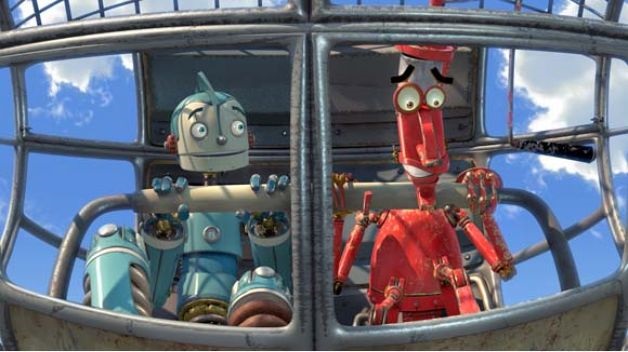
Robots © Blue Sky2005 was to be the first weak year in the history of computer animated features. This was a year in which no films were made that felt as if they were better than the last ones.

In fact, both Blue Sky’s ‘Robots’ and Dreamworks’s ‘Madagascar’ are mediocre in the whole catalog of computer animation. Surprisingly, the two most interesting features of 2005 were stop motion films: Aardman’s ‘Wallace and Gromit and the Curse of the Were-Rabbit‘ and Warner Brothers’ ‘Tim Burton’s Corpse Bride‘. This age-old technique defeated the modernity of computer animation, as both films topped the computer animated features in originality and consistency of story and design.

‘Robots’ is unfortunately typical for the regression in the computer animated field. First the animation: the robots are a good excuse for rather jerky motions, and its colorful setting never feels real. This setting is similar to that of ‘Monsters, Inc.‘ (2001): a totally different world, this time inhabited with robots, which at the same time is an exact copy of our own modern urban world. Also, main protagonist Rodney’s arrival in Robot City is very reminiscent of a similar scene in ‘A Bug’s Life’ (1998), and the all too obligatory ‘follow your dream’ story line had already become stale by 2005, too. In all, the film’s story is much more standard than its exotic setting would suggest.

Blue Sky’s storytelling is also very inconsistent and has many flaws in its timing. For example, the big finale never pays off and his topped by a very cloying ending. Worse, Rodney has no less than two love interests, one of which is suddenly dropped, while the love between him and Cappy, the other, is hardly shown. In effect it seems non-existent. Then there are way too many side characters, none of which is well-developed. Most of them are wise-crackers, who place their one-liners in a nasty, unpleasant way. Robin Williams’s character Fender is as tiresome as his genie was delightful in ‘Aladdin’ (1992). Even Rodney’s hero Bigwald is unappealing in his first scene. And it remains unclear why he has retreated in the first place.

All these flaws are such a pity, for one can feel the great joy in the making of ‘Robots’, especially in the transport sequence, where Rodney and Fender are travelling in a giant Rube Goldberg machine. This scene, although unimportant to the story, is the highlight of this otherwise very disappointing film.

Unfortunately, 2006 would be hardly better, with Blue Sky’s weak  ‘Ice Age 2: The Meltdown’, and the entertaining, but a little too routine films ‘Over The Hedge‘, ‘Flushed Away’ (Dreamworks) and ‘Open Season‘ (Sony’s debut in the field). Even Pixar would release its then weakest picture with ‘Cars’…

Watch the trailer for ‘Robots’ yourself and tell me what you think:

Director: Ralph Bakshi
Release Date: November 15, 1978
Rating: ★
Review:

The Lord of the Rings © Ralph BakshiI’m going to spend only a few words on this film: it is not an animation film. It may be drawn, animated it is not. Practically every movement is rotoscoped, with some scenes containing little more than colored live action footage.

The result is a surplus of movement, a severe inconsistency of style, a general feel of cheapness, and, animationwise, absolutely nothing to enjoy. On the contrary: the result is appalling.

Furthermore, the acting is tiresome, the pace painstakingly slow, the characters more often than not rather unsympathetic, the story incomplete, and the settings often in lack of dramatic effect, though I must admit that the film shares some strikingly similar scenes with the Peter Jackson’s later live action version (which incidentally contains much, much more animation than Bakshi’s film).

In short, Bakshi’s ‘The Lord of the Rings’ is by all means a failure, and one of the most hideously ugly films I’ve ever seen in any genre.

Watch the Balrog scene from ‘The Lord of the Rings’ yourself and tell me what you think:

Director: Robert McKimson
Release Date: December 14, 1957
Stars: Bugs Bunny, Elmer Fudd
Rating: ★★★½
Review:

Rabbit Romeo © Warner Brothers‘Rabbit Romeo’ opens with Elmer Fudd receiveing an enormous package from his uncle Judd Fudd containing a ‘Slobavian rabbit’.

The Slobavian rabbit turns out to be a giant female rabbit called Millicent. Elmer will get $500 if he will guard the rabbit until his uncle arrives. Unfortunately Millicent gets lonely, and expresses that by wrecking things, so Elmer seeks a companion, which of course has to be Bugs Bunny. In the end of the cartoon Bugs gets rid of the all too loving Millicent by putting Elmer into a rabbit suit.

‘Rabbit Romeo’ is a rare combination of storyman Michael Maltese and director Robert McKimson. Maltese’s peppy story makes it one of McKimson’s better latter day shorts. The designs on Bugs and Elmer may be flat and uninspired,  the animation on Millicent is great. Moreover, McKimson’s timing is excellent, and he excels in some facial expressions on Bugs Bunny, which belong to the best in any Bugs Bunny short.

Watch ‘Rabbit Romeo’ yourself and tell me what you think:

https://www.dailymotion.com/video/x2jignc?GK_FACEBOOK_OG_HTML5=1

This is Bugs Bunny cartoon No. 134
To the previous Bugs Bunny cartoon: Show Biz Bugs
To the next Bugs Bunny cartoon: Hareless Wolf

Director: Chuck Jones
Release Date: March 8, 1958
Stars: Daffy Duck, Porky Pig
Rating: ★★★★
Review:

Robin Hood Daffy © Warner Brothers‘Robin Hood Daffy’ is the last of Chuck Jones’s great series of Daffy and Porky pairings.

Like earlier entries, such as ‘Drip-along Daffy‘ (1951) or ‘Deduce You Say’ (1956), Daffy fails completely in acting out the hero he is supposed to be. In this cartoon Daffy Duck is Robin Hood, but he has a hard time proving that to a skeptical Friar Tuck (Porky Pig). He does so by relentlessly trying to rob a rich nobleman who rides on a remarkably little donkey in a hilariously silly fashion.

This nobleman character is totally unaware of the antics around him and is a late addition to a series of similar odd characters that populated many of Jones’s early films, like the Minah Bird (1941-1947) and the bearded sailor in ‘The Dover Boys‘ (1942). Daffy’s attempts, on the other hand, are more akin to those of the Coyote in the Road Runner series. The best gag is when he tries to swing on a rope, Errol Flynn-style, shouting “Yoicks and away”, only to crash into multiple tree trunks.

Porky is redesigned completely into Chuck Jones’s late design: with ridiculously cute eyelashes, anticipating similar redesigns of Jerry in Jones’s Tom & Jerry cartoons seven years later. The redesign is not a success: Porky looks a little too feminine and too cute for the purposes of the cartoon.

Watch ‘Robin Hood Daffy’ yourself and tell me what you think:

http://www.b99.tv/video/robin-hood-daffy/

This is Porky Pig cartoon no. 150
To the previous Porky Pig cartoon: Boston Quackie
To the next Porky Pig cartoon: China Jones

This is Daffy Duck cartoon No. 83
To the previous Daffy Duck cartoon: Don’t Axe Me
To the next Daffy Duck cartoon: China Jones

‘Robin Hood Daffy’ is available on the DVD-set ‘Looney Tunes Golden Collection Volume Three’

Director: Les Clark
Release Date: August 1, 1958
Rating: ★★★
Review:

Paul Bunyan © Walt Disney‘Paul Bunyan’ belongs to a group of Disney specials that retell tall tales from the West, following ‘The Legend of Johnny Appleseed‘ and ‘Pecos Bill‘ from ‘Melody Time‘ (1948).

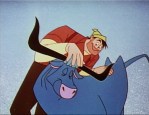
The short is told by three “eye witnesses”, who tell us about the great deeds of the mighty lumberjack Paul Bunyan, who was “63 axe handles high”, and his equally gigantic ox Babe. The best part describes how Bunyan and Babe have reshaped the American landscape: their footsteps turn into the land of 10,000 lakes (in Minnesota), and they themselves build landmarks like the Missouri River, Pikes Peak in Colorado, and the Grand Tetons and Yellowstone Falls in Wyoming.

Eyvind Earle supervised the color schemes, while Tom Oreb designed the characters, like they did for ‘Sleeping Beauty‘ (1959). Their designs are very bold and angular, and the background art, painted by Eyvind Earle and Walt Peregoy, is a delight to watch. Composer George Bruns composed a catchy theme song for the giant hero, which is sung several times throughout the short.

Unfortunately, the short is hampered by a remarkable slowness and a terrible lack of good gags, which make it at 17 minutes too long to remain entertaining. In the end ‘Paul Bunyan’ is more interesting for its looks than for its story.

‘Paul Bunyan’ was the only non-educational short directed by Disney veteran Les Clark, who had been with Disney since the birth of his own studio in 1928.

Watch ‘Paul Bunyan’ yourself and tell me what you think:

‘Paul Bunyan’ is available on the DVD ‘Walt Disney Treasures: Disney Rarities’

Director: Chuck Jones
Release Date: 1957
Stars: Ralph Phillips
Rating: ★★
Review:

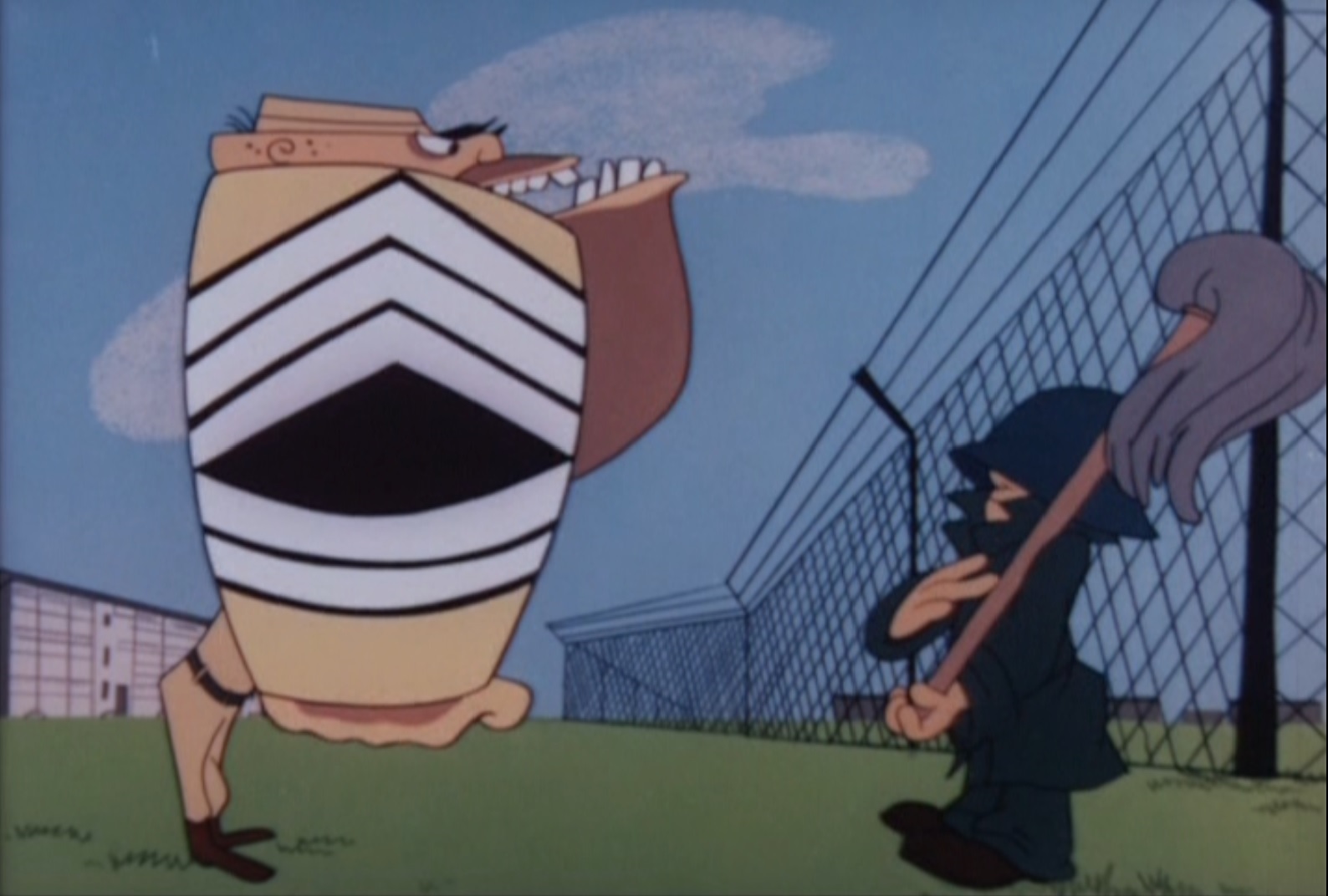
Drafty, Isn't It © Warner Brothers‘Drafty, isn’t it’ is the second of two propagandistic advertisement shorts Chuck Jones made for the US Army in the late 1950s.

Like its predecessor, ‘90 Days of Wondering‘ (1956), it stars a young adult form of dreamer boy Ralph Phillips. In this short Ralph Phillips has nightmares about all his ideas of  adventure being blocked by a giant shadow of a soldier beckoning him. Then he’s visited by an army pixie who elists some fictions and facts about the army. The cliches, of course, are the most hilarious. This short also contains a very Tex Avery-like running gag in which he pixie repeatedly has to put Ralph’s dog to sleep by singing it a fast lullaby.

‘Drafty, Isn’t It?’ is a well-made and beautiful film, and it would have been more enjoyable were it not so sickeningly propagandistic.

Watch ‘Drafty, Isn’t It?’ yourself and tell me what you think:

Director: Robert McKimson
Release Date: July 20, 1957
Stars: Speedy Gonzales
Rating: ★★★★
Review:

Tabasco Road © Warner BrothersIt was Robert McKimson, not Friz Freleng, who directed the first Speedy Gonzales film ‘Cat-Tails for Two’. But it took four years before McKimson revisited this character.

By then Friz Freleng had redesigned McKimson’s creation in ‘Speedy Gonzales’, which had won an Academy Award.

McKimson’s returns to Speedy Gonzales actually results in one of Speedy’s finest films. Here Speedy tries to protect two drunken mice called Pablo and Fernando from a large grey cat. ‘Tabasco Road’ is a very talkative cartoon, but it’s also inspired and charming, especially because of the characters of Pablo and Fernando, who are as intoxicating as they are intoxicated. The best gag, however, is when Speedy’s action appears too fast for the viewer, and Speedy replays it for us in slow motion.

Watch ‘Tabasco Road’ yourself and tell me what you think:

http://www.dailymotion.com/video/x2kubnh

Director: Chuck Jones
Release Date: 1956
Stars: Ralph Phillips
Rating: ★★★
Review:

90 Days of Wondering © Warner Brothers’90 Days of Wondering’ is a rather propagandistic advertising film to persuade ex-soldiers to reenlist.

Despite its rather questionable message, the film is beautifully designed and animated. Especially striking is its dazzling opening sequence in which we see a young man (an adult version of dreamer boy Ralph Phillips from ‘From A to Z-Z-Z-Z’ from 1954) being extremely happy to leave the army and rushing home. This opening sequence has a speed and gusto that recalls the Warner Brother shorts from the 1940s. It contrasts with the slow pace of the scenes following after, where the young man soon discovers he is out of tune with is hometown. Soon he is visited by two small characters explaining him why he should reenlist…

In 1957 ’90 Days of Wondering’ was followed by yet another propaganda film for the army called ‘Drafty, isn’t it?‘. It also stars the adult version of Ralph Phillips.

Watch ‘90 Days of Wondering’ yourself and tell me what you think:

Director: Chuck Jones
Release Date: November 10, 1956
Stars: Road Runner, Wile E. Coyote
Rating:   ★★★★
Review:

There They Go-Go-Go! © Warner BrothersThis ninth Road Runner cartoon has a deviant opening, in which we watch the coyote baking a chicken out of clay.

Of course he rather has real meat, and his attempts to catch the Road Runner include a spear on a chord, a revolver on a spring, a catapult, a bundle of maces, a half-sewn-through ladder, a wheel of dynamite sticks and a rocket.

The best gag is saved for last, in which the coyote has assembled several rocks above the road. When these fail to fall on the Road Runner, the coyote nervously tries to make them fall until he realizes that he succeeds and they will fall on him. He then brings forth a sign saying “In Heaven’s name, what am I doing?”.

‘There they Go-Go-Go’ contains the most abstract backgrounds ever conceived in a Road Runner cartoon – Maurice Noble really pushes the limits here. Nevertheless they were reused the next year in ‘Scrambled Aches’.

Watch ‘There They Go-Go-Go!’ yourself and tell me what you think:

http://vimeo.com/60592

Director: Chuck Jones
Release Date: July 6, 1957
Stars: Bugs Bunny, Elmer Fudd
Rating:   ★★★★★ ♕
Review:

What's Opera, doc © Warner BrothersOne of the most celebrated animated cartoons of all time, ‘What’s Opera, Doc’ places the typical Elmer Fudd-Bugs Bunny chase routine into the world of Wagnerian opera.

The cartoon’s masterstroke is that it uses all the cliches of the chase, which go all the way back to the first Bugs Bunny Cartoon ‘A Wild Hare‘ (1940), but that they are carried out in the most serious, Wagnerian fashion. The result is ridiculously pompous, mocking Wagnerian opera, as well as playing homage to it. Milt Franklyn’s score quotes music from five Wagner operas: ‘Der fliegende Holländer’, ‘Die Walküre’, ‘Siegfried’, ‘Rienzi’ and ‘Tannhäuser’.

The cartoon’s operatic character is emphasized not only by operatic singing, but also by featuring Wagnerian magic (a magic helmet), a ballet (a staple of French opera, but only employed by Richard Wagner in his very first operas), and a sad ending, a cliche of 19th century opera in general. Michael Maltese provided new lyrics to Wagner’s pilgrim chorus from ‘Tannhäuser’ and made it into a rather Hollywood musical-like love duet between Elmer and Bugs.

The animation is outstanding throughout, especially in the ballet and love duet between Bugs and Elmer. Indeed, for the ballet sequence the animators studied Tatania Riabouchinska and David Lichine from The Original Ballet Russe, and there’s a genuine seriousness about this scene. Yet, the main attraction of the cartoon lies in Maurice Noble’s extreme background layouts and bold color designs. Especially when Elmer gets furious, there is a startling emotional use of colors that has not been seen on the animated screen since ‘Bambi‘ (1942).

The opening sequence, with Elmer casting a mighty shadow is a straight homage to ‘The Night on Bold Mountain’ sequence from ‘Fantasia’ (1940), while the shots of Bugs being dressed as Brünnhilde and riding an oversized horse are retaken from ‘Herr meets Hare’ from 1945 (which, like ‘What’s Opera, doc?” was also penned by Michael Maltese). In this sense the cartoon is as much a homage to animation history as it is to opera.

‘What’s Opera, doc?’ is a brilliant cartoon of pure grandeur and one of Chuck Jones’s all time masterpieces. What’s most striking is that it was made during the normal grind of a commercial animated cartoon studio. The film took much longer than normal to make, which Jones and his unit could only manage to do by cheating on their schedule, stealing time from a much more ordinary short, the Road Runner cartoon ‘Zoom and Bored’ (1957).

Watch ‘What’s Opera, Doc?’ yourself and tell me what you think:

http://www.dailymotion.com/video/x1atzuy

This is Bugs Bunny cartoon No. 131
To the previous Bugs Bunny cartoon: Piker’s Peak
To the next Bugs Bunny cartoon: Bugsy and Mugsy
Director: Friz Freleng
Release Date: January 5, 1957
Rating:  ★★★★★
Review:

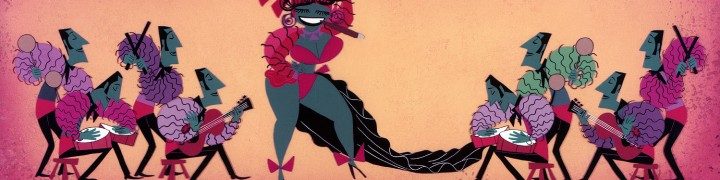
Three Little Bops © Warner Brothers‘Three Little Bops’ retells the story of the three little pigs in a jazz style.

The film features voice actor Stan Freberg as a singing narrator. In the cartoon the three little pigs are jazz musicians who play jump blues (not bebop!). The wolf is a corny jazz cat, who wants to sit in, but whose trumpet playing is too amateurish to entertain. Only in hell the wolf learns that “you gotta get hot to play real cool”.

The film is unique within the Warner Bros. cartoon canon because it features neither voice work by Mel Blanc nor music by Carl Stalling/Milt Franklyn. It even lacks the ‘That’s All Folks!’ ending, showing a ‘The End’, instead. In the cartoon Stan Freberg does all the singing, while the swinging rhythm & blues music is provided by jazz musician Shorty Rogers and his combo. Together with ‘Rhapsody in Rivets‘ (1941), the cartoon is one of the best examples of director Friz Freleng’s perfect sense of musical timing. The result is one of the most entertaining animated cartoons of the late 1950s.

Watch ‘Three Little Bops’ yourself and tell me what you think:

Director: Chuck Jones
Release Date: December 31, 1955
Rating:  ★★★★★ ♕
Review:

One Froggy Evening © Warner Brothers‘One Froggy Evening’ tells about a construction worker, who discovers a singing frog inside a cornerstone of a building.

He dreams of earning loads of money with the frog, but unfortunately the frog sings for him only, not for anybody else. This leads to the man’s ruin, and in the end he disposes the frog into another building. But in 2056 AD the same thing is about to happen all over again…

‘One Froggy Evening’ is one of the most perfect cartoons ever made (one competitor that comes to mind is ‘The Band Concert’ from 1935): its story, penned by Michael Maltese, is told with the most economical means, without any dialogue. The silent acting is superb, the timing excellent and the handling of the facial expressions gorgeous. The transition of the frog (baptized Michigan J. Frog in the seventies) from lively entertainer to ordinary amphibian is completely convincing, and a great example of the power of animation.

Although the frog was supposedly locked inside the building in 1892, most of the songs it sings are from a later date: ‘Hello! Ma Baby’ was published in 1899, ‘Won’t You Come Over to My House in 1906, ‘I’m Just Wild About Harry’ in 1921, and ‘Please Don’t Talk About Me When I’m Gone’ is even from 1930. Only ‘Come Back to Erin’ and ‘Throw Him Down McCloskey’ are apt, being from 1868 and 1890, respectively. The catchy ‘The Michigan Rag’ was written especially for this cartoon.

‘One Froggy Evening’ feels like a parable. It’s a story of greed, of misfortune, of headstrong belief in a bad idea, and of shattered dreams. It is not hilariously funny, but delightful and simply beautiful. It was Chuck Jones’s personal favorite, and it’s deservedly regarded as an all-time classic. Not that anyone in 1955 thought so, though. The Academy Award went to ‘Speedy Gonzales’, while ‘One Froggy Evening’ didn’t even get an Oscar nomination. Meanwhile, ‘One Froggy Evening’ remains one of the very, very few animated cartoons to inspire a scene in a live action movie, in this case the alien scene in Mel Brooks’s ‘Spaceballs’ (1987).

Watch ‘One Froggy Evening’ yourself and tell me what you think:

https://vimeo.com/50941741

Director: Paul J. Smith
Release Date: October 22, 1956
Rating:  ★★★★½
Review:

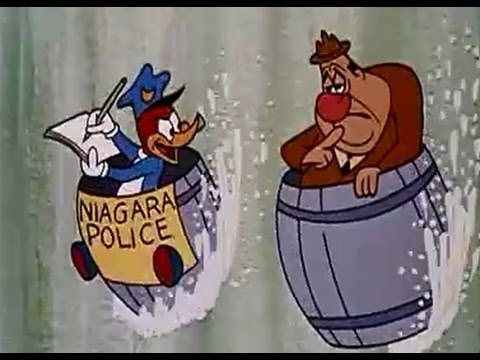
Niagara Fools © Walter LantzIn this cartoon Woody Woodpecker wants to ride the Niagara falls in a barrel.

However, there’s a park ranger who tries to stop him, and it’s this ranger who repeatedly ends in a barrel on the falls.

It’s amazing to discover a gem like this between the badly designed, badly animated and badly timed Walter Lantz shorts of the late 1950s. Although this cartoon, too, features ugly animation, the story and the gags (penned by Disney-veterans Dick Kinney and Milt Schaffer) are very good. The result is by all means one of the best Woody Woodpeckers of the fifties.

Watch ‘Niagara Fools’ yourself and tell me what you think:

This is Woody Woodpecker cartoon No. 71
To the previous Woody Woodpecker cartoon: Calling All Cuckoos
To the next Woody Woodpecker cartoon: Arts and Flowers

‘Niagara Fools’ is available on the DVD-set ‘The Woody Woodpecker and Friends Classic Cartoon Collection Volume 2’

Director: Robert McKimson
Release Date: July 7, 1956
Stars: Daffy Duck
Rating:  ★★★
Review:

Stupor Duck © Warner Brothers‘Stupor Duck’ is a spoof on the Fleischer’s Superman cartoons, a series that had ended 13 years before, and was earlier parodied by Chuck Jones in ‘Super Rabbit’ (1943), starring Bugs Bunny.

This time Daffy is “Stupor Duck”, who, overhearing a television program, seeks for the non-existent villain Aardvark Ratnick, seeing his deeds in everything. Daffy, for example, rescues a submarine from ‘sinking’. The best part of the cartoon is its opening sequence which perfectly parodies the Fleischer’s opening sequence. The rest of the cartoon is unfortunately hampered by mediocre timing.

Watch ‘Stupor Duck’ yourself and tell me what you think:

http://www.ebaumsworld.com/video/watch/82993447/

This is Daffy Duck cartoon No. 75
To the previous Daffy Duck cartoon: Rocket Squad
To the next Daffy Duck cartoon: A Star Is Bored

‘Stupor Duck’ is available on the DVD-set ‘Looney Tunes Golden Collection Volume Five’

Director: Jack Kinney
Release Date: February 24, 1956
Stars: Donald Duck, Chip ‘n Dale
Rating:  ★★★
Review:

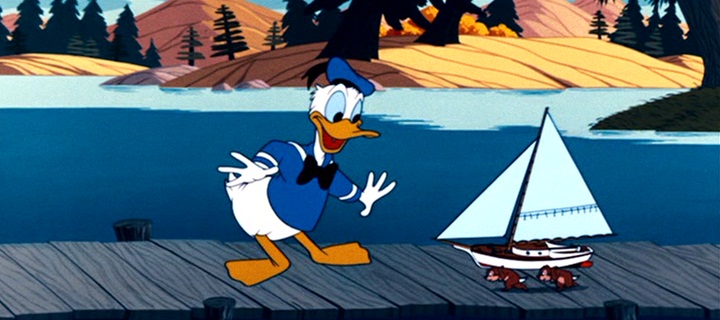
Chips Ahoy © Walt DisneyThis Cinemascope cartoon is one of finals. It was the last screen appearance of Chip ‘n Dale, it was the last non-educational Donald Duck short and it was the last cartoon directed by Goofy director Jack Kinney, whose own Goofy series had stopped three years earlier.

The short features a quite ordinary battle between Chip ‘n Dale and Donald. This time the squirrels steal Donald’s miniature boat to sail to an island full of acorns. Highlights are Donald acting out a thunderstorm and Dale’s deadpan reactions to Donald’s attempts to persuade them into various boats.

By 1956 Jack Kinney, the greatest director of comedy the Disney studio had ever seen, had been out of favor for some time, and on March 13, 1958 he was fired. He continued animating during the dark ages of animation, in which animation was only seen in light of expenses. He worked on UPA’s first feature, ‘1001 Arabian Nights’ and on Popeye films for television, besides several small and often unfinished projects with his own animation company. In 1988 he wrote his highly entertaining and richly illustrated autobiography ‘Walt Disney and Assorted other Characters’. Jack Kinney passed away on February 9, 1992, 82 years old.

Watch ‘Chips Ahoy’ yourself and tell me what you think:

This is Donald Duck cartoon No. 114
To the previous Donald Duck cartoon: Up a Tree
To the next Donald Duck cartoon: How to Have an Accident in the Home

Director: Robert McKimson
Release Date: August 31, 1946
Stars: Henery Hawk, Foghorn Leghorn
Rating:  ★★★★★
Review:

Walky Talky Hawky © Warner BrothersAlready in his fourth film as a director McKimson introduces his most durable star, Foghorn Leghorn.

The loud-mouthed rooster is coupled with Henery Hawk, in his second appearance since the Chuck Jones cartoon ‘The Squawkin’ Hawk’ (1942). Also featured is the Foghorn Leghorn’s regular opponent, the barnyard dog, and their recurring feud is already laid out in this short. Foghorn Leghorn uses Henery in this feud, making him believe the dog, not he, is a chicken. In the end Henery catches both, and even a horse, exclaiming; “one of them got to be a chicken”.

‘Walky Talky Hawky’ is one of McKimson’s most inspired cartoons. Both Foghorn Leghorn and the barnyard dog are great characters, and the short is full of great, rather Clampettian animation.

Foghorn Leghorn’s vocal mannerisms were inspired by a 1930s radio character called ‘The Sheriff’. Later, mannerisms from another radio character, Senator Claghorn, crept into the rooster’s vocabulary. For a detailed account on the origins of Foghorn Leghorn, see Keith Scott’s excellent post on Cartoon Brew.

Watch ‘Walky Talky Hawky’ yourself and tell me what you think:

http://vimeo.com/34727339

Enter your email address to follow this blog and receive notifications of new posts by email.

Join 918 other subscribers
Bookmark and Share

Categories