
You are currently browsing the tag archive for the ‘dream’ tag.
Director: Walt Disney
Production Date: 1923
Stars: Virginia Davis (Alice), Walt Disney, Hugh Harman, Rudolf Ising, Ub Iwerks, Carman Maxwell
Rating: ★★★½
Review:
 ‘Alice’s Wonderland’ is the pilot film for the Alice cartoons, which Disney made in Kansas city, before trying his luck in Hollywood.
The title card of this pilot reads: “Scenario and direction by Walt Disney. Photography by Ubbe Iwerks and Rudolf Ising. Technical direction by Hugh Harman and Carman Maxwell.”
Alice (the four year old Virginia Davis) drops by the studio and tells Walt Disney she likes to watch him drawing some funnies. Walt Disney lacks his familiar mustache in this sequence, but he is already the kind entertainer of children here, and he takes her to a sheet of paper on where a cat chases a dog out of a dog house. The rest of the studio is also populated by animators (Iwerks, Harman, Ising and Maxwell all appear in this cartoon) and toons alike. The whole crew ‘s watching a boxing match between a dog and a cat, for example.
That night Alice dreams she arrives in cartoonland by train. She’s welcomed by animals and she performs a little dance for them. Unfortunately four lions break out of Cartoonland Zoo and they chase her into a tree, into a cave, into a rabbit hole and finally, to a cliff. She falls off the cliff, and then she awakes.
This cartoon is very entertaining. The idea of a girl in a cartoon (the inverse of the idea of Fleischer’s Out of the Inkwell, a series that was around for eight years by then) works wonderfully, and the cartoon is lively. It already contains lots of music and dance, and a very rubbery animated train, besides the normal stiff animation you find in most cartoons of the twenties. The animation of the train looks forward to the flexible animation style that would later make Ub Iwerks and Walt Disney famous.
Luckily, Disney was able to sell the Alice series, starting his Hollywood career. His fledgling studio released 56 Alice Comedies in the next four years, until the series was replaced by Oswald the Lucky Rabbit in 1927. The series was quite successful, allowing Disney to expand and to improve. In that sense, ‘Alice’s Wonderland’ lay the foundation of the Disney imperium.
Watch ‘Alice’s Wonderland’ yourself and tell me what you think:
‘Alice’s Wonderland’ is available on the DVD ‘Walt Disney Treasures: Disney Rarities’
Director: Frank Moser
Release date: July 25, 1920
Stars: Bud and Susie
Rating: ★★
Review:

‘Bud and Susie’ was an animation series created by Frank Moser that consisted of at least twenty cartoons and run from 1920 to 1921. ‘Down the Mississippi’ does little to advertise the series as something outstanding, when compared to contemporary series like Earl Hurd’s Bobby Bumps’ or Otto Messmer’s Felix the Cat.
Like, Ub Iwerks, Moser is known as a very fast animator. However, unlike Iwerks, Moser wasn’t either innovative or funny. It may be unfair to use such an early cartoon as ‘Down the Mississippi’ as an example, but the ‘Bud and Susie’ series was Moser’s own creation, so it could have been inspired. This is not the case.
In this film Bud, Susie and their cat read ‘Huckleberry Finn’. When the sandman puts Bud to sleep, he dreams he’s on a raft on the Mississippi with his sister and the cat. The cat catches an electric eel and Bud catches a crocodile. They camp at the river bank, where they’re about to be eaten by a bear, which looks like an oversized mouse. The print on the ‘Presenting Felix the Cat’ DVD unfortunately stops here.
‘Down the Mississippi’ is clearly rooted in the comic strip tradition, although there are only two text balloons. Like, Ub Iwerks, Moser is known as a very fast animator, in fact he famed himself as being the fastet animator in the world. However, unlike Iwerks, Moser wasn’t either innovative or funny. His animation is certainly very readable but crude, and the animal designs are anything but original. Most interesting are his animation of the waves and the background art of the camping site. Notice that the cat’s tail changes into a question mark at one point, a feature normally attributed to Felix the Cat.
Nothing is particularly outstanding in this cartoon, which isn’t funny either. Indeed, Art Babbitt was unimpressed with Moser’s art. As he relates to Charles Solomon in his book ‘Enchanted Drawings’: “Moser was a man devoid of humor. He worked very rapidly, but his work was crude and without feeling. Of course, everybody’s work was crude in those days, but he constantly told you he was the fastest animator in the world. I undiplomatically told him that was like being the fastest violinist in the world. You can play very fast, but you can’t play worth a damn!” (Enchanted Drawings – The History of Animation p. 95).
Frank Moser would later co-found Terrytoons with Paul Terry. The two were likely kindred spirits, more interested in efficiency than in art.
Watch ‘Down the Mississippi’ Yourself and tell me what you think:
‘Down the Mississippi’ is available on the DVD ‘Presenting Felix the Cat – The Otto Messmer Classics 1919-24’
Director: Winsor McCay
Release Date: 1921
Rating: ★★★½
Review:
 ‘The Flying House’ is the last of the three ‘Dream of a rarebit fiend’ films Winsor McCay completed in 1921.
In this short the classic rarebit makes a woman dream that her man has made a flying machine out of their house. With their flying house they fly to the moon, where they’re almost swatted by a giant. When they run out of gas they circle in empty space until they’re hit by a rocket, and both fall down. At this point, of course, the woman awakes.
Compared to the other two Rarebit Fiend films, ‘Bug Vaudeville‘ and ‘The Pet‘, this cartoon uses a lot of dialogue, both in balloons and in title cards. Moreover, there’s a lot of reverse and repeated animation – thus not all movements are too convincing. Although the story does not quite delivers what it promises, it contains a few good gags. And, as always, both McCay’s drawing style and command of perspective are top notch. Especially the shots of the house flying are very impressive.
Yet the film’s most stunning sequence is when the house leaves earth to fly to the moon. In one convincingly realistic shot we see the earth rotating, the moon appearing behind it and growing larger, while the house flies towards us, orbiting the earth. This is by all means a spectacular piece of animation, especially because it was done 37 years before the space age. McCay clearly and understandably was proud of this sequence, and so he announces it with a title card.
Unfortunately, ‘The Flying House’ was to be Winsor McCay’s last completed film. His legacy is formidable, and he undoubtedly belongs to the best and most imaginative animators/animation directors of all time.
Watch ‘The Flying House’ yourself and tell me what you think:
This is Winsor McCay’s tenth and last film
To Winsor McCay’s ninth film: The Pet
Director: Winsor McCay
Release Date: 1921
Rating: ★★★★★ ♕
Review:
 ‘The Pet’ is the second of the three ‘Dream of the rarebit fiend’ films Winsor McCay released in 1921. It is arguably the best of the three, and probably the best of all Winsor McCay’s films: it combines a well-executed story with a perfect command of animation. It’s too bad it isn’t more well-known.
In ‘The Pet’ a woman dreams she adopts a small animal that grows larger and larger every day, eating the cat, everything on the table, the furniture, and later on, a tree, a car and some buildings, until it explodes. The dream is totally believable with its inner logic and its wonderful execution. The growth of the animal is shown with a very imaginative use of perspective and beautiful backgrounds. For example, when the pet grows to gigantic proportions, we see it stride behind some very high buildings, towering over our heads.
More than 25 years later Tex Avery would return to the same subject in ‘King-size Canary’ (1947).
Watch ‘The Pet’ yourself and tell me what you think:
http://www.spike.com/video/dreams-of-rarebit/2917218.
This is Winsor McCay’s ninhth film
To Winsor McCay’s eight film: Bug Vaudeville
To Winsor McCay’s tenth and last film: The Flying House
Director: Winsor McCay
Release Date: 1921
Rating: ★★★★
Review:
 After a period of unfinished projects, Winsor McCay completed a series of three related films in 1921, ‘Dreams of a Rarebit Fiend’.
These films are the animated counterparts of his comic strip of the same name, which run from 1904 to 1913. The films, like the comics, are about ordinary people having a bad dream. When they awake, they blame it on the food they’ve eaten.
The three animated Dreams of a Rarebit Fiend can be regarded as McCay’s most mature works. They’re not as revolutionary as ‘Gertie the Dinosaur‘ or ‘The Sinking of the Lusitania‘, but they display a total command of form and style, and they are flawless in their execution. It’s too bad, McCay didn’t complete any other film after these three, although he lived for another 13 years.
‘Bug Vaudeville’ is the first of the three ‘Dream of the Rarebit Fiend’ films. In this short, a man falls asleep against a tree and dreams he witnesses a bug vaudeville show. He watches the grasshopper and the ants performing acrobatics, a daddy longlegs (with beard and a a hat) dancing, a cockroach stunting on a bicycle, tumble bugs performing acrobatics, two potato bugs boxing and a butterfly on a horse-like black beetle. He awakes when he dreams that he’s been attacked by a giant spider.
‘Bug Vaudeville’ is an entertaining short, but in some respects it is the weakest of the three Dream of a Rarebit Fiend films. Its viewpoint is static: we see the same stage for the most part of the film, without any change of setting. The bugs are drawn relatively simple, and there’s no particularly outstanding animation involved, either of character or of effects. Highlight may be the cockroach on the bicycle, with its certain control of perspective.
Watch ‘Bug Vaudeville’ yourself and tell me what you think:
This is Winsor McCay’s eighth film
To Winsor McCay’s seventh, unfinished film: Flip’s Circus
To Winsor McCay’s ninhth film: The Pet
Director: Winsor McCay
Release Date: January 1912
Rating: ★★★½
Review:
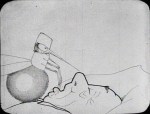 Winsor McCay’s second cartoon is about a giant mosquito who sucks a sleeping man until his body is a giant bulb. Then, suddenly aware of the audience, he performs some tricks on the man’s nose, sucks some more and explodes.
Unlike McCay’s first film, ‘Little Nemo‘, a long live action intro is absent, and more importantly, this one tells a real story. These are both great improvements on ‘Little Nemo’. Moreover, the mosquito is quite a character, arguably the first in animated history: he wears a tall hat and carries a suitcase. Besides, he’s not only a menace to the man, but also playful and a bit of a showoff. In ‘Before Mickey’ Donald Crafton tells us McCay even baptized the character ‘Steve’.
The film stands in the tradition of McCay’s ‘Dream of the Rarebit Fiend’ comics and is a rather peculiar combination of a sleeper’s nightmare and a bit of silliness. The mosquito is larger than life, and when he sticks in his long proboscis into the man’s head, it looks incredibly painful. This makes some of the action a discomforting watch, and this is perhaps the first time an animated film tries to draw on an audience’s emotions.
Unfortunately, the action is rather slow, and there’s a lot of reverse animation, in which McCay reuses the same drawings in reverse order. This may have spared drawings, but it doesn’t look convincing in its perfect symmetry of movement. Nevertheless, the realism with which the man is drawn and animated remains absolutely stunning.
Despite some flaws ‘How a Mosquito Operates’ remains an original and fresh film, and like all McCay’s films, very well animated.
Watch ‘How a Mosquito Operates’ yourself and tell me what you think:
This is Winsor McCay’s second film
To Winsor McCay’s first film: Little Nemo
To Winsor McCay’s third film: Gertie the Dinosaur
Director: Dave Fleischer
Release Date: April 6, 1934
Stars: Betty Boop
Rating: ★★★½
Review:
 Late at night, Betty Boop is making a jigsaw puzzle with a picture of Alice in Wonderland on it.
When the clock says it’s time for bed, the rabbit jumps out of the puzzle, and through the mirror. Betty follows him, and the mirror changes her more or less into a sexy Alice, with long curly hair, which becomes her very well.
In Wonderland, the Mad Hatter’s hat pulls out several characters from ‘Alice in Wonderland’ and ‘Through the Looking Glass’, a.o. Humpty Dumpty, the Duchess, the Mad Hatter, the Walrus and the Carpenter, the Gryphon and the Mock Turtle. Betty sings “How Do You Do” to them, before being kidnapped by the evil Jabberwock. Of course, the creatures come to her rescue, accompanied by Franz Liszt’s Second Hungarian Rhapsody, but when she falls off a cliff, she awakes.
‘Betty in Blunderland’ is a sweet, albeit a bit uninspired cartoon that fails to deliver its promises. It features wonderful designs of the Wonderland characters, many of which are clearly based on the original illustrations by Sir John Tenniel. However, the Fleischers don’t do anything interesting with them. We watch Tweedledee and Tweedledum fighting, the duchess doing a boring dance, and the Gryphon and the Mock Turtle shooting craps. None of these scenes is remotely interesting. Moreover, one grows tired of creatures kidnapping Betty, something that happens in several cartoons from the era, e.g. ‘Mother Goose Land‘ and ‘Parade of the Wooden Soldiers‘ (both 1933).
Two years later Betty was followed by Mickey who, too, dreamed stepping through the mirror into Wonderland, in ‘Thru the Mirror’ from 1936, which is by all means a much more memorable cartoon.
Watch ‘Betty in Blunderland’ yourself and tell me what you think:
This is Betty Boop cartoon No. 27
To the previous Betty Boop cartoon: Ha! Ha! Ha!
To the next Betty Boop cartoon: Betty Boop’s Rise to Fame
‘Betty in Blunderland’ is available on the French DVD Box Set ‘Betty Boop Coffret Collector’
Director: Graham Heid
Release Date: May 27, 1938
Rating: ★★★★
Review:
 ‘Wynken, Blynken and Nod’ is one of the last, and certainly one of the most spectacular Silly Symphonies ever made.
There is hardly any story: at the start of the cartoon we hear the poem being sung by a sugary soprano, then we watch Wynken, Blynken and Nod sailing the Milky Way and fishing ‘starfish’ and being at the mercy of some clouds.
The three babies are very alike, with Nod being the ‘Dopey’ of the three, and the humor is mild. But, boy, the looks of this cartoon! Like two other Silly Symphonies obsessed with babies and their bare behinds (‘Lullaby Land’ from 1933 and ‘Water Babies’ from 1935), ‘Wynken, Blynken and Nod’ is a showcase of Disney Animation. The cartoon features extraordinarily beautiful backgrounds, and literally bursts with effect animation, rendering astonishingly beautiful stars, comets, clouds and lightnings. The fantasy is enhanced by a wonderful score, which makes clever use of ‘Twinkle Twinkle Little Star’. All this gives one the feeling of watching a mini-Fantasia.
Certainly, no animated cartoon would ever show such lushness again. As such, in a sense ‘Wynken, Blynken and Nod’ forms the end and culmination of an era, which had started in the end of 1933, in which the Disney studio combined ever growing ambitions with childish and sugary material.
‘Wynken, Blynken and Nod’ was the only cartoon directed by Graham Heid. Remarkably little is known about this artist, who also contributed to ‘Pinocchio‘, ‘Fantasia’ and ‘Bambi‘. In fact, I can only find a birth date (November 14, 1909). This is rather surprising, for one can have worse seven minutes of fame than this delightful short. Luckily, animation historians Jerry Beck & Michael Barrier help us out on the Cartoon Research F.A.Q. page.
One trivial remark: ‘Wynken, Blynken and Nod’ is based on the 1889 published poem ‘Dutch Lullaby’ by Eugene Field. Indeed, the words Wynken and Blynken seem to suggest some Dutch origin, but there are no such verbs in the Dutch language, which would translate ‘to wink’ and ‘to blink’ as ‘knipogen’ and ‘knipperen’, respectively.
Watch ‘Wynken, Blynken and Nod’ yourself and tell me what you think:
This is Silly Symphony No. 70
To the previous Silly Symphony: Moth and the Flame
To the next Silly Symphony: Farmyard Symphony
Director: David Hand
Release Date: August 31, 1935
Stars: Mickey Mouse, Pluto
Rating: ★★★★★
Review:
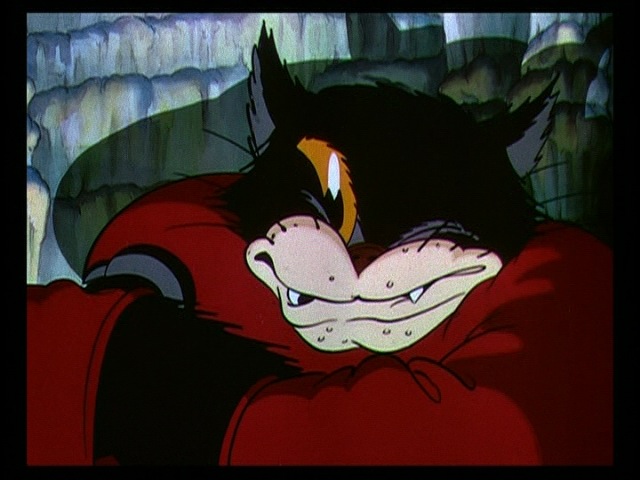 Although this cartoon is part of the Mickey Mouse series, Pluto is its star.
After he has chased a little kitten, he dreams that his Judgement Day has come and that he’s put on trial by a number of cheating cats.
Like most of Disney’s dream-cartoons this one contains wonderful backgrounds, characters and ideas, thanks to story men Joe Grant and Bill Cottrell. The dream sequence is executed in a Silly Symphony-like fashion with lots of rhyme and song and very beautiful animation. The prosecutor, animated by Bill Roberts, is particularly well done: he’s an impressive figure, whose stature anticipates Stromboli from ‘Pinocchio‘ (1940).
Pluto now is a fully developed character who easily carries the complete cartoon on his own. Mickey’s part, on the other hand, is reduced to that of a cameo, something that would occur more and more in the years to come.
Watch ‘Pluto’s Judgement Day’ yourself and tell me what you think:
This is Mickey Mouse cartoon No. 78
To the previous Mickey Mouse cartoon: Mickey’s Fire Brigade
To the next Mickey Mouse cartoon: On Ice
Director: Wilfred Jackson
Release Date: July 13, 1935
Stars: Mickey Mouse, Pluto
Rating: ★★★★
Review:
 ‘Mickey’s Garden’ is Mickey’s second color cartoon (after ‘The Band Concert‘).
It’s also Pluto’s first: he passes the transition into color fluently, getting his typical orange color we’re all familiar with now.
Mickey and Pluto are in the garden trying to kill a number of insects eating Mickey’s crop. When Mickey accidentally sprays himself with bug poison he starts to hallucinate (the transition to the dreamworld is particularly psychedelic: everything, including the background becomes unsteady and wobbly). He dreams that all plants and bugs have grown. This leads to some imaginative scenes. The bugs are not very lifelike, though. The animators even make a weird mistake by giving a particularly evil-looking beetle eight legs instead of six.
Watch ‘Mickey’s Garden’ yourself and tell me what you think:
This is Mickey Mouse cartoon No. 76
To the previous Mickey Mouse cartoon: Mickey’s Kangaroo
To the next Mickey Mouse cartoon: Mickey’s Fire Brigade
Director: David Hand
Release Date: January 21, 1933
Stars: Mickey Mouse, Pluto
Rating: ★★★★★
Review:
 ‘The Mad Doctor’ is Mickey’s third horror cartoon and easily his best (the other two are ‘The Haunted House’ from 1929 and ‘The Gorilla Mystery’ from 1930).
The plot is simple: it’s night, the weather is foul and Pluto is kidnapped by an evil scientist called Dr. XXX, who takes him into his laboratory, which is reminiscent of that of Frankenstein in James Whales’ film of the same name, 1931. Mickey follows Pluto’s tracks into a creepy castle, entering it in a scene which reuses some footage of ‘Egyptian Melodies‘ from 1931. Inside the castle he has to deal with several skeletons, including a ridiculous hybrid of a skeleton and a spider. Soon, he’s captured, too, and about to be killed by a chainsaw. Fortunately, it turns out to be all just a dream…
Besides the horror, this cartoon also features elaborate designs and loads of special effects. Especially beautiful is its shadowing on the characters. It also has a strong musical element, as the mad scientist sings all his lines. Some of the gags are quite surreal and reminiscent of the Fleischer style, like a lock locking itself or the scientist cutting off Pluto’s shadow. The cartoon also features a gag with many doors in one doorpost. This gag would be reused and improved by Tex Avery in ‘The Northwest Hounded Police’ from 1946.
Watch ‘The Mad Doctor’ yourself and tell me what you think:
This is Mickey Mouse cartoon No. 52
To the previous Mickey Mouse cartoon: Building a Building
To the next Mickey Mouse cartoon: Mickey’s Pal Pluto
Director: Wilfred Jackson
Release Date: August 19, 1933
Rating: ★★★★½
Review:
 In ‘Lullaby Land’ a baby is lulled to sleep by his mother, singing ‘rock-a-bye baby’. The song takes the baby and his stuffed dog to Lullaby Land, a wonderfully surreal land made of plaids, rattles etc.
There the baby encounters a parade of baby objects, and a forbidden garden, full of sharp things, like knives and scissors. Despite the warnings of the female choir in the soundtrack, the baby enters. He destroys all watches from a watch tree with a hammer, and plays with matches. The smoke evokes three bogey men, which scare the baby away. Finally, the baby meets the Sandman, who puts the baby asleep to the tune of Johannes Brahms’s lullaby.
With cartoons like ‘Lullaby Land’ Disney set new standards for animation that are still thrilling today. Don’t get me wrong, the cartoon is rather patronizing and sugary cute, especially through the soundtrack. But this is compensated by wonderful surrealistic images, beautiful artwork and superb animation. And, hey, this way of warning against sharp things and matches just may work with small children.
Lullaby Land itself is a highly original fantasy world, and especially its first images are stunningly beautiful. The dance of the bogey men contains some striking use of color that anticipates similar surreal images in ‘Dumbo‘ (1941). Moreover, it is the first example of totally unrealistic color use in animated cartoons, and therefore a milestone.
Unfortunately, the cartoon also marks a trend of childishness creeping into the animation world, not only at Disney’s, but at all other studios, as well. For example, ‘Lullaby Land’ is the first of a whole series of Silly Symphonies obsessed with little babies, and their bare behinds in particular, with ‘Wynken, Blynken and Nod‘ from 1938 being the last example.
Anyway, ‘Lullaby Land’ left all competitors far behind. Later, both Walter Lantz (‘Candy Land’, 1934) and Max Fleischer (‘Somewhere in Dreamland‘, 1936) tried to copy the concept with far less convincing results.
Watch ‘Lullaby Land’ yourself and tell me what you think:
This is Silly Symphony No. 38
To the previous Silly Symphony: Old King Cole
To the next Silly Symphony: The Pied Piper
Director: Jack Kinney
Release Date: January 1, 1943
Stars: Donald Duck
Rating: ★★★★★ ♕
Review:
 In ‘Der Fuehrer’s Face’ Donald is apparently a citizen of ‘Nutziland’, a fascist country where even trees and clouds are swastika-shaped.
Donald is awoken by a silly march band singing the sarcastic title song (penned by Disney composer Oliver Wallace and sung with gusto by Spike Jones). Then he has breakfast that consists of only one coffee bean, ‘aroma de bacon & eggs’ and a slice of wooden bread. All too soon he has to work at the assembly line, making shells and saluting to images of Adolf Hitler.
In the end, it appears that it was all just a dream, and Donald, in his Stars and Striped-colored room, sighs, embracing a golden copy of the statue of liberty: “Am I glad to be a citizen of the United States of America”. This closing scene is rather corny and the satire of the film misses some points: most of the (German) citizens of Nazi Germany were not poor and did not have to work like slaves, as is suggested here. Instead, the Nazis used forced labor forces from their occupied territories.
Nevertheless, ‘Der Fuehrer’s Face’ was both artistically and commercially the most successful of the Disney war time propaganda films. It even won an academy award for being the best animated short of 1943. It’s so successful, because, unlike most other propaganda shorts, it’s outrageously funny: its satire is so zany, its depiction of ‘Nutzi land’ so wacky, and the scene at the assembly line so out-to-lunch, that one cannot stop laughing. When Donald goes mad, these segments are even topped by a brightly colored, rather avantgardistic and very surrealistic stream-of-consciousness-like scene, which resembles similar dream sequences in ‘Dumbo‘ (1941) and ‘The three Caballeros‘ (1944).
This short was not directed by any of the two regular Donald Duck directors of the time, Dick Lundy and Jack King, who both preferred a more unassuming type of humor, but by Jack Kinney, who is most famous for directing Goofy, and who was undoubtedly the wackiest of the Disney directors, of which this film certainly is proof.
Watch ‘Der Fuehrer’s Face’ yourself and tell me what you think:
This is Donald Duck cartoon No. 38
To the previous Donald Duck cartoon: Bellboy Donald
To the next Donald Duck cartoon: Donald’s Tire Trouble


 Dr. Grob's Animation Review