
You are currently browsing the category archive for the ‘computer-animated films’ category.
Director: Pete Docter
Release date: October 11, 2020
Rating: ★★★★★
Review:
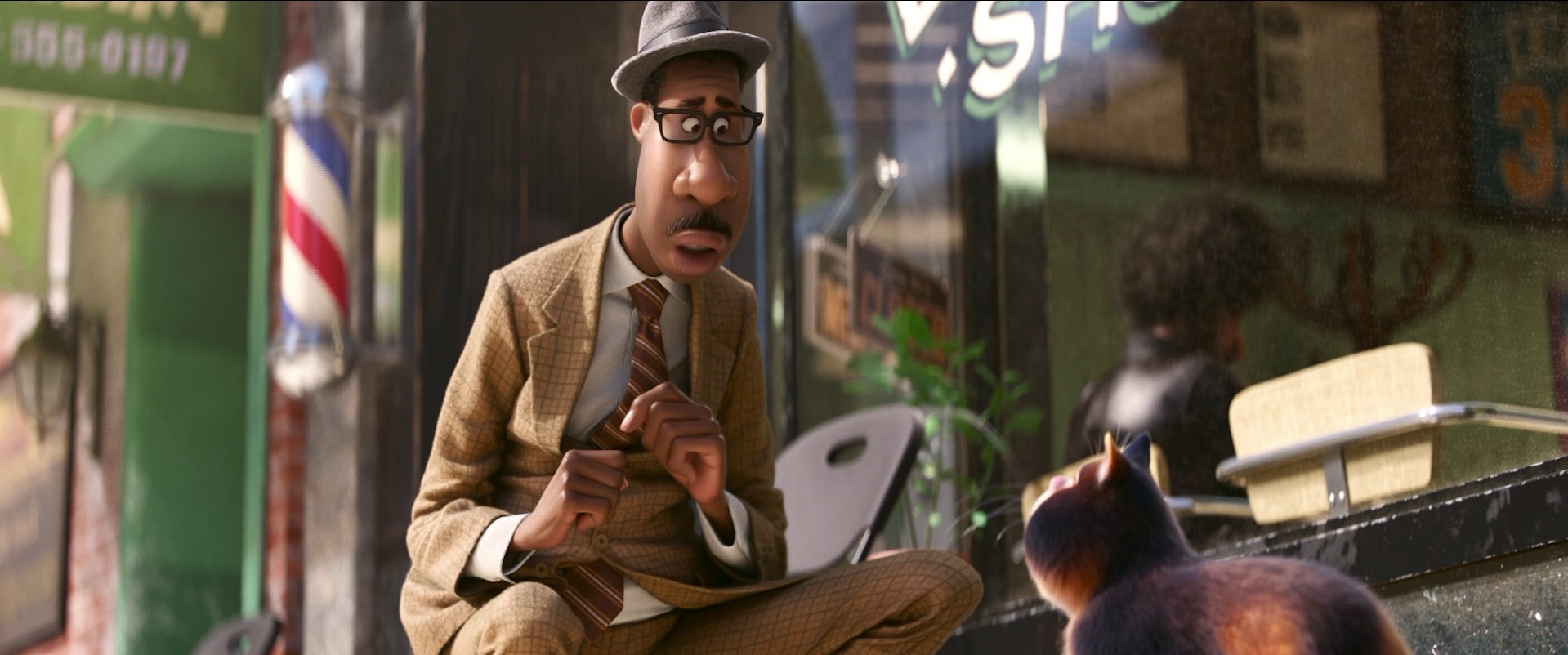
From the 2010s on Pixar’s output became very erratic. Excellent films became rarer, and too much of their output was just okay or even subpar. That said, the studio’s summits were still higher than anything in American studio animation around it, as ‘Soul’ for example proves.
What sets Pixar apart from all other American animation studios is its will to tackle more profound life questions, and not just the tired ‘importance of family’ trope that floods Disney films or the ‘believe in yourself’ message that has become the stale message of almost any American animation film around. No, ‘Soul’ ticks nothing less than the question of what it means to be alive and does so in a surprisingly subtle way, never laying the moral too thick.
‘Soul’ tells about Joe Gardner (a wonderful Jamie Foxx), an aspiring jazz pianist in New York, who finds himself teaching jazz to untalented school children and still depending on his mother, while he still longs for a breakthrough, despite being past his prime. Then opportunity knocks…
‘Soul’ is one of those extremely rare animation films starring African American people, and like the great predecessor in this respect, ‘The Princess and the Frog’ (2009), we see the black protagonist change into another shape for quite a while, because for a substantial part of the movie we watch ‘Joe Gardner’ wander ‘the great before’ in his spirit form. One almost starts to wonder if the American studios don’t dare to make their audiences watch black characters for too long. But luckily, we quite quickly return to New York and to its black community. I love how the film is about blacks without being about being black. The film also stars a very strong (and not totally sympathetic) female star saxophone player called Dorothea Williams, and jazz indeed plays an important part in the feature, even if the film isn’t about jazz, or music, at all.
For in ‘the great before’ Joe meets ‘22’, a soul terrified of life, and dodging being born for centuries. ‘22’ (greatly voiced by Tina Fey) simply refuses being born, and she isn’t able either, because she hasn’t found her spark, yet. It’s up to Joe to find it with her, otherwise he’ll never return to Earth.
The before-life scenes belong to the great world building sequences of any fantasy film. The new souls, for example, are guided by weird two-dimensional beings, all called ‘Jerry’, who look like they’ve walked away from a Picasso painting. There’s nothing of ‘this world is actually like contemporary America’, like that of ‘Monsters, Inc.’, ‘Cars’ or ‘Onward’. Even the colorful afterlife in ‘Coco’ looks rather mundane compared to this place, with its clear 1950s cartoon modern designs and strange surroundings.
‘Soul’ knows a wonderful plot with many surprise turns and unexpected twists and certainly entertains to the very end. The only very weak spot is Joe’s all too easy return to the other world in the end. This return was clearly needed for the plot, but the sequence feels forced and fails to convince, unfortunately breaking the suspense of disbelief. Nonetheless, the film certainly shows what it means to be alive, and there are sequences of great beauty and deep emotion, given to us in subtle doses and understated character animation. In all, ‘Soul’ belongs to the best animation film can offer, and it is arguably the first animated masterpiece of the new decade.
Watch the trailer for ‘Soul’ yourself and tell me what you think:
‘Soul’ is available on Blu-Ray and DVD
Director: Rémi Chayé
Release date: June 28, 2020
Rating: ★★★★★
Review:

In 2015 Rémi Chayé surprised the animation world with his strong feature film ‘Tout en haut du monde’ (Long Way North), but his second feature, ‘Calamity, une enfance de Martha Jane Cannary’ arguably is even better.
Like the previous film ‘Calamity’ excels in an absolutely gorgeous digital background art, showing the prairies and mountains of the West in a plethora of colors, making each frame a delight to watch. But of course, this isn’t enough to sustain a feature film, and I am glad I can say that the story is also very good.
Like ‘Tout en haut du monde’ ‘Calamity’ stars a strong young female protagonist, and even more than in the previous film, ‘Calamity’ deals with the oppressive gender roles women were forced into, even if it didn’t suit their characters, ambitions and talents, at all. The film, of course, is based on real life enfant terrible Calamity Jane (1852-1903), but only vaguely so, and the film is called ‘A childhood’ and not ‘THE Childhood’, because the events depicted are mostly fictional and do not correspond to what we know about the historical Martha Jane Can(n)ary.
Nevertheless, with this film Chayé succeeds in making a subtle yet strong feminist statement. In fact, ‘Calamity’ is one of two strong European animation films from 2020 showing the historical plight of women, and how a masculine society kept them down for ages, for ‘Wolfwalkers’ by Cartoon Saloon tackles the same issues.
In the film we follow young Martha Jane (ca. 12-14 years old, I guess) accompanying her father and her two younger siblings on a caravan to Oregon. Her rather clumsy father is quite an outcast in the caravan, and Martha Jane is frequently mocked by Ethan, the son of the caravan’s leader, Mr. Abraham. When Martha Jane’s father breaks his ribs and must lay down in the wagon, and when goods get stolen from the caravan there’s an opportunity for Martha to break out of her role as an obedient girl, which she does with gusto, defying all counterforces she meets.
During the film Martha Jane poses as a boy called Marcus for a long time, and the only implausibility is when she gets chained to a real boy called Jonas. How she manages to maintain her disguise during these days baffles me. Otherwise, this is a strong coming of age film, which shows that women can be the equals of men, if they’re only allowed to.
Apart from gorgeous background art, the film includes appealing character designs, an effective, often surprisingly Japanese-like animation style and appropriate music. The result is one of the best feature films of 2020, on the same level as the more famous ‘Soul’ and ‘Wolfwalkers’.
Watch the trailer for ‘Calamity, a Childhood of Martha Jane Cannary’ yourself and tell me what you think:
‘Calamity, une enfance de Martha Jane Cannary (Calamity, a Childhood of Martha Jane Cannary)’ is available on Blu-Ray and DVD
Director: Walt Dohm
Release date: April 10, 2020
Rating: ★★
Review:
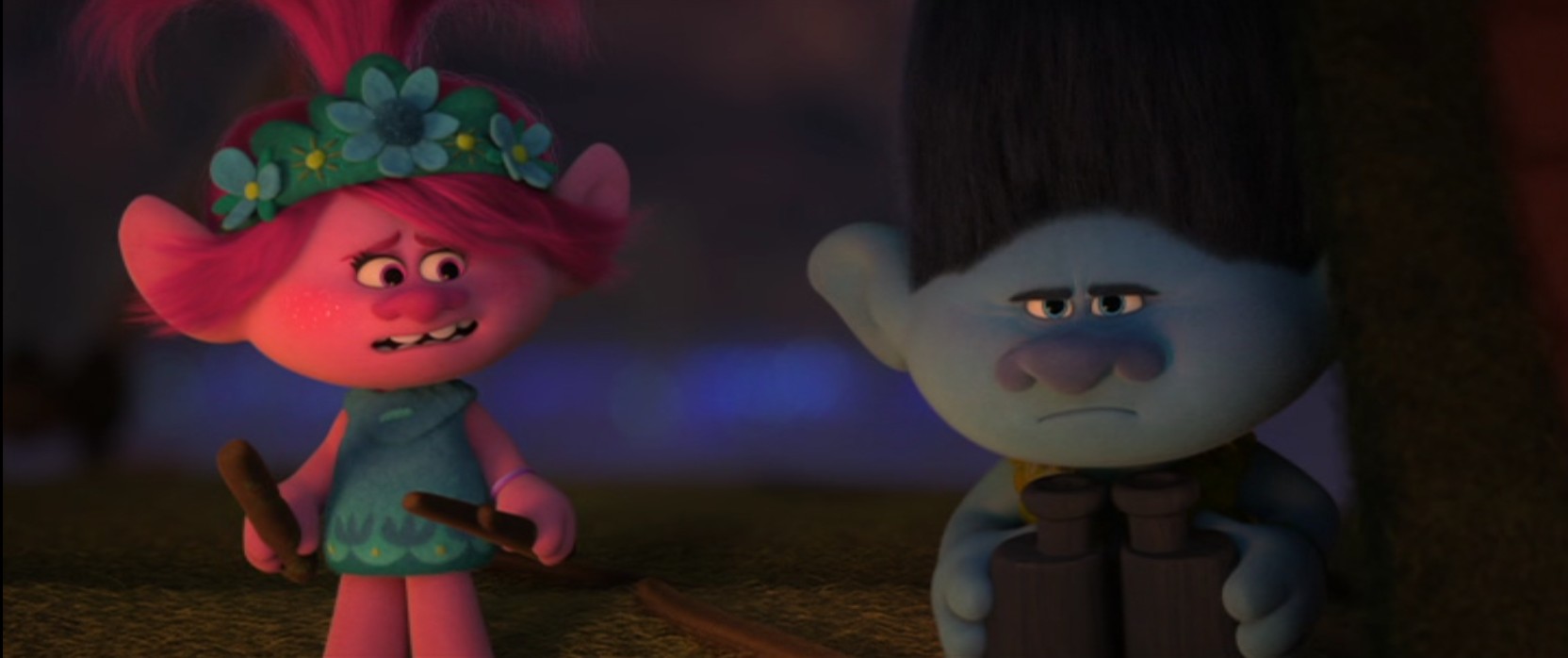
Dreamworks’ 2016 Film ‘Trolls’ was a bit of a surprise, given the fact that it was based on a pretty ugly Danish toy line from the 1950s. Despite its lackluster origins, the film was an unforeseen outburst of color, textures and music, even spawning a major hit (‘Can’t Stop the Feeling!’) for Justin Timberlake, who voiced Branch, one of the main characters.
‘Trolls’ nevertheless was nothing remarkable storywise, but compared to its successor, ‘Trolls World Tour’ still by far the more interesting movie. ‘Trolls World Tour’ is even more colorful and more tactile than its predecessor, but its plot is disappointingly lazy, conventional, and frustratingly inconsistent (more of which, later).
There are even two obligate breakup scenes, neither of which makes sense, and the film’s obvious morale is even explained to us by Poppy at the very end. What do they think at Dreamworks? That their public consists of complete morons? Even a six-year-old could have distilled the message from the story. There’s a pinky promise, which is introduced with much bravado, but which remains inconsequential, after all. At one point Branch convinces the villains to side with him, but we don’t even see how he manages to do that.
These are just a few examples of an annoying lack of storytelling skills demonstrated in the movie.
In fact, problems already start with the film’s premise: ‘Trolls World Tour’ throws the world building of the original movie completely overboard to install a new one, in which there are five more troll kingdoms, all based on a major music genre. Given the wide range of music that exists in the world, the idea of a mere six kingdoms is absurd to begin with, but soon becomes apparent that this world building is not only incomplete, it’s highly inconsistent.
Of all genres imaginable, especially jazz is painfully lacking, only represented by one character exemplifying ‘smooth jazz’, while all world genres are diminished to three sets of isolated characters, representing K-pop, reggaeton, and… yodeling. Now, as a Dutchman, I was pleasantly surprised that the yodeling featured came from the hard rocking seventies hit ‘Hocus Pocus’ by Dutch group Focus, but otherwise, frankly, it makes no sense. Why do these characters lack a kingdom of their own? Why did they become bounty hunters (for that’s what they are)? What of all other genres imaginable? Where are those trolls?
The major genres in the other kingdoms hardly fare better than jazz however: classical music is represented by 18th- 19th century orchestral music only, funk and hiphop are merged as if it were one genre, and the dance depicted is of the poppiest sort imaginable. Rock, meanwhile, looks mostly like an evil metal kingdom, led by a punky princess, whose story ark (she has no real friends) is both forced and neglected. I liked country land, led by a Kelly Clarkson voiced character, most, especially because the textile background art was most apparent in this world.
For this background art is the real star of the movie: all troll landscapes are made of textiles, even the water at the edge of a pond has a frayed edge. While yawning at all the obligate antics of the characters, these background images kept me smiling and in admiration throughout the picture.
But of course, background art cannot save a film with such a weak story as ‘Trolls World Tour’ has, and the end result simply is subpar. It’s a shame, for obviously, a lot of talent has been wasted on this picture, not least the great music stars like Anderson .Paak, George Clinton, Mary J. Blige, and Ozzy Osbourne who have lent their voice to this lackluster product. And let’s not forget the animation talent. For example, when Poppy realizes she might not have been a good queen after all, this is a piece of excellent character animation, but we don’t care, nonetheless, because the emotion is forced into the plot, and has no logical place in the narrative. ‘Trolls World Tour’ is full of such moments and can best be quickly forgotten.
Watch the trailer for ‘Trolls World Tour’ yourself and tell me what you think:
‘Trolls World Tour’ is available on Blu-Ray and DVD
Director: Dan Scanlon
Release date: February 21, 2020
Rating: ★★★
Review:

‘Onward’, Pixar’s 22nd feature film, was the first of a series of four originals after a decade of sequels (the 2010s saw seven sequels compared to a mere four originals), making the 2020s a more interesting decade than the 2010s were. Unfortunately, Pixar’s return to original stories didn’t necessarily mean their films got better. ‘Onward’, at least, is not a bad film, but it never becomes great, either. The movie just lingers in mediocrity, relying too heavily on tried formulas and cliches.
‘Onward’ takes place in a fantasy world populated by elves, unicorns, centaurs, fauns, manticores and so on. But like the human-less worlds of ‘Monsters Inc.’, ‘Cars’ or to a lesser extent the later ‘Elemental’ the makers haven’t made any effort to make this world a really original one, turning it into just another lazy version of suburbia America. The whole idea of ‘Onward’ is that it used to be a magical place, until technology took over, making this world as bland and devoid of magic as ours.
In this world we follow teenager elf Ian, who’s designed as your average clumsy insecure teenager, a sort of Linguini from ‘Ratatouille’ (2007), but blue and with pointed ears. Ian also is one of those protagonists that all too often recur in animation films: one that has lost a parent (see also e.g. ‘Kung Fu Panda’ (2008), ‘The Good Dinosaur‘ (2015) and ‘Abominable’ from 2019). On his birthday Ian makes some resolutions to become a better person, but they are all thwarted, until his mother gives him and his quirky elder brother Barley a gift from their deceased father…
What follows is a truly dangerous quest in which the two brothers must team up to restore their father for just one day. This they do accompanied by their dad’s two legs, for that’s all what Ian managed to retrieve from the spirit world in the first place. Barley’s extensive knowledge of magic, which he got from playing a role game “based on reality” is a great help during their quest. Unfortunately for Barley, despite all his knowledge of magic, he hasn’t got the magic skill, but Ian has.
With their quest the two brothers not only restore magic to their world, Ian also comes to realize that his older brother is not only an annoying looney to be ashamed of, but much more to him. And yet, a more interesting and more original yet sadly underdeveloped character than either two brothers, is Ian’s and Barley’s mother, who comes into action and who dares to take risks to save her boys.
The brothers’ magical quest stands in huge contrast with the mundane world they live in, and the studio never really manages to wed these two worlds. In the end, the whole concept of a fantasy world turned mundane remains a forced and unconvincing one, and that one gift from a random father could restore magic to the entire world is anything but believable, even within the fantasy context.
Moreover, as said, the film relies too much on tropes to tell its stories. The magic in ‘Onward’ feels like a direct copy from the Harry Potter’-films with its use of spells. There is the obligate breakup scene, one that is particularly painful, because by that time Ian should have known better. And then there’s a curse, which actually stands in the way of a plot that should concentrate on the relationship between the two brothers, which the film mostly does, but to which, to me at least, the whole magic idea seems superfluous and unnecessary.
Of course, the power of animation is that it can show impossible things like elves and manticores, but for once, I believe that the film would be more courageous if it would tell the story of two real brothers living in American suburbia, bonding together after the death of their father. For this is the essence of the film, meaning that the fantasy part, despite driving the plot, is mostly fluff. Despite the final resurrection of the father being a beautiful moment in the movie, the film just doesn’t manage to pluck one emotional string like ‘Monsters, Inc.’ (2001), ‘Wall-E’ (2008), ‘Up’ (2009) or ‘Coco’ could. Pixar certainly could do better, something they would luckily prove with their next feature, ‘Soul‘.
Watch the trailer for ‘Onward’ yourself and tell me what you think:
‘Onward’ is available on Blu-Ray and DVD
Director: Mike Mitchell
Release date: February 2, 2019
Rating: ★★★
Review:

One of the surprises of 2014 was ‘The Lego Movie’, a surprisingly funny and sophisticated movie, making clever use of the source material, and transcending by far the product placement it actually was. Its huge success spawned the equally great ‘The Lego Batman Movie’ and the much weaker ‘The Lego Ninjago Movie’ (both from 2017), but one had to wait for five years for the true sequel: The Lego Movie 2: The Second Part.
This second movie immediately starts with a new threat to Bricksburg, the city in which Emmett lives, this time from the planet Duplo. In a toddler’s voice the new arrivals claim: “We are from the Planet Duplo, we are here to destroy you”. After some mayhem we jump to five years later, in which Bricksburg has apparently been destroyed and rebuilt as ‘Apocalypseburg’, a Mad Max-like post-apocalyptic world in which according to his girlfriend Lucy there’s no place anymore for niceness and optimism, although Emmett is still full of these things, despite having nightmares of “Armamageddon” (sic).
To make matters worse, a new, almost indestructible alien arrives with the name of General Mayhem, messenger of the shape-shifting Queen Watevra Wa’Nabi from the “Systar System”. What follows is another adventure full of references to other movies (e.g. The Wizard of Oz), which takes place both in the LEGO world and in live action, and in which Emmett meets a though guy called Rex Dangervest, who teach Emmett to grow up, or does he?
Unfortunately, this movie strives too hard to play a similar trick to the LEGO world as the first film, but it does all too obviously so. For example, we could see the origin of ‘Systar system’ from miles away. A huge talent like Maya Rudolph is wasted on the live action scenes, which remain formulaic and unspontaneous. The film’s message, too, is brought right in your face and lacks all the subtleties of the first film. There are some nice touches (for example, Bruce Willis playing a Lego version of himself, some nice 2D animation and a couple of pleasant songs), but overall the film never transcends mediocrity, despite all the evident effort. Thus one must conclude that after two films most of the inspiration for LEGO movies had died out.
Watch the trailer for ‘The Lego Movie 2: The Second Part’ yourself and tell me what you think:
‘The Lego Movie 2: The Second Part’ is available on Blu-Ray and DVD
Directors: Max Lang & Daniel Snaddon
Release date: December 25, 2019
Rating: ★★★½
Review:

‘The Snail and the Whale’ is yet another Magic Light Pictures production based on a Julia Donaldson and Axel Scheffler book. Like all the books and films based on them since 2009’s ‘The Gruffalo’ the film is told in rhyme. But because this adventure takes place mostly at sea, there’s much more CGI involved than usual, and the film thus is less tactile than Magic Light Pictures earlier productions.
The story is cute and shows that even the smallest can make a difference. Yet, the film is less compelling than say ‘The Gruffalo’ (2009), ‘Room on the Broom‘ (2012) or ‘Stick Man’ (2015) and that’s because of the source material, which just isn’t on the same level of story telling. The small gags present in earlier films are also lacking, and for a too large part we just watch the little snail enjoy its travels without anything else happening.
The animation, of course, is top notch, and the designs are, as always, appealing, although the human figures are much less interesting than the animals, and the whale is rendered rather straight. You can also sense the difficulty of the interaction between the two animals, because of the gigantic size difference. The result is a charming film, if not among Magic Light Pictures’ best works.
Watch the trailer of ‘The Snail and the Whale’ yourself and tell me what you think:
‘The Snail and the Whale’ is available on DVD
Directors: Troy Quane & Nick Bruno
Release date: December 4, 2019
Rating: ★★★
Review:

In the opening scenes of ‘Spies in Disguise’ we are introduced to young boy Walter Beckett, the son of a single mom, who’s a police officer. Walter is a ‘weirdo’ to his class mates, but secretly a genius, inventing all kinds of surprisingly peaceful weapons for his mom. Fourteen years later, he has found employment at ‘H.T.U.V.’, a non-existing American spy agency, as one of the inventors cooking up new weaponry for the organization’s spies.
Superstar among these spies is Lance Sterling. Voiced by Will Smith, Sterling is a black version of James Bond: clear-headed, cool and on the cocky side. But things quickly turn against him, when an unknown villain takes his identity, and Sterling becomes hunted by his own agency. To redeem his name, he unwillingly has to team up with Walter and his pacifist weaponry, which includes a very unlikely transformation of the hero…
‘Spies in Disguise’ was adapted from the 2009 animated short ‘Pigeon: Impossible’ and is for the most part standard spy fare, taking place in faraway places like Mexico and Venice. The buddy theme is also tried material, and there are the obligate scenes of almost every American animated feature film of the era, like the obligate breakup scene, and a ‘all hope is lost’ moment. No, the most original aspect of ‘Spies in Disguise’ lies in its strong pacifist theme. As Walter puts it: “when you fight fire with fire, we all get burned”. Even the villain, who certainly meant the worst, is spared in the end.
Artistically the film remains on safe grounds. The human designs are dull and uninspired. For example, Walter is yet another variation on ‘the clumsy young man’ design, akin to Linguini in ‘Ratatouille’ (2007) or Johnny Loughran in ‘Hotel Transylvania’ (2012), while Lance Sterling is too clearly modelled on Smith’s coolest film roles, like that of agent J in ‘Men in Black’ (1997). The rest of the designs are on the angular side, without ever venturing into bold stylization. The color palette is perhaps the most interesting aspect of the film.
Unfortunately, Blue Sky wasn’t allowed to show if it could venture into more exciting territories, because ‘Spies in Disguise’ was the last feature film by the ill-fated animation studio. When Disney bought 20th Century Fox in March 2019 it acquired the animation studio with it. Of course, Disney had no use for yet another animation studio, and thus ‘Blue Sky’ was closed in 2021, officially due to the consequences of the covid pandemic…
Watch the first trailer of ‘Spies in Disguise’ yourself and tell me what you think:
‘Spies in Disguise’ is available on Blu-Ray and DVD
Director: Andrew Erekson
Release date: September 27, 2019
Rating: ★★★½
Review:

In the Dreamworks short ‘Marooned’ a little robot on the moon dreams of going to Earth. He tries to build a rocket to achieve his goal, but then he finds another robot in the moon dust…
‘Marooned’ is a cute little short full of subtle character animation and silent comedy. One quickly identifies with the little robot and his plight. Moreover, the short excels in pleasant looks: the moon is rendered in stark contrasts, and the whole short has a particular neo-fifties look. Even the Earth looks stylized.
The only criticism I have is that not every action is staged that well: some little scenes are harder to follow than should.
Watch the trailer of ‘Marooned’ yourself and tell me what you think:
‘Marooned’ is available on the Blu-Ray and DVD of ‘Abominable’
Director: Piet Kroon
Release date: October 13, 2018
Rating: ★★
Review:

The Dutch animated feature film industry long consisted of one movie only, ‘Als je begrijpt wat ik bedoel’ (The Dragon That Wasn’t (Or Was He?)) from 1983. But in recent years several other films saw the light, mostly directed at youngsters: ‘Nijntje de film’ (Miffy the Movie) from 2013 , ‘Pim & Pom: Het Grote Avontuur’ and ‘Trippel Trappel – Dierensinterklaas’, which are both from 2014, and more recently ‘Knor’ (‘Oink’) from 2022 and ‘Vos en haas redden het bos’ from 2024. An oddball within this recent canon is ‘Heinz’ from 2018.
‘Heinz’ was a comic strip by René Windig and Eddie de Jong that run in Dutch newspapers from 1987 to 2000 and again from 2004 to 2006. The comic strip was about a cat, Heinz, who quickly got more anthropomorphized until he became a sort of everyman. The strip knew some continuities but remained first and foremost a gag strip. Nevertheless, the authors dreamt of an animation film at least since the early 2000s.
Although film studio Zig Zag film started working on a film already in 2002, Windig’s and De Jong’s dream never amounted to anything. That is, until the project got new backing and new support from veteran animator Piet Kroon in 2015.
Piet Kroon had ample experience in America, having directed the animation for ‘Osmosis Jones’ (2001) and having worked on stories for a wide variety of animated feature films, e.g. ‘The Iron Giant’ (1999), ‘The Tale of Despereaux’ (2008), ‘Rio’ (2011) and ‘Ferdinand’ (2017). Kroon wrote a completely new story for the film, and with this much of the charm of the original comic strip got lost, and I doubt whether Windig and De Jong are pleased with the end result.
The first aspect of the original comic strip that went out of the window was its family-friendly nature, despite being produced by Burny Bos, who produced some of the best Dutch live action children’s movies. The feature film is clearly directed to adults and has little to offer for younger audiences (in the Netherlands the film is advised for 12 years and older, that says enough). The second major change Kroon made was the setting. The original comic strip takes place in an undefined fantasy Netherlands, but the movie Heinz clearly lives in the center of Amsterdam, which incidentally is also the residence of the comic strip’s two authors.
A more profound and more disturbing change than these two is the change of character of the cat himself. In the comic strip Heinz certainly is cranky, and sometimes insufferable, but in the movie, he is a downright irresponsible drunkard and deadbeat. In fact, in the early scenes the cat is so unsympathetic one wonders why he must watch the cat’s immature antics in the first place. Heinz’s voice by Ruben van der Meer, on the other hand, is well-chosen.
Heinz’s girlfriend Dolly fares little better, as she has changed from a sweet love to a working-class shrew, while Heinz’s friend Frits is nastier and more unsympathetic than his comic book counterpart. Frits also suffers from a bad voice choice (Reinder van der Naalt). In fact, one must look hard for any sympathetic character in the film…
Kroon certainly has tried to put as many characters from the original comic strip as possible into the film, and thus the movie is simply crowded with characters, who mostly make little to no sense to anyone not familiar with the source material. These characters and the rather random inclusion of some gags from the original comic strip make the film too much of an inside joke. On the other hand, the story itself is entertaining enough: it involves time travel, takes Heinz to a remote volcano island and to New York, where he must battle an evil scientist from outer space. But the unsympathetic leads, the plethora of characters, and the random, and often repeated gags make the film a tiresome watch.
The film’s stylistic choices don’t help. The background art is pretty ugly and consists of reworked photo material against which the characters don’t read very well. The ocean is even live action footage. Again, with this method much of the original charm of the comic strip gets lost. The computer animation is a mixed bag. There are a lot of animation cycles, and especially the numerous background characters walk around like automatons with little to no life in them.
No doubt, these technical drawbacks result from an all too tight budget, as it’s a marvel that the film came about in the first place. Most charming are the depictions of Heinz’s fantasies, which consist of traditional animation of René Windig’s idiosyncratic drawings. It’s too bad only these little sequences were made this way.
In all, ‘Heinz’ is a disappointing movie that will attract small audiences, neither satisfying fans of the original comic strip nor anyone else. I cannot find any figures, but I am pretty sure the movie turned out to be a box office flop, and I regret to say unsurprisingly so.
Watch the Dutch trailer for ‘Heinz’ yourself and tell me what you think:
‘Heinz’ is available on DVD (Dutch only)
Director: Michel Ocelot
Release date: June 11, 2018
Rating: ★★★
Review:

Michel Ocelot belongs to the great author-directors of animated feature films, bringing us such gems as ‘Kirikou et la Sorcière’ (1998), ‘Azur & Asmar’ (2006) and ‘Les Contes de la nuit’ (2011). But somehow, his latest movie, ‘Dilili à Paris’ from 2018 has escaped international attention.
The most obvious reason for this is that ‘Dilili à Paris’ is first and foremost an ode to Paris of 1900-1901*. It’s thus an utterly French film, simply crowded by famous people, many of which actively play a role in the story. I counted 26 painters, actors, dancers, authors, composers, and scientists, not counting a multitude of more in the background. Luckily, this doesn’t mean that film is a nationalistic one, for Ocelot includes a lot of foreigners in his pantheon of greats, e.g. Polish scientist Marie Curie, Romanian sculptor Constantin Brâncuși, Venezuelan composer Reynaldo Hahn, future British king Edward VII and Brazilian aviation pioneer Alberto Santos-Dumont.
In fact, by centering the film on these great minds in science and art, the film is also an ode to the fantasy and free thought of people. At the same time, the film is a firm statement against narrowmindedness, xenophobia, and oppression. Which brings us to the third theme of the film, which is a strong feminist one. In fact, apart from Dilili’s friend, the Parisian boy Orel, all main players are women, including soprano Emma Calvé (voiced by Natalie Dessay), stage actress Sarah Bernhardt, the aforementioned Marie Curie, and the feminist Louise Michel. Together with these women and many of the other famed people, Dilili and Orel unravel a secret plot in which the mysterious ‘male-masters’ kidnap little girls. Their anti-feminist scheme turns out to be one of nightmarish proportions. It’s clear that to Ocelot one should not underestimate, let alone oppress any human being, whether based on age, sex, color, nationality or whatever. A message that cannot be reinstated enough.
Dilili herself is an original heroine, a tiny Kanak girl from New Caledonia, who speaks French fluently, but who’s only brought to Paris to reenact her lifestyle in the jungle at the Exposition Universelle, a world exhibition that run from April 14 to November 12, 1900. When touring through Paris Dilili is dressed like a prize doll, and she also provides the film running gag, because to every person she meets she repeats the utterly polite sentence of ‘je suis heureuse de vous rencontrer’ (I am delighted to meet you). Of course, she experiences racism during her Parisian journeys, but this is not the film’s main theme.
Paris meanwhile comes to life in the extremely intricate background art, which is clearly based on photo material of contemporary Paris. The computer animation unfortunately is less impressive, and at times downright stiff. Especially Orel is poorly animated. When he makes friends with Dilili his moves and facial expressions are so terribly rigid, it doesn’t transcend puppet theater. The ending, too, leaves much to be desired, as the film’s finale is partly told during the end titles.
In the end the film is a little bit too crowded by famous people and certainly too poorly animated to be a masterpiece, but the mystery plot is a fine one, and the film’s message an important one. Above all ‘Dilili à Paris’ is a fine children’s film that deserves to be seen at least once.
Watch the trailer for ‘Dilili à Paris’ yourself and tell me what you think:
‘Dilili à Paris’ is available on Blu-Ray and DVD
* In fact, we can date the time period of the film pretty well, as Pablo Picasso first set foot in Paris in September 1900, and Edward VII became king on January 22, 1901, thus the events must be placed between September 1900 and January 1901.
Directors: Bob Persichetti, Peter Ramsey & Rodney Rothman
Release date: December 14, 2018
Rating: ★★★½
Review:

For American feature animation 2018 was mostly a rather uneventful year. True, the year started off well with the release of ‘Isle of Dogs’, and it was also the year of Nina Paley’s second animation feature, ‘Seder-Masochism’, but for the rest it was a year of uninventive sequels (Pixar’s ‘Incredibles 2’, Disney’s ‘Ralph Breaks the Internet, Sony’s ‘Hotel Transylvania 3: Summer Vacation’) and mediocre stand-alones (Warner Bros.’ ‘Smallfoot’ and Illumination’s ‘The Grinch’).
But then, at the closing of the year suddenly a complete game-changer entered the scene: ‘Spider-Man into the Spider-Verse’. The film was brought by Sony Animation, the most evasive from all major animation studios, releasing both gruesomely bad movies like ‘The Smurfs’ (2013) and ‘The Emoji Movie’ (2017), as well as more interesting experiments, like ‘Surf’s Up’ (2007). This animated Spider-Man feature certainly falls into the latter category, bringing the animation world a totally new aesthetic.
Like all other films mentioned (sans ‘Seder-Machochism’) ‘Spider-Man into the Spider-Verse’ is a 3D computer-animated film, but unlike all others this feature has a distinct comic book style, complete with clearly visible halftone dots, and even color-shifts that look like misprinting of color layers when the ‘camera’ gets out of focus. The film even adds other stylistic elements from comic books, like page-turning effects, text panels and panel-like split screens to enhance the comic book feel. Even though traditional texturing and rendering is completely in place, never does the art aspire to be realistic, but always to keep the comic book feel intact.
‘Spider-Man into the Spider-Verse’ thus is a delight to watch, and a welcome fresh take on traditional 3D computer animation. In fact, the excitement the film stirred in the animation world is comparable to that of ‘The Matrix’ (1999) in the live action film industry. That its stylistic innovation was not an isolated event was proved by subsequent films like ‘Puss in Boots: The Last Wish’ (Dreamworks, 2022) and ‘Teenage Mutant Ninja Turtles: Mutant Mayhem’ (Paramount, 2023). Certainly the latter took heed of the lessons from ‘Spider-Man’.
The story of ‘Spider-Man into the Spider-Verse’ is another reboot of the then 56 years old comic. This time we follow a black teenager from Brooklyn called Miles, who is a son from an over-protective cop, but who leans more towards his less well-behaved uncle Aaron. The most remarkable event in the film is that the original Spider-Man, Peter Parker, actually dies, and Miles, who due to unexplained events is bitten by a radio-active spider, too, must take his place.
In fact, the plot is much more complicated, and involves villain Kingpin trying to get his deceased wife and son back from a parallel universe opened by a portal devised by Doctor Olivia “Liv” Octavius, another villain who apparently is the successor to Doc Ock (I’m hardly familiar with the Spider-Man world, so these villains are unknown to me).
The portal also imports five spider-men from alternate universes (and I guess, the Alchemax spider that bit Miles), most importantly a less successful middle-aged Peter Parker and a young Spider-Woman called Gwen, but also a manga girl-spider-man, a black and white film-noir Spider-man and even a looney tune-like spider-man-pig called ‘Spider-Ham’. Part of the fun is the play with these alternate universe characters, some of which are gleefully silly, but I must say the main story is told pretty heavy-handedly.
In fact, the film’s story is hardly as good as the visuals: it’s hard to follow, it’s full of plot-holes, it has some rather forced scenes (most notably the utterly improbable scene in May Parker’s basement, and a believe-in-yourself-like scene in which Miles really becomes a Spider-Man), and a large dose of melodrama that I could hardly stand. Moreover, the finale is taking place in such a messy setting, I had no idea what was going on.
No, did ‘Spider-Man into the Spider-Verse’ not have the astonishing looks it has, I wouldn’t have been entertained so much, the fun parallel world plot notwithstanding. But as it is, ‘Spider-Man into the Spider-Verse’ is one of the most important animated features from the 2010s, a status corroborated by its equally praised sequel, ‘Spider-Man: Across the Spider-Verse’ from 2023.
Watch the trailer for ‘Spider-Man into the Spider-Verse’ yourself and tell me what you think:
‘Spider-Man into the Spider-Verse’ is available on Blu-Ray and DVD
Director: Milorad Krstić
Release date: August 9, 2018
Rating: ★★★½
Review:

One of the more surprising and more original animated feature films from 2018 was this little gem from Hungary. Conceived and directed by Milorad Krstić, a director of Slovenian origin, ‘Ruben Brandt’ shows that one can make an adult animation film without an immature focus on sex and violence (there is violence in this feature film, because ‘Ruben Brandt’ is a crime thriller, but this violence is part of the plot, and not a gratuitous display of gore).
‘Ruben Brandt’ tells about a psychiatrist treating some criminals, who in turn help him overcome his nightmares by collecting artworks from all over the world. This plot is exciting, but on the flimsy side and as nonsensical as a James Bond movie. Moreover, the film fails to solve all the initiated plotlines, and the all too easy ending is a bit of a letdown.
Nevertheless, ‘Ruben Brandt’ remains an entertaining watch from start to finish, not only because of the surreal atmosphere, enhanced by the depiction of several of the art collector’s nightmares, but because of the film’s idiosyncratic looks.
Being a film on art, the film draws a huge inspiration from its subject, and the film breathes art in almost every frame. According to the end titles the film cites more than fifty art works, and part of the fun of watching the movie is to identify a reference in the background. Moreover, the color schemes, the designs and especially the character designs are very bold and unlike anything in any other animation film.
True, the three main characters Ruben Brandt, Kowalski and Mimi look fairly normal, even if their facial designs are already unique, but their co-stars can have two noses, eyes placed above each other, an eye placed inside an ear, three eyes, three breasts, and so forth and so on. There’s even a character with a Janus head, who is only two-dimensional, a characteristic used in the plot. The background characters are often even more bizarre, let alone the birds and fish depicted, and even if the movie were dull (which it certainly isn’t) one can enjoy the surreal imagery.
The film uses both traditional and computer animation and although the computer animation is less satisfying than the traditional animation, the mix is very well done.
In all, ‘Ruben Brandt’ is a highly authentic film that shows surrealism is far from dead, and with his grotesque designs Krstić shows that even 3D computer animation can be exciting and strikingly original.
Watch the trailer for ‘Ruben Brandt, Collector’ yourself and tell me what you think:
‘Ruben Brandt, Collector’ is available on Blu-Ray and DVD
Director: Nina Paley
Release date: June 11, 2018
Rating: ★★★
Review:

Seder-Masochism is the second feature animation film by independent animation artist Nina Paley (born 1968), who created quite a stir with the lovely ‘Sita Sings the Blues’ (2008) in which she blended events in her personal life with the story of the Ramayana, but from a woman’s view.
Apparently, Paley was criticized for using a myth from another culture for her feminist message, with attackers typically focusing on Paley’s supposed lack of understanding of Hindu religion, an irrelevant argument, as the misogyny that Paley attacked is plainly visible in the source text (especially in the last book). Moreover, the Ramayana is hardly unique in its treatment of women as second rate citizens, which can be found in practically all ancient texts.
To underline this message, for her second feature Paley dived into her own heretical religious culture, that of Jewism. The result is a more vicious and more pamphlet-like feature than ‘Sita Sings the Blues’, mostly because the personal note is hardly present, only in an interview of Paley with her father, recorded years prior, about his stance towards Judaism, and that of the Pesach (or Passover) in particular. In these scenes Paley is shown as a sacrificial goat and her father as God himself.
The Pesach, and the story from the book of Exodus behind it, forms the central element of ‘Seder-Masochism’. The ‘Seder’ in the title apparently is a ritual feast at the beginning of the Jewish Pesach celebration, and contains some questionable elements, like rejoicing over the Egyptian victims of the ten plagues and of the closing of the Red Sea.
Surprisingly, Paley juxtaposes the story of Exodus with the idea that initially human culture was matriarchal and devoted to mother goddesses, a theory popular with feminists, but unsupported by archeological evidence. Paley even goes so far as suggesting the golden calf from the Exodus story was a return to such a mother goddess, and thus to times of more equality between and women. Indeed, Paley seems to blame Moses, or monotheism in general for the misogynist patriarchy that dominates most of human culture in its historical existence. This is pure fantasy and can be easily debunked. But of course, ‘Seder-Masochism’ is no documentary, but Paley’s personal take on monotheism and its approach to women.
Yet, Paley’s clear atheist approach to the biblical story is more vicious than anything in ‘Sita Sings the Blues’, which makes the film less approachable and less a classic than Paley’s first movie. Especially when Paley turns to real life footage of religion-inspired violence the film becomes pure agit-prop. Nevertheless, the scene in which Moses returns from Mount Sinai, commanding a stop to the women’s temporal liberation and forcing them back into their niqab-like clothing remains a painful one, and rightfully evokes anger about religious societies who limit the freedom of women.
Even with its strong message, Paley’s way of storytelling remains highly attractive. Paley’s dry sense of humor permeates much of the film, and her visual style is charming throughout, her command of minimal, but effective animation one of the highest degrees. I especially like the poetic intro in which a female goddess flows through space, and sprouts plants, animals, and eventually men on a soundtrack of the most beautiful Bulgarian female chant. Paley’s dance animation of ancient female statues is also a masterstroke, and an attraction in its own right (Paley offers them as singular GIFs).
Moreover, Paley very skillfully mixes the interview excerpts, an enormous variety of existing music and even a 1950s record in which a man tells about the Seder celebration. In contrast with ‘Sita Sings the Blues’, in which only records by 1920s singer Annette Hanshaw were used, ‘Seder-Masochism’ plunders the Western pop music tradition, often to a very striking effect. Notice, for example the single sample of ‘Helter Skelter’ from The Beatles during the sixth plague, and the earlier mentioned scene in which Moses returns uses Led Zeppelin’s ‘Your Time Is Gonna Come’ to a painful effect. But the film’s highlight in this respect must be the use of 10cc’s ‘The Things We Do for Love’ which accompanies images of Jews gleefully chopping off foreskins, beheading little goats and killing men and women.
The bitter irony of this sequence is topped by the ‘This Land Is Mine’ sequence, which Paley finished first, and which can be watched as a separate video clip. In this utterly bleak section, we watch several nations fight over the land of Israel, killing one another in greater and greater numbers, with Death itself ultimately being triumphant. With Israel raging the war in Gaza today, with its tens of thousands of innocent Palestine victims, this bleak sequence remains as topical as ever.
The ‘This Land Is Mine’ sequence was also one of the last pieces of animation Paley did in Macromedia Flash, before moving over to Moho. But the most surprising piece of animation in the film is not done on either platform but done with embroidery, in a process Paley calls ‘embroidermation’. This is a lovely piece of stop-motion that Paley rightfully saves for the end, just before the ‘This Land Is Mine’ finale.
In all, ‘Seder-Masochism’ is a beautiful, if rather angry film with a strong feminist message. It cannot stand the comparison with ‘Sita Sings the Blues’, which remains the more balanced work, but as author feature films like this remain utterly rare in the animation field, I strongly recommend watching this feature nonetheless. At least it will make you think about the position of women in society. Paley offers her film for free online, and the movie can be downloaded from her site.
Watch the trailer for ‘Seder-Masochism’ yourself and tell me what you think:
‘Seder-Masochism’ can be downloaded for free from Nina Paley’s website
Director: Sarah Smith
Release date: November 11, 2011
Rating: ★★½
Review:

After making ‘Flushed Away’ (2006) in cooperation with Dreamworks, the British animation studio Aardman made another computer animated film, this time in cooperation with Sony, as part of a three year contract with the American production company. Upon its release ‘Arthur Christmas’ was a box office success, but since then it has rather went into oblivion, and I can see why, because the film unfortunately is a flawed one.
In the world of ‘Arthur Christmas’ Father Christmas is not an eternal figure, but a dynasty, with Santa Clauses succeeding each other in time. The film tells about Arthur, whose father is the current Santa Claus, but whose mission are much controlled by his son, Arthur’s elder brother Steve, with military precision. In contrast, Arthur is clumsy, cowardly, afraid of heights and thus totally useless to the Santa Claus clan. Or is he? When, despite all military precision, one present is not delivered, Arthur comes into action.
I’ve once read an article in which someone from Aardman complained that ‘Arthur Christmas’ was not even nominated for an Academy Award, blaming it on the fact that their film was overlooked because it was a holiday film. But the truth is, ‘Arthur Christmas’ is just not that good.
The film’s characters aren’t that sympathetic. The current Santa is as incapable, as he is irresponsible. His son Steve is more ambitious than he is caring, and Arthur may have his heart in the right place, he stumbles through most of the film, which is rather tiring to watch. The finale, in which all elder Santa Clauses realize Arthur’s worth, feels forced and obligatory, and one hardly believes Arthur’s clumsy days are now over.
But the film’s biggest problem is its lack of originality. The film lacks the quirky charm of the British studio’s stop motion work (there are some nice touches here and there, like a wobbly toy on Grandsanta’s sleigh, but these are rare). And despite the British voice cast and mostly European setting, the film feels very, very American. Plot-wise the film ticks all familiar boxes, without straining from tried paths.
Moreover, the designs are erratic and inconsistent: the humans are all cartoony, but the reindeer have realistic designs, and the film features some pretty ugly lions. In fact, the film is utterly unrecognizable as an Aardman product, the only feature film in their catalogue being so generic and bland in its looks.
Luckily, ‘Arthur Christmas’ would be Aardman’s last computer animated movie. With their next project the studio returned to more familiar and much more satisfying waters with ‘The Pirates! In an Adventure with Scientists!’ (2012).
Watch the trailer for ‘Arthur Christmas’ yourself and tell me what you think:
‘Arthur Christmas’ is available on Blu-Ray and DVD
Director: Nina Paley
Release date: February 11, 2008
Rating: ★★★★★
Review:
Unlike the European and Japanese animation field, the American animation studio system is unkind to author films. Walt Disney’s ‘Lilo & Stitch’ (Chris Sanders, 2002) probably comes closest, apart from several feature films based on animated television series. Thankfully, some individual artists have filled this gap, most notably Bill Plympton, releasing no less than seven features. Other notable artists are Don Hertzfeldt (‘It’s Such a Beautiful Day’ from 2012), and Nina Paley. Amazingly, all these artists mostly work totally alone, which makes their accomplishments even more stunning.
Nina Paley ‘Sita Sings the Blues’ for example, is written, directed and produced by Paley alone, which took her five to six years, and which could only be finished with help from crowd-funding, being one of the first animated projects to use this type of fund raising.
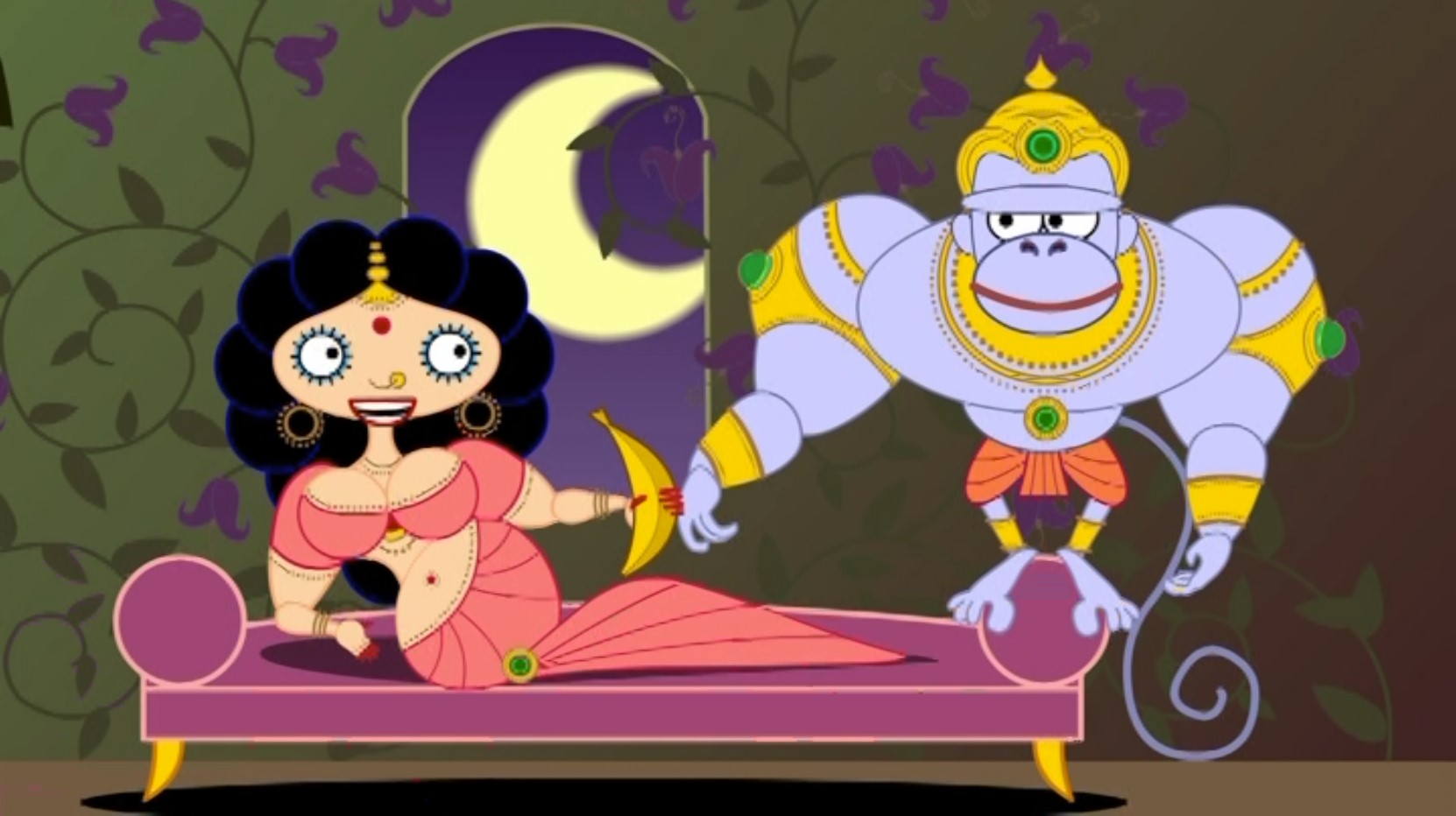
‘Sita Sings the Blues’ retells the Indian epic ‘The Ramayana’, but it’s also a personal film, in which Paley links her own situation to that of Sita, the perfect wife to the hero Rama. The most incongruous element are the eleven songs by 1920s jazz singer Annette Hanshaw, an artist sadly almost forgotten, whom Paley had discovered prior to the film making. The linking of these sweet and gentle tin pan alley songs to the Ramayana is as odd as it is effective, and the pairing certainly contributes to the uniqueness of the film.
The film uses several different animation styles: Nina Paley’s own personal story is told in a traditional scribbly animation style, with sets based on photographic material. These parts are the least attractive of the lot, even though Paley shows to be a very able animator in this classic cartoon style. The Ramayana is retold by three Indians (Aseem Chhabra, Bhavana Nagulapally and Manish Acharya) who are depicted as traditional shadow puppets of Hanuman, Sita, and Rama, respectively. The story they are telling together is shown in tongue-in-cheek cut-out animation.
The ‘official’ story is also told in cut-out animation, using very attractive recreations of traditional Indian paintings. But the best parts to look at are the songs, which are done in a most attractive cartoon modern design. In these song parts Paley reuses a lot of animation cycles, but actually she makes excellent use of the flash medium, and she makes the most of her limited animation.
Apart from these five alternating styles, there’s also a short sequence using rotoscope and a much more pop-art influenced videoclip-like filming style. All these are apparently done in Macromedia flash.
As said, ‘Sita Sings the Blues’ retells the Ramayana, reducing the huge epic to its barest elements. For example, Lakshmana is hardly mentioned, and the monkey king Sugriva not at all. Moreover, unlike the traditional poem, the focus is on Sita, not Rama, and Paley highlights the questionable parts from the original poem (one at the end of the Yuddha Kanda, and another in the Uttara Kanda), in which Rama treats Sita very unfairly indeed, just like Paley’s own partner does in real life. This makes ‘Sita Sings the Blues’ a feminist film, which sheds a welcome critical light on the traditional depiction and treatment of women, then and now.
As the story is told by three people, who remember the story differently and interpret it in different ways, this leads to some very funny moments. But Paley adds some humor, too, in the ‘official’ story part, for example when the female rakshasa (a sort of demon) Shurpanakha tells her brother Ravana about the beauty of Sita, comparing all her body parts with lotuses.
As said, the Annette Hanshaw songs boast the most attractive designs, and like traditional opera arias, they shed an emotional light on the events. However, Paley cleverly propels the story forward even during these sequences. Yet, as the songs are featured in their entirety, typically lasting ca. 3 minutes, they also drag the film down. As there are eleven of them, one tends to grow a little weary of them as the film progresses. Nevertheless, ‘Sita Sings the Blues’ does a great job in restoring interest in this almost forgotten singer. Unfortunately, the Hanshaw songs were not free from copyright, causing Paley a lot of trouble, and eventually causing her to release the film completely free from copyright.
The Annette Hanshaw songs are juxtaposed to some Indian pop music, mostly by artist Masaladosa. Particularly strong is the angry song which follows the scene in which Paley gets dumped by email. The complete soundtrack is as attractive as the film’s visual designs, and the two complement each other very well.
In all, ‘Sita Sings the Blues’ is not without its flaws, but as it is made by a single woman, it’s no less than a tour-de-force, and the result is a very interesting personal film, which makes one think. Moreover, the film shows the great power and endless possibilities of animation, and single-handedly puts Paley into the pantheon of the medium’s greats. In 2018 Paley made yet another feature called ‘Seder-Masochism’, which unfortunately has attracted much less attention.
Watch the trailer for ‘Sita Sings the Blues’ yourself and tell me what you think:
‘Sita Sings the Blues’ is available on DVD
Director: Jeroen Jaspaert
Airing date: December 25, 2017
Rating: ★★★½
Review:

‘The Highway Rat’ is the sixth animated Christmas special by Magic Light Pictures. Like all the others (save ‘Revolting Rhymes’ from 2016) the film is based on a children’s book by Julia Donaldson and Axel Scheffler, and like all, narrated in rhyme.
The film boasts the same charming stop-motion-like computer animation and elaborate real sets as the others, and features excellent music by René Aubry, but frankly, the film’s source material is less engrossing than for example ‘The Gruffalo’ (2009) or ‘Room on the Broom‘ (2012). The first half consists of the highway rat taking away food from passing animals only, and the creature’s punishment and reform feel rather obligate and uninspired.
Nevertheless, the film remains a wonderful thing to look at, as neither the animation nor the visuals cease to charm. Especially entertaining is the silent comedy, mostly provided by the Highway Rat’s horse. Done with great subtlety and excellent use of eye expressions this is animation at its very best.
Watch an excerpt from ‘The Highway Rat’ yourself and tell me what you think:
‘The Highway Rat’ is available on DVD
Director: Carlos Saldanha
Release date: December 10, 2017
Rating: ★★★
Review:

The classic children’s book ‘The Story of Ferdinand’ by writer Munro Leaf and illustrator Robert Lawson appeared in 1936, and already in 1938 Walt Disney turned, quite faithfully, the story into an animated short called ‘Ferdinand the Bull’.
Of course, for its twelfth feature length film the Blue Sky studio had to expand the story. Like in the book and like Disney’s film Ferdinand is a flower loving bull who refuses to fight, but who ends up in the arena, anyway. There the similarities stop. To this core the studio added a lot of characters and complications. In the process the book’s essentially pacifistic character has been replaced by a more generic message that being gentle, friendly, and helpful doesn’t mean that one is weak, on the contrary. Also added is that all-American dream that one can change the world oneself (“It does not have to be this way” one can hear repeatedly in the movie).
The studio transfers the story to present day Spain and adds a background story of young Ferdinand growing up in a place called ‘Casa del toro’. Young Ferdinand sees his father off into the arena, never to return. This prompts the peaceful calf to escape, and somewhere in the neighborhood of Ronda (the town’s famous Puente Nuevo can be seen in some of the background views from Ferdinand’s flower hill) Ferdinand is found and adopted by a girl called Nina and her father Juan, a flower farmer.
After thirteen minutes young Ferdinand turns into his adult counterpart, and he has grown into a big bull, indeed. When he ends up at ‘Casa del Toro’ again, Ferdinand has a hard time keeping his pacifist ideals, and even worse, he learns a terrible truth about bullfighting, prompting him to rescue his fellow casa inmates.
Woven into this story are a lot of extra characters, rather crowding the story. At Nina’s place there’s a dog called Paco (weakly voiced by Jerrod Carmichael), while ‘Casa del Toro’ features five other bulls, a female “calming” goat called Lupe (a nice voice job by Kate McKinnon), three German horses, and three hedgehogs, which are strange enough rendered in purples and blues. The three German horses add to the fun, but are hardly essential to the plot, and particularly the three hedgehogs come across as stock characters. These three drive a car in a scene that seems directly stolen from ‘Toy Story 2’ in which other small characters manage to drive together.
True, ‘Ferdinand’ is well told, and knows no dead moments. But it doesn’t hold any surprises, either, and the film feels frustratingly run-of-the-mill. Even the gags are disappointingly predictable. The chase scene in Madrid is inspired, but the all too sweet finale is a letdown: there’s absolutely no drama or conflict left in the end. Meanwhile, the charm of the original book gets completely lost in all the antics of Ferdinand’s co-stars, and the sometimes gross out humor (for example, Lupe repeatedly throws up things). It’s also worthwhile to mention that the film is less anti-bullfighting than one would hope.
The film also feels lackluster visually: there are no interesting character designs, and even some ugly ones (some of the humans, a problem troubling the studio since its first Ice Age movie). There is some stylization (for example the bark of the tree on Ferdinand’s hill, a cartoony bee and an almost mechanical butterfly), but this is not carried through consistently. The rendering, too, feels poor, especially when compared to the contemporary ‘Coco’, giving the characters a hard edge and all too saturated colors. The background art, too, is rather simple and uninspired. Even worse, some of the animation is shockingly stiff, especially that of Nina and Juan. On the upside, there are some nicely staged scenes, like Ferdinand entering the slaughterhouse, or Ferdinand entering the ring. In the latter scene, the camera swoops around Ferdinand while he walks into the arena, capturing both the overwhelming scenery and Ferdinand’s reaction to it.
In all ‘Ferdinand’ is not bad, but it’s no classic, either, as the film is as entertaining as it is forgettable.
Watch the trailer for ‘Ferdinand’ yourself and tell me what you think:
‘Ferdinand’ is available on Blu-Ray and DVD
Directors: Bruno Chauffard & Glenn McCoy
Release date: December 5, 2017
Rating: ★★★
Review:
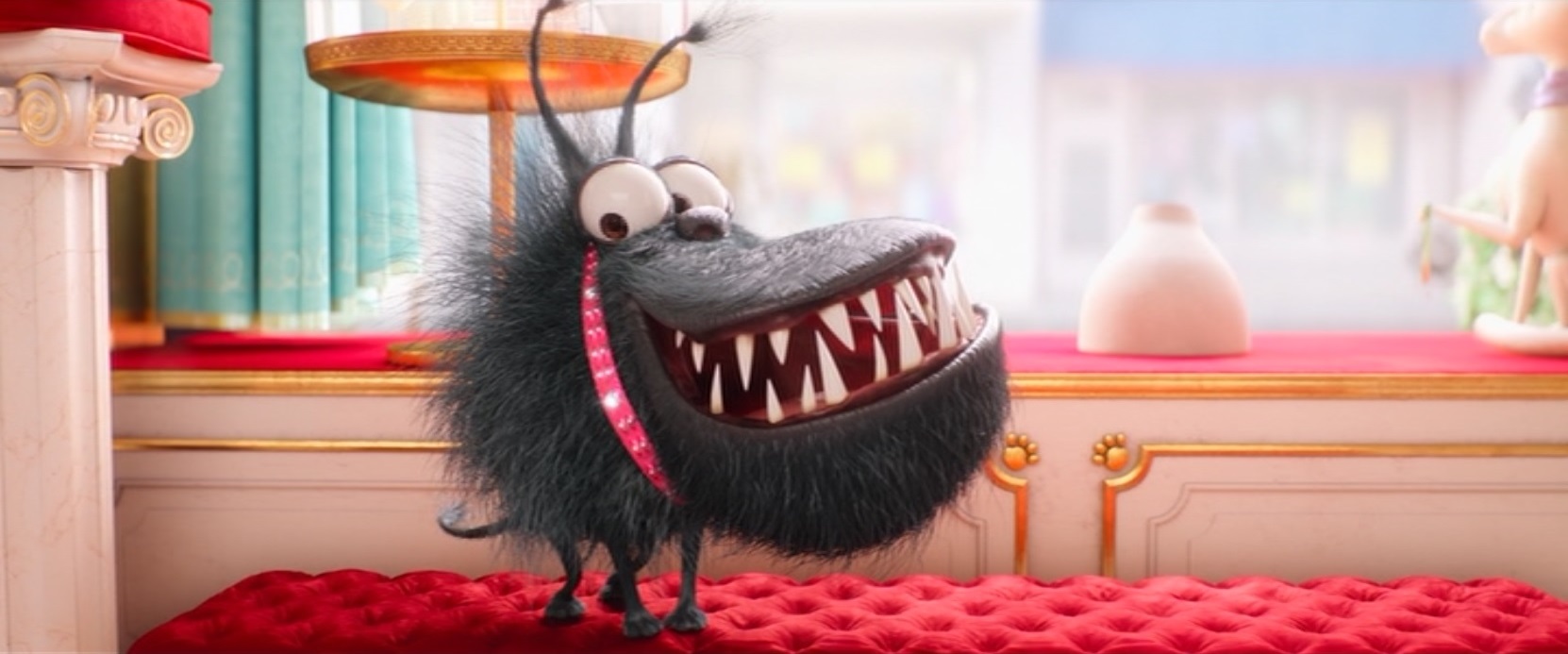
‘The Secret Life of Kyle’ stars Gru’s monstrous dog from the ‘Despicable Me’ films.
In this short Gru’s dog, Kyle, has fallen in love with a neighboring poodle. When he discovers a rival Alsatian Kyle obtains a fancy collar for his love interest, but in the end he wins her over with the squeeky toy he carries around.
‘The Secret Life of Kyle’ is a nice, if forgettable short offering some swell silent comedy in the best cartoon tradition, but without adding anything to it.
Watch ‘The Secret Life of Kyle’ yourself and tell me what you think:
‘The Secret Life of Kyle’ is available on the Blu-Ray and DVD of ‘Despicable Me 3’
Director: Joel Crawford
Airing date: November 24, 2017
Rating: ★★★
Review:

I bought this DVD by mistake, mistaking it for ‘Trolls World Tour‘. Oh, well, I might as well watch and review it. ‘Trolls Holiday’ is a television special that features the characters from ‘Trolls’ (2016). The 30 minute short is a holiday special that, refreshingly, is not about Christmas.
The story is extraordinarily simple and straightforward: when Poppy discovers that the Bergens have no holiday left since the abolition of Trollstice, she decides to give them one of the trolls’ own numerous holidays. Unfortunately she gets so carried away she doesn’t realize she distresses her Bergen best friend Bridget during the show. Bridget asks Poppy to leave. Luckily soon Poppy realizes what she has done, while Bridget realizes what Poppy was trying to do. So in the end she invents a holiday of her own, ‘Troll-A-Bration’, celebrating their friendship.
‘Trolls Holiday’ is a nice if unnecessary addendum to the Trolls movie. Both Anna Kendrick and Justin Timberlake reprise their roles, and there’s a lot of singing, especially during Poppy’s presentation. The special ends with both Bergens and Trolls singing Madonna’s ‘Holiday’.
However, the most entertaining parts are the digital cut-out animation sequences telling the background story and Poppy’s plan. During the caterpillar bus ride the trolls shortly change into their real life versions, which is pretty distressing, as this only shows how infinitely more ugly the original toys were when compared to the fluffy versions of the film.
Watch the first four minutes of ‘Trolls Holiday’ and tell me what you think:
‘Trolls Holiday’ is available on DVD
Director: James Ford Murphy
Release date: October 24, 2017
Rating: ★★½
Review:

‘Miss Fritter’s Racing Skoool’ is short spin off short from ‘Cars 3‘ and present on the Blu-Ray/DVD of the movie.
The film is a short commercial by Miss Fritter, the modified school bus from ‘Cars 3’, featuring four cars stating how her school changed their lives, and with cars impersonating Lightning McQueen and Cruz Ramirez, with whom we are watching the add.
This short is nothing special, but it does entertain for its three minutes, although it is quickly forgotten afterwards.
Watch ‘Miss Fritter’s Racing Skoool’ yourself and tell me what you think:
‘Miss Fritter’s Racing Skoool’ is available on the Blu-Ray and DVD of ‘Cars 3’ and of the ‘Pixar Short Films Collection: Volume 3’


 Dr. Grob's Animation Review