
You are currently browsing the category archive for the ‘Independent film makers’ category.
Director: Jiří Trnka
Release Date: 1954
Rating: ★★★
Review:
 A young man on a motorcycle is on his way to his girl.
Along the way he stops at a bar, where a wedding is taking place. There he’s offered a drink, which he reluctantly accepts. However, one leads to another and he is quite intoxicated when leaving the bar. Driving at night he tries to speed against a car, a train and even a plane, but he finally crashes, never to see his girl.
This educational film warns us not to combine drinking with driving. In this respect the film is very dull and predictable, but Trnka’s illusion of speed and drunkenness is astonishing.
Watch ‘A Drop Too Much’ yourself and tell me what you think:
http://en.channel.pandora.tv/channel/video.ptv?ch_userid=noisypig&prgid=46485008&ref=rss
Director: Jiří Trnka
Release Date: 1951
Rating: ★★★½
Review:
 ‘The Merry Circus’, is puppet-animator Trnka’s try at cut-out animation.
The film shows that Trnka was a master in this technique as well: the animation is superb: the sense of weight, muscular tensions and balance is nothing less than stunning. Moreover, the cut-outs seem to float in mid-air, casting wonderful shadows on the background.
Unfortunately, the film’s subject is not that interesting. We watch circus artists perform, among them two sea lions juggling, a girl on a horse, three trapeze acrobats and an acrobat bear balancing on a chair on a bottle on a glass. Even though some of the shown tricks are quite improbable, the only truly surrealistic act is the fish on the slack-rope.
Despite the lack of story, the film is an enjoyable watch: its visual design is beautiful and poetic, its animation fluent and convincing, and its circus atmosphere well-captured. ‘The Merry Circus’ may not be Trnka’s best film, but it’s only the high quality of some of his other films that makes this one second-rate.
Watch ‘The Merry Circus’ yourself and tell me what you think:
http://veehd.com/video/4587370_Jiri-Trnka-The-Merry-Circus-Vesely-Cirkus-1951
Director: Jiří Trnka
Release Date: 1949
Rating: ★★★
Review:
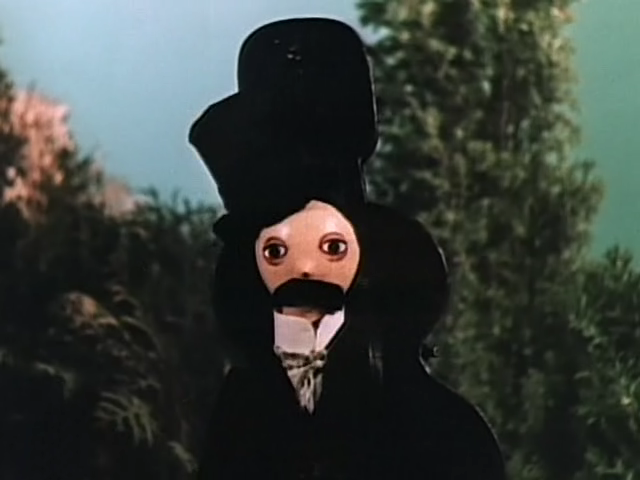 ‘Story of the Bass Cello’ is a re-telling of a classic story by Anton Chekhov.
The film tells about a bass player and a girl who both take a swim, but whose clothes are stolen. The bass player invites the lady to take place in his bass case, but when he’s after the possible thief, the case is picked up by his fellow instrumentalists and brought to the palace, where an astonished crowd discovers the naked lady inside.
‘Story of the Bass Cello’ is a mildly amusing and sweet film. It contains nice silent comedy. The short is a little bit slow, however, and not as good as Trnka’s more outrageous ‘The Song of the Prairie‘ from the same year.
Watch ‘Story of the Bass Cello’ yourself and tell me what you think:
http://veehd.com/video/4587175_Jiri-Trnka-Roman-s-Basou-Story-Of-The-Bass-Cello-1949
Director: Jiří Trnka
Release Date: 1949
Rating: ★★★★★
Review:
 With ‘The Song of the prairie’ Trnka’s both made a parody of and a homage to the classic Western.
The film uses all the cliches of the genre: a stagecoach, masked bandits, a damsel in distress, a hero with a white hat, a villain fancying the girl, and a climax on a cliff.
Trnka’s animation has much improved since ‘The Emperor’s Nightingale‘: the cinematography is excellent, and particularly the illusion of speed is astonishing. The film is wonderfully tongue-in-cheek and full of brilliant silent comedy, showing Trnka’s then unsurpassed mastery in stop-motion. ‘The Song of the Prairie’ is one of Trnka’s most enjoyable films, and deserves a more classic status.
Watch ‘The Song of the Prairie’ yourself and tell me what you think:
Director: Jiří Trnka
Release Date: April 15, 1949
Rating: ★★★
Review:
 ‘The Emperor’s Nightingale’ is Jiří Trnka’s second feature film (he made no less than six in total).
It tells the familiar story by Hans Christian Andersen from an original perspective: he frames the fairy tale by a live-action story about a lonely rich boy, who lives in a restricted environment. When the boy goes to bed, he dreams the fairy-tale, which stars some of his toys. Thus, after more than seven minutes, the animation kicks in.
In the boy’s dream, the Chinese emperor is a lonely little rich boy, restricted by rules, too, and the whole film seems a plea for freedom and against rules and restrictions, quite some message in communist Czechoslovakia. This theme is enhanced by the English narration, wonderfully voiced by Boris Karloff, which is a welcome addition to Trnka’s silent comedy. The whole film breathes a kind of surrealistic atmosphere and Trnka’s use of camera angles is astonishing, as is his sometimes very avant-garde montage.
Nevertheless, the pacing of the film is slow, its humor sparse and only mildly amusing, and the puppet animation still too stiff to allow elaborate character animation. Therefore, the film hasn’t aged very well, and although a tour-de- force, ‘The Emperor’s Nightingale’ falls short as a timeless masterpiece.
Watch ‘The Emperor’s Nightingale’ yourself and tell me what you think:
Director: Paul Driessen
Release Date: 1981
Rating: ★★★★★
Review:
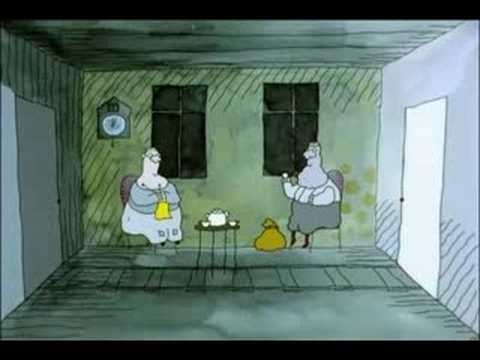 ‘Het treinhuisje’ is one of Paul Driessen’s most beautiful films.
This short builds on the surreal concept of a home built right on a railway track. The daily life of the couple living in the house is dominated by a train passing right through their home at certain times.
With simple and direct storytelling Driessen sets the drama, in which this very train ruins the life of the couple. All the time we stick inside the couple’s home. Only when the man tells of his misfortunes, we shortly cut to the outside world. Ironically, it’s the railway itself that ruins the couple’s life.
The story is told without dialogue, and supported by beautiful country music. The emotions of the couple are depicted well, and are very subtle. However, the film also shows Driessen’s typical animation style at its most radical: the film’s surrealism is enhanced by strange disappearances of the characters when they cross the room and by a ghostly avant-image of the train before it really enters the house.
The film also shares the trademark morbid humor with other Driessen films, especially in the cuckoo clock and in the persistent fly bugging the characters throughout the picture. Nevertheless, the melancholy atmosphere dominates, and its the film’s drama that impresses the viewer time and time again.
Watch ‘Het treinhuisje’ yourself and tell me what you think:
‘Het treinhuisje’ is available on the DVD ‘The Dutch Films of Paul Driessen’
Director: Paul Driessen
Release Date: 1980
Rating: ★★★★
Review:
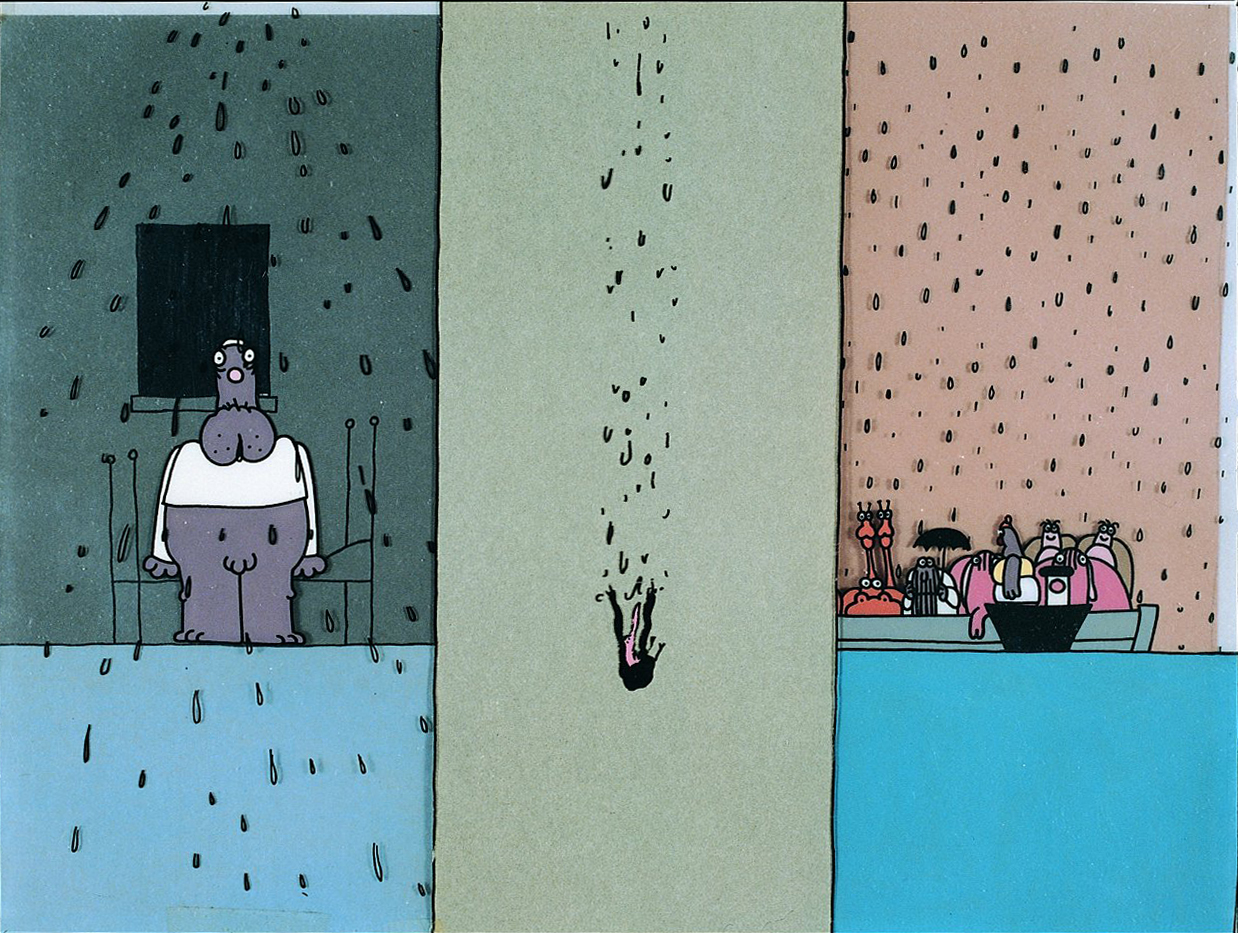 In this film Paul Driessen experiments with the split screen for the first time.
Here we see three narrow frames: the left frame (Land) depicting a sleeping man, the middle one (Air) a bird, and the right one (Sea) a couple on a boat on the ocean. The story involves several themes explored in all three frames, which at times interact but only come together in the end
Like many of Paul Driessen’s shorts ‘Te land ter zee en in de lucht’ involves morbid humor, including a running gag of an ark sinking several times. The film uses no dialogue and no music, only sound effects with very effective results.
Driessen would take the split screen technique to the max in ‘The End of the World in Four Seasons’ (1995), but the genius of ‘Te land, ter zee en in de lucht’ would only be topped by his melancholy film ‘The Boy Who Saw the Iceberg’ from 2000.
Watch ‘Te land, ter zee en in de lucht’ yourself and tell me what you think:
‘Te land, ter zee en in de lucht’ is available on the DVD ‘The Dutch Films of Paul Driessen’
Director: Paul Driessen
Release Date: 1977
Rating: ★★★★½
Review:
 A man is going to eat an egg, when he suddenly hears a voice from within. He destroys the egg, killing the unseen victim. However his cruel behavior is soon punished in an echo of events.
‘The Killing of an Egg’ is a short cartoon with a very limited setting. The whole action takes place within a single square frame and its perspective is changed only once. In this claustrophobic surrounding the story unfolds its own inner logic. In this limited time-space Paul Driessen shows his mastery of story telling.
This classic cartoon is a prime example of Paul Driessen’s mature style. It’s the first film in which he plays with framing the action (soon followed by split screens, eventually leading to the extreme example of ‘The End of the World in Four Seasons’ from 1995). The film shows Driessen’s typical way of telling a short story based on a simple, yet clever idea which makes the cartoon tick like an inevitable fate. Later examples of this style are ‘Home on the Rails‘ (1981) and ‘Sunny Side Up‘ (1985). And finally, this film is typical of Driessen’s dark humor, which always has a disturbing edge to it. We may feel as powerful as this man, but we, too, will be crushed in the end…
Watch ‘Ei om zeep’ yourself and tell me what you think:
‘Ei om zeep’ is available on the DVD ‘The Dutch Films of Paul Driessen’
Director: Paul Driessen
Release Date: 1977
Rating: ★★★
Review:

After working in Canada for the NFB for five years, Driessen experienced a major personal setback, when his marriage failed, and his ex left for The Netherlands with their two children. Driessen soon missed his son and daughter and returned to his native country himself.
In The Netherlands he rented a small attic in The Hague to work and live in. Here he made ‘David’, which he dedicated to his children Anouk and Kaj.
David is the world’s tiniest cartoon star. He’s so small, even the little gnomes can’t see him. During most of the cartoon his presence is only known by his footsteps and his voice. In fact, David is probably the first cartoon star to remain invisible throughout the picture. Nevertheless, Driessen manages to keep the film entertaining, even though most of the time we look at an empty screen.
This film is clearly meant for children and unfortunately, it is hampered by its slowness and large amount of dialogue of David himself (in the Dutch version provided by actor Aart Staartjes). Much of the fun is in David trying to make himself known. Despite its joyful spirit, the film contains a morbid ending, when David, having survived a giant and a predatory bird, is eventually squashed by an unknowing pedestrian…
‘David’ was Driessen’s sixth film, and his idiosyncratic style has matured immensely since his first film, ‘The Story of Little John Bailey‘ (1970). With his next film ‘Killing of an Egg‘ he would animate his first masterpiece.
Watch ‘David’ yourself and tell me what you think:
‘David’ is available on the DVD ‘The Dutch Films of Paul Driessen’
Director: Paul Driessen
Release Date: 1970
Rating: ★★½
Review:
 Paul Driessen’s very first film is a charming little short for children.
Made largely in Spain with help of small subsidy from the Dutch Ministry of Culture, the film tells about a small boy who accidentally sets a forest on fire, but repays his deed by extinguishing another one with help of an elephant with two trunks.
The simple story is hampered by the childish voice over (the English version is much more enjoyable than the original in that respect), and the film certainly doesn’t belong to Driessen’s best works, but its imaginative colors and weird perspectives are still thrilling. It already shows the film maker’s very distinctive animation style, which he would expand and improve over the years, creating such masterpieces as ‘On Land, at Sea and in the Air‘ (1980) and ‘The Writer‘ (1988).
Watch ‘Het verhaal van Kleine Yoghurt’ yourself and tell me what you think:
http://v.youku.com/v_show/id_XNzQ1MTE2NTI=.html
‘Het verhaal van Kleine Yoghurt’ is available on the DVD ‘The Dutch Films of Paul Driessen’
Director: Raoul Servais
Release Date: 1979
Rating: ★★★★★ ♕
Review:
 A man rescues a harpy from a man who strangles her. He takes her home, but with disastrous results, because he soon discovers that the harpy eats all his food…
‘Harpya’ is a fantastic surreal film, which makes great use of a mixture of animation, live action and pixillation to create a totally unique atmosphere. The film is both funny and uncanny, and its story is Servais’s best since ‘Sirene’ (1968).
With ‘Harpya’ Raoul Servais made his most enduring work. It’s his all-time masterpiece, and a central film in his oeuvre, defining his mature style.
Watch ‘Harpya’ yourself and tell me what you think:
Director: Raoul Servais
Release Date: 1973
Rating: ★★★
Review:
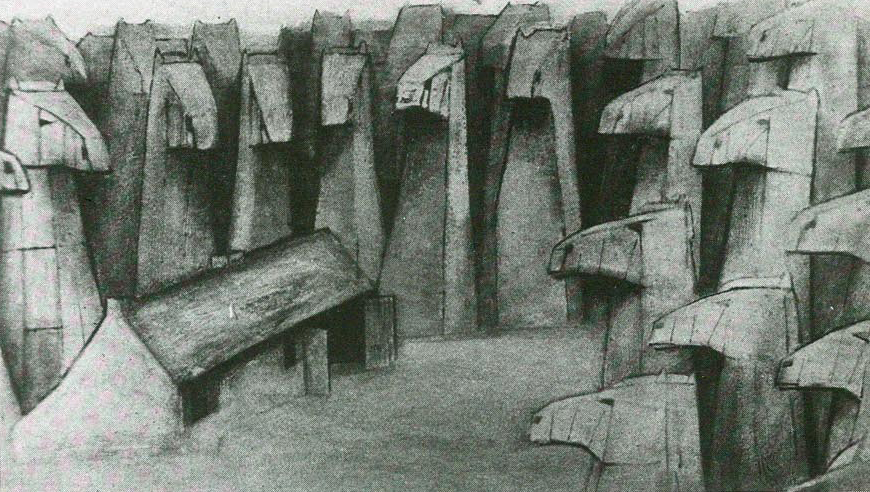 ‘Pegasus’ tells about a lonely blacksmith who lives in the countryside.
The blacksmith has a love for horses, but unfortunately his surroundings are totally devoid of them. So he builds a horse head out of metal to worship. Unfortunately, the horse head appears to have an ability to grow and reproduce, surrounding his house like a forest.
‘Pegasus’ is a beautiful and surreal film. Unfortunately, it ends quite abruptly, leaving behind a sense that not everything has been said, yet.
Watch ‘Pegasus’ yourself and tell me what you think:
Director: Raoul Servais
Release Date: 1971
Rating: ★★½
Review:
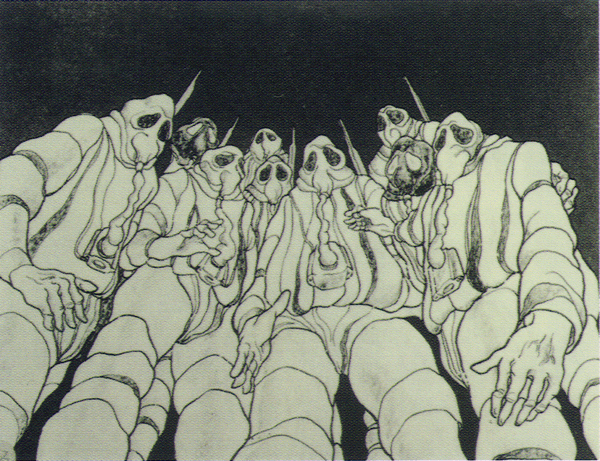 Operation X-70 is a half silly, half scary short by Belgian film maker Raoul Servais.
It tells about a poisonous gas, which turns people into spiritual beings. The gas is advertised as a ‘clean weapon’, because it doesn’t kill people. When the gas is accidentally bombed on the Benelux (Belgium, Holland and Luxemburg), it turns people into angels.
The film impresses with its weird idea, its dark and gloomy atmosphere, and its anti-war message. However, like Raoul Servais’s earlier film ‘Goldframe’ (1968), the film suffers from an all too present dialogue. In the end the short’s images are more lasting than the film itself is.
Watch ‘Operation X-70’ yourself and tell me what you think:
Director: Georges Schwizgebel
Release Date: 1977
Rating: ★★★
Review:
 In ‘Hors-jeu’ we watch a soccer match change into a basketball match and into an ice hockey game. When violence enters, however, the game stops.
With this short film Schwizgebel builds on the concepts introduced in his previous film, ‘Perspectives‘. In ‘Hors-jeu’ he incorporates sound-effects and a rather surrealistic play with the rotoscoped images into his style. Surrealism would dominate his next film, ‘Le ravissement de Frank N. Stein‘ (1982), but in its visual style ‘Hors-jeu’ looks more forward to later films, like ‘78 Tours‘ (1985).
Watch ‘Hors-jeu’ yourself and tell me what you think:
http://v.youku.com/v_show/id_XNzU1MjYzMjg=.html
‘Hors-jeu’ is available on the DVD ‘Les Peintures animées de Georges Schwizgebel’
Director: Georges Schwizgebel
Release Date: 1975
Rating: ★★★
Review:
 As the title implies, this short film is a study in perspectives. It also seems to address the arbitrariness of things, as we see a walking woman change into herself, into skaters and into a running dog, whenever our perspective of her changes. The film uses effective piano music by Bach.
‘Perspectives’ introduces several aspects of Schwizgebel’s mature style: the painted canvas, the rotoscoped movements, the constant changing of perspectives, the prominent shadows and his mastery of metamorphosis. In his next films Schwizgebel would expand on this technique, which would eventually lead to such masterpieces as ‘La jeune fille et les nuages’ (2000) and ‘L’Homme sans ombre’ (2004).
Watch ‘Perspectives’ yourself and tell me what you think:
http://v.youku.com/v_show/id_XNzU1MzkzOTY=.html
‘Perspectives’ is available on the DVD ‘Les Peintures animées de Georges Schwizgebel’
Director: Georges Schwizgebel
Release Date: 1974
Rating: ★★★★
Review:
 In ‘le vol d’Icare’ a man wants to fly like the birds. In the end he succeeds.
More important than the plot, however, is the technique of this film, which makes use of huge pixels, giving it a very digital look. Even though the man and the birds are extremely simplified, their motions are instantly recognizable. Even more remarkable is that the film contains some kind of baroque feel, amplified by Louis Couperin’s harpsichord music.
‘Le Vol d’Icare’ was Swiss animator Georges Schwizgebel’s first animated film. It doesn’t resemble his later films. In fact, it doesn’t resemble any other animation film. But it already shows Schwizgebel’s originality and virtuosity, and it can be considered his first masterpiece.
Watch ‘Le vol d’Icare’ yourself and tell me what you think:
‘Le vol d’Icare’ is available on the DVD ‘Les Peintures animées de Georges Schwizgebel’
Director: Osvaldo Cavandoli
Release Date: 1974
Stars: La Linea
Rating: ★★★★
Review:
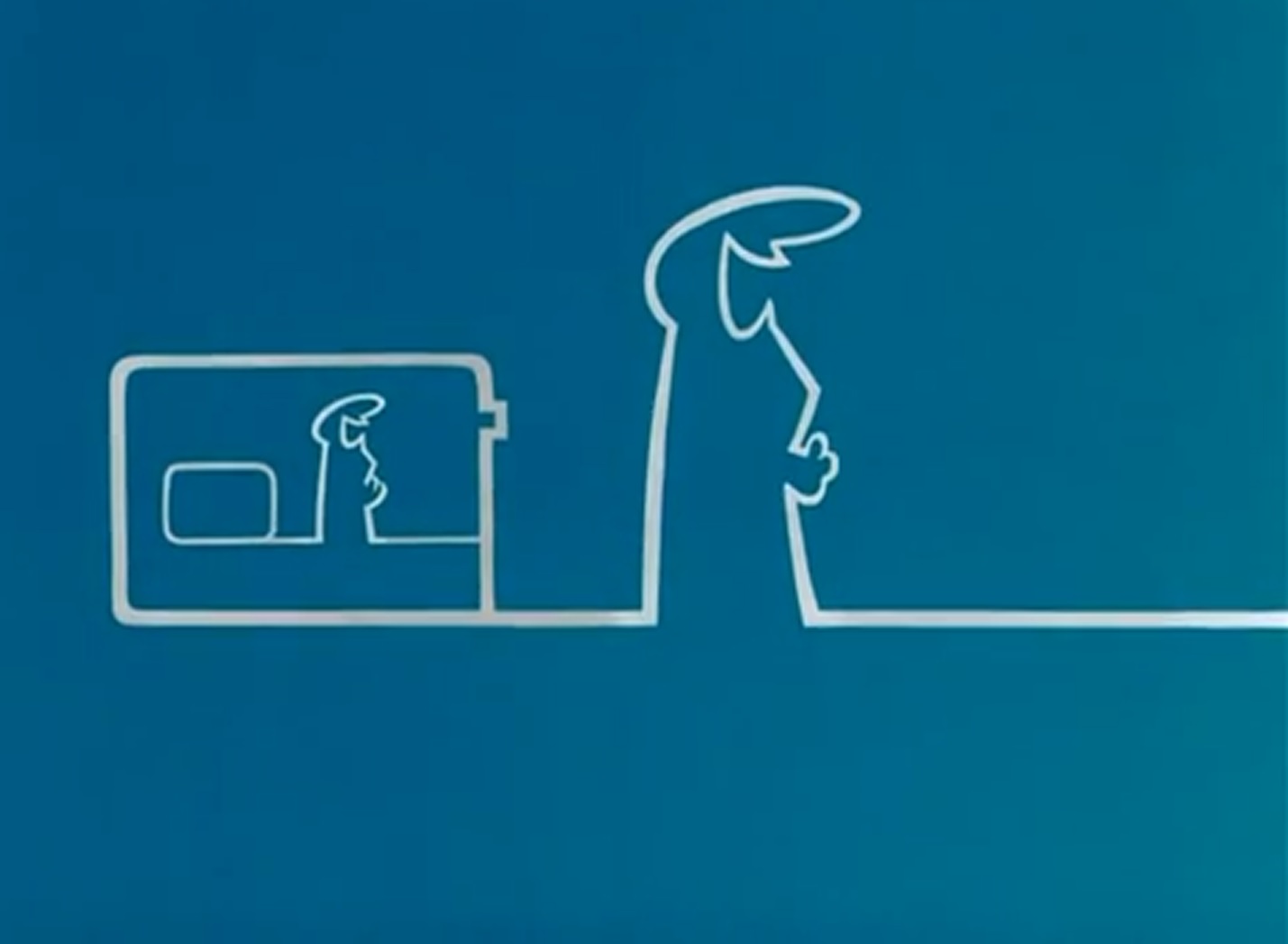 La Linea is an Italian television series, which takes graphic design, introduced by UPA to the animated screen, to the max.
The first of all La Linea shorts defines the complete series: it consists of numerous unrelated gags around the jabbering little man Linea, who lives in a 2-dimensional world, consisting of only one white line, of which he is part.
This cheerful, but temperamental guy has some characteristics that return in every single episode: First, he talks an Italian-sounding sort of gibberish, provided by voice actor Carlo Bonomi. Second, he always walks to the left of the screen. Third, he always encounters at least one interruption of the line during his walk. Fourth, he frequently argues with his off-screen creator, of whom we only see his hand drawing things for the little guy. And Fifth, our hero has also has an intoxicating laugh, which is heard at least once.
All designs are extremely stylized, yet perfectly recognizable, and beautifully animated. The backgrounds are monochromic, changing from green to red to blue etc. All these elements make this series such a classic, even though most of the episodes are completely plotless, and only last about 2 minutes.
In this particular episode La Linea encounters a turtle, a television set, a tap and a woman. He plays golf and takes a rollercoaster ride. It doesn’t make any sense, but it’s fun. Franco Godi’s music in this particular cartoon is more present than in the following ones, using a tune with voices instead of the instrumental background music of later cartoons.
Watch ‘La Linea episode 1’ yourself and tell me what you think:
‘La Linea episode 1’ is available on the DVD ‘La Linea 1’
Director: Don Hertzfeldt
Release Date: August 24, 2012
Rating: ★★★★★ ♕
Review:
 ‘It’s such a Beautiful Day’ tells about Bill, a man with some kind of terminal disease, which affects his memory. The film uses an episodic, non-linear narrative, and at times feels as confused as the protagonist’s mind.
Hertzfeldt uses some unconventional ways to tell his story. He himself tells us the story in a dry, matter-of-factly, slightly worrying voice over, which makes the sometimes poignant episodes even more gripping. The images themselves are very simple: the people in the film are no more than stick figures. But because of Hertzfeldt’s perfect sense of timing, these simple images are richer than many more elaborately drawn animation films. The stick figure images are interchanged with 8mm-film-like live action fragments of details in streets, trees, the sea etc. Hertzfeldt’s basic screen is black, in which often more than one of his images is projected. This technique harks back to the silent era, and gives his film a timeless look.
Hertzfeldt uses all these techniques to tell a fragmented, associative narrative, which is rich in detailed observations on daily life. The scenes motivate the viewer to try to connect the presented information into an overall story. The scenes are often comical, even hilarious, with Bill watching a man with a leaf blower as a particular highlight. As often, however, the scenes are moving and very emotional. Throughout the feature the deterioration of Bill’s mind becomes clearly visible, and when he decides to take a walk around the block, the result is as funny as it is painful. The most beautiful part, however, is when Bill celebrates life, paying attention to details that normally go unnoticed. The film’s finale, too, is no less than glorious.
‘It’s such a Beautiful Day’ is a compilation of three short films released earlier: ‘Everything will be OK’ (2006), ‘I Am So Proud of You’ (2008), and ‘It’s Such a Beautiful Day’ (2012). To compile these into one feature is a very logical step. In fact, watching them together as one continuous story actually makes much more sense. The result is one of the most original feature films ever made, and also one of the most moving. An impressive effort by any standard, and especially when considering that this is a one-man-project.
Watch the trailer of ‘It’s Such a Beautiful Day’ and tell me what you think:
Director: Władysław Starewicz
Release Date: 1922
Rating: ★★★★★
Review:
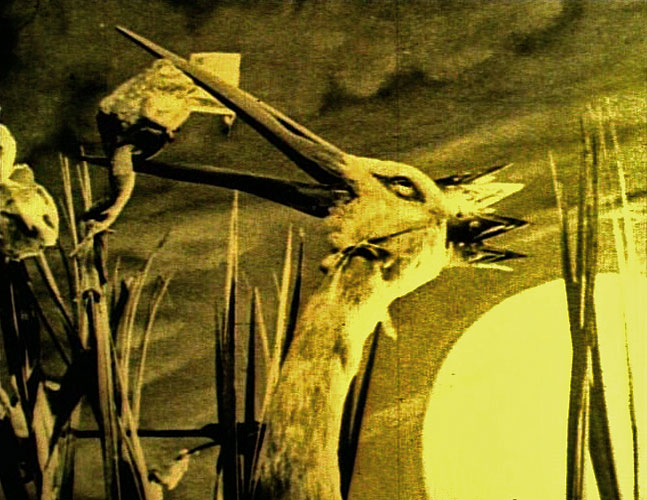 After the October revolution, Władysław Starewicz fled to France, where he continued to make stop motion films until his death in 1965. ‘The Frogs Who Wanted a King’ is the fourth film he made in France, and probably his most political.
The film is based on one of Aesop’s fables. Some frogs ask Jupiter for a king. Jupiter sends them one, but the king looks like a tree and does nothing at all. The frogs don’t like him, so Jupiter sends them a stork, who, naturally, eats the unfortunate amphibians.
The message may be that it’s better to have a dull government than one that kills you, a message Starewicz could certainly relate to, being forced to exile by the oppressing communist regime in Russia.
Once again, Starewicz’ animation is top notch. The film has a particularly fable-like character, taking place in its own, very convincing universe.
Watch ‘The Frogs Who Wanted a King’ yourself and tell me what you think:
Director: Władysław Starewicz
Release Date: 1913
Rating: ★★★½
Review:
 ‘The Insects’ Christmas’ is Starewicz’s next film after his masterpiece ‘The Cameraman’s Revenge‘.
Although the short uses insects again, it’s a whole different film, turning to the sweet subject of Christmas. It’s probably the first animated film about Christmas ever made.
The plot is surprisingly simple: Father Christmas climbs down a Christmas tree, awakes some insects and a frog, who are hibernating underground, and he invites them to a Christmas party. He gives them presents and they all go skiing and skating.
This film’s story cannot be compared to the mature plot of ‘The Cameraman’s revenge‘. It’s more like a child’s dream of Christmas. The film reuses puppets from ‘The Cameraman’s Revenge’ and others, and even though the animation is less engaging than in Starewicz’s earlier film, it is still of a stunning virtuosity, making the result still a delight to watch. Note, for example, the illusion of wind in the animation of Father Christmas’s coat.
Watch ‘The Insects’ Christmas’ yourself and tell me what you think:
‘The Insects’ Christmas’ is available on the DVD ‘The Cameraman’s Revenge & other Fantastic Tales’


 Dr. Grob's Animation Review