
You are currently browsing the category archive for the ‘★★★★½’ category.
Director: Charles Nichols
Release Date: September 21, 1951
Stars: Pluto, Milton
Rating: ★★★★½
Review:
 ‘Cold Turkey’ was the very last Pluto cartoon, although Pluto would return in Mickey Mouse’s last three cartoons (1952/1953).
The short couples Pluto to Milton, the zany cat who had been introduced in ‘Puss-Cafe‘ the previous year, only to star in three cartoons.
‘Cold Turkey’ opens with some live action footage on a television set featuring a wrestling match. Pluto and Milton sleep right through it, only to awake at an add for hot turkey. The pair first tries to get the turkey out of the television set, then try to find it in the kitchen. When they discover one in the fridge, the companionship turns into rivalry.
‘Cold Turkey’ is less funny than either ‘Puss-Cafe’ or ‘Plutopia‘, the other two cartoons featuring Milton, but it’s still an enjoyable short. The best part may be the pedal bin scene. It’s sad to see the Pluto series ending when its makers had finally made it into a funny one, with its last eleven cartoons being among the best of the entire series.
Watch ‘Cold Turkey’ yourself and tell me what you think:
This is Pluto’s 43rd and last cartoon
To the previous Pluto cartoon: Plutopia
‘Cold Turkey’ has been released on the Walt Disney Treasures DVD-set ‘The Complete Pluto Volume Two’
Director: Charles Nichols
Release Date: July 21, 1950
Stars: Pluto, Bent-Tail & Bent-Tail junior
Rating: ★★★★½
Review:
 ‘Pests of the West’ is the second of three cartoons featuring the coyote Bent-Tail and his dopey son.
In ‘Sheep Dog‘ (1949) they’d tried to steal sheep; this time the hungry duo is after the chickens. Pluto is only the straight man in a cartoon, which is devoted to the delightful interplay between father and son.
Although not as classic as ‘The Legend of Coyote Rock’, ‘Pests of the West’ is a funny cartoon. The short is packed with gags, some being quite Tex Averyan, like the son hanging in mid air until his father knocks him down. However, its highlight is the great scene in which Pluto and Bent-Tail fight for a chicken. The wonderful and jazzy soundtrack enhances all the fun. It was composed by Paul Smith, who had been an arranger for Disney since the late 1930s, and would become a noteworthy composer on the studio’s True-Life Adventures.
Watch ‘Pests of the West’ yourself and tell me what you think:
This is Pluto cartoon No. 38
To the previous Pluto cartoon: Puss-Cafe
To the next Pluto cartoon: Food for Feudin’
Director: Dick Lundy
Release Date: August 27, 1948
Stars: Woody Woodpecker, Buzz Buzzard
Rating: ★★★★½
Review:

‘Wet Blanket Policy’ uses exactly the same idea as Dick Lundy’s last Donald Duck short, ‘Flying Jalopy‘ (1943).
The cartoon even uses the same adversary in Buzz Buzzard, a swindler who makes Woody sign an insurance contract that will give Buzz a $10,000 when Woody dies (in the original Donald Duck cartoon the character was called Ben Buzzard).This leads to a fast and very murderous chase sequence full of nonsense.
Penned by Warner Bros. alumnus Ben Hardaway and Heck Allen, who had collaborated with Tex Avery at MGM, ‘Wet Blanket Policy’ is one of Woody’s wildest cartoons. Unfortunately, it’s also the first in which Woody’s proportions start to waver. At one point he’s particularly tiny. This unsteady sizing of Woody would become a particular problem of the cartoons of the 1950s. Buzz Buzzard, however, proved to be a strong adversary for Woody, and became Woody’s antagonist in many of the following Woody Woodpecker cartoons.
Watch ‘Wet Blanket Policy’ yourself and tell me what you think:
This is Woody Woodpecker cartoon No. 29
To the previous Woody Woodpecker cartoon: Wacky-Bye Baby
To the next Woody Woodpecker cartoon: Wild and Woody
‘Wet Blanket Policy’ is available on the DVD-set ‘The Woody Woodpecker and Friends Classic Cartoon Collection’
Director: Paul J. Smith
Release Date: October 22, 1956
Rating: ★★★★½
Review:
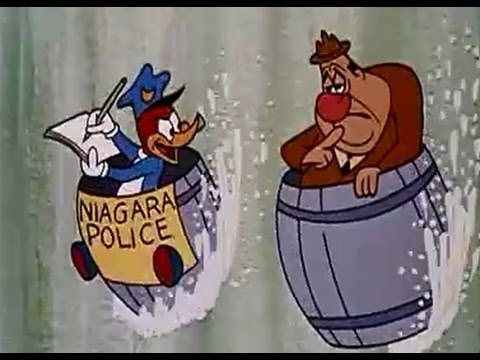 In this cartoon Woody Woodpecker wants to ride the Niagara falls in a barrel.
However, there’s a park ranger who tries to stop him, and it’s this ranger who repeatedly ends in a barrel on the falls.
It’s amazing to discover a gem like this between the badly designed, badly animated and badly timed Walter Lantz shorts of the late 1950s. Although this cartoon, too, features ugly animation, the story and the gags (penned by Disney-veterans Dick Kinney and Milt Schaffer) are very good. The result is by all means one of the best Woody Woodpeckers of the fifties.
Watch ‘Niagara Fools’ yourself and tell me what you think:
This is Woody Woodpecker cartoon No. 71
To the previous Woody Woodpecker cartoon: Calling All Cuckoos
To the next Woody Woodpecker cartoon: Arts and Flowers
‘Niagara Fools’ is available on the DVD-set ‘The Woody Woodpecker and Friends Classic Cartoon Collection Volume 2’
Directors: William Hanna & Joseph Barbera
Release Date: October 10, 1942
Stars: Tom & Jerry
Rating: ★★★★½
Review:
 During a chase at the barnyard Jerry seeks shelter with a large and angry chicken.
This short contains the very first example of the extreme cartoon violence that would become so typical for the Tom and Jerry series: the scene in which Jerry tries to cut off Tom’s head with a pair of hedge-shears.
The short’s highlight, however, is Jerry’s Josephine Baker-like dance with yellow feathers when he’s trying to disguise himself as a little chick.
‘Fine Feathered Friend’ is the first Tom & Jerry cartoon to start with their familiar opening tune.
Watch ‘Fine Feathered Friend’ yourself and tell me what you think:
This is Tom & Jerry cartoon No. 8
To the previous Tom & Jerry cartoon: The Bowling Alley Cat
To the next Tom & Jerry cartoon: Sufferin’ Cats
Director: Friz Freleng
Release Date: December 2, 1961
Stars: Tweety & Sylvester
Rating: ★★★★½
Review:
 ‘The Last Hungry Cat’ must be one of the best entries in the Tweety and Sylvester series.
The short is a parody of the television show ‘Alfred Hitchcock Presents’, which aired from 1955 to 1965. Luckily, you don’t have to be familiar with this program (I’m not) to enjoy this cartoon.
Introduced by an Alfred Hitchcock-like shadow of a pig, the short tells the story of Sylvester, who for once thinks he has actually eaten Tweety and who is then eaten by guilt.
The cartoon makes use of a conscience-like voice-over and very beautifully colored and a surprisingly large amount of well-staged angular backgrounds (staged by Hawley Pratt, who gets co-directing credits, and painted in beautiful blues and yellows by Tom O’Loughlin). The images succeed in evoking an atmosphere that reflects Sylvester’s inner feelings. Especially the staging of Sylvester’s sleeplessness is very well done: still images of Sylvester lying awake are inter-cut with close-ups of his alarm clock, in rapid succession, zooming in all the time. These scenes are accompanied by Milt Franklyn’s ominous music and insistent ticking of the clock, only.
It’s a surprise such a well-made, beautiful and compelling cartoon could be made as late a 1961. The short is a worthy addition to the very small guilt cartoon canon, which also includes ‘Nursery Scandal‘ from 1933, ‘Pudgy Picks a Fight‘ from and ‘Donalds’ Crime’ from 1945.
Watch ‘The Last Hungry Cat’ yourself and tell me what you think:
Director: Unknown
Release Date: March 5, 1928
Stars: Oswald the Lucky Rabbit, Honey, Pete
Rating: ★★★★½
Review:
 In this gag-packed cartoon Oswald and Pete compete over Honey, a female cat character, who was Oswald’s girlfriend in 1928.
Pete and Oswald both ride in their cars to her house in a scene looking forward to the early Mickey Mouse cartoon ‘The Barn Dance‘ from later that year. Oswald serenades her until a goat eats all his sheet music and even his banjo. Then he turns the animal into a hurdy gurdy, like Mickey would do later that year in ‘Steamboat Willie‘. When Pete arrives, he and Oswald fight over Honey, almost tearing her apart. Honey gives them the cold shoulder and leaves with a third guy into the distance. Then our rivals kick each other in remorse, like Donald Duck and Peter Pig would do six years later in ‘Wise Little Hen‘ (1934).
As you may notice, ‘Rival Romeos’ contains quite a lot of embryonic gags that Walt Disney would reuse later in other cartoons. Because of these prophetical gags ‘Rival Romeos’ is a highlight among Disney’s Oswald cartoons.
Watch ‘Rival Romeos’ yourself and tell me what you think:
This is Oswald the Lucky Rabbit cartoon No. 14
To the previous Oswald the Lucky Rabbit cartoon: Africa Before Dark
To the next Oswald the Lucky Rabbit cartoon: Bright Lights
Director: Âle Abreu
Release Date: September 20, 2013
Rating: ★★★★½
Review:
 It seems that with their growing economies the BRIC countries enter a new creative era, in which costly projects like animated features are now possible. Especially Brazil is a surprising new country from which unique and distinct animation films sprout.
In 2013 the Holland Animation Film Festival had shown the ambitious ‘Uma História de Amor e Fúria‘, this year it’s the charming film ‘O menino e o mundo’ (The Boy and the World). Surprisingly, given the extremely different animation styles, the two features have more in common than one would expect.
According to its director Âle Abreu* the idea of ‘O menino e o mundo’ was conceived when the little boy character suddenly appeared in his notes when studying Latin American protest music of the last hundred years. The film tells about this little boy growing up in the countryside, near the jungle, who goes to seek his father, who has left for the city to work. On his trip he discovers the real world that is Brazil, far from his idyllic place in the hills. He meets cotton pickers, people in the cotton industry, and even discovers how cotton is shipped to some futuristic cities (vaguely resembling the US) to be made into clothes, which are shipped back to Brazil to be sold at ridiculous prices.
I say Brazil, but Abreu insists that this story is the story of practically every Latin American country, or even every third world country emerging from a dark dictatorial past and now getting caught up in the World Economy. Indeed, the film’s world may be one great fantasy, with vehicles like animals, towns like mountains, and great futuristic cities in the sky. Yet, what happens in this world is instantly recognizable to people all over the world,
Meanwhile, the film clearly shows the grand effects of the global economy on the lives of ordinary and poor people. Without reservation Abreu shows us cotton pickers being fired because they are old and sick, workers working ridiculously long hours in hot industries to produce cotton, only to be replaced by a machine in the end. We watch poor people living in favelas (slums), while advertisements on the streets and on television produce images of a happy life they’ll never be able to reach. We watch people who demand more freedom being oppressed by military police, in a particular powerful sequence in which a colorful bird of freedom is crushed by a black bird of oppression, etc.
It’s this focus on social injustice that ‘O menino e o mundo’ shares with ‘Uma História de Amor e Fúria’. Unlike the latter film, however, Abreu’s film never becomes too heavy-handed, because we keep on seeing this world through the eyes of a child. To achieve this, Abreu uses a wonderfully naive style resembling children’s drawings and pastel crayons. All images are drenched in imagination and wonder, even those of the city and the oppressive forces, whose tanks look like large elephants. When the boy approaches the city, more and more magazine clippings are added to the colorful images. Abreu says he wanted to tell a tale about freedom, so he wanted to have freedom during the making of this film, too. He says: “A director should listen to the voice of his film, and listen to where the film wants to go“.
The result is an absolutely gorgeously looking film, simply bursting in color and fantasy. The animation, too, is superb, especially when considering that most of it was done in Photoshop. According to Abreu the drawings were then printed, filmed, and imported in After Effects for compositing. Moreover, the whole film was made with a very small crew. Nevertheless, the makers have reached a high quality by any standards.
To tell his story Abreu uses no dialogue. Yes, we hear people speak, but in a language that is constructed of Portuguese words spoken out backwards. Indeed, the voice actors had to act and sing in this backward language. However, in no way comprehensible dialogue is missed, for Abreu is perfectly capable of storytelling by images alone. Added to the mix is the cheerful score by Ruben Feffer and Gustavo Kurlat, which is a perfect match to the colorful images. According to Abreu, even the sounds of nature are made by musical means, like hand claps for rain.
‘O menino e o mundo’ is a magical film of sheer delight, deserving to be shown everywhere in the world. And unlike American films, it doesn’t shun the big questions our world needs to answer. For this bravery alone, it deserves a large audience.
Watch the trailer for ‘O menino e o mundo’ and tell me what you think:
* Quotations from Abreu are taken from his introduction and Q&A at the screening of his film at the Holland Animation Film Festival, March 20, 2014.
Director: Chris Wedge
Release Date: 1998
Rating: ★★★★½
Review:
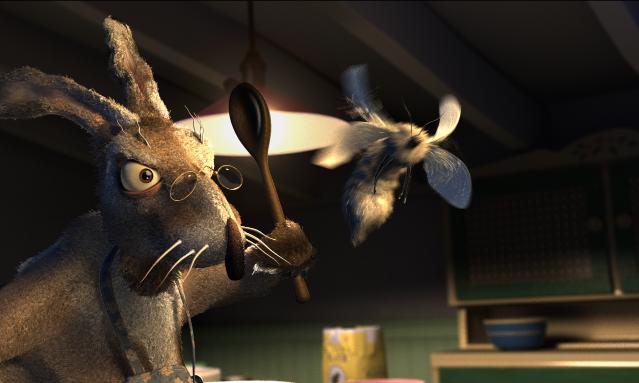 An elderly bunny tries to bake a cake, when she’s being disturbed by a giant moth.
After a wild chase the moth falls into the cake mix and she angrily bakes the insect with it. At this point the film takes a remarkable turn…
With Pixar’s ‘Geri’s Game’ (1997), ‘Bunny’ is one of the first computer animated shorts that make you forget you’re watching a computer animated film. With its quite original story and its beautiful execution, it transcends the medium, and its deservedly won the Oscar for best animated short in 1998.
Chris Wedge and his Blue Sky studio (founded in 1987, by Tron-alumni) later moved on to produce feature length computer-animated films, becoming the fourth American studio to do so, after Pixar, PDI/Dreamworks and DNA Productions. It would be especially successful with its Ice Age films. However, none of the sequential Blue Sky films would reach the emotional depths of this gentle little short.
Watch ‘Bunny’ yourself and tell me what you think:
‘Bunny’ is available on the DVD ‘Ice Age’
Director: Georges Schwizgebel
Release Date: 1992
Rating: ★★★★½
Review:
 ‘La course à l’abîme’ is a depiction of the final ride into hell from ‘La Damnation de Faust’ (1846) by Hector Berlioz.
The film consists of a very associative series of images, tied together by the two riders, Faust & Méphistophélès. Like in Schwizgebel’s earlier film ‘78 tours‘ (1985) we watch images changing perspective and morphing into each other, to stunning effects. All builds up to a spectacular finale, in which we see all the animation within one frame.
‘La course à l’abîme’is the first film showing Schwizgebel’s interest in classic European stories. It’s a clear precursor of later films, like ‘L’année du daim’ (1995), ‘La jeune fille et les nuages’ (2000) and ‘L’homme sans ombre’ (2004), in which he uses his stunning techniques for narrative purposes.
Watch ‘La course à l’abîme’ yourself and tell me what you think:
‘La course à l’abîme’ is available on the DVD ‘Les Peintures animées de Georges Schwizgebel’
Director: Georges Schwizgebel
Release Date: 1985
Rating: ★★★★½
Review:
 In ’78 Tours’ Schwizgebel uses his technique of rotating perspectives and metamorphosis, which he had developed in films like ‘Perspectives‘ (1975) to stunning effects.
’78 Tours’ is a short film set to accordion music, which uses circles as a leitmotiv, as well as coffee and a park. The film is completely painted, using deep colors and stark shadows. Schwizgebel’s unique virtuoso style really comes to a full bloom in this film, which must be regarded as his first masterpiece.
Watch ‘78 Tours’ yourself and tell me what you think:
’78 Tours’ is available on the DVD ‘Les Peintures animées de Georges Schwizgebel’
Director: Paul Driessen
Release Date: 1977
Rating: ★★★★½
Review:
 A man is going to eat an egg, when he suddenly hears a voice from within. He destroys the egg, killing the unseen victim. However his cruel behavior is soon punished in an echo of events.
‘The Killing of an Egg’ is a short cartoon with a very limited setting. The whole action takes place within a single square frame and its perspective is changed only once. In this claustrophobic surrounding the story unfolds its own inner logic. In this limited time-space Paul Driessen shows his mastery of story telling.
This classic cartoon is a prime example of Paul Driessen’s mature style. It’s the first film in which he plays with framing the action (soon followed by split screens, eventually leading to the extreme example of ‘The End of the World in Four Seasons’ from 1995). The film shows Driessen’s typical way of telling a short story based on a simple, yet clever idea which makes the cartoon tick like an inevitable fate. Later examples of this style are ‘Home on the Rails‘ (1981) and ‘Sunny Side Up‘ (1985). And finally, this film is typical of Driessen’s dark humor, which always has a disturbing edge to it. We may feel as powerful as this man, but we, too, will be crushed in the end…
Watch ‘Ei om zeep’ yourself and tell me what you think:
‘Ei om zeep’ is available on the DVD ‘The Dutch Films of Paul Driessen’
Director: Pete Doctor
Release Date: November 2, 2001
Rating: ★★★★★
Review:
 Pixar’s fourth film can be considered the studio’s best up to that point.
The very idea of monsters needing to scare children to fuel their city is a masterstroke. As is their mutual fright for children. The idea of closet doors leading to a parallel world is used to the max, especially in the breathtaking finale, whose premise is both logical to the plot as strikingly original and totally unexpected. Nothing to the story is predictable, and its lead characters Sully, Mike and Boo and their nemesis, the slithery Randall, are very well developed.
The only two lesser points may be Monstropolis itself, which is a surprisingly unimaginative copy of an average American town, and the film’s humor. Compared to Dreamworks’s ‘Shrek’, released earlier that year, Monsters, Inc.’s humor is rather mild. It heads for steady smiles, not for loud guffaws. Moreover, the loudmouth comic sidekick, the green eyeball Mike (voiced by Billy Crystal), never really gets convincingly funny or very sympathetic, and he pales compared to Eddie Murphy’s Donkey in ‘Shrek’.
No, the main selling point of Monsters Inc. is heart: the endearing ‘love story’ between top scare Sully and the little child Boo is completely convincing. This makes ‘Monsters, Inc.’, apart from being startlingly original, a sweet film. One that is able to move you time and time again.
Besides, ‘Monsters, Inc.’ displays some spectacular effect animation, the highlight being Sully laying in the snow, with his hair blowing in the blizzard, something unseen up to that point.
In 2013 ‘Monsters, Inc.’ fell prey to Hollywood’s sequel mania ,spawning the prequel ‘Monster University’.
Director: John Lounsberry, Wolfgang Reitherman & Art Stevens
Release Date: June 22, 1977
Rating: ★★★★½
Review:
 ‘The Rescuers’ was a joint venture of an old and a new generation of animators at the Disney studio. It is without doubt the best of the three features the studio made in the seventies.
It was Disney’s first feature film since ‘One Hundred and One Dalmatians‘ (1961) in which Wolfgang Reitherman shared the direction duties, and this fact alone arguably improves the end product.
Unlike the earlier features ‘The Aristocats’ (1970) and ‘Robin Hood‘ (1973) it doesn’t contain any reused animation (with a possible exception of animation from ‘Bambi‘ in a minor mood scene). And while ‘The Aristocats’ and ‘Robin Hood’ relied on proven formulas, both being very reminiscent of ‘Jungle Book’ (1967), ‘The Rescuers’ has a fresh story (based on a children’s book by Margery Sharp), and a unique, surprisingly gloomy atmosphere. In Sharp’s book the mice rescue a prisoner, but for the film the Disney story men chose an orphan girl named Penny to be rescued. A masterstroke, for the lovable little girl easily becomes the center of the story, which contains a lot of heart.
However, all the film’s main characters are adorable: the lovely Hungarian mouse Bianca (voiced by Eva Gabor) and her companion, the superstitious yet valiant janitor Bernard are such great characters that they were able to spawn Disney’s first sequel, ‘The Rescuers Down Under’ in 1990. Medusa is a real and wonderful villain. She hasn’t got any special powers and at times she’s portrayed as preposterous, but mostly she’s sly, mean and genuinely scary: a worthy adversary for our heroes to deal with. She was animated by Milt Kahl, the last and arguably best piece of animation he ever did for the studio.
Medusa may steal the show, but even the minor characters like Orville the Albatross, Rufus the cat, Evenrude the damselfly, Snoops and the two Alligators are delightful. They all contribute to a story, which is concise and well-told. It evolves without delays or side-ways, and leads to a great finale in Devil’s Bayou.
‘The Rescuers’ is also the first Disney feature since ‘Bambi’ (1942) not to be a musical, but to use songs to evoke moods only. All these elements contribute to a story which is both thrilling and moving. The film’s opening credits use a song and beautiful oil paintings by Mel Shaw to start the story. Unfortunately, the background paintings in the rest of the movie are more prosaic, mixing moody oil paintings with more graphic backgrounds to an uneven effect. The animation on the other hand is superb throughout.
Unfortunately, ‘The Rescuers’ proved more of a swansong of the old generation of nine old men than the beginning of a new era. The following features were much weaker, and only with ‘The Little Mermaid’ (1989) Disney found a genuinely new and strong voice. Thus stands ‘The Rescuers’ as a beacon of light in the dark ages of animation that were the 1970s and 1980s.
Watch the trailer of’The Rescuers’ and tell me what you think:
Director: Friz Freleng
Release Date: October 6, 1951
Stars: Bugs Bunny, Yosemite Sam
Rating: ★★★★½
Review:
 Sam is running for mayor. One of his election promises is “to rip the country of every last rabbit”. This prompts Bugs to fight Sam with his own weapons, running for mayor, too.
Their election campaigns are far from fair and lead to a string of blackout gags. At one point we watch Bugs imitating Theodore Roosevelt, and there’s a great ant gag, which is accompanied by ridiculously sounding sped-up classical music. But the short’s highlight may be the piano gag, in which Bugs has to play a tune to ignite a bomb. However, Bugs repeatedly plays the wrong note, so Sam plays it for him… In the end of the cartoon the two rivals discover that the citizens have elected a “mare”. This prompts them into playing Russian roulette…
‘Ballot Box Bunny’ is an inspired and funny cartoon, even if it does not belong to either Bugs’s or Freleng’s greatest.
Watch ‘Ballot Box Bunny’ yourself and tell me what you think:
http://www.220.ro/desene-animate/13-Ballot-Box-Bunny/tJrHLV31Kl/
‘Ballot Box Bunny’ is available on the DVD set ‘Looney Tunes Golden Collection, Vol. 1’
This is Bugs Bunny cartoon No. 85
To the previous Bugs Bunny cartoon: His Hare Raising Tale
To the next Bugs Bunny cartoon: Big Top Bunny
Director: Fernando Cortizo
Release Date: October 31, 2012
Rating: ★★★★½
Review:
 2012 was a good year for stop motion animation fans: no less than four stop motion features were released that year. In March we had Aardman’s ‘The Pirates! In an Adventure with Scientists!’, followed by Laika’s ‘ParaNorman’ in August and Disney’s ‘Frankenweenie’ in September. Least known among these was the last release, from October: ‘O Apóstolo’ from Spain.
Somehow, stop motion feature film makers seem to favor horror-inspired plots, and ‘O Apóstolo’ is no exception. However, unlike ‘ParaNorman’ or ‘Frankenweenie’, ‘O Apóstolo’ is not a lighthearted family film. Instead, it’s a dark gothic thriller, and it succeeds surprisingly well in maintaining a high level of suspense throughout most of the picture.
Both the film’s theme and setting are typical Spanish: the film is drenched in a catholic atmosphere, and it’s set in a remote village on the road to Santiago de Compostela, famous for its numerous pilgrims. We follow the thief Ramon, who has escaped from prison to turn to this village to collect a treasure his cell mate has hidden there.
We soon discover that there is something terribly wrong with the little village. Its inhabitants seem to lure innocent pilgrims, and try to keep them there. It remains long unknown why, keeping the suspense at a high level. And even when the obligatory explanation of the events comes, the makers present it elegantly: the explanation, despite being long and quite absurd, is beautifully done in 2D animation with quasi-medieval designs, accompanied by a song.
Luckily, the film also has its lighter moments, mostly in a subplot, involving a particularly unsympathetic archbishop, who goes on his way to invest the loss of pilgrims. It’s soon clear that the film makers have plotted a punishment for this haughty, selfish character.
Apart from the gripping plot, ‘O Apóstolo’ excels in gorgeous production values. The little village and its sinister forest surroundings are conceived with stunning detail. They are as rich as any life action background, and contribute highly to the dark and creepy atmosphere. The puppets are designed less originally than the other features mentioned above, but retain a certain realism, which makes it possible to relate to them, especially with the main protagonist, Ramon the thief. The sole exception is the priest, whose appearance is too absurd and too sinister to blend in. It’s a pity, because his dominant presence casts a shadow on the more underplayed (and underdesigned) other village characters, whose threat is much more subtle, and therefore more disturbing.
In all, ‘O Apóstolo’ easily draws you in. It is without doubt one of the most original and best animated films of 2012. It definitely deserves to be more well-known.
Watch the official trailer of ‘O Apóstolo’ and tell me what you think:
Director: Charles Nichols
Release Date: April 7, 1950
Stars: Pluto, Butch, Dinah
Rating: ★★★★½
Review:
 In ‘Wonder Dog’ Pluto tries to impress Dinah, but she’s in love with ‘Prince, the wonder dog’, a circus dog featured on a poster.
Pluto imagines himself to be a circus dog too, but his attempts all fail, much to the amusement of a watching Butch. When Pluto nags Butch, and the latter chases him, he accidentally and unwillingly turns into the acrobat he wanted to be, gaining Dinah’s love once more.
‘Wonder Dog’ is a wonderful cartoon, with some great comedy. Its story, by Bill Peet & Milt Banta, has a surprisingly natural flow, without becoming cliche. Like ‘Pluto’s Heart Throb‘ from earlier that year it illustrates that the trio of Pluto, Dinah and Butch could inspire some excellent comedy. Unfortunately, ‘Wonder Dog’ marks Dinah’s last screen appearance, after a mere four cartoons.
Watch ‘Wonder Dog’ yourself and tell me what you think:
This is Pluto cartoon No. 35
To the previous Pluto cartoon: Pluto and the Gopher
To the next Pluto cartoon: Primitive Pluto
Director: Friz Freleng
Release Date: September 2, 1949
Stars: Porky Pig
Rating: ★★★★½
Review:
 ‘Dough for the Do-Do’ is a remake of Bob Clampett’s ‘Porky in Wackyland‘ (1938) in color.
The cartoon is more than a recoloring, however. Porky is reanimated throughout, and several scenes are different from the original. Scenes that are omitted are the paperboy appearing on the title card, Porky showing us a picture of the dodo, and the cat-dog attacking itself. Two scenes are altered: the way the guide ‘leads’ Porky to the dodo, and the finale: in the original Porky dresses as a paperboy announcing that Porky has captured the dodo, in ‘Dough for the Do-Do’, Porky dresses like a do-do, making the bird itself think he has caught the last of the do-dos.
The most conspicious difference between ‘Dough for the Do-Do’ and ”Porky in Wackyland’, however, is found in the backgrounds: where the original had rather undefined, a little George Herriman-like backgrounds, the remake uses clearly Salvador Dalí-inspired settings, full of typical Dalí-rocks, sticks and eyes. The title card even shows Dalí’s melted watches, linking cartoon surrealism to high art surrealism. Dalí-inspired scenery would return two years later in the Porky Pig cartoon ‘Wearing of the Grin’ from 1951.
It is striking to see how different this cartoon is from its contemporaries. ‘Porky in Wackyland’ was a milestone in surrealism, a move forward in wackiness, an innovative cartoon stirring up the childish make-belief world of the 1930s cartoons. However, eleven years later its remake ‘Dough for the Do-do’ feels old-fashioned: its animation is crude, its characters are unrefined, and its zaniness seems to come from another era.
And it does: in the late 1940s, the wild surrealism of the early Warner Bros. cartoons had toned down. It survived in cartoon conventions, which always contained a twist of surrealism, but the outlandishness had disappeared. Now, more emphasis was played on character humor and dialogue, something the Warner Bros. studio excelled at with its numerous stars. Only at MGM and Walter Lantz some of the original zany vibe was retained, but at large the wild era of studio cartoons was clearly over.
Watch ‘Dough for the Do-Do’ yourself and tell me what you think:
http://www.220.ro/desene-animate/16-Porky-Dough-For-The-Do-Do-1949/mL0EVmznKK/
‘Dough for the Do-Do’ is available on the DVD set ‘Looney Tunes Golden Collection, Vol. 1’
This is Porky Pig cartoon no. 128
To the previous Porky Pig cartoon: Often an Orphan
To the next Porky Pig cartoon: Bye, Bye Bluebeard
Directors: William Hanna & Joseph Barbera
Release Date: October 22, 1949
Stars: Tom & Jerry
Rating: ★★★★½
Review:
 Jerry’s Diary’ is Tom and Jerry’s first compilation cartoon.
However, Hanna & Barbera even make this cheap form of cartoon making upper class: ‘Jerry’s Diary’ contains lots of original footage and has a surprisingly good story of its own. Only after 1’56 the compilation starts, to end one and a half minute before the cartoon ends itself.
In the encompassing story an anthropomorphized radio tells Tom that it’s ‘be kind to animals week’, so Tom is persuaded to give Jerry little gifts. He knocks on Jerry’s door, carrying flowers, a box of sweets and a pie. Jerry’s not in, however, and inside his home Tom discovers Jerry’s diary, which he can’t resist reading.
Enter the compilation, which features scenes from ‘Tee for Two’ (1945), ‘Mouse Trouble’ (1944), ‘Kitty Foiled‘ (1948) and ‘Yankee Doodle Mouse‘ (1943). Tom gets so annoyed reading this stuff that, when Jerry finally does show up, he throws the pie at him, smearing him against the wall and leaving the little mouse in complete bewilderment.
After this cartoon, four other compilations would follow, up to their very last year of theatrical cartoons, 1967. However, none of these would reach the high standard of ‘Jerry’s Diary’.
Watch an excerpt from ‘Jerry’s Diary’ yourself and tell me what you think:
This is Tom & Jerry cartoon No. 45
To the previous Tom & Jerry cartoon: Love That Pup
To the next Tom & Jerry cartoon: Tennis Chumps
Director: Charles Nichols
Release Date: April 29, 1949
Stars: Figaro, Minnie Mouse, Pluto
Rating: ★★★★½
Review:
 Minnie has knitted a sweater for a very unwilling Pluto, to much hilarity of Figaro and the neighboring dogs.
While trying to get rid of it, Pluto falls into the water, making the sweater shrink. Minnie is in all tears, when she discovers the sweater is ruined. But wait! This tiny sweater perfectly fits the equally unwilling Figaro! So, Pluto has the last laugh.
This cartoon was to be Figaro’s sixth and last cartoon appearance. It’s undoubtedly one of the funniest Pluto films, if not hilarious. The best part is the long scene in which Pluto tries to get the sweater off. Like in the best Donald Duck cartoons this leads to nonsensical antics with the inanimate object, which deforms almost beyond recognition.
The short’s opening shot is also noteworthy: the film opens with the viewer looking straight into Pluto’s eyes, an effect that goes all the way back to ‘The Skeleton Dance‘ (1929).
Watch ‘Pluto’s Sweater’ yourself and tell me what you think:
http://www.toontube.com/video/2746/Plutos-Sweater-1949
This is Pluto cartoon No. 30
To the previous Pluto cartoon: Pluto’s Surprise Package
To the next Pluto cartoon: Bubble Bee


 Dr. Grob's Animation Review