
You are currently browsing the category archive for the ‘★★★’ category.
Directors: Tex Avery
Release Date: March 20, 1943
Stars: Droopy, The Wolf
Rating: ★★★
Review:
 ‘Dumb-Hounded’ marks the debut of Droopy, the first of all cartoon heroes to be deliberately deadpan.
He is introduced as a very slow bloodhound used to catch the escaped convict, the wolf. He manages to do so by being everywhere the wolf flees to.
Droopy’s übercalm contrasts nicely with the wolf’s extreme double-takes. The best gag is when Droopy asks the wolf not to move, whereupon the wolf uses a multitude of vehicles to flee to a very remote log cabin, only to find Droopy there, exclaiming: “you moved, didn’t you?”. This sequence has a lightning fast montage, something that is lacking from the rest of the film, which suffers a little from an inconsistent story line. The result is a film that is not quite satisfying in the end.
Tex Avery may have felt the same, for he would remake ‘Dumb Hounded’ only three years later with ‘Northwest Hounded Police‘, which uses the same or similar gags to a much greater comic effect.
After Bugs Bunny, Droopy would be Tex Avery’s best effort in creating a cartoon star. The phlegmatic dog would last until 1958, starring 24 cartoons in total. The wolf would be his adversary until 1949, after which he was exchanged for the bulldog Spike. Nevertheless, the wolf would return in 1954, in two Western cartoons, ‘Drag-along Droopy’ and ‘Homesteader Droopy’. Unfortunately, Droopy’s popularity would never come near MGM’s superstars Tom and Jerry, let alone win Academy Awards, like the cat and mouse duo did.
Watch ‘Dumb-Hounded’ yourself and tell me what you think:
https://www.dailymotion.com/video/x3f26u0
‘Dumb-Hounded’ is available on the Blu-Ray ‘Tex Avery – Scewball Classics Volume 1’ and the DVD ‘Tex Avery’s Droopy – The Complete Theatrical Collection’
Director: Frank Tashlin
Release Date: December 11, 1943
Rating: ★★★
Review:
 This cartoon opens with “Dicky Bird”, the canary, missing.
Rudolph, the cat who ate the bird (!), pretends the poor fellow has flown out of the window, so his mistress orders another one, which turns out to be considerably harder to catch.
The main body of ‘Puss ‘n Booty’ consists of blackout gags that anticipate the Tweety and Sylvester cartoons by four years.
This short was Warner Bros.’ last cartoon in black and white. Nevertheless, its broad use of blacks, greys and white and the startling camera angles (Frank Tashlin’s trademark) make it as modern as any other cartoon of the era.
Watch ‘Puss ‘n Booty’ yourself and tell me what you think:
Director: Juan Antin
Release Date: October 3, 2002
Rating: ★★★
Review:
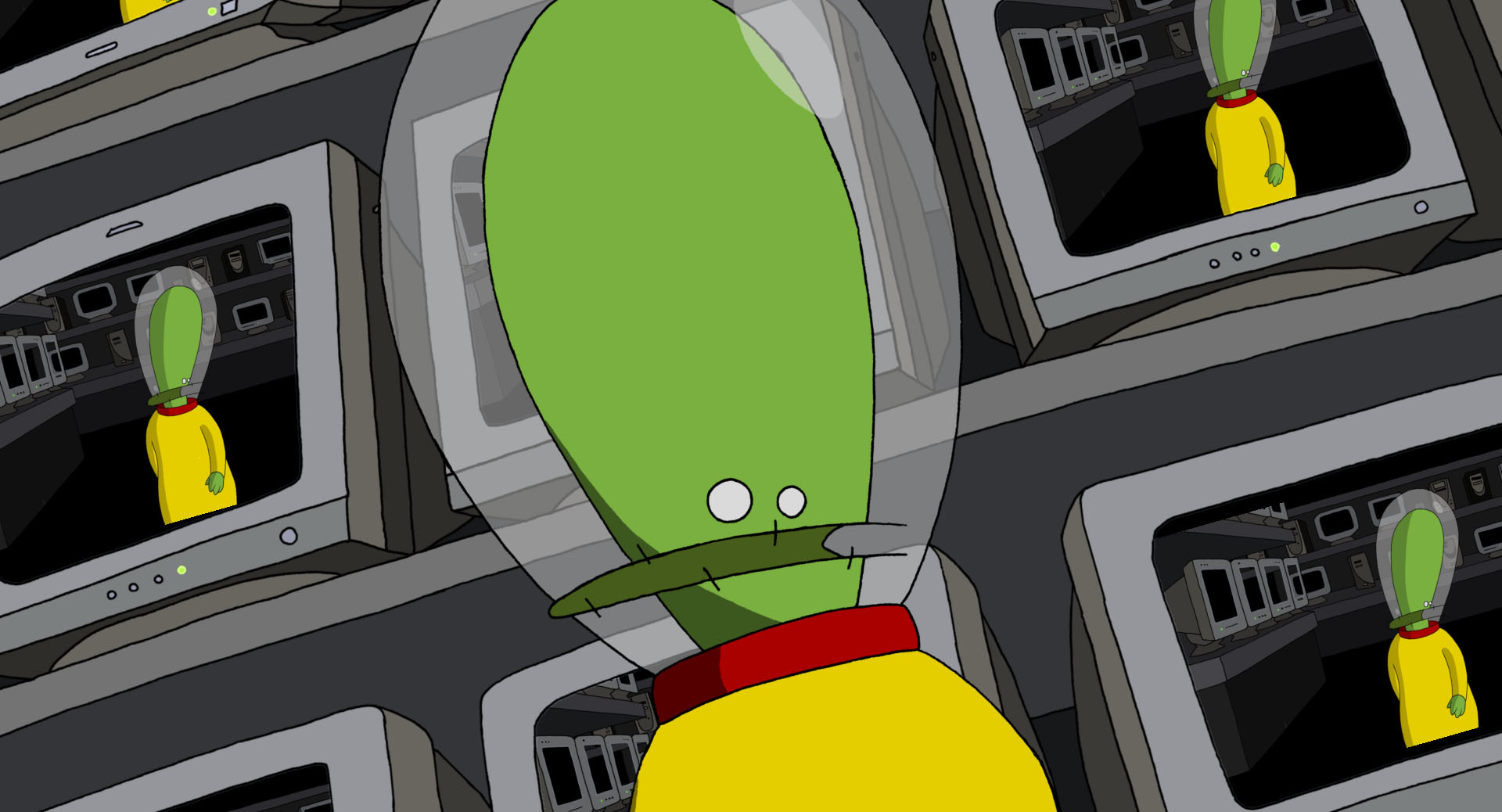 ‘Mercano el Marciano’ is a curious feature film from Argentine about an ugly little Martian who gets stranded in the evil city of Buenos Aires, where he ends up living in the sewer.
Here he builds a virtual Mars to play in for himself on the internet, but soon it is discovered and exploited by businessmen. Together with a nerdy boy and a trio of alternatives Mercano takes revenge. This leads to a silly musical finale.
The film uses original designs and is nicely animated. Unfortunately, it is also hampered by slow timing, poor gags, graphic violence, ugly colors and bad sound design. The result is an original, yet mediocre film, which is not too surprising, when one considers the film was made with a budget of only $250,000 (for comparison: a contemporary Hollywood production like ‘Monsters, Inc’ cost $115 million).
‘Mercano el Marciano’ seems to be an early example of an international movement in animation film, which favors urban settings, violence and rather adult material (e.g. ‘The District!’ (2004) from Hungary, and ‘George the Hedgehog’ (2011) from Poland).
Watch ‘Mercano el Marciano’ yourself and tell me what you think:
Director: Unknown
Release Date: April 30, 1928
Stars: Oswald the Lucky Rabbit, Peg Leg Pete
Rating: ★★★½
Review:
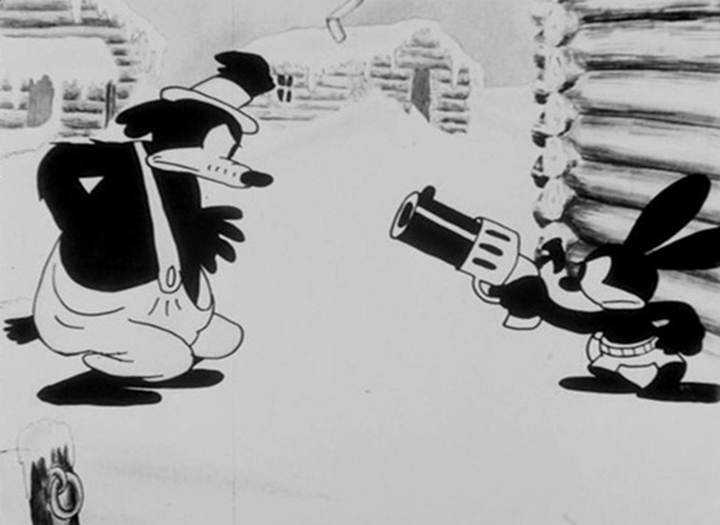 Oswald is a mounted police officer in charge of catching Peg Leg Pete, who, in spite of his name, has two legs here.
Oswald follows Pete on a mechanical horse, but in the end they’re both chased by a bear. Oswald, however, manages to get both Pete and the bear into prison.
‘Ozzie of the Mounted’ feels rather routine, and is less remarkable than say ‘Rival Romeos‘ or ‘Oh, What a Knight‘. The chase scene fills a large part of the cartoon, but contains few clever gags. Nevertheless, the animation of Oswald swinging around on his mechanical horse’s loose spring is still fascinating to watch. It’s also interesting to point out that Oswald’s mechanical horse looks far more mechanical than his mechanical cow in ‘The Mechanical Cow‘ from seven months earlier. This shows the subtle but steady progress the Walt Disney studio was making in animation, even before it became famous for that.
Watch ‘Ozzie of the Mounted’ yourself and tell me what you think:
This is Oswald the Lucky Rabbit cartoon No. 18
To the previous surviving Oswald the Lucky Rabbit cartoon: Bright Lights
To the next Oswald the Lucky Rabbit cartoon: Hungry Hoboes
Director: Unknown
Release Date: October 17, 1927
Stars: Oswald the Lucky Rabbit
Rating: ★★★
Review:
 War has broken out. This leads to a surprisingly cheerful crowd of people happily volunteering to be a soldier. As if The Great War had never happened.
Oswald volunteers too, after a long goodbye to his girlfriend. In the trenches, he’s still kissing her portrait, until it is bombed by a mouse. This leads to an air battle between Oswald and the little rodent, which ends with Oswald beating up the mice, until he’s confronted by an angry officer. Oswald and the officer get into a bombing duel, in which Oswald uses an elephant, which explodes. In the end even Oswald himself is literally blown to pieces, but he’s revived by his girlfriend who’s a red cross nurse.
The depiction of war in this cartoon is surprisingly positive, and there are a lot of gags. Real danger is never felt, but the cartoon does feature some startling images of huge cannons swooping into the camera. Four years later Hugh Harman, who did some of the animation, would reuse elements of ‘Great Guns’ in his own World War I film ‘Bosko the Doughboy‘ (1931).
Watch ‘Great Guns’ yourself and tell me what you think:
This is Oswald the Lucky Rabbit cartoon No. 4
To the previous Oswald the Lucky Rabbit cartoon: The Mechanical Cow
To the next Oswald the Lucky Rabbit cartoon: All Wet
Director: Unknown
Release Date: October 3, 1927
Stars: Oswald the Lucky Rabbit
Rating: ★★★
Review:
 In his fifth film Oswald has a mechanical cow to deliver milk with.
When his girlfriend gets kidnapped by a mob of gangsters, the cow helps him to rescue her. The gangsters come to a surprisingly cruel end, when they fall off a cliff and are eaten by sharks.
The cow behaves anything but mechanical. On the contrary, it is very rubbery, and even lazy and sleepy in the first scene, and its animation is not different from that of any of the other characters.
Watch ‘The Mechanical Cow’ yourself and tell me what you think:
This is Oswald the Lucky Rabbit cartoon No. 3
To the previous Oswald the Lucky Rabbit cartoon: Oh, Teacher
To the next Oswald the Lucky Rabbit cartoon: Great Guns
Director: Sam Stephens & Christopher Mauch
Release Date: May 2013
Rating: ★★★
Review:
 ‘Tumbleweed Tango’ is a charming little film about two balloon dogs falling in love in a menacing desert full of prickly cacti. The two dance a romantic tango, and together transform into a large bird, escaping the threatening cacti world.
‘Tumbleweed Tango’ is a virtuoso computer animation film, full of swooping camera takes, elaborate landscapes, and convincing animation on the two balloon dogs. Even their metamorphosis into the balloon bird is believable.
Watch ‘Tumbleweed Tango’ yourself and tell me what you think:
Director: David Hand
Release Date: December 19, 1936
Rating: ★★★
Review:
 The success of Oscar-winning ‘Three Orphan Kittens‘ (1935) undoubtedly prompted this sequel, which is both less beautiful, less entertaining and less remarkable than the original short.
The film is aptly titled ‘More Kittens’, which shows its crowd-pleasing character. This time the kittens create havoc in the garden, while dealing with a fly, a tortoise and a teasing blue bird.
The cartoon is remarkable for introducing the good-natured St. Bernard Bolivar, who would become Donald Duck’s dog in the comic strip two years later. He’s not named here, but the likeness is so stunning, not only in design but also in character, that there’s no doubt it’s him. True, there was also a St. Bernard in ‘Alpine Climbers’ (1936), but this dog lacks Bolivar’s character, being more of a cliche St. Bernard instead.
Watch ‘More Kittens’ yourself and tell me what you think:
This is Silly Symphony No. 65
To the previous Silly Symphony: Mother Pluto
To the next Silly Symphony: Woodland Café
Director: Frank Tashlin
Release Date: December 19, 1936
Stars: Porky Pig
Rating: ★★★
Review:
 Porky has a game refuge in Canada, in which he defends rather cute animals against an evil hunter.
The hunter is designed like the lieutenant from ‘Little Beau Porky‘, but we only see him appear after 4’30. Before this his threat is shown by his shadow only, a remarkably inventive device for a cartoon of the 1930s.
Like other early Warner Brothers films, ‘Porky in the North Woods’ looks very primitive, and rather Disney-anno-1932/1933-like. Yet it features an extremely fast sequence of a squirrel running a ridiculously long distance through the woods to get help (and back to fetch and apple). Such short and fast sequences of characters crossing ridiculously long distances would become a trademark of Tashlin’s colleague Tex Avery. Like his first two films, Tashlin’s third short at Warner Bros. features a battle sequence: this time we watch an enormous number of animals being called to arms.
Porky hardly talks in this cartoon – it seems Tashlin tried to avoid his tiresome stutter. Indeed, in 1937, the original voice artist would be replaced by Mel Blanc, who was able to make Porky’s stutter funny.
Watch ‘Porky in the North Woods’ yourself and tell me what you think:
http://www.dailymotion.com/video/x2xp64z
This is Porky Pig cartoon no. 17
To the previous Porky Pig cartoon: The Village Smithy
To the next Porky Pig cartoon: Porky the Wrestler
Director: David Hand
Release Date: October 26, 1935
Rating: ★★★
Review:
 On a winter night three kittens are thrown in a sack into a garden.
Luckily they can escape the cold by entering the house, which they explore. This sweet cartoon contains elaborate gags with a.o. pepper, a bottle of milk, and a pianola.
‘Three Orphan Kittens’ was penned by Joe Grant and Bill Cottrell, and benefited from Fred Moore’s appealing animation. Indeed, it won an Academy Award. Its success made it one of those rare Silly Symphonies to evoke a sequel (‘More Kittens‘ from 1936). Moreover, it clearly inspired other animation film makers: the milk bottle gag was more or less copied by Fleischer in ‘We did it‘ (1936) which also stars three kittens. And, some of the pianola gags may have inspired Hanna and Barbera in their ‘The Cat Concerto‘ (1947).
At least Hanna and Barbera copied the black maid (of whom we only see her arms and legs) for their own Mammy Two-Shoes in the Tom & Jerry series. The black maid would also return in a few Disney shorts: ‘More Kittens‘ (1936), ‘The Pantry Pirate‘ (1940, starring Pluto), and ‘Figaro and Cleo‘ (1943).
Watch ‘Three Orphan Kittens’ yourself and tell me what you think:
This is Silly Symphony No. 56
To the previous Silly Symphony: Music Land
To the next Silly Symphony: Cock o’ the Walk
Director: Jeff Newitt
Release Date: 1992
Rating: ★★★
Review:
 A gentleman uses a flower to determine whether his girl loves him or not.
The contrasts between happiness (she loves him) and pain (she loves him not) get more and more extreme during the film, providing unsettling images of terror.
Like ‘Adam‘, ‘Loves Me, Loves Me Not’ is an example of dark humor, typical for the Aardman Studios at the time. The dark humor is typified by the screams of pain the flower exclaims, when its petals are removed, by the highly disturbing soundtrack and by the images of suicide and threat.
Combining virtuoso clay animation with some cel animation, the film is a technical masterpiece. It also features some great silent comedy, and especially the deft gestures of the Clark Gable-like gentleman are nicely done.
Watch ‘Loves Me, Loves Me Not’ yourself and tell me what you think:
‘Loves Me, Loves Me Not’ is available on the DVD ‘Aardman Classics’
Director: Jan Švankmajer
Release Date: 1970
Rating: ★★★
Review:
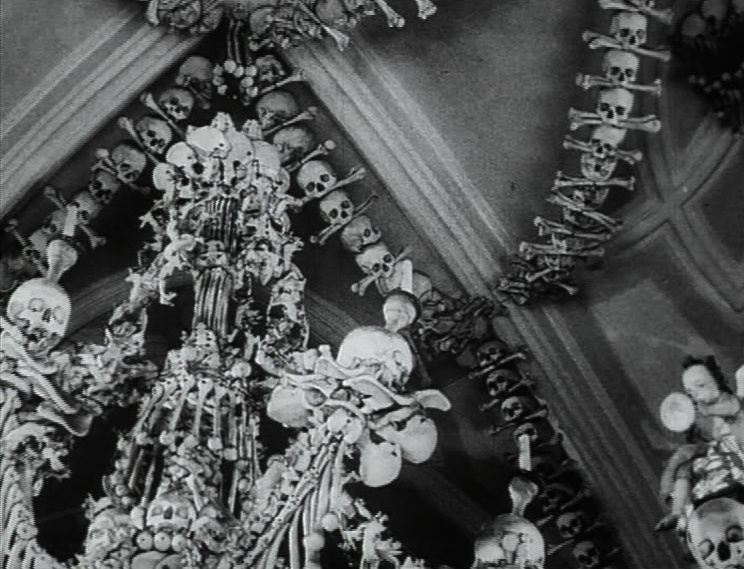 ‘The Ossuary’ is a commissioned documentary film about a Czech chapel in Sedlec, which is decorated with thousands of bones and skulls of victims of the 1318 plague and of the Hussite wars of 1421.
Two versions of this film exists: one with a soundtrack of a rather mundane guide guiding a group of children, in which she repeatedly warns not to touch the bones on a penalty of fifty crowns. Her tour is mixed with the uncanny sound of a rattling bicycle. For unclear reasons this soundtrack was considered subversive and forbidden by the Czechoslowakian regime. Therefore a second version was made using a jazz soundtrack.
In both versions the soundtrack conflicts with the morbid images, which are composed in a rhythmical way that even appeals when watched silently. The film contains no animation, but is full of Švankmajer’s idiosyncratic cinematography.
Watch ‘The Ossuary’ yourself and tell me what you think:
‘The Ossuary’ is available on the DVD ‘Jan Svankmajer – The Complete Short Films’
Director: Jan Švankmajer
Release Date: 1969
Rating: ★★★
Review:
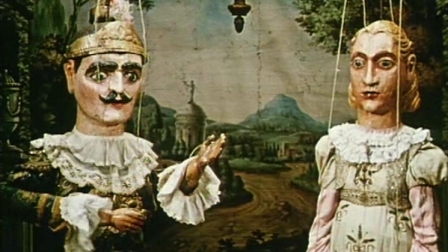 In ‘Don Juan’ Švankmajer’s retells a classic tale from the marionette theater.
The story unfolds in half an hour: Don Juan is a rogue who kills his father, the father of his beloved and his own brother, only to be taken into the depths off hell.
Oddly enough the film is enacted by people dressed as marionettes and behaving accordingly. This allows the marionettes to leave the theater and to perform in the real world, which is strangely intermingled with the marionette theater. This blend of the real and the artificial gives the film a weird and disturbing atmosphere. Švankmajer would reuse and improve upon this mix in his masterpiece, the feature film ‘Faust‘ (1994).
This film contains hardly any animation, and may therefore not be included in this blog. However, it takes a central part in Švankmajer’s oeuvre, who has always blended several different techniques into his works. It’s best to review his oeuvre as a whole, being animated or not.
Watch ‘Don Šajn’ yourself and tell me what you think:
‘Don Šajn’ is available on the DVD ‘Jan Svankmajer – The Complete Short Films’
Director: Jiří Trnka
Release Date: 1954
Rating: ★★★
Review:
 A young man on a motorcycle is on his way to his girl.
Along the way he stops at a bar, where a wedding is taking place. There he’s offered a drink, which he reluctantly accepts. However, one leads to another and he is quite intoxicated when leaving the bar. Driving at night he tries to speed against a car, a train and even a plane, but he finally crashes, never to see his girl.
This educational film warns us not to combine drinking with driving. In this respect the film is very dull and predictable, but Trnka’s illusion of speed and drunkenness is astonishing.
Watch ‘A Drop Too Much’ yourself and tell me what you think:
http://en.channel.pandora.tv/channel/video.ptv?ch_userid=noisypig&prgid=46485008&ref=rss
Director: Jiří Trnka
Release Date: 1949
Rating: ★★★
Review:
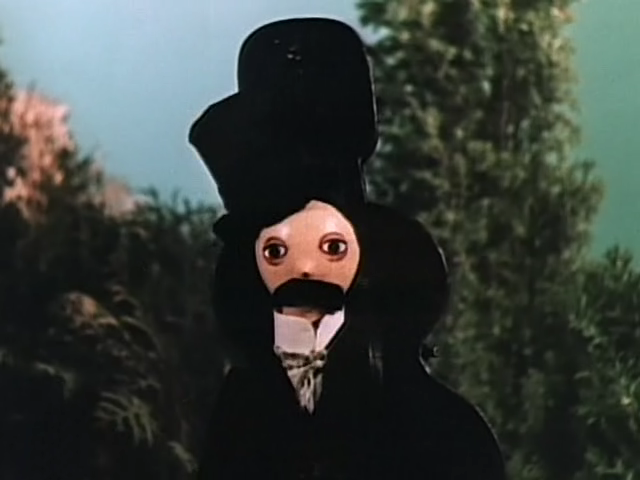 ‘Story of the Bass Cello’ is a re-telling of a classic story by Anton Chekhov.
The film tells about a bass player and a girl who both take a swim, but whose clothes are stolen. The bass player invites the lady to take place in his bass case, but when he’s after the possible thief, the case is picked up by his fellow instrumentalists and brought to the palace, where an astonished crowd discovers the naked lady inside.
‘Story of the Bass Cello’ is a mildly amusing and sweet film. It contains nice silent comedy. The short is a little bit slow, however, and not as good as Trnka’s more outrageous ‘The Song of the Prairie‘ from the same year.
Watch ‘Story of the Bass Cello’ yourself and tell me what you think:
http://veehd.com/video/4587175_Jiri-Trnka-Roman-s-Basou-Story-Of-The-Bass-Cello-1949
Director: Jiří Trnka
Release Date: April 15, 1949
Rating: ★★★
Review:
 ‘The Emperor’s Nightingale’ is Jiří Trnka’s second feature film (he made no less than six in total).
It tells the familiar story by Hans Christian Andersen from an original perspective: he frames the fairy tale by a live-action story about a lonely rich boy, who lives in a restricted environment. When the boy goes to bed, he dreams the fairy-tale, which stars some of his toys. Thus, after more than seven minutes, the animation kicks in.
In the boy’s dream, the Chinese emperor is a lonely little rich boy, restricted by rules, too, and the whole film seems a plea for freedom and against rules and restrictions, quite some message in communist Czechoslovakia. This theme is enhanced by the English narration, wonderfully voiced by Boris Karloff, which is a welcome addition to Trnka’s silent comedy. The whole film breathes a kind of surrealistic atmosphere and Trnka’s use of camera angles is astonishing, as is his sometimes very avant-garde montage.
Nevertheless, the pacing of the film is slow, its humor sparse and only mildly amusing, and the puppet animation still too stiff to allow elaborate character animation. Therefore, the film hasn’t aged very well, and although a tour-de- force, ‘The Emperor’s Nightingale’ falls short as a timeless masterpiece.
Watch ‘The Emperor’s Nightingale’ yourself and tell me what you think:
Director: Paul Driessen
Release Date: 1977
Rating: ★★★
Review:

After working in Canada for the NFB for five years, Driessen experienced a major personal setback, when his marriage failed, and his ex left for The Netherlands with their two children. Driessen soon missed his son and daughter and returned to his native country himself.
In The Netherlands he rented a small attic in The Hague to work and live in. Here he made ‘David’, which he dedicated to his children Anouk and Kaj.
David is the world’s tiniest cartoon star. He’s so small, even the little gnomes can’t see him. During most of the cartoon his presence is only known by his footsteps and his voice. In fact, David is probably the first cartoon star to remain invisible throughout the picture. Nevertheless, Driessen manages to keep the film entertaining, even though most of the time we look at an empty screen.
This film is clearly meant for children and unfortunately, it is hampered by its slowness and large amount of dialogue of David himself (in the Dutch version provided by actor Aart Staartjes). Much of the fun is in David trying to make himself known. Despite its joyful spirit, the film contains a morbid ending, when David, having survived a giant and a predatory bird, is eventually squashed by an unknowing pedestrian…
‘David’ was Driessen’s sixth film, and his idiosyncratic style has matured immensely since his first film, ‘The Story of Little John Bailey‘ (1970). With his next film ‘Killing of an Egg‘ he would animate his first masterpiece.
Watch ‘David’ yourself and tell me what you think:
‘David’ is available on the DVD ‘The Dutch Films of Paul Driessen’
Director: Raoul Servais
Release Date: 1973
Rating: ★★★
Review:
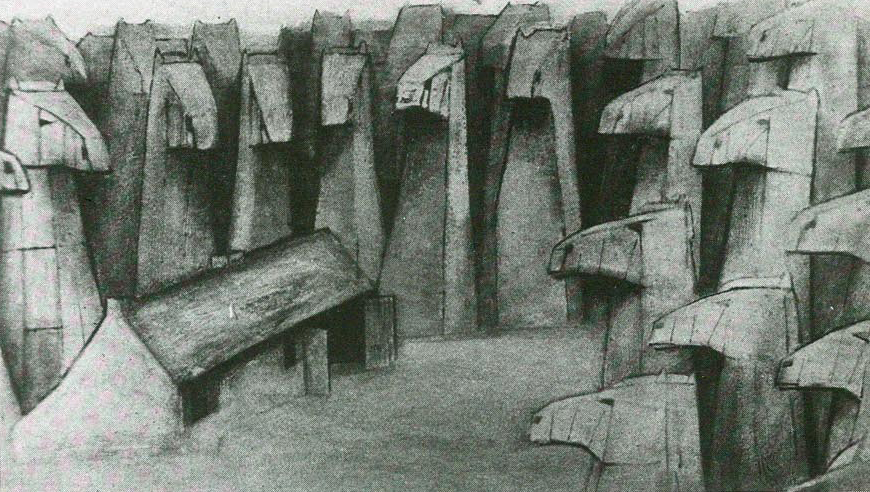 ‘Pegasus’ tells about a lonely blacksmith who lives in the countryside.
The blacksmith has a love for horses, but unfortunately his surroundings are totally devoid of them. So he builds a horse head out of metal to worship. Unfortunately, the horse head appears to have an ability to grow and reproduce, surrounding his house like a forest.
‘Pegasus’ is a beautiful and surreal film. Unfortunately, it ends quite abruptly, leaving behind a sense that not everything has been said, yet.
Watch ‘Pegasus’ yourself and tell me what you think:
Director: Georges Schwizgebel
Release Date: 1977
Rating: ★★★
Review:
 In ‘Hors-jeu’ we watch a soccer match change into a basketball match and into an ice hockey game. When violence enters, however, the game stops.
With this short film Schwizgebel builds on the concepts introduced in his previous film, ‘Perspectives‘. In ‘Hors-jeu’ he incorporates sound-effects and a rather surrealistic play with the rotoscoped images into his style. Surrealism would dominate his next film, ‘Le ravissement de Frank N. Stein‘ (1982), but in its visual style ‘Hors-jeu’ looks more forward to later films, like ‘78 Tours‘ (1985).
Watch ‘Hors-jeu’ yourself and tell me what you think:
http://v.youku.com/v_show/id_XNzU1MjYzMjg=.html
‘Hors-jeu’ is available on the DVD ‘Les Peintures animées de Georges Schwizgebel’
Director: Georges Schwizgebel
Release Date: 1975
Rating: ★★★
Review:
 As the title implies, this short film is a study in perspectives. It also seems to address the arbitrariness of things, as we see a walking woman change into herself, into skaters and into a running dog, whenever our perspective of her changes. The film uses effective piano music by Bach.
‘Perspectives’ introduces several aspects of Schwizgebel’s mature style: the painted canvas, the rotoscoped movements, the constant changing of perspectives, the prominent shadows and his mastery of metamorphosis. In his next films Schwizgebel would expand on this technique, which would eventually lead to such masterpieces as ‘La jeune fille et les nuages’ (2000) and ‘L’Homme sans ombre’ (2004).
Watch ‘Perspectives’ yourself and tell me what you think:
http://v.youku.com/v_show/id_XNzU1MzkzOTY=.html
‘Perspectives’ is available on the DVD ‘Les Peintures animées de Georges Schwizgebel’


 Dr. Grob's Animation Review