
You are currently browsing the category archive for the ‘★’ category.
Director: Jack King
Release Date: August 11, 1939
Stars: Donald Duck
Rating: ★
Review:
 In ‘Donald’s Penguin’ Donald Duck receives a present from one Admiral Bird, South Pole.
The package appears to contain a female penguin, whom Donald calls Tootsie. In ‘Donald’s Penguin’ Donald’s behavior is quite different than from the earlier ‘Polar Trappers‘ (1938), in which he tried to kill several penguins in order to eat them. True, even in this gentle cartoon he threatens to blast the penguin away with a shotgun, but mostly the short shows Donald’s soft side. This doesn’t lead to great comedy, and mostly ‘Donald’s Penguin’ seems to be the Donald Duck counterpart of the later, but equally dull Pluto-befriends-an-animal series (e.g. ‘Pluto’s Playmate‘ from 1941 and ‘Canine Patrol‘ from 1945). Nonetheless, ‘Donald’s Penguin’ is a rare Disney cartoon in which creatures are killed, as Donald’s three goldfish all end in the penguin’s stomach.
‘Donald’s Penguin’ was the last cartoon in which Donald Duck wears a white cap. In his next short, ‘The Autograph Hound’ it was replaced by a blue one, probably for greater contrast.
Watch ‘Donald’s Penguin’ yourself and tell me what you think:
This is Donald Duck cartoon no. 12
To the previous Donald Duck cartoon: Sea Scouts
To the next Donald Duck cartoon: The Autograph Hound
‘Donald’s Penguin’ is available on the DVD set ‘The Chronological Donald Volume 1’
Director: Dave Fleischer
Release Date: April 28, 1939
Stars: Popeye, Olive Oyl
Rating: ★
Review:
 ‘Leave Well Enough Alone’ opens with Popeye visiting Olive Oyl’s pet shop, buying all her animals (dogs) for $500, only to set them free immediately.
Only a parrot stays behind. He sings the cartoon’s title tune, in which he tells us that it’s better to be safe inside, being cared for than free in the outer world. Indeed, in no time all the dogs have been caught by a dog catcher. Popeye buys them all from the dog catcher and restores them to the shop.
‘Leave Well Enough Alone’ is low on gags, its title song is trite, but most importantly, its message is highly questionable. It’s very strange to watch such a free spirit as Popeye finally obeying to this extremely conservative motto. Was it a hidden message from Max to his employees?
Watch ‘Leave Well Enough Alone’ yourself and tell me what you think:
This Popeye film No. 70
To the previous Popeye film: Aladdin and His Wonderful Lamp
To the next Popeye film: Wotta Nitemare
‘Leave Well Enough Alone’ is available on the DVD Set ‘Popeye the Sailor Volume Two’
Director: Dave Fleischer
Release Date: June 9, 1939
Stars: Betty Boop, Pudgy
Rating: ★
Review:
 In the opening scene of ‘The Scared Crows’ we watch Betty and Pudgy planting seeds, which are immediately eaten by crows.
Betty chases them away using a scarecrow, but one flies against a tree, and Betty takes the poor bird inside to nurse it. However, the crow soon invites all his friends inside, and the flock creates havoc in Betty’s kitchen. Using the scarecrow as a disguise Betty chases them all away, restoring peace.
‘The Scared Crows’ is a slow and tiresome cartoon, and it’s difficult to see anything noteworthy in it, apart from being Pudgy’s last theatrical cartoon. The little cute dog had hardly made an impression during its five year career, never reaching the stardom of its owner, let alone Popeye, Fleischer’s major star, and he wasn’t missed.
Watch ‘The Scared Crows’ yourself and tell me what you think:
This is Betty Boop cartoon No. 82
To the previous Betty Boop cartoon: Musical Mountaineers
To the next Betty Boop cartoon: Rhythm on the Reservation
‘The Scared Crows’ is available on the French DVD Box Set ‘Betty Boop Coffret Collector’
Director: Dave Fleischer
Release Date: January 26, 1939
Stars: Hunky and Spunky
Rating: ★
Review:
 ‘Always Kickin” sees the return of that infamous duo of burrows, Hunky and Spunky.
In the opening scene we watch Hunky teaching Spunky how to kick backwards. Next we watch Spunky trying to be like the birds. He fails at attempts to sing, to build a nest and to fly, and all the bird mock the little donkey. Then an evil vulture or eagle (it’s not very clear) arrives, and kidnaps one of the young birds, much to the distress of the other birds. Spunky comes to the rescue, using the newly learned kicking technique to kick the hell out of the evil bird. In the end we watch all the birds admiring Spunky’s kicking practice.
It’s difficult to say anything positive about this cartoon. Its story is so utterly cloying, its protagonists so terribly boring, and its timing so remarkably slow, it’s a real pain to sit it out. When one does so, the short’s seven-and-half minutes feel much, much longer… One can only guess what the Fleischers ever saw in their donkey duo, as they made yet another five cartoons with them.
Watch ‘Always Kickin” yourself and tell me what you think:
‘Always Kickin” is available on the DVD-set ‘Somewhere in Dreamland – Max Fleischer’s Color Classics: The Definitive Collection’
Director: Dave Fleischer
Release Date: October 28, 1938
Rating: ★
Review:
 ‘The Playful Polar Bears’ starts with just that: playful Polar Bears.
Soon, we follow a disobedient little bear, who wants to catch a fish without entering the ice cold water. When a bunch of hunters arrive, all bears flee into an ice cave, except for the little one. When his mother finds him, she thinks he has been shot, which leads to an overlong mourning and funeral scene. Of course, the little one is unharmed, and in the end shot we watch the polar bears being playful again.
With ‘The Playful Polar Bears’ the Fleischer brothers hark all the way back to early Silly Symphonies like ‘Arctic Antics‘ (1930) and ‘Birds in the Spring‘ (1933), without adding anything new. It’s a great example of their misguided plagiarism of Disney’s Silly Symphonies series: there’s a protagonist, but nothing to let him gain the audience’s sympathy. There’s emotion, but it’s played out in the most standardized way. Thus in no frame we’re able to feel with the mother polar bear, whose emotions remain abstract and generic. Besides, the story lacks inner logic. In the opening shots it’s clearly established that the little polar bear hates the ice cold water, but nothing is done with this information. Moreover, the hunters are finally defeated by the deus ex machina of a snow storm, which sends their ship home.
So, in ‘The Playful Polar Bears’, there’s a lot happening on the screen, but nothing that’s remotely interesting. Films like these painfully showed what Disney had and what the Fleischers lacked. Luckily, they also made Popeye cartoons, which showed that the Fleischers really could make enjoyable cartoons, because in the Popeye series they could play their own game, instead of trying to imitate somebody else’s.
Watch ‘The Playful Polar Bears’ yourself and tell me what you think:
‘The Playful Polar Bears’ is available on the DVD-set ‘Somewhere in Dreamland – Max Fleischer’s Color Classics: The Definitive Collection’
Director: Friz Freleng
Release Date: January 28, 1939
Stars: The Captain and the Kids
Rating: ★
Review:
 In ‘Seal Skinners’ a million dollar seal has escaped and a ten thousand dollar reward has been promised to anyone who can bring him back.
Somehow, both the captain and the kids, his arch rival Long John Silver and an unknown Eskimo are at the North Pole, waiting for the escaped animal. At one point Long John Silver dresses as a seal himself. When the captain and the kids discover the scam, they roll him into a barrel and shake him like a cocktail. This is arguably the best gag in an otherwise remarkably unfunny cartoon, which ends with no conclusion.
‘Seal Skinners’ features some excellent animation, and Scott Bradley’s score is pretty inspired, but these aspects cannot save the cartoon, which suffers from lack of inner logic, and an absence of appealing characters.
Watch ‘Seal Skinners’ yourself and tell me what you think:
‘Seal Skinners’ is available on the DVD-set ‘Looney Tunes Golden Collection Volume Six’
Director: Friz Freleng
Release Date: June 25, 1938
Stars: The Captain and the Kids
Rating: ★
Review:
 ‘A Day at the Beach’ features the complete Katzenjammer family frolicking at the beach.
The film lacks any story, and consists of an unrelated string of repetitive gags whose only reason of existence seems to demonstrate that one can milk a gag to nausea. For example, there’s almost endless footage of the captain battling with a jumpy sun for some shade, and there’s a running ‘gag’ of the ocean destroying grandpa’s der inspector’s sand castle.
Only when Ma almost drowns, the cartoon gains something of a momentum. The film’s best feature, however, is it depiction of drunken sea creatures, a very small highlight in an otherwise endlessly boring film.
Watch ‘A Day at the Beach’ yourself and tell me what you think:
http://www.dailymotion.com/video/xvqhqi
‘A Day at the Beach’ is available on the DVD-set ‘Looney Tunes Golden Collection Volume Six’
Director: Frank Tashlin
Release Date: October 8, 1938
Rating: ★
Review:
 ‘Little Pancho Vanilla’ is one of Frank Tashlin’s particularly Silly Symphony-like Merrie Melodies. Indeed, the short’s star, Little Pancho Vanilla, looks like a grumpy cousin of Disney’s Little Hiawatha (1937).
Pancho dreams of becoming a bullfighter, especially when his three sisters admire a Clark Gable-like toreador. To prove his worth Little Pancho Vanilla rushes off to the arena, trying to join a group of amateur toreadors, to no avail. However, he accidentally lands inside, crashing the bull by falling on it, twice, and thus becoming a success.
There’s little to enjoy in ‘Little Pancho Vanilla’, the main hero is far from sympathetic, and the bullfight scenes are hardly interesting. The best gag is when the bull kicks all amateurs in all corners as if they were billiard balls. The end gag, however, only depicts these Mexicans as ignorant people.
At best Warner Bros. produced Silly Symphonies-lookalikes like this cartoon were better than Fleischer’s attempts in the same field, but it was a good thing Warner Bros. soon moved away from them, and embraced their own unique cartoon style wholeheartedly.
Watch ‘Little Pancho Vanilla’ yourself and tell me what you think:
http://www.dailymotion.com/video/x5qmfv3
‘Little Pancho Vanilla’ is available on the DVD-set ‘Looney Tunes Golden Collection: Volume 4’
Director: Dave Fleischer
Release Date: June 24, 1938
Stars: Hunky and Spunky
Rating: ★
Review:

Hunky and Spunky are two donkeys. Hunky, the large black one, teaches her child Spunky, a little brown one, to open cacti by kicking them apart.
A little later Hunky goes to sleep, while Spunky plays with a little rabbit. Unfortunately, he’s caught by an evil red-nosed man who uses the little ass to carry his heavy load. Luckily, Hunky comes to the rescue to Hunky’s cries for help. She kicks both the man and his house to another hill, and all is fine.
Absolutely nothing is remotely interesting in this cartoon, let alone funny. The two characters form arguably the most forgettable cartoon duo of all time. Even Fleischer’s tabletop is not present (I was wrong about this as Chad points out below – the cartoon starts with a tabletop scene). The result is a sweet, but utterly boring cartoon, which starts and ends with a gentle country song.
The Fleischer studio had outstayed the Van Beuren studio and Ub Iwerks’s studio, but with films like these one almost can feel them losing the game, not only to the leading Disney studio, but also to the much peppier Warner Bros. studio. Nevertheless, ‘Hunky and Spunky’ got an Academy Award nomination (which it luckily lost to Disney’s ‘Ferdinand the Bull‘), and so this ill-conceived pair would star no less than six other cartoons, and lasted until 1941.
Watch ‘Hunky and Spunky’ yourself and tell me what you think:
‘Hunky and Spunky’ is available on the DVD-set ‘Somewhere in Dreamland – Max Fleischer’s Color Classics: The Definitive Collection’
Director: Dave Fleischer
Release Date: December 31, 1937
Rating: ★
Review:
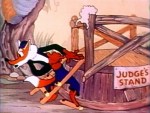 ‘Little Lamby’ is one of the most sickeningly sugary entries within Max Fleischer’s Color Classics series.
In this short we watch an evil fox entering peaceful ‘Animalville’. In order to catch some fresh meat, he organizes a baby contest with himself as the judge. He chooses an innocent little lamb as the winner. As the fox states it : “He’s the winner, and my dinner”, before he rushes off on a motorcycle to his hideout. Of course, the townspeople follow him, and during the film’s climax they try to enter the fox’s tree house, while the fox prepares the totally unaware lamb for dinner…
‘Little Lamby’ is totally devoid of humor, and the short is hampered by tiresome vocalizations, especially of the fox, whose wordless grunts get on the nerves. Moreover, the animation is erratic, with the quality often not exceeding that of cartoons from four/five years earlier. No, the only interesting thing about ‘Little Lamby’ is its opening shot, in which we watch the fox wandering through a beautiful 3D tabletop landscape.
Watch ‘Little Lamby’ yourself and tell me what you think:
‘Little Lamby’ is available on the DVD-set ‘Somewhere in Dreamland – Max Fleischer’s Color Classics: The Definitive Collection’
Director: Dave Fleischer
Release Date: August 12, 1938
Stars: Betty Boop, Pudgy
Rating: ★
Review:

‘Pudgy the Watchman’ opens with an alley cat driving a mouse-like car in a beautiful 3D landscape, conceived with Max Fleischer’s unique tabletop technique.
This cat, called Al E. Katz, stops at Betty Boop’s house, and tricks Betty to hire him as a ‘mouse eradicator’ by using a toy mouse. Meanwhile we watch Pudgy playing with the little critters in the cellar. The cat disturbs this peaceful scene by catching the mice in no time and playing darts using them. But one escapes and sets them all free, while the cat gets drunk from Betty’s wine cellar. With help from Pudgy the mice chase the cat out of the house.
‘Pudgy the Watchman’ has a straightforward story, but that’s the best one can say about this cartoon. The makers forgot to provide it with anything resembling a gag. The result is an utterly forgettable cartoon, and certainly one of the most boring entries even in Pudgy’s already mediocre catalog.
Watch ‘Pudgy the Watchman’ yourself and tell me what you think:
This is Betty Boop cartoon No. 75
To the previous Betty Boop cartoon: The Swing School
To the next Betty Boop cartoon: Sally Swing
‘Pudgy the Watchman’ is available on the Blu-Ray ‘Betty Boop: The Essential Collection, Vol. 4’ and the French DVD Box Set ‘Betty Boop Coffret Collector’
Directors: Rollin Hamilton & Tom McKinson
Release Date: November 3, 1933
Stars: Cubby the Bear
Rating: ★
Review:
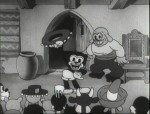 ‘The Gay Gaucho’ was the second of two Cubby Bear films made by the California-based Harman-Ising studio.
Like the first, ‘Cubby’s World Flight‘, it looks back, not forward, bringing back in mind the first Merrie Melodie, ‘Lady, Play Your Mandolin‘ (1931) and the early Mickey Mouse cartoons ‘Gallopin’ Gaucho‘ (1928) and ‘The Cactus Kid‘ (1930).
The setting is Argentine, and Cubby (Bosko, but in a different design) is a gaucho. He visits a canteen, where his girlfriend is a dancer. Then a Peg Leg Pete-like character enters, kidnapping the girl, with Cubby pursuing him. This story already was uninspired and routine, but Harman and Ising top its triteness by revealing it was all just a dream.
‘The Gay Gaucho’ is well-animated (by Friz Freleng and Paul Smith), but utterly forgettable, and it only proves that Cubby was so devoid of character, he couldn’t inspire at all. The result is one of the most forgettable films of 1933.
Watch ‘The Gay Gaucho’ yourself and tell me what you think:
‘The Gay Gaucho’ is available on the Blu-Ray ‘The Complete Animated Adventures of Cubby Bear’ and on the DVD ‘The Complete Adventures of Cubby Bear’
Director: Steve Muffati
Release Date: October 6, 1933
Stars: Cubby the Bear
Rating: ★
Review:
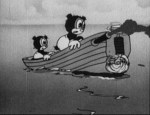 ‘Cubby’s Picnic’ is a cartoon vaguely set in a park. It starts with Cubby, our bland and practically emotionless hero, directing a bandstand, with all members drinking all the time.
Later we watch Cubby and his girlfriend watching a magician at a festival, later we see them in a loving mood, and going on a boat trip. We watch a school of fish singing, then several mosquitoes attacking our heroes. The cartoon, surprisingly, ends with Cubby returning to the bandstand.
‘Cubby’s Picnic’ is remarkably plotless, even for a Van Beuren cartoon. Things are just happening, without any logic or story arc, resulting in probably the worst cartoon of 1933
‘Cubby’s Picnic’ marks Steve Muffati’s debut as a director. Unfortunately, with this cartoon he only proved that he couldn’t direct at all. Nonetheless, Muffati directed five other cartoons for Van Beuren before the studio closed down. Despite his lack of direction talent, Muffati proved to be a talented animator, and he later turned up at the Fleischer studio/Famous Studio, animating for Superman, Popeye and Little Audrey films. He also drew comic strips featuring Famous characters like Little Audrey and Caspar the Friendly Ghost.
Watch ‘Cubby’s Picnic’ yourself and tell me what you think:
‘Cubby’s Picnic’ is available on the Blu-Ray ‘The Complete Animated Adventures of Cubby Bear’ and on the DVD ‘The Complete Adventures of Cubby Bear’
Director: Teizô Katô
Release Date: October 22, 1932
Rating: ★
Review:
 Surprisingly, the story of ‘The Plane Cabby’s Lucky Day’ takes place in the far future of 1980. By then the animals have inherited the earth, as people have taken the skies. Thus the film first takes place in an urban landscape of endless skyscrapers.
Unfortunately, the aimless story of a young flying cab driver soon hits more traditional settings, when the cab driver crashes on an island with talking animals etc. Moreover, Cabby’s behavior is shown to be very traditional, as he takes good care of his mother and helps a wounded bird. The story’s moral is that charity is a good investment.
Director-animator Teizo Kato was a newcomer in Japanese animation and it shows. His animation is incredibly primitive, and akin to American studio films from the 1910s. His animation lacks all hints of weight or personality, and is tiresome to watch. The long and boring story doesn’t help either, resulting in one of the worst products of early Japanese animated cinema.
Watch ‘The Plane Cabby’s Lucky Day’ yourself and tell me what you think:
http://cy.cyworld.com/home/22635133/post/4C403230C5957824B7388401
‘The Plane Cabby’s Lucky Day’ is available on the DVD-box set ‘Japanese Anime Classic Collection’
Directors: Frank Sherman & George Rufle
Release Date: May 26, 1933
Stars: Tom and Jerry
Rating: ★
Review:
 ‘In the Park’ takes place in a park, literally.
The short opens with Tom and Jerry reading the newspaper on a park bench. Somewhere else, a policeman seduces a sexy babysitter. Of course, the baby escapes, following a plot all too similar to the Fleischer Screen Song ‘Let Me Call You Sweetheart‘ (1932). Tom and Jerry more or less adopt the little brat, going at lengths in trying to comfort the little kid. In the end the baby is restored to its baby-sitter, and the cop kisses its behind. The cartoon ends with Tom and Jerry laughing at the policeman.
There’s little to enjoy in the rather run-of-the-mill ‘In the Park’, except for Gene Rodemich’s lively score. The designs are remarkably heterogeneous: the baby-sitter is remarkably well-drawn, Tom, Jerry and the policeman have generic early 1930’s designs, while the brat seems stuck in the 1920’s era.
Watch ‘In the Park’ yourself and tell me what you think:
This is Tom & Jerry cartoon No. 24
To the previous Tom & Jerry cartoon: Hook & Ladder Hokum
To the next Tom & Jerry cartoon: Doughnuts
‘In the Park’ is available on the DVD ‘The Complete Animated Adventures of Van Beuren Studio’s Tom and Jerry’
Directors: George Stallings & Frank Tashlin
Release Date: April 28, 1933
Stars: Tom and Jerry
Rating: ★
Review:
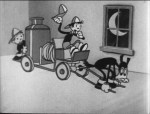 In ‘Hook & Ladder Hokum’ Tom and Jerry are fire fighters.
The cartoon opens with the two playing checkers and preparing for bed. As soon as they’ve lain down, the fire alarm rings, and the two rush to the burning house. However, Tom, Jerry and their horse are remarkably incompetent in extinguishing the fire, and the horse even manages to destroy the house completely.
‘Hook & Ladder Hokum’ marks Frank Tashlin’s first and only direction billing at Van Beuren. Tashlin had been an animator and story man at the studio. Tashlin later would improve cartoon directing at Warner Bros., and would become a successful live action director for e.g. Jane Mansfield, and Martin and Lewis comedies. It’s very difficult to detect any of his talent in this cartoon, as most of the action is still silent as if it had been made in the silent era. For example, there’s a scene in which Tom & Jerry gesture the horse to hurry, and later the flames spell the words ‘help’ and ‘hurry’.
In some of the close-ups the duo look better designed than normal, however. This just may be Frank Tashlin’s influence, but who knows? In any case, ‘Hook & Ladder Hokum’ compares unfavorably to the Mickey Mouse cartoon ‘The Fire Fighters‘, even though the Disney short is three years older.
Watch ‘Hook & Ladder Hokum’ yourself and tell me what you think:
This is Tom & Jerry cartoon No. 23
To the previous Tom & Jerry cartoon: Puzzled Pals
To the next Tom & Jerry cartoon: In the Park
‘Hook & Ladder Hokum’ is available on the DVD ‘The Complete Animated Adventures of Van Beuren Studio’s Tom and Jerry’
Director: Mannie Davis
Release Date: July 7, 1933
Stars: Cubby the Bear
Rating: ★★
Review:
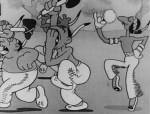 In ‘Indian Whoopee’ Cubby reads about Captain John Smith and Pocahontas before falling asleep.
Our hero soon dreams he’s John Smith himself, camping in the woods. He’s soon discovered by an Indian, however, and threatened by the whole tribe, including a pretty funny gay one. After a chase scene, Cubby is captured and about to be executed, despite the pleas of the little Pocahontas girl. Then, of course, he awakes.
‘Indian Whoopee’ is pretty boring, especially the chase scene is surprisingly low on gags, and lasts way too long. The best gag may be the little Fleischer-like gag of tent pegs pulling Cubby’s tent down, when he almost snores it away.
Watch ‘Indian Whoopee’ yourself and tell me what you think:
‘Indian Whoopee’ is available on the DVD ‘The Complete Adventures of Cubby Bear’, the Blu-Ray ‘The Complete Animated Adventures of Cubby Bear’ and the Blu-Ray/DVD ‘ Technicolor Dreams and Black & White Nightmares’
Director: Mannie Davis
Release Date: March 10, 1933
Stars: Cubby the Bear, Honey
Rating: ★
Review:
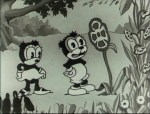 ‘Love’s Labor Won’, Cubby the Bear’s second cartoon, is the most musical short featuring Van Beuren’s poor man’s Mickey Mouse.
The cartoon starts with Cubby riding a dachshund to his girlfriend’s house. This anonymous girl, only called Honey by Cubby, is yet another variation on Oswald’s Honey, Flip’s Honey, or Mickey’s Minnie and fails to be distinct in any sense. The two make music together. At one point Cubby takes his gloves off to play the piano four hands with them, incidentally revealing to have nails. Cubby’s and Honey’s duet causes a lot of singing and dancing by forest animals. It’s startling to watch the Van Beuren studio embracing the song-and-dance-routine so passionately in 1933, when other studios were already abandoning them. But then suddenly some kind of story resolves when the routine is disturbed by a mean old wolf. Cubby fights him, and the cartoon ends with his triumph.
Despite the joyful setting, there’s little to enjoy in ‘Love’s Labor Won’. The animation is sloppy, and Cubby is frustratingly bland, not even emulating Mickey’s persistent optimism. In this cartoon he has a ridiculous crooner voice, which would not return in subsequent cartoons.
Watch ‘Love’s Labor Won’ yourself and tell me what you think:
‘Love’s Labor Won’ is available on the DVD ‘The Complete Adventures of Cubby Bear’ and the Blu-Ray ‘The Complete Animated Adventures of Cubby Bear’
Directors: John Foster & George Rufle
Release Date: September 16, 1932
Stars: Tom and Jerry
Rating: ★
Review
 ‘Barnyard Bunk’ opens with a farmer at sleep at a farm, which falls apart. It’s soon clear the farm is destroyed by numerous cheeky mice.
Enter Tom and Jerry playing saxophones. Their music makes a hen laying eggs, a cow producing tons of milk, and two woodpeckers producing a pile of wood. At one point all the lifeless objects of the farm start dancing. In the end the farmer pays the duo for the saxophones, but the moneybag turns out to be filled with mice.
It’s quite shocking to see that in ‘Barnyard Bunk’, a film made well into 1932, still features animation language of the silent era. The short features no dialogue, and the gestures of Tom, Jerry and the farmer are still of the 1920s. The designs of the farmer and the mice do not fare better, and the whole cartoon exudes from archaism. Its only modern feature is the dressed cow, which shows that already by 1932 the Hays code was getting hold of the cartoon industry.
Watch ‘Barnyard Bunk’ yourself and tell me what you think:
This is Tom & Jerry cartoon No. 15
To the previous Tom & Jerry cartoon: Jolly Fish
To the next Tom & Jerry cartoon: A Spanish Twist
‘Barnyard Bunk’ is available on the DVD ‘The Complete Animated Adventures of Van Beuren Studio’s Tom and Jerry’
Directors: Yasuji Murata & Chuzo Aoji
Release Date: 1932
Stars: Momotaro
Rating: ★
Review:
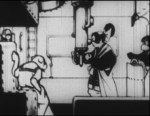 After ‘Momotaro’s Sky Adventure‘ Aoji and Murata send Japan’s folk hero off in a military submarine to fight a large shark.
Like in his earlier film Momotaro is asked by others to do that, and the film vaguely seems to glorify the navy, even though it’s much less successful in doing so than Momotaro’s earlier nationalist film was for the air force: the film runs rather short, Murata’s 1920s style animation is not particularly exciting or convincing, and for today’s audiences it’s quite unsettling to watch the hero fighting a large fish with a surplus of warfare, including numerous torpedoes. The Japanese clearly had less difficulties with this slaughter. In any case, the hero, and his friends Monkey and Dog (Crane couldn’t join them as he can’t swim) are awarded as heroes at the end of the cartoon.
Watch ‘Momotaro’s Underwater Adventure’ yourself and tell me what you think:
‘Momotaro’s Underwater Adventure’ is available on the Japanese DVD Box Set ‘Japanese Anime Classic Collection’.


 Dr. Grob's Animation Review