
You are currently browsing the tag archive for the ‘fantasy’ tag.
Director: Dan Scanlon
Release date: February 21, 2020
Rating: ★★★
Review:

‘Onward’, Pixar’s 22nd feature film, was the first of a series of four originals after a decade of sequels (the 2010s saw seven sequels compared to a mere four originals), making the 2020s a more interesting decade than the 2010s were. Unfortunately, Pixar’s return to original stories didn’t necessarily mean their films got better. ‘Onward’, at least, is not a bad film, but it never becomes great, either. The movie just lingers in mediocrity, relying too heavily on tried formulas and cliches.
‘Onward’ takes place in a fantasy world populated by elves, unicorns, centaurs, fauns, manticores and so on. But like the human-less worlds of ‘Monsters Inc.’, ‘Cars’ or to a lesser extent the later ‘Elemental’ the makers haven’t made any effort to make this world a really original one, turning it into just another lazy version of suburbia America. The whole idea of ‘Onward’ is that it used to be a magical place, until technology took over, making this world as bland and devoid of magic as ours.
In this world we follow teenager elf Ian, who’s designed as your average clumsy insecure teenager, a sort of Linguini from ‘Ratatouille’ (2007), but blue and with pointed ears. Ian also is one of those protagonists that all too often recur in animation films: one that has lost a parent (see also e.g. ‘Kung Fu Panda’ (2008), ‘The Good Dinosaur‘ (2015) and ‘Abominable’ from 2019). On his birthday Ian makes some resolutions to become a better person, but they are all thwarted, until his mother gives him and his quirky elder brother Barley a gift from their deceased father…
What follows is a truly dangerous quest in which the two brothers must team up to restore their father for just one day. This they do accompanied by their dad’s two legs, for that’s all what Ian managed to retrieve from the spirit world in the first place. Barley’s extensive knowledge of magic, which he got from playing a role game “based on reality” is a great help during their quest. Unfortunately for Barley, despite all his knowledge of magic, he hasn’t got the magic skill, but Ian has.
With their quest the two brothers not only restore magic to their world, Ian also comes to realize that his older brother is not only an annoying looney to be ashamed of, but much more to him. And yet, a more interesting and more original yet sadly underdeveloped character than either two brothers, is Ian’s and Barley’s mother, who comes into action and who dares to take risks to save her boys.
The brothers’ magical quest stands in huge contrast with the mundane world they live in, and the studio never really manages to wed these two worlds. In the end, the whole concept of a fantasy world turned mundane remains a forced and unconvincing one, and that one gift from a random father could restore magic to the entire world is anything but believable, even within the fantasy context.
Moreover, as said, the film relies too much on tropes to tell its stories. The magic in ‘Onward’ feels like a direct copy from the Harry Potter’-films with its use of spells. There is the obligate breakup scene, one that is particularly painful, because by that time Ian should have known better. And then there’s a curse, which actually stands in the way of a plot that should concentrate on the relationship between the two brothers, which the film mostly does, but to which, to me at least, the whole magic idea seems superfluous and unnecessary.
Of course, the power of animation is that it can show impossible things like elves and manticores, but for once, I believe that the film would be more courageous if it would tell the story of two real brothers living in American suburbia, bonding together after the death of their father. For this is the essence of the film, meaning that the fantasy part, despite driving the plot, is mostly fluff. Despite the final resurrection of the father being a beautiful moment in the movie, the film just doesn’t manage to pluck one emotional string like ‘Monsters, Inc.’ (2001), ‘Wall-E’ (2008), ‘Up’ (2009) or ‘Coco’ could. Pixar certainly could do better, something they would luckily prove with their next feature, ‘Soul‘.
Watch the trailer for ‘Onward’ yourself and tell me what you think:
‘Onward’ is available on Blu-Ray and DVD
Director: Mike Mitchell
Release date: February 2, 2019
Rating: ★★★
Review:

One of the surprises of 2014 was ‘The Lego Movie’, a surprisingly funny and sophisticated movie, making clever use of the source material, and transcending by far the product placement it actually was. Its huge success spawned the equally great ‘The Lego Batman Movie’ and the much weaker ‘The Lego Ninjago Movie’ (both from 2017), but one had to wait for five years for the true sequel: The Lego Movie 2: The Second Part.
This second movie immediately starts with a new threat to Bricksburg, the city in which Emmett lives, this time from the planet Duplo. In a toddler’s voice the new arrivals claim: “We are from the Planet Duplo, we are here to destroy you”. After some mayhem we jump to five years later, in which Bricksburg has apparently been destroyed and rebuilt as ‘Apocalypseburg’, a Mad Max-like post-apocalyptic world in which according to his girlfriend Lucy there’s no place anymore for niceness and optimism, although Emmett is still full of these things, despite having nightmares of “Armamageddon” (sic).
To make matters worse, a new, almost indestructible alien arrives with the name of General Mayhem, messenger of the shape-shifting Queen Watevra Wa’Nabi from the “Systar System”. What follows is another adventure full of references to other movies (e.g. The Wizard of Oz), which takes place both in the LEGO world and in live action, and in which Emmett meets a though guy called Rex Dangervest, who teach Emmett to grow up, or does he?
Unfortunately, this movie strives too hard to play a similar trick to the LEGO world as the first film, but it does all too obviously so. For example, we could see the origin of ‘Systar system’ from miles away. A huge talent like Maya Rudolph is wasted on the live action scenes, which remain formulaic and unspontaneous. The film’s message, too, is brought right in your face and lacks all the subtleties of the first film. There are some nice touches (for example, Bruce Willis playing a Lego version of himself, some nice 2D animation and a couple of pleasant songs), but overall the film never transcends mediocrity, despite all the evident effort. Thus one must conclude that after two films most of the inspiration for LEGO movies had died out.
Watch the trailer for ‘The Lego Movie 2: The Second Part’ yourself and tell me what you think:
‘The Lego Movie 2: The Second Part’ is available on Blu-Ray and DVD
Director: Mamoru Hosoda
Release date: May 16, 2018
Rating: ★★★
Review:

‘Mirai’ was the third feature film Mamoru Hosoda made for his own studio, Studio Chizu. Hosoda favors rather episodic films about growing up, and ‘Mirai’ is no exception, although the film takes place in a much smaller time frame than ‘Wolf Children’ or ‘The Boy and the Beast’.
Main protagonist of the film is ca. four-year-old boy Kun, who lives in a design house in Yokohama (the town is depicted regularly during the film in swooping bird-eye’s view shots), but more importantly, who gets a baby sister, the Mirai from the title. Mirai also means future, and in fact, the Japanese title is ‘Mirai no Mirai’, or ‘Mirai from the future’. Indeed, Kun meets an older version of his younger sister from the future, as well as some other characters, while he struggles to adapt to the new situation he finds himself in.
Because with the coming of little Mirai a lot changes for the young boy: his parents have less attention for him, focusing more on the new baby, they’re more often tired and crabby, and they struggle with combining working and caring, now there are two children around. Needless to say, Kun has a hard time getting adjusted, and even gets jealous of his innocent baby sister.
The film focuses on some key scenes, in which Kun experiences a setback, at least in his own mind, and then something magical happens in the little courtyard of his house. First the little boy first meets a humanized form of the family dog, and then his younger sister in older form (there’s more, but I won’t spoil it here).
Unfortunately, Hosoda doesn’t stick to the boy-sister relationship, and at some point, the magic scenes also help Kun overcome his fears. Moreover, a four-year-old is a difficult and questionable protagonist of a film that wants to show the hero’s progress. After all, he is just a little boy. It’s little surprising that Hosoda spends considerable time on Kun’s parents, and their development during this crucial part of their lives. And, indeed, to be frank, Hosoda’s honest depiction of the hardships of young parenthood and of raising one’s own children is much more interesting than Kun’s ‘development’ of character.
Main attraction of the film are the five magical scenes, with the first two showing some broad comedy, as the man-dog and Mirai from the future roam around the house. The third and fourth start to feel obligatory, even though the fourth has a nice nostalgic feel to it. But with the fifth, Hosoda goes completely overboard, and one wonders why these nightmarish scenes, taking the film to a altogether other atmosphere, were even necessary. In fact, this finale, in which Hosoda wants to tell us something about family ties, is too overtly self-explanatory and spoils a film that wasn’t perfect to start with.
In fact, ‘Mirai’ drags a little, being mostly confined to the small space of Kun’s house and with Kun’s development of character as an important, but very weak story device. The film’s episodic nature doesn’t really help, spreading the story thin, a problem that also invades ‘Wolf Children’ and ‘The Boy and the Beast’. I wish Hosoda was able to keep his use of time as tight as his use of space in this movie. ‘Mirai’ is not a failure, the film is too original for that, but it’s arguably Hosoda’s weakest feature film so far, never reaching the emotional heights of either ‘Wolf Children’, ‘The Boy and the Beast’ or even his debut film, ‘The Girl Who Leapt Through Time’ from 2006.
Watch the trailer for ‘Mirai’ yourself and tell me what you think:
‘Mirai’ is available on Blu-Ray and DVD
Director: Mari Okada
Release date: February 24, 2018
Rating: ★★★
Review:

The Japanese animation industry apparently is so rich that new interesting films can pop up seemingly out of nowhere. For example, ‘Maquia: When the Promised Flower Blooms’ (from now on ‘Maquia’) is made by the P.A. Works studio, which since its founding in 2000 focused on television series, and which only made four feature films, the first being based on a video game, the second made for television, the third for training purposes, and the fourth based on a television series.
So, their fifth feature film to be a completely original story, not based on a video game, television series or even a manga, comes as a surprise. It seems that ‘Maquia’ was the pet project by its director Mari Okada, who wrote the story herself. Okada, apparently is somewhat of a modern legend as she has written for over fifty television series since 2001, and is called by Wikipedia “one of the most prolific writers currently working in the anime industry”. She’s one of the brains behind ‘Anohana: The Flower We Saw That Day’ (2011), one of only two anime television series I have watched, and it comes to no surprise to me that the ‘Maquia’s’ story style has something in common with that series. Both series and film have a strong focus on human drama, with emotions reigning uncontrolled, and tears flowing frequently. In fact, despite the high fantasy setting, ‘Maquia’ has a strong element of melodrama, and the rather forced emotions, so different from the more restrained style in studio Ghibli, or the films by Yasujirō Ozu for that matter, actually made it harder for me to relate with these people.
‘Maquia’ is a fantasy film, set in a rather Middle Earth-like world, and starts with the depiction of a society of near-immortals called Lorphs, whose surroundings are particularly like the depictions of elven kingdoms in Peter Jackson’s adaptation of The Lord of the Rings. These Lorphs write their memories by weaving cloths and live far away from more mortal men. One of these, a young girl called Maquia (from which the English film title takes its name) rather out of nowhere complaints she is so alone. Shortly after this scene of distress the eternal city is attacked by an army of men, and Maquia soon finds herself in the outside world, where she adopts a baby, whose mother is killed.
From then on, the film takes an episodic nature, showing us various stages of the mother-son relationship until the son, whom Maquia calls Ariel, has matured, while his mother, in contrast, has retained the same teen appearance she had in the beginning.
The film apparently tries to say something about how to love is to lose and to let go, how to find beauty in the short lives we have, and how relationships form the most important part of life, but the film’s messages get deluded in a rather complex story, in which we do not only follow Maquia, but also her childhood friend Leilia, who is forced to become a queen by her abductors, the captain who destroyed the Lorph city in the first place and one Lang, a boy/man with whom Maquia spent her first years in the mortal world. The bigger story, and all its subplots are far less interesting than Maquia’s relationship to her adopted son, and both prolong and distract the film unnecessarily.
Apart from being unfocused and very, very emotional, ‘Maquia’ is also hampered by an overblown score by Kenji Kawai, all too forcefully guiding the viewer in which emotion to feel. Even worse, are the rather lazy and utterly generic human designs, which nowhere transcend your average anime television series. The animation, too, is fair, but not outstanding. There’s also a small dose of computer animation that is used sparingly and effectively. No, the film’s highlights are not the story, music, character designs or the animation, but the background art and the lighting, which are both no less than magnificent, and which both give ‘Maquia’ a splendor that make the film a delight to watch, even when the characters and events themselves don’t.
I like ‘Maquia’ being an original story, and its theme of what it means to be (im)mortal is interesting, but the film is too long, too episodic, too meandering and too dramatic to entertain, and I am pretty sure in the end I will not remember either the film’s story or its characters, but the beautiful background art and superb lighting, which the make the film a standout, after all.
Watch the trailer for ‘Maquia: When the Promised Flower Blooms’ yourself and tell me what you think:
‘Maquia: When the Promised Flower Blooms’ is avaiable on Blu-Ray and DVD
Directors: John & Faith Hubley
Release date: 1973
Rating: ★★★★
Review:
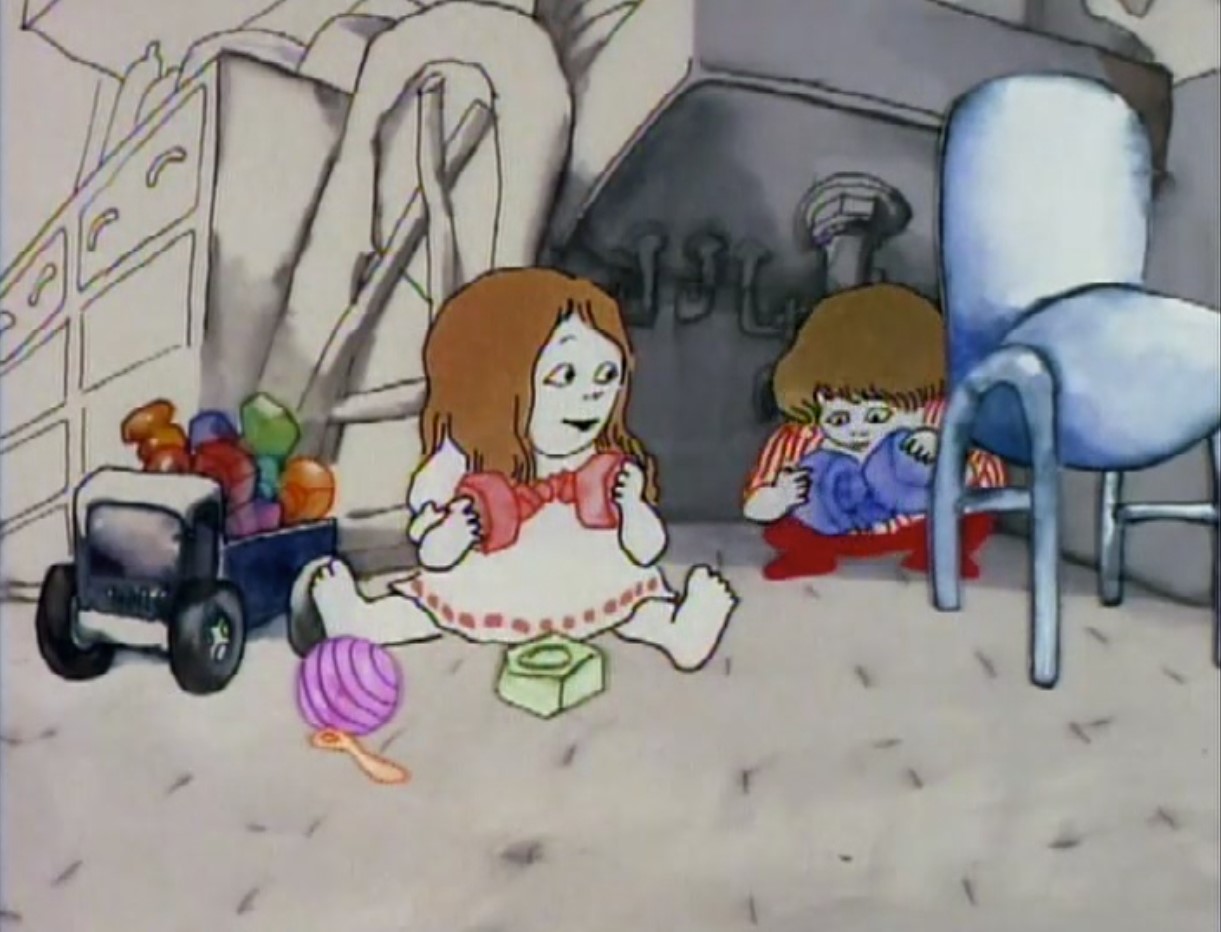
In ‘Cockaboody’ John and Faith Hubley returned to the techniques and world of ‘Moonbird‘ (1959). Once again they recorded the voices of their own children, this time the toddlers Emily and Georgia, while playing. The soundtrack is thus by design completely improvised and as children’s conversations go, all over the place.
John and Faith Hubley illustrate the dialogue with delightful drawings that augment the fantasy of the two girls. For example, when Georgia goes into a tantrum, it takes the form of a green tiger threatening her older sister. Or when Georgia utters the original word ‘cockaboody’, which gives the film its title, it’s transformed into a mysterious duck-like creature.
The watercolor background art convincingly depicts the Hubley’s house as one big place to play in. Throughout the film, we remain with the two little girls, for one little scene in which we see the mother’s reaction to the loud noises the two toddlers produce.
‘Cockaboody’ may be a rather random film, starting and ending nowhere, but in between we have a lovely ride together with the two children.
Watch ‘Cockaboody’ yourself and tell me what you think:
‘Cockaboody’ was released on the DVD ‘Selected Films of John and Faith Hubley 1956-1973’, which came with the March/April 2014 issue of magazine ‘The Believer’
Director: Hiromasa Yonebayashi
Release date: July 8, 2017
Rating: ★★★½
Review:

‘Mary and the Witch’s Flower’ is the first film by Studio Ponoc, founded by Yoshiaki Nishimura, who was a producer for Studio Ghibli before. Director Hiromasa Yonebayashi, too, is a Studio Ghibli alumnus, being an animator for the famed studio since 1997, and directing the studio’s 21st feature film ‘When Marnie Was There’ (2014).
It comes to no surprise then that ‘Mary and the Witch’s Flower’ is very, very Ghibli-like. Already the packaging of the DVD would fool anyone. But the similarity doesn’t stop there: even the opening titles emulate Ghibli; the character designs, too, are very Ghibli-like; the film is based on a British children’s book, just like Ghibli’s ‘Howl’s Moving Castle’ (2004), ‘Arrietty’ (2010) and ‘When Marnie Was There’; the film stars a young female protagonist (Mary) who has to survive without her parents, just like ‘Kiki’s Delivery Service’ (1997), ‘Spirited Away’ (2001) and ‘From Up on Poppy Hill’ (2010); Mary is a witch like Kiki; she’s accompanied by a cat who plays an important part just like Kiki and like Shizuku in ‘Whisper of the Heart’ (1995), and the film is partly set in a fantasy world, just like ‘Spirited Away’.
Now, this is immediately the film’s main flaw: studio Ponoc imitates Ghibli very well but doesn’t bring anything original of its own. The final product is practically indistinguishable from the source of inspiration. That doesn’t mean, however, that ‘Mary and the Witch’s Flower’ is a bad movie. The story is told well enough, the animation is top notch, and the fantasy world looks great. I certainly had a good time watching it, and would recommend the movie to all lovers of the Studio Ghibli product. But Studio Ponoc’s debut could and should have been something much more of their own. If you compare, for example, ‘Mary and the Witch’s Flower’ to the idiosyncratic ‘Night Is Short, Walk on Girl’ from the same year, it becomes clear which studio brings something original to the world, and which one does not.
Watch the trailer for ‘Mary and the Witch’s Flower’ yourself and tell me what you think:
‘Mary and the Witch’s Flower’ is available on Blu-Ray and DVD
Directors: Kresten Vestbjerg Andersen, Thorbjørn Christoffersen & Philip Einstein Lipski
Release date: September 29, 2011
Rating: ★★★
Review:

Arguably the least serious animated feature to be released in 2011 is a surprising little entry from Denmark called ‘Ronal the Barbarian’. The film is set in a bare fantasy world called ‘Metallonia’, and makes fun of many sword and sorcery tropes, as well as ‘Lord of the Rings’ and several leather metal cliches from the early eighties. Especially fans of Judas Priest should be delighted. In this respect, the end song accompanying the end titles is one of the film’s highlights, spoofing e.g. Led Zeppelin and Queen.
With its men walking around in tiny strings, with its lusty amazonians, with an oracle on a toilet, and with its many references to sex this could be a film too immature for its own good, but actually, the film makers play their story surprisingly straight, and despite all the parody and nonsense the film does have heart. It does help that fun is made of both male and female characters, and neither the overblown machos nor the incapable amazonians can be taken too seriously.
‘Ronal the Barbarian’ tells about Ronal, the only barbarian of ‘the tribe of Kron’ to be feeble, cowardly, and weak. When on one day his whole tribe is kidnapped and taken away, he must go on a dreaded quest, helped by an oversexed teenager bard called Alibert, by a very strong and heroic “shield maiden” called Zandra, and by a rather silly hippie-like elf called Elric.
Unfortunately, the characters are little more than vignettes. Ronal, to begin with, has little to counter his weakness. He seems to be a bit smarter than his fellow tribe members, but he’s far from cunning, and certainly not instantly likeable: during the first half of the film, he’s often whining and moaning, which makes the budding love story between him and Zandra hard to believe. Ronal’s transition to a more heroic character is more believable, especially because he remains clumsy and weak until the very end.
Alibert, too, is a character on the shallow side: his interest in dames is practically his only character trait, and he fails as comic relief, but not as a friend. In the end, he is as loyal to Ronal as Sam to Frodo. Elric isn’t a round character at all, but a pure caricature of everything elfish as depicted in Peter Jackson’s ‘The Lord of the Rings’ trilogy. Most interesting of the four is shield maiden Zandra, because she must deal with a tradition that is a curse to her. Zandra’s subplot is vital to the film and make it into a deeper product than could be expected.
Unfortunately, Zandra is not designed too well. Her eyes remind too often those of South Park characters, and she’s depicted as being quite stout and clearly older than the puny Ronal, making their romance less likely, again.
The quest story ticks all the familiar boxes: there’s an evil and almost invincible opponent, there’s a heavily guarded hidden kingdom, there’s a legend important to the plot, and there’s even room for the all too obligate breakup scene so common in animation films these years. And, of course, Ronal does grow into the hero he has to be in the end. But I must say the film makers tell their tale well, and there are no dead points or superfluous scenes during the film whatsoever. The focus stays with Ronal most of the time, and even when it doesn’t, the scenes still serve the plot completely.
For a European film the 3D computer animation is fair, if not outstanding. The rendering is on the poor side, but it does its job, and the world building is convincing enough for the story. The animation, too, is most of the time okay if nothing to write home about. Especially the animation on lesser characters is visibly mediocre, and there’s little character animation, although the animators do their best in two scenes in which the thought processes of respectively Ronal and Zandra are depicted. But, as most of the action is far from serious, and even rather silly, most of the animation does its job quite nicely. Like the designs, the animation is often broad and jerky, enhancing the comic effect. The effect animation itself, too, is excellent, and helps the world building a lot, especially during the finale.
‘Ronal the Barbarian’ is no masterpiece, but as said, the film is told well, and accounts for 90 minutes of pure fine entertainment. It’s no more than that, but the film clearly doesn’t aspire to. So I’d say: quest fulfilled!
Watch the trailer for ‘Ronal the Barbarian’ yourself and tell me what you think:
‘Ronal the Barbarian’ is available on Blu-Ray and DVD
Director: Hiroyuki Okiura
Release date: September 10, 2011
Rating: ★★★★★
Review:
To me the Japanese Production I.G. studio is a company hard to grasp what it’s about. Since 1987 the studio produces television series, OVAs, feature films, video games and even music. With its vast production quantity seems more important than quality, and production more important than vision or style. For example, of its fifty plus feature films only a very few created a stir in the West, and these are as diverse as ‘Ghost in the Shell’ (1995), ‘Jin-Roh: The Wolf Brigade’ (2000), ‘Giovanni’s Island’ (2014) and ‘Miss Hokusai’ (2015).
Of all these ‘A Letter to Momo’ comes closest to an author film. The film was conceived, written and directed by Hiroyuki Okiura, after he had directed the widely acclaimed ‘Jin-Roh: The Wolf Brigade’. The whole film took a staggering seven years to make, but the amount of work visibly pays off, because ‘A Letter to Momo’ can be placed among the best films ever to come out of Japan, being on the same level as the best from Ghibli, Momaru Hosoda or Makoto Shinkai. It’s therefore highly incomprehensible that the film remains Okiura’s only own creation.
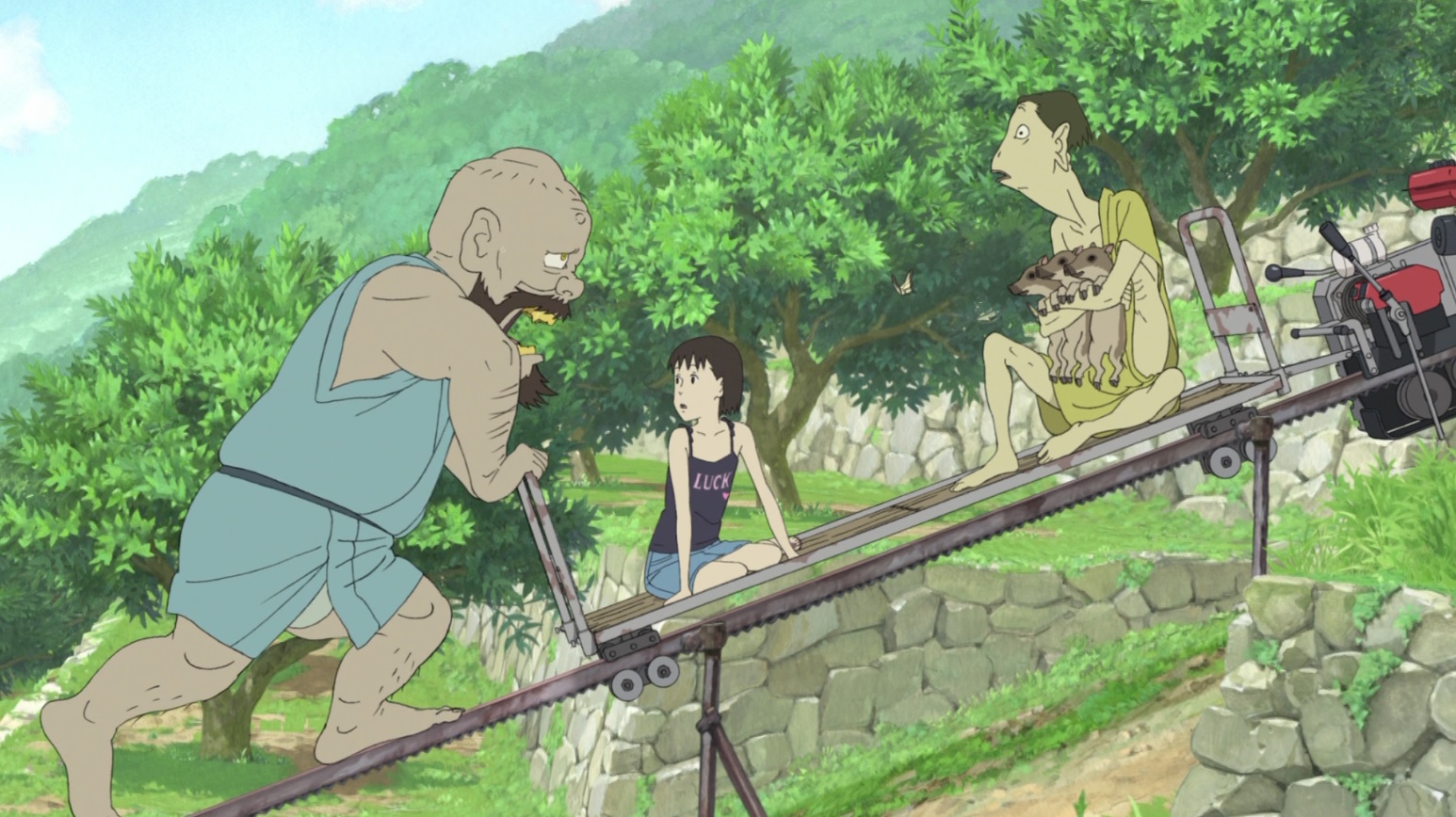
‘A Letter to Momo’ takes place in one hot summer on the island, and tells about Momo, an eleven year old girl whose father has unexpectedly died, and who moves with her mother Ikuko from buzzling Tokyo to the place of her mother’s roots: a quiet rural town on the remote Osaki Shimojima island, somewhere Southeast of Hiroshima in the Seto inland sea. Both events are clearly traumatic experiences to the young teenager, who remains shy, stubborn, withdrawn, and taciturn, despite her mother’s efforts to befriend her with the local children, who surely are willing enough to let her join their group. These early scenes are shown on a leisurely speed, depicting Momo’s boredom, isolation, and loneliness very well.
But things get worse, Momo’s new home turns out to be haunted: there are voices in the attic, and some vague creature seems to follow her mom when she’s off to work. Soon, a trio of goblins manifest themselves to the young girl, and she has a hard time getting used to their presence. During the movie she must learn to live with them, and she finally figures out why they are there in the first place.
The fantasy sequences with the three dimwitted goblins are fun, but throughout the movie Momo’s emotions remain central to the story, especially the loss Momo experiences after her father’s death, her relationship with her mother, who’s also grief-stricken, and her slow opening to the island children. A recurring metaphor of Momo’s transition from being shy, miserable, and scared to a teenager capable of enjoying life once again is shown in a few swimming scenes, in which the island children jump from a high bridge into the sea.
The human drama and the fantasy finally come together in a breathtaking finale when a typhoon visits the island. This sequence is the most Ghibli-like of the whole film. This is the dramatic highlight of a film that otherwise remains modest in how it tells its sweet and moving tale.
The looks of ‘A Letter to Momo’ are no less than gorgeous. The film boasts a rather unique style, with a very high level of realism. The drawings are exceptional for their surprisingly attractive and very thin line work, and the animation, supervised by Masashi Ando, is no less than excellent. Especially, the command of the human form is breathtaking. It apparently took four years to animate the complete film, but every animation drawing of Momo and her mother is a beauty to look at, and absolutely conveys a wide range of emotions and expressions, rarely resorting to anime cliches, if ever. For example, it’s startling to watch someone cough as realistically as Ikuko does in this film. ‘A Letter to Momo’ is also one of those rare Japanese animation film in which the characters actually do look Japanese, with black hair, porcelain to yellow-brown skins and eyes of more realistic proportions than usually encountered in anime.
The background art, supervised by Hiroshi Ôno (who previously worked on ‘Kiki’s Delivery Service’) is gorgeous, too. It does not deviate from artwork of other Japanese animation films, but again, its level of realism is staggering. The documentary on the Blu-Ray I have of this film shows pictures of the real thing, and the film makers have captured the island of Osaki Shimojima astonishingly well. Moreover, they’ve managed to do so, while keeping the background paintings very attractive and always in service of the animated action. There’s a small dose of computer animation, which always remains modest and functional (a boat, a fan, some moving background art), and which doesn’t disrupt the graphic quality of the film.
In all, ‘A Letter to Momo’ is a heart-warming tale on loss and grief, very well made and one of the most gorgeous animation films to come out of Japan to look at. Highly recommended.
Watch the trailer for ‘A Letter to Momo’ yourself and tell me what you think:
‘A Letter to Momo’ is available on Blu-Ray and DVD
Director: Rosto A.D.
Release date: June 10, 2011
Rating: ★★★★
Review:
One of the most virtuoso and most idiosyncratic animated film makers ever to emerge from The Netherlands was Rosto (real name Robert Stoces). His films ‘(the rise and fall of the legendary) Anglobilly Feverson’ (2002) and ‘Jona/Tomberry’ created quite a stir, the latter winning the Grand Prix Canal+ prize at the Cannes Film Festival. In these fantastic films Rosto mixed live action, puppetry, and computer animation into a seamless mix. Moreover, they showed a unique if erratic voice that was completely its own.
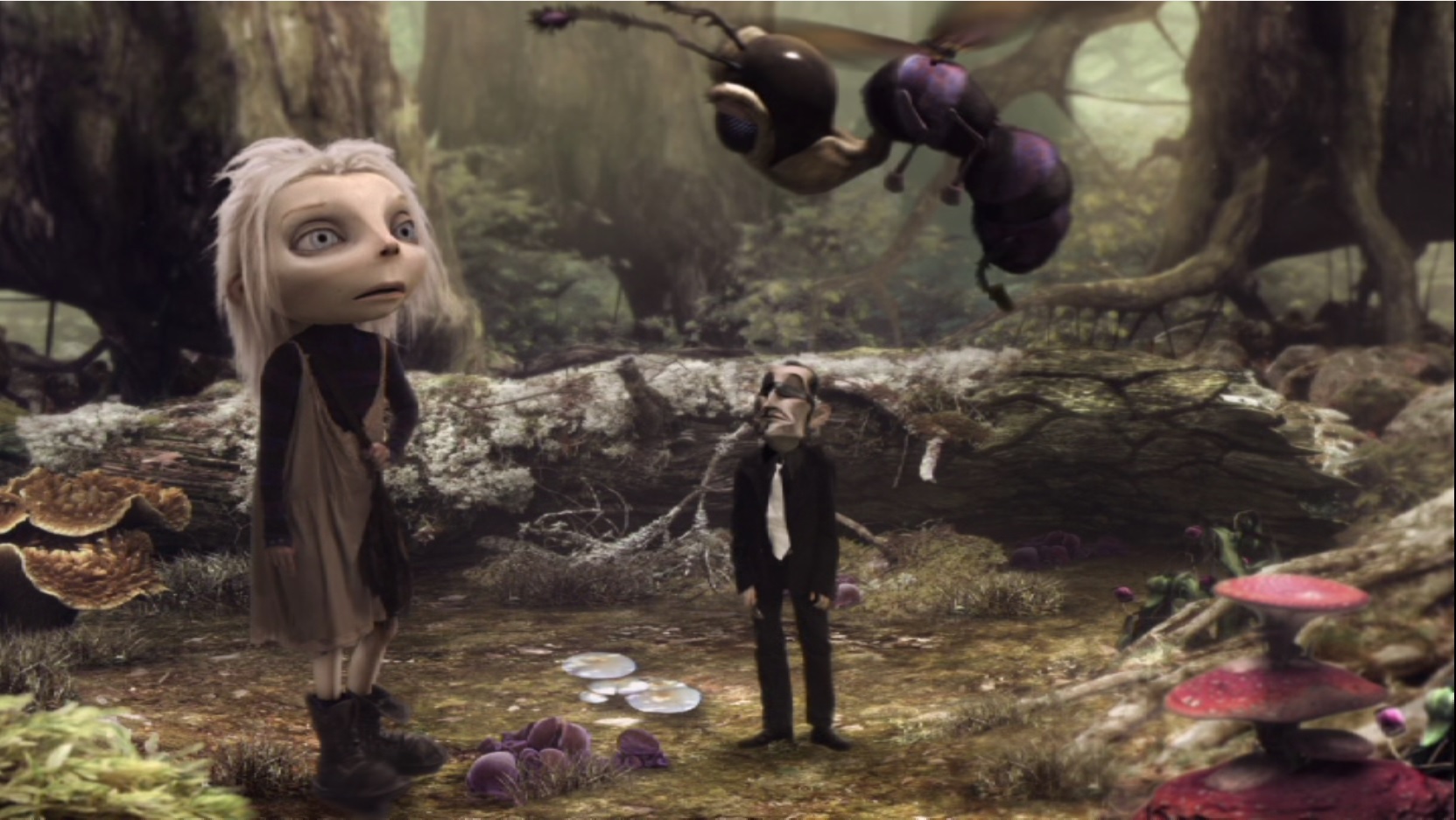
‘The Monster of Nix’, Rosto’s most ambitious project, is no different. The film lasts half an hour and took six years to make. The short is essentially a musical with a rather post-modern tale-biting story, vaguely reminiscent of ‘The Neverending Story’. The film stars a boy called Willy (based on Rosto’s own son Max and aptly voiced by Joe Eshuis), who lives with his grandmother in a small village, surrounded by woods. Short after the film starts, Willy can’t find his grandmother. Even worse, many villagers have lost people and things, so Willy goes on a quest to seek his grandma and to find the evil monster behind this, finding strange creatures like Virgil, a giant swallow with human hands for claws and the woody “langemen” on his way.
‘The Monster of Nix’ boasts collaborators like Terry Gilliam (voicing a wood ranger), Tom Waits (voicing Virgil) and The Residents (performing two songs), as well as high production values. As expected from a Rosto film, the visuals are very strange, but compelling and overwhelming, seamlessly merging live action and animation to a unique mix. There are several rock music references, which are also typical of Rosto’s style, and there’s a spooky atmosphere akin to Tim Burton.
Rosto even composed the songs himself. Unfortunately, his score is more weird than attractive, and his story isn’t entirely convincing, either, reaching a rather dead point half way, never to recover entirely. But because of its unique atmosphere the film is well worth a watch.
Sadly, Rosto died in 2019, only fifty years old. His death is a grave loss to the Dutch animation world.
Watch the trailer for ‘The Monster of Nix’ yourself and tell me what you think:
‘The Monster of Nix’ is available on DVD
Director: Enrico Casarosa
Release date: June 6, 2011
Rating: ★★★½
Review:

In ‘La Luna’ a little boy accompanies his father and grandfather on a boat trip with an original and unexpected destination.
This cute little film features dialogue, but as this is quasi-Italian gibberish, the story is told through the expressions and body movements of the three characters. There’s a subtle undercurrent of passing on traditions and finding your own voice within tradition.
The film explores no new territories technically, but features a superb color design, rendered in beautiful blues and yellows. The sound design, too, is worth mentioning. Especially, the sound of the stars is very well done. Less successful is Michael Giacchino’s score, which sugarcoats the action too much.
‘La Luna’ was shown before ‘Brave‘. With this film director Enrico Casarosa clearly digs into his own Italian roots. The result is a modest homage to a child’s wonder and fantasy.
Watch ‘La Luna’ yourself and tell me what you think:
‘La Luna’ is available on the Blu-Ray and DVD of ‘Brave’, as well as on the ‘Pixar Short Films Collection, Vol. 2’
Director: Henry Selick
Release Date: April 12, 1996
Rating: ★★★½
Review:

Based on the children’s book by Roald Dahl from 1961 ‘James and the Giant Peach’ is, in fact, a hybrid, starting and ending as a live action movie, with the middle forty minutes (ca. half the movie) being done entirely in stop-motion.
The opening scenes set ‘James and the Giant Peach’ as one of the great fantasy films of the nineties. The sets and atmosphere are magical and dreamlike, with no attempt at reality. James’s horrific aunts, too, are grotesque and deeply rooted in caricature. They are excellently played by British actresses Miriam Margolyes and Joanna Lumley, who are allowed to play their personas as broadly as possible. Young James, in contrast, remains perfectly normal, and Paul Terry’s performance is on the brink of boring.
Despite the great opening scenes, the real fun starts when James descends into the giant peach. During this scene he transforms into his puppet self, and inside he meets a sextet of giant ‘insects’ (in fact, three of them are insects, the others being a myriapod, an arachnid and an annelid), with whom he decides to fly to New York, cleverly using sea gulls to propel the peach into the air.
Except for the all too bland glowworm, the arthropods are delightful characters: there is a very American sounding boastful and bragging centipede (Richard Dreyfuss), a motherly ladybug (Jane Leeves), an aristocratic and knowledgeable grasshopper (Simon Callow), an anxious and gloomy earth worm (David Thewlis), and a femme fatale-like but friendly French female spider (Susan Sarandon). The design of these is less eccentric than that of the protagonists in ‘The Nightmare Before Christmas’, but still have some freaky touches, most notably Miss. Spider’s eyes, which each consist of two yellow eyeballs. Moreover, they all have the correct number of legs, with Miss Spider’s eight legs all ending in elegant boots. The animation, too, retains some creepy-crawly quality, and Miss Spider remains a little scary, despite her friendliness.
The voice cast is excellent, and most of the humor originates from the interplay between these characters, but there is plenty of action anyway, with the bugs having to battle a mechanical shark, defend themselves against a ghost ship, and fight starvation.
Unfortunately, after 59 minutes we return to live action, when James and his friends land in New York. True, this New York remains a fantasy-product, with very stagy and crooked sets, but lasting a staggering 30 minutes this finale turns out to be overlong and weak. It does not really help that the film makers decide to make the aunts survive the crushing of their car and to follow James into New York, an idea not in the book. Believability is certainly breached in these scenes, because of the fake character of the sets, some wooden action of the crowds, and the strange interplay between the grotesque aunts and the more down-played Americans. Moreover, the insects are mostly absent from these scenes, which only show that young actor Paul Terry cannot carry these scenes on his own, which seem to drag without inspiration.
Another letdown of this film are the four songs by Randy Newman. All four are weak and forgettable. Even worse, they are clearly superfluous, and they threaten to stall the action instead of helping the story forward. Luckily, there are only four of them, making ‘James and the Giant Peach’ much more tolerable as a film than ‘The Nightmare Before Christmas’ was, but nevertheless I regard this film yet another victim of the unwritten rule that every animation film should be a musical, which was prevalent in the 1980s and 1990s.
The overlong finale and unwelcome songs prevent ‘James and the Giant Peach’ to become an all-time classic, and certainly it was not well received back then, becoming a box office bomb. With this the short Disney adventure into stop motion ended. This is pity because the stop motion animation is excellent and delightful to watch throughout.
There is also a fair deal of computer animation, surprisingly executed by Sony Pictures Image works, who did an excellent job on the rhinoceros, some dancing clouds, and the mechanical shark. The latter, especially, is a great piece of computer animation, as it blends surprisingly well with the stop-motion and never loses its fantastical character.
Disney thus may have stopped making stop motion films, but both Tim Burton and Henry Selick continued to follow this path, with Tim Burton making ‘Corpse Bride’ in 2005 and ‘Frankenweenie’ (again for Disney) in 2012, while Henry Selick joined Will Vinton’s LAIKA studio in 2005 to make the widely acclaimed ‘Coraline’ (2009).
Watch the trailer for ‘James and the Giant Peach’ yourself and tell me what you think:
‘James and the Giant Peach’ is available on Blu-Ray and DVD
Director: Andreas Hykade
Release Date: 1995
Rating: ★★★½

‘Wir lebten im Gras’ is the first of three films in which German animator Andreas Hykade explores the loss of innocence, the other two being ‘Ring of Fire’ (2000) and ‘Der Kloane’ (The Runt, 2006).
The film is also the most cryptic of the three, full of images that are very difficult to decipher. The film is set in a rather mythical place, ‘two streets away from the end of the world’ and has a timeless and universal feel.
The story is told by a boy voice over, who reminisces about his father, who told him that “All women is whore and all men is soldier”. Outside the voice over there is no dialogue. The little boy tries to see the world through his father’s eyes, but this conflicts with his softer side, and he’d rather fall in love with the enigmatic ‘dandelion girl’.
The film is less straightforward than this synopsis suggests, however, and the film is more surreal and suggestive than narrative. For example, the boy’s adventures are interjected by nightmarish dream sequences, the meaning of which is never really explained. These dream sequences are rendered in an expressionistic pastel style, reminiscent of Lorenzo Mattotti’s art work. This style contrasts highly with the simple cel animation.
Hykade’s drawing style is highly original. His human designs are simple, almost stickman-like, but genitals are very prominent, and the father is drawn as a more robust, earthly character.
The animation is very virtuoso, with a great feel for timing. Moreover, Hykade uses a lot of changing perspective, and has an admirable command of movement.
‘Wir lebten im Gras’ was Hykade’s last student film, but it certainly is his first major work. With this film Hykade proved to be a strong new voice in the animation world, a fact he consoled with his masterpiece ‘Ring of Fire’ from 2000.
Watch ‘Wir lebten im Gras’ yourself and tell me what you think:
‘Wir lebten im Gras’ is available on the DVD ‘Desire & Sexuality – Animating the Unconscious Vol. 2’
This episode is all about Duckman’s sexual fantasies.
Director: Paul Demeyer
Stars: Duckman
Airing Date: March 26, 1994
Rating: ★★★★★

After the death of his wife Beatrice, one and a half year ago, Duckman’s sexual live has come to a standstill, while Cornfed even admits he’s still a virgin.
Matters get worse when Duckman and Cornfed are visited by a blonde twin, who look like the epitome of male fantasies, with their huge boobs and seductive voices. But Duckman is so insecure he goes through plastic surgery, enlarging his bill, to dare to confront the twin.
Yet he really gets cured by a weird dominatrix-psychiatrist. This part contains a great journey inside Duckman’s inner soul, and we learn how his former wife Beatrice died.
This highly entertaining episode knows some great reuse of Avery’s classic wolf takes, and features excerpts from two Frank Zappa songs.
Watch ‘Psyche’ yourself and tell me what you think:
This is Duckman episode no. 4
To the previous Duckman episode: Gripes of Wrath
To the next Duckman episode: Gland of Opportinity
‘Psyche’ is available on the DVD-box ‘Duckman – The Complete Series’
Director: Jiří Brdečka
Release Date: 1963
Rating: ★★★½
 In ‘Spatne namalovana slepice (which translates as ‘Badly Drawn Hens’)’ we watch three kids in a school class: a dreamy boy, a little girl who sits next to him, and a nerdy boy with glasses.
When the teacher orders the class to reproduce an intricate drawing of a chicken, the bespectacled boy reproduces the poster with photographic accuracy. The dreamy boy, however, makes a semi-abstract interpretation of the subject and the teacher reprimands the little boy. But then, at night, his colorful drawing comes to life…
This film is a clear ode to fantasy and celebrates the breaking of rules. This is a subject that’s often encountered in European animation films from the 1950s and 1960s, and which would have special appeal in the Eastern Bloc, with its repressive communist regimes.
Brdečka uses an idiosyncratic angular style, clearly influenced by the cartoon modern movement of the 1950s, but especially akin to contemporary developments at Zagreb film in Yugoslavia. His film uses vocal sounds, but no dialogue, and relies mostly on visual gags. However, there’s one great scene in which a famed ornithologist called Dr. Vogelbird repeatedly listens to a tape recorder saying his own name.
In the end, the film is a little too inconsistent and too wandering to become a classic, but its sympathetic story and charming drawing style make the short a nice watch.
Watch ‘Spatne namalovana slepice’ yourself and tell me what you think:
‘Spatne namalovana slepice’ is available on the DVD-box ‘Annecy – Le coffret du 50e Anniversaire’
Director: Priit Pärn
Release Date: 1984
Rating: ★★★★
Review:
 ‘Time Out’ is Priit Pärn’s fifth film, but the first to gain a widespread attention, and to win a number of international prizes.
It shows the filmmaker’s idiosyncratic style and unique surrealism, without the dark side, often present in his other films. The film is filled with child-like wonder, and a happy atmosphere, enhanced by the joyful reggae music by composer Olav Ehala.
The film opens with a room in which a very stressed out cat lives. The cat is in a constant need to check his alarm clock, which is on a shelf too high for him. When he finally reaches the clock, he discovers he can’t read it without his glasses, so he has to find them first, etc. Pärn shows this pointless ritual in several variations over and over again, following the cat running around in his room.
At one point, however, the alarm clock breaks, and time stands still. At this point of the film the cat finds himself in a fantastic world where everything can happen. This part is extremely rich in visual tricks, which go all the way back to Émile Cohl’s ‘Fantasmagorie‘ (1908). Nothing is what it seems, and metamorphosis runs freely. Unfortunately, in the end, time is restored, and the cat has to face his former stressful life once again.
‘Time Out’ certainly shows Priit Pärn’s mastery, and excellent timing. His fantasy is extraordinary, and the film shows the power of animation like few other films do. It’s also a reminder that we should snap out of the daily routine, and let our mind wander, and be really creative. When one takes time, everything may be possible!
Watch ‘Time Out’ yourself and tell me what you think:
Directors: Ted Berman & Richard Rich
Release Date: July 24, 1985
Rating: ★★½
Review:
 ‘The Black Cauldron’ was the first new Disney animation film I saw when I was a kid. At the age of twelve I found it an exciting and scary adventure. Unfortunately, watching it again many years later my views have changed.
‘The Black Cauldron’ was a clear attempt by a young team to bring something new to the screen. It was to be Disney’s first and only step in the realm of ‘epic fantasy’, a genre explored before by Ralph Bakshi in the unsuccessful features ‘Wizards’ (1977), ‘The Lord of the Rings’ (1978) and ‘Fire and Ice’ (1983), by Jim Henson’s much more interesting puppet movie ‘The Dark Crystal’ (1982), and by the then popular television series ‘He-Man and the Masters of the Universe’ (1983-1985), whose evil character, Skeletor, looks remarkably similar to the Horned King in ‘The Black Cauldron’.
The film’s source however, is much older, and lies in the first two novels of the children’s fantasy series ‘The Chronicles of Prydain’ (1964-1968) by Lloyd Alexander, and the Disney studio already started working on it in 1971. The film tries to squeeze the contents of Alexander’s two books into 77 minutes and it shows.
The Disney studio clearly is at unease with the serious atmosphere of the epic fantasy. It’s the only animated Disney feature not to feature any song at all, and even the comic reliefs Gurgi and Flweddur Fllam are hardly funny. Instead, the studio follows ex-Disney artist Don Bluth into a much darker realm. With ‘The secret of NIMH.’ (1982) Bluth had shown that an animated feature could contain a more serious and darker tone, and ‘The Black Cauldron’ is clearly Disney’s own attempt at it.
This is exemplified most by the Horned King, and his army of skeletons. The horned king is nothing more than a skull himself, and remarkably scary for a Disney film. Not only this villain, but most of ‘The Black Cauldron’ is drawn in grim tones, however, and there is hardly any air from the gloomy atmosphere.
The story, on the other hand, is remarkably light. And here lies the main problem with ‘The Black Cauldron’. Despite his evil appearance, the Horned King never tries to harm our heroes, and his castle is leaky as a sieve. Taran and princess Eilonwy can wander about in the dungeons of the castle undisturbed, where Taran absurdly easily finds a magic sword. The escape, too, is an easy one. And it seems that outside his castle the horned king has no power, at all. And when he finally has his army of the dead, it is destroyed when it’s still crossing the drawbridge. Ironically, the feature’s scariest scene is when the horned king dies.
The story is hampered by its episodic character. Most of what happens is a result of chance, and our heroes wander around cluelessly throughout the film. The film’s hero, Taran, suffers from a badly cast voice and remains a bland character, who, unlike Gurgi, fails to steal the audience’s heart. Moreover, the character animation wanders at times, sometimes becoming over-excessive, and the film contains one conflict scene that feels utterly forced and superfluous. The film’s message only appears at 56 minutes, with an almost gratuity ‘you must believe in yourself’, which hardly forms a turning point in the series of events.
The film’s undisputed highlight lies in its inspired soundtrack by Elmer Bernstein and in the character of the furry creature Gurgi, who, with hindsight, looks like the inspiration for Gollum in Peter Jackson’s ‘The Lord of the Rings’, in his speech and behavior. The cowardly Gurgi for example attaches to Taran half-heartedly, calling him ‘master’, just like Gollum does with Frodo in ‘The Lord of the Rings’.
‘The Black Cauldron’ was a failure at the box office. And thus it proved to be an experiment the studio never repeated. The next year, Disney returned to much more familiar territory with ‘The Great Mouse Detective’ with much better results. Indeed, the studio’s final breakthrough in its attempts to rejuvenate, ‘The Little Mermaid’ (1989), was the result of a return to the successful princess films ‘Snow White and the Seven Dwarfs’ (1937), ‘Cinderella’ (1950) and ‘Sleeping Beauty’ (1959).
Watch the trailer for ‘The Black Cauldron’ yourself and tell me what you think:
‘The Black Cauldron’ is available on DVD and Blu-Ray
Director: Gitanjali Rao
Release Date: May 2006
Rating: ★★★★
Review:
 An old woman lives in a little flat and uses her collection of matchboxes to dream away to more adventurous lives.
In this film Rao contrasts the dull and lonely reality (in grey tones) with the colorful matchbox-based fantasies. The mood is poetic, and the film progresses at a gentle speed. Rao’s designs are sometimes naive, but her animation skills are splendid. She’s absolutely one of the masters of painted animation. Especially noteworthy is her animation of the cat. Also important is Rajivan Ayyappan’s sound design, which is spot on.
‘Printed Rainbow’ is by all means a mature work. Rao’s work is even more impressive, when one considers that she wrote, animated, directed and produced the film on her own in India, a country with a rather short animation history. Although India has made some strides in commercial animation, independent animation is still very rare. Thus Rao’s work is all the more wonderful. Luckily, more people saw it that way and Rao’s film won no less than 22 awards.
Watch ‘Printed Rainbow’ yourself and tell me what you think:
‘Printed Rainbow’ is available on the DVD ‘International Animation: Modern Classics’


 Dr. Grob's Animation Review