You are currently browsing the tag archive for the ‘magic’ tag.
Director: Dan Scanlon
Release date: February 21, 2020
Rating: ★★★
Review:

‘Onward’, Pixar’s 22nd feature film, was the first of a series of four originals after a decade of sequels (the 2010s saw seven sequels compared to a mere four originals), making the 2020s a more interesting decade than the 2010s were. Unfortunately, Pixar’s return to original stories didn’t necessarily mean their films got better. ‘Onward’, at least, is not a bad film, but it never becomes great, either. The movie just lingers in mediocrity, relying too heavily on tried formulas and cliches.
‘Onward’ takes place in a fantasy world populated by elves, unicorns, centaurs, fauns, manticores and so on. But like the human-less worlds of ‘Monsters Inc.’, ‘Cars’ or to a lesser extent the later ‘Elemental’ the makers haven’t made any effort to make this world a really original one, turning it into just another lazy version of suburbia America. The whole idea of ‘Onward’ is that it used to be a magical place, until technology took over, making this world as bland and devoid of magic as ours.
In this world we follow teenager elf Ian, who’s designed as your average clumsy insecure teenager, a sort of Linguini from ‘Ratatouille’ (2007), but blue and with pointed ears. Ian also is one of those protagonists that all too often recur in animation films: one that has lost a parent (see also e.g. ‘Kung Fu Panda’ (2008), ‘The Good Dinosaur‘ (2015) and ‘Abominable’ from 2019). On his birthday Ian makes some resolutions to become a better person, but they are all thwarted, until his mother gives him and his quirky elder brother Barley a gift from their deceased father…
What follows is a truly dangerous quest in which the two brothers must team up to restore their father for just one day. This they do accompanied by their dad’s two legs, for that’s all what Ian managed to retrieve from the spirit world in the first place. Barley’s extensive knowledge of magic, which he got from playing a role game “based on reality” is a great help during their quest. Unfortunately for Barley, despite all his knowledge of magic, he hasn’t got the magic skill, but Ian has.
With their quest the two brothers not only restore magic to their world, Ian also comes to realize that his older brother is not only an annoying looney to be ashamed of, but much more to him. And yet, a more interesting and more original yet sadly underdeveloped character than either two brothers, is Ian’s and Barley’s mother, who comes into action and who dares to take risks to save her boys.
The brothers’ magical quest stands in huge contrast with the mundane world they live in, and the studio never really manages to wed these two worlds. In the end, the whole concept of a fantasy world turned mundane remains a forced and unconvincing one, and that one gift from a random father could restore magic to the entire world is anything but believable, even within the fantasy context.
Moreover, as said, the film relies too much on tropes to tell its stories. The magic in ‘Onward’ feels like a direct copy from the Harry Potter’-films with its use of spells. There is the obligate breakup scene, one that is particularly painful, because by that time Ian should have known better. And then there’s a curse, which actually stands in the way of a plot that should concentrate on the relationship between the two brothers, which the film mostly does, but to which, to me at least, the whole magic idea seems superfluous and unnecessary.
Of course, the power of animation is that it can show impossible things like elves and manticores, but for once, I believe that the film would be more courageous if it would tell the story of two real brothers living in American suburbia, bonding together after the death of their father. For this is the essence of the film, meaning that the fantasy part, despite driving the plot, is mostly fluff. Despite the final resurrection of the father being a beautiful moment in the movie, the film just doesn’t manage to pluck one emotional string like ‘Monsters, Inc.’ (2001), ‘Wall-E’ (2008), ‘Up’ (2009) or ‘Coco’ could. Pixar certainly could do better, something they would luckily prove with their next feature, ‘Soul‘.
Watch the trailer for ‘Onward’ yourself and tell me what you think:
‘Onward’ is available on Blu-Ray and DVD
Director: Chuck Jones
Release date: November 30, 1963
Stars: Bugs Bunny
Rating: ★
Review:

‘Transylvania 6-5000’ is one of those late Warner Bros. Cartoons, which are equally beautiful to look at as they are boring to watch.
In this short Bugs Bunny wanted to travel to Pittsburgh, Pennsylvania, only to end up in Transylvania, where he encounters a vampire with the name Count Bloodcount.
The cartoon is very talkative, and features an annoying female two-headed bird. Worse are the central gags, which are all constructed around the words Abacadabra, which turn the count into a vampire, and ‘hocus pocus’, which turn him back to a human form, again. These sequences suffer from a lack of inner logic and sloppy timing, and are hardly as funny as intended. Bill Lava’s canned music doesn’t help, either.
Despite its gorgeous settings, one cannot conclude but that the Warner Bros. studio ran out of inspiration and of ideas quickly in the early 1960s, contributing to its own shutdown after only one other cartoon, ‘Señorella and the Glass Huarache‘ (which, incidentally, is more fun than this jaded Bugs Bunny cartoon). And yet, already in 1964 Warner Bros. cartoons appeared again, now produced by the DePatie-Freleng cartoon studio of Pink Panther fame. And thus four more Bugs Bunny cartoon were released in 1964, before the character was retired.
Watch ‘Transylvania 6-5000’ yourself and tell me what you think:
This is Bugs Bunny cartoon No. 164
To the previous Bugs Bunny cartoon: Mad as a Mars Hare
To the next Bugs Bunny cartoon: Dumb Patrol
‘Transylvania 6-5000’ is available on the DVD-box ‘Looney Tunes Golden Collection Volume Five’
Director: Zlatko Grgić
Release date: 1971
Stars: Maxicat
Rating: ★★★
Review:
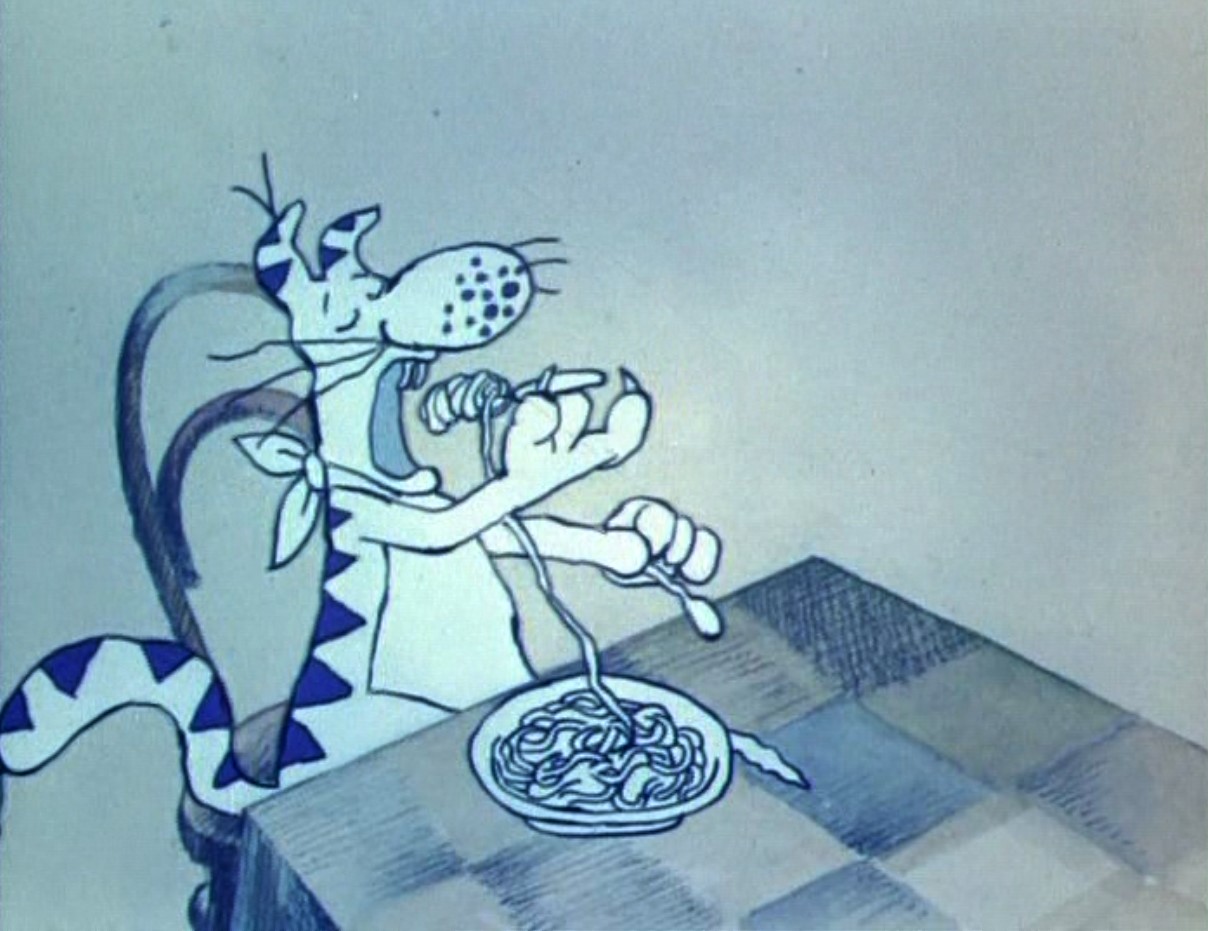
These are three very short episodes of the Maxicat series, which consisted of 24 episodes in total. These feature a very cartoony cat with a big nose experiencing Pink Panther-like adventures on a grey, featureless canvas.
In the first Maxicat finds a magical hat, in the second he eats spaghetti, and in the last he finds a flying broom. All three are short and classic gag cartoons with the dialogue-less action being accompanied by very jolly music. As these three episodes prove, Maxicat is an enjoyable series from the very creative Zagreb Film Studio from Yugoslavia.
Watch some Maxicat episodes yourself and tell me what you think:
These Maxicat episodes are available on the DVD ‘The Best of Zagreb Film: Be Careful What You Wish For and The Classic Collection’
Director: Hiromasa Yonebayashi
Release date: July 8, 2017
Rating: ★★★½
Review:

‘Mary and the Witch’s Flower’ is the first film by Studio Ponoc, founded by Yoshiaki Nishimura, who was a producer for Studio Ghibli before. Director Hiromasa Yonebayashi, too, is a Studio Ghibli alumnus, being an animator for the famed studio since 1997, and directing the studio’s 21st feature film ‘When Marnie Was There’ (2014).
It comes to no surprise then that ‘Mary and the Witch’s Flower’ is very, very Ghibli-like. Already the packaging of the DVD would fool anyone. But the similarity doesn’t stop there: even the opening titles emulate Ghibli; the character designs, too, are very Ghibli-like; the film is based on a British children’s book, just like Ghibli’s ‘Howl’s Moving Castle’ (2004), ‘Arrietty’ (2010) and ‘When Marnie Was There’; the film stars a young female protagonist (Mary) who has to survive without her parents, just like ‘Kiki’s Delivery Service’ (1997), ‘Spirited Away’ (2001) and ‘From Up on Poppy Hill’ (2010); Mary is a witch like Kiki; she’s accompanied by a cat who plays an important part just like Kiki and like Shizuku in ‘Whisper of the Heart’ (1995), and the film is partly set in a fantasy world, just like ‘Spirited Away’.
Now, this is immediately the film’s main flaw: studio Ponoc imitates Ghibli very well but doesn’t bring anything original of its own. The final product is practically indistinguishable from the source of inspiration. That doesn’t mean, however, that ‘Mary and the Witch’s Flower’ is a bad movie. The story is told well enough, the animation is top notch, and the fantasy world looks great. I certainly had a good time watching it, and would recommend the movie to all lovers of the Studio Ghibli product. But Studio Ponoc’s debut could and should have been something much more of their own. If you compare, for example, ‘Mary and the Witch’s Flower’ to the idiosyncratic ‘Night Is Short, Walk on Girl’ from the same year, it becomes clear which studio brings something original to the world, and which one does not.
Watch the trailer for ‘Mary and the Witch’s Flower’ yourself and tell me what you think:
‘Mary and the Witch’s Flower’ is available on Blu-Ray and DVD
Director: Michel Ocelot
Release Date: February 13, 2011
Rating: ★★★½
Review:

This is a review of the 2011 film, not to be confused with the television series from 1992, which explores a similar style.
After two Kirikou movies (1998, 2005) and the praised ‘Azur & Asmar’ (2006) French director Michel Ocelot returned to the silhouette style he had explored in ‘Les trois inventeurs’ (1979) and in ‘Les contes da la nuit’ (1992) in particular. The result was a series of ten episodes for Canal+ called ‘Dragons et princesses’. These were aired in 2010, and more or less compiled in the feature film ‘Les contes de la nuit’ from the next year. This film compiles five of the ten stories from ‘Dragons et princesses’ and adds an extra one, called ‘La Fille-biche et le fils de l’architecte’ (The Young Doe and the Architect’s Son).
All stories are original, conceived by Ocelot himself, including the dialogue. Yet, their style is firmly rooted in ancient storytelling and fairytales. Thus, the heroes are pretty emblematic, a given that is emphasized by the bridging ‘story’. In these bridging episodes an old man teams up with two children to invent the stories. The children then act them out, while the old man does some background research on architecture and clothing and such. The two youngsters are then dressed by robot arms, and the tale can begin.
And so, each tale stars the same two children, and almost of them are about love. To be fair, these bridging parts make very little sense, and after the sixth story we don’t even return to this setting.
Much more interesting are the stories themselves. Set in different times and places, they have a surprising universal character and really feel as a homage to classic storytelling, a form of narrative other modern animation film makers seem to have lost. In fact, Ocelot’s most obvious inspiration is Lotte Reiniger (1899-1981), who also told classic tales in silhouette animation. Ocelot truly is her artistic successor, even though he trades the scissors and cut-out animation for 2D computer graphics.
As all stories are told in silhouette, the story depends greatly on body language and dialogue. It’s a little unfortunate then that the 2D computer animation is often rather stiff and unconvincing. At times the heroes’ faces are seen from the front, showing their eyes, but not their mouths, which makes one depend on the dialogue even more.
The stories themselves nevertheless are entertaining. The first, ‘the night of the werewolf’ takes place at the Burgundian court of the 15th century and tells about two rival sisters. The third, ‘The Chosen One of the Golden City’ takes place in Mexico in the 16th century and tells about a conquistador visiting a city of gold. This story knows some very stylized background art. The fourth, ‘Tom-Tom Boy’ is set in West Africa and takes us back to the world of ‘Kirikou et la sorcière’ (1998), with its bare breasted women. The fifth, ‘The Boy Who Never Lied’ is set in medieval Tibet, and certainly the most tragic of the collection. The mountainous background art in this story has the most 3D-feel to it of the whole lot. The final story, ‘The Young Doe and the Architect’s Son’ returns to France. Set in the 13th century it features very detailed gothic background art and a short piece of 3D computer animation.
The best story, however, is the second, ‘TJ and the Beauty Unknowing’. This story starts in the Caribbean, but soon the hero enters the land of the death, in which he must fulfill three tasks to save his life. This story makes great use of the tropes of ancient fairy tales, without following the classic love story tropes of the other entries.
Watch the trailer for ‘Tales of the Night’ yourself and tell me what you think:
Les Contes de la nuit (Tales of the Night) is available on DVD
Director: Jan Švankmajer
Release Date: August 1996
Rating: ★★★½
Review:
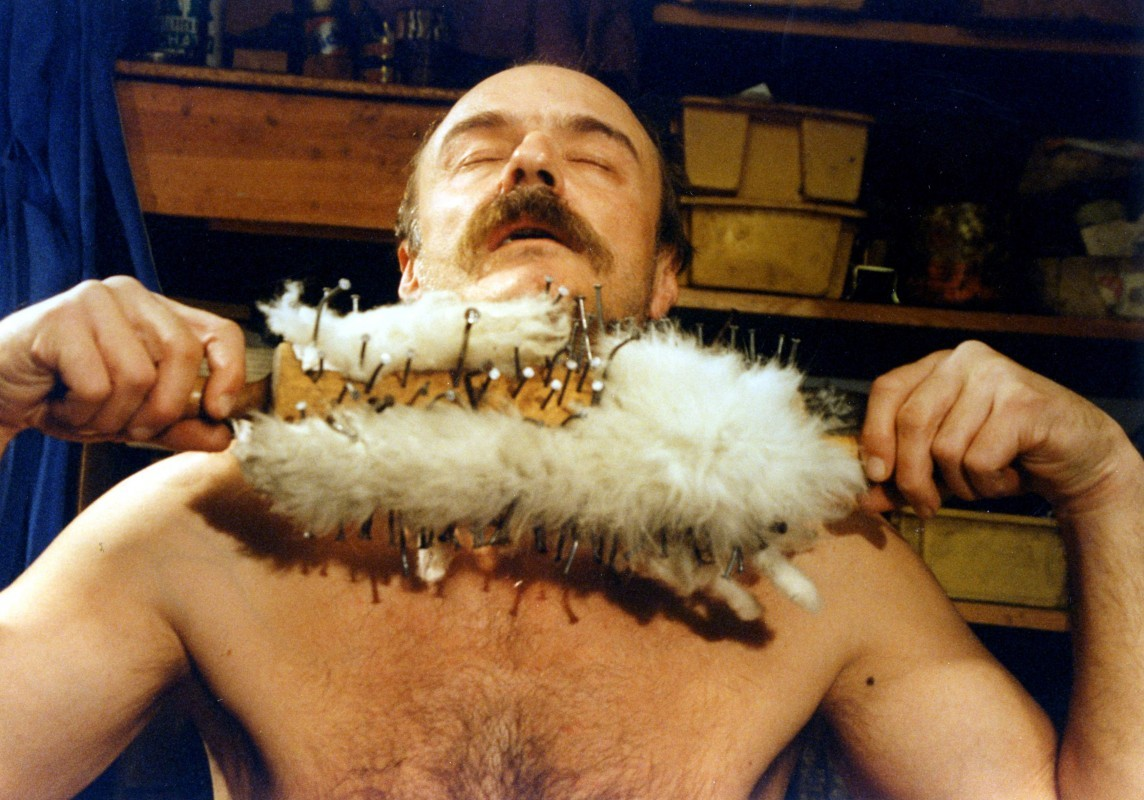
Although the move from animation to live action clearly was a gradual one (after all, ‘Alice‘ contained quite a bit of live action, while ‘Faust‘ was a live action film augmented with puppetry and animation), ‘Spiklenci slasti’ (Conspirators of Pleasure) can be regarded Jan Švankmajer’s first non-animated film, even if it stills contains a few bits of stop-motion and pixilation.
The change of technique doesn’t mean a change of style, however. The film is 100% Švankmajer throughout, with its complete lack of dialogue, its sound design (which is very reminiscent of that of animated films, indeed, with its emphatic sounds – we even hear the nonexistent sound of blinking of eyes), its idiosyncratic use of music (each individual has his/her own accompanying piece of music), its extreme close-ups, its sets of old buildings in a state of decay, and of course, a high dose of surrealism.
‘Spiklenci slasti (Conspirators of Pleasure)’ is an erotic film without sex. The titles are shown on a background of 18th century pornography, but the movie itself contains very little nudity, which is male only.
Main protagonist of the film is an unnamed bearded bachelor (played by Petr Meissel and identified as Mr. Pivoňka by Švankmajer). The film starts with him buying a sex magazine, but soon the magazine makes way for far more disturbing and puzzling acts of pleasure, involving a cupboard and a chicken. Mr. Pivoňka’s antics are interlaced with that of a postwoman, a mustached man, his lonely and abandoned wife, who’s a newsreader (Anna Wetlinská, who really was a newsreader), and the shop owner from the first scene, who’s secretly in love with Anna Wetlinská, and who builds an elaborate contraption around the television set she appears on.
The first 45 minutes are one big build-up to the pleasure acts themselves, and this is the most satisfying part of the film, because Švankmajer keeps the viewer puzzled where all the efforts of these people go to. Unfortunately, the acts of pleasure themselves are less compelling, as they’re not necessarily perverse as well as weird, and maybe this section is a bit overlong.
The shopkeeper’s machine is the absolute highlight, but the postwoman’s actions are absolutely grotesque, and that of Mr. Pivoňka and his neighbor, Mrs. Loubalová, sadomachistic, very violent and even morbid. Their acts involve the most animation, as their acts involve animated stuff dolls coming to life. But by now one could argue that the animation is more of a special effect than an element of style, although the pixilation still is used as a mean of surrealist story telling.
As the film comes to a finale, the boundary between reality and fantasy gets crossed. Anna Wetlinská seemingly takes over the shopkeeper’s machine, and comes to a climax herself. In the end the people’s fetishes get mixed, while Mr. Pivoňka’s mysterious ritual appears to have severe real life consequences indeed…
Nevertheless, one would like to know more about the postwoman and her incomprehensible rituals, as she seems to be some kind of facilitator of the desires of others. Also Anna Wetlinská’s bad marriage deserved a little bit more attention.
‘Conspirators of Pleasure’ is a very original and entertaining movie, but the film remains on the shallow side and lacks the layered surrealism of ‘Alice’ or ‘Faust’.
Watch the trailer for ‘Conspirators of Pleasure’ yourself and tell me what you think:
‘Conspirators of Pleasure’ is available on Blu-Ray and DVD
Directors: Mark Andrews & Brenda Chapman
Release Date: June 10, 2012
Rating: ★★★½
Review:

It’s hard to call ‘Brave’ the first Pixar letdown, that questionable honor goes to ‘Cars 2’ from the previous year, but the film certainly is a disappointment, not delivering upon its potential.
The film had a rather troubled production, with writer/director Brenda Chapman being replaced halfway by Mark Andrews, and somehow it shows. ‘Brave’ is arguably the first Pixar film that comes across as a half-baked product, with story ideas not worked out to the max.
The film’s premise is good: ‘Brave’ is the first Pixar film with a female protagonist, a princess even, surprisingly placing the film in a long Disney tradition. But Merida is not your average princess. The Scottish red-haired girl is a feisty character, a talented archer, a lover of action and adventure, and bound to step in her father’s footsteps, who’s a great warrior himself. Unfortunately, her mother stifles her into a more traditional role of womanhood, constantly telling her what a princess ought and not ought to do. Even worse, her mother prepares Merida for marriage, with several suitors coming over to compete for her. Unfortunately, not one of them is suiting marriage material (for example, one talks unintelligible, without any obvious reason), and Merida isn’t interested in this prospect, anyway, so she plans to compete herself, as she’s by far the best archer of the lot, repeating the arrow-splitting act of ‘Robin Hood’ (1973).
So far so good, but then the tale suddenly abandons the archery subplot completely. Instead, it dwindles away into a tale of magic, in which Merida deliberately poisons her mother, changing the poor woman into a bear. Unfortunately, at this point the story of independence is abandoned completely, as Merida now must bond with her bear-mother and to protect her against the men, who gladly would kill the beast. Sure, Merida’s mother now learns what Merida has learned outside the castle, but Merida’s insight in her mother’s ways is less worked out, and there’s a very unconvincing scene in which she steps in her mother’s footsteps, addressing the men, guided by her mother’s gestures. Anyhow, as soon Merida’s mother has turned into a bear, her problems are obviously bigger than Merida’s own, and thus the attention naturally shifts from the curly teenager to the poor woman, which contributes to a lack of focus, which permeates the film anyhow. I believe the very idea of turning Merida’s mother into a bear is a fundamental problematical one, a mistake central to the film’s story problems, especially when compared to the similar ‘Brother Bear’ (2003) and ‘The Emperor’s New Groove’ (2000) in which the main protagonist himself turns into an animal.
At any rate, after the archery scene the story begins to falter, leaving an awful lot of plot holes open. For example, there’s an ancient legend on four clans, but this idea is worked out badly, and hardly connected to the main story. The function of the killing of the giant bear Mor’du is puzzling – wouldn’t it have been better to show that only united the clans could be able to defeat the bear?
‘Brave’ also wastes an opportunity to become a real feminist film. First, in spite of it all, Merida still is a princess, and thus far from an ordinary woman – and her plight is slight when compared to that of her (invisible) less high-born sisterhood. If one compares her burden to that of Robyn in Cartoon Saloon’s ‘Wolfwalkers’ (2020) the difference becomes clear. Robyn is depicted working all day, shut off from the real world, while Merida at least can practice archery and such. Second, the role pressure solely comes from her mother, not society – and it’s even implied her father couldn’t care less whether Merida behaves like a princess or not. I think it would have served the film better if Merida’s plight were compared to that of a brother, but the film makers gave the princess a triplet as siblings, which are too young for comparison, and whose only function in the story is as comic relief. At one point they too turn into bears, but nobody seems to care…
No, it’s not the story, nor a feminist message that defines ‘Brave’, it’s texture. The Pixar studio made tremendous progress in depicting cloth and hair in this film, advancing computer animation once again. Merida’s extremely curly hair stands out as particularly well done, but so do the tartans of the tribes, which for the first time look like real fabric. Strangely, the building and rendering of the nature settings has aged less well – the light often is too sharp, leading to overexposed settings, especially on the sunlit grass and leaves. Moreover, the trees are too obviously generated, and look pretty fake. Luckily, the story is entertaining enough that this is soon forgotten.
Another design choice that I like less is the magnification of human sexual dimorphism: Merida’s father is almost three times the size of her slender mother or herself. Unfortunately, this depiction of men and women only diminishes the possible message of equality. Even worse, all the men are depicted as dim-witted and fight-ready, leaving the queen as seemingly the only sane person in this world.
‘Brave’ may be a disappointment, the film still is very well animated. The voice acting is superb, too, starring several Scottish and English actors, so no fake accent can be heard. The soundtrack is fair, with its quasi-Celtic themes, and the cinematography is excellent, but all this cannot rescue a rambling story, leaving ‘Brave’ a film as excellent as it is unsatisfying. A studio like Pixar certainly could and should have done a better job.
Watch the trailer for ‘Brave’ yourself and tell me what you think:
‘Brave’ is available on Blu-Ray and DVD
Director: Émile Cohl
Release Date: November 23, 1908
Rating: ★★★★★
Review:
 ‘Le cerceau magique’ starts with a live action sequence taking place in a park.
There a girl brings her broken hoop to her uncle, who conjures a new one, a bigger one, and an even bigger one. The last hoop is a magical hoop, able to change the man’s and girl’s outfits into 16th century costumes.
Happily the girl runs off with the hoop, which leads to a short string of images showing life in 1908 Paris. But at one point she hangs the hoop on a wall, and here the real film starts, because inside the hoop all kinds of images form and move, like origami animals, some dice forming a word, a paper man with a wheelbarrow circling the hoop from the inside, a compass drawing a flowery figure, a moon-face, a clown balancing on his nose, etc. The film ends when the girl takes the hoop from the wall again and bows to the audience, implying that she was the conjurer of these images.
‘Le cerceau magique’ is a unique film because it features both stop-motion and drawn animation. Rarely are these techniques used together. Cohl even adds live action to the mix, leading to a quite enjoyable film, if a rather directionless one. Unfortunately, the surviving print is very bad, and quite a bit of the middle section is indistinguishable through the wearing of the film.
Watch ‘Le cerceau magique’ yourself and tell me what you think:
‘Le cerceau magique’ is available on the DVDs ‘Émile Cohl – L’agitateur aux mille images’
.
Director: Jack Kinney
Release Date: April 18,1941
Stars: Goofy
Rating: ★★★
Review:
 The start of Goofy’s solo career was eventful, and all his five earliest solo cartoons can be regarded as key shorts in the evolution of the character.
‘Baggage Buster’ is a particularly transitional cartoon. The short was made after Pinto Colvig’s departure to the Max Fleischer studio in Miami, leaving Goofy voiceless. The result is that in ‘Baggage Buster’ Goofy has become a completely silent character, while by 1941 silent characters already had become a rare feat.
Of course, director Jack Kinney and his team would use this fact to their advantage in the great ‘how to’ cartoons, starting with ‘How to Ride a Horse’ sequence in ‘The Reluctant Dragon’ of two months later, but in ‘Baggage Buster’ Goofy still is his 1930s self. After ‘Baggage Buster’ Kinney never reverted to this version of the character, and he was only revived in a few Mickey Mouse shorts, and in the Goofy cartoons ‘Foul Hunting’ (1947, by Jack Hannah) and ‘The Big Wash’ (1948, by Clyde Geronimi). In these two cartoons, however, Goofy speaks again, leaving ‘Baggage Buster’ being the sole cartoon in which our character remains a strange mix of the 1930s Goof and the 1940s silent character.
Like Donald had been in his first solo cartoon, ‘Donald’s Ostrich’ (1937), Goofy is a station master at some remote train station. And where Donald had to deal with an all too hungry ostrich, Goofy struggles with a magician’s trunk. The trunk knows quite some tricks, and even defies gravity, giving Goofy a hard time. The most bizarre scene is when Goofy’s body largely disappears inside the magician’s hat, leaving him walking on his arms.
The cartoon ends with the trunk producing an endless stream of animals, and soon Goofy’s little station is flocked by e.g. a lion, an armadillo, a shark, a flying squirrel, a giraffe, a crocodile, a stork (carrying a baby), a seal, an elephant, an ant eater, and even a sperm whale and a dinosaur…
As is often the case with cartoons dealing with magic, however, the humor never reaches great heights, as the magic permits an ‘anything can happen’ mantra, which spoils the fun. It’s so much funnier when cartoon magic is applied without the ‘it’s magic’ excuse.
Goofy’s looks once again are more streamlined than before, but only with ‘How to Ride a Horse’ he would reach his new appearance, which would last until he was redesigned once again, for ‘Tennis Racquet’ in 1949.
Watch ‘Baggage Buster’ yourself and tell me what you think:
This is Goofy cartoon No. 3
To the previous Goofy cartoon: Goofy’s Glider
To the next Goofy cartoon: The Art of Skiing
‘Baggage Buster’ is available on the DVD set ‘Walt Disney Treasures: The Complete Goofy’
Director: Chuck Jones
Release Date: March 25, 1939
Stars: Two Curious Dogs, proto-Bugs Bunny
Rating: ★★½
Review:
 Chuck Jones uses the silly rabbit from Ben Hardaway’s ‘Porky’s Hare Hunt‘ (1938) and makes it a magician’s rabbit in a cartoon featuring his earliest stars, the “Two Curious Dogs”, which had made their debut in January in ‘Dog Gone Modern’.
In ‘Prest-O Change-O” the two dogs flee from a dog catcher into a magician’s house, where the tall dog meets the rabbit, while the small dog struggles with a “hindu rope”.
Jones’s handling of the material is very Disney-like, slow in action and with much attention for situation comedy. Unfortunately, his two dog characters are anything but funny, and the complete film fails to impress. The rabbit, a forerunner of Bugs Bunny, is as unsympathetic as he was in ‘Porky’s Hare Hunt’ and rightfully gets punched in the end. He doesn’t talk, however, but shows the weird laugh he got in ‘Porky’s Hare Hunt’.
‘Prest-O Change-O’ doesn’t add anything, however, and the rabbit remains unappealing. So, after this film this particular rabbit was transformed into another design, making its debut in ‘Hare-um Scare-um’ of five months later.
Watch ‘Prest-O Change-O’ yourself and tell me what you think:
‘Prest-O Change-O’ is available on the Blu-Ray set ‘Looney Tunes Platinum Collection: Volume 2’
This is the second of four cartoons featuring a Bugs Bunny forerunner
To the first proto-Bugs Bunny cartoon: Porky’s Hare Hunt
To the next proto-Bugs Bunny cartoon: Hare-um Scare-um
Director: Paul Driessen
Release Date: 1988
Rating: ★★★★★ ♕
Review:
 In an old castle a medieval writer is writing such lively stories, it attracts Death’s attention.
The writer tells a story about a peddler and his son, who has a touch of magic. All goes well, until Death comes in, and messes with the writer’s stories to ruin them and fill them with death and misery. Nevertheless, he fails to kill the son, who’s the writer’s main protagonist. With his magical powers the young boy escapes certain death several times. However, when in the end, the writer turns out to be same man as the little boy in his stories, Death has the last laugh.
‘De schrijver en de dood’ is one of Paul Driessen’s darkest and gloomiest films. His typical black humor is not absent, and is best visible in the little snapshots, which disrupt the story’s continuity for small morbid gags. But more than in any other of his films death is more disturbing than funny, and the sadness and misery are heartfelt. At the same time, it’s also one of Driessen’s most poetical films. The images are rich and full of fantasy, and in his own way Driessen creates a convincing medieval world to marvel at.
Watch ‘De schrijver en de dood’ yourself and tell me what you think:
‘De schrijver en de dood’ is available on the DVD ‘The Dutch Films of Paul Driessen’


 Dr. Grob's Animation Review