
You are currently browsing the category archive for the ‘★★★★★ ♕’ category.
Director: John Hubley
Release Date: March 27, 1952
Rating: ★★★★★ ♕
Review:
 In a time when most Hollywood animation studios produced chase cartoons featuring anthropomorphized animals, UPA and director John Hubley come with a court drama about a murder…
That we have something different in our hands is underlined when during the opening titles we watch a choreographer being billed. Indeed, ‘Rooty Toot Toot’ is something different, and widely praized as one of the most beautiful cartoons ever produced.
Based on the traditional murder ballad ‘Frankie and Johnny’, it’s set in a court room. We come to know how the jealous girl Frankie shot her lover Johnny down, when she caught him with singer Nellie Bly. Then Frankie’s lawyer, Honest John, comes in with a rather different story…
‘Rooty Toot Toot’ is not a flawless cartoon. Phil Moore’s music is a rather unsuccessful marriage between musical and jump blues, lacking strong melodies. His score even threatens to wear the action down. One can only guess what the cartoon would have sound like in the hands of a more capable composer.
Moreover, Honest John’s account of the murder is a missed opportunity. It’s too silly and too cartoonish to be believed (the following bullets come right out of the chase cartoon). Indeed, the lawyer himself declares it to be fiction, making all claims of ‘Rooty Toot Toot’ being a sort of cartoon ‘Rashomon’ out of place and unfounded. In substance ‘Rooty Toot Toot’ is much more akin to that other great musical court cartoon, ‘Who Killed Cock Robin?‘ from 1935, which is also based on a traditional text.
No, the real attraction of ‘Rooty Toot Toot’ lies in it looks: practically every frame is a beautiful illustration in itself. The colors and designs, by Paul Julian, are elegant and stylish; simple, yet sophisticated. There’s a perfect harmony between characters and backgrounds, and the stark colors enhance both character and mood.
The animation, too, is superb. John Hubley didn’t think much of his colleague’s Bobe Cannon’s ideal of “drawings that moved”. Instead we watch moving characters, and it’s clear where the choreography comes in, for many characters move with a ballet-like elegance, especially Frankie and Honest John. The movement of the characters is often unreal (as in Nellie’s curling arms), but always delicate. It’s no surprise that the animation was done by the able hands of veteran animators like Art Babbitt and Grim Natwick. When the Jury declares Frankie not guilty, the cartoon bursts in a frenzy of bold design that has to be seen to be believed.
Even if ‘Rooty Toot Toot’ is not perfect, it’s a masterpiece nonetheless, and one of the best cartoons UPA ever produced.
Watch ‘Rooty Toot Toot’ yourself and tell me what you think:
Director: Chuck Jones
Release Date: December 16, 1950
Stars: Bugs Bunny, Elmer Fudd
Rating: ★★★★★ ♕
Review:
 ‘Rabbit of Seville’ is the second of three superb Chuck Jones Bugs Bunny cartoons on opera, bridging ‘Long-Haired Hare‘ (1949) and ‘What’s Opera, Doc?‘ (1957).
The cartoon starts with an open air opera theater setting with the Elmer-Bugs chase quickly entering the scene. When Elmer hits the stage, Bugs quickly opens the curtains, prompting the orchestra to play ‘The Barber from Seville’ by Gioachino Rossini. This leads to a wonderful aria by Bugs, and even Elmer joins in.
But the best part of the film is the silent comedy that follows on the music of the opera’s overture. During this sequence Bugs Bunny’s expressions are priceless, and the action is beautifully staged to the music, leading to a great finale in which Elmer and Bugs get married.
Throughout the picture Jones’s timing and staging are perfect. It improves on both Charlie Chaplin’s barber scene in ‘The Great Dictator’ (1940) and on the vaguely similar Woody Woodpecker cartoon ‘Barber of Seville‘ (1944). The result is no less than a masterpiece.
Surprisingly, this cartoon about ‘The Barber of Seville’ does not feature the famous ‘Largo el factotum’ aria from that opera. This is remarkable, for this aria was a staple in cartoons, and used extensively in e.g. ‘Barber of Seville’, the Tex Avery cartoon ‘Magical Maestro’ and Chuck Jones own Tom & Jerry cartoon ‘The Cat Above, The Mouse Below‘ (1964).
Watch ‘Rabbit of Seville’ yourself and tell me what you think:
https://www.dailymotion.com/video/x301k1t
‘Rabbit of Seville’ is available on the DVD set ‘Looney Tunes Golden Collection, Vol. 1’
This is Bugs Bunny cartoon No. 77
To the previous Bugs Bunny cartoon: Bushy Hare
To the next Bugs Bunny cartoon: Hare We Go
Director: Robert McKimson
Release Date: June 17, 1950
Stars: Bugs Bunny, Elmer Fudd
Rating: ★★★★★ ♕
Review:
 ‘What’s Up, Doc?’ starts very much like Friz Freleng’s ‘A Hare Grows in Manhattan‘ from 1947: Bugs Bunny is a Hollywood star, interviewed by the press.
However, Writer Warren Foster and director McKimson’s take is much funnier than Freleng’s: instead of turning to an ordinary chase sequence, the duo retains the idea of Bugs being a real actor throughout the picture. The cartoon shows his erratic career in the vaudeville scene.
The most absurd take is when Bugs Bunny is down in the dumps. We seem him hanging out in the park with actors, who, by 1950, belonged pretty much to the has-beens: Al Jolson, Jack Benny, Eddie Cantor and Bing Crosby. At this point, it is Elmer, “the famous vaudeville star”, who turns Bugs into a star. We watch the duo performing in what must be the most terrible vaudeville act ever put on screen. But when Bugs utters “what’s up, doc” the duo hits the jackpot.
This loony, self-satirizing from-rags-to-riches story is entertaining throughout, and leads to a great finale. It may well have inspired the equally tongue-in-cheek opening sequence of ‘Singin’ in the Rain’ (1952), which shows some similarities to McKimson’s short.
‘What’s Up, Doc?’ is without doubt one of McKimson’s best cartoons. Sadly, the film more or less marks the end of McKimson’s most inspired era, for during the 1950s the quality of his cartoons steadily declined, becoming more and more routine, and less and less funny.
Watch ‘What’s Up, Doc?’ yourself and tell me what you think:
‘What’s Up, Doc?’ is available on the DVD set ‘Looney Tunes Golden Collection, Vol. 1’
This is Bugs Bunny cartoon No. 72
To the previous Bugs Bunny cartoon: Big House Bunny
To the next Bugs Bunny cartoon: 8 Ball Bunny
Director: Tex Avery
Release Date: April 9, 1949
Stars: Droopy, the Wolf, Lina Romay
Rating: ★★★★★ ♕
Review:
 ‘Señor Droopy’ is one of Tex Avery’s most classic cartoons and arguably the best bullfight cartoon of all time, another candidate being Chuck Jones’s ‘Bully for Bugs’ from 1953.
‘Señor Droopy’ is set in Mexico and features the wolf as an overconfident champion bullfighter and Droopy as his measly challenger. Both are in love with Mexican film star/singer Lina Romay, but it’s of course Droopy who wins her: the last scene shows live action footage of this forgotten film star petting our happy hero.
But it’s of course not the story that makes the short so memorable. It’s the gags, and they come in fast and plenty. The film is stuffed with Avery’s own weird logics and cosmic laws, which lead to many a hilarious situation. The best example of Avery’s unique logic may be the following gag: when the bull has vanished between two wooden doors, the wolf closes them together, then another time, but this time vertically, reducing their size by two. He continues doing so until the large doors have been reduced to a tiny cube. He then casually throws the cube behind him, which quickly unfolds to the size of the original doors, which open to reveal a stairway to a cellar, from which the bull rushes back into the arena. Seeing is believing.
‘Señor Droopy’ is not entirely flawless: the wolf’s transformation from über-confident to panic-stricken is not really convincing, and Avery reuses the road gag from ‘Wild and Woolfy‘ (1945), which makes less sense inside the arena. But who cares! The interplay between the wolf, the bull and Droopy is delightful throughout, and even a minor character like the Mexican announcer is animated with gusto.
Watch ‘Señor Droopy’ yourself and tell me what you think:
http://www.veoh.com/watch/v202445Gjy2WGzy?h1=Senor+Droopy+-+Droopy
Director: Tex Avery
Release date: April 11, 1955
Stars: Chilly Willy
Rating: ★★★★★ ♕
Review:
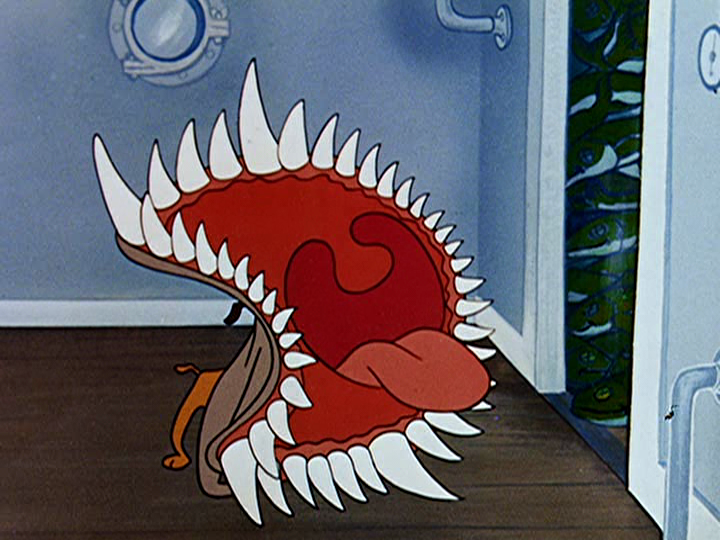 In ‘The Legend of Rockabye Point’ a polar bear tries to steal blue finned tuna from a ship which is guarded by a vicious bulldog.
However, he’s hindered by Chilly Willy, who does anything to awaken the bulldog. The polar bear repeatedly tries to save his skin by singing the bulldog back to sleep. In the end, it has become a habit, and we watch the old-aged polar bear singing his old friend to sleep in his arms.
Penned by Michael Maltese, this cartoon shares some ideas with ‘Deputy Droopy’ (which was made earlier, but only released six months later), but the result is fresh and original. ‘The Legend of Rockabye Point’ was the third of four cartoons Tex Avery made at Walter Lantz’s studio, and without doubt it is the best of the lot. Avery’s timing is, as always, excellent, and the gags come fast and funny. In fact, the cartoon is one of Tex Avery’s all time best, and it stands as Avery’s last masterpiece.
Watch ‘The Legend of Rockabye Point’ yourself and tell me what you think:
Director: Paul Grimault
Release Date: 1947
Rating: ★★★★★ ♕
Review:
 One of the most poetic animation films ever made, ‘le petit soldat’ is a very inspired re-telling of Hans Christian Andersen’s classic fairy tale of the steadfast tin soldier.
In this version, written by poet Jacques Prévert and undoubtedly inspired by the recent experiences of World War II, the soldier is actually an acrobat doll who gets drafted by a humming-top into an unexplained war.
In his absence, Jack-in-the-box tries to seduce his love, a ballerina doll. And when our little soldier finally returns from the battlefield, injured, Jack tries to kill him by taking his heart-shaped winding key away and by trying to drown him into an icy river. Fortunately, in a dramatic climax, the ballerina saves her love from drowning, while the villain gets stuck in a gin-trap.
‘Le petit soldat’ is entirely told in pantomime and a great improvement upon ‘La flûte magique‘, Grimault’s film from the previous year: its storytelling is better, its settings more dramatic, its characterization more convincing, and its animation more sophisticated. Indeed, this beautiful short about triumphant love arguably is Grimault’s masterpiece, even topping his beautiful, but uneven feature film ‘Le roi et l’oiseau’ (1952/1980), which is also based on a Jacques Prévert story.
Watch ‘Le petit soldat’ yourself and tell me what you think:
http://www.dailymotion.com/video/x3qi9b_le-petit-soldat-grimault-prevert-19_shortfilms
‘Le petit soldat’ is available on the DVD ‘Le roi et l’oiseau’
Director: Chuck Jones
Release Date: July 6, 1957
Stars: Bugs Bunny, Elmer Fudd
Rating: ★★★★★ ♕
Review:
 One of the most celebrated animated cartoons of all time, ‘What’s Opera, Doc’ places the typical Elmer Fudd-Bugs Bunny chase routine into the world of Wagnerian opera.
The cartoon’s masterstroke is that it uses all the cliches of the chase, which go all the way back to the first Bugs Bunny Cartoon ‘A Wild Hare‘ (1940), but that they are carried out in the most serious, Wagnerian fashion. The result is ridiculously pompous, mocking Wagnerian opera, as well as playing homage to it. Milt Franklyn’s score quotes music from five Wagner operas: ‘Der fliegende Holländer’, ‘Die Walküre’, ‘Siegfried’, ‘Rienzi’ and ‘Tannhäuser’.
The cartoon’s operatic character is emphasized not only by operatic singing, but also by featuring Wagnerian magic (a magic helmet), a ballet (a staple of French opera, but only employed by Richard Wagner in his very first operas), and a sad ending, a cliche of 19th century opera in general. Michael Maltese provided new lyrics to Wagner’s pilgrim chorus from ‘Tannhäuser’ and made it into a rather Hollywood musical-like love duet between Elmer and Bugs.
The animation is outstanding throughout, especially in the ballet and love duet between Bugs and Elmer. Indeed, for the ballet sequence the animators studied Tatania Riabouchinska and David Lichine from The Original Ballet Russe, and there’s a genuine seriousness about this scene. Yet, the main attraction of the cartoon lies in Maurice Noble’s extreme background layouts and bold color designs. Especially when Elmer gets furious, there is a startling emotional use of colors that has not been seen on the animated screen since ‘Bambi‘ (1942).
The opening sequence, with Elmer casting a mighty shadow is a straight homage to ‘The Night on Bold Mountain’ sequence from ‘Fantasia’ (1940), while the shots of Bugs being dressed as Brünnhilde and riding an oversized horse are retaken from ‘Herr meets Hare’ from 1945 (which, like ‘What’s Opera, doc?” was also penned by Michael Maltese). In this sense the cartoon is as much a homage to animation history as it is to opera.
‘What’s Opera, doc?’ is a brilliant cartoon of pure grandeur and one of Chuck Jones’s all time masterpieces. What’s most striking is that it was made during the normal grind of a commercial animated cartoon studio. The film took much longer than normal to make, which Jones and his unit could only manage to do by cheating on their schedule, stealing time from a much more ordinary short, the Road Runner cartoon ‘Zoom and Bored’ (1957).
Watch ‘What’s Opera, Doc?’ yourself and tell me what you think:
http://www.dailymotion.com/video/x1atzuy
This is Bugs Bunny cartoon No. 131
To the previous Bugs Bunny cartoon: Piker’s Peak
To the next Bugs Bunny cartoon: Bugsy and Mugsy
Director: Chuck Jones
Release Date: December 31, 1955
Rating: ★★★★★ ♕
Review:
 ‘One Froggy Evening’ tells about a construction worker, who discovers a singing frog inside a cornerstone of a building.
He dreams of earning loads of money with the frog, but unfortunately the frog sings for him only, not for anybody else. This leads to the man’s ruin, and in the end he disposes the frog into another building. But in 2056 AD the same thing is about to happen all over again…
‘One Froggy Evening’ is one of the most perfect cartoons ever made (one competitor that comes to mind is ‘The Band Concert’ from 1935): its story, penned by Michael Maltese, is told with the most economical means, without any dialogue. The silent acting is superb, the timing excellent and the handling of the facial expressions gorgeous. The transition of the frog (baptized Michigan J. Frog in the seventies) from lively entertainer to ordinary amphibian is completely convincing, and a great example of the power of animation.
Although the frog was supposedly locked inside the building in 1892, most of the songs it sings are from a later date: ‘Hello! Ma Baby’ was published in 1899, ‘Won’t You Come Over to My House in 1906, ‘I’m Just Wild About Harry’ in 1921, and ‘Please Don’t Talk About Me When I’m Gone’ is even from 1930. Only ‘Come Back to Erin’ and ‘Throw Him Down McCloskey’ are apt, being from 1868 and 1890, respectively. The catchy ‘The Michigan Rag’ was written especially for this cartoon.
‘One Froggy Evening’ feels like a parable. It’s a story of greed, of misfortune, of headstrong belief in a bad idea, and of shattered dreams. It is not hilariously funny, but delightful and simply beautiful. It was Chuck Jones’s personal favorite, and it’s deservedly regarded as an all-time classic. Not that anyone in 1955 thought so, though. The Academy Award went to ‘Speedy Gonzales’, while ‘One Froggy Evening’ didn’t even get an Oscar nomination. Meanwhile, ‘One Froggy Evening’ remains one of the very, very few animated cartoons to inspire a scene in a live action movie, in this case the alien scene in Mel Brooks’s ‘Spaceballs’ (1987).
Watch ‘One Froggy Evening’ yourself and tell me what you think:
Director: Bob Clampett
Release Date: June 9, 1945
Stars: Tweety
Rating: ★★★★★ ♕
Review:
 Two cats, a yellow dopey one and a red one who’s a caricature of Jimmy Durante, fight over a little white kitten.
She tells them that she’ll go out with the first who brings her a little bird. Enter Tweety, who, despite his cute and helpless appearance, finishes with the two cats in no mild manner. On the contrary, ‘A Gruesome Twosome’ is probably the most violent of all classic cartoons. It’s also very beautifully animated, full of wild and zany action, and simply hilarious. The highlights are a dog, who “doesn’t actually belong in the picture” and a very silly pantomime horse costume.
With ‘A Gruesome Twosome’ director Bob Clampett made one of his most extreme cartoons. Its outrageousness splashes from the screen in every scene. Its theme of sex and violence is executed in a much wilder way than Tex Avery would do, let alone any other director of the era. The cartoon’s sheer energy still impresses today. In this way, ‘A Gruesome Twosome’ may be viewed as the ultimate Bob Clampett film.
‘A Gruesome Twosome’ was the last of the three Tweety cartoons Bob Clampett directed (the other two being ‘A Tale of Two Kitties’ from 1942 and ‘Birdy and the Beast’, 1944). The character would reappear in a redesigned, less grotesque and much cuter form in 1947 in ‘Tweety Pie’ to start a much better known career with Sylvester, as directed by Friz Freleng.
Watch ‘A Gruesome Twosome’ yourself and tell me what you think:
http://www.dailymotion.com/video/x1z5zgx_tweety-bird-ep-03-a-gruesome-twosome_fun
Directors: Tex Avery
Release Date: August 3, 1946
Stars: Droopy, The Wolf
Rating: ★★★★★ ♕
Review:
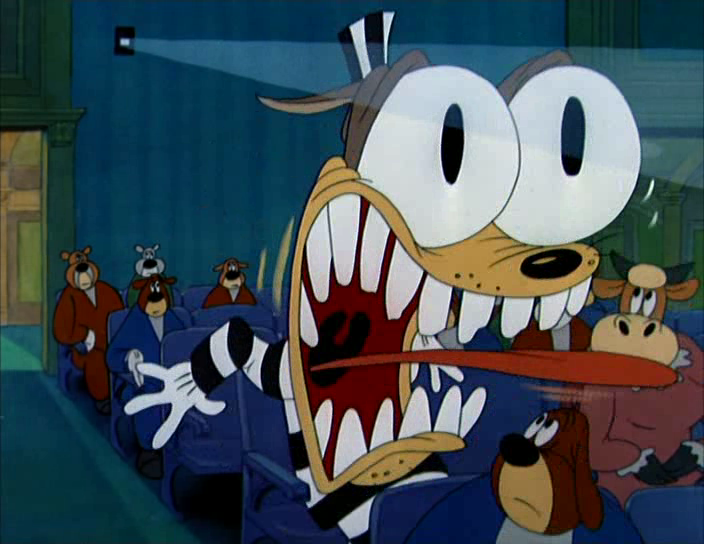
In ‘Northwest Hounded Police’ Avery revisited the material of ‘Dumb-Hounded‘ (1943) to make a film that is faster, more concise, more extreme, more paranoid and funnier than the original.
The idea of Droopy being everywhere is quickly established, while the focus lies on the wolf’s double takes, which get more and more extreme during the film, including the famous jaw drop. The cool part is that Droopy (or ‘Sergeant McPoodle’ as he’s called here) only has to be there to scare the wits out of the wolf. He doesn’t do anything but being there.
In the wolf’s double takes Tex Avery explores the limits of cartoon exaggeration. These extreme takes make ‘Northwest Hounded Police the epitome of animated cartoon paranoia, displaying a world of fear that has not been seen on the animated screen since the Fleischer cartoon ‘Bimbo’s Initiation‘ (1931). If there should be only one classic Tex Avery cartoon, this must be it.
Watch ‘Northwest Hounded Police’ yourself and tell me what you think:
http://www.veoh.com/watch/v202943sX3q26aT?h1=Northwest+Hounded+Police+-+Droopy
Directors: William Hanna & Joseph Barbera
Release Date: July 7, 1945
Stars: Tom & Jerry
Rating: ★★★★★ ♕
Review:
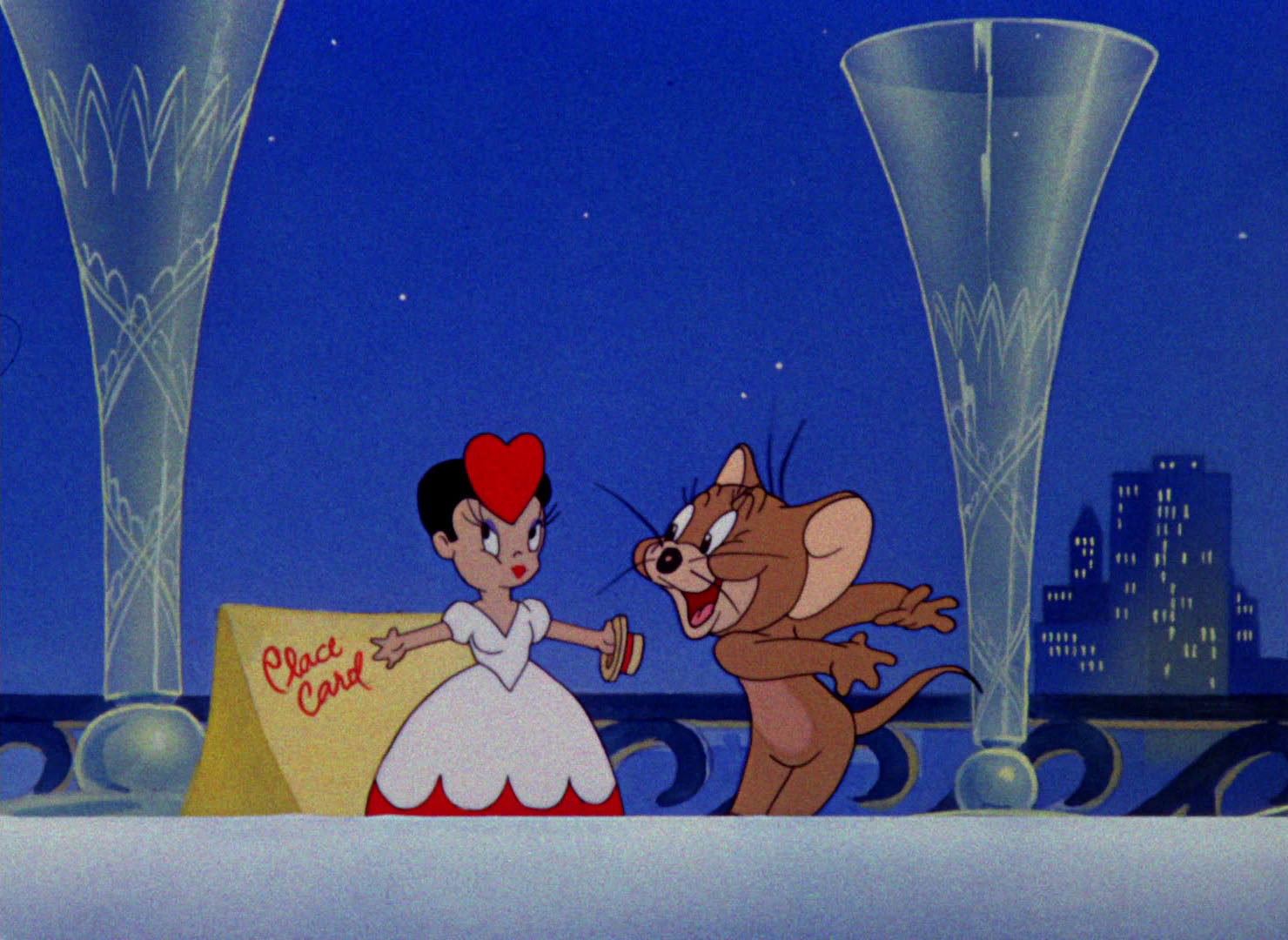 Tired of the country life, Jerry heads for Broadway, where he admires the big city.
Jerry’s luck is short-lived however, and after some bad experiences in the New York dumps (which involves hundreds of alley cats and scary subways), Jerry flees home, kissing a puzzled Tom in his joy.
‘Mouse in Manhattan’ is an outsider within the Tom & Jerry series, as it lacks the typical cat and mouse chase. Instead it focuses on Jerry’s journey, only. Nevertheless, it must be one of the most beautiful Tom and Jerry cartoons ever made. Jerry’s adventures in New York are accompanied by gorgeous and stunning backgrounds (most using a mouse perspective), and Scott Bradley’s particularly lush music. Bradley based his score on Louis Alter’s ‘Manhattan Serenade’ from 1928, which was also used in the MGM 1944 musical ‘Broadway Rhythm’, accompanying acrobatic stunts by the Ross Sisters. The music is so essential to the film, it almost seems the film was made for the score.
The cartoon is a sheer delight from the beginning to the end, but the highlight is Jerry’s dance with the female table figures on the roof of a very high hotel. This scene has the same class as its source of inspiration, the MGM musical.
Watch ‘Mouse in Manhattan’ yourself and tell me what you think:
This is Tom & Jerry cartoon No.19
To the previous Tom & Jerry cartoon: The Mouse Comes to Dinner
To the next Tom & Jerry cartoon: Tee for Two
Directors:William Hanna & Joseph Barbera
Release Date: January 16, 1943
Stars: Tom & Jerry, Meathead
Rating: ★★★★★ ♕
Review:
 In ‘Sufferin’ Cats’ Tom and a red alley cat fight over Jerry.
‘Sufferin’ Cats’ introduces the red alley cat, who was Tom’s first rival in the series. The red cat would return in ‘Baby Puss‘ later that year, but soon he would be replaced by Meathead, a black cat.
‘Sufferin’ Cats’ is a wild and funny cartoon, which is considerably faster than all earlier Tom and Jerry shorts. The gags come in quick and plenty, and are supported by one of Scott Bradley’s all time best scores, in which Tom and Jerry’s musical themes build up to a frantic finale during the cartoon’s main chase. Metamorphosis now reaches greater heights than in ‘The Bowling Alley Cat‘, when the red cat changes into an ironing board when crashing into the gate.
With its increase in speed and violence ‘Sufferin’ Cats’ marks a new era in the Tom & Jerry Series: from now on the duo would be less cute, but much funnier.
Watch ‘Sufferin’ Cats’ yourself and tell me what you think:
This is Tom & Jerry cartoon No.9
To the previous Tom & Jerry cartoon: Fine Feathered Friend
To the next Tom & Jerry cartoon: The Lonesome Mouse
Director: Hayao Miyazaki
Release Date: July 20, 2001
Rating: ★★★★★ ♕
Review:
 After several very fine films, like ‘My Neighbor Totoro‘ (1988) and ‘Princess Mononoke’ (1997), Miyazaki tops himself with his masterpiece ‘Spirited Away’. This film single-handedly places him among the greatest masters of animation of all time.
The film depicts a strange and inexplicable, yet surprisingly complete fantasy world, with a conviction and originality that has rarely been seen since Lewis Carroll’s ‘Alice in Wonderland’. At the same time, unlike several of Miyazaki’s earlier films, one feels that ‘Spirited away’ could only have been made in Japan. Its setting of a public bath, with its numerous gods and demi-gods, is totally Japanese.
Yet, its story about coming of age is universal as is its appeal. The little girl Chihiro (or Sen, as she’s called during most of the film) is the greatest of Miyazaki’s heroines. Like Kiki in ‘Kiki’s Delivery Service’ (1989), she matures during the film, but the fears and terrors she has to conquer are far more alarming than Kiki’s, and her growth is way more convincing. Not only has she to prove herself, she has to regain her name, and most importantly, she has to rescue her parents, who have been transformed into pigs in a particularly horrifying scene. At one scene we see her stricken with traumatic stress. In another we watch her breaking down. Despite some exaggerations (a flood of tears, for example), these scenes are so surprisingly real, they startle the viewer who’s used to the formalized emotions of many commercial animation films, whether Japanese or Western.
However, the character animation of Chihiro is outstanding throughout the film: she is a true girl and not an adult in disguise, and her emotions feel genuine and seem deeply rooted in observation of real human behavior. We identify immediately with her, and she’s strong enough a character to make her extraordinary journey in that strange, mysterious and dreamlike world believable.
Typical for Miyazaki, even in this hostile world our young heroine is not without friends, and even the most unpleasant characters (Yubaba and Without Face) are not without their weaknesses or positive character traits. On the other hand, even the good can look fearsome and unpleasant, as Yaku does in his dragon form. Also typical for Miyazaki is his depiction of children at work (see ‘Laputa – Castle in the Sky‘ (1986) and ‘Kiki’s Delivery Service’). On the other hand, his recurring theme of man versus nature is less apparent in this film, although it does appear in the form of a polluted river god.
In all, ‘Spirited Away’ is a rich film of pure delight and will enchant everyone everywhere in the world.
Watch the trailer for ‘Spirited Away’ yourself and tell me what you think:
Director: Te Wei
Release Date: 1988
Rating: ★★★★★ ♕
Review:
 After a hiatus of 25 years, China’s pioneering star animator Te Wei returns with this powerful and serene film, which is probably the most Chinese film ever made.
‘Feeling from Mountain and Water’* tells about an old master passing of the Guqin, a Chinese zither, and most revered of all Chinese classical instruments. Feeling his time has come, the old master passes his art on to a musical boyish fisherman. In the end we watch the boy playing an ode to his master and to nature on the guqin, which is now his.
The designs of this short are extremely beautiful, the watercolor backgrounds are on the verge of the abstract, and the animation is delicate and sophisticated. The film knows no dialogue, and much of the story is more suggested than shown.
Te Wei must have felt close to the film’s subject, as he himself was already in his seventies when he made this. Meanwhile, a younger gang of Chinese animators had taken inspiration from his films from the 1960s in what must have been a Chinese animation renaissance since the devastation of the cultural revolution.
‘Feeling from Mountain and Water’ is a very beautiful and meditative film on nature, music and life, and to me the masterpiece of Chinese animation.
Watch ‘Feeling from Mountain and Water’ yourself and tell me what you think:
‘Feeling from Mountain and Water’ is available on the French DVD ‘Impression de montagne et d’eau’
* this film is also known by its French title: impression de montagne et d’eau
Director: Hayao Miyazaki
Release Date: April 16, 1988
Rating: ★★★★★ ♕
Review:
 Set in the early post-war period, ‘My Neighbor Totoro’ is the sister film to ‘Grave of the Fireflies‘, released on the same date as a double bill.
The film is a way more lighthearted affair than ‘Grave of the Fireflies’, however. With ‘My Neighbor Totoro’ Miyazaki definitely entered the children’s world, which he had already explored a little in ‘Laputa: Castle in the Sky‘ (1986). But where the latter film firmly puts the children into an adult world, in ‘My Neighbor Totoro’ Miyazaki explores the children’s world itself.
The film focuses on two little girls: ca. eight year old Satsuki and her sister, four year old Mei. They move with their father to an old ramshackle house in the countryside to be near the hospital where their ill mother is staying. In a giant camphor tree next to this new home Mei and Satsuki meet the Totoros, three forest spirits: a tiny one, a small one and a huge one. When Mei gets lost, the giant Totoro and a cat bus help Satsuki to find her.
‘My Neighbor Totoro’ is a delightful film for children and their parents. There’s no conflict or villain whatsoever, and even when there seems to be drama, when the two children think their mother may be dying, there’s really little to worry about. But like in ‘E.T.’ (1982) we share the children’s point of view, in which there really is a problem. ‘My Neighbor Totoro’ draws us convincingly and irresistibly into this magical world of children. The film knows no dull moments, and is full of wonderful scenes, the best being Satsuki, Mei and the giant Totoro waiting for the bus in the pouring rain. Its strong focus and perfect execution makes ‘My Neighbor Totoro’ arguably the best of all Studio Ghibli films.
At any rate ‘My Neighbor Totoro’ is a gem even among Miyazaki’s films, which are of a constant high quality throughout. He must have felt so himself, for it’s the large Totoro which gave the Ghibli Studio their studio icon.
Watch the trailer for ‘My Neighbor Totoro’ yourself and tell me what you think:
Director: Isao Takahata
Release Date: April 16, 1988
Rating: ★★★★★ ♕
Review:
 Based on the semi-autobiographical novel by Akiyuki Nosaka, ‘Grave of the Fireflies’ is a strong, emotional and immensely sad film. It kicks in right away, when we hear Seita say “September 12, 1945. That was the night I died”.
What follows is Seita’s story: this boy, about fourteen, first loses his mother in the fire raid of Kobe, which destroys the wooden town completely. Then he and his little sister Setsuko try to live at their aunt’s place, but the initially kind woman grows increasingly hostile to them. So Seita decides to find his own living space for him and his sister in an abandoned shelter, first trying to get food by buying it, then by stealing. Unfortunately, Setsuko sickens from malnutrition, and while he finally has a real meal for her, she dies. Seita manages to build her funeral, but although not shown, the film suggests Setsuko’s death has broken his will, leading to his own death as depicted in the first scene.
The rather straightforward story is told with several flashbacks and flash-forwards and with a unique focus on details of everyday life, which really makes the two children come to life. The realism of ‘Grave of the Fireflies’ is unprecedented, the animation of Setsuko in particular being very lifelike, despite a less fluent animation technique. Never before has such a realistic and endearing child entered the animated screen.
The film’s subject matter, which confronts the Japanese viewer with the lowest point in their recent history, is daring and so is its execution, with its concise focus on human suffering, instead of heroism or action. The film makes the viewer really feel the impact of war on innocent civilians: the agony of shortages, hunger and despair, while the rest of the war remains at the background. Takahata focuses on Seita’s love for his little sister, and his struggle to shield her from the effects of war. Seita is a sympathetic character, but not without flaws. His struggle to survive and to nurture his sister is heroic, but his decision to leave his aunt is also iinduced by pride, and it’s partly his own stubbornness that prevents him from reconciling with his aunt, which may have prevented Setsuko’s death. It’s hard to blame him, though, for he’s a child himself, after all.
‘Grave of the Fireflies’ is one of the most serious animation features ever made, dealing with war and death. It’s also very sad, bringing tears to the eyes of almost every viewer. Like ‘Animal Farm‘ (1954), ‘Le planète sauvage‘ (1973) or ‘Watership Down’ (1978), ‘Grave of the Fireflies’ is one of the few truly serious animation features, expanding the medium’s subject matter, and it’s a cinematic masterpiece by any standard.
‘Grave of the Fireflies’ was released as a double bill with ‘My Neighbour Totoro‘, which is equally classic, but very different in tone, indeed.
Watch the trailer for ‘Grave of the Fireflies’ yourself and tell me what you think:
Director: Katsuhiro Otomo
Release Date: July 16, 1988
Rating: ★★★★★ ♕
Review:
 In 2019, 31 years after World War III, which destroyed the old town completely, Neo-Tokyo is even bigger and more urbanized than the old one. And more violent, too. The city is constantly on the brink of anarchy.
We follow Kaneda and Tetsuo, two members of a rough motorbike gang. When Tetsuo is hospitalized and taken away from his friend, Kaneda tries to retrieve him, while getting involved with a girl, who’s a revolutionary and whose troupe is after Tetsuo, too. Tetsuo, meanwhile, discovers he’s getting immense powers. Tetsuo suffers from an inferiority complex, and he realizes it’s payback time. He sets out to seek the mystical Akira, destroying most of Neo-Tokyo along the way. But in the end his powers take control of him, and while he and Akira merge to form a new universe in a very 2001 A Space Odyssey-like ending, Kaneda and his girlfriend Kei can look to a new future in a partly destroyed Neo-Tokyo.
If this plot line may sound a little hard to follow – it is, and I left quite some subplots out of it, too. ‘Akira’ is a violent and action-loaded science fiction film. Its plot may be vague and all too complex, the violent images never cease to impress. The film’s depiction of apocalyptic destruction, its speed, its wide range of characters, and its use of extreme camera angles are unprecedented in any animation film, and sometimes the grandness of the film’s scale is staggering. Some of the scenes are very complicated, with many people animated within one frame. And the story, too, seems to aim to encompass everything within the feature’s 124 minutes. Not surprising, considering that the film is based on a manga story six fat volumes thick.
Although Anime had known earlier masterpieces, it’s ‘Akira’, which set new standards in its home country. Moreover, it’s this film, which put the Japanese animation feature film industry firmly on the map in Western countries, which thus far practically had known the country’s television series, only. Thus, for most Westerners Japanese animation was synonymous to cheap animation, and the use of ridiculously large eyes. However, ‘Akira’ showed the Western world that Japan was perfectly capable of producing films of a high quality and stunning originality. Japanese animation has only grown in popularity since Akira’s release, and has become a major inspiration for many Western films and television series, animated or not.
Watch the trailer for ‘Akira’ yourself and tell me what you think:
‘Akira’ is available on DVD and Blu-Ray
Director: Alexandre Alexeieff
Release Date: 1933
Rating: ★★★½
Review:
 Predating Disney’s film to the same classical piece by seven years, this ‘video clip’ to the music of ‘Night on Bald Mountain’ by Modest Mussorgsky is an impressive mood piece.
The Russian-French artist Alexeieff animated ‘Une nuit sur le mont chauve’ on a so-called pinscreen, a device he invented himself , and which consists of a screen with numerous pins, which can be pushed further in or out, to produce a shadowy image together. This technique is highly original, and the images produced are totally unique.The film’s imagery has more in common with surreal paintings from the era than with any other animation film from the 1930s. ‘Une nuit sur le mont chauve’ was Alexeieff’s first film on the pinscreen. Together with his wife Claire Parker he would animate five more, of which ‘The Nose’ (1963) is arguably the best.
The film does not tell a story, but shows us a string of expressionistic images of animal and human forms, floating through air, and morphing into disturbing creatures. The animation is sometimes excellent (with a human figure circling through the air as a particular standout), but at times primitive, too, and the film suffers a little from the crude montage. Both shortcomings are a direct result of the limitations of the pinscreen. However, Alexeieff’s vision overcomes the film’s drawbacks, and ‘Une nuit sur le mont chauve’ is rightly considered an animation classic.
Watch ‘Une nuit sur le mont chauve’ yourself and tell me what you think:
‘Une nuit sur le mont chauve’ is available on the DVD ‘Alexeïeff – le cinéma épinglé’
Director: Ruth Lingford
Release Date: 1997
Rating: ★★★★★ ♕
Review:
 When death takes away her child, a mother gives up everything to get her back.
‘Death and the Mother’ is Ruth Lingford’s re-telling of a classic fairy-tale by Hans Christian Andersen. It’s an animation masterpiece: its strong and gritty animation, the beautiful string quartet music by Nigel Broadbent, the subtle sound effects – all add up to a very strong, dark and emotional film. Lingford makes clever use of the computer to create a very graphic film that looks like an animated woodcut. In an age in which computer animation almost equals 3D animation, this is a refreshing technique, with a stark impact and an imagery unparalleled in the animation field.
Moreover, Lingford captures Andersen’s tale of grief, love and sacrifice very well, without trying to update it. Just by staying true to the essence of the original story she has made a timeless classic. Her wordless film is as universal as it can get, and capable of communicating to audiences worldwide. It’s a welcome antidote to the Disney fairy tale retellings, which get more and more watered down, and which lose a lot of the originals’ charm with it.
Watch ‘Death and the mother’ yourself and tell me what you think:
‘Death and the Mother’ is available on the DVD inside the book ‘Animation Now!’
Director: Paul Driessen
Release Date: 1988
Rating: ★★★★★ ♕
Review:
 In an old castle a medieval writer is writing such lively stories, it attracts Death’s attention.
The writer tells a story about a peddler and his son, who has a touch of magic. All goes well, until Death comes in, and messes with the writer’s stories to ruin them and fill them with death and misery. Nevertheless, he fails to kill the son, who’s the writer’s main protagonist. With his magical powers the young boy escapes certain death several times. However, when in the end, the writer turns out to be same man as the little boy in his stories, Death has the last laugh.
‘De schrijver en de dood’ is one of Paul Driessen’s darkest and gloomiest films. His typical black humor is not absent, and is best visible in the little snapshots, which disrupt the story’s continuity for small morbid gags. But more than in any other of his films death is more disturbing than funny, and the sadness and misery are heartfelt. At the same time, it’s also one of Driessen’s most poetical films. The images are rich and full of fantasy, and in his own way Driessen creates a convincing medieval world to marvel at.
Watch ‘De schrijver en de dood’ yourself and tell me what you think:
‘De schrijver en de dood’ is available on the DVD ‘The Dutch Films of Paul Driessen’


 Dr. Grob's Animation Review