You are currently browsing the category archive for the ‘★★★★★’ category.
Directors: Clyde Geronimi, Wilfred Jackson & Hamilton Luske
Release Date: June 16, 1955
Rating: ★★★★★
Review:
 ‘Lady and the Tramp’ is a mild and friendly film based both on story ideas by Joe Grant that went as far back as 1939, and a short story by novelist Ward Greene. It tells the story of Lady, an upper class female Cocker Spaniel living around the turn of the century.
Lady’s life of luxury seems to be threatened by the coming of a baby, but it is the babysitter, aunt Sarah, who’s her real nemesis. The cat-loving old lady quickly has Lady muzzled, and it’s up to the tramp to rescue her. They spend a night out together, but in the morning, while they’re chasing chickens “together”, Lady gets caught and ends in the city dogpound. There she discovers that the tramp is quite a ladies’ man. It seems their short-lived relationship is over, but then the tramp helps her catching a rat that has sneaked into the house and into the baby’s room…
‘Lady and the Tramp’ was the first animated feature in Cinemascope. The film uses the new technique to great effects, with the action carefully laid out to the broad screen. Its backgrounds are very beautiful, and remarkably lush or, when necessary, highly dramatic. Only in the love scene they become somewhat stylized, showing a Mary Blair influence otherwise absent from the film.
The high quality animation is a delight to watch and stands out in an age of stylized and limited animation, something the 1950s more and more became to be. Like the animals in ‘Bambi‘ (1942), the dogs have a look and feel of real animals, while, at the same time, being full characters one can relate to, with a complete range of human expressions. Even the minor characters, like the dogs in the dogpound, are perfectly animated in that respect. The voices help in this dualism, often being a combination of human and dog-like sounds.
The humans, on the other hand, are hardly seen, and only the strongly caricatured ones, Aunt Sarah, Tony and Joe, have something of a character. It is telling that the most famous and probably most romantic kiss in animation history can be seen in this movie and is a kiss between two dogs. In this scene Lady and the tramp share a meal of spaghetti, accompanied by romantic music by the two Italian restaurant owners. This scene, animated by Frank Thomas, is the undisputed highlight of the film. Honorable mention goes to the very lifelike fight between the tramp and a large rat, a strongly dramatic scene animated by Wolfgang Reitherman, which can compete with the fighting scene in ‘Bambi’ in its impact.
Watch the dining scene from ‘Lady and the Tramp’ yourself and tell me what you think:
Director: Charles Nichols
Release Date: December 23, 1954
Stars: Donald Duck, the Park Ranger
Rating: ★★★★★
Review:
 By 1954 Donald Duck was Walt Disney’s only cartoon star to survive as, Mickey, Pluto and Goofy all had retired in 1953.
Following Tom & Jerry, who had entered the large screen one month earlier, he was to enjoy the last stage of his cinema career in Cinemascope, being the only Disney cartoon star to do so.
‘Grand Canyonscope’ is the first of Donald’s Cinemascope cartoons, and it uses the new technique to great effects. Donald is an annoying tourist in the Grand Canyon, repeatedly bothering the park ranger from ‘Grin and Bear it‘. The action makes excellent use of the wide screen, and the Grand Canyon is portrayed in beautiful scenic backgrounds, which are the real stars of this extraordinarily beautiful Donald Duck cartoon.
Watch ‘Grand Canyonscope’ yourself and tell me what you think:
This is Donald Duck cartoon No. 109
To the previous Donald Duck cartoon: The Flying Squirrel
To the next Donald Duck cartoon: No Hunting
Director: Tex Avery
Release Date: December 26, 1953
Stars: Droopy, The Wolf
Rating: ★★★★★
Review:
 ‘The Three Little Pups’ starts as a pastiche of the Disney classic ‘Three Little Pigs‘ (1933) with dogs instead of pigs, and the wolf being a dogcatcher.
However it changes into a typical Avery-cartoon as soon as the wolf has failed to blow the smart little pup’s dog house down. He then goes completely berserk on trying to break the house down only to freeze and say into the camera in a remarkably laid-back Southern voice, provided by Daws Butler: “Well, that’s a well-built dog house, man”.
This is clearly a completely different wolf than we had seen before in Tex Avery’s cartoons. Instead of having wild takes, his reactions to his humiliations are absurdly stolid. All through the picture, he remains completely calm, and several times we can hear him whistling the civil war tune ‘Kingdom Coming’, accompanied by the barest minimum of percussion. This would become his signature song in his reappearances in the Tex Avery one-shot ‘Billy Boy’ (1954), and in two of Michael Lah’s Droopy cartoons: ‘Sheep Wrecked‘ (1958) and ‘Blackboard Jumble’ (1957), which reuses some animation from ‘The Three Little Pups’.
Incidentally, the wolf is not the first animated character to whistle this tune. Twenty years earlier, Pooch the Pup already whistled it in the Walter Lantz cartoon ‘King Klunk‘ (1933). Avery worked at Lantz at the time – is it possible he remembered the tune from this cartoon?
The phlegmatic Southern Wolf is by all means a hilarious character to watch, and he plays surprisingly well against the equally deadpan Droopy. Add lots of gags, Tex Avery’s superb timing and spot on music by Scott Bradley, and we have a fine cartoon of excellent comedy. ‘Meow, man!’
Note the anti-television gags in this short. Tex Avery would make more of those in ‘Drag-along Droopy’ (1954). During the 1950s television made things difficult indeed for theatrical cartoons. Less and less visits were paid to the cinemas, and so studios were forced to cut down their costs. This process ultimately led to the demise of the theatrical cartoon, and to the decline of American studio animation in general, which reached an all-time low in the 1970s, only to be revived again at the end of the 1980s.
Watch ‘The Three Little Pups’ yourself and tell me what you think:
‘The Three Little Pups’ is available on the DVD-set ‘Tex Avery’s Droopy – The Complete Theatrical Collection’ and on the French DVD-box ‘Tex Avery’
s.Director: Jack Hannah
Release Date: June 20 1947
Stars: Donald Duck, The Aracuan Bird
Rating: ★★★★★
Review:
 ‘Clown of the Jungle’ reintroduces the Aracuan bird from ‘The Three Caballeros‘ (1944), now hindering Donald’s attempts to photograph birds.
The Aracuan bird is a surreal character, defying all laws of nature. For example, it can cycle in mid-air, duplicate itself and draw a door on a rock, and enter it. These abilities are very rare for a Disney character, and there’s no doubt that the Aracuan bird was inspired by the more absurd humor from the Warner Bros. and Tex Avery’s MGM cartoons.
Director Jack Hannah handles this type of humor remarkably well, delivering the gags in a fast pace and with an excellent timing, making ‘Clown of the Jungle’ not only the most surreal, but also one of the wildest and funniest Disney cartoons from the postwar era.
Being such a wonderful character, The Aracuan bird would return once more the following year, in the sequence ‘Blame it on the Samba‘ from ‘Melody Time‘ (1948). Unfortunately, the character remained alone in its zaniness within the Disney canon, and other Disney postwar cartoons remained much more conventional.
Watch ‘Clown of the Jungle’ yourself and tell me what you think:
This is Donald Duck cartoon No. 62
To the previous Donald Duck cartoon: Sleepy Time Donald
To the next Donald Duck cartoon: Donald’s Dilemma
Director: Andreas Hykade
Release Date: September 2006
Rating: ★★★★
Review:
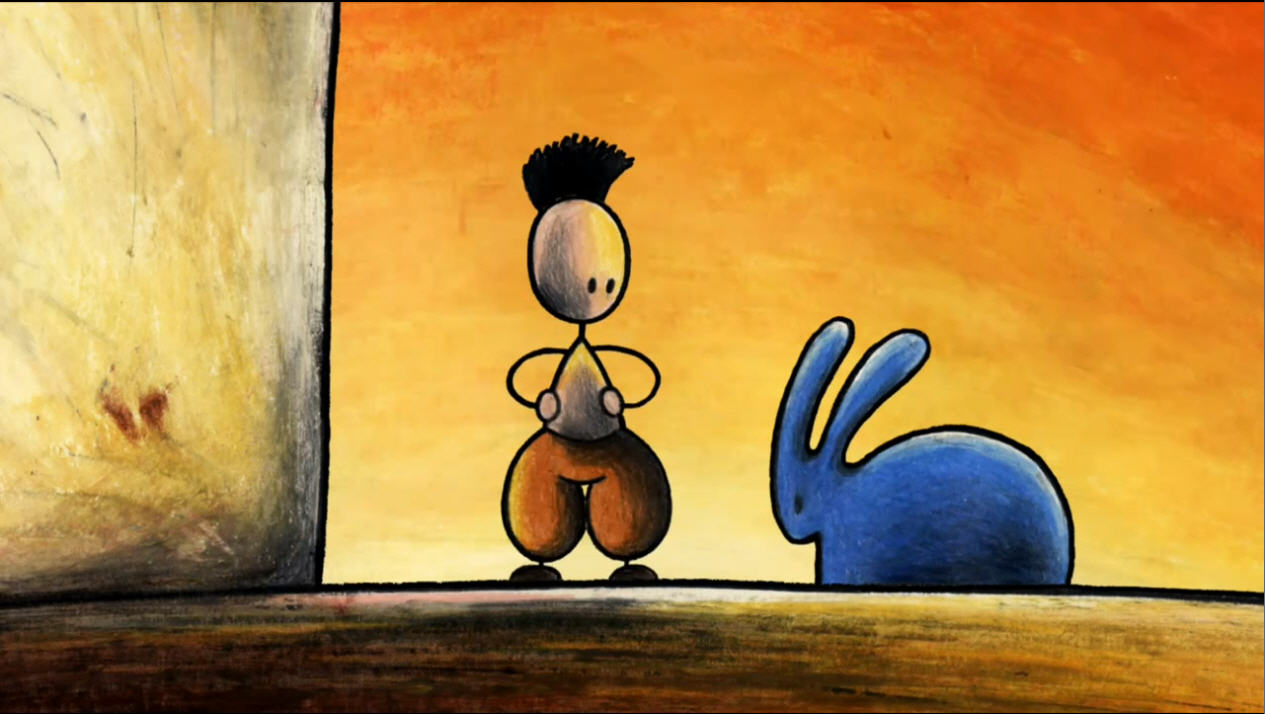 ‘The Runt’ is Hykade’s fourth independent film. It’s a disturbing short about a little boy who is allowed to keep a pet rabbit, if he’s going to kill it himself the next year.
Hykade’s simple and cute designs, and use of bright colors contrast with the film’s grim story, but they also make it watchable for everybody. There’s practically no reference to any time or place, and its story about death and coming of age has a universal appeal. Its timelessness makes the film an instant classic.
‘The Runt’ may not be as bold as his previous film, ‘Ring of Fire’ (2000), it is a great example of Andreas Hykade’s talent. He has succeeded in creating one of those rare shorts that make you think.
Watch ‘The Runt’ yourself and tell me what you think:
‘The Runt’ is available on the DVD ‘International Animation: Modern Classics’
Directors: Nick Park & Steve Box
Release Date: September 4, 2005
Stars: Wallace & Gromit
Rating: ★★★★★
Review:
 After three excellent two-reelers British animation heroes Wallace and Gromit were ready for their first feature film.
‘The Curse of the Were-Rabbit’ elaborates primarily on the themes of ‘A Close Shave‘: love and horror. This time Wallace and Gromit are after a giant rabbit threatening the crops breeds for a vegetable contest in the village.
The stop motion animation in this film is practically flawless, elevating the century old technique to the highest standards possible. Indeed, both this film and ‘Tim Burton’s Corpse Bride‘, another stop motion film, were far superior to any computer animated feature film released in 2005 or 2006.
‘The Curse of the Were-Rabbit’ is not only a great animation film, it is great cinema, with excellent camera work, a flawless story, wonderful characterization and lean storytelling that builds to a spectacular climax. Especially the animation of Gromit is stunning, because his acting is completely silent throughout the picture and uses only the eyes to suggest emotion.
Watch ‘Wallace & Gromit: The Curse of the Were-Rabbit’ yourself and tell me what you think:
Director: Friz Freleng
Release Date: January 5, 1957
Rating: ★★★★★
Review:
 ‘Three Little Bops’ retells the story of the three little pigs in a jazz style.
The film features voice actor Stan Freberg as a singing narrator. In the cartoon the three little pigs are jazz musicians who play jump blues (not bebop!). The wolf is a corny jazz cat, who wants to sit in, but whose trumpet playing is too amateurish to entertain. Only in hell the wolf learns that “you gotta get hot to play real cool”.
The film is unique within the Warner Bros. cartoon canon because it features neither voice work by Mel Blanc nor music by Carl Stalling/Milt Franklyn. It even lacks the ‘That’s All Folks!’ ending, showing a ‘The End’, instead. In the cartoon Stan Freberg does all the singing, while the swinging rhythm & blues music is provided by jazz musician Shorty Rogers and his combo. Together with ‘Rhapsody in Rivets‘ (1941), the cartoon is one of the best examples of director Friz Freleng’s perfect sense of musical timing. The result is one of the most entertaining animated cartoons of the late 1950s.
Watch ‘Three Little Bops’ yourself and tell me what you think:
Director: Robert McKimson
Release Date: August 31, 1946
Stars: Henery Hawk, Foghorn Leghorn
Rating: ★★★★★
Review:
 Already in his fourth film as a director McKimson introduces his most durable star, Foghorn Leghorn.
The loud-mouthed rooster is coupled with Henery Hawk, in his second appearance since the Chuck Jones cartoon ‘The Squawkin’ Hawk’ (1942). Also featured is the Foghorn Leghorn’s regular opponent, the barnyard dog, and their recurring feud is already laid out in this short. Foghorn Leghorn uses Henery in this feud, making him believe the dog, not he, is a chicken. In the end Henery catches both, and even a horse, exclaiming; “one of them got to be a chicken”.
‘Walky Talky Hawky’ is one of McKimson’s most inspired cartoons. Both Foghorn Leghorn and the barnyard dog are great characters, and the short is full of great, rather Clampettian animation.
Foghorn Leghorn’s vocal mannerisms were inspired by a 1930s radio character called ‘The Sheriff’. Later, mannerisms from another radio character, Senator Claghorn, crept into the rooster’s vocabulary. For a detailed account on the origins of Foghorn Leghorn, see Keith Scott’s excellent post on Cartoon Brew.
Watch ‘Walky Talky Hawky’ yourself and tell me what you think:
Directors: Tex Avery
Release Date: November 3, 1945
Stars: Droopy, Red, The Wolf
Rating: ★★★★★
Review:
 After the successful ‘The Shooting of Dan McGoo‘ Droopy from earlier that year, Red and the Wolf join forces again in ‘Wild and Woolfy’, a hilarious spoof on the classic western.
The cartoon has the simple plot of Droopy following the wolf, who has kidnapped Red after her performance of a nice country & western yodeling song. But Tex Avery once again packs the film with gags, including a wonderful and now classic empty road gag.
Film composer Scott Bradley reuses his twelve tone row he had introduced in the Tom & Jerry cartoon ‘Puttin’ on the Dog’ (1944) to accompany Droopy riding his little blue horse, with equally funny results.
Watch ‘Wild and Woolfy’ yourself and tell me what you think:
http://www.dailymotion.com/video/x3sxit_tex-avery-mgm-1945-wild-and-woolfy_fun
Directors: Tex Avery
Release Date: April 14, 1945
Stars: Droopy, Red, The Wolf
Rating: ★★★★★
Review:
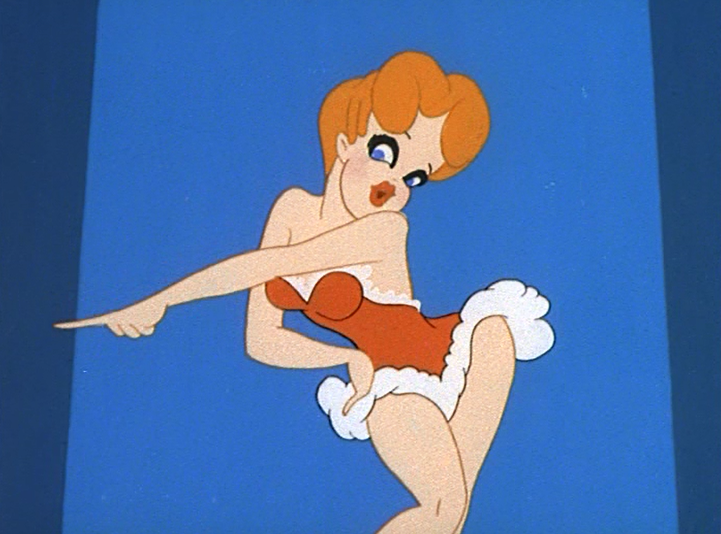 In his second film Droopy enters the wolf’s world of sex, joining forces with the ever sexy Red as his lover Lou, while the wolf’s the villain entering the Alaskan saloon and Droopy is ‘dangerous Dan McGoo’ himself.
The cartoon is a hilarious re-telling of the poem ‘The Shooting of Dan McGrew’ by Robert Service. It is simply packed with self-conscious gags and puns. Red is absolutely stunning, when she sings a great army song, displaying her popularity with the armed forces. Her performance remains a tour of the force of animation, courtesy of animator Preston Blair.
‘The Shooting of Dan McGoo’ was Tex Avery’s second take on Service’s poem, the first being the Warner Brothers cartoon ‘Dangerous Dan McFoo‘ from 1939, which phlegmatic dog star anticipates Droopy.
Watch ‘The Shooting of Dan McGoo’ yourself and tell me what you think:
Director: Bob Clampett
Release Date: June 28, 1945
Stars: Porky Pig
Rating: ★★★★★
Review:
 ‘Wagon Heels’ is one of the least known of Bob Clampett’s masterpieces.
In this short Porky is as a scout of a ‘wagon train’ (a weird mix of a caravan and a train). He has to face ‘Injun Joe the Superchief’, an enormously powerful Indian. In this he’s helped by a very silly blue Hillbilly character called Sloppy Moe.
‘Wagon Heels’ is a remake of the already very funny ‘Injun Trouble’ (1938), but it’s weirder, zanier, wilder and much better timed than the original. ‘The film is extremely rich in nonsensical gags, the highlight being the demonstrations of Injun Joe’s indestructible power. The result is an utterly hilarious film, and an indisputed highlight in the Bob Clampett canon.
Watch ‘Wagon Heels’ yourself and tell me what you think:
https://www.dailymotion.com/video/x2yhp06
This is Porky Pig cartoon no. 110
To the previous Porky Pig cartoon: Trap Happy Porky
To the next Porky Pig cartoon: Baby Bottleneck
Director: Clyde Geronimi
Release Date: December 17, 1943
Rating: ★★★★★
Review:
 This Disney short is an original take on the classic fable. It has a clear war message, even though there’s no direct visible link to World War II.
The villain, Foxy Loxy, uses a psychology book, from which he quotes, to lure the inhabitants of a poultry farm into his cave. The inhabitants of the poultry farm are clear representations of contemporary American society, including the upper class (turkeys), female middle class (chicken), male working class (ducks) and the youth (chickens and roosters, whom we see dancing to hot jazz in a short scene).
Foxy Loxy chooses a simpleton called Chicken Little as his main object, making him believe the sky is falling and encouraging him to spread the rumor. Originally, Foxy Loxy was to read from Adolf Hitler’s book ‘Mein Kampf’. It is not likely that the quotes are really from ‘Mein Kampf’, but they do contain surprisingly true lessons in how to manipulate the masses and how to undermine the present authority.
The film’s clear war message is not to fall for rumors and not to join mass hysteria. The film’s ending is as grim as there ever was one in a classic cartoon. In fact, the vision of a graveyard full of chicken bones is only topped by the similar ending in ‘Education for Death’ from the same year.
‘Chicken Little’ remains a little known Disney film, but its message is surprisingly fresh, and is probably even more valid today in an era in which propaganda and false rumors roam the internet and social media than it was during World War II.
‘Chicken Little’ was to be the last short directed by Clyde Geronimi before his dull comeback in ‘The big wash’ (1948). The Disney studio revisited the fable in 2005 in the feature film ‘Chicken Little’, which has ca. nothing in common with this far more interesting and disturbing short.
Watch ‘Chicken Little’ yourself and tell me what you think:
Director: Frank Tashlin
Release Date: October 14, 1944
Rating: ★★★★★
Review:
 ‘Plane Daffy’ opens with a military squad of pigeons hopelessly awaiting the return of Homer Pigeon, a dopey character, resembling Bob Clampett’s Bashful Buzzard from ‘Bugs Bunny Gets the Boid’ (1942).
This character has fallen into the clutches of Hatta Mari (an obvious reference to Mata Hari, a Dutch exotic dancer and spy during World War I). Hatta Mari appears to be a seductive pin up pigeon and a spy for the axis powers. After he realizes he has revealed his secret, Homer shoots himself (!).
The squad now seeks another for the job, to which Daffy, ‘the woman hater’, happily volunteers. Finally, after a wild chase, he too has to reveal his secret to the Fuehrer. But it turns out to be “Hitler is a stinker”, to which Adolf exclaims “that’s no secret!”, and Goehring and Goebbels add: “Ja! Everyone knows that!”.
‘Plane Daffy’ is one of the best war cartoons the Warner Bros. studio ever made. It may have been inspired by Walter Lantz’s ‘Pigeon Patrol’, but it’s much faster, wilder and zanier. It uses a voice over in rhyme, and citation-rich dialogue, and it’s full of extremely wild and zany animation.
Watch ‘Plane Daffy’ yourself and tell me what you think:
https://www.dailymotion.com/video/x1ykypg_daffy-duck-ep-31-plane-daffy_fun
This is Daffy Duck cartoon No. 27
To the previous Daffy Duck cartoon: Slightly Daffy
To the next Daffy Duck cartoon: The Stupid Cupid
‘My Favorite Duck’ is available on the DVD-set ‘Looney Tunes Golden Collection Volume Four’
Director: Bill Roberts
Release Date: August 27, 1943
Rating: ★★★★★
Review:
 ‘Reason and Emotion’ is a rather odd propaganda short, telling us about Reason and Emotion, who are depicted as two little characters living inside our heads.
The short ‘demonstrates’ where uncontrolled emotion can lead to: a man gets slapped in the face by a woman, while the woman eats too much. This makes ‘Reason and Emotion’ one of the first cartoons about weight and diets.
Then the short shows how reason is destroyed by Adolf Hitler (in an extraordinarily vicious, but wonderfully animated caricature), who uses fear, sympathy, pride and hate to indoctrinate the Nazi mind. This is one of the propaganda shorts, which treat the Germans as victims of their Nazi leaders (see also ‘Education for Death‘ from the same year). This contrary to the Japanese, who, in WWII animated propaganda films, were all treated as despicable, mean and low. The film also warns against panic and falling for false rumors.
Emotion is depicted as a rough, dumb, but fun-loving caveman, while Reason is a bespectacled thin and rather boring character. One cannot resist to love the Emotion-type, especially in its female form, as depicted in the woman’s head. This female character is animated with gusto by Ollie Johnston.
Watch ‘Reason and Emotion’ yourself and tell me what you think:
Director: Chuck Jones
Release Date: July 3, 1943
Stars: Bugs Bunny
Rating: ★★★★★
Review:
 Two castaways on a raft are so hungry they are ready to eat each other.
Then they land on a tropical, quasi-Hawaiian island, which strangely enough is inhabited by Bugs Bunny, and the two hungry men immediately try to catch and eat our hero. Of course they don’t manage to do so, and in a hilarious end scene, it’s Bugs, not they, who sails off on an ocean stormer into the distance.
The two castaways were modeled on the cartoon’s story men, Tedd Pierce (the tall one) and Michael Maltese (the short one), and the two men actually voiced their cartoon counterparts themselves.
The cartoon’s real stars however, are its outrageous backgrounds. Designed by Bernyce Polifka and painted by her husband, Gene Fleury, they are arguably the boldest backgrounds in any cartoon from the pre-UPA-era. The island is depicted in brassy, strangely colored, semi-abstract to abstract images, with no sense of three-dimensionality, whatsoever. Nevertheless, the clearly three-dimensional characters read surprisingly well against the outlandish backgrounds.
Polifka had replaced John McGrew, who had worked with Fleury on experimental backgrounds for Chuck Jones cartoons like ‘Conrad the Sailor‘ (1942) and ‘The Aristo-Cat‘ (1943), but who had joined the navy in 1942. The couple shared McGrew’s boldness, and worked with Jones on ‘Hell-Bent for Election’ (1944), one of UPA’s earliest films. But apparently they left Warner Bros. somewhere in 1943-1944. In 1949 they worked for Lou Bunin’s part live action part stop motion feature ‘Alice in Wonderland’, but after this job, they seemingly disappeared from the animation world. So, ‘Wackiki Wabbit’ remains their most famous and greatest legacy. The backgrounds themselves can be admired on the late Michael Sporn’s excellent blogpost on this cartoon.
Watch ‘Wackiki Wabbit’ yourself and tell me what you think:
This is Bugs Bunny cartoon No. 18
To the previous Bugs Bunny cartoon: Jack Rabbit and the Beanstalk
To the next Bugs Bunny cartoon: A Corny Concerto
Directors: William Hanna & Joseph Barbera
Release Date: December 25, 1943
Stars: Tom & Jerry, Meathead
Rating: ★★★★★
Review:
 A little girl makes Tom behave like a baby.
Tom only reluctantly cooperates, until he discovers the milk bottle. Jerry mocks him and warns three alley cats of Tom’s baby behavior. They mock him too, all too more violently, which leads to a frantic samba finale in which the little cat does a great Carmen Miranda impersonation, singing her hit song ‘Mamãe eu quero’ from the film ‘Down Argentine Way’ (1940).
Tom’s friends, the red cat from ‘Sufferin’ Cats‘, Meathead (in his debut) and a little cat, would reunite only seven years later in ‘Saturday Evening Puss‘ (1950). Apart from the finale the greatest scene is when Jerry behaves like ‘she’ is caught naked in the bathroom of a doll house.
Watch ‘Baby Puss’ yourself and tell me what you think:
This is Tom & Jerry cartoon No.11
To the previous Tom & Jerry cartoon: Yankee Doodle Mouse
To the next Tom & Jerry cartoon: Zoot Cat
Directors: William Hanna & Joseph Barbera
Release Date: June 26, 1943
Stars: Tom & Jerry
Rating: ★★★★★
Review:
 In this Tom and Jerry short their chase routine is pictured as if it were World War II itself.
War references include a periscope, a “jeep”, (paper) planes, a bomber (throwing light bulbs), a parachute (a bra), and lots of fireworks. Tom is the clear villain now, with Jerry acting the role of the brave American soldier. At the end of the cartoon Tom explodes in the sky revealing the American flag to which Jerry salutes.
Although not a real war cartoon (Tom and Jerry do not fight Nazis or anything like that), it is drenched in war spirit. Moreover, the short is extremely fast and furious, with gags coming without any break. No wonder it won an Academy Award.
Watch ‘Yankee Doodle Mouse’ yourself and tell me what you think:
http://www.dailymotion.com/video/x2kxk46
This is Tom & Jerry cartoon No.11
To the previous Tom & Jerry cartoon: The Lonesome Mouse
To the next Tom & Jerry cartoon: Baby Puss
Directors: William Hanna & Joseph Barbera
Release Date: July 18, 1942
Stars: Tom & Jerry
Rating: ★★★★★
Review:
 ‘The Bowling Alley Cat’ is the first Tom and Jerry cartoon to take please outside their familiar home setting. In this short the cat and the mouse play at an abandoned bowling alley.
The short is mildly paced, but its timing is excellent and the silent comedy delightful, supported by Scott Bradley’s excellent score.
The film contains an early example of metamorphosis, in which Tom changes into a familiar household object, this time a ninepin. This type of metamorphosis would become a recurrent gag in the Tom & Jerry series. Compared to later entries Tom’s deformation in ‘The Bowling Alley Cat’ is mild, and still a little plausible. This kind of plausibility was abandoned the next year in the more frantic cartoon ‘Sufferin’ Cats‘.
Watch ‘The Bowling Alley Cat’ yourself and tell me what you think:
This is Tom & Jerry cartoon No. 7
To the previous Tom & Jerry cartoon: Puss ‘n Toots
To the next Tom & Jerry cartoon: Fine Feathered Friend
Directors: Dean DeBlois & Chris Sanders
Release Date: June 21, 2002
Rating: ★★★★★
Review:
 Stitch is a genetic experiment (called ‘experiment 6-2-6’) designed to destroy, but sentenced into exile by an intergalactic councel.
All too soon our fluffy little mutant escapes and he ends at the Hawaiian island of Kauai, where he befriends lonely little Lilo, who lives a difficult life with her older sister Nani after the death of their parents. Here Stitch learns to tone down his inclination to destruction and how to love and care.
‘Lilo & Stitch’ is a very appealing film. Its designs, based on Chris Sanders’ idiosyncratic story drawings, are round, cuddly and original. Adding to the friendly atmosphere are the lush watercolor backgrounds, the first in a Disney feature since ‘Bambi‘ (1942). The animation is superb throughout, and Lilo, Stitch and Nani are round and instantly likable characters, who have nothing of the wisecracking arrogance of many other animated characters from the era. The film’s familiar family theme never gets cloying and is countered by a lot of humor. The result is a film full of love and joy.
Probably, because it was made in Orlando, Florida, far from the main company, the film also eschews the rather tiresome Disney musical convention, and features an original soundtrack featuring Elvis Presley songs and Hawaiian chants, instead. True, the plot borrows freely from ‘Men in Black’ (1997), and the science fiction setting feels a little awkward in a Disney film, but the story of loneliness, love and acceptance is well-told, and equally appealing to the young and old.
Moreover, the film proves that one can perfectly well make a good movie out of original and typical elements. A film maker like Hayao Miyazaki knows this, off course. But unfortunately, this message has been lost on the American animation studios, as very few of the subsequent American feature films succeeded in displaying this level of originality in characterization, soundtrack and design. Thus ‘Lilo & Stitch’ remains as Disney’s best attempt at an ‘author film’ (not counting the almost forgotten ‘Teacher’s Pet’ from 2004).
Unfortunately, ‘Lilo & Stitch’ seemed to be Disney’s last masterpiece of traditional animation. Even though it was followed by yet two other 2D animation features, it marked an end of an era lasting 65 years. Disney soon jumped the computer animation band wagon with rather mediocre results, arguably only hitting their stride in 2010 with ‘Tangled‘. Luckily, in 2009 the studio made a surprising, but unfortunately isolated return to the traditional medium with the excellent ‘The Princess and the Frog’.
Watch the trailer for ‘Lilo & Stitch’ yourself and tell me what you think:
Director: Hayao Miyazaki
Release Date: March 11, 1984
Rating: ★★★★★
Review:
 Although the titles say ‘based on the graphic novel’, the manga of the same name was actually created to be able to make the picture.
Based on his own original story, ‘Nausicaä of the Valley of Wind’ is Miyazaki’s first mature film. It’s already a typical Miyazaki film, with its strong environmental message, strong female characters, the absence of clear villains, and the setting of an alien, yet totally convincing world.
The film tells of Nausicaä, princess of a small medieval-like state in a green valley, which is threatened not only by the strange, hostile and poisonous insect world nearby, but also by other human states, especially the militaristic state of Tolmekia. The humans are more preoccupied with destruction than with comprehension. Because of this shortsighted and drastic behavior, the humans almost destroy their entire environment. It is Nausicaä, with her unique understanding of animals and her pacifistic nature, who saves the day.
‘Nausicaä of the Valley of Wind’ is an epic science fiction film, made on a grand scale, with layered characters, beautiful designs, and excellent animation. Its production led to the foundation of the Ghibli studios, which high quality standards it already meets. In no sense it feels like a first-born or a dated film. Even though it’s from 1984, it is remarkably fresh and its message still viable. In other words, ‘Nausicaä of the Valley of Wind’ is the first of a long series of Ghibli studio classics.
Miyazaki would revisit the theme of a sick and angered nature in the similar and equally impressive ‘Princess Mononoke’ (1997). Once again it’s a princess who saves the day…
Watch the trailer for ‘Nausicaä of the Valley of Wind’ yourself and tell me what you think:


 Dr. Grob's Animation Review