Director: Unknown Release Date: May 28, 1928 Stars: Oswald the Lucky Rabbit, Honey, Peg Leg Pete Rating: ★★★★½ Review:
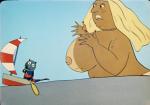
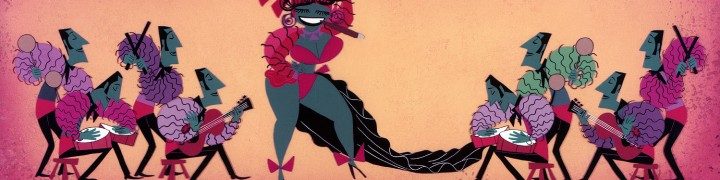
‘Oh What A knight’ can be regarded as an early forerunner of the Mickey Mouse cartoon ‘Ye Olden Days‘ (1933).
Both shorts feature a medieval setting and both Oswald and Mickey are minstrels courting their love in a castle. However, where in ‘Ye Olden Days’ Goofy is the unlikely villain, Oswald’s opponent is Pete, who wears an anachronistic high hat.
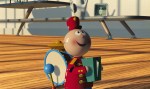
Oswald serenades his sweetie Honey with an equally anachronistic accordeon. Soon, Oswald and Pete duel in grand adventure film-like manner, with Oswald kissing Honey between the fights. One scene in particular has beautifully animated shadows. In the final falling scene Honey loses her pants, and is shown naked. All characters are animated very flexibly: there’s a lot of stretching, falling apart etc.
‘Oh, What a Knight’ is a very entertaining entry in the Oswald the Lucky Rabbit series, and shows that Disney already went for high quality before the advent of Mickey.
Watch ‘Oh, What a Knight’ yourself and tell me what you think:
This is Oswald the Lucky Rabbit cartoon No. 20
To the previous Oswald the Lucky Rabbit cartoon: Hungry Hoboes
To the next Oswald the Lucky Rabbit cartoon: Sky Scrappers
Director: Priit Pärn Release Date: 1992 Rating: ★★★★★ ♕ Review:
If ‘Breakfast on the Grass‘ was a dark and disturbing portrait of life in the Soviet Union, Priit Pärn’s next film, ‘Hotel E’, took off the mask from the former Soviet state like no other film.
Released shortly after Estonia’s declaration of independence on 20 August 1991, it’s the film on the fall of the iron curtain, seen from an Eastern European perspective. Pärn paints Eastern and Western Europe in the most extreme contrasts, and with different animation styles.
The film starts with two short legends: the legend of the traitor. Told in cut out animation, it tells the story of a young man who looks, when a door opens to a more colorful world…
The second legend is called ‘The legend of the redeemer’. This is set in a rather renaissance sunny landscape, and tells of an outcast who can bridge the missing parts in an otherwise perfect society. This part features virtuoso painted rotoscope animation in the style of Paul Rubens and Frans Hals. Both legends are worked out in detail in the rest of the film, which forms ‘Hotel E’ proper.
‘Hotel E’ (Hotel Europe) starts with a depiction of Western Europe (named ‘The American Dream’) as a lethargic dream room, filled with rich, lazy, and spoiled people, filling their empty, purposeless lives with petty problems, and hardly capable of communicating with each other. This world is filmed in slow, rotoscoped movements in the most colorful pop-art style.
Meanwhile, next door, in the Eastern European room, things are very different indeed. This world is depicted in Pärn’s crude scratchy animation style, and accompanied by nervous, dissonant music. Here it’s dark, it’s filthy, it’s full of flies, and life there is extremely stressful. The inhabitants all sit around a round table, and their presence is constantly checked by a moving clock hand. The room is frequently illuminated by search lights, and if one fails to stay in place for whatever reason, he’s executed immediately. Paranoia and secrecy reign. Moreover, chances can change randomly, and someone who was in favor first, can be out of luck next time.
One of the inhabitants of this cruel world manages to break free and he’s capable to visit the other world next door. He repeats his visits, despite the fact that he has to leave his concerned wife behind, and despite the fact he’s increasingly seen as a traitor by his fellow citizens. Even worse, he seemingly has little to add to the luxurious world of the West, and his longings there are hardly answered, let alone his problems understood. Only in the end he manages to find his place in this society, when only he turns out to be able to restore the inhabitants’ happiness. At that point we watch the wall between the two rooms collapsing, exposing the rotten world of the East and its eager inhabitants, and we hear one Western woman exclaim ‘o, shit…’.
‘Hotel E’ is Pärn’s most openly political film. It must be regarded as one of his masterpieces, and because of its historical significance, the most important film by the Estonian master. Pärn’s visual language is at its most extreme here, and the film is very difficult to decipher. In fact, much of what is happening is hard to comprehend. But anyone who takes the plunge, is rewarded by a most moving, and impressive film, indeed, the message of which still rings today.
Watch ‘Hotel E’ yourself and tell me what you think:
Director: Priit Pärn Release Date: 1987 Rating: ★★★★★ Review:
Made directly after ‘Time Out’, ‘Breakfast on the Grass’ is one of Priit Pärn’s most powerful films.
It’s also one of his most difficult, and its message is at times hard to decipher. Pärn doesn’t tell straightforward stories, and much remains unexplained. Most importantly, it’s one of the few films showing insight in Eastern European life under the communist oppression. Its atmosphere is gloomy, its graphic style crude and scratchy, its humor dark, and its surrealism disturbing.
In ‘Breakfast on the Grass’ we follow four people, two men and two women, who struggle in their daily life. The first, Anna, strongly feels she’s an outcast in the society. She’s not really part of the system, and misses out on its benefits, as exemplified by her search for rare apples. The second, Georg, imagines himself a playboy, but reality is harder. In pursuit of a suit, with which he can fulfill his playboy dreams he has to go through a grind of corruption. Everyone wants something rare in exchange for offered service. Berta has lost her face as soon she became a mother. She only regains it when she finds the attention of a man. And finally, Eduard shrinks when he needs a paper signed from a very high official. Luckily he gets help from a female friend…
Also starring in these stories is an anonymous artist, who is constantly followed by a flock of crows or dragged around by two state officials. A clearer statement of oppression is hard to find in any Soviet film.
In the end, the four people succeed in their aim, and together they go to a park, where they form a life tableau of Edouard’s Manet’s painting ‘Déjeuner sur l’herbe‘ (1863) which lends its name to the film’s title. This hopeful statement of beauty, freedom and art is as quickly dismantled, however, and the final shot is for the artist, whose arm is smacked by a steam roller…
Like few other films ‘Breakfast on the Grass’ shows what life is like in an oppressed state, where food is scarce, where bureaucracy and corruption run freely, and where the role you play is more important than your personal preferences. Even though the Glasnost was in full flight in 1987, it’s a wonder such a dark accusation was possible in the Soviet Union, of which Estonia was then still part.
Watch ‘Breakfast on the Grass’ yourself and tell me what you think:
Director: Priit Pärn Release Date: 1984 Rating: ★★★★ Review:
‘Time Out’ is Priit Pärn’s fifth film, but the first to gain a widespread attention, and to win a number of international prizes.
It shows the filmmaker’s idiosyncratic style and unique surrealism, without the dark side, often present in his other films. The film is filled with child-like wonder, and a happy atmosphere, enhanced by the joyful reggae music by composer Olav Ehala.
The film opens with a room in which a very stressed out cat lives. The cat is in a constant need to check his alarm clock, which is on a shelf too high for him. When he finally reaches the clock, he discovers he can’t read it without his glasses, so he has to find them first, etc. Pärn shows this pointless ritual in several variations over and over again, following the cat running around in his room.
At one point, however, the alarm clock breaks, and time stands still. At this point of the film the cat finds himself in a fantastic world where everything can happen. This part is extremely rich in visual tricks, which go all the way back to Émile Cohl’s ‘Fantasmagorie‘ (1908). Nothing is what it seems, and metamorphosis runs freely. Unfortunately, in the end, time is restored, and the cat has to face his former stressful life once again.
‘Time Out’ certainly shows Priit Pärn’s mastery, and excellent timing. His fantasy is extraordinary, and the film shows the power of animation like few other films do. It’s also a reminder that we should snap out of the daily routine, and let our mind wander, and be really creative. When one takes time, everything may be possible!
Watch ‘Time Out’ yourself and tell me what you think:
Director: Jan Švankmajer Release Date: 1989 Rating: ★★★★ Review:
‘Flora’ is an ultra-short film made for MTV. It only lasts 30 seconds.
In it we watch a woman who’s tied down to a hospital bed. She apparently consists partly of vegetables, which are quickly rotting away, as if life is leaving her by the seconds. There’s a relieving glass of water nearby, but out of her reach. This is a puzzling and rather unsettling image, which knows no release.
Flora was the Roman goddess of flowers, and her features resemble that of a Giuseppe Arcimboldo-character, another homage by Švankmajer to the Renaissance-master, after ‘Dimensions of Dialogue‘ (1982). But how did the goddess come into this setting of utter distress? Watching her decaying alive is painful, even within this short time-frame.
Watch ‘Flora’ yourself and tell me what you think:
‘Flora’ is available on the DVD ‘Jan Svankmajer – The Complete Short Films’
Director: Jan Švankmajer Release Date: 1989 Rating: ★★★★★ Review:
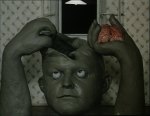
In ‘Darkness Light Darkness’ we watch several body parts entering a small room in order to assemble a complete man.
Together with ‘The Death of Stalinism in Bohemia’ (1990), ‘Darkness Light Darkness’ is Švankmajer’s last classic animated short film before he embarked on a career of directing features, which featured less and less animation.
‘Darkness Light Darkness’ is on the same level of virtuosity as ‘Dimensions of Dialogue‘ (1982): its stop motion animation, by star animator Bedřich Glaser, and its sound design, by Ivo Špalj, are both no less than perfect. However, it’s much lighter of tone than the earlier film. In this short film Švankmajer and Bedřich Glaser use a particularly cartoony type of animation. For example, the entry of the genitalia is a hilarious highlight.
Nevertheless, even this film has a darker side: when the man is complete, he completely fills the room, which is way too small for him. We hear him breathing heavily, and can assume he his in great pain in his cramped position. The cartoon ends with this claustrophobic image before darkness enters again. So, somehow, even this enjoyable film tells something about the human condition, how during our lifetimes we can develop ourselves only to end in the eternal dark again…
Because of its unity of space and time, and because of its unique inner logic, ‘Darkness Light Darkness’ is one of the best told animated shorts ever. It shows Švankmajer’s mastery. In that respect it’s unfortunate that in the 1990s he moved on to live action films.
Watch ‘Darkness Light Darkness’ yourself and tell me what you think:
Director: Jan Švankmajer Release Date: September 1988 Rating: ★★★★ Review:
‘Another Kind of Love’ is a beautiful result of the glory days of MTV: A video clip by Jan Švankmajer!
Švankmajer treats Hugh Cornwell’s charming if rather forgettable song in his own typical way: the setting is one windowless room, he films the ex-Stranglers singer’s mouth a lot in close-up, there are objects with tongues (in this case singing shoes) and there’s a beautiful clay woman, who shares features with the woman in ‘Dimensions of Dialogue‘ (1982), apparently because the same template has been used.
Highlights form the deformations of the singer’s head, whose features have been reproduced very well in the clay model, and the clip’s finale, in which the woman emerges from the wall to embrace the singer, and drawing him into the wall, leaving the room empty.
Watch ‘Another Kind of Love’ yourself and tell me what you think:
‘Another Kind of Love’ is available on the DVD ‘Jan Svankmajer – The Complete Short Films’
Director: Jan Švankmajer Release Date: 1988 Rating: ★★★★½ Review:
Švankmajer’s films in the communist years preceding the velvet revolution of 1989 show a lighter tone than his earlier films. It’s like one can breath some of the thawing atmosphere in Czechoslovakia during the Perestroika years.
‘Virile games’ is a typical example. Although the film contains some very graphic violence, the film remains a rather cartoony atmosphere, and its end is rather tongue-in-cheek.
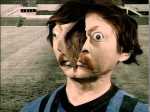
In ‘Virile Games’ we follow a mustached man watching a football match on the television. It’s a very weird soccer match, however: all players have the spectator’s face, and scoring happens by killing the opponents. These killings occur in the most bizarre ways, all deforming the opponent’s head till the player drops dead. One opponent for example is killed with cake forms, another by toy train….
In the second half the football match moves to the spectator’s own home, and the killing continues with the man’s own kitchen tools. However, tied to his screen, the man keeps watching the television set, not noticing that the violence occurs just around him.
In this film Švankmajer blends live action, stop motion, rather Terry Gilliam-like cut-out animation and pixilation with the stunning self-assurance of a mature film maker. Especially the clay-animation is top-notch. Like Georges Schwizgebel’s ‘Hors-jeu‘ (1977) the film directly couples soccer to violence, a clear indication of the author’s worries about growing football hooliganism. Apart from that, the film shows the maker’s trademark ingredients, like his obsession with food.
Watch ‘Virile Games’ yourself and tell me what you think:
‘Virile Games’ is available on the DVD ‘Jan Svankmajer – The Complete Short Films’
Director: Mark Baker Release Date: 1988 Rating: ★★★★★ Review:
‘The Hill Farm’ is a long animation film exploring man’s relation to nature.
First we watch the inhabitants of the hill farm themselves: simple farmers, who know the dangers and hardships of nature, and who treat their livestock without romanticism (as exemplified by the farmer’s wife killing chicken without ado).
At one point the hill farm is visited by tourists, who are completely alienated from nature. One of them faints at the sight of the farmer’s wife killing a chicken. When confronted by nature’s dangers (as embodied by a gigantic bear-like beast) they don’t recognize the danger at all. To them nature is something to visit, something to make snapshots from. The third party is a group of huntsmen, who (try to) kill everything in sight, including even the farmer’s bees.
The whole film takes place at a leisurely speed, without dialogue. Mark Baker’s visual style is simple, but very effective. His angular designs and graphic backgrounds are beautiful, and his animation has a unique timing, which is as comical as it is to the point. The narration is very open, leaving the interpretation to the viewer. The end result is one of the most beautiful animation films of the 1980’s.
Watch ‘The Hill Farm’ yourself and tell me what you think:
‘The Hill Farm’ is available on the DVD Box Set ‘Annecy – Le coffret du 50e Anniversaire’
Directors: Robert Zemeckis (live action) & Richard Williams (animation) Release Date: June 22, 1988 Stars: Roger Rabbit, Baby Herman, Bob Hoskins, Jessica Rabbit, Christopher Lloyd, Yosemite Sam, Dumbo, Hyacinth Hippo, Donald Duck, Daffy Duck, Betty Boop, Goofy, Droopy, Tweety, Mickey Mouse, Bugs Bunny, Koko the Clown, Pinocchio, Woody Woodpecker, Pete, Porky Pig a.o. Rating: ★★★★★ ♕ Review:
Very rarely a film comes out that raises great expectations, but also lives up to it. ‘Who Framed Roger Rabbit’ is such a picture.
Brought to us by golden team of film entertainment professionals, producing company Walt Disney, executive producer Steven Spielberg and director Robert Zemeckis, ‘Who Framed Roger Rabbit’ stands among the great fantasy films of the 1980s.
More importantly, however, it heralded a renaissance in the animation world after ca. 20-25 dark years, in which animation got cheaper, lousier, more commercial and more and more directed at kids. ‘Who Framed Roger Rabbit’ showed that once there was a golden age of animation, in which animation was impressive, massively funny and directed at adults. The film clearly pays homage that period. For example, the Baby Herman cartoon with which the film starts, combines Disney-like elongated prop-gags with Tex Averyan takes and Tom & Jerry-like cartoon violence. Indeed, Tom & Jerry seem to be the cartoon’s biggest influence with its household setting, fast pacing and violent takes on Roger.
The film renewed the attention for the golden age (roughly 1930-1955) and spawned a new era, in which Disney found inspiration again. Who Framed Roger Rabbit’ is one of the least typical Disney-features Disney ever made, and the introduction of Warner Bros./MGM-like cartoon humor was a great injection for the company, resulting in genuinely fast and funny animation in its own features, most notably in ‘Aladdin’ (1992) and ‘Hercules’ (1997).
Moreover, in the age following the movie, TV-animation suddenly got interesting (Nickelodeon with series like Ren & Stimpy and Rocko’s Modern Life, Cartoon Network with series like Cow & Chicken and Dexter’s Laboratory), and animation returned to evening television, aimed at adults (The Simpsons, Duckman, South Park). For people like me, who had grown up in the deserts of 1970s and 1980s this change in perception of what animation was and could be was very welcome, and in my perception it all began with this film.
‘Who Framed Roger Rabbit’ is not only a milestone, however, it’s a hugely entertaining movie itself, with a strong plot and great scenes. The animation, led by Richard Williams, is pre-computer, but an enormous improvement on similar earlier films combining animation with live action (e.g. ‘The Three Caballeros‘, ‘Mary Poppins’, ‘Elliott and the dragon’). Not only are the character animated very well, they’re staged stunningly fluently, following the camera, and they’re shaded like they are actually in the set, giving them a 3D quality like no cartoon character in a live-action setting ever had before.
This sense of the cartoon characters being in the same space as the actors is greatly helped by an endless string of very convincing special effects, using real props. For example the weasel gang leader handles a real gun, and when he splashes water, the water is real, too. Meanwhile, of course, the characters remain drawn on cells. To contemporary eyes there’s a great lesson here, in that cartoon characters needn’t be animated in 3D to get a real sense of existential body…
Part of the fun of ‘Who Framed Roger Rabbit’ of course, is the presence of several classic cartoon stars, coming from different animation studios and appearing for the first (and only) time together in one film. It’s a great pleasure to watch Disney characters (a.o. Donald and Mickey) appearing together with Warner Bros. characters (a.o. Daffy, Bugs, Tweety, Yosemite Sam), MGM (Droopy) and even from former Disney-rival Fleischer (Betty Boop, and for a brief moment Koko). Only Walter Lantz’s star Woody Woodpecker doesn’t get the screen time he deserves, and Popeye and Hanna & Barbera’s Tom & Jerry are notably absent. The fun is raised by the presence of two of the original voice talents, Mel Blanc (Bugs Bunny, Daffy Duck, Tweety & Porky Pig) and Mae Questel (Betty Boop).
However, the film’s own stars are hardly less entertaining. Roger Rabbit, voiced by Charles Fleischer, easily carries the film, and Jessica Rabbit is not only a female attraction, but a wonderfully subtle character, with great lines like ‘I’m not bad, I’m just drawn that way‘. The live action stars are equally strong, most notably Bob Hoskins, who brings a very subtle tragic edge to his cynical character Eddie Valiant, the film’s starring role.
The story has surprisingly critical overtones, with its plot circling around the loss of Los Angeles public transport in favor of freeways, something that really happened in the late 1940s (the showing of ‘Goofy Gymnastics‘ places the film’s time setting firmly in 1949). Judge Doom’s vision of what the freeway looks like is the film’s most cynical moment. Especially when his lifeless vision of commerce, cheapness and efficiency is placed against the loss of Toontown – symbol of fun, creativity and the extras of life.
In all, ‘Who Framed Roger Rabbit’ is a great film, a classic which doesn’t fail to entertain. It was not the first film to blend cartoon stars in the real world (the idea is almost as old as animation itself, going all the way back to ‘Gertie the Dinosaur‘ (who interacted with her creator Winsor McCay in a theater), or Fleischer’s Out of the inkwell films from the 1910s) – nor was it the last (less successful successors include ‘Cool World‘ from 1992 and ‘Space Jam’ from 1996), but it is arguably the best in its kind. It’s questionable whether we’ll see a film like this again, as nowadays there’s a tendency of recreating cartoon characters in 3D, with ‘The Smurfs’ (2011) as the most appalling example.
Watch the trailer for ‘Who Framed Roger Rabbit’ yourself and tell me what you think:
Director: René Laloux Release Date: January 28, 1988 Rating: ★★½ Review:
‘Gandahar’ was to be René Laloux’s last feature, and like his former two feature films, ‘La planète sauvage‘ (1973) and ‘Les maîtres du temps‘ (1982), it’s a science fiction film set on a strange planet.
The film is especially related to ‘Les maîtres du temps’. Not only in visual style, but also with its story line involving mindless oppressors and time travelling. This time we’re on the paradise-like planet Gandahar, which is suddenly attacked by a powerful, yet unknown force. Soldier Sylvain is send away to find out who these enemies are…
‘Gandahar’ is the least successful of Laloux’s features. Its story, based on a 1969 novel by Jean-Pierre Andrevon, is entertaining enough, but the film’s narrative style is terrible. Practically everything that’s happening is explained by the main characters to us, even when we as viewers had come to our own conclusions. This is most preposterous in an early scene in which Sylvain finds his love interest Airelle, who immediately exclaims she’s falling in love with our hero. This must be one of the worst love scenes ever put to the animated screen.
The film’s ultimate villain is rather surprising, as is his downfall, even though he’s killed off ridiculously easily. Strangely enough the creature is given a long death scene, before the film abruptly ends. We don’t even watch Sylvain reunite with his love interest! Not that we did care, anyway, for the film’s main protagonists are as characterless as possible.
It’s a pity, for the film’s aesthetics are quite okay for a 1980s film. The animation, by a North-Korean studio, is fair, if not remarkable, and the designs by French comic book artist Philippe Caza are adequately otherwordly. Sure, he’s no Moebius, let alone a Roland Topor, and he never reaches the strangeness of the latter’s fantastic planet from 1973. In fact the film rarely succeeds in escaping the particularly profane visual style of the 1980s (e.g. ‘Heavy Metal’). Most interesting are the backgrounds, and Gabriel Yared’s musical score, which is inspired and which elevates the film to a higher level.
Watch ‘Gandahar’ yourself and tell me what you think:
‘Legend of the Forest’ is Tezuka’s longest and most ambitious short film.
Like many of his films it shows Tezuka’s concern with environmental issues. However, foremost, this film is Tezuka’s answer to Disney’s ‘Fantasia’ (1940). Based on the first and last movement of Pyotr Ilyich Tchaikovsky’s 4th Symphony it portraits the fight of forest creatures against the demolition of their forest.
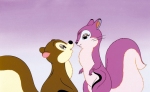
The first movement tells about the struggle of a lone flying squirrel against one lumberjack and against the jealous fellow-forest animals. This part is the most extraordinary for its diversity in styles. It is as if Tezuka wanted to show the evolution of animation itself within his emotional story. At first, the story is told in manga-images only. There’s no movement, even though the realistic images are very lively. The next episode is in Émile Cohl’s style, followed by a very convincing homage to Winsor McCay’s ‘Gertie the Dinosaur‘ (1914). This is followed by a scene in which the little squirrel looks like Otto Messmer’s Felix the Cat or as an early Disney character. This episode is particularly beautifully animated. When a man comes into the forest with a chainsaw, Tezuka’s jumps to the style of Fleischer’s Popeye, including Fleischer’s tabletop-technique for 3d effects.
It’s followed by the first episode in color, in which the squirrel finds a female companion. This part starts as a clear tribute to the very first animation film in technicolor, Disney’s ‘Flowers and Trees‘ (1932), but is mostly drawn like a 1940s cartoon. The final episode of the first part, in which the man shoots his girl and the squirrel sacrifices himself, is quite Bambi-like. Interestingly, throughout the episode, the backgrounds and the staging retain a typical anime-like character.
The second part, using the symphony’s final movement, is less impressing than the first part. It starts with a very Fantasia-like fairy scene, but when we watch very anime-like breasted foxes, we know we’re in a different film. This part tells how magical forest characters (including a few dwarfs) win a war over a forest from a Hitler-like foreman. This part in particular resonates in several Ghibli-films with similar themes, like ‘Pom Poko‘ (1994) or ‘Princess Mononoke’ (1997).
The complete film is an original and unique statement, which deserves to be much more famous than it actually is. Tezuka’s animated output was of a high quality anyhow, but this film may stand as a particularly artistic highlight within his extraordinary career.
Watch ‘Legend of the Forest’ yourself and tell me what you think:
Director: Nicole van Goethem Release Date: 1985 Rating: ★ Review:
‘A Greek Tragedy’ won an Academy Award and the first prize at the Annecy Inernational Film Festival. I remain puzzled why.
‘A Greek Tragedy’ was Van Goethem’s first own film. It’s a classic gag cartoon featuring three living, scarcely clad female caryatids supporting an old ruin. When the ruin crumbles, and they’re finally free, we watch them dancing into the distance.
The designs are trite, the synthesizer music is ugly, the humor is poor, and the story forgettable. If this short has a hidden, perhaps feminist message, it’s lost on me. And then to imagine, that one of the short’s competitors for the Oscars was ‘Luxo jr.’, a far more convincing and rewarding film in every respect!
Watch ‘Een Griekse tragedie’ yourself and tell me what you think:
‘Een Griekse tragedie’ is available on the DVD Box Set ‘Annecy – Le coffret du 50e Anniversaire’
Director: Jan Švankmajer Release Date: August 3, 1988 Rating: ★★★★★ ♕ Review:
Of all classic literature, Lewis Carroll’s ‘Alice in Wonderland’ is certainly the most dreamlike, and it’s no wonder that it came to the attention of Czech master surrealist Jan Švankmajer.
Already in 1971 he had made a film on Carroll’s poem Jabberwocky, but arguably, this film has little to do with the poem. ‘Alice’ continues the surreal atmosphere of his earlier film and remains faithful to the book.
‘Alice’ was Jan Švankmajer’s first feature length film, and it really shows his craft and strikingly original vision. It is one of the best, probably the most original, and certainly the most disturbing film adaptation of Lewis Carroll’s world famous book. In any case, it’s among the best animated features of all time.
Where the Walt Disney version focused on the loony, fantastic parts of the story, Švankmajer emphasizes its irrational, surreal character. Švankmajer puts the story in a setting completely his own. Although the film opens with the classic opening near the brook, after the titles, the action takes place mostly indoors, creating a claustrophobic atmosphere typical for this film, only matched by Švankmajer’s second feature film, ‘Faust’ (1994). In Švankmajer’s film ‘wonderland’ consists of an endless string of dirty old rooms, connected by many doors and desks with drawers, all of which the knob comes off. Even the lovely garden is no more than a stage with props.
The drawer knobs form the running gag in a movie which is low on humor, but high on unsettling and impressive images, starting with the stuffed rabbit suddenly coming to life and smashing the glass of its glass display with its scissors. Other highly memorable scenes are the stuffed rabbit eating sawdust, which falls out again its open belly; the mouse cooking on Alice’s head, the room of hole-digging socks; and the mindless and mechanical repetition of the mad tea-party scene, timed to perfection.
Švankmajer’s wonderland is a morbid world. Its inhabitants are stuffed animals, dolls, playing cards, and even a bunch of macabre fantasy creatures, oddly joined together from body parts from different animals and lifeless objects, and which form a real threat to the little girl. In this world, anything can become alive, as demonstrated by e.g. Alice’s own socks. At the same time, Alice remains the only really living thing, and even she turns into a doll three times. Death, too, is near: at one point in the film we see the mouse, still in his clothes, caught by a mousetrap, dead. And in Švankmajer’s wonderland, the queen of heart’s orders are executed, and several characters are decapitated, including the mad hatter and the march hare…
‘Alice’ uses a perfect blend of stop motion and live action, and has an excellent protagonist in young actor Kristýna Kohoutová. If the film has one flaw, it must be the girl’s voice, which provides all the dialogue and narration. It’s often unwelcome and out of place, and it doesn’t really work well in dialogue-rich scenes, like the mad tea scene or the trial scene.
Švankmajer is at his best when the action is silent and the images speak for themselves. These scenes are greatly added by superb sound design, provided by Ivo Špalj and Robert Jansa, which add to the creepy, wretched atmosphere of the film. ‘Alice’ is certainly not your average family film, but the viewer who dares to enter this film’s unique world, will not be disappointed.
Watch the trailer for ‘Alice’ yourself and tell me what you think:
Director: John Lasseter Release Date: March 17, 1989 Rating: ★★★★★ Review:
After three impressive short films, the fledgling Pixar company decided to relax a little bit.
The result is ‘Knick Knack’, in which boundaries are pushed much less clearly, but which demonstrates like no other short that Pixar animation is rooted deeply in an animation tradition.
‘Knick Knack’ features toy souvenirs, focusing on a snowman trying to escape the prison of his snow globe to join some sunny souvenirs. Harking back to the Warner Bros. cartoons of the 1940s and 1950s, ‘Knick Knack’ is self-consciously cartoony. For example, the snowman is able to produce various tools out of nowhere. Moreover, his actions are driven by a sexual desire, induced by the rather grotesque female souvenir from Miami*. These traits are typical of classic cartoon characters, like Daffy Duck and Bugs Bunny.
Unlike these, however, the snowman is a silent character, and his fanatism is more reminiscent of the equally silent Coyote in Chuck Jones’s Road Runner cartoons. Like the Coyote, the snowman is conscious of the camera, and shares his emotions directly with us, the audience.
‘Knick Knack’ only clocks 3 minutes, but its gag story is perfectly executed in this short time to a wonderful finale. The result is a very entertaining and funny cartoon, with an excellently matching soundtrack by Bobby McFerrin.
However, it was to be the last short Pixar would make in eight years. After its release, the company suffered some changes: it ditched its hardware department, making the studio department suddenly the core of the business. Now the studio could focus on its first feature length film, ‘Toy Story‘…
Watch ‘Knick Knack’ yourself and tell me what you think:
* Upon the film’s rerelease as a short for ‘Finding Nemo’ (2003) the Miami souvenir and the mermaid were redesigned, losing their bulbous boobs. With this step they became less obviously stereotyped objects of male desire, making the snowman’s actions less overtly sex-driven. Unfortunately, with this removal the film lost a little of its bite.
Director: John Lasseter Release Date: August 1988 Rating: ★★★★½ Review:
After ‘Luxo Jr.‘ ‘Tin Toy’ is the most important of the early Pixar shorts.
Not only did it win an Academy Award, being the first computer animated film to do so, it was also the source of inspiration to the first computer animated feature length film, ‘Toy Story‘ (1995). Like ‘Toy Story’ it explores the idea of toys being alive.
The short focuses on a little tin one man band toy, who encounters a monstrous baby, much to its dismay. The baby, indeed, looks terribly ugly. It’s an early attempt at the human form, and although it’s animated surprisingly well, it’s not really a success. Being a giant monster in the eyes of the toy, however, the ugly design does succeed. So, although ‘Tin Toy’ demonstrates it was maybe a little too early for the human form, its brave attempt showed the way for much more to come.
Apart from that, it’s a splendid little story, much more elaborate than Pixar’s earlier two films, and perfect in its execution. An excellent example is the scene in which the tin toy flees under the couch, only to discover numerous other toys hiding in fear. This scene is a masterstroke, as it perfectly explains how toys get hidden away far under couches and beds, like they somehow do in real life.
In the short time span the tin toy goes from emotions of hopeful anticipation to dismay and fear, turning into surprise, pity and finally proud stubborness. These emotions are completely convincing and prove that computer animation was perfectly able to tell a moving story. Now the company’s fulfilling of their dream of an animated feature would not be far away anymore.
Watch ‘Tin Toy’ yourself and tell me what you think:
Director: John Lasseter Release Date: November 30, 1987 Rating: ★★★★½ Review:
With ‘Red’s Dream’, made for computer graphics conference SIGGRAPH, Pixar pushed the envelope once more, after its success with ‘Luxo jr.‘ the year before.
‘Red’s Dream’ is very impressive in its moody and rainy night time setting. But once again, it is able to tell an emotional story about a lonely and forgotten unicycle, which stands forgotten in the corner of a bike shop, where he dreams of performing in the circus.
The dream sequence, featuring a vaguely realistic clown, is the weakest part of the film. The clown is well animated, but looks terribly unreal and is a little scary in its ugliness. The unicycle Red, on the other hand, is a character one can identify with.
Unlike ‘Luxo Jr.’ from one year earlier, animator John Lasseter allows some unrealistic distortions on the unicycle in order to make its emotions work. However, he keeps those to a minimum, keeping Red a believable unicycle. The film’s power lies in the effect that in the last scene one is so involved with Red’s emotions, one tends to forget the stunning computer graphics that are at play to show us the shop at night.
Watch ‘Red’s Dream’ yourself and tell me what you think:
Director: John Lasseter Release Date: August 17, 1986 Rating: ★★★★★ ♕ Review:
Of all classics of animation, ‘Luxo Jr.’ is certainly the shortest. This little gem only lasts ninety seconds, and can feel more like a study than as a mature cartoon. That said, the short is brilliant in its concept and execution.
Being the fledgling company Pixar’s very first film, ‘Luxo Jr.’ is the first of a series of shorts, in which the ambitious team explored the boundaries of computer animation, ever pushing them further away. ‘Luxo Jr.’ is a first example. It was made in a time in which computer animation was mainly used for special effects. Of course in ‘Luxo Jr.’ there’s special attention to lighting and texture, too, but most importantly: it shows that computer animation can also be used to tell an engaging story with characters.
Even in their simplicity, the two table lamps are recognizable characters, one old and parental, the other young and enthusiastic. The effect is the more extraordinary, as animator John Lasseter didn’t use eyes or squash-and-stretch techniques: the lamps remain lamps.
Thus, the cute Luxo jr. showed the world that in principle computer animation was as much able to tell a moving story with emotional characters as any other medium. Unlike the earlier ‘The Adventures of André and Wally B‘ (1984), which remains too primitive and too uneven to be of lasting charm, ‘Luxo jr.’ is as engaging today as it was at its first screening.
After ‘Luxo, jr.’ Pixar would keep on demonstrating the story powers of computer animation with three other brilliant cartoons: ‘Red’s Dream‘ (1987), ‘Tin Toy‘ (1988) and ‘Knick Knack‘ (1989), culminating nine years later in the first computer animated feature film ‘Toy Story‘ (1995).
However, it’s Luxo jr. that showed the way way back in 1986. No wonder the studio keeps the feisty little lamp still in their logo.
Watch ‘Luxo jr’ yourself and tell me what you think:
Director: John Lasseter Release Date: July 25, 1984 Rating: ★★★ Review:
‘The Adventures of André and Wally B.’ is a rather pompous title for this very short film, which only lasts eighty seconds, and features ca. one gag.
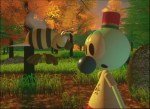
Made for ‘The Lucasfilm Computer Graphics Project’, two years before the birth of Pixar, it is clearly made to showcase two computer animation techniques above anything else. Most impressive is the quasi-realistic, almost pointillist forest background. Much more primitive, but ultimately much more important is the animation of the two characters, for which young animator John Lasseter was brought in from the Walt Disney studios. Lasseter animates André and the bee Wally B self-consciously cartoony, as if they had walked in straight from the 1930s. They don’t blend at all with the quasi-realistic backgrounds, and they look appallingly primitive to modern eyes, but they’re the very first computer graphics to show character animation, even at its most rudimentary.
‘The Adventures of André and Wally B.’ will never become a classic, for it’s too uneven and too shallow for that, but it is one of animation’s milestone films.
Watch ‘The Adventures of André and Wally B’ yourself and tell me what you think:
This film is named after a medieval sword smith who made swords that were supposedly cursed, creating blood lust in its wielder and finally making him commit suicide.
The film is an illustration of this curse and of its own motto: “A man with arms which can kill people like puppets is not aware that he himself has already become a puppet”. For this dark anti-violence film Tezuka uses realistic imagery and limited animation, which make the film look a little like an animated comic.
The film’s visual language is utterly Japanese, accompanied by equally Japanese music. But its message is universal, and another example of Tezuka’s strong dislike of war and violence. Even if it is not amongst his most impressive works, the film still manages to deliver its dark message.
Watch ‘Muramasa’ yourself and tell me what you think:
Animation Backgrounds
A blog dedicated to background paintings from animation films. Kept until 2016.
Animation Scoop
Animation historian Jerry Beck’s animation film news blog.
Cartoon Brew
Topical blog on animation film, led by animation historian Amid Amidi.
Cartoon Modern
Amid Amidi’s blog on modern design cartoon art from the forties, fifties and sixties.
Cartoon Research
THE site on classic animation research, hosted by cartoon historian Jerry Beck.
Cartoons Theory
Frank Beef analyzes classic cartoons. Kept until 2020.
Century Film Project
Michael reviews films of 100 years old and older, roughly in chronological order.
Classic Cartoons
A similar blog featuring many stills and comic strips. Kept until 2012.
Comet over Hollywood
Jessica Pickens reviews classic Hollywood films, especially musicals.
Deja View
Top ex-Disney animator Andreas Deja’s own blog.
Disney History
Esteemed Disney historian Didier Ghez on the latest books on Disney history.
Feeling Animated
Paul Astell brings us thorough reviews of animated features.
Flickers in Time
Short and to the point reviews of classic films (lately mostly pre-code talkies) by an anonymous retired Foreign Service Officer from California
 ‘Oh What A knight’ can be regarded as an early forerunner of the Mickey Mouse cartoon ‘Ye Olden Days‘ (1933).