
You are currently browsing the category archive for the ‘★★’ category.
Director: Bill Kroyer
Release Date: April 10, 1992
Rating: ★★
Review:
 Until the rise of computer animation in the late 1990s, with powerful players entering the field (first Pixar, then Dreamworks, followed by BlueSky, Sony Animation and Illumination) the Walt Disney studio was the virtual monopolist of the animated feature.
In the 1980s their only challenge had come from former Disney-animator Don Bluth, who made three successful animated features during that decade, before going downhill with ‘All Dogs Go to Heaven’ (1989) and ‘Rock-a-Doodle’ (1991).
All the more surprising to find the young animation studio Kroyer Films (only founded in 1986) to make a brave attempt to beat Disney at its own game with ‘FernGully: The Last Rain Forest’. The film is extraordinarily Disney-like, starring a heroin, with a rather bland male love interest, Disney-like designs and animation, and a plethora of songs, changing the film into one of the obligate musicals, which animated features up to 1996 were expected to be.
What makes the film unique is its Australian setting and its ecological message, which quite fits the time, but which falls into the trap of over-romanticizing nature severely: why did the animators consider it necessary to add elves and an evil spirit? Why couldn’t the forest animals themselves be the heroes, and the humans the only villains? Why showing surprising healing powers at the end of the movie, while its scientifically known that it takes several centuries for primary forest to recover, if ever? If one compares this film to Ghibli’s ‘Pom Poko‘ (1994), one must conclude that Ghibli succeeds in bringing the subtle environmental message across, where Ferngully essentially fails.
Despite its Australian setting, the film is very American (using voice artists like Robin Williams, Tone Lōc, and Cheech and Chong, and film music by Alan Silvestri for example), and as said, very Disney-like. Unfortunately, the film hardly lives up to its high ambition: the animation never reaches Disney’s height – there’s in fact quite some superfluous movement, revealing the use of rotoscope. Moreover, the designs remain generic to downright ugly. For example, the film’s heroin, Crysta, is not half as appealing as Disney’s Ariel (The Little Mermaid, 1989) or Belle from ‘Beauty and the Beast (1991). Worse, Crysta and and her love interest Zak are surprisingly devoid of character, and the comedy duo Cheech and Chong is wasted on side characters of no interest.
The music is by Alan Silvestri, of ‘Back to the Future’ and ‘Who Framed Roger Rabbit‘ fame, but his romantic themes get on the nerves. Besides, there are way too many songs, most of which stop the action, instead of pushing it forward. The best song, sung by rapper Tone Lōc, is also the most superfluous. The character who sings it, a goanna (or monitor lizard, as it is known outside Australia) enters the film to sing this song, only to disappear again.
On the positive side: the opening sequence, done in aboriginal style, is beautiful; Robin Williams does his best as the comic relief Batty Koda, a laboratory bat; the animation on the amorphous villain Hexxus is quite impressive, making him a remarkably scary character; and the healing sequence is simply beautiful, with its bold Fantasia-like colors and abstract designs.
‘FernGully’ did moderately well at the box office, but remains Kroyer Films’ only feature. Later in the nineties, distributor 20th Century Fox teamed up with Don Bluth to make two more animated features, the successful, and again very Disney-like ‘Anastasia’ (1997), and the flopped science-fiction feature ‘Titan A.E.’ (2000). It was only after 20th Century Fox purchased the animation studio ‘Blue Sky’ (1997) and released ‘Ice Age’ (2002) that the company became a major player in the animation feature field.
In hindsight, ‘FernGully’ is most interesting for being a forerunner of ‘Avatar’ (2009), which features a surprisingly similar tale. Like most of the Don Bluth films, the movie mostly manages to demonstrate how Disney’s ideas on animated features had become the gospel on how to make one. And even though some of these dogmas were to be seriously challenged from 1996 on (the idea that all animated features have to be musicals, for example), most of these unwritten rules remain to this day, making most American animated features, and many of their European imitations, awfully generic.
Watch the trailer for ‘FernGully: The Last Rain Forest’ yourself and tell me what you think:
‘FernGully: The Last Rain Forest’ is available on DVD
Director: Émile Cohl
Release Date: 1912
Rating: ★
Review:
 After his move to the United States in 1912 Émile Cohl starting experimenting with putting the idiom of comic strips to the animated screen, being the first person to do so.
Cohl used ‘The Newlyweds’ my comic artist George McManus as the source for his new series, and the resulting films form not only the first animated series, but also the first pictures that could be titled animated cartoons.
This could have been a milestone in animated cinema, but unfortunately, the result is appalling: apart from the metamorphosis with which Cohl bridges scenes, there’s no animation at all, resulting in extremely static images. The text balloons fill the whole screen, more often than not obscuring complete personages.
Without the text balloons, there’s no story to follow. The result is that this is probably the first film suffering from too much dialogue, despite being silent!
Despite all its flaws, the Newlyweds films were a success, and Cohl made several of these pictures, of which only two survive: this one, ‘Zozor ruine la réputation de sa famille’, and ‘He Poses for his Portrait‘ (also known as ‘Le Portrait de Zozor’).
Watch ‘Zozor ruine la réputation de sa famille’ yourself and tell me what you think:
‘Zozor ruine la réputation de sa famille’ is available on the DVDs ‘Émile Cohl – L’agitateur aux mille images’
Director: Émile Cohl
Release Date: May 4, 1913
Rating: ★★
Review:
 After short stints at Pathé and Eclipse Cohl sailed to the United States to join Éclair New York.
‘Bewitched Matches’ is one of the few films Cohl made in the United States before sailing back again to France in 1914.
‘Bewitched Matches’ has a rather zany fairy tale plot of a witch visiting three daughters. When their father chases the witch out of his house, the witch bewitches the matches. This leads to a long animation sequence in which the matches form images of a horse, crosses, a windmill, the American flag, a pipe smoking man, a radiant sun, an acrobat on the tightrope and a skeleton.
Neither the framing story nor the animated part is too interesting, and ‘Bewitched Matches’ should be regarded as one of Cohl’s lesser inspired films.
‘Bewitched Matches’ is available on the DVDs ‘Émile Cohl – L’agitateur aux mille images’
Director: Émile Cohl
Release Date: 1910
Rating: ★★
Review:
 Émile Cohl was an extremely prolific animation artist, virtually responsible for almost the world’s complete animation output of 1908-1910. Thus it doesn’t come as a surprise that not all his films are masterpieces.
For example, ‘Rien n’est impossible à l’homme’ is a rather disjointed gag film about what man can do nowadays. The most interesting scene is the first one, in which we watch a live action street scene from above (supposedly from an airplane, but the camera remains static throughout). Other scenes use cut-out animation to show a diver smoking at the bottom of the sea, or a musician making an obelisk cry.
None of the gags are remotely funny, and the whole film feels like a garbage bag of unrelated gag material, making watching the short a rather tiresome experience.
Watch ‘Rien n’est impossible à l’homme’ yourself and tell me what you think:
‘Rien n’est impossible à l’homme’ is available on the DVDs ‘Émile Cohl – L’agitateur aux mille images’
Director: Émile Cohl
Release Date: 1910
Rating: ★★
Review:
 ‘Le champion du jeu à la mode’ is about a company of people, who all try to solve a jigsaw puzzle, until one of the men exclaims that he can solve the puzzle in no time. How he does it is never revealed, but we watch the puzzle assemble itself through stop motion.
Essentially, this is a one trick film, and both the comedy and the animation pale, when compared to Cohl’s contemporary films, like ‘Le placier est tenace’ and ‘Le peintre néo-impressioniste’.
Watch ‘Le champion du jeu à la mode’ yourself and tell me what you think:
‘Le champion du jeu à la mode ‘ is available on the DVDs ‘Émile Cohl – L’agitateur aux mille images’
Director: Émile Cohl
Release Date: 1910
Rating: ★★
Review:
 This animation film uses both cut-out, stop-motion and pen animation in a mix unique to Émile Cohl.
Nevertheless ‘L’enfance de l’art’ is among Cohl vaguest and least impressive films: things are just happening on the screen, like a monster disturbing a painter or some monsters drawn on human hands. We can also watch some morphing images of animals and more monsters. In this respect the title is well chosen…
Watch ‘L’enfance de l’art’ yourself and tell me what you think:
‘L’enfance de l’art ‘ is available on the DVDs ‘Émile Cohl – L’agitateur aux mille images’
Director: Émile Cohl
Release Date: February 19, 1910
Rating: ★★
Review:
 In ‘Le Binetoscope’ a clown presents some kind of apparatus that absorbs something from the audience and puts it on the screen.
This idea is an excuse for some animation, first shown on a screen behind the (live action) clown, but after two minutes filling the complete movie screen. In this sequence Cohl uses his metamorphosis technique on faces. He even changes a complete alphabet into faces. Then the clown returns to take a bow.
Cohl’s metamorphosis technique remains always interesting to watch, and it’s clever how he uses pen animation and cut-out together in this film, but his pictures in ‘Le Binettoscope’ aren’t too remarkable, and pale when compared to some of his 1909 films like ‘Les générations comiques‘ or ‘Les transfigurations‘.
Watch ‘Le Binetoscope’ yourself and tell me what you think:
‘Le Binetoscope’ is available on the DVDs ‘Émile Cohl – L’agitateur aux mille images’
Director: Émile Cohl
Release Date: 1909
Rating: ★★
Review:
 ‘Monsieur Clown chez les lilleputiens’ is one of Cohl’s experiments in puppet animation.
Unfortunately, puppet animation never became Cohl’s forte, and this film shows Cohl’s limited fantasy when using this technique, which is disappointing when compared to the wild, limitless surrealism (avant la lettre) of his drawn films.
‘Monsieur Clown chez les lilleputiens’ just shows a clown performing some tricks for an audience at a circus. The clown performs tricks with an elephant, a black dog, a chair, a horse, and a female acrobat. The film knows only one setting and one camera point, and there is little to laugh. The best gag is when the clown pulls an enormously long thread, only to reveal that the thread is attached to a miniature horse.
Watch ‘Monsieur Clown chez les lilleputiens’ yourself and tell me what you think:
‘Monsieur Clown chez les lilleputiens’ is available on the DVDs ‘Émile Cohl – L’agitateur aux mille images’
Director: Émile Cohl
Release Date: 1908
Rating: ★★
Review:
 ‘Le petit soldat qui devient dieu’ is a short film about a little tin soldier.
We watch him and the other tin soldiers leave their box, and perform some antics in front of a childlike drawing of a house. At one point the little soldier is left behind, when the others return to their box. Suddenly we watch him floating on a paper boat down the sewer, and on the Seine.
Apparently the tin soldier floats to the ocean, because in the next scene he’s found by an African boy and taken to his negro tribe, who are about to kill another black man. The chief licks the tin soldier and dies instantly. Then the other tribesman crown the other black man. The end.
‘Le petit soldat qui devient dieu’ is another one of Cohl’s early experiments in stop-motion, blending it with live action. Unfortunately, the short is the weakest of Cohl’s 1908 films: the tin soldier sequences are very static, all taking place against the same backdrop, and consisting of little more than soldiers marching. Moreover, none of the action makes sense. But the end is the worst: not only is this scene totally incomprehensible, the cannibals are but white men in blackface, and their characters are the worst cliche cannibals imaginable.
Watch ‘Le petit soldat qui devient dieu’ yourself and tell me what you think:
‘Le petit soldat qui devient dieu’ is available on the DVDs ‘Émile Cohl – L’agitateur aux mille images’
Director: Cody Cameron
Release Date: August 8, 2007
Rating: ★★
Review:
 ‘The ChubbChubbs Save Xmas’ sees the return of the ChubbChubbs, the title heroes of Sony’s Academy Award winning short ‘The ChubbChubbs!‘ from 2002, and their alien keeper Meeper.
After five years these personas are still as annoying as they had been in 2002, but surprisingly, ‘The ChubbChubbs Save Xmas’ is a better movie than the original short had been. Things at Sony animation clearly had improved in the five years that separate the two films, and both character design, color schemes and overall design are much more consistent in the new film than in the original. Consequence is that Meeper and his friends are rather out of tune with their more modern and slicker surroundings, which makes them even more obnoxious.
The short’s story is utterly forgettable, but there are some good gags, even if some are pretty violent for a Christmas film. Nevertheless, ‘The ChubbChubbs Save Christmas’ is only one notch up from the earlier film, and remains mediocre, if only because Meeper and the ChubbChubbs themselves are such ugly-voiced and annoying characters.
Watch ‘The ChubbChubbs Save Xmas’ yourself and tell me what you think:
https://www.dailymotion.com/video/x94zq9
‘The ChubbChubbs Save Xmas’ is available as a bonus on the DVD ‘Surfs Up’
Director: Dick Lundy
Release Date: October 24, 1941
Stars: Donald Duck
Rating: ★★
Review:
 ‘Donald’s Camera’ opens with Donald reading a sign saying ‘Shoot nature with a camera instead of a gun’.
Donald immediately becomes anti-hunting, eschewing the sight of a gun and deploring the fate of some stuffed animals in a hunting shop’s window. In the next scene Donald is on his way in the forest, trying to photograph some wild animals. He fails to take a picture of a chipmunk, and is laughed at by a whole bunch of cute animals, who seem to have entered the cartoon straight from ‘Snow White and the Seven Dwarfs’ (1937).
After three-and-a-half minutes Donald meets the main adversary of the cartoon, the obnoxious woodpecker from ‘Self Control‘ (1938). The angry bird doesn’t want to get photographed and gives Donald a hard time. Thus in the end, we watch Donald wandering the forest, carrying two guns and dragging a miniature canon with him in search of the pesky little bird.
‘Donald’s Camera’ is a genuine gag cartoon, and contains some very fast animation, but the short is hampered by Lundy’s gentle approach to directing. The silliest gag is when Donald puts the woodpecker into two ridiculous poses.
Watch ‘Donald’s Camera’ yourself and tell me what you think:
This is Donald Duck cartoon No. 28
To the previous Donald Duck cartoon: Old MacDonald Duck
To the next Donald Duck cartoon: Chef Donald
‘Donald’s Camera’ is available on the DVD-set ‘The Chronological Donald Volume 1’
Director: Jack King
Release Date: September 12, 1941
Stars: Donald Duck
Rating: ★★
Review:
 ‘Old MacDonald Duck’ was the cartoon announced three months earlier in ‘The Reluctant Dragon‘. As Donald Duck explains himself in that feature in this cartoon he’s a farmer.
The short opens with a musical routine on ‘Old MacDonald had a farm’ (naturally). This almost Silly Symphony-like sequence lasts ninety seconds. Then the main body of the cartoon starts, in which Donald milks his cow Clementine, hindered by a fly. This leads to a battle between Donald and the fly, with Donald using milk squeezed from Clementine’s udders to bomb the little insect, in a rather early war analogy (predating the attack on Pearl Harbor by two months). Of course, it’s the fly who has the last laugh.
Clementine, whose theme music is, of course, ‘Oh My Darling’, is wonderfully animated. The fly is the second of a line of insects Donald had to deal with, after the bee in ‘Window Cleaners‘ (1940). The battle between duck and fly is well done, but never becomes hilarious. There’s a little too much emphasis on the fly being a small, innocent creature unnecessarily bullied by Donald. Apparently to give the otherwise obnoxious animal some sympathy, something that’s typical for all the Donald vs. insect cartoons. I guess, however, that the humor would have worked better, if the audience’s sympathy had remained with Donald himself, with the fly playing the same role as the inanimate objects did in contemporary, much better cartoons like ‘Donald’s Vacation‘ (1940) or ‘Early to Bed‘ (1941).
Watch ‘Old MacDonald Duck’ yourself and tell me what you think:
This is Donald Duck cartoon No. 27
To the previous Donald Duck cartoon: Truant Officer Donald
To the next Donald Duck cartoon: Donald’s Camera
‘Old MacDonald Duck’ is available on the DVD-set ‘The Chronological Donald Volume 1’
Director: Dave Fleischer
Release Date: August 8, 1941
Stars: Popeye, Poopdeck Pappy
Rating: ★★
Review:
 In ‘Pest Pilot’ Popeye suddenly has exchanged sailing for flying.
Apparently, Popeye owns an “air-conditioned airport”, where he works on some planes. Poopdeck Pappy drops by, begging Popeye to let him fly, which Popeye keeps refusing. When put outside, Pappy finds an idle plane, and the old man takes off immediately, flying recklessly all over the world, and crashing into Popeye’s airport again.
Surprisingly little happens in this ‘Pest Pilot’: we practically only see Pappy begging and flying. Poopdeck Pappy’s flight is mildly amusing, and in fact the short’s best gag is Popeye’s original way of making a propeller.
‘Pest Pilot’ was the last Fleischer cartoon featuring Poopdeck Pappy. Popeye’s old man would turn up in ‘Seein’ Red White ‘n Blue’ (1943), but was revived by Paramount in only eight cartoons. Poopdeck Pappy’s last three Fleischer cartoons were rather weak, but earlier ones had shown that the character certainly had comic potential, so why he was eventually shelved, we’ll never know.
Watch ‘Pest Pilot’ yourself and tell me what you think:
This Popeye film No. 98
To the previous Popeye film: Child Psykolojiky
To the next Popeye film: I’ll Never Crow Again
‘Pest Pilot’ is available on the DVD set ‘Popeye the Sailor 1941-1943’
Director: Dave Fleischer
Release Date: June 13, 1941
Stars: Popeye
Rating: ★★
Review:
 A Russian fur seller called G. Geezil draws Popeye inside his shop, but when Popeye discovers that all his bearskins are in fact, rabbit, the man proposes Popeye shoots a bear himself.
Popeye immediately sets out to do so, and corners a bear on a cliff. But when the bear calls for his family to say goodbye, Popeye breaks his gun. Suddenly the bear takes his revenge, and Popeye is only saved by his spinach, robbing the bear of his skin in a matter of seconds, only to discover it’s a G. Geezil coat, too…
The story idea of ‘Olive’s Boithday Presink’ harks all the way back to the Talkartoon ‘A Hunting We Will Go‘ (1932), and it’s just as weak. The bear’s goodbye scene is the highlight, in its perfect silent melodramatic comedy. However, there’s little else to enjoy: the shop scene feels like it was made years before, and the final battle is over before you know it.
Watch ‘Olive’s Boithday Presink’ yourself and tell me what you think:
This Popeye film No. 96
To the previous Popeye film: Popeye Meets Rip van Winkle
To the next Popeye film: Child Psykolojiky
‘Olive’s Boithday Presink’ is available on the DVD set ‘Popeye the Sailor 1941-1943’
Director: Bob Clampett
Release Date: May 10, 1941
Rating: ★★
Review:
 ‘Farm Frolics’ was the second Merrie Melodie directed by Bob Clampett.
In this cartoon Clampett follows Tex Avery with his own spot gag cartoon, this time on farm life, making it strangely similar to the Walter Lantz cartoon ‘Fair Today‘ from only three months earlier.
The Warner Bros.’ spot gag cartoons rarely belonged to the best of their repertoire, and ‘Farm Frolics’, too, is hardly funny. Even the running gag of this forgettable cartoon is trite, and fails to provide a welcome finale. Nevertheless, the animation is very fine. For example, there’s some surprisingly realistic animation on a horse. Thus even this weak short shows that by 1941 the Warner Bros. animators could do almost everything.
Watch ‘Farm Frolics’ yourself and tell me what you think:
‘Farm Frolics’ is available on the DVD set ‘Looney Tunes Golden Collection Volume 5’
Director: Walter Lantz
Release Date: February 24, 1941
Rating: ★★
Review:
 ‘Fair Today’ is a spot gag cartoon on a county fair.
The short uses a voice over in the tradition of Tex Avery’s Warner Bros. Spot gag cartoons, e.g. ‘Circus Today’ (1940), ‘Holiday Highlights’ (1940) and ‘Aviation Vacation‘ (1941). Indeed, three months later the Warner Bros. studio itself came with a similar cartoon called ‘Farm Frolics‘. The Warner Bros. connection is further enhanced by the presence of Mel Blanc as voice artist, and a ‘story’ by Warner Bros.-alumnus Ben Hardaway.
The Warner Bros.-influx does not lead to a funny cartoon, however. Even Avery’s spot gag cartoons were more than often rather tiresome, and Lantz’s ‘Fair Today’ is more miss than hit. The gags flow in at a high speed, but let’s face it: most of them are very corny, to say the least, and they include some very bad puns. The obligate running gag is give to an old lady in search of her little boy. The best gag is when the narrator says “let’s skip over to … ‘ and the camera hops accordingly through the scene.
Watch ‘Fair Today’ yourself and tell me what you think:
‘Fair Today’ is available on the DVD set ‘The Woody Woodpecker and Friends Classic Cartoon Collection Volume 2’
Director: Chuck Jones
Release Date: April 12, 1941
Stars: Sniffles
Rating: ★★
Review:
 ‘Toy Trouble’ marks the return of Sniffles’s friend the bookworm, from ‘Sniffles and the Bookworm’ (1939) and ‘The Egg Collector’ (1940).
This time the two friends snoop around in the toy collection of a department store. All goes well until the duo encounters a cat.
Like Sniffles himself, the bookworm is more cute than funny, and like most Sniffles cartoons this short suffers from a terrible slowness. The result is a rather tiresome watch. Nevertheless, it contains a nice scene in which Sniffles hides in a row of Porky Pig dolls, predating a similar scene in the Tom & Jerry cartoon ‘The Night Before Christmas’ by eight months. There’s also a mechanical duck, which accounts for some gags that look all the way forward to the elaborate gags of Chuck Jones’s Road Runner and Tom & Jerry cartoons.
Watch ‘Toy Trouble’ yourself and tell me what you think:
‘Toy Trouble’ is available on the Blu-Ray set ‘Looney Tunes Mouse Chronicles: The Chuck Jones Collection’
Director: Ikuo Ōishi
Release Date: 1939
Rating: ★★
Review:
 ‘Swim, Monkey, Swim’ tells about monkey, who learns to swim, and immediately joins a swimming contest.
The monkey wins by cheating, riding a ‘water imp’. In the end he succeeds in “cheating the others, but not his heart”.
‘Swim Monkey Swim’ is a primitive film, with the designs and animation looking like an Aesop Fable from the 1920s. Indeed, Ōishi was a Japanese animation pioneer, already making films in the 1910s. But if this film really was made 1939, it seems he had little learned since. The designs are nice and readable, but the film’s timing is too slow, rendering endless footage of the race. With its ten minutes the film is overlong and overstays its welcome.
Watch ‘Swim, Monkey, Swim’ yourself and tell me what you think:
‘Swim, Monkey, Swim’ is available on the DVD-box set ‘Japanese Anime Classic Collection’
Director: Walter Lantz
Release Date: March 28, 1941
Rating: ★★
Review:
 ‘Scrub Me Mama with a Boogie Beat’ opens with scenes from ‘Lazy Town’, a place in the South full of lazy negroes, whose depiction is the epitome of racist stereotyping: everyone is asleep, doing things ridiculously slowly or with a minimum of effort. Oh! Those lazy Southern blacks!
Then a steamer stops, and a sexy, light-skinned woman steps out, immediately reviving the male population. She starts the title song, and all the villagers join in.
‘Scrub Me Mama With a Boogie Beat’ is rather tiresome to watch. The boogie-woogie song itself never really comes off, and is less swinging as it could be. But more importantly, the images accompanying the song are hardly funny, as most of the ‘humor’ comes from those ha-ha silly blacks doing things on the musical beat. As none of these gags work today, the short becomes surprisingly empty.
In fact, together with the Van Beuren cartoon ‘Plane Dumb‘ (1932) ‘Scrub Me Mama with a Boogie Beat’ is a likely candidate of being the most offensive racist cartoon around. Only the singing girl is given some dignity, but her race remains unclear, and she could as well be white.
Some of the animation on this girl was reused on the Andrews Sisters in the equally racist, yet less offensive, and much more entertaining ‘The Boogie Woogie Bugle Boy of Company B‘ from six months later.
‘Scrub Me Mama with a Boogie Beat’ was one of the first cartoons to evoke serious issues because of its racism, as upon its re-release in 1948, it was heavily criticized by the National Association for the Advancement of Colored People (NAACP). With help from the more powerful Jewish Labor Committee (JLC), the NAACP managed to make Universal withdraw the cartoon in February 1949. After this incident black stereotypes virtually vanished from the animated screen, except for the occasional cannibal here and there.
Watch ‘Scrub Me Mama with a Boogie Beat’ yourself and tell me what you think:
‘Scrub Me Mama with a Boogie Beat’ is available on the DVD ‘Lantz Studio Treasures Starring Oswald’
Director: Jack King
Release Date: April 5, 1940
Stars: Donald Duck, Pluto
Rating: ★★
Review:
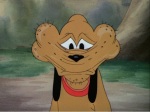 In ‘Donald’s Dog Laundry’ Donald Duck has built a rather Rube Goldberg-like dog washing machine.
Donald decides that the unwilling Pluto is to be his first customer in bath, and tries to get him in bath, first with the use of a whistling rubber bone, and then with an all too lifelike cat hand-puppet. Of course, it’s the duck himself who takes the plunge, yet the cartoon ends with Donald cheering because his apparatus works.
‘Donald’s Dog Laundry’ is full of the mild and long character animation routines so typical of the Mickey Mouse cartoons of the second half of the 1930s. Where in later Warner Bros. or MGM cartoons the rubber bone and hand-puppet would have been only two of several attempts, in this short the two devices are milked at length. Especially, Pluto, probably animated by Norm Ferguson, gets ample screen-time, to a rather tiring effect.
Watch ‘Donald’s Dog Laundry’ yourself and tell me what you think:
This is Donald Duck cartoon No. 16
To the previous Donald Duck cartoon: The Riveter
To the next Donald Duck cartoon: Mr. Duck Steps Out
‘Donald’s Dog Laundry’ is available on the DVD set ‘The Chronological Donald Volume 1’


